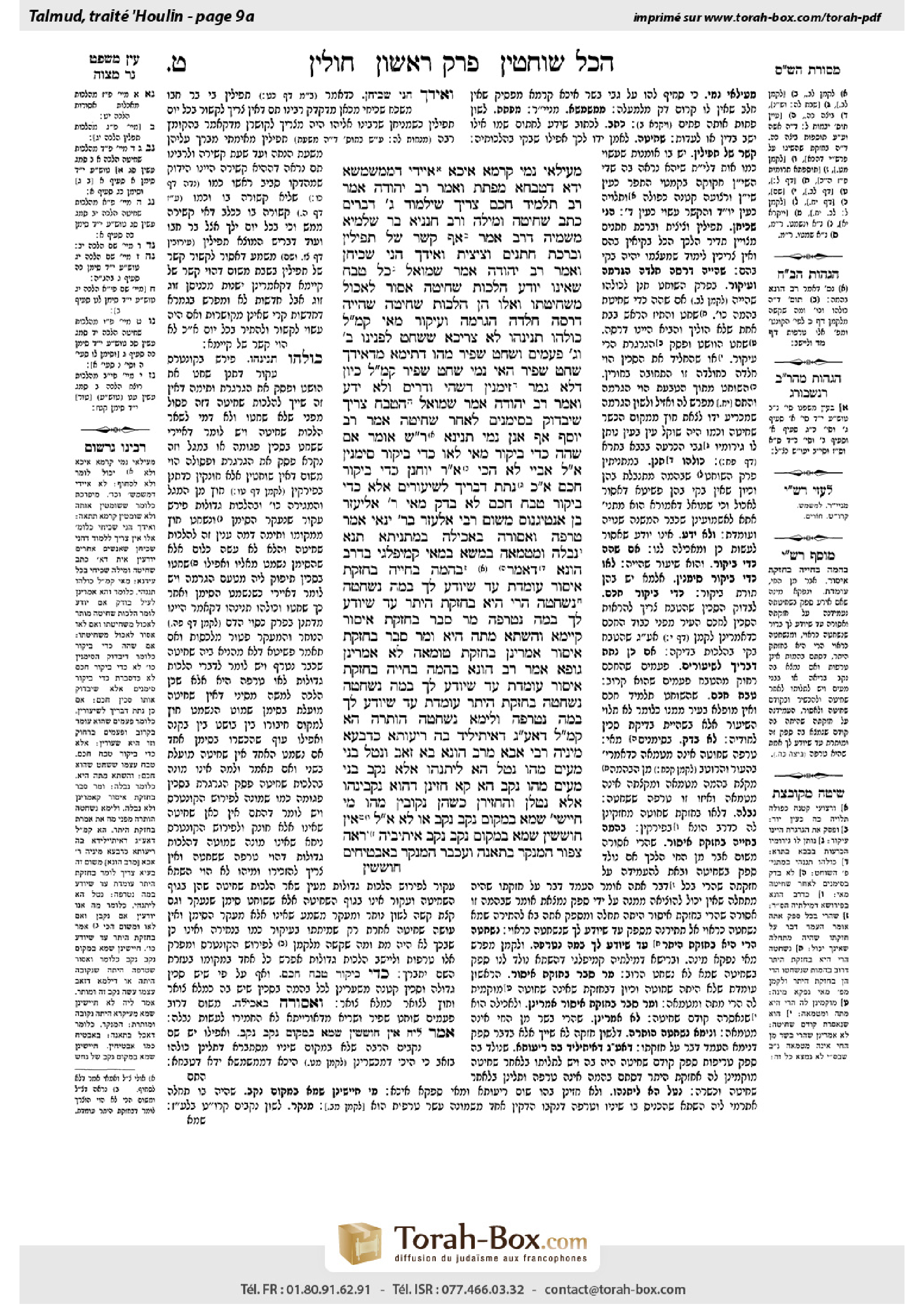
Chullin 9a: Talmud study for Daf Yomi
Study the Talmud for Daf Yomi with scanned pages, Hebrew text, English translations from Sefaria and AI-generated French translations.
Passage selection and English or AI-generated French translation are available where the scan has annotations. Daf Study is independent of Torah-Box and Sefaria.
Browse Chullin · חולין · All tractatesChullin 9a text and translations
This page of Chullin includes the Aramaic text, an English translation and an AI-generated French translation, alongside the scan above.
חולין ט׳ א · Aramaic and Hebrew text
מֵעִילַּאי נָמֵי קְרָמָא אִיכָּא? אַיְּידֵי דִּמְמַשְׁמְשָׁא יְדָא דְּטַבָּחָא מִפַּתַּת.
וְאָמַר רַב יְהוּדָה אָמַר רַב: תַּלְמִיד חָכָם צָרִיךְ שֶׁיִּלְמוֹד שְׁלֹשָׁה דְּבָרִים: כְּתָב, שְׁחִיטָה, וּמִילָה. וְרַב חֲנַנְיָא בַּר שֶׁלֶמְיָא מִשְּׁמֵיהּ דְּרַב אָמַר: אַף קֶשֶׁר שֶׁל תְּפִילִּין, וּבִרְכַּת חֲתָנִים, וְצִיצִית. וְאִידַּךְ – הָנֵי שְׁכִיחָן.
וְאָמַר רַב יְהוּדָה אָמַר שְׁמוּאֵל: כׇּל טַבָּח שֶׁאֵינוֹ יוֹדֵעַ הִלְכוֹת שְׁחִיטָה אָסוּר לֶאֱכוֹל מִשְּׁחִיטָתוֹ, וְאֵלּוּ הֵן הִלְכוֹת שְׁחִיטָה: שְׁהִיָּיה, דְּרָסָה, חֲלָדָה, הַגְרָמָה, וְעִיקּוּר.
מַאי קָא מַשְׁמַע לַן? כּוּלְּהוּ תְּנִינְהוּ! לָא צְרִיכָא, שֶׁשָּׁחַט לְפָנֵינוּ שְׁתַּיִם וְשָׁלֹשׁ פְּעָמִים וּשְׁחַט שַׁפִּיר; מַהוּ דְּתֵימָא: מִדְּאִידַּךְ שְׁחַט שַׁפִּיר, הַאי נָמֵי שְׁחַט שַׁפִּיר, קָא מַשְׁמַע לַן: כֵּיוָן דְּלָא גְּמִר, זִימְנִין דְּשָׁהֵי וְדָרֵיס וְלָא יָדַע.
וְאָמַר רַב יְהוּדָה אָמַר שְׁמוּאֵל: הַטַּבָּח צָרִיךְ שֶׁיִּבְדּוֹק בַּסִּימָנִים לְאַחַר שְׁחִיטָה. אָמַר רַב יוֹסֵף: אַף אֲנַן נָמֵי תְּנֵינָא, רַבִּי שִׁמְעוֹן אוֹמֵר: אִם שָׁהָה כְּדֵי בִּיקּוּר. מַאי לָאו כְּדֵי בִּיקּוּר סִימָנִין?
אֲמַר לֵיהּ אַבָּיֵי: לָא, הָכִי אָמַר רַבִּי יוֹחָנָן: כְּדֵי בִּיקּוּר חָכָם. אִם כֵּן, נָתַתָּ דְּבָרֶיךָ לְשִׁיעוּרִים! אֶלָּא, כְּדֵי בִּיקּוּר טַבָּח חָכָם.
לֹא בָּדַק, מַאי? רַבִּי אֱלִיעֶזֶר בֶּן אַנְטִיגְנוֹס מִשּׁוּם רַבִּי אֶלְעָזָר בְּרַבִּי יַנַּאי אָמַר: טְרֵפָה, וַאֲסוּרָה בַּאֲכִילָה. בְּמַתְנִיתָא תָּנָא: נְבֵלָה, וּמְטַמְּאָה בְּמַשָּׂא.
בְּמַאי קָמִיפַּלְגִי? בִּדְרַב הוּנָא, דְּאָמַר: בְּהֵמָה בְּחַיֶּיהָ בְּחֶזְקַת אִיסּוּר עוֹמֶדֶת, עַד שֶׁיִּוָּדַע לָךְ בַּמֶּה נִשְׁחֲטָה. נִשְׁחֲטָה – הֲרֵי הִיא בְּחֶזְקַת הֶיתֵּר, עַד שֶׁיִּוָּדַע לָךְ בַּמֶּה נִטְרְפָה.
מָר סָבַר: בְּחֶזְקַת אִיסּוּר קָיְימָא, וְהַשְׁתָּא מֵתָה הִיא; וּמָר סָבַר: בְּחֶזְקַת אִיסּוּר אָמְרִינַן, בְּחֶזְקַת טוּמְאָה לָא אָמְרִינַן.
גּוּפָא, אָמַר רַב הוּנָא: בְּהֵמָה בְּחַיֶּיהָ בְּחֶזְקַת אִיסּוּר עוֹמֶדֶת עַד שֶׁיִּוָּדַע לָךְ בַּמֶּה נִשְׁחֲטָה, נִשְׁחֲטָה – בְּחֶזְקַת הֶיתֵּר עוֹמֶדֶת עַד שֶׁיִּוָּדַע לָךְ בַּמֶּה נִטְרְפָה. וְלֵימָא: ״נִשְׁחֲטָה הוּתְּרָה״! הָא קָא מַשְׁמַע לַן, דְּאַף עַל גַּב דְּאִיתְיְלִיד בַּהּ רֵיעוּתָא.
כְּדִבְעָא מִינֵּיהּ רַבִּי אַבָּא מֵרַב הוּנָא: בָּא זְאֵב וְנָטַל בְּנֵי מֵעַיִם, מַהוּ?
נָטַל?! הָא לֵיתַנְהוּ, אֶלָּא נָקַב בְּנֵי מֵעַיִים מַהוּ? נָקַב?! הָא קָא חָזֵינַן דְּהוּא נַקְבִינְהוּ! אֶלָּא נְטָלָן וְהֶחְזִירָן כְּשֶׁהֵן נְקוּבִין, מַהוּ? מִי חָיְישִׁינַן שֶׁמָּא בִּמְקוֹם נֶקֶב נָקַב, אוֹ לָא?
אֲמַר לֵיהּ: אֵין חוֹשְׁשִׁין שֶׁמָּא בִּמְקוֹם נֶקֶב נָקַב.
אֵיתִיבֵיהּ: רָאָה צִפּוֹר הַמְנַקֵּר בִּתְאֵנָה וְעַכְבָּר הַמְנַקֵּר בָּאֲבַטִּיחִים,
Chullin 9a · English translation
from above too there is a membrane that should prevent the forbidden fat from flowing onto the piece of meat even if the forbidden fat is placed directly upon it. The Gemara explains: Since the hand of the slaughterer touches the upper membrane, that membrane disintegrates and the forbidden fat flows onto the meat.
§ And Rav Yehuda says that Rav says: A Torah scholar is required to learn the requisite skills to perform three matters: Writing, so that he will be able to write texts on various occasions, ritual slaughter, and circumcision. And Rav Ḥananya bar Shelamya says in the name of Rav: He must also learn to tie the knot of the phylacteries, and to recite the blessing of the grooms by heart and with the traditional intonation, and to tie ritual fringes to the corners of a garment. The Gemara notes: And the other amora, Rav Yehuda, holds that those skills are commonplace and do not require special training.
§ And Rav Yehuda says that Shmuel says: With regard to any slaughterer who does not know the halakhot of ritual slaughter, it is prohibited to eat from his slaughter. And these are the halakhot of ritual slaughter: Interrupting the slaughter, pressing the knife, concealing the knife under the windpipe or the gullet in the course of an inverted slaughter, diverting the knife from the place of slaughter, and ripping the simanim from their place before cutting them.
The Gemara asks: What is the novelty in what Rav is teaching us? We learned all of them in the mishnayot in the second chapter of this tractate, and therefore it is obvious that a slaughterer who does not know these halakhot is not qualified. The Gemara answers: No, it is necessary in a case where the slaughterer slaughtered before us twice or three times and slaughtered well. Lest you say: From the fact that he slaughtered the other animals well, this animal he also slaughtered well; therefore, Rav teaches us: Since he did not learn the halakhot, sometimes it happens that he interrupts the slaughter or presses the knife, and he does not know that he invalidated the slaughter.
§ And Rav Yehuda says that Shmuel says: The slaughterer must examine the simanim, the windpipe and the gullet, after completing the slaughter. Rav Yosef said: We learn in a mishna (32a) as well: Rabbi Shimon says: The slaughter is not valid if he interrupted the slaughter for an interval equivalent to the duration of an examination. What, is it not an interval equivalent to the duration of an examination of the simanim? Apparently, one is obligated to examine the simanim.
Abaye said to him: No, this is what Rabbi Yoḥanan says: It is an interval equivalent to the duration of an examination of the knife, as the Sages instituted that one must take the knife to be examined by a Torah scholar prior to slaughtering the animal. Rav Yosef said to him: If so, you have rendered your statement subject to circumstances, as sometimes the Torah scholar is near and sometimes the Torah scholar is far, and the time required for examination varies accordingly. Rather, it is an interval equivalent to the duration of an examination performed by a slaughterer who is a Torah scholar. In that case, the travel time is not factored, just the time of the examination, which does not vary.
The Gemara asks: If the slaughterer did not examine the simanim after completing slaughter of the animal, what is the halakha? Rabbi Eliezer ben Antigonus says in the name of Rabbi Elazar, son of Rabbi Yannai: The halakhic status of the slaughtered animal is that of a tereifa, and it is forbidden for consumption, but it does not impart impurity. It was taught in a baraita: Its halakhic status is that of an unslaughtered carcass, and it imparts impurity by means of carrying it.
The Gemara asks: With regard to what principle do they disagree? The Gemara answers: They disagree with regard to the application of the halakha stated by Rav Huna, who says: An animal during its lifetime exists with the presumptive status of prohibition, as it is prohibited to eat a living animal, and it continues to have this status even after its death until it will become known to you in what manner it was slaughtered, i.e., whether it was properly slaughtered. Once the animal was slaughtered, it exists with the presumptive status of permissibility until it will become known to you in what manner it was rendered a tereifa.
It is with regard to the application of this halakha that Rabbi Elazar, son of Rabbi Yannai, and the tanna of the baraita disagree in a case where the slaughterer did not examine the simanim after completing the slaughter. One Sage holds: Since it has not been verified that the animal was slaughtered properly, the animal exists with the presumptive status of prohibition, and since now it is dead, it assumes the status of an unslaughtered carcass and imparts impurity. And one Sage holds: With regard to the presumptive status of prohibition, we say that the animal is forbidden until it is verified that it was slaughtered properly; with regard to the presumptive status of ritual impurity we do not say that the animal is impure, as a living animal is not ritually impure.
§ The Gemara proceeds to analyze the matter itself. Rav Huna says: An animal during its lifetime exists with the presumptive status of prohibition until it will become known to you in what manner it was slaughtered. Once the animal was slaughtered, it exists with the presumptive status of permissibility until it will become known to you in what manner it was rendered a tereifa. The Gemara challenges this: And let us say that once the animal was slaughtered, it became permitted, instead of saying that it exists with the presumptive status of permissibility. The Gemara explains: This teaches us that even if a flaw developed in the animal that raises uncertainty with regard to its permitted status, it retains its presumptive status of permissibility.
As Rabbi Abba raised a dilemma before Rav Huna: If a wolf came and took the innards of a slaughtered animal, what is the halakha?
The Gemara asks: Took? In that case the innards are not there, and therefore there is no way of seeing an indication of a flaw. Rather, the dilemma is: In a case where a wolf perforated the innards of a slaughtered animal, what is the halakha? The Gemara challenges: Perforated? We see that the wolf perforated them and in that case too there is no indication of a flaw. Rather, the dilemma is: In a case where a wolf took the innards and returned them when they are perforated, what is the halakha? Are we concerned that perhaps the wolf perforated the innards in the place of a preexisting perforation and the animal was a tereifa from the outset, or is that possibility not a concern?
Rav Huna said to Rabbi Abba: One is not concerned that perhaps the wolf perforated the innards in the place of a preexisting perforation, because one relies on the presumptive status of permissibility.
Rabbi Abba raised an objection to the opinion of Rav Huna: If one saw a bird pecking at a fig or a mouse gnawing at melons,
Chullin 9a · Traduction française (IA)
Il y a aussi une membrane au-dessus qui doit empêcher que le gras interdit ne coule sur la pièce de viande, même si le gras interdit est placé directement dessus. La Guemara explique : Puisque la main du boucher touche la membrane supérieure, celle-ci se désintègre et le gras interdit coule sur la viande.
§ Et Rav Yéhuda dit que Rav dit : Un savant de la Torah doit apprendre les compétences nécessaires pour accomplir trois choses : l'écriture, afin qu'il puisse écrire des textes en diverses occasions, la bain-maïm, et la circoncision. Et Rav Ḥananya bar Shelamya dit en nom de Rav : Il doit aussi apprendre à faire le nœud des phylactères, à réciter la bénédiction des mariés d'après cœur et avec l'intonation traditionnelle, et à attacher les franges rituelles aux coins d'un vêtement. La Guemara note : Et l'autre amora, Rav Yéhuda, considère que ces compétences sont courantes et n'exigent pas un entraînement spécial.
§ Et Rav Yéhuda dit que Shmuel dit : Concernant tout boucher qui ne connaît pas les halakhot de la bain-maïm, il est interdit de manger de sa bain-maïm. Et ces sont les halakhot de la bain-maïm : interrompre la bain-maïm, appuyer le couteau, cacher le couteau sous la trachée ou la gorge lors d'une bain-maïm inversée, dévier le couteau du lieu de la bain-maïm, et arracher les simanim de leur place avant de les couper.
La Guemara demande : Quel est l'originalité dans ce que Rav nous enseigne ? Nous avons appris tout cela dans les miznayot du deuxième chapitre de ce traité, et donc il est évident qu'un boucher qui ne connaît pas ces halakhot n'est pas qualifié. La Guemara répond : Non, il est nécessaire dans le cas où le boucher a accompli la bain-maïm devant nous deux ou trois fois et l'a accomplie bien. De peur que vous disiez : Puisque l'animal qu'il a bain-maïm avant est bien bain-maïm, celui-ci il l'a aussi bien bain-maïm ; donc Rav nous enseigne : Puisque il n'a pas appris les halakhot, parfois il arrive qu'il interrompe la bain-maïm ou qu'il appuie le couteau, et il ne sait pas qu'il a invalidé la bain-maïm.
§ Et Rav Yéhuda dit que Shmuel dit : Le boucher doit examiner les simanim, la trachée et la gorge après avoir achevé la bain-maïm. Rav Yosef a dit : Nous apprenons dans une mizna (32a) également : Rabbi Šimon dit : La bain-maïm n'est pas valide si l'on interrompt la bain-maïm pendant un intervalle équivalent à la durée d'une inspection. Qu'est-ce que cela n'est pas un intervalle équivalent à la durée d'une inspection des simanim ? Apparemment, on est tenu d'examiner les simanim.
Abaye dit à lui : Non, c'est ce que dit Rabbi Yoḥanan : C'est une pause équivalente à la durée d'une inspection du couteau, car les Sages ont institué que l'on doit présenter le couteau à un savant de la Torah avant de sacrifier l'animal. Rav Yosef dit à lui : Si c'est ainsi, vous avez rendu votre déclaration conditionnelle, car parfois le savant de la Torah est proche et parfois il est loin, et la durée de l'inspection varie selon cela. En réalité, c'est une pause équivalente à la durée d'une inspection effectuée par un boucher qui est un savant de la Torah. Dans ce cas, le temps de trajet n'est pas pris en compte, seulement le temps de l'inspection, qui ne varie pas.
Le Guemara pose la question : Si le boucher n'a pas examiné les simanim après avoir achevé la sacrifice de l'animal, quelle est la halakha ? Rabbi Eliezer ben Antigonus dit en nom de Rabbi Elazar, fils de Rabbi Yannai : Le statut halakhique de la bête sacrifiée est celui d'une tereifa, et elle est interdite à la consommation, mais elle ne transmet pas l'impureté. Il a été enseigné dans une baraïta : Son statut halakhique est celui d'un cadavre non sacrifié, et il transmet l'impureté par le fait de le transporter.
Le Guemara pose la question : Sur quel principe ces deux parties s'opposent-elles ? Le Guemara répond : Ils s'opposent sur l'application de la halakha énoncée par Rav Huna, qui dit : Une bête pendant sa vie existe avec le statut présomptif d'interdiction, car il est interdit de manger une bête vivante, et elle conserve ce statut même après sa mort jusqu'à ce que vous sachiez de quelle manière elle a été sacrifiée, c'est-à-dire si elle a été sacrifiée correctement. Une fois que la bête a été sacrifiée, elle existe avec le statut présomptif de permission jusqu'à ce que vous sachiez de quelle manière elle a été rendue tereifa.
C'est sur l'application de cette halakha que Rabbi Elazar, fils de Rabbi Yannai, et le tanna de la baraïta s'opposent dans un cas où le boucher n'a pas inspecté les simanim après avoir achevé la sacrifice. Un sage affirme : Puisque cela n'a pas été vérifié que la bête a été sacrifiée correctement, la bête existe avec le statut présomptif d'interdiction, et puisqu'elle est maintenant morte, elle acquiert le statut d'un cadavre non sacrifié et transmet l'impureté. Un autre sage affirme : En ce qui concerne le statut présomptif d'interdiction, nous disons que la bête est interdite jusqu'à ce qu'il soit vérifié qu'elle a été sacrifiée correctement ; en ce qui concerne le statut présomptif d'impureté, nous ne disons pas que la bête est impure, car une bête vivante n'est pas impure.
§ Le Guemara poursuit l'analyse de la question. Rav Huna dit : Une bête pendant sa vie existe avec le statut présomptif d'interdiction jusqu'à ce que vous sachiez de quelle manière elle a été sacrifiée. Une fois que la bête a été sacrifiée, elle existe avec le statut présomptif de permission jusqu'à ce que vous sachiez de quelle manière elle a été rendue tereifa. Le Guemara conteste cela : Et disons que, une fois que la bête a été sacrifiée, elle devient permise, au lieu de dire qu'elle existe avec le statut présomptif de permission. Le Guemara explique : Cela nous apprend que même si un défaut s'est développé dans la bête qui génère un doute concernant son statut permis, elle conserve son statut présomptif de permission.
Rabbi Abba a posé un dilemme devant Rav Huna : Si un loup est venu et a pris les viscères d'une bête sacrifiée, quelle est la halakha ?
La Guemara pose la question : A pris ? Dans ce cas, les entrailles ne sont pas présentes, et par conséquent, il n'y a aucun signe d'une imperfection. En réalité, le problème est : dans le cas où un loup a perforé les entrailles d'un animal sacrifié, quelle est la halakha ? La Guemara conteste : perforé ? Nous voyons que le loup a perforé les entrailles et dans ce cas également, il n'y a aucun signe d'une imperfection. En réalité, le problème est : dans le cas où un loup a pris les entrailles et les a rendues lorsqu'elles sont perforées, quelle est la halakha ? Nous sommes-nous inquiétés que peut-être le loup a perforé les entrailles à l'endroit d'une perforation préexistant et que l'animal était déjà un tereifa dès le départ, ou cette possibilité n'est-elle pas un souci ?
Rav Huna dit à Rabbi Abba : On ne s'inquiète pas que peut-être le loup a perforé les entrailles à l'endroit d'une perforation préexistant, car on repose sur le statut présomptif de la permission.
Rabbi Abba opposa un contre-argument à l'opinion de Rav Huna : Si l'on voyait un oiseau picorant une figue ou une souris mordant des melons,
Traduction française générée par IA à partir de l’édition anglaise de Sefaria. Vérifie toujours un passage avec le texte source.
Text from Sefaria: William Davidson Edition - Vocalized Aramaic (unknown); William Davidson Edition - English (CC BY NC).