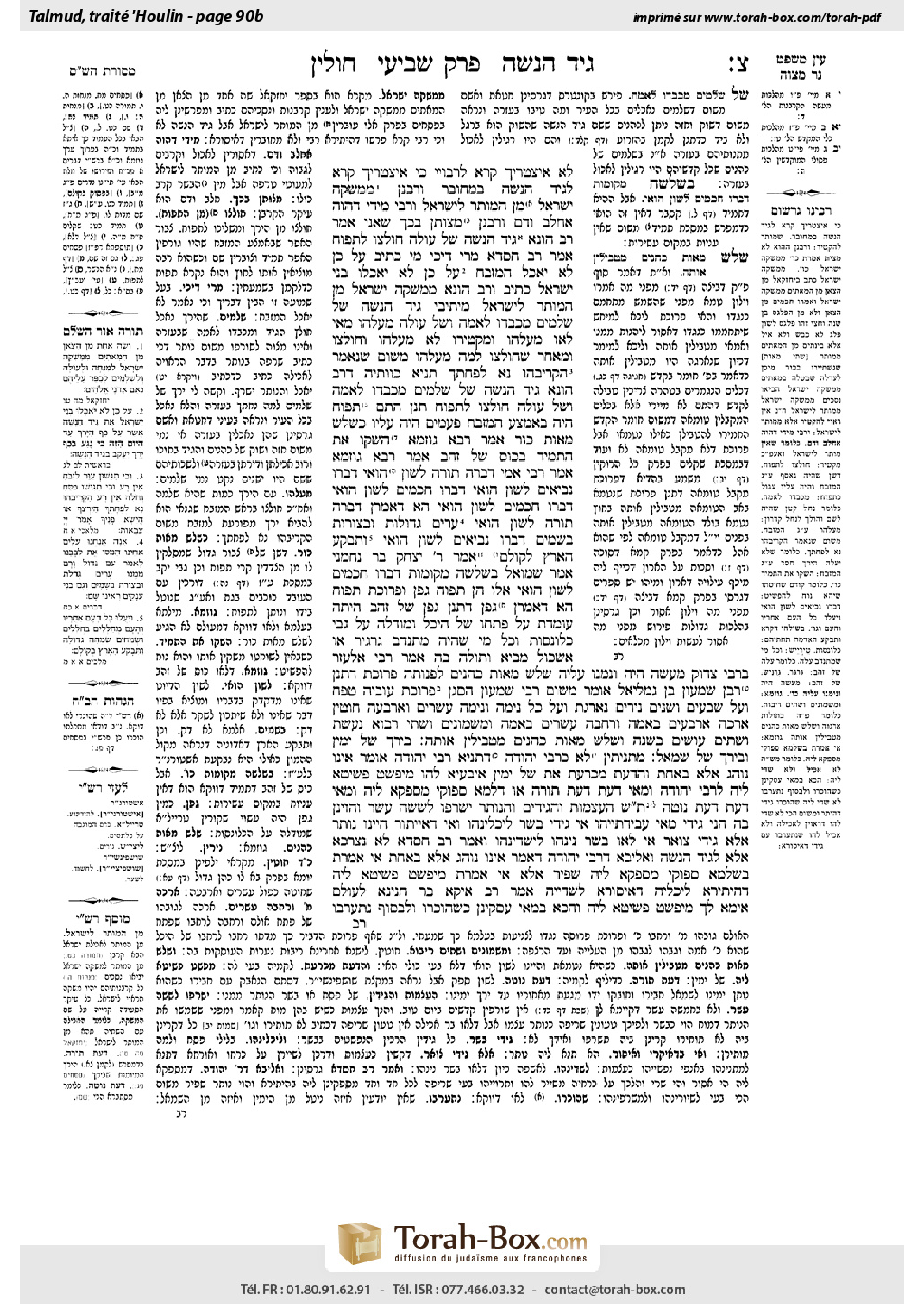
Chullin 90b: Talmud study for Daf Yomi
Study the Talmud for Daf Yomi with scanned pages, Hebrew text, English translations from Sefaria and AI-generated French translations.
Passage selection and English or AI-generated French translation are available where the scan has annotations. Daf Study is independent of Torah-Box and Sefaria.
Browse Chullin · חולין · All tractatesChullin 90b text and translations
This page of Chullin includes the Aramaic text, an English translation and an AI-generated French translation, alongside the scan above.
חולין צ׳ ב · Aramaic and Hebrew text
לָא אִיצְטְרִיךְ קְרָא לְרַבּוֹיֵי, כִּי אִיצְטְרִיךְ קְרָא לְגִיד הַנָּשֶׁה בִּמְחוּבָּר.
וְרַבָּנַן, ״מִמַּשְׁקֵה יִשְׂרָאֵל״ – מִן הַמּוּתָּר לְיִשְׂרָאֵל.
וְרַבִּי, מִידֵי דְּהָוֵה אַחֵלֶב וָדָם. וְרַבָּנַן, מִצְוָתָן בְּכָךְ שָׁאנֵי.
אָמַר רַב הוּנָא: גִּיד הַנָּשֶׁה שֶׁל עוֹלָה חוֹלְצוֹ לַתַּפּוּחַ. אָמַר רַב חִסְדָּא: מָרִי דֵּיכִי, מִי כְּתִיב ״עַל כֵּן לֹא יֹאכַל הַמִּזְבֵּחַ״? ״עַל כֵּן לֹא יֹאכְלוּ בְנֵי יִשְׂרָאֵל״ כְּתִיב.
וְרַב הוּנָא, ״מִמַּשְׁקֵה יִשְׂרָאֵל״ – מִן הַמּוּתָּר לְיִשְׂרָאֵל.
מֵיתִיבִי: גִּיד הַנָּשֶׁה שֶׁל שְׁלָמִים – מְכַבְּדוֹ לָאַמָּה, וְשֶׁל עוֹלָה – מַעֲלֵהוּ. מַאי לָאו, מַעֲלֵהוּ וּמַקְטִירוֹ?
לֹא, מַעֲלֵהוּ וְחוֹלְצוֹ. וּמֵאַחַר שֶׁחוֹלְצוֹ לָמָּה מַעֲלֵהוּ, מִשּׁוּם שֶׁנֶּאֱמַר ״הַקְרִיבֵהוּ נָא לְפֶחָתֶךָ״.
תַּנְיָא כְּוָותֵיהּ דְּרַב הוּנָא: גִּיד הַנָּשֶׁה שֶׁל שְׁלָמִים – מְכַבְּדוֹ לָאַמָּה, וְשֶׁל עוֹלָה – חוֹלְצוֹ לַתַּפּוּחַ.
תְּנַן הָתָם: תַּפּוּחַ הָיָה בְּאֶמְצַע הַמִּזְבֵּחַ, פְּעָמִים הָיָה עָלָיו כִּשְׁלֹשׁ מֵאוֹת כּוֹר. אָמַר רָבָא: גּוּזְמָא.
הִשְׁקוּ אֶת הַתָּמִיד בְּכוֹס שֶׁל זָהָב, אָמַר רָבָא: גּוּזְמָא.
אָמַר רַבִּי אַמֵּי: דִּבְּרָה תּוֹרָה לְשׁוֹן הֲוַאי, דִּבְּרוּ נְבִיאִים לְשׁוֹן הֲוַאי, דִּבְּרוּ חֲכָמִים לְשׁוֹן הֲוַאי. דִּבְּרוּ חֲכָמִים לְשׁוֹן הֲוַאי – הָא דַּאֲמַרַן.
דִּבְּרָה תּוֹרָה לְשׁוֹן הֲוַאי – ״עָרִים גְּדוֹלוֹת וּבְצוּרוֹת בַּשָּׁמַיִם״, דִּבְּרוּ נְבִיאִים לְשׁוֹן הֲוַאי – ״וַתִּבָּקַע הָאָרֶץ לְקוֹלָם״.
אָמַר רַבִּי יִצְחָק בַּר נַחְמָנִי אָמַר שְׁמוּאֵל: בִּשְׁלֹשָׁה מְקוֹמוֹת דִּבְּרוּ חֲכָמִים לְשׁוֹן הֲוַאי, אֵלּוּ הֵן: תַּפּוּחַ, גֶּפֶן, וּפָרוֹכֶת. תַּפּוּחַ – הָא דַּאֲמַרַן.
גֶּפֶן – דִּתְנַן: גֶּפֶן שֶׁל זָהָב הָיְתָה עוֹמֶדֶת עַל פִּתְחוֹ שֶׁל הֵיכָל, מוּדְלָה עַל גַּבֵּי כְּלוֹנְסוֹת, וְכׇל מִי שֶׁהָיָה מִתְנַדֵּב גַּרְגֵּיר אוֹ אֶשְׁכּוֹל – מֵבִיא וְתוֹלֶה בָּהּ. אָמַר רַבִּי אֶלְעָזָר בְּרַבִּי צָדוֹק: מַעֲשֶׂה הָיָה, וְנִמְנוּ עָלֶיהָ שְׁלֹשׁ מֵאוֹת כֹּהֲנִים לְפַנּוֹתָהּ.
פָּרוֹכֶת, דִּתְנַן: רַבָּן שִׁמְעוֹן בֶּן גַּמְלִיאֵל אוֹמֵר מִשּׁוּם רַבִּי שִׁמְעוֹן הַסְּגָן – פָּרוֹכֶת עוֹבְיָהּ טֶפַח, וְעַל שִׁבְעִים וּשְׁנַיִם נִירִים נֶאֱרֶגֶת, וְעַל כׇּל נִימָה וְנִימָה עֶשְׂרִים וְאַרְבָּעָה חוּטִין. אׇרְכָּהּ אַרְבָּעִים בָּאַמָּה, וְרׇחְבָּהּ עֶשְׂרִים בְּאַמָּה, וּמִשְּׁמוֹנִים וּשְׁתֵּי רִבּוֹא נַעֲשֵׂת, וּשְׁתַּיִם עוֹשִׂים בְּשָׁנָה, ושְׁלֹשׁ מֵאוֹת כֹּהֲנִים מַטְבִּילִין אוֹתָהּ.
בְּיָרֵךְ שֶׁל יָמִין וּבְיָרֵךְ שֶׁל שְׂמֹאל. מַתְנִיתִין לָא כְּרַבִּי יְהוּדָה, דְּתַנְיָא: רַבִּי יְהוּדָה אוֹמֵר: אֵינוֹ נוֹהֵג אֶלָּא בְּאַחַת, וְהַדַּעַת מַכְרַעַת אֶת שֶׁל יָמִין.
אִיבַּעְיָא לְהוּ: מִיפְשָׁט פְּשִׁיטָא לֵיהּ לְרַבִּי יְהוּדָה, וּמַאי דַּעַת? דַּעַת תּוֹרָה, אוֹ דִלְמָא סַפּוֹקֵי מְסַפְּקָא לֵיהּ, וּמַאי דַּעַת? דַּעַת נוֹטָה.
תָּא שְׁמַע: הָעֲצָמוֹת וְהַגִּידִים וְהַנּוֹתָר יִשָּׂרְפוּ לְשִׁשָּׁה עָשָׂר. וְהָוֵינַן בַּהּ: הָנֵי גִּידֵי מַאי עֲבִידְתַּיְיהוּ? אִי גִּידֵי בָשָׂר – לֵיכְלִינְהוּ, וְאִי דְּאִיַּיתּוּר – הַיְינוּ נוֹתָר! אֶלָּא גִּידֵי צַוָּאר, אִי לָאו בָּשָׂר נִינְהוּ – לִישְׁדִּינְהוּ?
וְאָמַר רַב חִסְדָּא: לֹא נִצְרְכָה אֶלָּא לְגִיד הַנָּשֶׁה, וְאַלִּיבָּא דְּרַבִּי יְהוּדָה, דְּאָמַר: אֵינוֹ נוֹהֵג אֶלָּא בְּאַחַת.
אִי אָמְרַתְּ בִּשְׁלָמָא סַפּוֹקֵי מְסַפְּקָא לֵיהּ – שַׁפִּיר, אֶלָּא אִי אָמְרַתְּ מִיפְשָׁט פְּשִׁיטָא לֵיהּ דְּהֶיתֵּירָא – לֵיכְלֵיהּ, דְּאִיסּוּרָא – לִשְׁדְּיֵיהּ!
אָמַר רַב אִיקָא בַּר חֲנִינָא: לְעוֹלָם אֵימָא לָךְ מִיפְשָׁט פְּשִׁיטָא לֵיהּ, וְהָכָא בְּמַאי עָסְקִינַן – כְּשֶׁהוּכְּרוּ וּלְבַסּוֹף נִתְעָרְבוּ.
Chullin 90b · English translation
it was not necessary for the verse to include them. When a verse was necessary it was for the sciatic nerve that is still attached to the flesh. The term “it all” teaches that if the sciatic nerve is attached to the flesh it is brought up to the altar.
And the Rabbis would explain their opinion based upon the verse: “And one lamb of the flock, out of two hundred, from the well-watered pastures [mimashke] of Israel; for a meal offering, and for a burnt offering, and for peace offerings, to make atonement for them, says the Lord God” (Ezekiel 45:15). Since the term mashke also means beverage, which is consumed, the verse is interpreted to mean that offerings may be sacrificed only from that which is permitted to the Jewish people for consumption. Since the sciatic nerve is not permitted for consumption, it may not be sacrificed on the altar. Consequently, the term “it all” is understood to include sinews and bones even if they have become detached from the flesh.
And Rabbi Yehuda HaNasi would respond that a sciatic nerve that is attached to the flesh may be brought up to the altar, just as it is permitted to sacrifice forbidden fat and blood upon the altar even though they are forbidden for consumption. And the Rabbis would say that forbidden fat and blood are different, because the Torah explicitly states that their mitzva is to be offered on the altar in this way, whereas the Torah never mandates the sacrifice of the sciatic nerve upon the altar. According to Rav Naḥman bar Yitzḥak, Rabbi Ḥiyya bar Yosef agrees with Rabbi Yehuda HaNasi that the sciatic nerve is offered upon the altar together with the rest of the animal, whereas Rabbi Yoḥanan holds in accordance with the opinion of the Rabbis that the sciatic nerve is not offered upon the altar.
§ The Gemara cites another discussion with regard to the sciatic nerve of a burnt offering. Rav Huna says: The sciatic nerve of a burnt offering is not placed upon the altar with the rest of the animal. Rather, one removes it and places it on the circular mound of ashes in the center of the altar. Rav Ḥisda said: Master of this [mari dikhi] ruling! Is it written in the Torah: Therefore the altar does not consume the sciatic nerve? This would indicate that it is prohibited to sacrifice the sciatic nerve on the altar. Rather, it is written: “Therefore the children of Israel eat not the sciatic nerve” (Genesis 32:33).
And Rav Huna holds that the phrase: “From the well-watered pastures of Israel,” indicates that offerings may be sacrificed only from that which is permitted to the Jewish people. Since the sciatic nerve is not permitted for consumption, it may not be sacrificed upon the altar.
The Gemara raises an objection to Rav Huna’s opinion. It is taught in a baraita: What should one do with the sciatic nerve of a peace offering, since the meat of the offering must be eaten but the sciatic nerve is forbidden? One sweeps it to the Temple courtyard drain. And in the case of the sciatic nerve of a burnt offering, one brings it up to the altar. The Gemara comments: What, is it not that the baraita means that he brings it up to the altar and burns it with the rest of the animal, which contradicts the statement of Rav Huna?
The Gemara responds: No, the baraita means that he brings it up to the altar and removes it from the thigh before placing the thigh on the fire. The Gemara asks: But since he removes it from the thigh, why does he bring it up to the altar? The Gemara answers that one cannot bring the thigh up to the altar after the sciatic nerve has been removed because it is stated with regard to one who sacrifices offerings that are damaged or unattractive: “Present it now unto your governor; will he be pleased with you, or will he accept your person? says the Lord of hosts” (Malachi 1:8). Consequently, the leg of the animal must be brought up to the altar while it is whole, and the sciatic nerve must be removed on top of the altar.
It is taught in a baraita in accordance with the opinion of Rav Huna: With regard to the sciatic nerve of a peace offering, one sweeps it into the Temple courtyard drain; and with regard to the sciatic nerve of a burnt offering, one removes it and places it on the circular mound of ashes in the center of the altar.
We learned in a mishna there (Tamid 28b): There was a circular mound of ashes in the center of the altar, and sometimes there was as much as three hundred kor of ashes upon it. Rava said: This description is an exaggeration [guzma]; the tanna means merely that there was a significant quantity of ashes.
Similarly, it is taught in a mishna (Tamid 30a) that before slaughtering the daily offering the priests gave the lamb selected for the daily offering water to drink in a golden cup, in order to render the animal easier to flay after slaughter. With regard to this mishna, Rava said: It is an exaggeration, as the priests did not actually let the animal drink from a golden vessel.
The Gemara provides other examples of statements not meant literally. Rabbi Ami says: In some instances, the Torah spoke employing exaggerated [havai] language, the Prophets spoke employing exaggerated language, and the Sages spoke employing exaggerated language. The fact that the Sages spoke employing exaggerated language is evident from that which we stated above, concerning the mound of ashes and the lamb of the daily offering.
The Torah spoke employing exaggerated language, as it is written: “Hear, Israel: You are passing over the Jordan this day, to go in to dispossess nations greater and mightier than you, cities great and fortified up to heaven” (Deuteronomy 9:1), whereas the fortifications obviously did not actually reach up to heaven. The Prophets spoke employing exaggerated language, as it is written with regard to the coronation of King Solomon: “And all the people came up after him, and the people piped with pipes, and rejoiced with great joy, so that the earth rent with the sound of them” (I Kings 1:40), where the verse means merely that the sound was very loud.
Rabbi Yitzḥak bar Naḥmani says that Shmuel says: In three places the Sages spoke in exaggerated language, and they are with regard to the circular mound of ashes on the altar; the vine; and the Curtain separating the Sanctuary and Holy of Holies. The case of the circular mound of ashes is that which we said.
The case of the vine is as we learned in a mishna (Middot 36a): A golden ornament in the form of a vine was standing at the entrance to the Sanctuary, and it was hung upon poles. And whoever would donate an ornamental golden leaf, grape, or cluster of grapes to the Temple would bring it to the Temple and hang it upon the vine. Rabbi Elazar, son of Rabbi Tzadok, said: There was once an incident, and three hundred priests were enlisted to move the vine because of its immense weight. According to Shmuel, this description is also an exaggeration.
The case of the Curtain is as we learned in a mishna (Shekalim 8:2): Rabban Shimon ben Gamliel says in the name of Rabbi Shimon, the deputy High Priest: The Curtain is the thickness of a handbreadth [tefaḥ]. It is woven from seventy-two strands [nirim] of yarn, and each and every strand [nima] of those seventy-two is made from twenty-four threads consisting of six threads each of sky-blue wool, purple wool, scarlet wool, and fine linen. Its length is forty cubits, the height of the Sanctuary, and its width is twenty cubits, the width of the entrance. And it is made from eighty-two ten-thousands, i.e., 820,000 dinars. And the overseers of the Temple make two new Curtains every year. And the Curtain was so heavy that when it was immersed, three hundred priests would immerse it.
§ The mishna teaches that the prohibition of the sciatic nerve applies to the thigh of the right leg and to the thigh of the left leg. The Gemara says: The mishna is not in accordance with the opinion of Rabbi Yehuda, as it is taught in a baraita that Rabbi Yehuda says: The prohibition of the sciatic nerve applies only to the sciatic nerve in one of the animal’s thighs, and logic dictates that it is the right thigh.
A dilemma was raised before the Sages: Is it obvious to Rabbi Yehuda that the prohibition applies only to the sciatic nerve in the right thigh, and accordingly, what does he mean when he says that logic dictates? He means the logic of the Torah. Or perhaps he is uncertain as to whether it applies only to the right thigh or only to the left, and accordingly, what does he mean when he says that logic dictates? He means that logic inclines one to believe that the prohibition applies to the right thigh.
The Gemara suggests: Come and hear a resolution based upon the following mishna (Pesaḥim 83a): The bones of the Paschal offering that contain edible marrow but cannot be eaten because it is prohibited to break the bones of the Paschal offering; and the sinews; and the leftover meat should all be burned on the sixteenth of Nisan, not on the fifteenth, the first day of Passover. And we discussed it: What are the circumstances in which these sinews must be burned? If we say they are sinews of meat, let one eat them. Why are they burned? And if they are sinews that were left over and not eaten, that is the case of leftover meat; why does the mishna list sinews separately? Rather, the mishna is referring to sinews of the neck, which are different from other sinews and are therefore mentioned separately. But if they are not meat, why do they require burning? Let one simply discard them like other waste.
And Rav Ḥisda said: The mishna’s mention of sinews is necessary only in order to teach the halakha of the sciatic nerve, and in accordance with the opinion of Rabbi Yehuda, who said: The prohibition of the sciatic nerve applies only to the sciatic nerve in one of the animal’s thighs, and not to both.
The Gemara explains how this resolves the dilemma: Granted if you say that Rabbi Yehuda is uncertain as to whether it is the sciatic nerve of the right or the left thigh, it works out well. Since it is uncertain which thigh may be eaten, one may not eat either of them, and one must burn each of them on the sixteenth due to the possibility that it was the permitted one and now has the status of leftover meat. But if you say that it is obvious to Rabbi Yehuda that the sciatic nerve of only the right thigh is forbidden, let him eat the sciatic nerve of the permitted left thigh, and let him throw away only the sciatic nerve of the forbidden right thigh. Neither one should be burned.
The Gemara responds: Rav Ika bar Ḥanina said: Actually I could say to you that it is obvious to Rabbi Yehuda that the sciatic nerve of only the right thigh is forbidden. Nevertheless, here we are dealing with a case where the sciatic nerves were identified and removed, but ultimately the sciatic nerves became intermingled and one cannot tell which is from the right thigh and which is from the left thigh. Consequently, they must both be left over until the next day and then burned.
Chullin 90b · Traduction française (IA)
Il n'était pas nécessaire que la versette inclut ces choses. Lorsqu'une versette était nécessaire, c'était pour le nerf sciatique encore attaché à la chair. Le terme « tout » enseigne que si le nerf sciatique est attaché à la chair, il est amené sur l'autel.
Et les Rabbins expliquaient leur opinion en se basant sur la versette : « Et un agneau de la troupe, parmi deux cents, de la vallée des sources d'Israël ; pour une offrande de table, et pour un holocauste, et pour des offrandes de paix, afin de faire l'atonement pour eux, dit l'Éternel, le Seigneur » (Ezéchiel 45:15). Puisque le terme « mashke » signifie aussi boisson, qui est consommée, la versette est interprétée pour signifier que les offrandes peuvent être sacrifiées uniquement à partir de ce qui est permis aux Juifs pour la consommation. Puisque le nerf sciatique n'est pas permis à la consommation, il ne peut pas être sacrifié sur l'autel. Ainsi, le terme « tout » est compris pour inclure les nerfs et les os même s'ils sont devenus détachés de la chair.
Et Rabbi Yehuda HaNasi répondait que le nerf sciatique attaché à la chair peut être amené sur l'autel, tout comme il est permis de sacrifier les graisses et le sang interdits sur l'autel même s'ils sont interdits à la consommation. Et les Rabbins disaient que les graisses et le sang interdits sont différents, car la Torah stipule explicitement que leur mitsva est d'être offerts sur l'autel de cette manière, tandis que la Torah ne commande jamais la sacrifice du nerf sciatique sur l'autel. Selon Rav Naḥman bar Yitzḥak, Rabbi Ḥiyya bar Yosef est d'accord avec Rabbi Yehuda HaNasi que le nerf sciatique est offert sur l'autel avec le reste de l'animal, tandis que Rabbi Yoḥanan suit l'opinion des Rabbins que le nerf sciatique n'est pas offert sur l'autel.
§ La Guemara cite une autre discussion concernant le nerf sciatique d'un holocauste. Rav Huna dit : Le nerf sciatique d'un holocauste n'est pas placé sur l'autel avec le reste de l'animal. Plutôt, on le retire et on le place sur le monticule circulaire de cendres au centre de l'autel. Rav Ḥisda dit : Maître de cette décision [mari dikhi] ! La Torah ne dit-elle pas : « Par conséquent, l'autel ne consomme pas le nerf sciatique » ? Cela indiquerait qu'il est interdit de sacrifier le nerf sciatique sur l'autel. Plutôt, il est écrit : « Par conséquent, les enfants d'Israël ne mangent pas le nerf sciatique » (Genèse 32:33).
Et Rav Huna maintient que la phrase : « De la vallée des sources d'Israël », indique que les offrandes peuvent être sacrifiées uniquement à partir de ce qui est permis aux Juifs. Puisque le nerf sciatique n'est pas permis à la consommation, il ne peut pas être sacrifié sur l'autel.
La Guemara soulève une objection contre l'opinion de Rav Huna. Il est enseigné dans une baraïta : Que faire du nerf sciatique d'une offrande de paix, puisque la viande de l'offrande doit être mangée mais le nerf sciatique est interdit ? On le balaye vers le drain du cour d'Hadassah. Et dans le cas du nerf sciatique d'un holocauste, on le ramène sur l'autel. La Guemara commente : Quoi, n'est-ce pas que la baraïta signifie qu'on le ramène sur l'autel et qu'on le brûle avec le reste de l'animal, ce qui contredit la déclaration de Rav Huna ?
La Guemara répond : Non, la baraïta signifie qu'on le monte sur l'autel et qu'on le retire du cuisse avant de placer le cuisse sur le feu. La Guemara demande : Mais puisque l'on retire le nerf sciatique du cuisse, pourquoi l'on monte le cuisse sur l'autel ? La Guemara répond que l'on ne peut pas monter le cuisse sur l'autel après que le nerf sciatique ait été retiré, car il est dit concernant celui qui sacrifie des offrandes abîmées ou disgraciées : « Presente-le maintenant à ton gouverneur ; sera-t-il content de toi, ou acceptera-t-il ta personne ? dit l'Éternel des armées » (Malachie 1:8). Ainsi, la jambe de l'animal doit être montée sur l'autel telle quelle, et le nerf sciatique doit être retiré sur l'autel.
Il est enseigné dans une baraïta selon l'opinion de Rav Huna : Concernant le nerf sciatique d'une offrande de paix, on le balaye dans le drain du cour intérieur ; et concernant le nerf sciatique d'un holocauste, on le retire et on le place sur le monticule circulaire de cendres au centre de l'autel.
Nous avons appris dans une mitsna là (Tamid 28b) : Il y avait un monticule circulaire de cendres au centre de l'autel, et parfois il y avait autant de trois cents kor de cendres dessus. Rav a dit : Cette description est une exagération [guzma] ; le tanna veut simplement dire qu'il y avait une quantité importante de cendres.
De même, il est enseigné dans une mitsva (Tamid 30a) que avant de sacrifier l'offrande quotidienne, les prêtres donnaient à boire à l'agneau choisi pour l'offrande quotidienne dans une coupe d'or, afin de faciliter la peau après la mise à mort. Concernant cette mitsva, Rav a dit : C'est une exagération, car les prêtres n'ont pas réellement fait boire l'animal d'une coupe d'or.
La Guemara donne d'autres exemples de déclarations non littérales. Rabbi Ami dit : Dans certains cas, la Torah parlait avec un langage exagéré [havai], les Prophètes parlaient avec un langage exagéré, et les Sages parlaient avec un langage exagéré. Le fait que les Sages parlaient avec un langage exagéré est évident à partir de ce que nous avons dit ci-dessus, concernant le monticule de cendres et l'agneau de l'offrande quotidienne.
La Torah parlait avec un langage exagéré, car il est écrit : « Écoute, Israël : Tu passes le Jourdain ce jour-là, pour entrer et expulser des nations plus grandes et plus puissantes que toi, des villes grandes et fortifiées jusqu'au ciel » (Deutéronome 9:1), alors que les fortifications n'ont évidemment pas atteint le ciel. Les Prophètes parlaient avec un langage exagéré, car il est écrit concernant la couronne de roi Salomon : « Et tout le peuple est venu après lui, et le peuple a joué avec des instruments, et s'est réjoui avec une grande joie, de sorte que la terre a tremblé à cause du son » (I Rois 1:40), où la versette veut simplement dire que le son était très fort.
Rabbi Yitzḥak bar Naḥmani dit que Shmuel dit : Les Sages ont parlé de manière exagérée dans trois cas, à savoir concernant la montagne ronde de cendres sur l'autel ; la vigne ; et le rideau séparant le Saint des Saints du Saint des Saints. Le cas de la montagne ronde de cendres est celui que nous avons dit.
Le cas de la vigne est celui que nous avons appris dans une mitsva (Middot 36a) : Il y avait un ornement d'or en forme de vigne à l'entrée du Saint des Saints, suspendu à des poteaux. Et celui qui donnait une feuille d'or, une grappe ou un bouquet de raisins à la Maison de Dieu devait les apporter à la Maison de Dieu et les suspendre à la vigne. Rabbi Elazar, fils de Rabbi Tzadok, dit : Il y avait un incident, et trois cents prêtres ont été enrôlés pour déplacer la vigne en raison de son poids considérable. Selon Shmuel, cette description est également une exagération.
Le cas du rideau est celui que nous avons appris dans une mitsva (Shekalim 8:2) : Rabban Shimon ben Gamliel dit au nom de Rabbi Shimon, le chef du grand prêtre : Le rideau a une épaisseur d'un tefach. Il est tissé à partir de soixante-douze fils de laine, et chaque fils est constitué de vingt-quatre fils, répartis en six fils de laine bleue, laine violette, laine rouge et laine de lin. Sa longueur est de quarante coudées, la hauteur du Saint des Saints, et sa largeur est de vingt coudées, la largeur de l'entrée. Il est fait à partir de quatre-vingt-deux dinares, c'est-à-dire 820 000 dinares. Et les administrateurs du Temple font deux nouveaux rideaux chaque année. Et le rideau était si lourd que lorsqu'on le plongeait, trois cents prêtres devaient le plonger.
§ La mitsva enseigne que la prohibition du nerf sciatique s'applique à la cuisse du membre droit et à la cuisse du membre gauche. La Guemara dit : La mitsva ne suit pas l'opinion de Rabbi Yehuda, car on a appris dans une baraïta que Rabbi Yehuda dit : La prohibition du nerf sciatique s'applique uniquement au nerf sciatique d'une des cuisses de l'animal, et la logique indique qu'il s'agit de la cuisse droite.
Un dilemme a été soulevé devant les Sages : Est-ce évident pour Rabbi Yehuda que la prohibition s'applique uniquement au nerf sciatique du membre droit, et dans ce cas, que signifie-t-il lorsqu'il dit que la logique indique ? Il signifie la logique de la Torah. Ou peut-être est-il incertain quant à savoir si la prohibition s'applique uniquement au membre droit ou uniquement au membre gauche, et dans ce cas, que signifie-t-il lorsqu'il dit que la logique indique ? Il signifie que la logique incline à penser que la prohibition s'applique au membre droit.
La Guemara suggère : Venez écouter une résolution basée sur la mitsna suivante (Pesaḥim 83a) : Les os de l'offrande pascal dont la moelle est comestible mais ne peuvent être mangés car il est interdit de briser les os de l'offrande pascal ; et les nerfs ; et la viande restante doivent tous être brûlés le seizième de Nisan, pas le quinzième, le premier jour de la Pâque. Et nous avons discuté de cela : Quelles sont les circonstances dans lesquelles ces nerfs doivent être brûlés ? Si nous disons qu'ils sont des nerfs de viande, laissez-les manger. Pourquoi les brûle-t-on ? Et si ce sont des nerfs restants et non mangés, c'est le cas de la viande restante ; pourquoi la mitsna mentionne-t-elle les nerfs séparément ? Plutôt, la mitsna fait référence aux nerfs du cou, qui sont différents des autres nerfs et sont donc mentionnés séparément. Mais si ce n'est pas de viande, pourquoi doivent-ils être brûlés ? Laissez-les simplement jeter comme d'autres déchets.
Et Rav Ḥisda dit : La mention des nerfs dans la mitsva est nécessaire uniquement afin d'enseigner la halakha du nerf sciatique, et conformément à l'opinion de Rabbi Yehuda, qui dit : La prohibition du nerf sciatique s'applique uniquement au nerf sciatique d'un des membres de l'animal, et non aux deux.
La Guemara explique comment cela résout le dilemme : Admettons que vous disiez que Rabbi Yehuda est incertain quant à savoir si c'est le nerf sciatique du membre droit ou du membre gauche, cela fonctionne bien. Puisque c'est incertain quel membre peut être mangé, on ne doit pas manger aucun d'eux, et on doit brûler chacun d'eux le seizième en raison de la possibilité qu'il soit le permis et maintenant ait le statut de viande restante. Mais si vous disiez que c'est évident pour Rabbi Yehuda que le nerf sciatique du membre droit seul est interdit, laissez-le manger le nerf sciatique du membre gauche permis, et laissez-le jeter uniquement le nerf sciatique du membre droit interdit. Aucun des deux ne doit être brûlé.
La Guemara répond : Rav Ika bar Ḥanina dit : En réalité, je pourrais vous dire que c'est évident pour Rabbi Yehuda que le nerf sciatique du membre droit seul est interdit. Cependant, ici nous sommes dans un cas où les nerfs sciatiques ont été identifiés et retirés, mais finalement les nerfs sciatiques se sont mêlés et on ne peut pas savoir lequel vient du membre droit et lequel du membre gauche. Par conséquent, ils doivent tous deux rester jusqu'au lendemain et être brûlés.
Traduction française générée par IA à partir de l’édition anglaise de Sefaria. Vérifie toujours un passage avec le texte source.
Text from Sefaria: William Davidson Edition - Vocalized Aramaic (unknown); William Davidson Edition - English (CC BY NC).