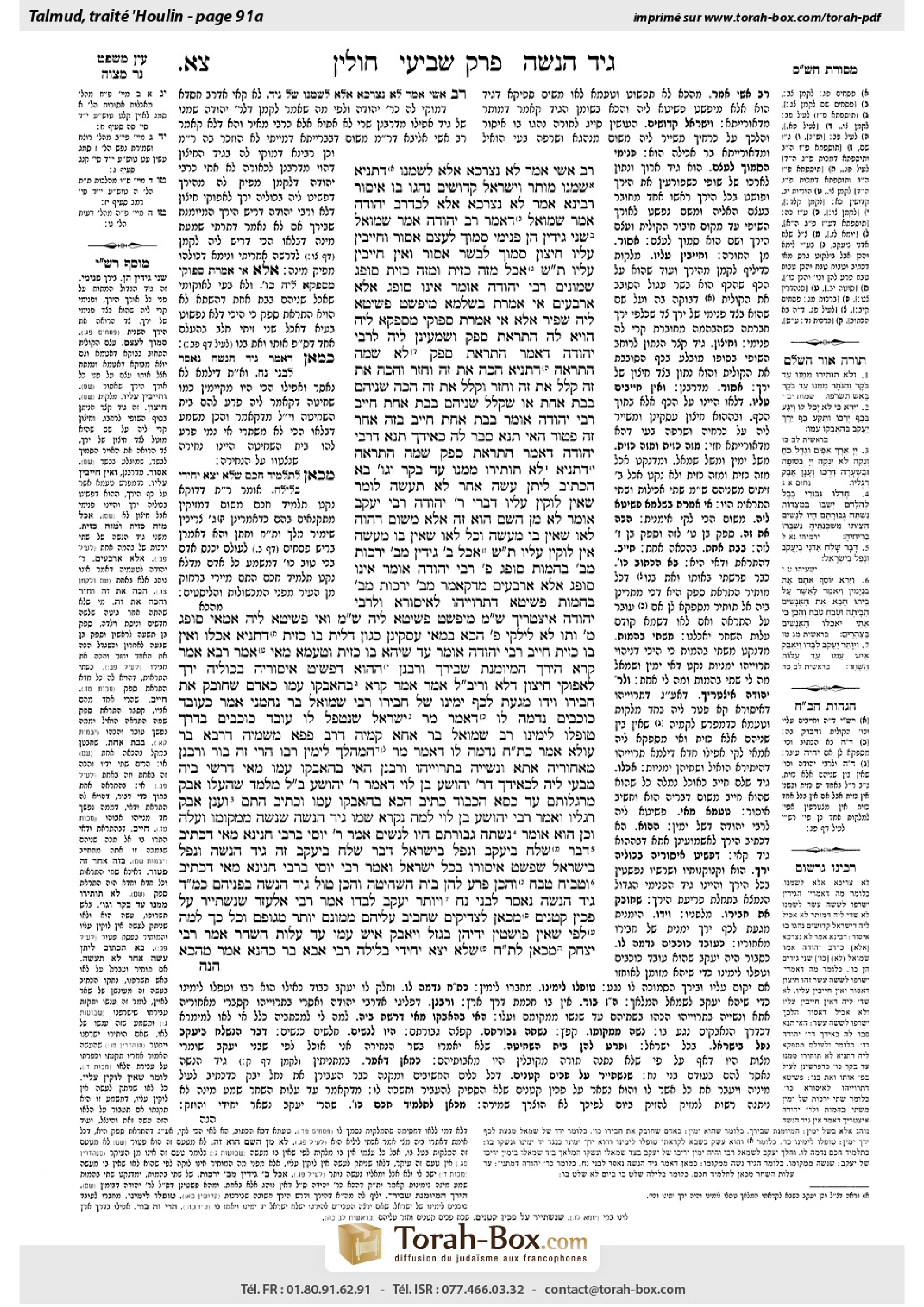
Chullin 91a: Talmud study for Daf Yomi
Study the Talmud for Daf Yomi with scanned pages, Hebrew text, English translations from Sefaria and AI-generated French translations.
Passage selection and English or AI-generated French translation are available where the scan has annotations. Daf Study is independent of Torah-Box and Sefaria.
Browse Chullin · חולין · All tractatesChullin 91a text and translations
This page of Chullin includes the Aramaic text, an English translation and an AI-generated French translation, alongside the scan above.
חולין צ״א א · Aramaic and Hebrew text
רַב אָשֵׁי אָמַר: לֹא נִצְרְכָה אֶלָּא לְשׇׁמְנוֹ, דְּתַנְיָא: שׇׁמְנוֹ מוּתָּר, וְיִשְׂרָאֵל קְדוֹשִׁים נָהֲגוּ בּוֹ אִיסּוּר.
רָבִינָא אָמַר: לֹא נִצְרְכָה אֶלָּא לְכִדְרַב יְהוּדָה אָמַר שְׁמוּאֵל, דְּאָמַר רַב יְהוּדָה אָמַר שְׁמוּאֵל, שְׁנֵי גִידִין הֵן: פְּנִימִי סָמוּךְ לְעֶצֶם – אָסוּר, וְחַיָּיבִין עָלָיו; חִיצוֹן סָמוּךְ לְבָשָׂר – אָסוּר, וְאֵין חַיָּיבִין עָלָיו.
תָּא שְׁמַע: אָכַל מִזֶּה כְּזַיִת וּמִזֶּה כְּזַיִת – סוֹפֵג שְׁמוֹנִים, רַבִּי יְהוּדָה אוֹמֵר: אֵינוֹ סוֹפֵג אֶלָּא אַרְבָּעִים.
אִי אָמְרַתְּ בִּשְׁלָמָא מִיפְשָׁט פְּשִׁיטָא לֵיהּ – שַׁפִּיר, אֶלָּא אִי אָמְרַתְּ סַפּוֹקֵי מְסַפְּקָא לֵיהּ – הָוְיָא לַהּ הַתְרָאַת סָפֵק, וְשָׁמְעִינַן לֵיהּ לְרַבִּי יְהוּדָה דְּאָמַר: הַתְרָאַת סָפֵק לֹא שְׁמָהּ הַתְרָאָה.
דְּתַנְיָא: הִכָּה אֶת זֶה, וְחָזַר וְהִכָּה אֶת זֶה, קִלֵּל אֶת זֶה, וְחָזַר וְקִלֵּל אֶת זֶה, הִכָּה שְׁנֵיהֶם בְּבַת אַחַת, אוֹ שֶׁקִּלֵּל שְׁנֵיהֶם בְּבַת אַחַת – חַיָּיב. רַבִּי יְהוּדָה אוֹמֵר: בְּבַת אַחַת – חַיָּיב, בְּזֶה אַחַר זֶה – פָּטוּר.
הַאי תַּנָּא סָבַר לַהּ כְּאִידַּךְ תַּנָּא דְּרַבִּי יְהוּדָה, דְּאָמַר: הַתְרָאַת סָפֵק שְׁמָהּ הַתְרָאָה.
דְּתַנְיָא: ״לֹא תוֹתִירוּ מִמֶּנּוּ עַד בֹּקֶר וְגוֹ׳״ – בָּא הַכָּתוּב לִיתֵּן עֲשֵׂה אַחַר לֹא תַעֲשֶׂה, לוֹמַר שֶׁאֵין לוֹקִין עָלָיו, דִּבְרֵי רַבִּי יְהוּדָה.
רַבִּי יַעֲקֹב אוֹמֵר: לֹא מִן הַשֵּׁם הוּא זֶה, אֶלָּא מִשּׁוּם דְּהָוֵה לָאו שֶׁאֵין בּוֹ מַעֲשֶׂה, וְכׇל לָאו שֶׁאֵין בּוֹ מַעֲשֶׂה – אֵין לוֹקִין עָלָיו.
תָּא שְׁמַע: אָכַל שְׁנֵי גִידִין מִשְּׁתֵּי יְרֵכוֹת מִשְּׁתֵּי בְהֵמוֹת – סוֹפֵג שְׁמוֹנִים; רַבִּי יְהוּדָה אוֹמֵר: אֵינוֹ סוֹפֵג אֶלָּא אַרְבָּעִים.
מִדְּקָאָמַר מִשְׁתֵּי יְרֵכוֹת מִשְּׁתֵּי בְהֵמוֹת, פְּשִׁיטָא דְּתַרְוַיְיהוּ לְאִיסּוּרָא, וּלְרַבִּי יְהוּדָה אִיצְטְרִיךְ. שְׁמַע מִינַּהּ מִיפְשָׁט פְּשִׁיטָא לֵיהּ, שְׁמַע מִינַּהּ.
וְאִי פְּשִׁיטָא לֵיהּ, אַמַּאי סוֹפֵג אַרְבָּעִים וְתוּ לָא? לִילְקֵי שְׁמוֹנִים! הָכָא בְּמַאי עָסְקִינַן – כְּגוֹן דְּלֵית בּוֹ כְּזַיִת, דְּתַנְיָא: אֲכָלוֹ וְאֵין בּוֹ כְּזַיִת – חַיָּיב, רַבִּי יְהוּדָה אוֹמֵר: עַד שֶׁיְּהֵא בּוֹ כְּזַיִת.
וְטַעְמָא מַאי? אָמַר רָבָא: אָמַר קְרָא ״הַיָּרֵךְ״ – הַמְיוּמֶּנֶת שֶׁבַּיָּרֵךְ.
וְרַבָּנַן, הַהוּא דְּפָשֵׁיט אִיסּוּרֵיהּ בְּכוּלֵּיהּ יָרֵךְ, לְאַפּוֹקֵי חִיצוֹן דְּלָא.
וְרַבִּי יְהוֹשֻׁעַ בֶּן לֵוִי אָמַר: אָמַר קְרָא ״בְּהֵאָבְקוֹ עִמּוֹ״ – כְּאָדָם שֶׁחוֹבֵק אֶת חֲבֵירוֹ, וְיָדוֹ מַגַּעַת לְכַף יְמִינוֹ שֶׁל חֲבֵירוֹ.
רַבִּי שְׁמוּאֵל בַּר נַחְמָנִי אָמַר: כְּגוֹי נִדְמָה לוֹ, דְּאָמַר מָר: יִשְׂרָאֵל שֶׁנִּטְפַּל לוֹ גּוֹי בַּדֶּרֶךְ – טוֹפְלוֹ לִימִינוֹ.
רַב שְׁמוּאֵל בַּר אַחָא קַמֵּיהּ דְּרַב פָּפָּא מִשְּׁמֵיהּ דְּרָבָא בַּר עוּלָּא אָמַר: כְּתַלְמִיד חָכָם נִדְמָה לוֹ, דְּאָמַר מָר: הַמְהַלֵּךְ לִימִין רַבּוֹ – הֲרֵי זֶה בּוּר.
וְרַבָּנַן, מֵאֲחוֹרֵיהּ אֲתָא, וְנַשְּׁיֵיהּ בְּתַרְוַיְיהוּ.
וְרַבָּנַן, הַאי ״בְּהֵאָבְקוֹ עִמּוֹ״ מַאי דָּרְשִׁי בֵּיהּ? מִבְּעֵי לֵיהּ לִכְאִידַּךְ דְּרַבִּי יְהוֹשֻׁעַ בֶּן לֵוִי, דְּאָמַר רַבִּי יְהוֹשֻׁעַ בֶּן לֵוִי: מְלַמֵּד שֶׁהֶעֱלוּ אֲבַק מַרְגְּלוֹתָם עַד כִּסֵּא הַכָּבוֹד, כְּתִיב הָכָא ״בְּהֵאָבְקוֹ עִמּוֹ״, וּכְתִיב הָתָם ״וְעָנָן אֲבַק רַגְלָיו״.
וְאָמַר רַבִּי יְהוֹשֻׁעַ בֶּן לֵוִי: לָמָּה נִקְרָא שְׁמוֹ גִּיד הַנָּשֶׁה? שֶׁנָּשָׁה מִמְּקוֹמוֹ וְעָלָה, וְכֵן הוּא אוֹמֵר: ״נָשְׁתָה גְבוּרָתָם הָיוּ לְנָשִׁים״.
אָמַר רַבִּי יוֹסֵי בְּרַבִּי חֲנִינָא: מַאי דִּכְתִיב ״דָּבָר שָׁלַח בְּיַעֲקֹב וְנָפַל בְּיִשְׂרָאֵל״? ״דָּבָר שָׁלַח בְּיַעֲקֹב״ – זֶה גִּיד הַנָּשֶׁה, ״וְנָפַל בְּיִשְׂרָאֵל״ – שֶׁפָּשַׁט אִיסּוּרוֹ בְּכׇל יִשְׂרָאֵל.
וְאָמַר רַבִּי יוֹסֵי בְּרַבִּי חֲנִינָא: מַאי דִּכְתִיב ״וּטְבוֹחַ טֶבַח וְהָכֵן״? פְּרַע לָהֶן בֵּית הַשְּׁחִיטָה, ״וְהָכֵן״ – טוֹל גִּיד הַנָּשֶׁה בִּפְנֵיהֶם, כְּמַאן דְּאָמַר גִּיד הַנָּשֶׁה נֶאֱסָר לִבְנֵי נֹחַ.
״וַיִּוָּתֵר יַעֲקֹב לְבַדּוֹ״, אָמַר רַבִּי אֶלְעָזָר: שֶׁנִּשְׁתַּיֵּיר עַל פַּכִּין קְטַנִּים, מִכָּאן לַצַּדִּיקִים שֶׁחָבִיב עֲלֵיהֶם מָמוֹנָם יוֹתֵר מִגּוּפָם, וְכׇל כָּךְ לָמָּה? לְפִי שֶׁאֵין פּוֹשְׁטִין יְדֵיהֶן בְּגָזֵל.
״וַיֵּאָבֵק אִישׁ עִמּוֹ עַד עֲלוֹת הַשָּׁחַר״, אָמַר רַבִּי יִצְחָק: מִכָּאן לְתַלְמִיד חָכָם שֶׁלֹּא יֵצֵא יְחִידִי בַּלַּיְלָה. רַבִּי אַבָּא בַּר כָּהֲנָא אָמַר מֵהָכָא:
Chullin 91a · English translation
Rav Ashi said: The mishna’s ruling that the sinews must be burned is necessary only with regard to the fat around the sciatic nerve, as it is taught in a baraita: The fat around the sciatic nerve is permitted by Torah law, but the Jewish people are holy and treated it as forbidden. Since it is permitted by Torah law, it has the status of sacrificial meat and may not be simply discarded. Nevertheless, since the Jewish people treat it as forbidden, they do not eat it even from the Paschal offering, despite the mitzva to eat that offering in its entirety. Therefore, it is left until after the time when the meat may be eaten and it is burned as leftover sacrificial meat.
Ravina said: The mishna’s statement is necessary only with regard to the outer nerve, and it is in accordance with that which Rav Yehuda said that Shmuel said. As Rav Yehuda said that Shmuel said: There are two nerves included in the prohibition of the sciatic nerve. The inner nerve that is next to the bone is forbidden by Torah law, and one is liable to be flogged for eating it. The outer nerve that is next to the flesh is forbidden by rabbinic law, and therefore one is not liable to be flogged for eating it. In the case of a Paschal offering, since the outer nerve is permitted by Torah law, it assumes the status of leftover sacrificial meat when it is not eaten.
The Gemara suggests: Come and hear another resolution to the dilemma about Rabbi Yehuda’s statement, from a mishna (96a): If one ate an olive-bulk from this sciatic nerve of the right leg and an olive-bulk from that sciatic nerve of the left leg, he incurs eighty lashes. Rabbi Yehuda says: He incurs only forty lashes.
Granted, if you say it is obvious to Rabbi Yehuda that the sciatic nerve of the right thigh is the one forbidden by Torah law, it is well. But if you say he is uncertain, why would he hold that one incurs any lashes? When the individual is forewarned not to partake of each sciatic nerve, which is necessary in order to be liable for incurring lashes, it is an uncertain forewarning, and we have heard about Rabbi Yehuda that he said: An uncertain forewarning is not characterized as forewarning.
As it is taught in a baraita: If one is uncertain which of two men is his father and he struck this one and then struck that one, or cursed this one and then cursed that one, or struck both of them simultaneously, or cursed both of them simultaneously, he is liable to receive the death penalty, as he certainly struck or cursed his father. Rabbi Yehuda says: If he struck or cursed both of them simultaneously he is liable, provided he was forewarned that his action will certainly render him liable to receive the death penalty. But if he struck or cursed them one after the other he is exempt. Apparently, Rabbi Yehuda is of the opinion that one is not punished after uncertain forewarning; since in this case it is impossible to determine which of them is the father, inevitably each forewarning is uncertain. Similarly, if Rabbi Yehuda is uncertain which sciatic nerve is forbidden by Torah law, he should hold that since the forewarning before eating either sciatic nerve is uncertain, one who consumes both should be exempt.
The Gemara answers: This tanna of that mishna, on 96a, holds in accordance with the opinion of another tanna with regard to the opinion of Rabbi Yehuda, who said that Rabbi Yehuda holds that an uncertain forewarning is characterized as forewarning.
As it is taught in a baraita: The verse states with regard to the Paschal offering: “And you shall not leave any of it until morning; but that which remains of it until morning you shall burn with fire” (Exodus 12:10). The verse comes to provide a positive mitzva to burn the leftover meat after it has taught a prohibition against leaving it over, to say that one is not flogged for violation of the prohibition; this is the statement of Rabbi Yehuda. Rabbi Yehuda holds that one is not flogged for any transgression that can be rectified by the performance of a positive mitzva.
Rabbi Ya’akov says: This, the halakha that one is not flogged, is not for that reason. Rather, it is because leaving over sacrificial meat is a prohibition that does not involve an action, as one violates the prohibition through failure to take action, and concerning any prohibition that does not involve an action, one is not flogged for its violation. The forewarning one could receive for this transgression is an uncertain one, because witnesses who forewarn the individual cannot be certain until daybreak that he will leave it over. Nevertheless, this baraita indicates that if not for the fact that leaving over sacrificial meat can be rectified by a positive mitzva, Rabbi Yehuda would hold that one is flogged for leaving over sacrificial meat.
The Gemara suggests: Come and hear a resolution of the uncertainty with regard to the opinion of Rabbi Yehuda from a baraita: If one ate two sciatic nerves from two thighs of two different animals, he incurs eighty lashes. Rabbi Yehuda says: He incurs only forty lashes.
The Gemara comments: From the fact that the first tanna said that he was referring to two thighs of two different animals, it is obvious that he meant they were both from the right thigh, because if one were from the right thigh and one were from the left thigh it would not matter if they were from two different animals or from the same animal. Consequently, both sciatic nerves are definitely forbidden by Torah law, and according to the first tanna one incurs eighty lashes for eating them. And it was necessary to teach that according to Rabbi Yehuda one incurs only forty lashes, as will be explained. Conclude from this baraita that it is obvious to Rabbi Yehuda that it is the sciatic nerve of the right thigh that is forbidden by Torah law. The Gemara affirms: Conclude from it that this is Rabbi Yehuda’s opinion.
The Gemara seeks to clarify the baraita: But if it is obvious to Rabbi Yehuda that the sciatic nerve from the right thigh is prohibited by Torah law, why does he incur forty lashes and nothing more? Let him be flogged eighty times. The Gemara answers: Here we are dealing with a case where the volume of one of the sciatic nerves is not an olive-bulk, and Rabbi Yehuda holds that in such a case one is not flogged for its consumption. As it is taught in a baraita: If one ate the entire sciatic nerve and its volume is not an olive-bulk, he is nevertheless liable to be flogged, because he ate a complete, natural unit of forbidden food. Rabbi Yehuda says: He is not liable unless it has a volume of at least an olive-bulk.
The Gemara asks: And what is the reason that Rabbi Yehuda holds that only the sciatic nerve of the right thigh is forbidden by Torah law? Rava said that it is because the verse states: “Therefore the children of Israel eat not the sciatic nerve that is upon the spoon of the thigh” (Genesis 32:33). The definite article indicates that this is referring to the most important thigh.
And the Rabbis, who hold that the sciatic nerves of both the right and left thighs are forbidden by Torah law, explain the definite article as teaching that the prohibition applies to the one whose prohibition spreads through the entire thigh, i.e., the inner nerve. This serves to exclude the outer nerve, which is not prohibited by Torah law.
And Rabbi Yehoshua ben Levi said that Rabbi Yehuda holds that the sciatic nerve of the right thigh is forbidden because the verse states: “And when he saw that he could not prevail against him, he touched the spoon of his thigh; and the spoon of Jacob’s thigh was strained, as he wrestled with him” (Genesis 32:26). The angel grappled with Jacob like a man who hugs another in order to throw him to the ground, and his hand reaches to the spoon of the right thigh of the other.
Rabbi Shmuel bar Naḥmani says: The angel appeared to him as a gentile, as the Master said: A Jew who is joined by a gentile on the road and continues his travels with him should position the gentile to his right, close to one’s dominant hand. This allows the Jew to defend himself against any potential attack. Since Jacob followed this practice, it was therefore Jacob’s right thigh that the angel touched.
Rav Shmuel bar Aḥa said before Rav Pappa in the name of Rava bar Ulla that the angel appeared to Jacob as a Torah scholar, and therefore Jacob positioned the angel on his right side, as the Master said: One who walks to the right of his teacher is an ignoramus, in that he does not know how to act with good manners. Consequently, it was Jacob’s right thigh that the angel touched.
And the Rabbis, who hold that the sciatic nerves of both thighs are forbidden, understand that the angel came from behind Jacob and hit him on both thighs.
The Gemara asks: And the Rabbis, what do they derive from this phrase: “As he wrestled with him” (Genesis 32:26)? The Gemara answers: They require it for the other interpretation of Rabbi Yehoshua ben Levi, as Rabbi Yehoshua ben Levi said: This teaches that the dust [avak] from their feet ascended to the throne of glory. It is written here: “As he wrestled [behe’avko] with him,” and it is written there in a description of how God will punish the wicked: “The Lord, in the whirlwind and in the storm is His way, and the clouds are the dust of His feet” (Nahum 1:3).
§ The Gemara cites another statement of Rabbi Yehoshua ben Levi concerning the sciatic nerve: And Rabbi Yehoshua ben Levi says: Why is its name called sciatic nerve [gid hanashe]? It is because the sciatic nerve left [nasha] its place and rose. And similarly the verse says: “The mighty men of Babylon have ceased to fight, they remain in their strongholds; their might has left [nashata], they are become as women” (Jeremiah 51:30).
The Gemara continues with other expositions pertaining to the sciatic nerve. Rabbi Yosei, son of Rabbi Ḥanina, said: What is the meaning of that which is written: “The Lord sent a word to Jacob, and it has fallen upon Israel” (Isaiah 9:7)? “He sent a word to Jacob”; this is a reference to the sciatic nerve. “And it has fallen upon Israel”; this teaches that its prohibition has been extended to the entire Jewish people.
And Rabbi Yosei, son of Rabbi Ḥanina, also said: What is the meaning of that which is written: “And when Joseph saw Benjamin with them, he said to the steward of his house: Bring the men into the house, and slaughter the animals, and prepare the meat; for the men shall dine with me at noon” (Genesis 43:16)? Joseph commanded his steward: Expose the place of the slaughter on the neck of the animal to them so that the brothers will know that it is being slaughtered correctly. “And prepare” teaches that Joseph instructed the steward to remove the sciatic nerve in their presence so that the brothers would know that it had been fully removed. The Gemara comments that this opinion is according to the one who said that the sciatic nerve was forbidden to the children of Jacob even before the Torah was given, when they still had the status of descendants of Noah.
The Gemara returns to the verse of Jacob wrestling with the angel. The verse states: “And Jacob was left alone; and a man wrestled with him until the breaking of the day” (Genesis 32:25). Rabbi Elazar says: The reason Jacob remained alone was that he remained to collect some small pitchers that had been left behind. From here it is derived that the possessions of the righteous are dearer to them than their bodies. And why do they care so much about their possessions? It is because they do not stretch out their hands to partake of stolen property.
The verse states: “And a man wrestled with him until the breaking of the day.” Rabbi Yitzḥak says: From here it is derived that a Torah scholar should not go out of his house alone at night, as Jacob went out alone at night and was injured. Rabbi Abba bar Kahana said that the source for this instruction is from here:
Chullin 91a · Traduction française (IA)
Rav Ashi a dit : La décision de la Michna selon laquelle les nerfs doivent être brûlés est nécessaire uniquement concernant la graisse autour du nerf sciatique, comme il est enseigné dans une baraïta : La graisse autour du nerf sciatique est permise selon la loi divine, mais le peuple juif est saint et la considère comme interdite. Puisque cela est permis selon la loi divine, cela a le statut de viande sacrificielle et ne peut être simplement rejeté. Cependant, puisque le peuple juif la considère comme interdite, ils ne la mangent même pas lors de l'offrande pascal, malgré la mitsva de la manger entièrement. Par conséquent, elle est laissée jusqu'après le moment où la viande peut être mangée et elle est brûlée comme viande sacrificielle restante.
Ravina a dit : La déclaration de la Michna est nécessaire uniquement concernant le nerf externe, et elle s'aligne avec ce que Rav Yéhuda a dit que Shmuel a dit. Comme Rav Yéhuda a dit que Shmuel a dit : Il y a deux nerfs inclus dans l'interdiction du nerf sciatique. Le nerf interne qui est près de l'os est interdit selon la loi divine, et l'on est puni de flagellation pour en manger. Le nerf externe qui est près de la chair est interdit selon la loi rabbinique, et par conséquent, l'on n'est pas puni de flagellation pour en manger. Dans le cas d'une offrande pascal, puisque le nerf externe est permis selon la loi divine, il assume le statut de viande sacrificielle restante lorsqu'il n'est pas mangé.
La Guemara suggère : Venez entendre une autre résolution du dilemme concernant la déclaration de Rabbi Yéhuda, à partir d'une Michna (96a) : Si l'on a mangé une quantité d'olive de ce nerf sciatique du membre droit et une quantité d'olive de ce nerf sciatique du membre gauche, il est puni de soixante-dix flagellations. Rabbi Yéhuda dit : Il est puni seulement de quarante flagellations.
Admettons, si vous dites que c'est évident pour Rabbi Yéhuda que le nerf sciatique du membre droit est celui interdit selon la loi divine, c'est bien. Mais si vous dites qu'il est incertain, pourquoi alors maintenir qu'il y a une punition ? Lorsque l'individu est averti de ne pas participer à chaque nerf sciatique, ce qui est nécessaire pour être puni, c'est un avertissement incertain, et nous avons entendu que Rabbi Yéhuda a dit : Un avertissement incertain n'est pas considéré comme un avertissement.
Comme il est enseigné dans une baraïta : Si l'on est incertain de savoir quel des deux hommes est son père et qu'on a frappé celui-ci et ensuite celui-là, ou qu'on a maudit celui-ci et ensuite celui-là, ou qu'on a frappé les deux en même temps, ou qu'on a maudit les deux en même temps, l'on est puni de la peine de mort, car l'on a certainement frappé ou maudit son père. Rabbi Yéhuda dit : Si l'on a frappé ou maudit les deux en même temps, l'on est puni, à condition qu'on ait été averti que son action rendra certainement l'individu coupable de la peine de mort. Mais si l'on a frappé ou maudit les deux l'un après l'autre, l'on est exempt. Apparemment, Rabbi Yéhuda est de l'opinion que l'on n'est pas puni après un avertissement incertain ; puisque dans ce cas, il est impossible de déterminer quel est le père, chaque avertissement est incertain. De même, si Rabbi Yéhuda est incertain de savoir quel nerf sciatique est interdit selon la loi divine, il devrait maintenir que puisque l'avertissement avant de manger chaque nerf sciatique est incertain, celui qui en mange deux devrait être exempt.
La Guemara répond : Ce tanna de cette michna, sur 96a, suit l'opinion d'un autre tanna concernant l'opinion de Rabbi Yéhuda, qui a dit que Rabbi Yéhuda considère que l'avertissement incertain est considéré comme un avertissement.
Comme il est enseigné dans une baraïta : Le verset dit concernant l'offrande pascal : « Et vous ne laisserez pas rester de cela jusqu'au matin ; mais ce qui restera de cela jusqu'au matin, vous le brûlerez en feu » (Exode 12:10). Le verset vise à établir une mitsva positive de brûler la viande restante après avoir enseigné une interdiction de la laisser reposer, pour dire que l'on n'est pas flagellé pour la violation ; c'est la déclaration de Rabbi Yéhuda. Rabbi Yéhuda maintient que l'on n'est pas flagellé pour toute transgression qui peut être rectifiée par la performance d'une mitsva positive.
Rabbi Yaakov dit : Cela, la halakha selon laquelle l'on n'est pas flagellé, n'est pas pour cette raison. Plutôt, c'est parce que laisser reposer la viande sacrificielle est une interdiction qui ne concerne pas une action, car l'on viole l'interdiction par l'inaction, et concernant toute interdiction qui ne concerne pas une action, l'on n'est pas flagellé pour sa violation. L'avertissement que l'on pourrait recevoir pour cette transgression est incertain, car les témoins qui avertissent l'individu ne peuvent être certains jusqu'au matin qu'il aura laissé reposer. Cependant, cette baraïta indique que si ce n'était pas pour le fait que laisser reposer la viande sacrificielle peut être rectifié par une mitsva positive, Rabbi Yéhuda aurait maintenu que l'on est flagellé pour laisser reposer la viande sacrificielle.
La Guemara suggère : Venez entendre une résolution de l'incertitude concernant l'opinion de Rabbi Yéhuda à partir d'une baraïta : Si l'on a mangé deux nerfs sciatiques de deux membres de deux animaux différents, l'on est puni de soixante-dix flagellations. Rabbi Yéhuda dit : L'on est puni seulement de quarante flagellations.
La Guemara commente : À partir du fait que le premier tanna a dit qu'il s'agissait de deux cuisses de deux animaux différents, il est évident qu'il voulait dire qu'ils étaient tous deux de la cuisse droite, car si l'un était de la cuisse droite et l'autre de la cuisse gauche, cela n'aurait pas fait de différence si ils étaient de deux animaux différents ou du même animal. Par conséquent, les deux nerfs sciatiques sont certainement interdits selon la loi divine, et selon le premier tanna, l'on est puni de soixante-dix flagellations pour en manger. Et il était nécessaire d'enseigner que selon Rabbi Yéhuda, l'on est puni seulement de quarante flagellations, comme cela sera expliqué. Concluez de cette baraïta que c'est évident pour Rabbi Yéhuda que c'est le nerf sciatique de la cuisse droite qui est interdit selon la loi divine. La Guemara affirme : Concluez-en que c'est l'opinion de Rabbi Yéhuda.
La Guemara cherche à clarifier la baraïta : Mais si c'est évident pour Rabbi Yéhuda que le nerf sciatique du cuisse droit est interdit par la Loi divine, pourquoi subit-il quarante coups de fouet et rien de plus ? Que l'on le fasse frapper soixante-dix fois. La Guemara répond : Nous sommes ici en présence d'un cas où le volume d'un des nerfs sciatiques n'est pas celui d'une olive, et Rabbi Yéhuda considère que dans ce cas, on ne fouette pas pour sa consommation. Comme il est enseigné dans une baraïta : Si l'on a mangé tout le nerf sciatique et que son volume n'est pas celui d'une olive, il est néanmoins tenu pour responsable d'être fouetté, car il a mangé une unité naturelle complète de nourriture interdite. Rabbi Yéhuda dit : Il n'est pas tenu pour responsable à moins qu'il ait un volume d'au moins une olive.
La Guemara demande : Et quelle est la raison pour laquelle Rabbi Yéhuda considère que seul le nerf sciatique du cuisse droit est interdit par la Loi divine ? Rava dit que c'est parce que la Parole dit : « Par conséquent, les enfants d'Israël ne doivent pas manger le nerf sciatique qui est sur le cuisse de la cuisse » (Genèse 32:33). L'article défini indique que cela se réfère au cuisse le plus important.
Et les Rabbins, qui considèrent que les nerfs sciatiques des deux cuisses sont interdits par la Loi divine, expliquent que l'article défini enseigne que l'interdiction s'applique à celui dont l'interdiction s'étend sur tout le cuisse, c'est-à-dire le nerf interne. Cela sert à exclure le nerf externe, qui n'est pas interdit par la Loi divine.
Et Rabbi Yéhoshua ben Levi dit que Rabbi Yéhuda considère que le nerf sciatique du cuisse droit est interdit parce que la Parole dit : « Et lorsqu'il vit qu'il ne pouvait pas vaincre, il toucha le cuisse de son adversaire ; et le cuisse de Jacob fut tendu, comme il le combattait » (Genèse 32:26). L'ange combattit Jacob comme un homme qui serre un autre dans ses bras pour le jeter au sol, et sa main atteint le cuisse droit de l'autre.
Rabbi Shmuel bar Naḥmani dit : L'ange apparut à lui comme un non-Juif, comme le Maître dit : Un Juif qui est accompagné par un non-Juif sur la route et continue son voyage avec lui doit placer le non-Juif à sa droite, près de sa main dominante. Cela permet au Juif de se défendre contre toute attaque potentielle. Puisque Jacob suivait cette pratique, c'était donc le cuisse droit de Jacob que l'ange avait touché.
Rav Shmuel bar Aḥa dit devant Rav Pappa en nom de Rava bar Ulla que l'ange apparut à Jacob comme un savant de la Torah, et donc Jacob plaça l'ange à sa droite, comme le Maître dit : Celui qui marche à droite de son maître est un ignorant, car il ne sait pas agir avec les bonnes manières. Ainsi, c'était le cuisse droit de Jacob que l'ange avait touché.
Et les Rabbins, qui affirment que les nerfs sciatiques des deux cuisses sont interdits, comprennent que l'ange est venu derrière Jacob et l'a frappé aux deux cuisses.
La Guemara demande : Et les Rabbins, qu'en déduisent-ils de cette phrase : « Comme il le combattait » (Genèse 32:26) ? La Guemara répond : Ils l'exigent pour l'autre interprétation de Rabbi Yéhoshua ben Levi, comme Rabbi Yéhoshua ben Levi dit : Cela enseigne que la poussière [avak] de leurs pieds est montée jusqu'au trône de gloire. Il est écrit ici : « Comme il le combattait [behe’avko] », et il est écrit là dans une description de la manière dont Dieu punira les méchants : « L'Éternel, dans le tourbillon et dans la tempête est Son chemin, et les nuages sont la poussière de Ses pieds » (Nahum 1:3).
§ La Guemara cite une autre déclaration de Rabbi Yéhoshua ben Levi concernant le nerf sciatique : Et Rabbi Yéhoshua ben Levi dit : Pourquoi est-ce appelé nerf sciatique [gid hanashe] ? C'est parce que le nerf sciatique a quitté [nasha] sa place et s'est levé. De même, la Parole dit : « Les hommes puissants de Babylone ont cessé de combattre, ils restent dans leurs forteresses ; leur force a quitté [nashata], ils sont devenus comme des femmes » (Jérémie 51:30).
La Guemara continue avec d'autres expositions concernant le nerf sciatique. Rabbi Yosei, fils de Rabbi Ḥanina, dit : Quelle est la signification de ce qui est écrit : « L'Éternel envoya un mot à Jacob, et il est tombé sur Israël » (Isaïe 9:7) ? « Il envoya un mot à Jacob » : cela fait référence au nerf sciatique. « Et il est tombé sur Israël » : cela enseigne que son interdiction s'est étendue à tout le peuple juif.
Et Rabbi Yosei, fils de Rabbi Ḥanina, a aussi dit : Quelle est la signification de ce qui est écrit : « Et lorsqu'Yossef vit Benjamin avec eux, il dit au steward de sa maison : Amène les hommes dans la maison, et tue les bêtes, et prépare la viande ; car les hommes dîneront avec moi à midi » (Genèse 43:16) ? Yossef commanda à son steward : Expose la place de la boucherie sur le cou de l'animal à leurs yeux afin qu'ils sachent qu'il est tué correctement. « Et prépare » enseigne que Yossef ordonna au steward de retirer le nerf sciatique devant eux afin qu'ils sachent qu'il avait été entièrement retiré. La Guemara commente que cette opinion est celle qui dit que le nerf sciatique était interdit aux enfants de Jacob même avant que la Torah ne soit donnée, lorsqu'ils avaient encore le statut de descendants de Noé.
La Guemara retourne à la verset de Jacob combattant l'ange. La Parole dit : « Et Jacob fut seul ; et un homme lutta avec lui jusqu'au lever du jour » (Genèse 32:25). Rabbi Eléazar dit : La raison pour laquelle Jacob fut seul était qu'il resta pour ramasser quelques petites outres qui avaient été laissées derrière. D'où l'on déduit que les biens des justes sont plus précieux pour eux que leur corps. Et pourquoi s'occupent-ils tant de leurs biens ? C'est parce qu'ils ne tendent pas leurs mains pour manger des biens volés.
La parabole dit : « Et un homme lutta avec lui jusqu'au lever du jour. » Rabbi Yitzhak dit : d'où l'on déduit que le sage ne doit pas sortir seul de sa maison la nuit, car Yaakov est sorti seul la nuit et a été blessé. Rabbi Abba bar Kahana a dit que la source de cette instruction est ici :
Traduction française générée par IA à partir de l’édition anglaise de Sefaria. Vérifie toujours un passage avec le texte source.
Text from Sefaria: William Davidson Edition - Vocalized Aramaic (unknown); William Davidson Edition - English (CC BY NC).