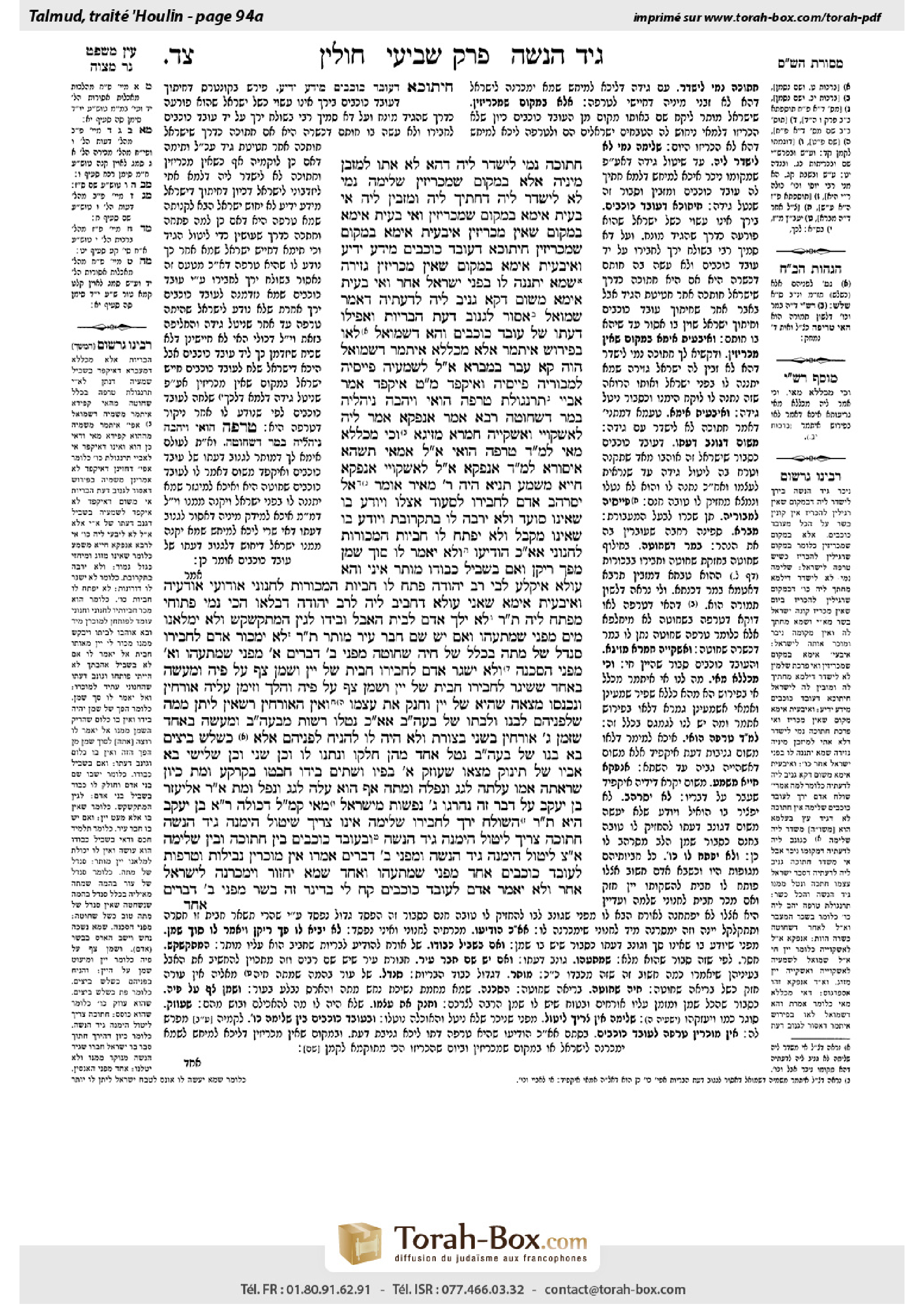
Chullin 94a: Talmud study for Daf Yomi
Study the Talmud for Daf Yomi with scanned pages, Hebrew text, English translations from Sefaria and AI-generated French translations.
Passage selection and English or AI-generated French translation are available where the scan has annotations. Daf Study is independent of Torah-Box and Sefaria.
Browse Chullin · חולין · All tractatesChullin 94a text and translations
This page of Chullin includes the Aramaic text, an English translation and an AI-generated French translation, alongside the scan above.
חולין צ״ד א · Aramaic and Hebrew text
חֲתוּכָה נָמֵי לִישַׁדַּר לֵיהּ, דְּהָא לָא אָתוּ לְמִזְבַּן מִינֵּיהּ! אֶלָּא בִּמְקוֹם שֶׁמַּכְרִיזִין, שְׁלֵימָה נָמֵי לָא לִישַׁדַּר לֵיהּ, דְּחָתֵיךְ לֵיהּ וּמְזַבֵּין לֵיהּ.
אִי בָּעֵית אֵימָא – בִּמְקוֹם שֶׁמַּכְרִיזִין, וְאִי בָּעֵית אֵימָא – בִּמְקוֹם שֶׁאֵין מַכְרִיזִין.
אִיבָּעֵית אֵימָא בִּמְקוֹם שֶׁמַּכְרִיזִין – חִיתּוּכָא דְּגוֹי מִידָּע יְדִיעַ.
וְאִיבָּעֵית אֵימָא בִּמְקוֹם שֶׁאֵין מַכְרִיזִין – גְּזֵירָה שֶׁמָּא יִתְּנֶנָּה לוֹ בִּפְנֵי יִשְׂרָאֵל אַחֵר.
וְאִי בָּעֵית אֵימָא, מִשּׁוּם דְּקָא גָנֵיב לֵיהּ לְדַעְתֵּיהּ, דְּאָמַר שְׁמוּאֵל: אָסוּר לִגְנוֹב דַּעַת הַבְרִיּוֹת, וַאֲפִילּוּ דַּעְתּוֹ שֶׁל גּוֹי.
וְהָא דִּשְׁמוּאֵל, לָאו בְּפֵירוּשׁ אִיתְּמַר, אֶלָּא מִכְּלָלָא אִיתְּמַר. דִּשְׁמוּאֵל הֲוָה קָא עָבַר בְּמַבָּרָא, אֲמַר לֵיהּ לְשַׁמָּעֵיהּ: ״פַּיְּיסֵיהּ לְמַבּוֹרֹיָה״, פַּיְּיסֵיהּ, וְאִיקְּפַד.
מַאי טַעְמָא אִיקְּפַד? אָמַר אַבָּיֵי: תַּרְנְגוֹלֶת טְרֵפָה הֲוַאי, וְיַהֲבַהּ נִיהֲלֵיהּ בְּמָר דִּשְׁחוּטָה. רָבָא אָמַר: אַנְפָּקָא אֲמַר לֵיהּ (לאשקויי) [לְאַשְׁקוֹיֵיהּ], וְאַשְׁקְיֵיהּ חַמְרָא מְזִיגָא.
וְכִי מִכְּלָלָא מַאי? לְמַאן דְּאָמַר טְרֵפָה הֲוַאי, אֲמַר לֵיהּ: אַמַּאי תְּשַׁהֵא אִיסּוּרָא?
לְמַאן דְּאָמַר אַנְפָּקָא אֲמַר לֵיהּ לְאַשְׁקוֹיֵי, אַנְפָּקָא חַיָּיא מַשְׁמַע.
תַּנְיָא, הָיָה רַבִּי מֵאִיר אוֹמֵר: אַל יְסַרְהֵב אָדָם לַחֲבֵירוֹ לִסְעוֹד אֶצְלוֹ, וְיוֹדֵעַ בּוֹ שֶׁאֵינוֹ סוֹעֵד, וְלֹא יַרְבֶּה לוֹ בְּתִקְרוֹבֶת, וְיוֹדֵעַ בּוֹ שֶׁאֵינוֹ מְקַבֵּל.
וְלֹא יִפְתַּח לוֹ חָבִיּוֹת הַמְּכוּרוֹת לְחֶנְוָנִי, אֶלָּא אִם כֵּן הוֹדִיעוֹ. וְלֹא יֹאמַר לוֹ סוֹךְ שֶׁמֶן מִפַּךְ רֵיקָן. וְאִם בִּשְׁבִיל כְּבוֹדוֹ – מוּתָּר.
אִינִי? וְהָא עוּלָּא אִיקְּלַע לְבֵי רַב יְהוּדָה, פָּתַח לוֹ חָבִיּוֹת הַמְּכוּרוֹת לַחֶנְוָנִי! אוֹדוֹעֵי אוֹדְעֵיהּ, וְאִיבָּעֵית אֵימָא: שָׁאנֵי עוּלָּא דְּחַבִּיב לֵיהּ לְרַב יְהוּדָה, דִּבְלָאו הָכִי נָמֵי (פַּתּוֹחֵי) מִפְתָּח [הֲוָה פָּתַח] לֵיהּ.
תָּנוּ רַבָּנַן: לֹא יֵלֵךְ אָדָם לְבֵית הָאֵבֶל, וּבְיָדוֹ לָגִין הַמִּתְקַשְׁקֵשׁ. וְלֹא יְמַלְּאֶנּוּ מַיִם, מִפְּנֵי שֶׁמַּתְעֵהוּ. וְאִם יֵשׁ שָׁם חֶבֶר עִיר – מוּתָּר.
תָּנוּ רַבָּנַן: לֹא יִמְכּוֹר אָדָם לַחֲבֵירוֹ סַנְדָּל שֶׁל מֵתָה בִּכְלַל שֶׁל חַיָּה שְׁחוּטָה, מִפְּנֵי שְׁנֵי דְבָרִים: אֶחָד – מִפְּנֵי שֶׁמַּתְעֵהוּ, וְאֶחָד – מִפְּנֵי הַסַּכָּנָה.
וְלֹא יְשַׁגֵּר אָדָם לַחֲבֵירוֹ חָבִית שֶׁל יַיִן וְשֶׁמֶן צָף עַל פִּיהָ. וּמַעֲשֶׂה בְּאֶחָד שֶׁשִּׁיגֵּר לַחֲבֵירוֹ חָבִית שֶׁל יַיִן וְשֶׁמֶן צָף עַל פִּיהָ, וְהָלַךְ וְזִימֵּן עָלֶיהָ אוֹרְחִין, וְנִכְנְסוּ, מְצָאָהּ שֶׁהִיא שֶׁל יַיִן, וְחָנַק אֶת עַצְמוֹ.
וְאֵין הָאוֹרְחִין רַשָּׁאִין לִיתֵּן מִמַּה שֶּׁלִּפְנֵיהֶם לִבְנוֹ וּלְבִתּוֹ שֶׁל בַּעַל הַבַּיִת, אֶלָּא אִם כֵּן נָטְלוּ רְשׁוּת מִבַּעַל הַבַּיִת.
וּמַעֲשֶׂה בְּאֶחָד שֶׁזִּמֵּן שְׁלֹשָׁה אוֹרְחִין בִּשְׁנֵי בַצּוֹרֶת, וְלֹא הָיָה לוֹ לְהַנִּיחַ לִפְנֵיהֶם אֶלָּא כְּשָׁלֹשׁ בֵּיצִים. בָּא בְּנוֹ שֶׁל בַּעַל הַבַּיִת, נָטַל אֶחָד מֵהֶן חֶלְקוֹ וּנְתָנוֹ לוֹ, וְכֵן שֵׁנִי, וְכֵן שְׁלִישִׁי. בָּא אָבִיו שֶׁל תִּינוֹק, מְצָאוֹ שֶׁעוֹזֵק אֶחָד בְּפִיו וּשְׁתַּיִם בְּיָדוֹ, חֲבָטוֹ בַּקַּרְקַע וָמֵת. כֵּיוָן שֶׁרָאֲתָה אִמּוֹ, עָלְתָה לַגָּג וְנָפְלָה וָמֵתָה, אַף הוּא עָלָה לַגָּג וְנָפַל וָמֵת.
אָמַר רַבִּי אֱלִיעֶזֶר בֶּן יַעֲקֹב: עַל דָּבָר זֶה נֶהֶרְגוּ שָׁלֹשׁ נְפָשׁוֹת מִיִּשְׂרָאֵל. מַאי קָמַשְׁמַע לַן? דְּכוּלַּהּ רַבִּי אֱלִיעֶזֶר בֶּן יַעֲקֹב הִיא.
תָּנוּ רַבָּנַן: הַשּׁוֹלֵחַ יָרֵךְ לַחֲבֵירוֹ, שְׁלֵימָה – אֵינוֹ צָרִיךְ שֶׁיִּטּוֹל הֵימֶנָּה גִּיד הַנָּשֶׁה. חֲתוּכָה – צָרִיךְ לִיטּוֹל הֵימֶנָּה גִּיד הַנָּשֶׁה. וּבְגוֹי, בֵּין חֲתוּכָה וּבֵין שְׁלֵימָה – אֵין צָרִיךְ לִיטּוֹל הֵימֶנָּה גִּיד הַנָּשֶׁה.
וּמִפְּנֵי שְׁנֵי דְבָרִים אָמְרוּ אֵין מוֹכְרִין נְבֵילוֹת וּטְרֵפוֹת לְגוֹי: אֶחָד – מִפְּנֵי שֶׁמַּתְעֵהוּ, וְאֶחָד – שֶׁמָּא יַחְזוֹר וְיִמְכְּרֶנָּה לְיִשְׂרָאֵל אַחֵר.
וְלֹא יֹאמַר אָדָם לְגוֹי ״קַח לִי בְּדִינָר זֶה בָּשָׂר״, מִפְּנֵי שְׁנֵי דְבָרִים:
Chullin 94a · English translation
Consequently, it should also be permitted to send to a gentile a thigh that has been cut, because Jews will not come to purchase it from him. Rather, if the mishna is referring to a place where all the butchers are Jewish, and they announce every time they sell a tereifa to a gentile, in which case Jews may purchase meat from the local gentiles when such an announcement is not made, one should not be permitted to send even a whole thigh to a gentile, due to the concern that he might cut it up and sell it to Jews who would not realize that it still contains the sciatic nerve.
The Gemara offers two answers: If you wish, say that the mishna is referring to a place where they announce every time they sell a tereifa; and if you wish, say that the mishna is referring to a place where they do not announce every time they sell a tereifa.
The Gemara explains: If you wish, say that the mishna is referring to a place where they announce every time they sell a tereifa, and nevertheless it is permitted to send a whole thigh of meat to a gentile. There is no concern that the gentile will sell the thigh to a Jew, because the Jew would know that it is non-kosher by the manner of cutting of the gentile. Jewish butchers would cut the meat in a distinctive manner that would not be replicated by a gentile who cut the meat.
And if you wish, say that the mishna is referring to a place where they do not announce every time they sell a tereifa, and nevertheless it is prohibited to give the gentile a thigh that has been cut up. The Sages issued a decree against doing so, lest he give it to the gentile in the presence of another Jew, who will think that it is kosher and purchase it from the gentile.
And if you wish, say that there is an entirely different reason why one may not send a gentile a cut-up thigh without removing the sciatic nerve: Because he thereby deceives the gentile. The gentile will think that the Jew has exerted himself to cut up the leg and remove the sciatic nerve and that although the Jew could have eaten the meat himself he decided to send it to the gentile. The gentile will therefore be more appreciative of the gift than he would be if he realized that the sciatic nerve had not been removed. This is as Shmuel said: It is prohibited to deceive people, and even to deceive a gentile.
And the Gemara points out that this ruling of Shmuel was not stated explicitly; rather, it was stated by inference, i.e., it was inferred based upon the following incident: Shmuel was once crossing a river in a ferry [mavra]. He said to his attendant: Compensate the ferryman with an appropriate gift. The attendant compensated him, but Shmuel became angry with his attendant.
The Gemara asks: What is the reason that Shmuel became angry? Abaye said: The compensation that the attendant gave the ferryman was a chicken that was a tereifa, and he gave it to him as though it were a slaughtered, kosher chicken. Rava said: Shmuel told him to give the ferryman wine for drinking in an anpaka, i.e., a utensil that holds a quarter-log and which was generally used for undiluted wine, but he gave him diluted wine for drinking. According to both Abaye and Rava, Shmuel was upset that his attendant deceived the gentile ferryman.
The Gemara asks: And if Shmuel’s opinion was derived by inference, what of it? The story clearly demonstrates that according to Shmuel it is prohibited to deceive a gentile. The Gemara answers that it cannot be ascertained with certainty that this is the reason Shmuel became angry. According to the one who said it was a chicken that was a tereifa that was given as compensation, perhaps Shmuel became angry and said to his attendant: Why did you retain in your possession an animal that is forbidden for consumption? This could have led to a Jew accidentally eating it.
Similarly, according to the one who said that Shmuel told him to give the ferryman wine to drink in an anpaka, since anpaka indicates undiluted wine and the attendant gave the ferryman diluted wine, perhaps Shmuel became angry simply because his attendant disobeyed his instruction.
§ Apropos the prohibition against acting deceitfully, the Gemara cites other statements on this topic. It is taught in a baraita that Rabbi Meir would say: A person may not importune [yesarhev] another to eat with him, making it seem as though he genuinely wants his company, but in reality he entreats him only because he knows that the other will not eat with him, i.e., will not accept the invitation. And similarly, one may not send another person many gifts merely because he knows that the other will not accept them.
And one may not open barrels of wine for a guest if they have already been sold to a storekeeper, unless he notifies the guest beforehand that the barrel had been sold. And he may not say to another: Anoint yourself with oil, and place an empty jug before him with the knowledge that he will not attempt to anoint himself. But if he does so for the guest’s honor, to show that he holds his guest in high esteem, rather than to deceive the guest so that he will feel indebted to him, it is permitted.
The Gemara asks: Is that so? But didn’t Ulla happen to come to the house of Rav Yehuda, and Rav Yehuda opened barrels of wine for Ulla that had already been sold to a storekeeper? The Gemara answers: Rav Yehuda notified Ulla that he was not opening the barrels especially for him. And if you wish, say that Ulla is different from an ordinary guest because he was very dear to Rav Yehuda, so that even without this, i.e., even if he had not already sold the barrels to a storekeeper, Rav Yehuda would have opened the barrels for him.
The Sages taught in a baraita: A person may not go to a house of mourning with a wine jug [lagin] in his hand that is mostly empty and where the small amount of wine rattles about, because the mourner will think that his visitor is bringing him a full jug of wine. And he may not fill up that jug of wine with water, because he thereby misleads the mourner into thinking he has brought him a full jug of undiluted wine. But if there is a crowd of people [ḥever ir] and the guest wants to honor the mourner in their presence, it is permitted.
The Sages taught in a baraita: A person may not sell to another a sandal made from the hide of an animal that died of natural causes as though it were a sandal made from the hide of a healthy animal that was slaughtered. This is prohibited due to two factors: One, because he misleads the customer into thinking that the leather is of higher quality than it really is; and another, because of the danger involved, as it is possible that the animal died from a snakebite and the poison seeped into the part of the animal’s hide from which the sandal is made.
And furthermore a person may not send a barrel of wine to another with oil floating at its mouth, such that the recipient thinks that it is a barrel of oil. There was an incident involving a certain individual who sent a barrel of wine to another with oil floating at its mouth, and that recipient, thinking it was a barrel of oil, went and invited guests to share it with him, and the guests arrived. When the host went to bring them oil, he found that it was a barrel of wine rather than oil, and in his shame at not having oil for them, he hanged himself and died.
The baraita continues: And guests are not permitted to give some of the food that is placed before them to the son or to the daughter of the host unless they first receive permission from the host.
And there was an incident involving a certain individual who invited three guests during years of famine, and he had enough to place only three eggs before them. The son of the host came, and one of the guests took his portion and gave it to the son. And similarly the second guest gave his portion to the son, and similarly the third guest. The father of the child came and found that his son was holding one egg in his mouth and two in his hand. The father became so angry with his son for taking all the food that he hit the son to the ground, and the son died. When his mother saw what had happened, she ascended to the roof and fell down to the ground and died. And when the father saw that both his son and his wife were dead he also ascended to the roof and fell down to the ground and died.
Rabbi Eliezer ben Yaakov said: For this matter of giving food to the child of the host, three Jewish souls were killed. The Gemara asks: What does this statement teach us? It is obvious from the incident that three people were killed. The Gemara answers: It teaches that the entire baraita is taught by Rabbi Eliezer ben Yaakov.
§ The Sages taught in a baraita: In the case of one who sends a whole thigh of an animal to another, he is not required to first remove the sciatic nerve from it. This is because the recipient can see that it has not yet been removed and will not eat it until he removes the sciatic nerve himself. But if one sends a thigh that has been cut up, he is required to first remove the sciatic nerve from it so that the recipient does not eat it unwittingly. And in the case of one who sends a thigh to a gentile, regardless of whether it is cut or whole he is not required to remove the sciatic nerve from it.
And it was due to two factors that the Sages said that one may not sell meat from unslaughtered animal carcasses or tereifot to a gentile: One, because it misleads him, as he thinks that it is kosher meat, which is more desirable; and another factor is the concern lest the gentile then sell the meat to another Jew, who will think it is kosher since it originally was sold by a Jew.
And similarly, a person may not say to a gentile: Purchase meat for me from a Jewish butcher with this dinar, due to two factors:
Chullin 94a · Traduction française (IA)
Par conséquent, il devrait également être permis d'envoyer à un non-Juif un quartier de cuisse qui a été coupé, car les Juifs ne viendront pas l'acheter chez lui. Cependant, si la Michna fait référence à un lieu où tous les bouchers sont Juifs et où ils annoncent chaque fois qu'ils vendent un animal mort, dans ce cas, les Juifs peuvent acheter de la viande chez les non-Juifs lorsqu'un tel annonce n'est pas faite, il ne devrait pas être permis d'envoyer même une cuisse entière à un non-Juif, en raison de la crainte qu'il puisse la découper et la vendre aux Juifs qui ne réaliseraient pas qu'elle contient encore le nerf sciatique.
La Guemara propose deux réponses : Si vous le souhaitez, dites que la Michna fait référence à un lieu où ils annoncent chaque fois qu'ils vendent un animal mort ; et si vous le souhaitez, dites que la Michna fait référence à un lieu où ils n'annoncent pas chaque fois qu'ils vendent un animal mort.
La Guemara explique : Si vous le souhaitez, dites que la Michna fait référence à un lieu où ils annoncent chaque fois qu'ils vendent un animal mort, et pourtant il est permis d'envoyer une cuisse entière de viande à un non-Juif. Il n'y a pas de crainte qu'il la vende aux Juifs, car le Juif saurait qu'elle est non-kosher par la manière de découpage du non-Juif. Les bouchers Juifs couperaient la viande d'une manière distinctive qui ne serait pas reproduite par un non-Juif qui couperait la viande.
Et si vous le souhaitez, dites que la Michna fait référence à un lieu où ils n'annoncent pas chaque fois qu'ils vendent un animal mort, et pourtant il est interdit de donner à un non-Juif une cuisse qui a été découpée. Les Sages ont émis un décret contre cela, de peur qu'il ne la donne au non-Juif en présence d'un autre Juif, qui penserait qu'elle est kasher et l'achèterait auprès du non-Juif.
Et si vous le souhaitez, dites qu'il existe une raison entièrement différente pour laquelle on ne doit pas envoyer à un non-Juif une cuisse découpée sans avoir retiré le nerf sciatique : parce qu'il y a une tromperie envers le non-Juif. Le non-Juif penserait que le Juif s'est donné la peine de découper la cuisse et de retirer le nerf sciatique, et qu'encore que le Juif aurait pu manger la viande lui-même, il a décidé d'envoyer la viande au non-Juif. Le non-Juif apprécierait donc davantage le cadeau qu'il ne le ferait s'il réalisait que le nerf sciatique n'avait pas été retiré. C'est ce que Shmuel a dit : il est interdit de tromper les gens, et même de tromper un non-Juif.
Et la Guemara souligne que cette décision de Shmuel n'a pas été formulée explicitement ; plutôt, elle a été inférée à partir de l'incident suivant : Shmuel traversait un fleuve en bateau [mavra]. Il a dit à son serviteur : Récompense le batelier avec un cadeau approprié. Le serviteur a récompensé, mais Shmuel s'est fâché contre son serviteur.
La Guemara demande : Quelle est la raison pour laquelle Shmuel s'est fâché ? Abaye a dit : La récompense que le serviteur a donnée au batelier était un poulet qui était un tereifa, et il l'a donné comme s'il s'agissait d'un poulet sacrifié, kasher. Rava a dit : Shmuel lui a dit de donner au batelier du vin à boire dans un anpaka, c'est-à-dire un récipient qui tient un quart de log et qui était généralement utilisé pour du vin non dilué, mais le serviteur a donné du vin dilué à boire. Selon Abaye et Rava, Shmuel était mécontent que son serviteur ait trompé le batelier non-Juif.
La Guemara demande : Et si l'opinion de Shmuel a été déduite par inférence, qu'y a-t-il de particulier ? L'histoire démontre clairement que selon Shmuel, il est interdit de tromper un non-Juif. La Guemara répond que cela ne peut pas être déterminé avec certitude comme étant la raison pour laquelle Shmuel s'est fâché. Selon celui qui a dit qu'il s'agissait d'un poulet qui était un tereifa que l'on donnait en récompense, peut-être Shmuel s'est-il fâché et a dit à son serviteur : Pourquoi as-tu gardé dans tes possessions un animal interdit à la consommation ? Cela aurait pu entraîner un Juif par accident de le manger.
De même, selon celui qui a dit que Shmuel lui avait dit de donner au batelier du vin à boire dans un anpaka, puisque l'anpaka indique du vin non dilué et que le serviteur a donné du vin dilué au batelier, peut-être Shmuel s'est-il fâché simplement parce que son serviteur avait désobéi à ses instructions.
§ En ce qui concerne l'interdiction d'agir de manière trompeuse, la Guemara cite d'autres déclarations sur ce sujet. Il est enseigné dans une baraïta que Rabbi Meir disait : Une personne ne doit pas importuner une autre à manger avec lui, en faisant semblant qu'elle veut vraiment sa compagnie, mais en réalité elle l'importune seulement parce qu'elle sait que l'autre ne mangera pas avec lui, c'est-à-dire ne acceptera pas l'invitation. De même, on ne doit pas envoyer à une autre personne de nombreux cadeaux simplement parce qu'on sait que l'autre ne les acceptera pas.
On ne doit pas ouvrir des tonneaux de vin pour un invité si ceux-ci ont déjà été vendus à un marchand, à moins qu'on n'ait prévenu l'invité auparavant que le tonneau avait été vendu. On ne doit pas non plus dire à une autre personne : Ancre-toi avec de l'huile, et placer un tonneau vide devant lui en sachant qu'il ne tentera pas d'ancre lui-même. Mais si on le fait pour l'honneur de l'invité, pour montrer qu'on tient son invité en haute estime, plutôt que pour tromper l'invité afin qu'il se sente redevable, cela est permis.
La Guemara demande : Est-ce ainsi ? Mais n'est-ce pas arrivé que Ulla soit venu chez Rav Yehuda, et que Rav Yehuda ait ouvert des tonneaux de vin pour Ulla qui avaient déjà été vendus à un marchand ? La Guemara répond : Rav Yehuda a prévenu Ulla qu'il ne l'ouvrait pas spécialement pour lui. Et si vous le souhaitez, dites que Ulla est différent d'un invité ordinaire parce qu'il était très cher pour Rav Yehuda, de sorte que même sans cela, c'est-à-dire même si les tonneaux n'avaient pas été vendus à un marchand, Rav Yehuda aurait ouvert les tonneaux pour lui.
Les Sages ont enseigné dans une baraïta : Une personne ne doit pas se rendre dans une maison de deuil avec un jarre de vin [lagin] à la main qui est presque vide et où la petite quantité de vin fait un bruit, car le deuil pensera que son visiteur lui apporte un jarre plein de vin. Et il ne doit pas remplir ce jarre de vin avec de l'eau, car cela pourrait tromper le deuil en pensant qu'il lui apporte un jarre plein de vin non dilué. Mais si il y a une foule de personnes [ḥever ir] et que le visiteur veut honorer le deuil devant eux, cela est permis.
Les Sages ont enseigné dans une baraïta : Une personne ne doit pas vendre à un autre une chaussure faite de la peau d'un animal mort naturellement comme si elle était faite de la peau d'un animal sain tué. Cela est interdit pour deux raisons : une, parce qu'il trompe le client en pensant que la peau est de meilleure qualité qu'elle ne l'est réellement ; et deux, en raison du danger, car il est possible que l'animal soit mort d'une morsure de serpent et que le venin ait pénétré dans la partie de la peau de l'animal d'où la chaussure est faite.
Et de plus, une personne ne doit pas envoyer un baril de vin à un autre avec de l'huile flottant à son couvercle, de sorte que le destinataire pense qu'il s'agit d'un baril d'huile. Il y avait un cas d'une personne qui a envoyé un baril de vin à un autre avec de l'huile flottant à son couvercle, et ce destinataire, pensant qu'il s'agissait d'un baril d'huile, a invité des invités à le partager avec lui, et les invités sont arrivés. Lorsque l'hôte est allé chercher de l'huile pour eux, il a découvert qu'il s'agissait d'un baril de vin plutôt que d'huile, et, honteux de ne pas avoir d'huile pour eux, il s'est pendu et est mort.
La baraïta continue : Les invités ne sont pas autorisés à donner une partie de la nourriture placée devant eux au fils ou à la fille de l'hôte, sauf s'ils reçoivent d'abord la permission de l'hôte.
Il y avait un cas d'une personne qui avait invité trois invités pendant des années de famine, et il avait suffisamment pour placer seulement trois œufs devant eux. Le fils de l'hôte est venu, et l'un des invités a pris sa part et l'a donnée au fils. De même, le deuxième invité a donné sa part au fils, et de même le troisième invité. Le père du petit est venu et a trouvé que son fils tenait un œuf dans sa bouche et deux dans ses mains. Le père s'est tellement fâché contre son fils pour avoir pris toute la nourriture qu'il l'a frappé au sol, et le fils est mort. Lorsque sa mère a vu ce qui s'était passé, elle est montée sur le toit et est tombée au sol et est morte. Et lorsque le père a vu que ses fils et sa femme étaient morts, il est monté sur le toit et est tombé au sol et est mort.
Rabbi Eliezer ben Yaakov a dit : Pour cette affaire de donner de la nourriture au fils de l'hôte, trois âmes juives ont été tuées. La Guemara demande : Quelle leçon cette déclaration nous apprend-elle ? Il est évident du cas que trois personnes ont été tuées. La Guemara répond : Elle nous apprend que toute la baraïta est enseignée par Rabbi Eliezer ben Yaakov.
§ Les Sages ont enseigné dans une baraïta : Dans le cas d'une personne qui envoie une cuisse entière d'un animal à un autre, il n'est pas nécessaire de retirer d'abord le nerf sciatique. Cela est dû au fait que le destinataire peut voir qu'il n'a pas encore été retiré et ne mangera pas jusqu'à ce qu'il le retire lui-même. Mais si une personne envoie une cuisse tranchée, il est nécessaire de retirer d'abord le nerf sciatique, de sorte que le destinataire ne mange pas sans le savoir. Et dans le cas d'une personne qui envoie une cuisse à un non-Juif, qu'elle soit entière ou tranchée, il n'est pas nécessaire de retirer le nerf sciatique.
Et c'est à cause de deux raisons que les Sages ont dit qu'on ne doit pas vendre de viande provenant de carcasses non sacrifiées ou de tereifot à un non-Juif : une, parce qu'il le trompe, car il pense que c'est de la viande kasher, qui est plus désirée ; et une autre raison est la crainte que le non-Juif vende alors la viande à un autre Juif, qui pensera qu'elle est kasher puisqu'elle a été vendue initialement par un Juif.
Et de même, une personne ne doit pas dire à un non-Juif : Achète de la viande pour moi auprès d'un boucher juif avec ce dinar, en raison de deux raisons :
Traduction française générée par IA à partir de l’édition anglaise de Sefaria. Vérifie toujours un passage avec le texte source.
Text from Sefaria: William Davidson Edition - Vocalized Aramaic (unknown); William Davidson Edition - English (CC BY NC).