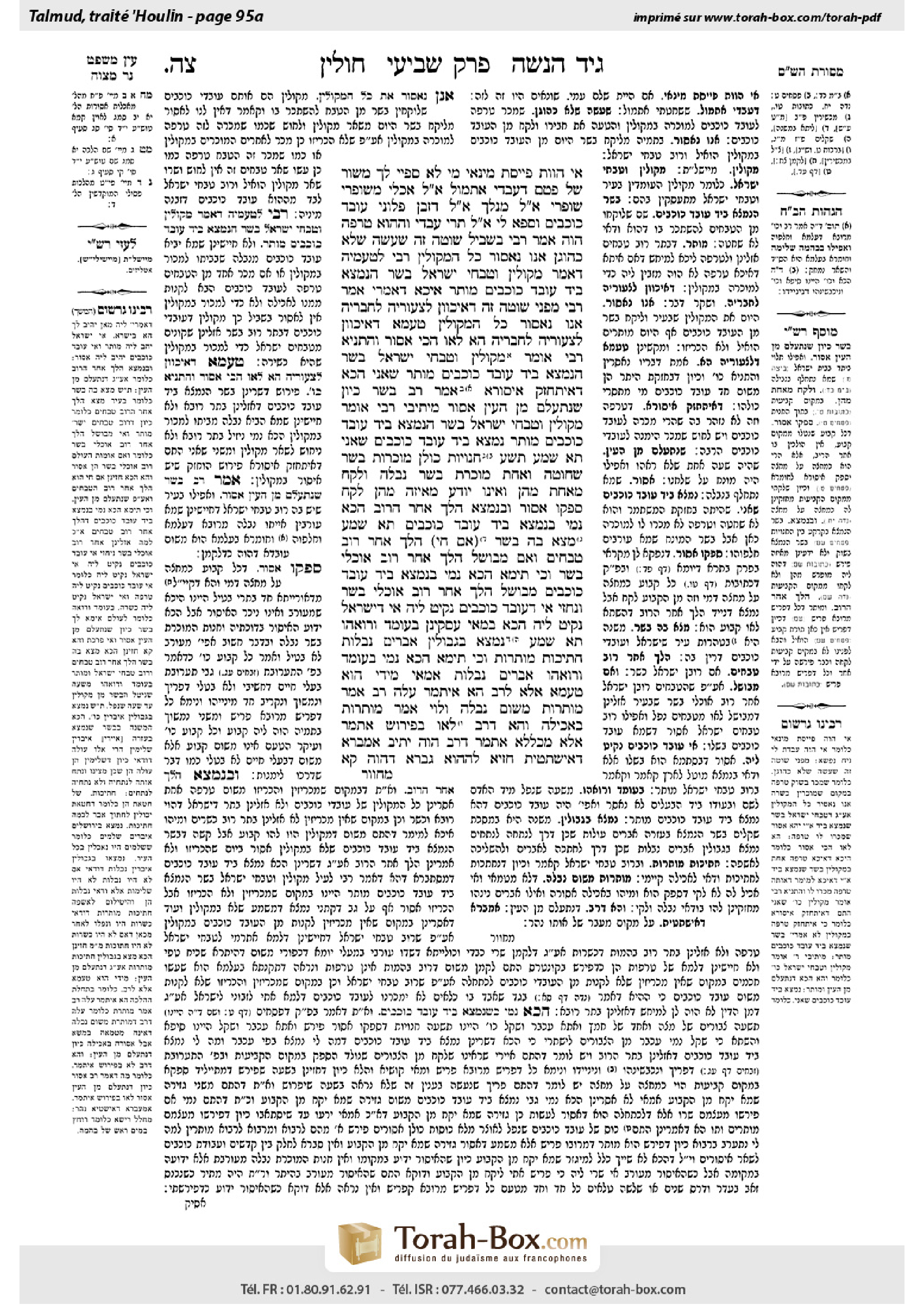
Chullin 95a: Talmud study for Daf Yomi
Study the Talmud for Daf Yomi with scanned pages, Hebrew text, English translations from Sefaria and AI-generated French translations.
Passage selection and English or AI-generated French translation are available where the scan has annotations. Daf Study is independent of Torah-Box and Sefaria.
Browse Chullin · חולין · All tractatesChullin 95a text and translations
This page of Chullin includes the Aramaic text, an English translation and an AI-generated French translation, alongside the scan above.
חולין צ״ה א · Aramaic and Hebrew text
אִי הֲוָה פָּיְיסַתְּ מִינַּאי, מִי לָא סְפַיִי לָךְ מִשּׁוֹר שֶׁל פַּטָּם דַּעֲבַדִי אֶתְמוֹל? אֲמַר לֵיהּ: אֲכַלִי מִשׁוּפְרֵי שׁוּפְרֵי. אֲמַר לֵיהּ: מְנָלָךְ? אֲמַר לֵיהּ: דִּזְבַן פְּלוֹנִי גּוֹי וּסְפָא לִי. אֲמַר לֵיהּ: תְּרֵי עֲבַדִי, וְהָהוּא טְרֵפָה הֲוָה.
אָמַר רַבִּי: בִּשְׁבִיל שׁוֹטֶה זֶה שֶׁעָשָׂה שֶׁלֹּא כַּהוֹגֶן, אָנוּ נֶאֱסוֹר כׇּל הַמָּקוֹלִין?!
רַבִּי לְטַעְמֵיהּ, דַּאֲמַר: מָקוֹלִין וְטַבָּחֵי יִשְׂרָאֵל, בָּשָׂר הַנִּמְצָא בְּיַד גּוֹי – מוּתָּר.
אִיכָּא דְאָמְרִי, אָמַר רַבִּי: מִפְּנֵי שׁוֹטֶה זֶה דְּאִיכַּוַּון לְצַעוֹרֵיהּ לְחַבְרֵיהּ, אָנוּ נֶאֱסוֹר כָּל הַמָּקוֹלִין?!
טַעְמָא דְּאִיכַּוַּון לְצַעוֹרֵיהּ לְחַבְרֵיהּ, הָא לָאו הָכִי, אָסוּר. וְהָתַנְיָא: רַבִּי אוֹמֵר: מָקוֹלִין וְטַבָּחֵי יִשְׂרָאֵל, בָּשָׂר הַנִּמְצָא בְּיַד גּוֹי מוּתָּר! שָׁאנֵי הָכָא, דְּאִיתַּחְזַק אִיסּוּרָא.
אָמַר רַב: בָּשָׂר, כֵּיוָן שֶׁנִּתְעַלֵּם מִן הָעַיִן – אָסוּר. מֵיתִיבִי: רַבִּי אוֹמֵר: מָקוֹלִין וְטַבָּחֵי יִשְׂרָאֵל, בָּשָׂר הַנִּמְצָא בְּיַד גּוֹי – מוּתָּר. נִמְצָא בְּיַד גּוֹי – שָׁאנֵי.
תָּא שָׁמַע: תֵּשַׁע חֲנוּיוֹת, כּוּלָּן מוֹכְרוֹת בְּשַׂר שְׁחוּטָה, וְאַחַת מוֹכֶרֶת בְּשַׂר נְבֵלָה, וְלָקַח מֵאַחַת מֵהֶן וְאֵינוֹ יוֹדֵעַ מֵאֵיזֶה מֵהֶן לָקַח – סְפֵקוֹ אָסוּר, וּבְנִמְצָא הַלֵּךְ אַחַר הָרוֹב. הָכָא נָמֵי – בְּנִמְצָא בְּיַד גּוֹי.
תָּא שְׁמַע: מָצָא בָּהּ בָּשָׂר (אִם חַי) – הַלֵּךְ אַחַר רוֹב טַבָּחִים, וְאִם מְבוּשָּׁל – הַלֵּךְ אַחַר רוֹב אוֹכְלֵי בָשָׂר.
וְכִי תֵּימָא: הָכָא נָמֵי בְּנִמְצָא בְּיַד גּוֹי, מְבוּשָּׁל הַלֵּךְ אַחַר רוֹב אוֹכְלֵי בָשָׂר? וְנֶחְזֵי: אִי דְּגוֹי נָקֵיט לֵיהּ, אִי דְּיִשְׂרָאֵל נָקֵיט לֵיהּ! הָכָא בְּמַאי עָסְקִינַן: בְּעוֹמֵד וְרוֹאֵהוּ.
תָּא שְׁמַע: נִמְצָא בַּגְּבוּלִין, אֵבָרִים – נְבֵלוֹת, חֲתִיכוֹת – מוּתָּרוֹת. וְכִי תֵּימָא: הָכָא נָמֵי בְּעוֹמֵד וְרוֹאֵהוּ, אֵבָרִים נְבֵלוֹת – אַמַּאי?
מִידֵּי הוּא טַעְמָא אֶלָּא לְרַב, הָא אִיתְּמַר עֲלַהּ: רַב אָמַר מוּתָּרוֹת מִשּׁוּם נְבֵלָה, וְלֵוִי אָמַר מוּתָּרוֹת בַּאֲכִילָה.
וְהָא דְּרַב, לָאו בְּפֵירוּשׁ אִתְּמַר, אֶלָּא מִכְּלָלָא אִתְּמַר. דְּרַב הֲוָה יָתֵיב אַמַּבָּרָא דְּאִישְׁתַּטְיָא, חַזְיֵיהּ לְהָהוּא גַּבְרָא דַּהֲוָה קָא
Chullin 95a · English translation
If you would have made peace with me yesterday, wouldn’t I have given you a cut from the fattened bull that I prepared yesterday? The other individual said to him: Nevertheless I ate from the finest of the fine of that bull that you prepared. The butcher said to him: From where did you get a piece? The other said to him: So-and-so the gentile bought it and fed it to me. The butcher said to him: I prepared two bulls yesterday. One was kosher, but that one you ate was a tereifa, which is why I sold it to a gentile.
Rabbi Yehuda HaNasi said when he heard of this incident: Because of this imbecile who acted improperly and sold non-kosher meat to the gentile butcher without publicizing that he did so, should we forbid all of the meat from gentile butcher shops in the city?
The Gemara notes that Rabbi Yehuda HaNasi conforms to his standard line of reasoning, as Rabbi Yehuda HaNasi said: If there are butcher shops in a city and Jewish butchers prepare the meat, any meat found in the possession of a gentile, i.e., in a gentile’s butcher shop, is permitted. There is no concern that the meat is from an animal that was a tereifa, because the Jewish butcher would not have sold it to a gentile to sell in his butcher shop.
The Gemara presents an alternate version of Rabbi Yehuda HaNasi’s reaction to the incident cited above: There are those who say that Rabbi Yehuda HaNasi said: Because of this imbecile, who intended only to cause distress to his fellow, should we forbid all of the meat from gentile butcher shops? That butcher was presumably lying about the meat having been from a tereifa.
The Gemara notes that the reason Rabbi Yehuda HaNasi considers the meat to be kosher is that the butcher intended only to cause distress to his fellow. This indicates that if that were not so, all the meat in the gentile butcher shops would be forbidden. But isn’t it taught in a baraita that Rabbi Yehuda HaNasi said: If there are butcher shops in a city and Jewish butchers prepare the meat, any meat found in the possession of a gentile is permitted? The Gemara answers: It is different here because it has been established that there is forbidden meat being sold in the butcher shops. Since it is known that a Jewish butcher sold non-kosher meat to a gentile proprietor of a butcher shop, one must be concerned that this was not an isolated incident.
§ Apropos meat in the possession of a gentile, the Gemara cites a related discussion. Rav says: Once meat is obscured from sight and unsupervised, it is forbidden, as one must be concerned that it was exchanged for non-kosher meat. The Gemara raises an objection based on a baraita: Rabbi Yehuda HaNasi said: If there are butcher shops in a city and Jewish butchers prepare the meat, any meat found in the possession of a gentile is permitted. The Gemara answers: Meat found in the possession of a gentile is different, because the meat was not left unsupervised.
The Gemara raises another objection to the statement of Rav. Come and hear the following baraita: With regard to nine stores in a city, all of which sell kosher meat from a slaughtered animal, and one other store that sells meat from unslaughtered animal carcasses, and an individual purchased meat from one of the stores and he does not know from which store he purchased the meat, in this case of uncertainty, the meat is forbidden. But in the case of meat found outside, follow the majority. Consequently, since most of the stores sell kosher meat, it may be assumed that the meat found outside is kosher, which contradicts Rav’s statement that meat that was left unsupervised is forbidden. The Gemara answers: Here also the baraita is referring to a case where the meat was not unsupervised but rather was found in the possession of a gentile.
The Gemara cites another challenge to the opinion of Rav: Come and hear the following mishna (Makhshirin 2:9): If one found meat in a city inhabited by both Jews and gentiles, if the meat is raw, follow the majority of butchers, so that if the majority of the butchers are Jewish, the meat is presumed to be kosher. And if the meat is cooked, follow the majority of meat eaters, because even if the majority of the butchers are Jewish, if the meat was cooked by a gentile it is forbidden. This mishna indicates that there are circumstances when the meat is permitted even though it was obscured from sight.
And if you would say that here also it is referring to a case where the meat is found in the possession of a gentile, why does the baraita state that if the meat is cooked, one should follow the majority of meat eaters? Let us see whether a gentile is holding it or a Jew is holding it. The Gemara answers: Here we are dealing with a case where the meat was on the ground but someone was standing and watching it from the time it was dropped on the ground, so that it was never left unsupervised. Yet, the person watching does not know whether it was dropped by a Jew or a gentile, and therefore a determination must be made based upon the majority of the people in the city.
The Gemara cites another challenge to the opinion of Rav from a mishna (Shekalim 19a). Come and hear: With regard to meat found in the outlying areas, outside of Jerusalem, if it is found as whole limbs, the meat presumably comes from carcasses of animals that were not properly slaughtered, as carcasses were generally cut up into full limbs and fed to dogs or sold to gentiles. But if it is in small pieces, it is presumably kosher and permitted to be eaten, as kosher meat was ordinarily cut up into small pieces. This mishna indicates that even though the meat was obscured from sight, it remains permitted. And if you would say that here also it is referring to a case where someone was standing and watching it, why is it assumed to be from a carcass if it is cut into whole limbs?
The Gemara answers: This mishna requires explanation only according to Rav, but wasn’t it stated with regard to that mishna: Rav says that the correct version of the mishna is that the small pieces of meat are permitted, in that they are not considered impure and that one who eats them is not liable to be flogged, as would be the case if it were meat from a carcass. But it is not actually permitted to eat the meat, due to the fact that it was obscured from sight. And Levi says: The mishna means to say that the small pieces of meat are even permitted to be eaten.
The Gemara comments: And this statement of Rav, that meat that was obscured from sight is forbidden, was not stated explicitly by Rav. Rather, it was stated that he held this opinion based on an inference from a different statement of Rav. As, Rav was once sitting on the ford of the Ishtetit River. He saw a certain man who was
Chullin 95a · Traduction française (IA)
Si tu avais fait la paix avec moi hier, ne m'aurais-tu pas donné une portion du taureau gras que j'avais préparé hier ? L'autre individu lui répondit : Cependant, j'ai mangé de la meilleure partie de ce taureau que tu avais préparé. Le boucher lui demanda : D'où as-tu obtenu une portion ? L'autre lui répondit : Un tel gentil l'a acheté et me l'a nourri. Le boucher lui dit : J'ai préparé deux taureaux hier. L'un était kasher, mais celui que tu as mangé était un tereifa, ce qui est la raison pour laquelle je l'ai vendu à un gentil.
Rabbi Yehuda HaNasi dit lorsqu'il apprit de cet incident : À cause de cet imbécile qui a agi de manière inappropriée et a vendu de la viande non kasher à un boucher gentil sans en faire la publicité, devrions-nous interdire toute la viande des boucheries gentiles de la ville ?
La Guemara note que Rabbi Yehuda HaNasi suit sa ligne de raisonnement habituelle, car Rabbi Yehuda HaNasi dit : Si des boucheries existent dans une ville et que les bouchers juifs préparent la viande, toute viande trouvée en possession d'un gentil, c'est-à-dire dans une boucherie gentil, est permise. Il n'y a pas de crainte que la viande provienne d'un animal tereifa, car le boucher juif ne l'aurait pas vendue à un gentil pour la vendre dans sa boucherie.
La Guemara présente une version alternative de la réaction de Rabbi Yehuda HaNasi à l'incident mentionné ci-dessus : Il y a ceux qui disent que Rabbi Yehuda HaNasi a dit : À cause de cet imbécile, qui avait l'intention de causer de la peine à son camarade, devrions-nous interdire toute la viande des boucheries gentiles ? Ce boucher était probablement en train de mentir sur le fait que la viande provenait d'un tereifa.
La Guemara note que la raison pour laquelle Rabbi Yehuda HaNasi considère la viande comme kasher est que le boucher avait l'intention de causer de la peine à son camarade. Cela indique que si ce n'était pas le cas, toute la viande des boucheries gentiles serait interdite. Mais n'est-il pas enseigné dans une baraïta que Rabbi Yehuda HaNasi a dit : Si des boucheries existent dans une ville et que les bouchers juifs préparent la viande, toute viande trouvée en possession d'un gentil est permise ? La Guemara répond : C'est différent ici, car il a été établi que de la viande non kasher est vendue dans les boucheries. Puisque l'on sait qu'un boucher juif a vendu de la viande non kasher à un gentil propriétaire d'une boucherie, on doit avoir des craintes que cela ne soit pas un cas isolé.
§ A propos de la viande en possession d'un gentil, la Guemara cite une discussion connexe. Rav dit : Une fois que la viande est cachée et non surveillée, elle est interdite, car on doit avoir des craintes qu'elle ait été échangée contre de la viande non kasher. La Guemara soulève un objet basé sur une baraïta : Rabbi Yehuda HaNasi a dit : Si des boucheries existent dans une ville et que les bouchers juifs préparent la viande, toute viande trouvée en possession d'un gentil est permise. La Guemara répond : La viande trouvée en possession d'un gentil est différente, car la viande n'a pas été laissée non surveillée.
La Guemara soulève une autre objection contre l'opinion de Rav. Viens écouter la suivante baraïta : Concernant neuf boutiques dans une ville, toutes vendant de la viande kasher d'un animal sacrifié, et une autre boutique vendant de la viande d'animaux non sacrifiés, et un individu achète de la viande d'une de ces boutiques sans savoir d'où il l'a achetée, dans ce cas d'incertitude, la viande est interdite. Mais dans le cas de viande trouvée à l'extérieur, on suit la majorité. Ainsi, puisque la majorité des boutiques vendent de la viande kasher, on peut supposer que la viande trouvée à l'extérieur est kasher, ce qui contredit l'opinion de Rav selon laquelle la viande laissée non surveillée est interdite. La Guemara répond : Ici aussi, la baraïta fait référence à un cas où la viande n'était pas laissée non surveillée mais plutôt en possession d'un gentil.
La Guemara cite un autre défi à l'opinion de Rav : Viens écouter la suivante mitsva (Makhshirin 2:9) : Si l'on trouve de la viande dans une ville habitée à la fois par des Juifs et des gentils, si la viande est crue, on suit la majorité des bouchers, de sorte que si la majorité des bouchers sont juifs, la viande est considérée comme kasher. Et si la viande est cuite, on suit la majorité des consommateurs, car même si la majorité des bouchers sont juifs, si la viande a été cuite par un gentil, elle est interdite. Cette mitsva indique que dans certains cas, la viande est permise même si elle est cachée.
Et si l'on disait que cela concerne aussi un cas où la viande est en possession d'un gentil, pourquoi la baraïta indique-t-elle que si la viande est cuite, on doit suivre la majorité des mangeurs de viande ? Examinons si un gentil la détient ou un Juif. La Guemara répond : Ici, il s'agit d'un cas où la viande était sur le sol, mais quelqu'un était debout et la surveillait depuis qu'elle avait été tombée, de sorte qu'elle n'avait jamais été laissée non surveillée. Cependant, la personne qui la surveillait ne savait pas si elle avait été laissée par un Juif ou un gentil, et une détermination doit être faite en fonction de la majorité des habitants de la ville.
La Guemara cite un autre défi à l'opinion de Rav à partir d'une mitsva (Shekalim 19a). Viens écouter : Concernant la viande trouvée en dehors des limites de Jérusalem, si elle est trouvée en morceaux entiers, la viande est considérée comme provenant de carcasses d'animaux non sacrifiés, car les carcasses étaient généralement coupées en morceaux entiers et données aux chiens ou vendues aux gentils. Mais si elle est en petits morceaux, elle est considérée comme kasher et permise à manger, car la viande kasher était normalement coupée en petits morceaux. Cette mitsva indique que même si la viande était cachée, elle reste permise. Et si tu dis que ici aussi, il s'agit d'un cas où quelqu'un était debout et la surveillait, pourquoi est-il supposé provenir d'une carcasse si elle est coupée en morceaux entiers ?
La Guemara répond : Cette Michna nécessite une explication uniquement selon Rava, mais n’était-il pas dit concernant cette Michna : Rava dit que la version correcte de la Michna est que les petits morceaux de viande sont permis, car ils ne sont pas considérés comme impurs et que celui qui les mange n’est pas puni de fouettage, ce qui serait le cas si c’était de la viande d’un cadavre. Cependant, il n’est pas réellement permis de manger la viande, en raison du fait qu’elle était obscure à la vue. Et Lévi dit : La Michna veut dire que les petits morceaux de viande sont même permis à manger.
La Guemara commente : Et cette déclaration de Rava, que la viande obscure à la vue est interdite, n’a pas été formulée explicitement par Rava. Plutôt, il a été dit qu’il tenait cette opinion en déduisant d’une autre déclaration de Rava. En effet, Rava était une fois assis sur la rive du fleuve Ishtetit. Il a vu un certain homme qui était
Traduction française générée par IA à partir de l’édition anglaise de Sefaria. Vérifie toujours un passage avec le texte source.
Text from Sefaria: William Davidson Edition - Vocalized Aramaic (unknown); William Davidson Edition - English (CC BY NC).