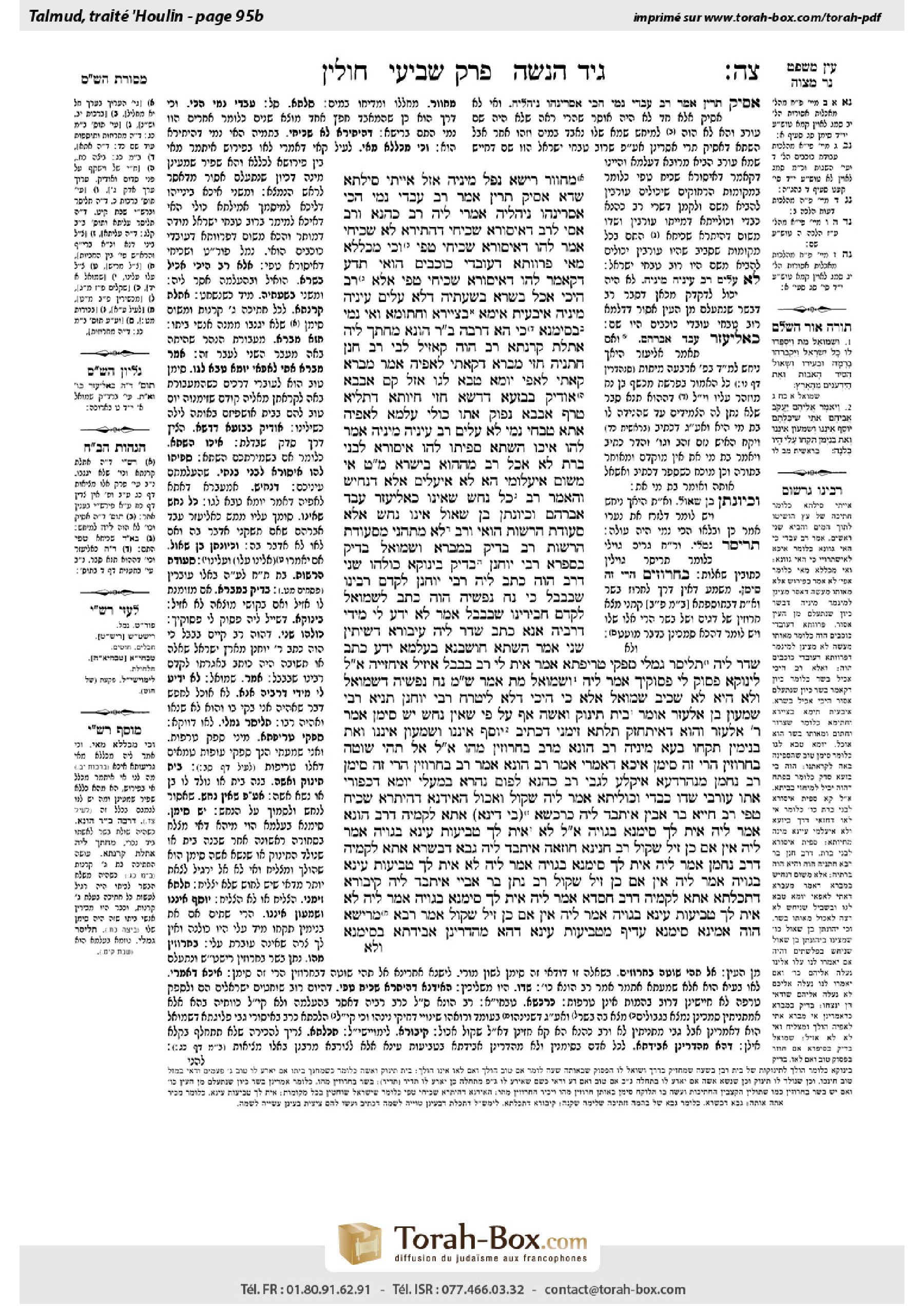
Chullin 95b: Talmud study for Daf Yomi
Study the Talmud for Daf Yomi with scanned pages, Hebrew text, English translations from Sefaria and AI-generated French translations.
Passage selection and English or AI-generated French translation are available where the scan has annotations. Daf Study is independent of Torah-Box and Sefaria.
Browse Chullin · חולין · All tractatesChullin 95b text and translations
This page of Chullin includes the Aramaic text, an English translation and an AI-generated French translation, alongside the scan above.
חולין צ״ה ב · Aramaic and Hebrew text
מְחַוַּור רֵישָׁא, נְפַל מִינֵּיהּ, אֲזַל אַיְיתִי סִילְתָּא שְׁדָא אַסֵּיק תְּרֵין, אָמַר רַב: עָבְדִי נָמֵי הָכִי, אַסְרִינְהוּ נִיהֲלֵיהּ.
אָמְרִי לֵיהּ רַב כָּהֲנָא וְרַב אַסִּי לְרַב: דְּאִיסּוּרָא שְׁכִיחִי, דְּהֶתֵּירָא לָא שְׁכִיחִי? אֲמַר לְהוּ: דְּאִיסּוּרָא שְׁכִיחִי טְפֵי.
וְכִי מִכְּלָלָא, מַאי? פַּרְוְותָא דְּגוֹיִם הֲוַאי, תֵּדַע, דְּקָאָמַר לְהוּ: ״דְּאִיסּוּרָא שְׁכִיחִי טְפֵי״.
אֶלָּא רַב, הֵיכִי אֲכַל בִּשְׂרָא בְּשַׁעְתֵּיהּ, דְּלָא (עלים) [מַעֲלֵים] עֵינֵיהּ מִינֵּיהּ? אִיבָּעֵית אֵימָא: בְּצַיְירָא וַחֲתִימָא, וְאִי נָמֵי: בְּסִימָנָא, כִּי הָא דְּרַבָּה בַּר רַב הוּנָא מְחַתֵּךְ לֵיהּ אַתְּלָת קַרְנָתָא.
רַב הֲוָה קָאָזֵיל לְבֵי רַב חָנָן חַתְנֵיהּ, חֲזָא מַבָּרָא דְּקָאָתֵי לְאַפֵּיהּ, אֲמַר: מַבָּרָא קָאָתֵי לְאַפַּי, יוֹמָא טָבָא לְגוֹ.
אֲזַל, קָם אַבָּבָא, אוֹדֵיק בְּבִזְעָא דְּדַשָּׁא, חֲזָא חֵיוְתָא דְּתַלְיָא, טְרַף אַבָּבָא, נְפוּק אֲתוֹ כּוּלֵּי עָלְמָא לְאַפֵּיהּ, אֲתָא טַבָּחֵי נָמֵי, לָא עַלֵּים רַב עֵינֵיהּ מִינֵּיהּ, אֲמַר לְהוּ: אִיכּוֹ הַשְׁתָּא סְפִיתוּ לְהוּ אִיסּוּרָא לִבְנֵי בְרַת. לָא אֲכַל רַב מֵהָהוּא בִּישְׂרָא.
מַאי טַעְמָא? אִי מִשּׁוּם אִיעַלּוֹמֵי – הָא לָא אִיעַלַּים, אֶלָּא דְּנַחֵישׁ.
וְהָאָמַר רַב: כׇּל נַחַשׁ שֶׁאֵינוֹ כֶּאֱלִיעֶזֶר עֶבֶד אַבְרָהָם וּכְיוֹנָתָן בֶּן שָׁאוּל – אֵינוֹ נַחַשׁ! אֶלָּא סְעוּדַת הָרְשׁוּת הֲוַאי, וְרַב לָא מִתְהֲנֵי מִסְּעוּדַת הָרְשׁוּת.
רַב בָּדֵיק בְּמַבָּרָא, וּשְׁמוּאֵל בָּדֵיק בְּסִפְרָא, רַבִּי יוֹחָנָן בָּדֵיק בְּיָנוֹקָא.
כּוּלְּהוּ שְׁנֵי דְּרַב, הֲוָה כָּתַב לֵיהּ רַבִּי יוֹחָנָן ״לָקֳדָם רַבֵּינוּ שֶׁבְּבָבֶל״. כִּי נָח נַפְשֵׁיהּ, הֲוָה כָּתַב לִשְׁמוּאֵל ״לָקֳדָם חֲבֵירֵינוּ שֶׁבְּבָבֶל״. אָמַר: לָא יָדַע לִי מִידֵּי דְּרַבֵּיהּ אֲנָא? כְּתַב שַׁדַּר לֵיהּ עִיבּוּרָא דְּשִׁיתִּין שְׁנֵי. אֲמַר: הַשְׁתָּא חוּשְׁבָּנָא בְּעָלְמָא יָדַע.
כְּתַב שַׁדַּר לֵיהּ תְּלֵיסַר גַּמְלֵי סְפֵקֵי טְרֵיפְתָּא, אֲמַר: אִית לִי רַב בְּבָבֶל, אֵיזִיל אִיחְזְיֵיהּ. אֲמַר לֵיהּ לְיָנוֹקָא: פְּסוֹק לִי פְּסוּקָיךְ, אֲמַר לֵיהּ: ״וּשְׁמוּאֵל מֵת״, אֲמַר: שְׁמַע מִינַּהּ נָח נַפְשֵׁיהּ דִּשְׁמוּאֵל.
וְלָא הִיא, לָא שְׁכֵיב שְׁמוּאֵל, אֶלָּא כִּי הֵיכִי דְּלָא לִיטְרַח רַבִּי יוֹחָנָן.
תַּנְיָא: רַבִּי שִׁמְעוֹן בֶּן אֶלְעָזָר אוֹמֵר: בַּיִת, תִּינוֹק, וְאִשָּׁה – אַף עַל פִּי שֶׁאֵין נַחַשׁ, יֵשׁ סִימָן.
אָמַר רַבִּי אֶלְעָזָר: וְהוּא דְּאִיתַּחְזַק תְּלָתָא זִימְנֵי, דִּכְתִיב: ״יוֹסֵף אֵינֶנּוּ וְשִׁמְעוֹן אֵינֶנּוּ וְאֶת בִּנְיָמִן תִּקָּחוּ״.
בְּעָא מִינֵּיהּ רַב הוּנָא מֵרַב: בַּחֲרוּזִין מַהוּ? אֲמַר לֵיהּ: אַל תְּהִי שׁוֹטֶה, בַּחֲרוּזִין הֲרֵי זֶה סִימָן. אִיכָּא דְּאָמְרִי: אָמַר רַב הוּנָא אָמַר רַב: בַּחֲרוּזִין הֲרֵי זֶה סִימָן.
רַב נַחְמָן מִנְּהַרְדְּעָא אִיקְּלַע לְגַבֵּי רַב כָּהֲנָא לְפוּם נַהֲרָא בְּמַעֲלֵי יוֹמָא דְכִפּוּרֵי, אֲתוֹ עוֹרְבֵי שָׁדוּ כַּבְדֵי וְכוּלְיָתָא, אֲמַר לֵיהּ: שְׁקוֹל וֶאֱכוֹל, הָאִידָּנָא דְּהֶיתֵּרָא שְׁכִיחַ טְפֵי.
רַב חִיָּיא בַּר אָבִין אִיתְּבַד לֵיהּ כַּרְכְּשָׁא בֵּי דִינָא, אֲתָא לְקַמֵּיהּ דְּרַב הוּנָא. אֲמַר לֵיהּ: אִית לָךְ סִימָנָא בְּגַוֵּיהּ? אֲמַר לֵיהּ: לָא. אִית לָךְ טְבִיעוּת עֵינָא בְּגַוֵּיהּ? אֲמַר לֵיהּ: אִין. אִם כֵּן, זִיל שְׁקוֹל.
רַב חֲנִינָא חוֹזָאָה אִיתְּבַד לֵיהּ גַּבָּא דְּבִשְׂרָא, אֲתָא לְקַמֵּיהּ דְּרַב נַחְמָן. אֲמַר לֵיהּ: אִית לָךְ סִימָנָא בְּגַוֵּיהּ? אֲמַר לֵיהּ: לָא. אִית לָךְ טְבִיעוּת עֵינָא בְּגַוֵּיהּ? אֲמַר לֵיהּ: אִין. אִם כֵּן, זִיל שְׁקוֹל.
רַב נָתָן בַּר אַבָּיֵי אִיתְּבַד לֵיהּ קִיבּוּרָא דִּתְכֵלְתָּא, אֲתָא לְקַמֵּיהּ דְּרַב חִסְדָּא. אֲמַר לֵיהּ: אִית לָךְ סִימָנָא בְּגַוֵּיהּ? אֲמַר לֵיהּ: לָא. אִית לָךְ טְבִיעוּת עֵינָא בְּגַוֵּיהּ? אֲמַר לֵיהּ: אִין. אִם כֵּן, זִיל שְׁקוֹל.
אָמַר רָבָא: מֵרֵישָׁא הֲוָה אָמֵינָא סִימָנָא עֲדִיף מִטְּבִיעוּת עֵינָא, דְּהָא מַהְדְּרִינַן אֲבֵידְתָא בְּסִימָנָא,
Chullin 95b · English translation
cleaning the head of an animal in the river. The head fell from him. He went and brought a basket, cast the basket into the river, and pulled out two animal heads. Rav said to him: Does it commonly happen this way that one loses one item and finds two? Just as one of the animal heads is not the one you dropped, it is possible that neither of them is the one you dropped. Therefore, Rav rendered both of them forbidden to him.
Rav Kahana and Rav Asi said to Rav: Is forbidden meat common but permitted meat not common? Most of the meat in this general location is kosher, so why did you forbid the two animal heads? He said to them: Forbidden meat is more common. From this incident the Sages derived that according to Rav, meat that has been obscured from sight becomes forbidden due to the possibility that the meat one finds now was actually deposited by ravens, who transported it from a location where the majority of the meat is forbidden.
The Gemara asks: And what does it matter if this opinion of Rav is known by inference based on this incident, rather than by an explicit statement made by Rav? The Gemara answers: There is room to say that this incident cannot serve as a precedent for a general policy, because that location was a port of gentiles, where most of the meat was non-kosher. Know that this is the case, as Rav said to Rav Kahana and Rav Asi: Forbidden meat is more common. Consequently, it is possible that Rav would not have prohibited the meat in a location where the majority of the meat is kosher.
The Gemara asks: But how did Rav ever eat meat if he holds that meat becomes forbidden if it is unsupervised for even a short time? The Gemara answers: Rav ate meat only in its time, i.e., shortly after it was slaughtered, when it had not been obscured from his sight from the time of the slaughter until he ate it. Alternatively, if you wish, say that Rav ate meat that was tied and sealed in a way that proved it had not been swapped for non-kosher meat. Or alternatively, he ate meat that could be recognized by a distinguishing mark, like that practice of Rabba bar Rav Huna, who would cut meat into pieces with three corners, i.e., triangles, before he would send it to his family members.
The Gemara relates that Rav was going to the home of Rav Ḥanan, his son-in-law. He saw that the ferry was coming toward him just when he arrived at the riverbank. He said: The ferry is coming toward me even though I did not arrange for it to come now; this is a sign that a good day, i.e., a festive meal, awaits me in the place where I am going.
After crossing the river on the ferry, Rav went and stood at the gate of Rav Ḥanan’s home. He looked through a crack in the door and saw an animal that was hanging and ready to be cooked. He knocked on the gate, and everyone went out to greet him, and the butchers also came out to greet him. Rav did not remove his eyes from the meat that the butchers were preparing. He said to them: If you had eaten the meat based upon the supervision you provided now, you would have fed forbidden meat to the sons of my daughter because no one apart from me was watching the meat when you all came out to greet me. And despite the fact that he had kept the meat in his sight Rav did not eat from that meat.
The Gemara asks: What is the reason that Rav did not eat the meat? If one suggests that he was concerned because it had been obscured from sight, that cannot be the reason, as Rav kept watching it so that it was not obscured from sight. Rather, Rav did not eat because he divined, i.e., he saw the arrival of the ferry as a good omen. This is prohibited, and therefore Rav penalized himself and abstained from the meat.
The Gemara asks: But doesn’t Rav say that any divination that is not like the divination of Eliezer, the servant of Abraham, when he went to seek a bride for Isaac (see Genesis 24:14), or like the divination of Jonathan, son of Saul, who sought an omen as to whether he and his arms bearer would defeat the Philistines (see I Samuel 14:8–12), is not divination? Since Rav did not rely on the omen in his decision making, he did not violate the prohibition against divination, and there was no reason for him to penalize himself. The Gemara answers: Rather, the reason Rav did not eat the meat is that it was an optional feast, rather than a feast associated with a mitzva, and Rav would not derive pleasure from an optional feast.
Having mentioned Rav’s reaction to the ferry in the incident cited above, the Gemara states that Rav would check whether to travel based upon the ferry; if it came quickly he would take the ferry, but otherwise he would not. And Shmuel would check what would happen to him by opening a scroll and reading from wherever it was open to. Rabbi Yoḥanan would check what was in store for him by asking a child to recite the verse he was learning.
The Gemara relates an incident when Rabbi Yoḥanan checked his luck based on a child’s verse. During all the years when Rav lived in Babylonia, Rabbi Yoḥanan, who lived in Eretz Yisrael, would write to him and begin with the greeting: To our Master who is in Babylonia. When Rav died, Rabbi Yoḥanan would write to Shmuel and begin with the greeting: To our colleague who is in Babylonia. Shmuel said: Does Rabbi Yoḥanan not know any matter in which I am his master? Shmuel wrote and sent to Rabbi Yoḥanan the calculation of the leap years for the next sixty years. Rabbi Yoḥanan was not impressed by this and said: Now he has merely demonstrated that he knows mathematics, which does not make him my master.
Shmuel then wrote and sent to Rabbi Yoḥanan explications of uncertainties pertaining to tereifot that had to be transported on thirteen camels. Rabbi Yoḥanan was impressed by this and said: I have a Master in Babylonia; I will go and see him. Before departing on his journey, Rabbi Yoḥanan said to a child: Recite to me your verse that you studied today. The child recited the following verse to Rabbi Yoḥanan: “Now Samuel was dead” (I Samuel 28:3). Rabbi Yoḥanan said to himself: Learn from this that Shmuel has died. Therefore, Rabbi Yoḥanan did not go to see Shmuel.
The Gemara comments: But it was not so; Shmuel had not died. Rather, the reason Rabbi Yoḥanan was given this sign was so that Rabbi Yoḥanan would not trouble himself to embark on the long and arduous journey from Eretz Yisrael to Babylonia.
It is taught in a baraita: Rabbi Shimon ben Elazar says: With regard to one who is successful with his first business transaction after he has built a home, after the birth of a child, or after he marries a woman, even though he may not use this as a means of divination to decide upon future courses of action, it is an auspicious sign that he will continue to be successful. Conversely, if his first transaction is not successful he may take that as an inauspicious sign.
Rabbi Elazar said: But this is provided that the sign has been established by repeating itself three times. This is based on a verse, as it is written: “And Jacob their father said to them: Me you have bereaved of my children: Joseph is not, and Simeon is not, and you will take Benjamin away; upon me are all these things come” (Genesis 42:36). If calamity were to befall Benjamin, that would establish a pattern of three tragedies.
§ The Gemara returns to discuss distinguishing marks that prevent meat from being prohibited despite its having been obscured from sight. Rav Huna inquired of Rav: If pieces of meat were strung together and then were obscured from sight, what is the halakha? Rav said to him: Do not be an imbecile; of course if the meat is strung together it is considered to be a distinguishing mark, and the meat is permitted. There are those who say this halakha as follows: Rav Huna said that Rav said: If pieces of meat are strung together it is a distinguishing mark, and the meat remains permitted even if it is obscured from sight.
The Gemara relates that Rav Naḥman of Neharde’a arrived at the home of Rav Kahana in Pum Nahara on the eve of Yom Kippur, which is a day when people commonly eat meat. Ravens came and dropped livers and kidneys. Rav Kahana said to Rav Naḥman: Take these livers and kidneys and eat them, as they are not forbidden, even though they were obscured from sight. This is because at this time permitted meat is more common than forbidden meat, since Jews slaughter many animals on this day.
Rav Ḥiyya bar Avin lost a cut of meat from an animal intestine among the barrels of wine in his wine cellar. When he found it, he came before Rav Huna to ask whether the meat was now prohibited because it had been obscured from sight. Rav Huna said to him: Do you have a distinguishing mark on it so that you can identify it? Rav Ḥiyya bar Avin said to him: No. Rav Huna asked him: Do you have visual recognition of it? Rav Ḥiyya bar Avin said to him: Yes. Rav Huna said: If so, go and take it and eat it.
Rav Ḥanina Ḥoza’a lost a side of meat. When he found it, he came before Rav Naḥman and asked him whether the meat was now prohibited because it had been obscured from sight. Rav Naḥman said to him: Do you have a distinguishing mark on it so that you can identify it? Rav Ḥanina Ḥoza’a said to him: No. Rav Naḥman asked him: Do you have visual recognition of it? Rav Ḥanina Ḥoza’a said to him: Yes. Rav Naḥman said: If so, go and take it and eat it.
Rav Natan bar Abaye lost a skein of sky-blue wool prepared for use in ritual fringes. He searched for it and found it. He came before Rav Ḥisda to ask whether the wool was now prohibited because it had been obscured from sight and may have become confused with other blue wool that is not valid for ritual fringes. Rav Ḥisda said to him: Do you have a distinguishing mark in it so that you can identify it? Rav Natan bar Abaye said to him: No. Rav Ḥisda asked him: Do you have visual recognition of it? Rav Natan bar Abaye said to him: Yes. Rav Ḥisda said: If so, go and take it, and you may use it for ritual fringes.
Rava said: At first I would say that a distinguishing mark is preferable to visual recognition, because we return a lost item to its owner based on a distinguishing mark,
Chullin 95b · Traduction française (IA)
Nettoyage de la tête d'un animal dans le fleuve. La tête tomba de lui. Il alla chercher un panier, jeta le panier dans le fleuve et en sortit deux têtes d'animaux. Rav dit à lui : Est-ce qu'il arrive souvent ainsi que l'on perde un objet et qu'on trouve deux ? Comme l'une des têtes d'animaux n'est pas celle que tu as perdue, il est possible que ni l'une ni l'autre ne soit celle que tu as perdue. Ainsi, Rav déclara qu'elles étaient interdites à lui.
Rav Kahana et Rav Asi dirent à Rav : La viande interdite est courante, mais la viande permise n'est pas courante ? La plupart de la viande dans cette région générale est kasher, donc pourquoi as-tu interdit les deux têtes d'animaux ? Il répondit à eux : La viande interdite est plus courante. À partir de cet incident, les Sages déduisirent que selon Rav, la viande qui est devenue invisible devient interdite en raison de la possibilité que la viande que l'on trouve maintenant ait été déposée par des corbeaux, qui l'ont transportée d'un lieu où la majorité de la viande est interdite.
La Guemara demande : Et que cela change-t-il si cette opinion de Rav est connue par déduction à partir de cet incident plutôt qu'en vertu d'une déclaration explicite de Rav ? La Guemara répond : Il y a de la place pour dire que cet incident ne peut pas servir de précédent pour une politique générale, car ce lieu était un port de non-Juifs, où la majorité de la viande était non-kasher. Sachez que c'est le cas, car Rav dit à Rav Kahana et Rav Asi : La viande interdite est plus courante. Ainsi, il est possible que Rav n'aurait pas interdit la viande dans un lieu où la majorité de la viande est kasher.
La Guemara demande : Mais comment Rav a-t-il jamais mangé de viande s'il considère que la viande devient interdite si elle est laissée sans surveillance même pendant un court moment ? La Guemara répond : Rav mangeait de la viande seulement à l'époque, c'est-à-dire peu après qu'elle avait été sacrifiée, lorsqu'elle n'avait pas été cachée de ses yeux depuis la mise à mort jusqu'à ce qu'il la mange. Alternativement, si vous préférez, dites que Rav mangeait de la viande qui était liée et scellée de manière à prouver qu'elle n'avait pas été échangée contre de la viande non-kasher. Ou alternativement, il mangeait de la viande qui pouvait être reconnue grâce à un signe distinctif, comme la pratique de Rabba bar Rav Huna, qui coupait la viande en morceaux avec trois angles, c'est-à-dire des triangles, avant de l'envoyer à ses proches.
La Guemara rapporte que Rav allait chez Rav Ḥanan, son gendre. Il vit que le ferry arrivait vers lui exactement au moment où il arrivait à la rive. Il dit : Le ferry arrive vers moi même si je n'ai pas organisé cela maintenant ; c'est un signe qu'un bon jour, c'est-à-dire un repas festif, m'attend dans l'endroit où je vais.
Après avoir traversé le fleuve en ferry, Rav alla se tenir à la porte de la maison de Rav Ḥanan. Il regarda par une fente de la porte et vit un animal qui était suspendu et prêt à être cuisiné. Il frappa à la porte, et tout le monde sortit pour le saluer, et les bouchers aussi sortirent pour le saluer. Rav ne détourna pas les yeux de la viande que les bouchers préparaient. Il dit à eux : Si vous aviez mangé la viande en fonction de la surveillance que vous avez fournie maintenant, vous auriez nourri la viande interdite aux enfants de ma fille, car personne d'autre que moi n'était surveillant la viande lorsque vous êtes tous sortis pour me saluer. Et malgré le fait qu'il avait gardé la viande sous ses yeux, Rav n'a pas mangé de cette viande.
La Guemara demande : Quelle est la raison pour laquelle Rav n'a pas mangé la viande ? Si l'on suggère qu'il était préoccupé parce qu'elle avait été cachée de la vue, cela ne peut pas être la raison, car Rav surveillait la viande de sorte qu'elle ne fût pas cachée. Plutôt, Rav n'a pas mangé parce qu'il a deviné, c'est-à-dire qu'il a vu l'arrivée du ferry comme un bon présage. Cela est interdit, et donc Rav s'est puni lui-même et a renoncé à la viande.
La Guemara demande : Mais ne dit-on pas que Rav affirme que toute divination qui n'est pas comme la divination d'Eliezer, le serviteur d'Abraham, lorsqu'il est allé chercher une épouse pour Isaac (voir Genèse 24:14), ou comme la divination de Jonathan, fils de Saül, qui a cherché un présage pour savoir si lui et son porteur d'armes allaient vaincre les Philistins (voir I Samuel 14:8-12), n'est pas une divination ? Puisque Rav n'a pas reposé sur le présage dans sa prise de décision, il n'a pas violé l'interdiction de divination, et il n'y avait pas de raison pour qu'il s'autopunisse. La Guemara répond : Plutôt, la raison pour laquelle Rav n'a pas mangé la viande est qu'il s'agissait d'un festin optionnel, plutôt que d'un festin lié à une mitsva, et Rav ne tirait pas de plaisir d'un festin optionnel.
Ayant mentionné la réaction de Rav au ferry dans l'incident cité ci-dessus, la Guemara indique que Rav vérifiait s'il devait voyager en fonction du ferry ; s'il arrivait rapidement, il prenait le ferry, sinon, il ne le prenait pas. Et Shmuel vérifiait ce qui lui arrivait en ouvrant un rouleau et en lisant à partir de n'importe où il était ouvert. Rabbi Yoḥanan vérifiait ce qui l'attendait en demandant à un enfant de réciter la prière qu'il apprenait.
La Guemara rapporte un incident où Rabbi Yoḥanan vérifiait sa chance en fonction d'une verset d'un enfant. Pendant tous les ans où Rav vivait en Babylone, Rabbi Yoḥanan, qui vivait en Eretz Yisrael, écrivait à lui et commençait par la formule de salutation : À notre maître qui est en Babylone. Lorsque Rav mourut, Rabbi Yoḥanan écrivit à Shmuel et commença par la formule de salutation : À notre collègue qui est en Babylone. Shmuel dit : Rabbi Yoḥanan ne connaît-il pas de matière où je suis son maître ? Shmuel écrivit et envoya à Rabbi Yoḥanan le calcul des années bissextiles pour les prochaines soixante années. Rabbi Yoḥanan ne fut pas impressionné par cela et dit : Maintenant, il a simplement démontré qu'il connaît les mathématiques, ce qui ne le rend pas mon maître.
Shmuel écrivit alors et envoya à Rabbi Yoḥanan les explications des incertitudes concernant les tereifot qui devaient être transportés sur treize chameaux. Rabbi Yoḥanan fut impressionné par cela et dit : J'ai un maître en Babylone ; je vais y aller. Avant de partir pour son voyage, Rabbi Yoḥanan dit à un enfant : Récite-moi le verset que tu as appris aujourd'hui. L'enfant récita le suivant à Rabbi Yoḥanan : « Maintenant Samuel était mort » (I Samuel 28:3). Rabbi Yoḥanan dit à lui-même : Apprends-en que Samuel est mort. Ainsi, Rabbi Yoḥanan ne partit pas voir Shmuel.
La Guemara commente : Mais ce n’était pas ainsi ; Shmuel n’avait pas encore mouru. En réalité, la raison pour laquelle Rabbi Yoḥanan avait reçu ce signe était afin que Rabbi Yoḥanan ne se donne pas la peine de entreprendre le long et pénible voyage de la Terre d’Israël vers Babylone.
Il est enseigné dans une baraïta : Rabbi Shim’on ben Elazar dit : Concernant celui qui réussit à sa première transaction commerciale après avoir construit une maison, après la naissance d’un enfant, ou après avoir épousé une femme, même s’il ne l’utilise pas comme moyen de divination pour décider de ses actions futures, cela constitue un signe favorable qu’il continuera à être prospère. À l’inverse, si sa première transaction n’est pas réussie, il peut considérer cela comme un mauvais présage.
Rabbi Elazar dit : Mais cela est conditionnel à ce que le signe ait été établi par répétition trois fois. Cela s’appuie sur un verset, car il est écrit : « Et Jacob leur père leur dit : Vous m’avez dépouillé de mes enfants : Joseph n’est pas là, et Siméon n’est pas là, et vous emporterez Benjamin ; sur moi viennent toutes ces choses » (Genèse 42:36). Si une calamité frappait Benjamin, cela établirait un motif de trois tragédies.
§ La Guemara reprend la discussion sur les marques distinctives qui empêchent la viande d’être interdite, même si elle a été occultée des yeux. Rav Huna demanda à Rav : Si des morceaux de viande étaient reliés ensemble et ensuite occultés des yeux, quelle est la halakha ? Rav répondit à lui : Ne sois pas un imbécile ; bien sûr, si la viande est reliée ensemble, cela constitue une marque distinctive, et la viande est permise. Certains disent que cette halakha est ainsi formulée : Rav Huna dit que Rav dit : Si des morceaux de viande sont reliés ensemble, cela constitue une marque distinctive, et la viande reste permise même si elle est occultée des yeux.
La Guemara rapporte que Rav Naḥman de Neharde’a est arrivé à la maison de Rav Kahana à Pum Nahara à la veille du Yom Kippour, jour où les gens mangent habituellement de la viande. Des corbeaux sont venus et ont jeté des foies et des reins. Rav Kahana dit à Rav Naḥman : Prends ces foies et reins et mange-les, car ils ne sont pas interdits, même s’ils ont été occultés des yeux. Cela est dû au fait que, à cette époque, la viande permise est plus courante que la viande interdite, car les Juifs sacrifient beaucoup d’animaux ce jour-là.
Rav Ḥiyya bar Avin a perdu un morceau de viande d’un intestin d’animaux parmi les barriques de vin de son cellier. Lorsqu’il l’a trouvé, il est venu devant Rav Huna pour demander si la viande était désormais interdite car elle avait été occultée des yeux. Rav Huna lui a dit : As-tu une marque distinctive dessus pour que tu puisses l’identifier ? Rav Ḥiyya bar Avin a répondu à lui : Non. Rav Huna a demandé : As-tu une reconnaissance visuelle de celle-ci ? Rav Ḥiyya bar Avin a répondu : Oui. Rav Huna a dit : Si c’est ainsi, va et prends-la et mange-la.
Rav Ḥanina Ḥoza’a a perdu un côté de viande. Lorsqu’il l’a trouvé, il est venu devant Rav Naḥman et lui a demandé si la viande était désormais interdite car elle avait été occultée des yeux. Rav Naḥman lui a dit : As-tu une marque distinctive dessus pour que tu puisses l’identifier ? Rav Ḥanina Ḥoza’a a répondu : Non. Rav Naḥman a demandé : As-tu une reconnaissance visuelle de celle-ci ? Rav Ḥanina Ḥoza’a a répondu : Oui. Rav Naḥman a dit : Si c’est ainsi, va et prends-la et mange-la.
Rav Natan bar Abaye a perdu un morceau de laine bleue préparé pour les franges rituelles. Il l’a cherché et l’a trouvé. Il est venu devant Rav Ḥisda pour demander si la laine était désormais interdite car elle avait été occultée des yeux et pouvait être confondue avec d’autres laines bleues non valides pour les franges rituelles. Rav Ḥisda lui a dit : As-tu une marque distinctive dessus pour que tu puisses l’identifier ? Rav Natan bar Abaye a répondu : Non. Rav Ḥisda a demandé : As-tu une reconnaissance visuelle de celle-ci ? Rav Natan bar Abaye a répondu : Oui. Rav Ḥisda a dit : Si c’est ainsi, va et prends-la, et tu peux l’utiliser pour les franges rituelles.
Rava a dit : D’abord, je disais que la marque distinctive est préférable à la reconnaissance visuelle, car nous rendons un objet perdu à son propriétaire grâce à une marque distinctive,
Traduction française générée par IA à partir de l’édition anglaise de Sefaria. Vérifie toujours un passage avec le texte source.
Text from Sefaria: William Davidson Edition - Vocalized Aramaic (unknown); William Davidson Edition - English (CC BY NC).