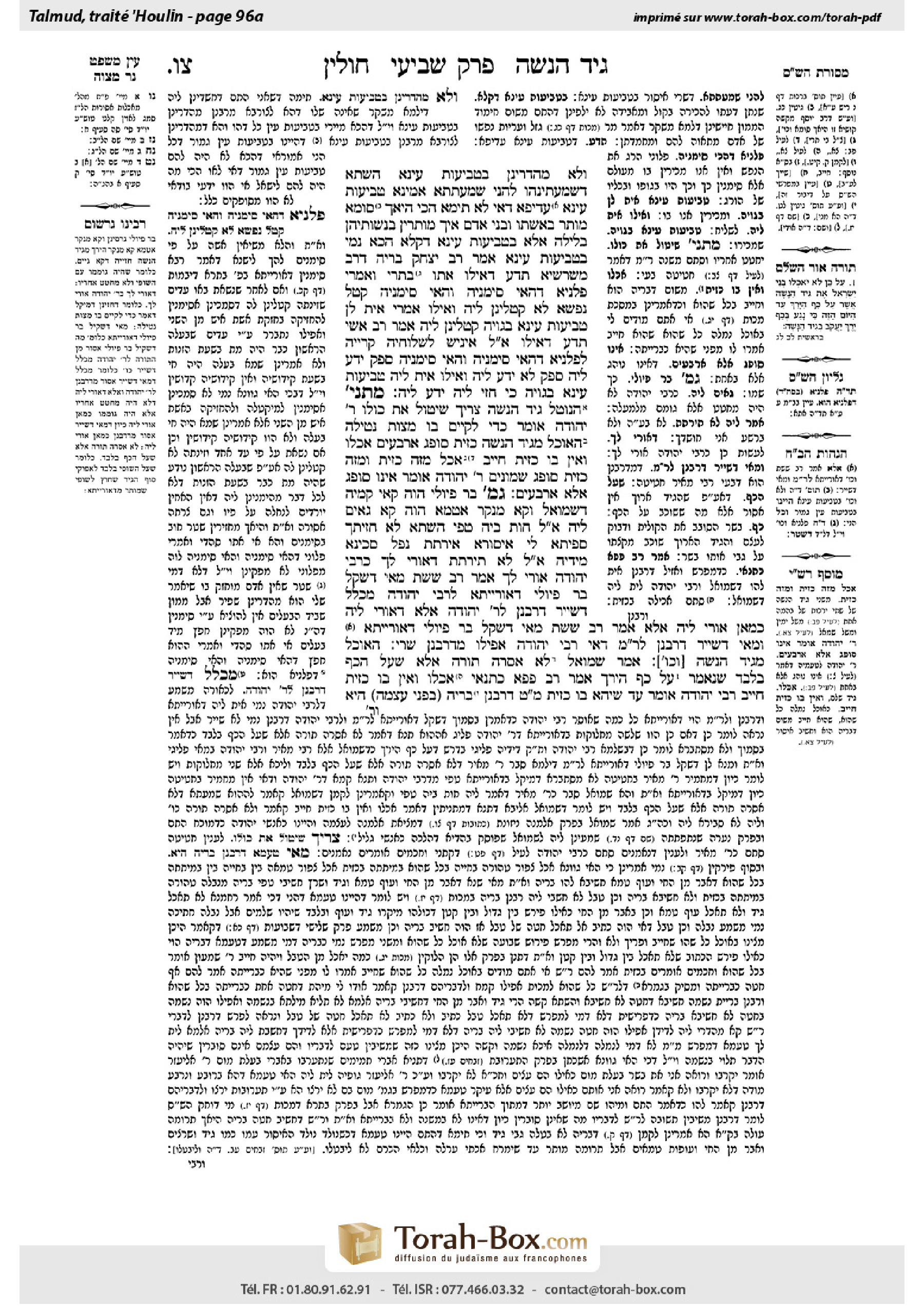
Chullin 96a: Talmud study for Daf Yomi
Study the Talmud for Daf Yomi with scanned pages, Hebrew text, English translations from Sefaria and AI-generated French translations.
Passage selection and English or AI-generated French translation are available where the scan has annotations. Daf Study is independent of Torah-Box and Sefaria.
Browse Chullin · חולין · All tractatesChullin 96a text and translations
This page of Chullin includes the Aramaic text, an English translation and an AI-generated French translation, alongside the scan above.
חולין צ״ו א · Aramaic and Hebrew text
וְלָא מַהְדְּרִינַן בִּטְבִיעוּת עֵינָא. הַשְׁתָּא דִּשְׁמַעְתִּינְהוּ לְהָנֵי שְׁמַעְתָּתָא, אָמֵינָא: טְבִיעוּת עֵינָא עֲדִיפָא.
דְּאִי לָא תֵּימָא הָכִי, הֵיאַךְ סוֹמֵא מוּתָּר בְּאִשְׁתּוֹ, וּבְנֵי אָדָם אֵיךְ מוּתָּרִין בִּנְשׁוֹתֵיהֶן בַּלַּיְלָה? אֶלָּא בִּטְבִיעוּת עֵינָא דְּקָלָא, הָכָא נָמֵי בִּטְבִיעוּת עֵינָא.
אָמַר רַב יִצְחָק בְּרֵיהּ דְּרַב מְשַׁרְשְׁיָא: תֵּדַע, דְּאִילּוּ אָתוּ בִּתְרֵי וְאָמְרִי: פְּלָנְיָא, דְּהַאי סִימָנֵיהּ וְהַאי סִימָנֵיהּ, קְטַל נַפְשָׁא – לָא קָטְלִינַן לֵיהּ, וְאִילּוּ אָמְרִי: אִית לַן טְבִיעוּת עֵינָא בְּגַוֵּיהּ – קָטְלִינַן לֵיהּ.
אָמַר רַב אָשֵׁי: תֵּדַע, דְּאִילּוּ אָמַר לֵיהּ אִינִישׁ לִשְׁלוּחֵיהּ: קַרְיֵיהּ לִפְלָנְיָא, דְּהַאי סִימָנֵיהּ וְהַאי סִימָנֵיהּ – סָפֵק יָדַע לֵיהּ, סָפֵק לָא יָדַע לֵיהּ, וְאִילּוּ אִית לֵיהּ טְבִיעוּת עֵינָא בְּגַוֵּיהּ – כִּי חָזֵי לֵיהּ, יָדַע לֵיהּ.
מַתְנִי׳ הַנּוֹטֵל גִּיד הַנָּשֶׁה, צָרִיךְ שֶׁיִּטּוֹל אֶת כּוּלּוֹ. רַבִּי יְהוּדָה אוֹמֵר: כְּדֵי לְקַיֵּים בּוֹ מִצְוַת נְטִילָה.
הָאוֹכֵל מִגִּיד הַנָּשֶׁה כְּזַיִת – סוֹפֵג אַרְבָּעִים. אֲכָלוֹ וְאֵין בּוֹ כְּזַיִת – חַיָּיב. אָכַל מִזֶּה כְּזַיִת וּמִזֶּה כְּזַיִת – סוֹפֵג שְׁמוֹנִים. רַבִּי יְהוּדָה אוֹמֵר: אֵינוֹ סוֹפֵג אֶלָּא אַרְבָּעִים.
גְּמָ׳ בַּר פָּיוֹלֵי הֲוָה קָאֵי קַמֵּיהּ דִּשְׁמוּאֵל, וְקָא מְנַקַּר אַטְמָא. הֲוָה קָא גָאֵים לֵיהּ, אֲמַר לֵיהּ: חוֹת בֵּיהּ טְפֵי, הַשְׁתָּא לָא חֲזֵיתָךְ – סְפֵית לִי אִיסּוּרָא!
אִירְתַת, נְפַל סַכִּינָא מִידֵיהּ. אֲמַר לֵיהּ: לָא תִּירְתַת, דְּאוֹרִי לָךְ כְּרַבִּי יְהוּדָה אוֹרִי לָךְ.
אָמַר רַב שֵׁשֶׁת: מַאי דִּשְׁקַל בַּר פָּיוֹלֵי – דְּאוֹרָיְיתָא, לְרַבִּי יְהוּדָה. מִכְּלָל דְּשַׁיַּיר – דְּרַבָּנַן, לְרַבִּי יְהוּדָה. אֶלָּא, דְּאוֹרִי לֵיהּ כְּמַאן אוֹרִי לֵיהּ?
אֶלָּא אָמַר רַב שֵׁשֶׁת: מַאי דִּשְׁקַל בַּר פָּיוֹלֵי – דְּאוֹרָיְיתָא, וּמַאי דְּשַׁיַּיר – דְּרַבָּנַן, לְרַבִּי מֵאִיר; דְּאִי רַבִּי יְהוּדָה – אֲפִילּוּ מִדְּרַבָּנַן שְׁרֵי.
הָאוֹכֵל מִגִּיד הַנָּשֶׁה [וְכוּ׳]. אָמַר שְׁמוּאֵל: לֹא אָסְרָה תּוֹרָה אֶלָּא שֶׁעַל הַכַּף בִּלְבַד, שֶׁנֶּאֱמַר: ״עַל כַּף הַיָּרֵךְ״.
אָמַר רַב פָּפָּא: כְּתַנָּאֵי, אֲכָלוֹ וְאֵין בּוֹ כְּזַיִת – חַיָּיב. רַבִּי יְהוּדָה אוֹמֵר: עַד שֶׁיְּהֵא בּוֹ כְּזַיִת.
מַאי טַעְמָא דְּרַבָּנַן? בְּרִיָּה (בִּפְנֵי עַצְמָהּ) הִיא.
Chullin 96a · English translation
but we do not return a lost item to one who claims to be its owner based solely on visual recognition. But now that I have heard these statements pertaining to meat or sky-blue wool that were obscured from sight and then permitted based upon visual recognition, I say that visual recognition is preferable to a distinguishing mark.
Furthermore, one must hold that sensory recognition is reliable even without identifying marks, for if you do not say so, how is it that a blind man is permitted to engage in sexual intercourse with his wife despite the fact that he cannot identify her by means of her identifying marks? And similarly, how are any men permitted to engage in intercourse with their wives at night, when it is dark and they cannot see their wives’ identifying marks? Rather, one must say that they identify their wives based on voice recognition. Here too, in these cases of lost meat and sky-blue wool, they remain permitted based on visual recognition.
Rav Yitzḥak, son of Rav Mesharshiyya, said: You can know that visual recognition is preferable to a distinguishing mark, because if two witnesses come to court and say: So-and-so, who has this distinguishing mark and that distinguishing mark, killed a person, we would not kill him based on this testimony. But if the two witnesses say: We have visual recognition of him, and they confirm that the accused individual committed murder, we kill him based on their testimony.
Rav Ashi said: You can know that visual recognition is preferable to a distinguishing mark, because if a man says to his agent: Call so-and-so, who has this distinguishing mark and that distinguishing mark, it is uncertain whether the agent will recognize him and know whom to call or whether he will not know him. But if he has visual recognition of him, when he sees him he will know it is him.
MISHNA: One who removes the sciatic nerve must scrape away the flesh in the area surrounding the nerve to ensure that he will remove all of it. Rabbi Yehuda says: Scraping is not required; it is sufficient to excise it from the area above the rounded protrusion in order to thereby fulfill the mitzva of removal of the sciatic nerve.
One who eats an olive-bulk of the sciatic nerve incurs forty lashes. If one eats an entire sciatic nerve and it does not constitute an olive-bulk, he is nevertheless liable to receive lashes, because a complete sciatic nerve is a complete entity. If one ate an olive-bulk from this sciatic nerve in the right leg, and an olive-bulk from that sciatic nerve in the left leg, he incurs [sofeg] eighty lashes. Rabbi Yehuda says: He incurs only forty lashes, for eating the olive-bulk from the right leg, and he is exempt for eating the olive-bulk from the left leg.
GEMARA: A man known as bar Peyoli was standing before Shmuel and was removing the sciatic nerve from the leg of an animal. He was cutting out the nerve without scraping away the surrounding flesh, in accordance with the opinion of Rabbi Yehuda. Shmuel said to him: Go down further and scrape away the flesh in order to remove the entire nerve. Now, if I would not have seen you and instructed you in the process of removing the sciatic nerve, you would have fed me forbidden meat.
Bar Peyoli became afraid due to Shmuel’s rebuke and the knife fell from his hand. Shmuel said to him: Do not be afraid. I do not think that you are an ignoramus or a wicked person. You are removing the sciatic nerve as you were taught; the person who taught you must hold in accordance with the opinion of Rabbi Yehuda, and this is how he taught you to remove the sciatic nerve. But I hold that the entire sciatic nerve must be removed, in accordance with the opinion of the first tanna.
Rav Sheshet said in explanation of this incident: That which bar Peyoli removed was the section of the sciatic nerve one is required to remove by Torah law according to the opinion of Rabbi Yehuda. The Gemara asks: Based upon this statement, one can derive by inference that he left behind the section of the sciatic nerve one is required to remove by rabbinic law according to the opinion of Rabbi Yehuda. But if so, in accordance with whose opinion did the person who taught him how to remove the sciatic nerve teach him? Even according to Rabbi Yehuda he would have transgressed a rabbinic prohibition.
Rather, Rav Sheshet said: That which bar Peyoli removed was the section of the sciatic nerve that is forbidden by Torah law. And that which he left over is forbidden by rabbinic law according to the opinion of Rabbi Meir, as explained above (92b) in a baraita; as if one were to follow the opinion of Rabbi Yehuda, the section that bar Peyoli left over is permitted even by rabbinic law.
§ The mishna teaches: One who eats an olive-bulk of the sciatic nerve incurs forty lashes. Shmuel says: The Torah prohibits only the part of the sciatic nerve that is on the rounded protrusion of flesh shaped like a spoon that is near the end of the femur. This is as it is stated in the verse: “Therefore the children of Israel eat not the sciatic nerve that is upon the spoon of the thigh” (Genesis 32:33).
Rav Pappa says: This statement of Shmuel is subject to a dispute between tanna’im, as it is taught in a baraita: If one ate the entire sciatic nerve and it did not contain an olive-bulk, he is nevertheless liable to be flogged. Rabbi Yehuda says: He is not liable unless it has a volume of at least an olive-bulk.
Rav Pappa explains how this relates to Shmuel’s statement. What is the reason for the opinion of the Rabbis, who disagree with Rabbi Yehuda? They hold that the sciatic nerve is a distinct entity. Therefore, even if one eats less than an olive-bulk it is a significant act of eating, and one is liable.
Chullin 96a · Traduction française (IA)
mais nous ne rendons pas un objet perdu à une personne qui affirme être son propriétaire uniquement sur la base de la reconnaissance visuelle. Mais maintenant que j'ai entendu ces déclarations concernant de la viande ou de la laine bleue qui étaient cachés de la vue et qui ont été autorisés sur la base de la reconnaissance visuelle, je dis que la reconnaissance visuelle est préférable à un signe distinctif.
De plus, il faut considérer que la reconnaissance sensorielle est fiable même sans signe distinctif, car si vous ne dites pas cela, comment est-il possible qu'un homme aveugle soit autorisé à avoir des relations sexuelles avec sa femme malgré le fait qu'il ne puisse pas la reconnaître par ses signes distinctifs ? De même, comment peuvent-ils être autorisés à avoir des relations sexuelles avec leurs épouses la nuit, lorsque l'obscurité empêche de voir leurs signes distinctifs ? Il faut plutôt dire qu'ils identifient leur épouse sur la base de la reconnaissance par la voix. Ici aussi, dans ces cas de viande perdue et de laine bleue, ils restent autorisés sur la base de la reconnaissance visuelle.
Rav Yitzḥak, fils de Rav Mesharshiyya, a dit : On peut savoir que la reconnaissance visuelle est préférable à un signe distinctif, car si deux témoins viennent devant le tribunal et disent : Cet individu, qui a ce signe distinctif et celui-ci, a tué une personne, nous ne le tuons pas sur la base de ce témoignage. Mais si les deux témoins disent : Nous avons la reconnaissance visuelle de lui, et qu'ils confirment que l'accusé a commis un meurtre, nous le tuons sur la base de leur témoignage.
Rav Ashi a dit : On peut savoir que la reconnaissance visuelle est préférable à un signe distinctif, car si un homme dit à son agent : Appelle celui-ci, qui a ce signe distinctif et celui-là, on ne sait pas si l'agent reconnaîtra et saura qui appeler ou s'il ne le reconnaîtra pas. Mais si l'agent a la reconnaissance visuelle de lui, lorsqu'il le verra, il saura que c'est lui.
MICHNA : Celui qui retire le nerf sciatique doit enlever la chair dans la zone autour du nerf afin de s'assurer qu'il retire tout. Rabbi Yehuda dit : Le frottement n'est pas requis ; il suffit de l'exciser du haut de la bosse pour remplir ainsi la mitsva de retrait du nerf sciatique.
Celui qui mange une quantité d'olive du nerf sciatique encourt quarante coups de fouet. Si l'on mange tout le nerf sciatique et cela ne constitue pas une quantité d'olive, il est néanmoins tenu responsable de recevoir des coups de fouet, car un nerf sciatique complet est une entité complète. Si l'on a mangé une quantité d'olive de ce nerf sciatique dans la jambe droite et une quantité d'olive de ce nerf sciatique dans la jambe gauche, il encourt soixante-dix-huit coups de fouet. Rabbi Yehuda dit : Il encourt seulement quarante coups de fouet, pour avoir mangé la quantité d'olive de la jambe droite, et il est exempt pour avoir mangé la quantité d'olive de la jambe gauche.
GUEMARA : Un homme connu sous le nom de bar Peyoli était devant Shmuel et retirait le nerf sciatique de la jambe d'un animal. Il retirait le nerf sans enlever la chair environnante, conformément à l'opinion de Rabbi Yehuda. Shmuel lui a dit : Descendez davantage et enlevez la chair afin de retirer tout le nerf. Maintenant, si je n'avais pas vu cela et ne l'avais pas guidé dans le processus de retrait du nerf sciatique, vous auriez nourri du viande interdite.
Bar Peyoli s'est effrayé à cause de la réprimande de Shmuel et le couteau est tombé de sa main. Shmuel lui a dit : Ne soyez pas effrayé. Je ne pense pas que vous soyez un ignorant ou un mauvais homme. Vous retirez le nerf sciatique comme vous l'avez appris ; celui qui vous a appris doit suivre l'opinion de Rabbi Yehuda, et c'est ainsi qu'il vous a appris à retirer le nerf sciatique. Mais je considère que tout le nerf sciatique doit être retiré, conformément à l'opinion du premier tanna.
Rav Sheshet a expliqué cela dans l'explication de cet incident : Ce que bar Peyoli a retiré est la section du nerf sciatique que l'on doit retirer selon la loi divine selon l'opinion de Rabbi Yehuda. La Guemara pose la question : Sur la base de cette déclaration, on peut déduire par inférence qu'il a laissé derrière lui la section du nerf sciatique que l'on doit retirer selon la loi rabbinique selon l'opinion de Rabbi Yehuda. Mais si c'est ainsi, selon l'opinion de qui l'homme qui l'a appris a appris à retirer le nerf sciatique ? Même selon Rabbi Yehuda, il aurait transgressé une interdiction rabbinique.
Plutôt, Rav Sheshet a dit : Ce que bar Peyoli a retiré est la section du nerf sciatique qui est interdite selon la loi divine. Et ce qu'il a laissé derrière est interdit selon la loi rabbinique selon l'opinion de Rabbi Meir, comme expliqué ci-dessus (92b) dans une baraïta ; comme si l'on suivait l'opinion de Rabbi Yehuda, la section que bar Peyoli a laissé derrière est permise même selon la loi rabbinique.
§ La mishna enseigne : Celui qui mange une quantité d'olive du nerf sciatique encourt quarante coups de fouet. Shmuel dit : La Torah interdit seulement la partie du nerf sciatique qui est sur la bosse de chair en forme de cuillère qui est près de la fin du fémur. C'est ce qui est dit dans la parabole : « Par conséquent, les enfants d'Israël ne mangent pas le nerf sciatique qui est sur la cuillère du cuisse » (Genèse 32:33).
Rav Pappa dit : Cette déclaration de Shmuel est sujette à un débat entre les tannaïm, comme il est enseigné dans une baraïta : Si l'on a mangé tout le nerf sciatique et cela ne contenait pas une quantité d'olive, il est néanmoins tenu responsable de recevoir des coups de fouet. Rabbi Yehuda dit : Il n'est tenu responsable que s'il a une quantité d'olive.
Rav Pappa explique comment cela se rapporte à la déclaration de Shmuel. Quelle est la raison de l'opinion des Rabbins, qui s'opposent à celle de Rabbi Yehuda ? Ils considèrent que le nerf sciatique est une entité distincte. Par conséquent, même si l'on mange moins qu'une quantité d'olive, c'est une action significative de manger, et l'on est tenu responsable.
Traduction française générée par IA à partir de l’édition anglaise de Sefaria. Vérifie toujours un passage avec le texte source.
Text from Sefaria: William Davidson Edition - Vocalized Aramaic (unknown); William Davidson Edition - English (CC BY NC).