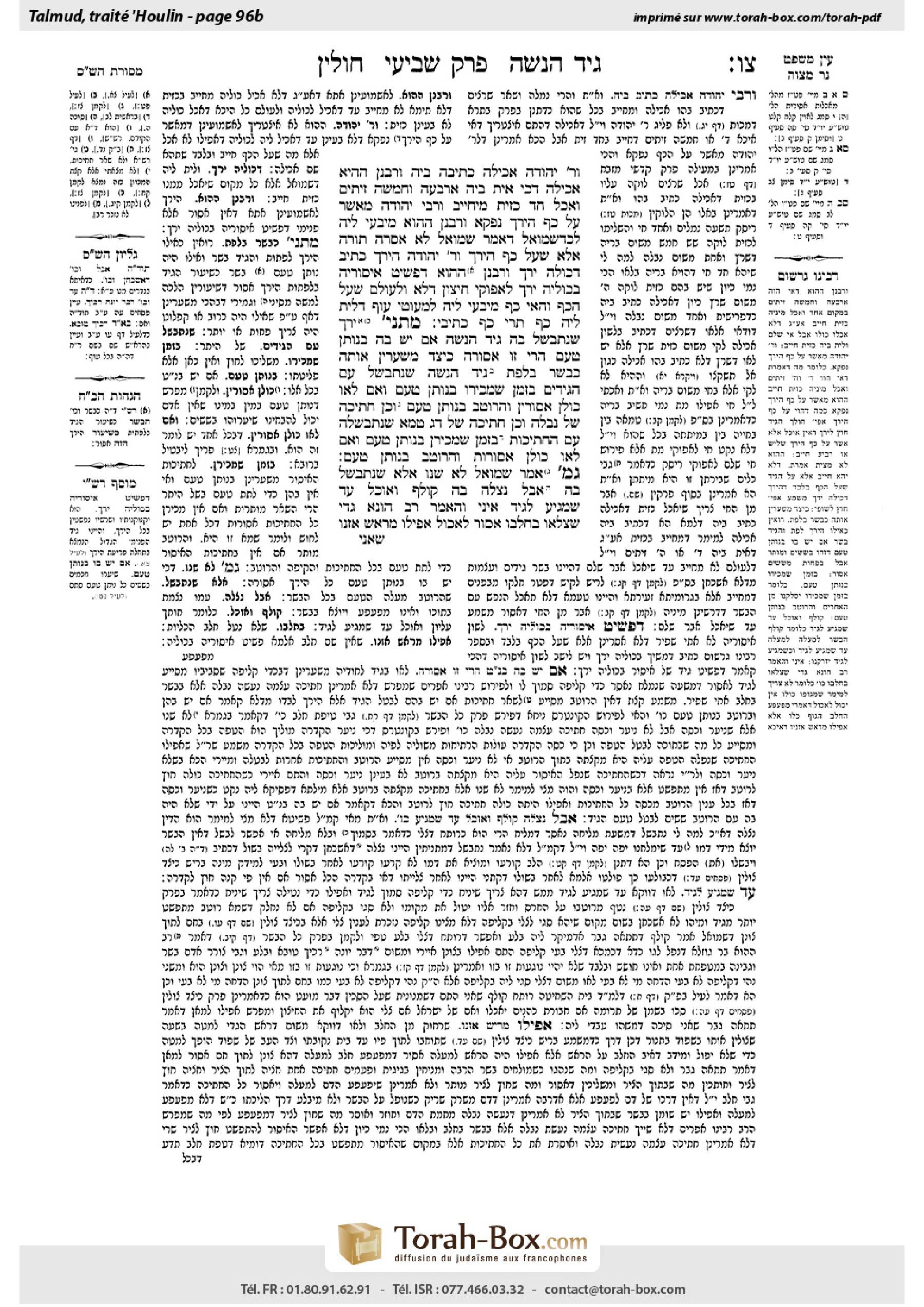
Chullin 96b: Talmud study for Daf Yomi
Study the Talmud for Daf Yomi with scanned pages, Hebrew text, English translations from Sefaria and AI-generated French translations.
Passage selection and English or AI-generated French translation are available where the scan has annotations. Daf Study is independent of Torah-Box and Sefaria.
Browse Chullin · חולין · All tractatesChullin 96b text and translations
This page of Chullin includes the Aramaic text, an English translation and an AI-generated French translation, alongside the scan above.
חולין צ״ו ב · Aramaic and Hebrew text
וְרַבִּי יְהוּדָה – אֲכִילָה כְּתִיבָה בֵּיהּ, וְרַבָּנַן – הַהִיא אֲכִילָה דְּכִי אִית בֵּיהּ אַרְבָּעָה וַחֲמִשָּׁה זֵיתִים וַאֲכַל חַד כְּזַיִת מִיחַיַּיב.
וְרַבִּי יְהוּדָה, מֵ״אֲשֶׁר עַל כַּף הַיָּרֵךְ״ נָפְקָא.
וְרַבָּנַן, הַהוּא מִיבְּעֵי לֵיהּ לִכְדִשְׁמוּאֵל, דְּאָמַר שְׁמוּאֵל: לֹא אָסְרָה תּוֹרָה אֶלָּא שֶׁעַל כַּף הַיָּרֵךְ. וְרַבִּי יְהוּדָה – ״הַיָּרֵךְ״ כְּתִיב, דְּכוּלַּהּ יָרֵךְ.
וְרַבָּנַן, הַהוּא דְּפָשֵׁיט אִיסּוּרֵיהּ בְּכוּלַּיהּ יָרֵךְ, לְאַפּוֹקֵי חִיצוֹן דְּלָא, וּלְעוֹלָם שֶׁעַל הַכַּף.
וְהַאי ״כַּף״ מִיבְּעֵי לֵיהּ לְמַעוֹטֵי עוֹף, דְּלֵית לֵיהּ כַּף! תְּרֵי ״כַּף״ כְּתִיבִי.
מַתְנִי׳ יָרֵךְ שֶׁנִּתְבַּשֵּׁל בָּהּ גִּיד הַנָּשֶׁה, אִם יֵשׁ בָּהּ בְּנוֹתֵן טַעַם – הֲרֵי זוֹ אֲסוּרָה. כֵּיצַד מְשַׁעֲרִין אוֹתָהּ? כְּבָשָׂר בְּלֶפֶת.
גִּיד הַנָּשֶׁה שֶׁנִּתְבַּשֵּׁל עִם הַגִּידִים, בִּזְמַן שֶׁמַּכִּירוֹ – בְּנוֹתֵן טַעַם, וְאִם לָאו – כּוּלָּן אֲסוּרִין, וְהָרוֹטֶב בְּנוֹתֵן טַעַם.
וְכֵן חֲתִיכָה שֶׁל נְבֵלָה, וְכֵן חֲתִיכָה שֶׁל דָּג טָמֵא שֶׁנִּתְבַּשְּׁלָה עִם הַחֲתִיכוֹת, בִּזְמַן שֶׁמַּכִּירָן – בְּנוֹתֵן טַעַם, וְאִם לָאו – כּוּלָּן אֲסוּרוֹת, וְהָרוֹטֶב בְּנוֹתֵן טַעַם.
גְּמָ׳ אָמַר שְׁמוּאֵל: לֹא שָׁנוּ אֶלָּא שֶׁנִּתְבַּשֵּׁל בָּהּ, אֲבָל נִצְלָה בָּהּ – קוֹלֵף וְאוֹכֵל עַד שֶׁמַּגִּיעַ לַגִּיד.
אִינִי? וְהָאָמַר רַב הוּנָא: גְּדִי שֶׁצְּלָאוֹ בְּחֶלְבּוֹ – אָסוּר לֶאֱכוֹל אֲפִילּוּ מֵרֹאשׁ אׇזְנוֹ!
Chullin 96b · English translation
And what does Rabbi Yehuda hold? He holds that since the term: Eating, is written with regard to the sciatic nerve, and a significant act of eating is generally defined as eating an olive-bulk, one is liable only if he eats an olive-bulk. And what do the Rabbis derive from this term? That usage of the term eating indicates that in a case where the sciatic nerve contains four or five olive-bulks and one ate only one olive-bulk, he is liable. Nevertheless, if one eats the entire sciatic nerve, he is liable even if it contains less than an olive-bulk.
And according to Rabbi Yehuda, from where is it derived that one is liable for eating one olive-bulk of a larger sciatic nerve? He holds that it is derived from the phrase “that is upon the spoon of the thigh,” which indicates that even if one eats only the part of the sciatic nerve that is upon the spoon of the thigh, rather than the entire sciatic nerve, he is liable.
And how do the Rabbis interpret that phrase? That phrase is necessary to teach the halakha stated by Shmuel, as Shmuel said: The Torah prohibits only the part of the sciatic nerve that is on the rounded protrusion of flesh shaped like a spoon. And what does Rabbi Yehuda hold with regard to the halakha stated by Shmuel? He derives from the fact that it is written: “The spoon of the thigh,” that the sciatic nerve of the entire thigh is forbidden, not just the part that is on the rounded protrusion of flesh shaped like a spoon.
And how do the Rabbis interpret “the spoon of the thigh”? According to the Rabbis, this expression indicates that the prohibition of the sciatic nerve applies to the nerve that extends throughout the entire thigh, i.e., the inner nerve, which serves to exclude the outer nerve, which is not forbidden by Torah law; but in fact, only the part of the inner nerve that is on the protrusion of flesh shaped like a spoon is forbidden, not the entire inner nerve.
The Gemara objects: But this term “spoon” is required to exclude the sciatic nerve of a bird, which does not have a rounded protrusion on its thigh bone that can be described as the spoon of the thigh, as taught in the mishna (89b). The Gemara explains: There are two usages of the term “spoon” written in the verse, and therefore two separate halakhot can be derived from this term.
MISHNA: In the case of a thigh that was cooked with the sciatic nerve in it, if there is enough of the sciatic nerve in it to impart its flavor to the thigh, the entire thigh is forbidden for consumption. How does one measure whether there is enough sciatic nerve to impart flavor to the meat of the entire thigh? One relates to it as though the sciatic nerve were meat imparting flavor to a turnip. If meat the volume of the sciatic nerve would impart flavor to a turnip the volume of the thigh when they were cooked together, then the entire thigh is forbidden.
With regard to a sciatic nerve that was cooked with other sinews, when one identifies the sciatic nerve and removes it, the other sinews are forbidden if the sciatic nerve was large enough to impart flavor. And if he does not identify it, all the sinews are forbidden because each one could be the sciatic nerve; but the broth is forbidden only if the sciatic nerve imparts flavor to the broth.
And similarly, in the case of a piece of an animal carcass or a piece of non-kosher fish that was cooked with similar pieces of kosher meat or fish, when one identifies the forbidden piece and removes it, the rest of the meat or fish is forbidden only if the forbidden piece was large enough to impart flavor to the entire mixture. And if he does not identify and remove the forbidden piece, all the pieces are forbidden, due to the possibility that each piece one selects might be the forbidden piece; but the broth is forbidden only if the forbidden piece imparts flavor to the broth.
GEMARA: The mishna teaches that a thigh that was cooked with the sciatic nerve is forbidden if the nerve imparts flavor to the thigh. Shmuel says: The Sages taught that the thigh is entirely forbidden only when it was cooked with the sciatic nerve inside it. But if the sciatic nerve was roasted inside the thigh, one may peel away the meat and eat it until he reaches the sciatic nerve, and then he removes the nerve.
The Gemara challenges: Is that so? But doesn’t Rav Huna say: With regard to a kid that was roasted with its forbidden fat, it is prohibited to eat any part of the animal, even from the top of its ear? This proves that roasting, like cooking, spreads the flavor of the forbidden fat throughout the entire animal.
Chullin 96b · Traduction française (IA)
Et que dit Rabbi Yéhuda ? Il affirme que puisque le terme « manger » est écrit concernant le nerf sciatique, et qu'un acte significatif de manger est généralement défini comme manger une quantité d'olive, on est puni seulement si l'on mange une quantité d'olive. Et que déduisent les Rabbins de ce terme ? Que l'usage du terme « manger » indique que dans le cas où le nerf sciatique contient quatre ou cinq quantités d'olive et qu'on a mangé seulement une quantité d'olive, on est puni. Cependant, si l'on mange tout le nerf sciatique, on est puni même s'il contient moins qu'une quantité d'olive.
Et selon Rabbi Yéhuda, d'où déduit-on que l'on est puni pour avoir mangé une quantité d'olive d'un nerf sciatique plus grand ? Il affirme qu'il est déduit du phrasé « qui est sur la cuillère du cuisse », ce qui indique que même si l'on mange seulement la partie du nerf sciatique qui est sur la cuillère du cuisse, plutôt que l'ensemble du nerf sciatique, on est puni.
Et comment les Rabbins interprètent-ils ce phrasé ? Ce phrasé est nécessaire pour enseigner la halakha énoncée par Shmuel, car Shmuel dit : La Torah interdit seulement la partie du nerf sciatique qui est sur la bosse de viande en forme de cuillère. Et que dit Rabbi Yéhuda concernant la halakha énoncée par Shmuel ? Il déduit le fait que cela est écrit : « la cuillère du cuisse », que le nerf sciatique de tout le cuisse est interdit, pas seulement la partie qui est sur la bosse de viande en forme de cuillère.
Et comment les Rabbins interprètent-ils « la cuillère du cuisse » ? Selon les Rabbins, cette expression indique que l'interdiction du nerf sciatique s'applique au nerf qui s'étend tout le long du cuisse, c'est-à-dire le nerf interne, qui sert à exclure le nerf externe, qui n'est pas interdit par la loi divine ; mais en réalité, seule la partie du nerf interne qui est sur la bosse de viande en forme de cuillère est interdite, pas l'ensemble du nerf interne.
La Guemara s'oppose : Mais ce terme « cuillère » est nécessaire pour exclure le nerf sciatique d'un oiseau, qui n'a pas une bosse arrondie sur son os du cuisse qui puisse être décrit comme la cuillère du cuisse, comme enseigné dans la mitsna (89b). La Guemara explique : Il y a deux usages du terme « cuillère » écrit dans la parasha, et par conséquent deux halakhot différentes peuvent être déduites de ce terme.
MITSVA : Dans le cas d'un cuisse qui a été cuit avec le nerf sciatique dedans, si il y a assez de nerf sciatique pour transmettre son goût au cuisse, l'ensemble du cuisse est interdit à la consommation. Comment mesure-t-on si il y a assez de nerf sciatique pour transmettre le goût au viande du cuisse entier ? On considère cela comme si le nerf sciatique était de la viande transmettant le goût à un navet. Si la viande ayant le volume du nerf sciatique transmettrait le goût à un navet ayant le volume du cuisse lorsqu'ils ont été cuits ensemble, alors l'ensemble du cuisse est interdit.
Concernant un nerf sciatique qui a été cuit avec d'autres nerfs, lorsque l'on identifie le nerf sciatique et l'enlève, les autres nerfs sont interdits si le nerf sciatique était suffisamment grand pour transmettre le goût. Et si l'on ne l'identifie pas, tous les nerfs sont interdits car chacun pourrait être le nerf sciatique ; mais le bouillon est interdit seulement si le nerf sciatique transmet le goût au bouillon.
Et de même, dans le cas d'une pièce d'un animal mort ou d'une pièce de poisson non-kosher qui a été cuit avec des morceaux similaires de viande ou de poisson kosher, lorsque l'on identifie la pièce interdite et l'enlève, les autres morceaux de viande ou de poisson sont interdits seulement si la pièce interdite était suffisamment grande pour transmettre le goût à l'ensemble du mélange. Et si l'on ne l'identifie pas et ne l'enlève pas, toutes les pièces sont interdites en raison de la possibilité que chaque pièce que l'on choisit puisse être la pièce interdite ; mais le bouillon est interdit seulement si la pièce interdite transmet le goût au bouillon.
GUEMARA : La mitsva enseigne que le cuisse qui a été cuit avec le nerf sciatique est interdit si le nerf transmet le goût au cuisse. Shmuel dit : Les Sages ont enseigné que le cuisse est entièrement interdit seulement lorsqu'il a été cuit avec le nerf sciatique à l'intérieur. Mais si le nerf sciatique a été rôti à l'intérieur du cuisse, on peut retirer la viande et manger jusqu'à ce qu'on atteigne le nerf sciatique, puis on enlève le nerf.
La Guemara conteste : Est-ce ainsi ? Mais ne dit pas Rav Huna : Concernant un agneau qui a été rôti avec sa graisse interdite, il est interdit de manger toute partie de l'animal, même du haut de son oreille ? Cela prouve que la cuisson, comme la roasting, répand le goût de la graisse interdite à travers tout l'animal.
Traduction française générée par IA à partir de l’édition anglaise de Sefaria. Vérifie toujours un passage avec le texte source.
Text from Sefaria: William Davidson Edition - Vocalized Aramaic (unknown); William Davidson Edition - English (CC BY NC).