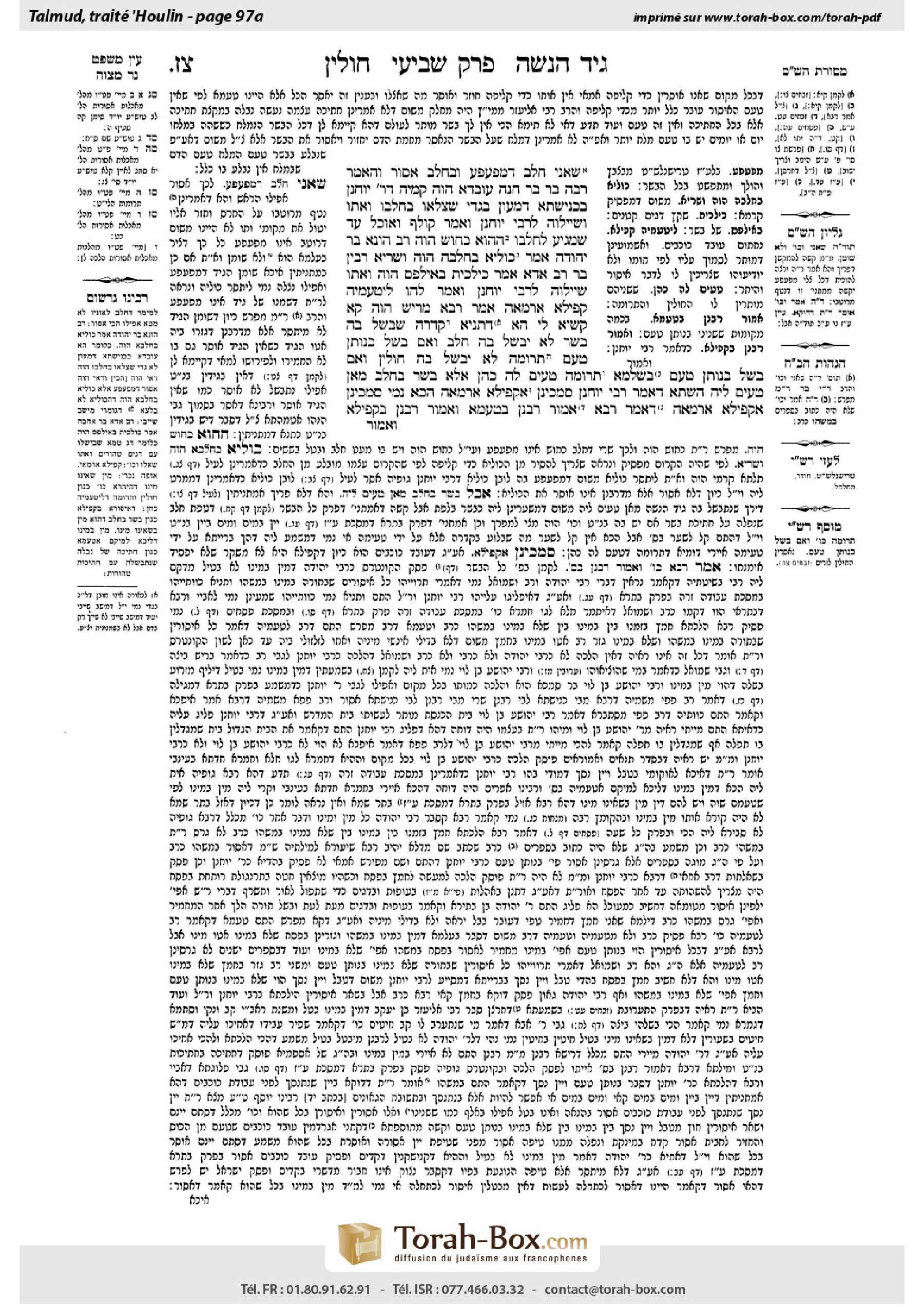
Chullin 97a: Talmud study for Daf Yomi
Study the Talmud for Daf Yomi with scanned pages, Hebrew text, English translations from Sefaria and AI-generated French translations.
Passage selection and English or AI-generated French translation are available where the scan has annotations. Daf Study is independent of Torah-Box and Sefaria.
Browse Chullin · חולין · All tractatesChullin 97a text and translations
This page of Chullin includes the Aramaic text, an English translation and an AI-generated French translation, alongside the scan above.
חולין צ״ז א · Aramaic and Hebrew text
שָׁאנֵי חֵלֶב, דִּמְפַעְפַּע.
וּבְחֵלֶב אָסוּר? וְהָאָמַר רַבָּה בַּר בַּר חָנָה: עוֹבָדָא הֲוָה קַמֵּיהּ דְּרַבִּי יוֹחָנָן בִּכְנִישְׁתָּא דְמָעוֹן, בִּגְדִי שֶׁצְּלָאוֹ בְּחֶלְבּוֹ, וַאֲתוֹ וְשַׁיְילוּהּ לְרַבִּי יוֹחָנָן, וְאָמַר: קוֹלֵף וְאוֹכֵל עַד שֶׁמַּגִּיעַ לְחֶלְבּוֹ! הָהוּא כָּחוּשׁ הֲוָה.
רַב הוּנָא בַּר יְהוּדָה אָמַר: כּוּלְיָא בְּחֶלְבָּהּ הֲוָה, וְשַׁרְיַאּ. רָבִין בַּר רַב אַדָּא אָמַר: כִּילְכִּית בְּאִילְפָּס הֲוָה, וַאֲתוֹ שַׁיְילוּהּ לְרַבִּי יוֹחָנָן, וַאֲמַר לְהוּ: לִיטְעֲמֵיהּ קַפִּילָא אֲרַמָּאָה.
אָמַר רָבָא: מֵרֵישׁ הֲוָה קָא קַשְׁיָא לִי הָא דְּתַנְיָא: קְדֵרָה שֶׁבִּשֵּׁל בָּהּ בָּשָׂר – לֹא יְבַשֵּׁל בָּהּ חָלָב, וְאִם בִּשֵּׁל – בְּנוֹתֵן טַעַם; תְּרוּמָה – לֹא יְבַשֵּׁל בָּהּ חוּלִּין, וְאִם בִּשֵּׁל – בְּנוֹתֵן טַעַם.
בִּשְׁלָמָא תְּרוּמָה, טָעֵים לַהּ כֹּהֵן, אֶלָּא בָּשָׂר בְּחָלָב – מַאן טָעֵים לֵיהּ? הַשְׁתָּא דְּאָמַר רַבִּי יוֹחָנָן: סָמְכִינַן אַקַּפִּילָא אֲרַמָּאָה, הָכָא נָמֵי סָמְכִינַן אַקַּפִּילָא אֲרַמָּאָה.
דְּאָמַר רָבָא: אֲמוּר רַבָּנַן בְּטַעְמָא, וַאֲמוּר רַבָּנַן בְּקַפִּילָא,
Chullin 97a · English translation
The Gemara answers: Forbidden fat is different from the sciatic nerve, because its flavor permeates throughout the animal, unlike that of the sciatic nerve.
The Gemara challenges Rav Huna’s statement: And in the case of a kid roasted with its forbidden fat, is the meat forbidden? But didn’t Rabba bar bar Ḥana say: There was an incident that came before Rabbi Yoḥanan in the synagogue of the town of Maon, where a young goat was roasted with its fat, and the people came and asked Rabbi Yoḥanan about the status of the meat, and he said: Peel away the meat and eat it until you reach the forbidden fat? This indicates that the flavor of the fat does not permeate the entire animal in which it is roasted. The Gemara answers: That kid was lean and had so little fat that its flavor did not permeate throughout the animal.
Rav Huna bar Yehuda said: That was a case of a kidney of a young goat roasted with its forbidden fat, and Rabbi Yoḥanan permitted it to be eaten because there is a membrane that separates the fat from the kidney and prevents the fat from penetrating the kidney. Ravin bar Rav Adda said: That was a case of a small, non-kosher fish known as kilkhit, which fell into a stewpot [ilpas], and they came to ask Rabbi Yoḥanan about its status. And he said to them: Let a gentile cook [kapeila] taste it in order to determine whether the flavor of the non-kosher fish has permeated the entire mixture.
Rava said: Initially that which is taught in the following baraita posed a difficulty for me: With regard to a pot in which one cooked meat, one may not cook milk in it; and if he did cook milk in it, the meat absorbed by the pot renders the milk forbidden if it imparts flavor to the milk. Similarly, if one cooked teruma in a pot, one may not cook non-sacred food in it; and if one did cook non-sacred food in it, the absorbed teruma renders the food in the pot sacred if it imparts flavor to it.
Rava explains: Granted, in the case of a pot used for teruma, a priest, who is permitted to partake of teruma, can taste the non-sacred food subsequently cooked in the pot in order to determine whether the teruma imparted flavor to the non-sacred food. But in a case where it is not known whether meat imparted flavor into milk, who can taste it? If the meat did impart flavor to the milk, it would be forbidden for any Jew to consume the milk. But now that Rabbi Yoḥanan said: We rely on a gentile cook in the case of the kilkhit, here also we rely on a gentile cook to taste it and say whether the meat has imparted flavor to the milk.
The Gemara summarizes the guidelines that determine when an item cooked with another item affects the status of the mixture. Rava said: The Sages said that there are cases where one relies on a Jew tasting the food, and the Sages said that there are some cases where one relies on a gentile cook to taste the food,
Chullin 97a · Traduction française (IA)
La Guemara répond : La graisse interdite est différente du nerf sciatique, car son goût pénètre dans tout l'animal, contrairement à celui du nerf sciatique.
La Guemara remet en question l'affirmation de Rav Huna : Et dans le cas d'un agneau rôti avec sa graisse interdite, la viande est-elle interdite ? Mais n'avait-il pas dit Rabba bar bar Ḥana : Il y avait un incident qui s'est produit devant Rabbi Yoḥanan dans la synagogue de la ville de Maon, où un petit agneau était rôti avec sa graisse, et les gens sont venus demander à Rabbi Yoḥanan sur le statut de la viande, et il a dit : Enlevez la viande et mangez-la jusqu'à ce que vous atteigniez la graisse interdite ? Cela indique que le goût de la graisse ne pénètre pas dans tout l'animal dans lequel elle est rôti. La Guemara répond : Cet agneau était maigre et avait si peu de graisse que son goût ne pénètre pas dans tout l'animal.
Rav Huna bar Yehuda a dit : C'était le cas d'un rein d'un petit agneau rôti avec sa graisse interdite, et Rabbi Yoḥanan a permis de le manger car il y a une membrane qui sépare la graisse du rein et empêche la graisse de pénétrer dans le rein. Ravin bar Rav Adda a dit : C'était le cas d'un petit poisson non-kosher appelé kilkhit, qui est tombé dans un chaudron, et ils sont venus demander à Rabbi Yoḥanan sur son statut. Et il a dit à eux : Faites goûter un non-Juif afin de déterminer si le goût du poisson non-kosher a pénétré dans toute la préparation.
Rava a dit : Initialement, ce qui est enseigné dans la baraïta suivante posait un problème pour moi : En ce qui concerne un chaudron dans lequel on a cuisiné de la viande, on ne peut pas cuire du lait dedans ; et si l'on a cuisiné du lait dedans, la viande absorbée par le chaudron rend le lait interdit si elle imprime un goût au lait. De même, si l'on a cuisiné de la terouma dans un chaudron, on ne peut pas cuisiner de nourriture non sacrée dedans ; et si l'on a cuisiné de la nourriture non sacrée dedans, la terouma absorbée rend la nourriture du chaudron sacrée si elle imprime un goût à celle-ci.
Rava explique : Bien sûr, dans le cas d'un chaudron utilisé pour la terouma, un prêtre, qui est autorisé à consommer la terouma, peut goûter la nourriture non sacrée ultérieurement cuisinée dans le chaudron afin de déterminer si la terouma a imprégné la nourriture non sacrée. Mais dans le cas où on ne sait pas si la viande a imprégné le lait, qui peut goûter ? Si la viande a imprégné le lait, cela serait interdit à tout Juif de consommer le lait. Mais maintenant que Rabbi Yoḥanan a dit : Nous nous appuyons sur un cuisinier non-Juif dans le cas du kilkhit, ici aussi nous nous appuyons sur un cuisinier non-Juif pour goûter et dire si la viande a imprégné le lait.
La Guemara résume les lignes directrices qui déterminent quand un aliment cuit avec un autre aliment affecte le statut de la préparation. Rava a dit : Les Sages ont dit qu'il y a des cas où on se fie à un Juif pour goûter la nourriture, et les Sages ont dit qu'il y a des cas où on se fie à un cuisinier non-Juif pour goûter la nourriture,
Traduction française générée par IA à partir de l’édition anglaise de Sefaria. Vérifie toujours un passage avec le texte source.
Text from Sefaria: William Davidson Edition - Vocalized Aramaic (unknown); William Davidson Edition - English (CC BY NC).