Chullin 97b: Talmud study for Daf Yomi
Study the Talmud for Daf Yomi with scanned pages, Hebrew text, English translations from Sefaria and AI-generated French translations.
Passage selection and English or AI-generated French translation are available where the scan has annotations. Daf Study is independent of Torah-Box and Sefaria.
Browse Chullin · חולין · All tractatesChullin 97b text and translations
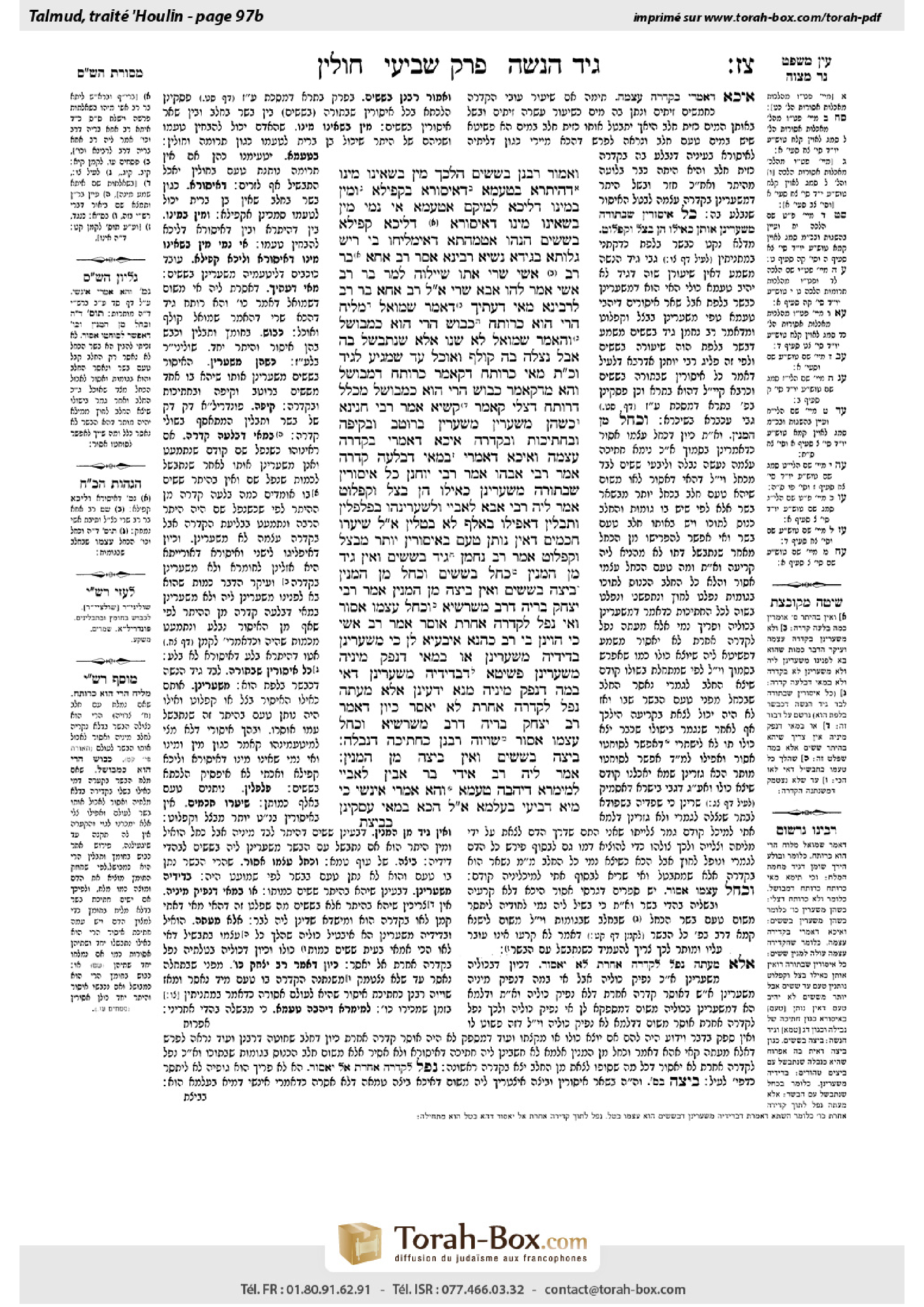
This page of Chullin includes the Aramaic text, an English translation and an AI-generated French translation, alongside the scan above.
חולין צ״ז ב · Aramaic and Hebrew text
וַאֲמוּר רַבָּנַן בְּשִׁשִּׁים. הִלְכָּךְ, מִין בְּשֶׁאֵינוֹ מִינוֹ דְּהֶיתֵּרָא – בְּטַעְמָא, דְּאִיסּוּרָא – בְּקַפִּילָא.
וּמִין בְּמִינוֹ, דְּלֵיכָּא לְמֵיקַם אַטַּעְמָא, אִי נָמֵי מִין בְּשֶׁאֵינוֹ מִינוֹ דְּאִיסּוּרָא, דְּלֵיכָּא קַפִּילָא – בְּשִׁשִּׁים.
הָנְהוּ אַטְמָהָתָא דְּאִימְּלִיחוּ בֵּי רֵישׁ גָּלוּתָא בְּגִידָא נַשְׁיָא, רָבִינָא אָסַר, רַב אַחָא בַּר רַב אָשֵׁי שָׁרֵי. אֲתוֹ שַׁיְילוּהּ לְמָר בַּר רַב אָשֵׁי, אֲמַר לְהוּ: אַבָּא שָׁרֵי.
אֲמַר לֵיהּ רַב אַחָא בַּר רַב לְרָבִינָא: מַאי דַּעְתָּיךְ – דְּאָמַר שְׁמוּאֵל: מָלִיחַ הֲרֵי הוּא כְּרוֹתֵחַ, כָּבוּשׁ הֲרֵי הוּא כִּמְבוּשָּׁל.
וְהָאָמַר שְׁמוּאֵל: לֹא שָׁנוּ אֶלָּא שֶׁנִּתְבַּשֵּׁל בָּהּ, אֲבָל נִצְלָה בָּהּ – קוֹלֵף וְאוֹכֵל עַד שֶׁמַּגִּיעַ לַגִּיד.
וְכִי תֵּימָא, מַאי כְּרוֹתֵחַ דְּקָאָמַר? כְּרוֹתֵחַ דִּמְבוּשָּׁל! וְהָא מִדְּקָאָמַר כָּבוּשׁ הֲרֵי הוּא כִּמְבוּשָּׁל, מִכְּלָל דְּרוֹתֵחַ דְּצָלִי קָאָמַר. קַשְׁיָא.
אָמַר רַבִּי חֲנִינָא: כְּשֶׁהֵן מְשַׁעֲרִין, מְשַׁעֲרִין בְּרוֹטֶב וּבַקֵּיפֶה וּבַחֲתִיכוֹת וּבִקְדֵרָה. אִיכָּא דְּאָמְרִי: בִּקְדֵרָה עַצְמָהּ, וְאִיכָּא דְּאָמְרִי: בְּמַאי דְּבָלְעָה קְדֵרָה.
אָמַר רַבִּי אֲבָהוּ אָמַר רַבִּי יוֹחָנָן: כׇּל אִיסּוּרִין שֶׁבַּתּוֹרָה (מְשַׁעֲרִינַן) [מְשַׁעֲרִין אוֹתָן] כְּאִילּוּ הֵן בָּצָל וְקַפְלוֹט.
אֲמַר לֵיהּ רַבִּי אַבָּא לְאַבָּיֵי: וּלְשַׁעֲרִינְהוּ בְּפִלְפְּלִין וְתַבְלִין, דַּאֲפִילּוּ בְּאֶלֶף לֹא בְּטֵלִין! אֲמַר לֵיהּ: שִׁיעֲרוּ חֲכָמִים דְּאֵין נוֹתֵן טַעַם בְּאִיסּוּרִין יוֹתֵר מִבָּצָל וְקַפְלוֹט.
אָמַר רַב נַחְמָן: גִּיד בְּשִׁשִּׁים, וְאֵין גִּיד מִן הַמִּנְיָן; כְּחָל בְּשִׁשִּׁים, וּכְחָל מִן הַמִּנְיָן; בֵּיצָה בְּשִׁשִּׁים, וְאֵין בֵּיצָה מִן הַמִּנְיָן.
אָמַר רַבִּי יִצְחָק בְּרֵיהּ דְּרַב מְשַׁרְשְׁיָא: וּכְחָל עַצְמוֹ אָסוּר, וְאִי נָפַל לִקְדֵרָה אַחֶרֶת – אוֹסֵר.
אָמַר רַב אָשֵׁי: כִּי הֲוֵינַן בֵּי רַב כָּהֲנָא, אִיבַּעְיָא לַן: כִּי מְשַׁעֲרִינַן בְּדִידֵיהּ מְשַׁעֲרִינַן, אוֹ בְּמַאי דִּנְפַק מִינֵּיהּ מְשַׁעֲרִינַן?
פְּשִׁיטָא דִּבְדִידֵיהּ מְשַׁעֲרִינַן, דְּאִי בְּמָה דִּנְפַק מִינֵּיהּ – מְנָא יָדְעִינַן? אֶלָּא מֵעַתָּה, נָפַל לִקְדֵרָה אַחֶרֶת – לֹא יֶאֱסֹר?
כֵּיוָן דְּאָמַר רַב יִצְחָק בְּרֵיהּ דְּרַב מְשַׁרְשְׁיָא: וּכְחָל עַצְמוֹ אָסוּר, שַׁוְּיוּהּ רַבָּנַן כַּחֲתִיכָה דִּנְבֵלָה.
בֵּיצָה בְּשִׁשִּׁים, וְאֵין בֵּיצָה מִן הַמִּנְיָן. אֲמַר לֵיהּ רַב אִידִי בַּר אָבִין לְאַבָּיֵי: לְמֵימְרָא דְּיָהֲבָה טַעְמָא? וְהָא אָמְרִי אִינָשֵׁי: כִּי מַיָּא דְּבֵיעֵי בְּעָלְמָא!
אֲמַר לֵיהּ: הָכָא בְּמַאי עָסְקִינַן?
Chullin 97b · English translation
and the Sages said that there are cases where the mixture is permitted if there is sixty times as much permitted food as forbidden food. Therefore, in a case where the mixture is a type of food mixed with food not of its own type, so that there is a difference in taste between the two components, when there are Jews for whom the mixture is permitted, one relies on a Jew tasting the mixture. This is the halakha when teruma is cooked with non-sacred food. When the mixture is potentially forbidden, e.g., in the case of meat cooked with milk, one relies on a gentile cook to taste it.
And if the mixture is composed of a type of food mixed with food of its own type, where one cannot ascertain whether the forbidden component has imparted flavor; or if it is composed of a type of food mixed with food not of its own type when the mixture may be forbidden and it is a case where there is no gentile cook available to taste it, the mixture is permitted if there is sixty times as much permitted food as forbidden food.
§ The Gemara (96b) cited Shmuel’s opinion with regard to the thigh of an animal that was roasted or cooked with the sciatic nerve still inside. The Gemara relates the following incident: There were those animal thighs that were salted in the home of the Exilarch with the sciatic nerve still inside; Ravina ruled that they were forbidden, whereas Rav Aḥa bar Rav Ashi ruled that they were permitted. They came and asked Mar bar Rav Ashi to render a decision. He said to them: My father permitted the meat in such circumstances.
Rav Aḥa bar Rav said to Ravina: What is your reasoning in prohibiting the meat? Is it because of what Shmuel said: A salted food item is considered like a boiling hot food item, and a food item marinated in vinegar, brine, or the like is considered like a cooked food item? Perhaps based on this statement of Shmuel you consider the salted thighs as though they have been cooked with their sciatic nerves, in which case they are forbidden.
But didn’t Shmuel also say (96b): They taught that the thigh is entirely forbidden only when it was cooked with the sciatic nerve inside it. But if the sciatic nerve was roasted inside the thigh, one may peel away the meat and eat it until he reaches the sciatic nerve, and then he removes the nerve.
And if you would say: What is the meaning of the phrase: Like a boiling hot food item, that Shmuel said? It is like boiling hot food that was cooked rather than hot food that was roasted, and therefore if the thigh was salted with its sciatic nerve the entire thigh becomes forbidden. This is not a convincing claim, because from the fact that Shmuel said: A food item marinated in vinegar, brine, or the like is considered like a cooked food item, it may be understood by inference that when he said that salted food is like boiling hot food he was saying that it is like boiling hot food that is roasted. The Gemara concludes: This poses a difficulty to the opinion of Ravina.
§ The Gemara elaborates on the statement that if permitted and forbidden foods are cooked together and there is sixty times as much permitted food as forbidden food, the mixture is permitted. Rabbi Ḥanina says: When they assess whether or not there is sixty times as much permitted food, they assess the volume of the broth, the deposits [kifa], the pieces of permitted food cooked in the pot, and the pot itself. The Gemara explains this last point: There are those who say this means that one includes the volume of the material of the pot itself, and there are those who say it means that one includes the volume of that which the pot has absorbed from the permitted food. When meat cooks its volume decreases, and some of the meat that constitutes that discrepancy is absorbed into the sides of the pot.
The Gemara continues its discussion of nullification. Rabbi Abbahu says that Rabbi Yoḥanan says: With regard to all forbidden foods that are prohibited in the Torah, if they are cooked with permitted food and one cannot tell whether they have imparted flavor to the permitted food, we assess the mixture as though the forbidden food were onion or leek [kaflot]. If that amount of onions or leeks would impart flavor to the permitted food, one must assume that the mixture is forbidden.
Rabbi Abba said to Abaye: But let one assess the mixture as though the forbidden food were pepper or other spices, which are even more pungent, in which case they would not be nullified even if they were mixed with a thousand times as much permitted food. Abaye said to him: The Sages ascertained that with regard to forbidden foods, there is nothing that imparts more flavor to a mixture than onion and leek.
§ The Gemara continues to discuss the nullification of forbidden foods. Rav Naḥman says: A sciatic nerve that was cooked with kosher food is nullified if the mixture contains permitted food that is sixty times the nerve’s volume, and the sciatic nerve itself is not counted in that number, because it cannot nullify itself. If an udder, which is meat but also contains milk, is cooked with other meat, the milk is nullified if the meat is sixty times its volume, and the udder itself is counted with the rest of the meat. If the egg of a non-kosher bird is cooked with kosher food, it is nullified if the permitted food is sixty times its volume, and the egg itself is not counted in that number, as it cannot nullify itself.
Rabbi Yitzḥak, son of Rav Mesharshiyya, says: In the case of an udder cooked with meat, even if the meat is sixty times the volume of the milk, so that the meat is permitted, the udder itself is forbidden, because the meat imparts flavor to the milk contained within the udder, which then renders the udder forbidden. And if the udder subsequently falls into another pot, it also renders the contents of that pot forbidden unless they are sixty times the volume of the udder.
Rav Ashi said: When we were in the study hall of Rav Kahana, a dilemma was raised before us: When we assess whether the contents of the pot are sufficient to nullify the udder, do we assess whether the pot contains sixty times as much permitted food as the entire volume of the meat of the udder itself, or do we assess only that milk which came out from the udder, since the udder itself has been removed from the mixture?
The Gemara responds: It is obvious that we assess the entire volume of the meat of the udder itself, as if we were to attempt to assess only that which came out of it, how would we know how much came out? The Gemara objects: If that is so, then if the udder falls into another pot, it should not render the food in that second pot forbidden, because it has been assumed that all the milk in the udder has been released into the first pot.
The Gemara explains: Since Rav Yitzḥak, son of Rav Mesharshiyya, says that even if there is sixty times as much meat in the pot as there is milk in the udder, the udder itself is forbidden, clearly the Sages equated the udder with a piece of non-kosher meat. Consequently, the reason the udder renders the contents of the second pot forbidden is that the udder is intrinsically forbidden, not because of the milk that is released into the pot while it is being cooked.
§ The Gemara addresses Rav Naḥman’s statement that if the egg of a non-kosher bird is cooked with kosher food, it is nullified if the permitted food is sixty times its volume, and the egg itself is not counted in that number, as it cannot nullify itself. Rav Idi bar Avin said to Abaye: Is this to say that the forbidden egg imparts flavor to the food with which it is cooked? But isn’t it true that when people want to indicate that food is tasteless, they say: This is like mere egg-water? This indicates that an egg does not impart flavor.
Abaye said to him: Here we are dealing with
Chullin 97b · Traduction française (IA)
et les Sages dirent qu'il y a des cas où la mixture est permise si la quantité de nourriture permise est soixante fois supérieure à la quantité de nourriture interdite. Ainsi, dans un cas où la mixture est une sorte de nourriture mélangée à une nourriture non de la même espèce, de sorte qu'il y a une différence de goût entre les deux composants, lorsqu'il y a des Juifs pour qui la mixture est permise, on se fie à un Juif qui goûte la mixture. C'est la halakha lorsque la terouma est cuite avec une nourriture non sacrée. Lorsque la mixture est potentiellement interdite, par exemple dans le cas de la viande cuite avec le lait, on se fie à un cuisinier gentil pour goûter.
Et si la mixture est composée d'une sorte de nourriture mélangée à une nourriture de la même espèce, où l'on ne peut pas déterminer si le composant interdit a transmis un goût ; ou si elle est composée d'une sorte de nourriture mélangée à une nourriture non de la même espèce, lorsque la mixture peut être interdite et qu'il n'y a pas de cuisinier gentil disponible pour goûter, la mixture est permise si la quantité de nourriture permise est soixante fois supérieure à la quantité de nourriture interdite.
§ La Guemara (96b) cite l'opinion de Shmuel concernant le coude d'un animal qui a été rôti ou cuit avec le nerf sciatique encore à l'intérieur. La Guemara rapporte l'incident suivant : Il y avait des coudes d'animaux salés dans la maison de l'Exilarch avec le nerf sciatique encore à l'intérieur ; Ravina jugea qu'ils étaient interdits, tandis que Rav Aḥa bar Rav Ashi jugea qu'ils étaient permis. Ils vinrent demander à Mar bar Rav Ashi un avis. Il leur dit : Mon père permit la viande dans de tels cas.
Rav Aḥa bar Rav dit à Ravina : Quelle est votre raisonnement pour interdire la viande ? Est-ce à cause de ce que Shmuel dit : Une nourriture salée est considérée comme une nourriture bouillante, et une nourriture marinée dans du vinaigre, du sel ou du genre est considérée comme une nourriture cuite ? Peut-être que, selon cette déclaration de Shmuel, vous considérez les côtes salées comme si elles avaient été cuites avec leur nerf sciatique, dans ce cas elles seraient interdites.
Mais n’a-t-il pas dit Shmuel aussi (96b) : Ils enseignèrent que le coude est entièrement interdit seulement lorsqu’il a été cuit avec le nerf sciatique à l’intérieur. Mais si le nerf sciatique a été rôti à l’intérieur du coude, on peut retirer la viande et manger jusqu’à ce qu’on atteigne le nerf sciatique, puis on retire le nerf.
Et si vous dites : Quelle est la signification de la phrase : Comme une nourriture bouillante, que Shmuel dit ? C’est comme une nourriture bouillante qui a été cuite plutôt que rôtie, et par conséquent, si le coude a été salé avec son nerf sciatique, tout le coude devient interdit. Cela n’est pas une argumentation convaincante, car à partir du fait que Shmuel dit : Une nourriture marinée dans du vinaigre, du sel ou du genre est considérée comme une nourriture cuite, on peut en déduire que lorsqu’il a dit que la nourriture salée est comme une nourriture bouillante, il voulait dire qu’elle est comme une nourriture bouillante qui est rôtie. La Guemara conclut : Cela pose un problème pour l’opinion de Ravina.
§ La Guemara développe la déclaration selon laquelle si des aliments permis et interdits sont cuits ensemble et que la quantité d'aliments permis est soixante fois supérieure à la quantité d'aliments interdits, la mixture est permise. Rabbi Ḥanina dit : Lorsqu'on évalue si la quantité d'aliments permis est soixante fois supérieure, on évalue le volume du bouillon, les dépôts [kifa], les morceaux d'aliments permis cuits dans la marmite, et la marmite elle-même. La Guemara explique ce dernier point : Il y a ceux qui disent que cela signifie qu'on inclut le volume du matériau de la marmite elle-même, et il y a ceux qui disent que cela signifie qu'on inclut le volume de ce que la marmite a absorbé des aliments permis. Lorsque la viande cuit, son volume diminue, et une partie de la viande qui constitue cette différence est absorbée dans les côtés de la marmite.
La Guemara continue sa discussion sur la nullification. Rabbi Abbahu dit que Rabbi Yoḥanan dit : Concernant tous les aliments interdits qui sont interdits dans la Torah, si ils sont cuits avec des aliments permis et qu'on ne peut pas déterminer s'ils ont transmis un goût aux aliments permis, on évalue la mixture comme si les aliments interdits étaient des oignons ou des échalotes [kaflot]. Si la quantité d'oignons ou d'échalotes transmettrait un goût aux aliments permis, on doit considérer que la mixture est interdite.
Rabbi Abba dit à Abaye : Mais on devrait évaluer la mixture comme si les aliments interdits étaient du poivre ou d'autres épices, qui sont encore plus piquants, dans ce cas ils ne seraient pas nullifiés même s'ils étaient mélangés à mille fois plus d'aliments permis. Abaye dit à lui : Les Sages ont établi que concernant les aliments interdits, il n'y a rien qui transmet plus de goût à une mixture que les oignons et les échalotes.
§ La Guemara continue à discuter de la nullification des aliments interdits. Rav Naḥman dit : Un nerf sciatique qui a été cuit avec de la nourriture kasher est nullifié si la mixture contient une nourriture permise soixante fois supérieure au volume du nerf sciatique, et le nerf sciatique lui-même n'est pas compté dans ce nombre, car il ne peut pas se nullifier lui-même. Si un pis, qui est de la viande mais qui contient aussi du lait, est cuit avec d'autres viandes, le lait est nullifié si la viande est soixante fois supérieure à son volume, et le pis lui-même est compté avec le reste de la viande. Si un œuf d'un oiseau non kasher est cuit avec de la nourriture kasher, il est nullifié si la nourriture permise est soixante fois supérieure à son volume, et l'œuf lui-même n'est pas compté dans ce nombre, car il ne peut pas se nullifier lui-même.
Rabbi Yitzḥak, fils de Rav Mesharshiyya, dit : Dans le cas d'un pis cuit avec de la viande, même si la viande est soixante fois supérieure au volume du lait, de sorte que la viande est permise, le pis lui-même est interdit, car la viande transmet un goût au lait contenu dans le pis, ce qui rend le pis interdit. Et si le pis tombe ensuite dans une autre marmite, il rend aussi interdits les contenants de cette marmite, sauf s'ils sont soixante fois supérieurs au volume du pis.
Rav Ashi a dit : Lorsque nous étions dans la salle de study de Rav Kahana, un dilemme a été soulevé devant nous : Lorsque nous évaluons si la quantité de contenu du récipient est suffisante pour annuler la moelle, évaluons-nous si le récipient contient soixante fois plus de nourriture permise que le volume total de la moelle elle-même, ou évaluons-nous uniquement la quantité de lait qui est sortie de la moelle, puisque la moelle elle-même a été retirée du mélange ?
La Guemara répond : Il est évident que nous évaluons le volume total de la moelle elle-même, comme si nous essayions d'évaluer uniquement ce qui en est sorti, comment saurions-nous combien en a été sorti ? La Guemara s'oppose : Si c'est ainsi, alors si la moelle tombe dans un autre récipient, elle ne rendrait pas la nourriture de ce second récipient interdite, car on suppose que tout le lait de la moelle a été libéré dans le premier récipient.
La Guemara explique : Puisque Rav Yitzḥak, fils de Rav Mesharshiyya, dit que même si la quantité de viande dans le récipient est soixante fois supérieure à la quantité de lait dans la moelle, la moelle elle-même est interdite, clairement les Sages ont équivalé la moelle à un morceau de viande non-kosher. Par conséquent, la raison pour laquelle la moelle rend interdite la nourriture du second récipient est que la moelle est intrinsèquement interdite, pas à cause du lait qui est libéré dans le récipient pendant la cuisson.
§ La Guemara examine la déclaration de Rav Naḥman selon laquelle si l'œuf d'un oiseau non-kosher est cuit avec de la nourriture permise, il est annulé lorsque la nourriture permise est soixante fois plus volumineuse que l'œuf, et l'œuf lui-même n'est pas compté dans ce nombre, car il ne peut pas annuler lui-même. Rav Idi bar Avin a dit à Abaye : Voulait-on dire que l'œuf interdit imprègne le goût de la nourriture avec laquelle il est cuit ? Mais n'est-ce pas vrai que lorsqu'on veut indiquer que la nourriture est insipide, on dit : Cela ressemble à de l'eau d'œuf ? Cela indique que l'œuf ne transmet pas de goût.
Abaye a dit à lui : Nous traitons ici d'une
Traduction française générée par IA à partir de l’édition anglaise de Sefaria. Vérifie toujours un passage avec le texte source.
Text from Sefaria: William Davidson Edition - Vocalized Aramaic (unknown); William Davidson Edition - English (CC BY NC).