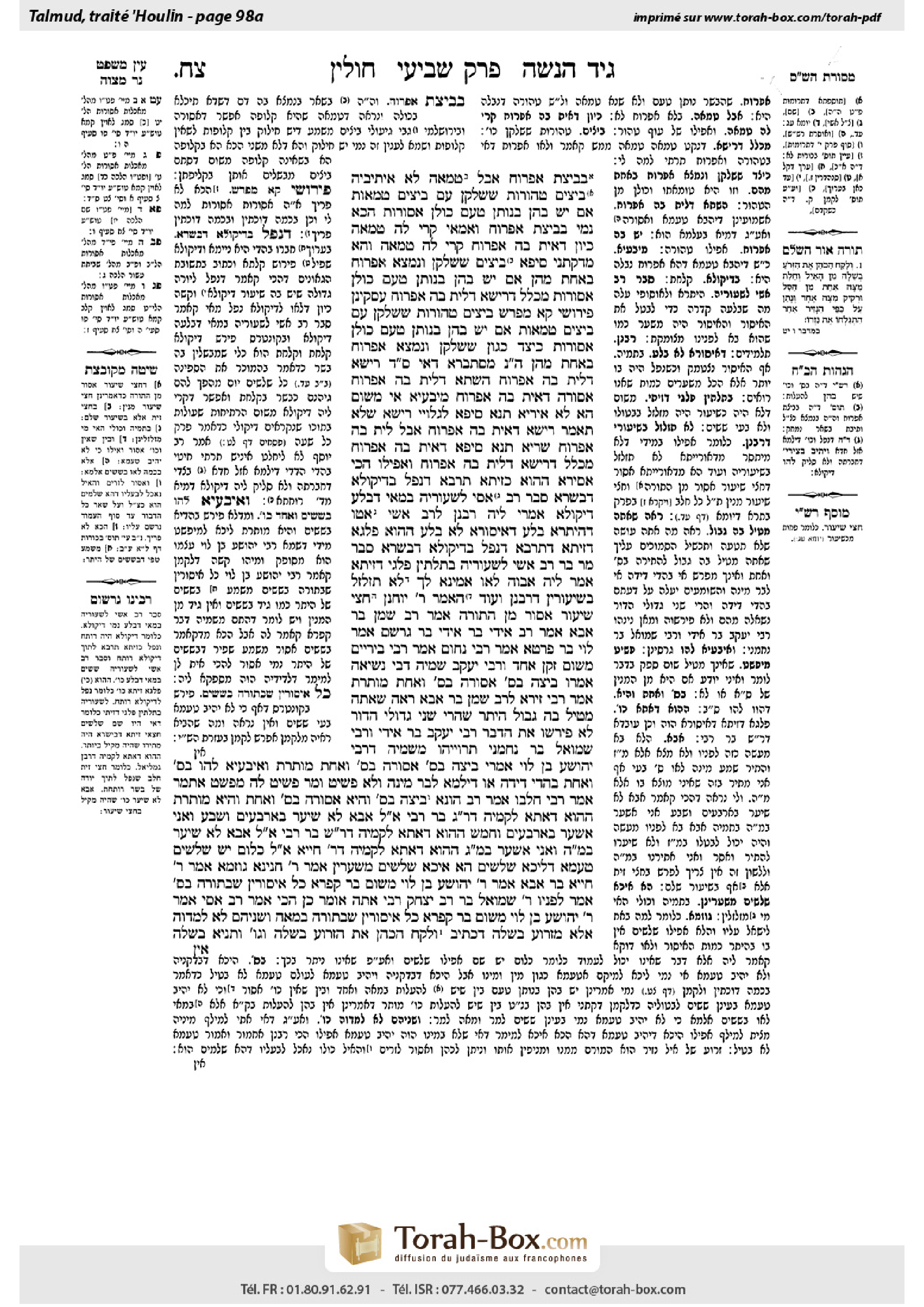
Chullin 98a: Talmud study for Daf Yomi
Study the Talmud for Daf Yomi with scanned pages, Hebrew text, English translations from Sefaria and AI-generated French translations.
Passage selection and English or AI-generated French translation are available where the scan has annotations. Daf Study is independent of Torah-Box and Sefaria.
Browse Chullin · חולין · All tractatesChullin 98a text and translations
This page of Chullin includes the Aramaic text, an English translation and an AI-generated French translation, alongside the scan above.
חולין צ״ח א · Aramaic and Hebrew text
בְּבֵיצַת אֶפְרוֹחַ, אֲבָל טְמֵאָה – לָא.
אֵיתִיבֵיהּ: בֵּיצִים טְהוֹרוֹת שֶׁשְּׁלָקָן עִם בֵּיצִים טְמֵאוֹת, אִם יֵשׁ בָּהֶן בְּנוֹתֵן טַעַם – כּוּלָּן אֲסוּרוֹת. הָכָא נָמֵי בְּבֵיצַת אֶפְרוֹחַ, וְאַמַּאי קָרֵי לַהּ ״טְמֵאָה״? כֵּיוָן דְּאִית בַּהּ אֶפְרוֹחַ, קָרֵי לַהּ ״טְמֵאָה״.
וְהָא מִדְּקָתָנֵי סֵיפָא: בֵּיצִים שֶׁשְּׁלָקָן וְנִמְצָא אֶפְרוֹחַ בְּאַחַת מֵהֶן, אִם יֵשׁ בָּהֶן בְּנוֹתֵן טַעַם – כּוּלָּן אֲסוּרוֹת, מִכְּלָל דְּרֵישָׁא דְּלֵית בַּהּ אֶפְרוֹחַ עָסְקִינַן.
פָּירוּשֵׁי קָא מְפָרֵשׁ: בֵּיצִים טְהוֹרוֹת שֶׁשְּׁלָקָן עִם בֵּיצִים טְמֵאוֹת, אִם יֵשׁ בָּהֶן בְּנוֹתֵן טַעַם – כּוּלָּן אֲסוּרוֹת. כֵּיצַד? כְּגוֹן שֶׁשְּׁלָקָן וְנִמְצָא אֶפְרוֹחַ בְּאַחַת מֵהֶן.
הָכִי נָמֵי מִסְתַּבְּרָא, דְּאִי סָלְקָא דַעְתָּךְ רֵישָׁא דְּלֵית בַּהּ אֶפְרוֹחַ – הַשְׁתָּא דְּלֵית בַּהּ אֶפְרוֹחַ אֲסוּרָה, דְּאִית בַּהּ אֶפְרוֹחַ מִיבַּעְיָא?
אִי מִשּׁוּם הָא לָא אִירְיָא, תְּנָא סֵיפָא לְגַלּוֹיֵי רֵישָׁא, שֶׁלֹּא תֹּאמַר: רֵישָׁא – דְּאִית בַּהּ אֶפְרוֹחַ, אֲבָל לֵית בַּהּ אֶפְרוֹחַ – שַׁרְיָא, תְּנָא סֵיפָא דְּאִית בַּהּ אֶפְרוֹחַ, מִכְּלָל דְּרֵישָׁא דְּלֵית בַּהּ אֶפְרוֹחַ, וַאֲפִילּוּ הָכִי אֲסִירָא.
הָהוּא כְּזֵיתָא תַּרְבָּא דִּנְפַל בְּדִיקּוּלָא דְּבִשְׂרָא, סָבַר רַב אַסִּי לְשַׁעוֹרֵיהּ בְּמַאי דִּבְלַע דִּיקּוּלָא, אָמְרִי לֵיהּ רַבָּנַן לְרַב אָשֵׁי: אַטּוּ דְּהֶיתֵּרָא בָּלַע, דְּאִיסּוּרָא לָא בָּלַע?
הָהוּא פַּלְגָא דְּזֵיתָא דְּתַרְבָּא דִּנְפַל בְּדִיקּוּלָא דְּבִשְׂרָא, סָבַר מָר בַּר רַב אָשֵׁי לְשַׁעוֹרֵיהּ בִּתְלָתִין פַּלְגֵי דְּזֵיתָא. אֲמַר לֵיהּ אֲבוּהּ: לָאו אָמֵינָא לָךְ לָא תְּזַלְזֵל בְּשִׁיעוּרִין דְּרַבָּנַן? וְעוֹד, הָאָמַר רַבִּי יוֹחָנָן: חֲצִי שִׁיעוּר אָסוּר מִן הַתּוֹרָה.
אָמַר רַב שֶׁמֶן בַּר אַבָּא, אָמַר רַב אִידִי בַּר אִידִי בַּר גֵּרְשֹׁם, אָמַר לֵוִי בַּר פְּרָטָא, אָמַר רַבִּי נַחוּם, אָמַר רַבִּי בִּירְיָים מִשּׁוּם זָקֵן אֶחָד, וְרַבִּי יַעֲקֹב שְׁמֵיהּ, דְּבֵי נְשִׂיאָה אָמְרוּ: בֵּיצָה בְּשִׁשִּׁים – אֲסוּרָה, בְּשִׁשִּׁים וְאַחַת – מוּתֶּרֶת.
אָמַר רַבִּי זֵירָא לְרַב שֶׁמֶן בַּר אַבָּא: רְאֵה שֶׁאַתָּה מֵטִיל בָּהּ גְּבוּל הֶיתֵּר, שֶׁהֲרֵי שְׁנֵי גְּדוֹלֵי הַדּוֹר לֹא פֵּירְשׁוּ אֶת הַדָּבָר. רַבִּי יַעֲקֹב בַּר אִידִי וְרַבִּי שְׁמוּאֵל בַּר נַחְמָנִי, תַּרְוַיְיהוּ מִשְּׁמֵיהּ דְּרַבִּי יְהוֹשֻׁעַ בֶּן לֵוִי אָמְרִי: בֵּיצָה בְּשִׁשִּׁים – אֲסוּרָה, בְּשִׁשִּׁים וְאַחַת – מוּתֶּרֶת.
וְאִיבַּעְיָא לְהוּ: בְּשִׁשִּׁים וְאַחַת, בַּהֲדֵי דִּידַהּ, אוֹ דִילְמָא לְבַר מִינַּהּ? וְלָא פְּשׁוּט, וּמָר פָּשֵׁיט לַהּ מִפְשָׁט.
אִתְּמַר, אָמַר רַבִּי חֶלְבּוֹ אָמַר רַב הוּנָא: בֵּיצָה בְּשִׁשִּׁים וְהִיא – אֲסוּרָה, בְּשִׁשִּׁים וְאַחַת וְהִיא – מוּתֶּרֶת.
הָהוּא דַּאֲתָא לְקַמֵּיהּ דְּרַבָּן גַּמְלִיאֵל בַּר רַבִּי, אֲמַר לֵיהּ: אַבָּא לֹא שִׁיעֵר בְּאַרְבָּעִים וָשֶׁבַע, וַאֲנִי אֲשַׁעֵר בְּאַרְבָּעִים וְחָמֵשׁ.
הָהוּא דַּאֲתָא לְקַמֵּיהּ דְּרַבִּי שִׁמְעוֹן בַּר רַבִּי, אֲמַר לֵיהּ: אַבָּא לֹא שִׁיעֵר בְּאַרְבָּעִים וְחָמֵשׁ, וַאֲנִי אֲשַׁעֵר בְּאַרְבָּעִים וְשָׁלֹשׁ.
הָהוּא דַּאֲתָא לְקַמֵּיהּ דְּרַבִּי חִיָּיא, אֲמַר לֵיהּ: כְּלוּם יֵשׁ שְׁלֹשִׁים?
טַעְמָא דְּלֵיכָּא שְׁלֹשִׁים, הָא אִיכָּא שְׁלֹשִׁים – מְשַׁעֲרִין? אָמַר רַבִּי חֲנִינָא: גּוּזְמָא.
אָמַר רַבִּי חִיָּיא בַּר אַבָּא, אָמַר רַבִּי יְהוֹשֻׁעַ בֶּן לֵוִי מִשּׁוּם בַּר קַפָּרָא: כָּל אִיסּוּרִין שֶׁבַּתּוֹרָה בְּשִׁשִּׁים. אָמַר לְפָנָיו רַבִּי שְׁמוּאֵל בַּר רַב יִצְחָק: רַבִּי, אַתָּה אוֹמֵר כֵּן? הָכִי אָמַר רַב אַסִּי אָמַר רַבִּי יְהוֹשֻׁעַ בֶּן לֵוִי מִשּׁוּם בַּר קַפָּרָא: כָּל אִיסּוּרִין שֶׁבַּתּוֹרָה בְּמֵאָה!
וּשְׁנֵיהֶם לֹא לְמָדוּהָ אֶלָּא מִ״זְּרוֹעַ בְּשֵׁלָה״, דִּכְתִיב: ״וְלָקַח הַכֹּהֵן אֶת הַזְּרֹעַ בְּשֵׁלָה וְגוֹ׳״, וְתַנְיָא: ״בְּשֵׁלָה״ –
Chullin 98a · English translation
an egg that contains a chick, as the chick imparts flavor to the food in which the egg is cooked. But with regard to an egg that does not contain a chick but is from a non-kosher bird, it does not impart flavor to the food with which it is cooked.
Rav Idi bar Avin raised an objection to this answer based on a baraita (Tosefta, Terumot 9:5): With regard to kosher eggs that one boiled with non-kosher eggs, if they have a ratio that allows the non-kosher eggs to impart flavor to the kosher eggs, they are all forbidden. This indicates that eggs from non-kosher birds do have flavor. Abaye answered: Here, too it is referring to an egg from a kosher bird that contains a chick. And why does the baraita call this a non-kosher egg, indicating that it is an egg from a non-kosher species? Since it has a chick inside, which causes the egg to be forbidden, the baraita calls it non-kosher.
The Gemara objects: But from the fact that the latter clause teaches: With regard to eggs that one boiled and a chick was found in one of them, if they have a ratio that allows the chick to impart flavor to them, they are all forbidden, it may be inferred that in the first clause we are dealing with an egg that does not have a chick inside.
The Gemara explains that this is an incorrect inference, as the latter clause is explaining the first clause, so that the baraita should be read as follows: With regard to kosher eggs that one boiled with non-kosher eggs, if they have a ratio that allows the non-kosher eggs to impart flavor to the kosher eggs, they are all forbidden. How so? It can be referring to a case where one boiled them and a chick was found in one of them.
The Gemara adds: So too it is reasonable to explain the baraita in this manner, as if it would enter your mind to say that the first clause is referring to a case where there is no chick in the egg, the latter clause is redundant: Now that the tanna has taught that in a case where there is no chick inside, the non-kosher egg imparts flavor to the kosher eggs and renders them forbidden, is it necessary for the tanna to teach that an egg that has a chick inside imparts flavor to the kosher eggs?
The Gemara rejects this argument: If it is due to that reason, there is no conclusive argument, i.e., the proof of the argument is inconclusive. The reason is that one can say that the tanna taught the latter clause to reveal the meaning of the first clause. The latter clause was stated so that you would not mistakenly say that the first clause is referring only to a case where the egg has a chick inside, but if there is no chick inside the kosher eggs would be permitted. Therefore, the tanna teaches the latter clause and specifies that it is referring to an egg that has a chick inside. By inference the first clause is referring to a case of an egg that does not have a chick inside, and even so it renders all of the other eggs forbidden.
§ The Gemara continues discussing the nullification of forbidden foods. There was once a certain olive-bulk of forbidden fat that fell into a pot of kosher meat. Rav Asi thought to measure the volume of the kosher meat together with that which the pot had absorbed. The Rabbis said to Rav Ashi: Is that to say that the pot absorbed the permitted meat but did not absorb the forbidden fat?
The Gemara relates a similar incident: There was once a certain half-olive-bulk of forbidden fat that fell into a pot of kosher meat. Mar bar Rav Ashi thought to measure the amount of kosher meat needed to nullify the forbidden fat as thirty half-olive-bulks, rather than sixty. His father, Rav Ashi, said to him: Have I not told you: Do not treat measures lightly even with regard to rabbinic prohibitions? And furthermore, didn’t Rabbi Yoḥanan say: A half-measure is prohibited by Torah law? Consequently, the half-olive-bulk of forbidden fat is nullified only in sixty times its volume of permitted meat.
§ The Gemara continues its discussion of nullifying forbidden foods. Rav Shemen bar Abba says that Rav Idi bar Idi bar Gershom says that Levi bar Perata says that Rabbi Naḥum says that Rabbi Biryam says in the name of a certain elder, and his name was Rabbi Ya’akov, that the Sages in the house of the Nasi said: If a non-kosher egg is mixed with kosher eggs, if there are sixty eggs they are all forbidden, but if there are sixty-one eggs they are all permitted.
Rabbi Zeira said to Rav Shemen bar Abba: See, one can infer from your words that you fix a limit to permit the eggs if there is a total of sixty-one eggs, including the non-kosher egg. This is a revelation, because the two most eminent Sages of the generation did not clarify this matter. These two eminent Sages were Rabbi Ya’akov bar Idi and Rabbi Shmuel bar Naḥmani, and both of them said in the name of Rabbi Yehoshua ben Levi: In a case where a non-kosher egg is mixed with kosher eggs, if there are sixty eggs they are all forbidden, but if there are sixty-one eggs they are all permitted.
And a dilemma was raised before these Sages: When Rabbi Yehoshua ben Levi said they are permitted if there are sixty-one eggs, does that mean there are sixty-one eggs altogether, with the non-kosher egg, or does it perhaps mean that there must be sixty-one kosher eggs aside from the non-kosher egg? And they did not resolve this dilemma. And yet, it appears as though the Master, Rav Shemen, has resolved the dilemma, because you implied that the mixture is kosher if there are a total of sixty-one eggs including the non-kosher egg.
The Gemara continues: It was stated that Rabbi Ḥelbo says that Rav Huna says: If a non-kosher egg becomes mixed with kosher eggs, if there are sixty kosher eggs in addition to that non-kosher egg, the entire mixture is forbidden. But if there are sixty-one kosher eggs in addition to that one non-kosher egg, the mixture is permitted.
§ There was a certain person who came before Rabban Gamliel bar Rabbi Yehuda HaNasi with a half-olive-bulk of non-kosher food that had been mixed with a larger amount of kosher food. Rabban Gamliel said to him: A similar case came before my father, and even though he did not measure the kosher food as being sixty times the volume of the non-kosher food, he nevertheless permitted the mixture due to the fact that there was forty-seven times as much kosher food as non-kosher food. And similarly, I will permit the mixture because I measure that the kosher food is forty-five times the volume of the non-kosher food.
Similarly there was a certain person who came before Rabbi Shimon bar Rabbi Yehuda HaNasi with a mixture of kosher and non-kosher food. Rabbi Shimon said to him: A similar case came before my father, and even though he did not measure the kosher food as being sixty times the volume of the non-kosher food, he nevertheless permitted the mixture due to the fact that there was forty-five times as much kosher food as non-kosher food. And similarly, I will permit the mixture because I measure that the kosher food is forty-three times the volume of the non-kosher food.
There was a certain man who came before Rabbi Ḥiyya with a mixture of kosher and non-kosher food. Rabbi Ḥiyya said to him: Is there even thirty times the volume of permitted food as forbidden food? Clearly, the mixture is forbidden.
The Gemara seeks to clarify: This indicates that the reason that he prohibited the mixture is that there was not thirty times as much kosher food as non-kosher food. But it may then be inferred that if there is thirty times as much kosher food as non-kosher food, one may assess, i.e., permit, the mixture. And this contradicts the halakha that non-kosher food is nullified only in a mixture containing sixty times as much kosher food as non-kosher food. Rabbi Ḥanina said: Rabbi Ḥiyya did not make this statement to set a halakhic principle, but merely as an exaggeration. There was not even thirty times the volume of kosher food, so it was obvious that the mixture was forbidden.
§ Rabbi Ḥiyya bar Abba says that Rabbi Yehoshua ben Levi says in the name of bar Kappara: All the forbidden foods in the Torah are nullified when they are mixed with kosher food that is sixty times their volume. Rabbi Shmuel bar Rav Yitzḥak said before Rabbi Ḥiyya bar Abba: My teacher, you say this citing Rabbi Yehoshua ben Levi, who said that bar Kappara said it. But this is what Rav Asi says that Rabbi Yehoshua ben Levi says in the name of bar Kappara: All the forbidden foods in the Torah are nullified when they are mixed with kosher food that is one hundred times their volume.
The Gemara adds: And both of them learned their principles of nullification only from the term: “Cooked foreleg,” as it is written with regard to the nazirite’s ram: “And the priest shall take the cooked foreleg of the ram” (Numbers 6:19). And it is taught in a baraita: The verse states: “Cooked,”
Chullin 98a · Traduction française (IA)
un œuf contenant un poussin, car le poussin imprime un goût au plat dans lequel l'œuf est cuit. Mais concernant un œuf ne contenant pas de poussin mais issu d'un oiseau non-kosher, il ne transmet pas de goût au plat avec lequel il est cuit.
Rav Idi bar Avin a soulevé une objection contre cette réponse, fondée sur une baraïta (Tosefta, Terumot 9:5) : Concernant des œufs kasher cuits avec des œufs non-kasher, si le rapport permet aux œufs non-kasher de transmettre un goût aux œufs kasher, tous sont interdits. Cela indique que les œufs d'oiseaux non-kasher ont un goût. Abaye a répondu : Ici aussi, il s'agit d'un œuf d'un oiseau kasher contenant un poussin. Et pourquoi la baraïta appelle-t-elle cet œuf non-kasher, indiquant qu'il provient d'une espèce non-kasher ? Parce qu'il contient un poussin à l'intérieur, ce qui rend l'œuf interdit, la baraïta l'appelle ainsi.
Le Guemara s'oppose : Mais à partir du fait que la clause ultérieure enseigne : Concernant des œufs cuits et un poussin a été trouvé dans l'un d'entre eux, si le rapport permet au poussin de transmettre un goût à ceux-ci, tous sont interdits, on peut en déduire que dans la première clause nous sommes en présence d'un œuf ne contenant pas de poussin à l'intérieur.
Le Guemara explique que cette déduction est incorrecte, car la clause ultérieure explique la première clause, donc la baraïta devrait être lue ainsi : Concernant des œufs kasher cuits avec des œufs non-kasher, si le rapport permet aux œufs non-kasher de transmettre un goût aux œufs kasher, tous sont interdits. Comment cela est-il possible ? Il peut s'agir d'un cas où l'on a fait bouillir et un poussin a été trouvé dans l'un d'entre eux.
Le Guemara ajoute : Il est également raisonnable d'expliquer la baraïta ainsi, car si cela vous venait à l'esprit de dire que la première clause s'applique à un cas où il n'y a pas de poussin dans l'œuf, la clause ultérieure est redondante : Maintenant que le tanna a enseigné que dans un cas où il n'y a pas de poussin à l'intérieur, l'œuf non-kasher transmet un goût aux œufs kasher et les rend interdits, est-il nécessaire que le tanna enseigne que l'œuf contenant un poussin transmet un goût aux œufs kasher ?
Le Guemara rejette cet argument : Si c'est pour cette raison, il n'y a pas d'argument concluant, c'est-à-dire la preuve de l'argument n'est pas concluante. La raison est que l'on peut dire que le tanna a enseigné la clause ultérieure pour révéler le sens de la première clause. La clause ultérieure a été émise afin que vous ne pensiez pas que la première clause s'applique uniquement à un cas où l'œuf contient un poussin, mais si il n'y a pas de poussin dans les œufs kasher, ceux-ci seraient permis. Par conséquent, le tanna enseigne la clause ultérieure et précise qu'il s'agit d'un œuf contenant un poussin. Par déduction, la première clause s'applique à un cas d'œuf ne contenant pas de poussin à l'intérieur, et même ainsi, il rend tous les autres œufs interdits.
§ Le Guemara poursuit la discussion sur l'annulation des aliments interdits. Il y avait une certaine quantité d'huile interdite égale à un olivier qui est tombée dans une casserole de viande kasher. Rav Asi pensait mesurer le volume de la viande kasher ainsi que celui que la casserole avait absorbé. Les Sages dirent à Rav Ashi : Est-ce que cela signifie que la casserole a absorbé la viande permise mais pas l'huile interdite ?
Le Guemara rapporte un incident similaire : Il y avait une certaine quantité d'huile interdite égale à la moitié d'un olivier qui est tombée dans une casserole de viande kasher. Mar bar Rav Ashi pensait mesurer la quantité de viande kasher nécessaire pour annuler l'huile interdite comme trente moitiés d'olivier, plutôt que soixante. Son père, Rav Ashi, lui dit : N'ai-je pas dit : Ne traitez pas les mesures à la légère même concernant les prohibitions rabbiniques ? Et de plus, n'a-t-il pas dit Rabbi Yoḥanan : Une demi-quantité est interdite par la Loi ? Par conséquent, la moitié d'olivier d'huile interdite est annulée uniquement dans soixante fois son volume de viande permise.
§ Le Guemara poursuit sa discussion sur l'annulation des aliments interdits. Rav Shemen bar Abba dit que Rav Idi bar Idi bar Gershom dit que Levi bar Perata dit que Rabbi Naḥum dit que Rabbi Biryam dit en nom d'un certain ancien, et son nom était Rabbi Ya’akov, que les Sages dans la maison du Nasi dirent : Si un œuf non-kasher est mélangé avec des œufs kasher, si l'on a soixante œufs, tous sont interdits, mais si l'on a soixante-et-un œufs, tous sont permis.
Rabbi Zeira dit à Rav Shemen bar Abba : Voyez, on peut en déduire de vos paroles que vous fixez une limite pour permettre les œufs si l'on a un total de soixante-et-un œufs, y compris l'œuf non-kasher. C'est une révélation, car les deux plus éminents Sages de la génération n'ont pas clarifié cette question. Ces deux Sages éminents étaient Rabbi Ya’akov bar Idi et Rabbi Shmuel bar Naḥmani, et tous deux dirent en nom de Rabbi Yehoshua ben Levi : Dans un cas où un œuf non-kasher est mélangé avec des œufs kasher, si l'on a soixante œufs, tous sont interdits, mais si l'on a soixante-et-un œufs, tous sont permis.
Et un dilemme a été soulevé devant ces Sages : Lorsque Rabbi Yehoshua ben Levi a dit qu'ils sont permis si l'on a soixante-et-un œufs, cela signifie-t-il qu'il y a soixante-et-un œufs au total, y compris l'œuf non-kasher, ou cela signifie-t-il peut-être qu'il faut avoir soixante-et-un œufs kasher en dehors de l'œuf non-kasher ? Et ils n'ont pas résolu ce dilemme. Et pourtant, il semble que le Maître, Rav Shemen, ait résolu ce dilemme, car vous avez suggéré que le mélange est permis si l'on a un total de soixante-et-un œufs, y compris l'œuf non-kasher.
Le Guemara continue : Il a été dit que Rabbi Ḥelbo dit que Rav Huna dit : Si un œuf non-kasher est mélangé avec des œufs kasher, si l'on a soixante œufs kasher en plus de cet œuf non-kasher, l'ensemble du mélange est interdit. Mais si l'on a soixante-et-un œufs kasher en plus de cet œuf non-kasher, le mélange est permis.
§ Il y avait un certain homme qui vint devant Rabban Gamliel fils de Rabbi Yehuda HaNasi avec une quantité égale à la moitié d'une olive de nourriture non-kosher mélangée à une quantité plus grande de nourriture kosher. Rabban Gamliel lui dit : Un cas semblable a été soumis à mon père, et même s'il n'avait pas mesuré la quantité de nourriture kosher comme étant soixante fois celle de la nourriture non-kosher, il permit tout de même le mélange en raison du fait que la quantité de nourriture kosher était quarante-sept fois supérieure à celle de la nourriture non-kosher. Et de même, je permets ce mélange car je mesure que la quantité de nourriture kosher est quarante-cinq fois supérieure à celle de la nourriture non-kosher.
De même, il y avait un certain homme qui vint devant Rabbi Shimon fils de Rabbi Yehuda HaNasi avec un mélange de nourriture kosher et non-kosher. Rabbi Shimon lui dit : Un cas semblable a été soumis à mon père, et même s'il n'avait pas mesuré la quantité de nourriture kosher comme étant soixante fois celle de la nourriture non-kosher, il permit tout de même le mélange en raison du fait que la quantité de nourriture kosher était quarante-cinq fois supérieure à celle de la nourriture non-kosher. Et de même, je permets ce mélange car je mesure que la quantité de nourriture kosher est quarante-trois fois supérieure à celle de la nourriture non-kosher.
Il y avait un certain homme qui vint devant Rabbi Ḥiyya avec un mélange de nourriture kosher et non-kosher. Rabbi Ḥiyya lui dit : Y a-t-il même trente fois la quantité de nourriture permise par rapport à la nourriture interdite ? Évidemment, le mélange est interdit.
La Guemara cherche à clarifier : Cela indique que la raison pour laquelle il a interdit le mélange est qu'il n'y avait pas trente fois plus de nourriture kasher que de nourriture non-kasher. Mais on pourrait alors en déduire que si la quantité de nourriture kasher est trente fois supérieure à celle de la nourriture non-kasher, on peut évaluer, c'est-à-dire permettre, le mélange. Et cela contredit la halakha selon laquelle la nourriture non-kasher est annulée uniquement dans un mélange contenant soixante fois plus de nourriture kasher que de nourriture non-kasher. Rabbi Ḥanina a dit : Rabbi Ḥiyya n'a pas fait cette déclaration pour établir un principe halakhique, mais simplement comme une exagération. Il n'y avait même pas trente fois la quantité de nourriture kasher, donc il était évident que le mélange était interdit.
§ Rabbi Ḥiyya bar Abba dit que Rabbi Yehoshua ben Levi dit en nom de bar Kappara : Toutes les nourritures interdites dans la Torah sont annulées lorsqu'elles sont mélangées à une quantité de nourriture kasher soixante fois supérieure. Rabbi Shmuel bar Rav Yitzḥak a dit devant Rabbi Ḥiyya bar Abba : Mon maître, vous dites cela en citant Rabbi Yehoshua ben Levi, qui a dit que bar Kappara l'a dit. Mais c'est ce que Rav Asi dit que Rabbi Yehoshua ben Levi dit en nom de bar Kappara : Toutes les nourritures interdites dans la Torah sont annulées lorsqu'elles sont mélangées à une quantité de nourriture kasher cent fois supérieure.
La Guemara ajoute : Et tous les deux ont appris leurs principes d'annulation uniquement à partir du terme : « Cuit », comme il est écrit concernant le bouc de la personne consacrée : « Et le prêtre prendra le cuir du bouc » (Nombres 6:19). Et il est enseigné dans une baraïta : Le verset dit : « Cuit »,
Traduction française générée par IA à partir de l’édition anglaise de Sefaria. Vérifie toujours un passage avec le texte source.
Text from Sefaria: William Davidson Edition - Vocalized Aramaic (unknown); William Davidson Edition - English (CC BY NC).