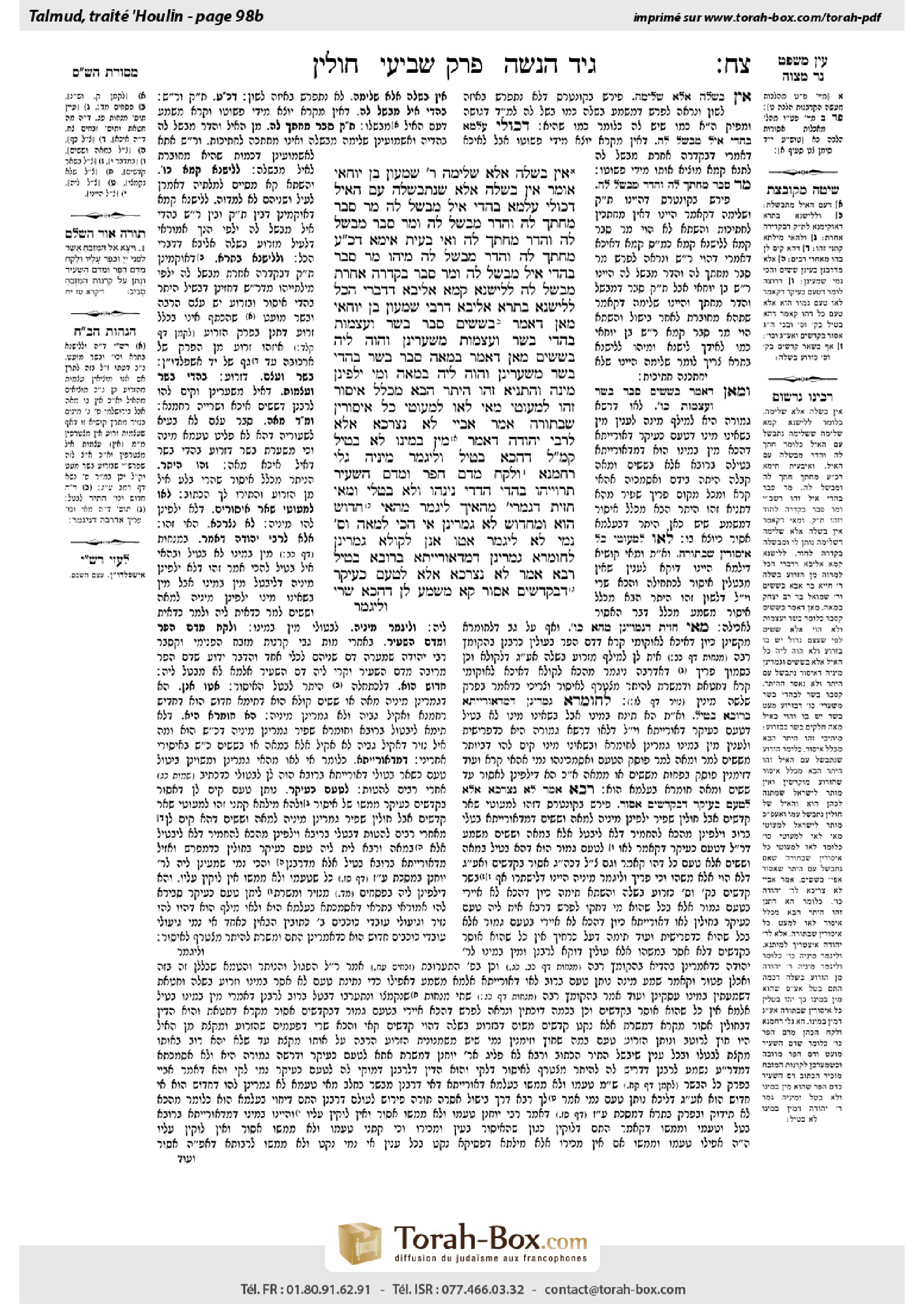
Chullin 98b: Talmud study for Daf Yomi
Study the Talmud for Daf Yomi with scanned pages, Hebrew text, English translations from Sefaria and AI-generated French translations.
Passage selection and English or AI-generated French translation are available where the scan has annotations. Daf Study is independent of Torah-Box and Sefaria.
Browse Chullin · חולין · All tractatesChullin 98b text and translations
This page of Chullin includes the Aramaic text, an English translation and an AI-generated French translation, alongside the scan above.
חולין צ״ח ב · Aramaic and Hebrew text
אֵין ״בְּשֵׁלָה״ אֶלָּא שְׁלֵימָה. רַבִּי שִׁמְעוֹן בֶּן יוֹחַאי אוֹמֵר: אֵין ״בְּשֵׁלָה״ אֶלָּא שֶׁנִּתְבַּשְּׁלָה עִם הָאַיִל.
דְּכוּלֵּי עָלְמָא בַּהֲדֵי אַיִל מְבַשֵּׁל לַהּ, מָר סָבַר: מְחַתֵּךְ לַהּ וַהֲדַר מְבַשֵּׁל לַהּ, וּמָר סָבַר: מְבַשֵּׁל לַהּ וַהֲדַר מְחַתֵּךְ לַהּ.
וְאִי בָּעֵית אֵימָא, דְּכוּלֵּי עָלְמָא מְחַתֵּךְ לַהּ וַהֲדַר מְבַשֵּׁל לַהּ, מִיהוּ מָר סָבַר: בַּהֲדֵי אַיִל מְבַשֵּׁל לַהּ, וּמָר סָבַר: בִּקְדֵרָה אַחֶרֶת מְבַשֵּׁל לַהּ.
לְלִישָּׁנָא קַמָּא – אַלִּיבָּא דְּדִבְרֵי הַכֹּל, לְלִישָּׁנָא בָּתְרָא – אַלִּיבָּא דְּרַבִּי שִׁמְעוֹן בֶּן יוֹחַאי.
מַאן דְּאָמַר בְּשִׁשִּׁים, סָבַר: בָּשָׂר וַעֲצָמוֹת בַּהֲדֵי בָּשָׂר וַעֲצָמוֹת מְשַׁעֲרִינַן, וְהָוֵה לֵיהּ בְּשִׁשִּׁים. מַאן דְּאָמַר בְּמֵאָה, סָבַר: בָּשָׂר בַּהֲדֵי בָּשָׂר מְשַׁעֲרִינַן, וְהָוֵה לֵיהּ בְּמֵאָה.
וּמִי יָלְפִינַן מִינַּהּ? וְהָתַנְיָא: זֶהוּ הֶיתֵּר הַבָּא מִכְּלַל אִיסּוּר, ״זֶהוּ״ לְמַעוֹטֵי מַאי? לָאו לְמַעוֹטֵי כׇּל אִיסּוּרִין שֶׁבַּתּוֹרָה!
אָמַר אַבָּיֵי: לֹא נִצְרְכָא אֶלָּא לְרַבִּי יְהוּדָה, דְּאָמַר מִין בְּמִינוֹ לֹא בָּטֵיל, קָא מַשְׁמַע לַן דְּהָכָא בָּטֵיל.
וְלִיגְמַר מִינֵּיהּ? גַּלִּי רַחֲמָנָא ״וְלָקַח מִדַּם הַפָּר וּמִדַּם הַשָּׂעִיר״, תַּרְוַיְיהוּ בַּהֲדֵי הֲדָדֵי נִינְהוּ וְלָא בָּטְלִי.
וּמַאי חָזֵית דְּגָמְרִינַן מֵהַאיְךְ, לִיגְמַר מֵהַאי? חִדּוּשׁ הוּא, וּמֵחִדּוּשׁ לָא גָּמְרִינַן.
אִי הָכִי, לְמֵאָה וְשִׁשִּׁים נָמֵי לָא לִיגְמַר?
אַטּוּ אֲנַן לְקוּלָּא גָּמְרִינַן? לְחוּמְרָא גָּמְרִינַן, דְּמִדְּאוֹרָיְיתָא בְּרוּבָּא בָּטֵיל.
רָבָא אָמַר: לֹא נִצְרְכָה אֶלָּא לְטַעַם כְּעִיקָּר, דִּבְקָדָשִׁים אָסוּר, קָא מַשְׁמַע לַן דְּהָכָא שָׁרֵי.
Chullin 98b · English translation
and the term “cooked” indicates that the verse is referring only to a foreleg that is whole. Rabbi Shimon ben Yoḥai disagrees and says: The term “cooked” indicates that the verse is referring only to a foreleg that is cooked with the entire ram.
The Gemara clarifies their dispute: Everyone agrees that one cooks the foreleg with the rest of the ram. But one Sage holds that one first cuts the foreleg off the animal and then cooks it along with the rest of the animal. And one Sage, Rabbi Shimon bar Yoḥai, holds that one first cooks the entire ram and then cuts off the foreleg.
And if you wish, say that everyone agrees that one first cuts off the foreleg and then cooks it. But one Sage, Rabbi Shimon bar Yoḥai, holds that one cooks the foreleg with the rest of the ram, and one Sage holds that he cooks the foreleg in another pot, separate from the rest of the ram.
The foreleg of the nazirite’s ram is permitted to be eaten only by a priest, whereas the rest of the ram is eaten by the nazirite even if he is not a priest. Consequently, according to the first formulation, all agree that the principle of nullification may be derived from here, since all agree that the foreleg is cooked together with the rest of the ram, and yet it does not cause the rest of the ram to be forbidden to a non-priest. According to the latter formulation, the principle of nullification may be derived from here in accordance with the opinion of Rabbi Shimon ben Yoḥai, who says that the foreleg is cooked together with the rest of the ram. But according to the latter formulation the first tanna holds that the foreleg is not cooked with the rest of the ram, in which case the principle of nullification cannot be derived from here.
The Gemara now returns to the dispute about whether non-kosher food is nullified in sixty or one hundred times its volume of kosher food, and explains how each opinion is derived from the halakha of the foreleg of the nazirite’s ram. The one who said that non-kosher food is nullified in sixty times its volume of kosher food holds that we assess the ratio of meat and bones of the foreleg to the meat and bones of the rest of the ram, and this is a ratio of one to sixty. The one who said that non-kosher food is nullified in one hundred times its volume of kosher food holds that we assess only the volume of the meat of the foreleg to the meat of the rest of the ram, and this is a ratio of one to one hundred.
The Gemara asks: And do we derive the principles of nullification from the case of the nazirite’s ram? But isn’t it taught in a baraita with regard to the nazirite’s ram, which absorbs the flavor of the foreleg with which it was cooked: This is a case of permitted meat that comes from the category of forbidden food, i.e., it is permitted despite the fact that it was cooked with forbidden food. The Gemara infers: What does the expression: This is, in the baraita serve to exclude? Does it not serve to exclude all the other forbidden foods that are in the Torah? This indicates that only the cooked foreleg of the nazirite’s ram is nullified in sixty or one hundred times its volume of permitted food, but other prohibited foods are not subject to the principle of nullification.
The Gemara answers that Abaye said: This emphasis is necessary only according to the opinion of Rabbi Yehuda, who said that in general, a type of food mixed with food of its own type is not nullified. Therefore the baraita teaches us that here, the flavor imparted by the foreleg to the rest of the nazirite’s ram is nullified.
The Gemara objects: Let Rabbi Yehuda learn from this case that all forbidden food can be nullified when it is mixed with permitted food of its own type. The Gemara explains: The Merciful One revealed in the Torah: “And he shall take of the blood of the bull and of the blood of the goat and put it upon the corners of the altar round about” (Leviticus 16:18). Both of these two bloods are mixed with each other, and although a bull has more blood than a goat has, the verse makes reference to the blood of the goat, indicating that it maintains its own identity and is not nullified.
The Gemara asks: And according to Rabbi Yehuda, what did you see that caused you to derive a principle from that verse with regard to the blood of the bull and the blood of the goat? Derive a principle from this verse about the foreleg of the nazirite’s ram. The Gemara answers: The case of the nazirite’s ram is a novelty, because even when nullification does apply one may not nullify a forbidden food ab initio, whereas here one is supposed to cook the foreleg together with the rest of the ram; and we do not learn principles from a novelty.
The Gemara challenges: If so, if Rabbi Yehuda does not consider the case of the nazirite’s ram a viable precedent for general halakhic principles, then let him also not learn from that case that when forbidden food is mixed with permitted food of a different type, it is nullified in either one hundred or sixty times its own volume. As discussed above, the two opinions in this regard are each based on the case of the nazirite’s ram.
The Gemara explains: Is that to say that we learn that forbidden food is nullified in sixty or one hundred times its volume of permitted food as a leniency? We learn it only as a stringency, as if it were not for this derivation, we would say that by Torah law forbidden food is nullified in a mixture in which there is a simple majority of permitted food.
Rava stated an alternative explanation of the term: This is, which appears in the baraita with regard to the nazirite’s ram: This limitation is necessary only for the principle that the halakhic status of the flavor of forbidden food is like that of its substance. If the flavor of sacrificial food is absorbed into another food, it renders that food forbidden, i.e., it is not nullified. Therefore, the baraita teaches us that here, in the case of the nazirite’s ram, the rest of the ram is permitted even to non-priests.
Chullin 98b · Traduction française (IA)
et le terme « cuit » indique que la versette fait référence uniquement à un avant-tranchant entier. Rabbi Shimon ben Yoḥai désaccorde et dit : le terme « cuit » indique que la versette fait référence uniquement à un avant-tranchant cuisiné avec le tout du bélier.
La Guemara clarifie leur débat : tout le monde convient que l'on cuisine l'avant-tranchant avec le reste du bélier. Mais un Sage affirme que l'on coupe d'abord l'avant-tranchant de l'animal et ensuite on le cuisine avec le reste de l'animal. Et un autre Sage, Rabbi Shimon bar Yoḥai, affirme que l'on cuisine d'abord le tout du bélier et ensuite on coupe l'avant-tranchant.
Et si vous le souhaitez, dites que tout le monde convient que l'on coupe d'abord l'avant-tranchant et ensuite on le cuisine. Mais un Sage, Rabbi Shimon bar Yoḥai, affirme que l'on cuisine l'avant-tranchant avec le reste du bélier, et un autre Sage affirme qu'on cuisine l'avant-tranchant dans une autre marmite, séparément du reste du bélier.
L'avant-tranchant du bélier du nazir est permis à manger uniquement par un prêtre, tandis que le reste du bélier est mangé par le nazir même s'il n'est pas un prêtre. Ainsi, selon la première formulation, tout le monde convient que le principe de nullification peut être déduit d'ici, car tout le monde convient que l'avant-tranchant est cuisiné avec le reste du bélier, et pourtant cela ne rend pas le reste du bélier interdit à un non-prêtre. Selon la seconde formulation, le principe de nullification peut être déduit d'ici selon l'opinion de Rabbi Shimon ben Yoḥai, qui dit que l'avant-tranchant est cuisiné avec le reste du bélier. Mais selon la seconde formulation, le premier tanna affirme que l'avant-tranchant n'est pas cuisiné avec le reste du bélier, dans ce cas le principe de nullification ne peut pas être déduit d'ici.
La Guemara revient maintenant au débat sur le fait que la nourriture non-kosher est nullifiée dans soixante ou cent fois son volume de nourriture kosher, et explique comment chaque opinion est déduite de la halakha de l'avant-tranchant du bélier du nazir. Celui qui dit que la nourriture non-kosher est nullifiée dans soixante fois son volume de nourriture kosher affirme que l'on évalue le rapport de la viande et des os de l'avant-tranchant au rapport de la viande et des os du reste du bélier, et ce rapport est de un à soixante. Celui qui dit que la nourriture non-kosher est nullifiée dans cent fois son volume de nourriture kosher affirme que l'on évalue uniquement le volume de la viande de l'avant-tranchant au volume de la viande du reste du bélier, et ce rapport est de un à cent.
La Guemara pose la question : et puisque nous déduisons les principes de nullification du cas du bélier du nazir, n'est-ce pas enseigné dans une baraïta concernant le bélier du nazir, qui absorbe le goût de l'avant-tranchant avec lequel il a été cuisiné : c'est un cas de viande permise qui provient de la catégorie de la nourriture interdite, c'est-à-dire qu'il est permis malgré le fait qu'il ait été cuisiné avec de la nourriture interdite. La Guemara infère : à quoi sert l'expression « c'est », dans la baraïta ? N'est-ce pas pour exclure ? N'est-ce pas pour exclure toutes les autres nourritures interdites de la Torah ? Cela indique que seul l'avant-tranchant cuisiné du bélier du nazir est nullifié dans soixante ou cent fois son volume de nourriture permise, mais d'autres nourritures interdites ne sont pas soumises au principe de nullification.
La Guemara répond que Abaye a dit : cette insistance est nécessaire uniquement selon l'opinion de Rabbi Yehuda, qui a dit que, en général, une nourriture de type donné mélangée à une nourriture de son propre type n'est pas nullifiée. Par conséquent, la baraïta nous enseigne que ici, le goût transmis par l'avant-tranchant au reste du bélier du nazir est nullifié.
La Guemara s'oppose : laissez Rabbi Yehuda apprendre de ce cas que toutes les nourritures interdites peuvent être nullifiées lorsqu'elles sont mélangées à une nourriture permise de leur propre type. La Guemara explique : L'Éternel a révélé dans la Torah : « Et il prendra du sang de l'agneau et du sang du bouc et le versera sur les angles de l'autel autour » (Lévitique 16:18). Ces deux sangs sont mélangés ensemble, et bien qu'un bouc ait plus de sang qu'un agneau, la versette fait référence au sang de l'agneau, indiquant qu'il maintient son propre identité et n'est pas nullifié.
La Guemara pose la question : et selon Rabbi Yehuda, qu'avez-vous vu qui vous a fait déduire un principe de cette versette concernant le sang du bouc et du sang de l'agneau ? Déduisez un principe de cette versette concernant l'avant-tranche du bélier du nazir. La Guemara répond : le cas du bélier du nazir est une nouveauté, car même lorsque la nullification s'applique, on ne peut pas nullifier une nourriture interdite dès le début, tandis que ici on est censé cuire l'avant-tranche avec le reste du bélier ; et nous ne déduisons pas les principes d'une nouveauté.
La Guemara conteste : si tel est le cas, si Rabbi Yehuda ne considère pas le cas du bélier du nazir comme un précédent viable pour les principes halakhiques généraux, alors laissez-le aussi ne pas apprendre de ce cas que lorsque la nourriture interdite est mélangée à une nourriture permise d'un type différent, elle est nullifiée soit dans soixante soit dans cent fois son propre volume. Comme discuté ci-dessus, les deux opinions concernant cela sont chacune basées sur le cas du bélier du nazir.
La Guemara explique : est-ce que cela signifie que nous apprenons que la nourriture interdite est nullifiée dans soixante ou cent fois son volume de nourriture permise comme une facilité ? Nous l'apprenons uniquement comme une rigueur, comme si ce n'était pas pour cette déduction que nous dirions que selon la loi divine la nourriture interdite est nullifiée dans un mélange où il y a une majorité simple de nourriture permise.
Rava a donné une autre explication du terme « c'est », qui apparaît dans la baraïta concernant le bélier du nazir : cette limitation est nécessaire uniquement pour le principe que le statut halakhique du goût de la nourriture interdite est comme celui de sa substance. Si le goût des aliments sacrés est absorbé dans un autre aliment, cela rend cet aliment interdit, c'est-à-dire qu'il n'est pas nullifié. Par conséquent, la baraïta nous enseigne que, dans ce cas, concernant le bélier du nazir, le reste du bélier est permis même aux non-prêtres.
Traduction française générée par IA à partir de l’édition anglaise de Sefaria. Vérifie toujours un passage avec le texte source.
Text from Sefaria: William Davidson Edition - Vocalized Aramaic (unknown); William Davidson Edition - English (CC BY NC).