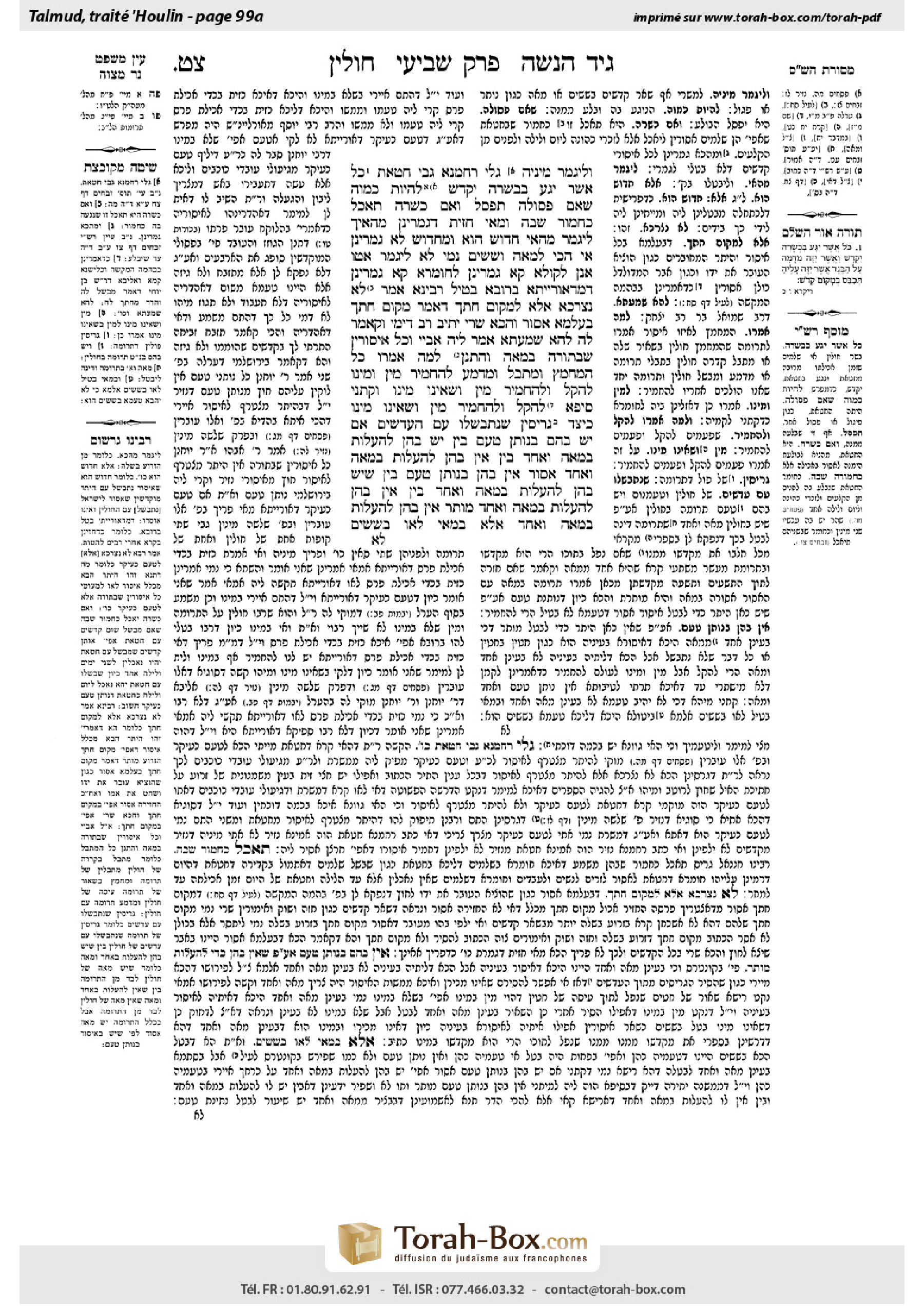
Chullin 99a: Talmud study for Daf Yomi
Study the Talmud for Daf Yomi with scanned pages, Hebrew text, English translations from Sefaria and AI-generated French translations.
Passage selection and English or AI-generated French translation are available where the scan has annotations. Daf Study is independent of Torah-Box and Sefaria.
Browse Chullin · חולין · All tractatesChullin 99a text and translations
This page of Chullin includes the Aramaic text, an English translation and an AI-generated French translation, alongside the scan above.
חולין צ״ט א · Aramaic and Hebrew text
וְלִיגְמַר מִינֵּיהּ? גַּלִּי רַחֲמָנָא גַּבֵּי חַטָּאת: ״כֹּל אֲשֶׁר יִגַּע בִּבְשָׂרָהּ יִקְדָּשׁ״, לִהְיוֹת כָּמוֹהָ – שֶׁאִם פְּסוּלָה תִּפָּסֵל, וְאִם כְּשֵׁרָה תֵּאָכֵל כֶּחָמוּר שֶׁבָּהּ.
וּמַאי חָזֵית דְּגָמְרִינַן מֵהַאיְךְ, לִיגְמַר מֵהַאי? חִדּוּשׁ הוּא, וּמֵחִדּוּשׁ לָא גָּמְרִינַן.
אִי הָכִי, לְמֵאָה וְשִׁשִּׁים נָמֵי לָא לִיגְמַר? אַטּוּ אֲנַן לְקוּלָּא קָא גָמְרִינַן? לְחוּמְרָא קָא גָמְרִינַן, דְּמִדְּאוֹרָיְיתָא בְּרוּבָּא בָּטֵיל.
רָבִינָא אָמַר: לֹא נִצְרְכָה אֶלָּא לִמְקוֹם חֲתָךְ, דְּאָמַר: מְקוֹם חֲתָךְ בְּעָלְמָא אָסוּר, וְהָכָא שְׁרֵי.
יָתֵיב רַב דִּימִי, וְקָאָמַר לַהּ לְהָא שְׁמַעְתָּא.
אֲמַר לֵיהּ אַבָּיֵי: וְכׇל אִיסּוּרִין שֶׁבַּתּוֹרָה בְּמֵאָה? וְהָתְנַן: לָמָה אָמְרוּ כׇּל הַמְחַמֵּץ וּמְתַבֵּל וּמְדַמֵּעַ לְהַחְמִיר – מִין וּמִינוֹ, לְהָקֵל וּלְהַחְמִיר – מִין וְשֶׁאֵינוֹ מִינוֹ.
וְקָתָנֵי סֵיפָא לְהָקֵל וּלְהַחְמִיר מִין וְשֶׁאֵינוֹ מִינוֹ, כֵּיצַד? גְּרִיסִין שֶׁנִּתְבַּשְּׁלוּ עִם הָעֲדָשִׁים, אִם יֵשׁ בָּהֶם בְּנוֹתֵן טַעַם, בֵּין יֵשׁ בָּהֶן לְהַעֲלוֹת בְּמֵאָה וְאֶחָד, בֵּין אֵין בָּהֶן לְהַעֲלוֹת בְּמֵאָה וְאֶחָד – אָסוּר.
אֵין בָּהֶן בְּנוֹתֵן טַעַם, בֵּין שֶׁיֵּשׁ בָּהֶן לְהַעֲלוֹת בְּמֵאָה וְאֶחָד, בֵּין אֵין בָּהֶן לְהַעֲלוֹת בְּמֵאָה וְאֶחָד – מוּתָּר.
אֵין בָּהֶן לְהַעֲלוֹת בְּמֵאָה וְאֶחָד, אֶלָּא בְּמַאי? לָאו בְּשִׁשִּׁים?
Chullin 99a · English translation
The Gemara objects: Let us learn from the case of the nazirite’s ram that the flavor of sacrificial food can be nullified. The Gemara explains: The Merciful One revealed in the Torah with regard to the sin offering: “Whatever shall touch its flesh shall be holy” (Leviticus 6:20). This teaches that the halakhic status of any food that touches and absorbs flavor from a sin offering becomes like it, so that if the sin offering is disqualified, this food shall also be disqualified, and if the sin offering is valid, this food may be eaten in accordance with the stringencies that apply to a sin offering.
The Gemara asks: And what did you see to indicate that we learn the principle of nullification concerning sacrificial food from that verse of the sin offering? Derive it instead from this verse concerning the foreleg of the nazirite’s ram. The Gemara answers: This case of the nazirite’s ram is a novelty, and we do not learn principles from a novelty.
The Gemara objects: If so, if the case of the nazirite’s ram is not a viable precedent for general halakhic principles, then one should also not learn from that case that when forbidden food is mixed with permitted food of a different type, it is nullified in either one hundred or sixty times its own volume. As discussed above, the two opinions in this regard are both based on the case of the nazirite’s ram. The Gemara responds: Is that to say that we learn that forbidden food is nullified in sixty or one hundred times its volume of permitted food as a leniency? We learn it only as a stringency, as if it were not for this derivation, one would say that by Torah law forbidden food is nullified in a mixture in which there is a simple majority of permitted food.
Ravina said an alternative explanation of the term: This is, that appears in the baraita with regard to the nazirite’s ram. This limitation is necessary only for the place where the foreleg is cut from the body of the ram, as it was said that in a case where permitted and forbidden foods were attached and one cut the forbidden section from the permitted section, the place of the cut on the permitted part is generally forbidden. But here, in the case of the nazirite’s ram, it is permitted.
§ The Gemara returns to discussing the statement of Rabbi Shmuel bar Rav Yitzḥak (98a) that forbidden food is nullified in a mixture only if there is one hundred times its volume of permitted food. Rav Dimi sat and said this halakha.
Abaye said to him: And is it true that all the forbidden foods in the Torah that are mixed with permitted foods are nullified only in a mixture containing one hundred times their volume of permitted food? But didn’t we learn in a mishna (Orla 2:6): Why did the Sages say that with regard to anyone who leavens non-sacred food with a leavening agent that is teruma or flavors it with spices of teruma or mixes teruma into non-sacred food, thereby making the food forbidden for non-priests, the halakha is to be stringent if he mixed one type of food that is teruma with non-sacred food of the same type. But the halakha is to be lenient and to be stringent if he mixed one type of teruma with non-sacred food of a different type.
And it is taught in the latter clause, i.e., in the following mishna (Orla 2:7): When it is stated that the halakha is to be lenient and to be stringent if he mixed one type of teruma with non-sacred food not of its type, how is this accomplished? For example, in a case of split beans of teruma that were cooked with non-sacred lentils, if there are enough split beans relative to the lentils to impart flavor to the lentils, then regardless of whether there are enough lentils to neutralize the split beans in one hundred and one times their volume, i.e., the volume of the lentils is one hundred and one times the volume of the split beans, or whether there are not enough lentils to neutralize the split beans in one hundred and one times their volume, the entire mixture is forbidden to a non-priest.
Conversely, if there are not enough split beans of teruma to impart flavor to the lentils, then regardless of whether there are enough lentils to neutralize the split beans in one hundred and one times their volume, or whether there are not enough lentils to neutralize the split beans in one hundred and one times their volume, the mixture is permitted even to a non-priest.
Abaye commented: When the mishna says that there are not enough lentils to neutralize the split beans in one hundred and one times their volume, and nevertheless if the split beans did not impart flavor to the lentils, the mixture is permitted, in what amount of lentils are the split beans nullified? Is it not that the split beans are permitted because they are mixed with sixty times their volume of non-sacred lentils? This contradicts the opinion of Rabbi Shmuel bar Rav Yitzḥak.
Chullin 99a · Traduction française (IA)
La Guemara s'oppose : Apprenons de l'exemple du bœuf du nazirite que le goût des aliments sacrés peut être annulé. La Guemara explique : L'Éternel a révélé dans la Torah concernant l'offrande expiatoire : « Tout ce qui touchera sa chair sera saint » (Lévitique 6:20). Cela enseigne que le statut halakhique d'un aliment qui touche et absorbe le goût d'une offrande expiatoire devient semblable au sien, de sorte que si l'offrande expiatoire est disqualifiée, cet aliment sera également disqualifié, et si l'offrande expiatoire est valide, cet aliment peut être mangé selon les stricteurs qui s'appliquent à une offrande expiatoire.
La Guemara demande : Et qu'as-tu vu pour indiquer que nous apprenons le principe d'annulation concernant les aliments sacrés à partir de cette versette sur l'offrande expiatoire ? Apprends-le plutôt à partir de cette versette concernant la cuisse du bœuf du nazirite. La Guemara répond : Ce cas du bœuf du nazirite est une nouveauté, et nous ne tirons pas de principes généraux d'une nouveauté.
La Guemara s'oppose : Si tel est le cas, si le cas du bœuf du nazirite n'est pas un précédent viable pour les principes halakhiques généraux, alors on ne devrait pas non plus apprendre de ce cas que lorsqu'un aliment interdit est mélangé à un aliment permis d'un autre type, il est annulé soit dans un centuple, soit dans un soixantuple de son volume. Comme discuté ci-dessus, les deux opinions concernant cela sont basées sur le cas du bœuf du nazirite. La Guemara répond : Est-ce que cela signifie que nous apprenons que l'aliment interdit est annulé dans un centuple ou un soixantuple de volume d'aliment permis comme une leniante ? Nous apprenons cela uniquement comme une stricteur, car sans cette dérivation, on dirait que selon la loi divine, l'aliment interdit est annulé dans un mélange où il y a une majorité simple d'aliment permis.
Ravina dit une autre explication du terme : Cela figure dans la baraïta concernant le bouc du nazirite. Cette limitation est nécessaire uniquement pour le lieu où la cuisse est coupée du corps du bouc, car il a été dit que dans un cas où des aliments permis et interdits étaient attachés et qu'on coupait la partie interdite de la partie permise, la zone de la coupure sur la partie permise est généralement interdite. Mais ici, dans le cas du bouc du nazirite, cela est permis.
§ La Guemara reprend la discussion sur l'affirmation de Rabbi Shmuel bar Rav Yitzḥak (98a) que l'aliment interdit est annulé dans un mélange uniquement si le volume d'aliment permis est cent fois celui de l'aliment interdit. Rav Dimi a dit cela.
Abaye a dit à lui : Et est-ce vrai que tous les aliments interdits de la Torah qui sont mélangés aux aliments permis sont annulés uniquement dans un mélange contenant cent fois leur volume d'aliment permis ? Mais n'avons-nous pas appris dans une mitsva (Orla 2:6) : Pourquoi les Sages ont-ils dit que concernant celui qui fait lever un aliment non sacré avec un agent de levain qui est terouma ou qu'il le parfume avec des épices de terouma ou qu'il mélange la terouma dans un aliment non sacré, rendant ainsi l'aliment interdit aux non-prêtres, la halakha est stricte si l'on a mélangé un type d'aliment terouma avec un aliment non sacré du même type. Mais la halakha est leniente et stricte si l'on a mélangé un type de terouma avec un aliment non sacré d'un autre type.
Et il est enseigné dans la clause suivante, c'est-à-dire dans la Michna suivante (Orla 2:7) : Lorsqu'il est dit que la halakha est leniente et stricte si l'on a mélangé un type de terouma avec un aliment non sacré non de son type, comment cela est-il accompli ? Par exemple, dans un cas de haricots de terouma écrasés cuits avec des lentilles non sacrées, si les haricots écrasés sont suffisants par rapport aux lentilles pour leur imprimer un goût, alors indépendamment de ce que les lentilles sont suffisantes pour neutraliser les haricots écrasés dans un centun et un fois leur volume, c'est-à-dire que le volume des lentilles est centun et un fois le volume des haricots écrasés, ou s'ils ne sont pas suffisants pour neutraliser les haricots écrasés dans un centun et un fois leur volume, le mélange est interdit aux non-prêtres.
À l'inverse, si les haricots écrasés de terouma ne sont pas suffisants pour imprimer un goût aux lentilles, alors indépendamment de ce que les lentilles sont suffisantes pour neutraliser les haricots écrasés dans un centun et un fois leur volume, ou s'ils ne sont pas suffisants pour neutraliser les haricots écrasés dans un centun et un fois leur volume, le mélange est permis même aux non-prêtres.
Abaye a commenté : Lorsque la Michna dit que les lentilles ne sont pas suffisantes pour neutraliser les haricots écrasés dans un centun et un fois leur volume, et pourtant si les haricots écrasés n'ont pas imprégné de goût aux lentilles, le mélange est permis, dans quelle quantité de lentilles les haricots écrasés sont-ils annulés ? N'est-ce pas que les haricots écrasés sont permis parce qu'ils sont mélangés à soixante fois leur volume de lentilles non sacrées ? Cela contredit l'opinion de Rabbi Shmuel bar Rav Yitzḥak.
Traduction française générée par IA à partir de l’édition anglaise de Sefaria. Vérifie toujours un passage avec le texte source.
Text from Sefaria: William Davidson Edition - Vocalized Aramaic (unknown); William Davidson Edition - English (CC BY NC).