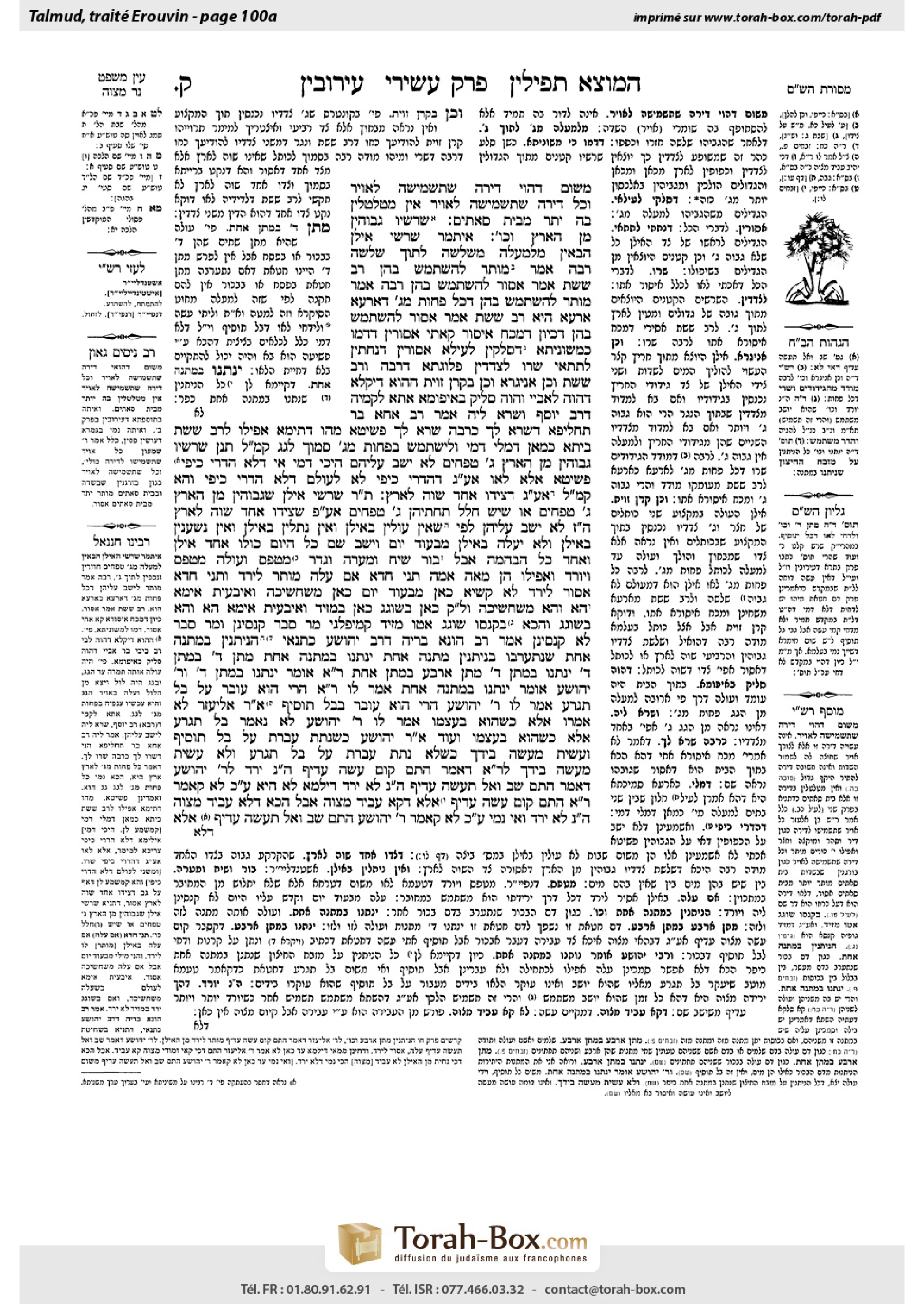
Eruvin 100a: Talmud study for Daf Yomi
Study the Talmud for Daf Yomi with scanned pages, Hebrew text, English translations from Sefaria and AI-generated French translations.
Passage selection and English or AI-generated French translation are available where the scan has annotations. Daf Study is independent of Torah-Box and Sefaria.
Browse Eruvin · עירובין · All tractatesEruvin 100a text and translations
This page of Eruvin includes the Aramaic text, an English translation and an AI-generated French translation, alongside the scan above.
עירובין ק׳ א · Aramaic and Hebrew text
מִשּׁוּם דְּהָוֵי דִּירָה שֶׁתַּשְׁמִישָׁהּ לַאֲוִיר, וְכׇל דִּירָה שֶׁתַּשְׁמִישָׁהּ לַאֲוִיר — אֵין מְטַלְטְלִין בָּהּ יָתֵר מִבֵּית סָאתַיִם.
שׇׁרָשָׁיו גְּבוֹהִין מִן הָאָרֶץ וְכוּ׳. אִיתְּמַר: שׇׁרְשֵׁי אִילָן הַבָּאִין מִלְּמַעְלָה מִשְּׁלֹשָׁה לְתוֹךְ שְׁלֹשָׁה, רַבָּה אָמַר: מוּתָּר לְהִשְׁתַּמֵּשׁ בָּהֶן, רַב שֵׁשֶׁת אָמַר: אָסוּר לְהִשְׁתַּמֵּשׁ בָּהֶן.
רַבָּה אָמַר: מוּתָּר לְהִשְׁתַּמֵּשׁ בָּהֶן, דְּכׇל פָּחוֹת מִשְּׁלֹשָׁה דְּאַרְעָא — אַרְעָא הִיא. רַב שֵׁשֶׁת אָמַר: אָסוּר לְהִשְׁתַּמֵּשׁ בָּהֶן, דְּכֵיוָן דְּמִכֹּחַ אִיסּוּר קָאָתֵי — אֲסוּרִין.
דְּדָמוּ כִּמְשׁוּנִּיתָא, דְּסָלְקִין לְעֵילָּא — אֲסוּרִין. דְּנָחֲתִין לְתַתַּאי — שְׁרוּ. לִצְדָדִין — פְּלוּגְתָּא דְּרַבָּה וְרַב שֵׁשֶׁת.
וְכֵן אַנִּיגְרָא, וְכֵן בְּקֶרֶן זָוִית.
הָהוּא דִּיקְלָא דַּהֲוָה לְאַבָּיֵי, וַהֲוָה סָלֵיק בְּאִיפּוּמָא. אֲתָא לְקַמֵּיהּ דְּרַב יוֹסֵף וּשְׁרָא לֵיהּ.
אָמַר רַב אַחָא בַּר תַּחְלִיפָא: דִּשְׁרָא לָךְ, כְּרַבָּה שְׁרָא לָךְ.
פְּשִׁיטָא? מַהוּ דְּתֵימָא אֲפִילּוּ לְרַב שֵׁשֶׁת בֵּיתָא כְּמַאן דִּמְלֵי דָּמֵי, וְלִישְׁתַּמֵּשׁ בְּפָחוֹת מִשְּׁלֹשָׁה סָמוּךְ לַגַּג, קָא מַשְׁמַע לַן.
תְּנַן: שׇׁרָשָׁיו גְּבוֹהִין מִן הָאָרֶץ שְׁלֹשָׁה טְפָחִים — לֹא יֵשֵׁב עֲלֵיהֶם. הֵיכִי דָמֵי? אִי דְּלָא הָדְרִי כָּיְפִי — פְּשִׁיטָא. אֶלָּא לָאו, אַף עַל גַּב דְּהָדְרִי כָּיְפִי!
לָא, לְעוֹלָם דְּלָא הָדָרִי כָּיְפִי, וְהָא קָא מַשְׁמַע לַן אַף עַל גַּב דְּצִידּוֹ אֶחָד שָׁוֶה לָאָרֶץ.
תָּנוּ רַבָּנַן שׇׁרְשֵׁי אִילָן שֶׁגְּבוֹהִין מִן הָאָרֶץ שְׁלֹשָׁה טְפָחִים אוֹ שֶׁיֵּשׁ חָלָל תַּחְתֵּיהֶן שְׁלֹשָׁה טְפָחִים, אַף עַל פִּי שֶׁצִּידּוֹ אֶחָד שָׁוֶה לָאָרֶץ — הֲרֵי זֶה לֹא יֵשֵׁב עֲלֵיהֶן, לְפִי שֶׁאֵין עוֹלִין בְּאִילָן, וְאֵין נִתְלִין בְּאִילָן, וְאֵין נִשְׁעָנִין בְּאִילָן.
וְלֹא יַעֲלֶה בְּאִילָן מִבְּעוֹד יוֹם וְיֵשֵׁב שָׁם כׇּל הַיּוֹם כּוּלּוֹ. אֶחָד אִילָן וְאֶחָד כׇּל הַבְּהֵמָה, אֲבָל בּוֹר שִׁיחַ וּמְעָרָה וְגָדֵר — מְטַפֵּס וְעוֹלֶה מְטַפֵּס וְיוֹרֵד, וַאֲפִילּוּ הֵן מֵאָה אַמָּה.
תָּנֵי חֲדָא: אִם עָלָה — מוּתָּר לֵירֵד, וְתָנֵי חֲדָא — אָסוּר לֵירֵד. לָא קַשְׁיָא: כָּאן — מִבְּעוֹד יוֹם, כָּאן — מִשֶּׁחָשֵׁיכָה.
וְאִיבָּעֵית אֵימָא, הָא וְהָא מִשֶּׁחָשֵׁיכָה, וְלָא קַשְׁיָא: כָּאן — בְּשׁוֹגֵג, כָּאן — בְּמֵזִיד.
וְאִיבָּעֵית אֵימָא, הָא וְהָא בְּשׁוֹגֵג, וְהָכָא בְּקָנְסוּ שׁוֹגֵג אַטּוּ מֵזִיד קָמִיפַּלְגִי. מָר סָבַר: קָנְסִינַן. וּמָר סָבַר: לָא קָנְסִינַן.
אָמַר רַב הוּנָא בְּרֵיהּ דְּרַב יְהוֹשֻׁעַ: כְּתַנָּאֵי. הַנִּיתָּנִין בְּמַתָּנָה אַחַת שֶׁנִּתְעָרְבוּ בְּנִיתָּנִין מַתָּנָה אַחַת — יִנָּתְנוּ בְּמַתָּנָה אַחַת, מַתַּן אַרְבַּע בְּמַתַּן אַרְבַּע — יִנָּתְנוּ בְּמַתַּן אַרְבַּע.
מַתַּן אַרְבַּע בְּמַתַּן אַחַת, רַבִּי אֱלִיעֶזֶר אוֹמֵר: יִנָּתְנוּ בְּמַתַּן אַרְבַּע. וְרַבִּי יְהוֹשֻׁעַ אוֹמֵר: יִנָּתְנוּ בְּמַתָּנָה אַחַת.
אָמַר לוֹ רַבִּי אֱלִיעֶזֶר: הֲרֵי הוּא עוֹבֵר עַל ״בַּל תִּגְרַע״! אָמַר לוֹ רַבִּי יְהוֹשֻׁעַ: הֲרֵי הוּא עוֹבֵר בְּ״בַל תּוֹסִיף״.
אָמַר רַבִּי אֱלִיעֶזֶר: לֹא אָמְרוּ אֶלָּא כְּשֶׁהוּא בְּעַצְמוֹ. אָמַר לוֹ רַבִּי יְהוֹשֻׁעַ: לֹא נֶאֱמַר ״בַּל תִּגְרַע״ אֶלָּא כְּשֶׁהוּא בְּעַצְמוֹ.
וְעוֹד אָמַר רַבִּי יְהוֹשֻׁעַ: כְּשֶׁנָּתַתָּ — עָבַרְתָּ עַל ״בַּל תּוֹסִיף״ וְעָשִׂיתָ מַעֲשֶׂה בְּיָדֶךָ. כְּשֶׁלֹּא נָתַתָּ — עָבַרְתָּ עַל ״בַּל תִּגְרַע״ וְלֹא עָשִׂיתָ מַעֲשֶׂה בְּיָדֶךָ.
לְרַבִּי אֱלִיעֶזֶר דְּאָמַר הָתָם ״קוּם עֲשֵׂה״ עָדִיף, הָכִי נָמֵי יֵרֵד. לְרַבִּי יְהוֹשֻׁעַ דְּאָמַר הָתָם ״שֵׁב וְאַל תַּעֲשֶׂה״ עָדִיף, הָכִי נָמֵי לֹא יֵרֵד.
דִּילְמָא לָא הִיא, עַד כָּאן לָא קָאָמַר רַבִּי אֱלִיעֶזֶר הָתָם ״קוּם עֲשֵׂה״ עָדִיף — אֶלָּא דְּקָא עָבֵיד מִצְוָה. אֲבָל הָכָא דְּלָא עָבֵיד מִצְוָה, הָכִי נָמֵי לֹא יֵרֵד.
וְאִי נָמֵי, עַד כָּאן לָא קָאָמַר רַבִּי יְהוֹשֻׁעַ הָתָם ״שֵׁב וְאַל תַּעֲשֶׂה״ עָדִיף — אֶלָּא
Eruvin 100a · English translation
This was prohibited because it is a dwelling that serves only the air, i.e., it is used only by someone guarding the fields or the like. It is not used as permanent living quarters, despite its partitions. And the rule with respect to any dwelling that serves only the air is that it is not permitted to carry in it if its area is more than two beit se’a. As it is not a proper place of residence, the Sages treated it as an enclosure.
The mishna states: If the roots of the tree are three handbreadths above the ground, one may not sit on them on Shabbat. It was stated that amora’im disagreed with regard to the roots of a tree that rise up and then bend and come down from above, from a height of three handbreadths to within three handbreadths of the ground. Rabba said: It is permitted to use them, and Rav Sheshet said: It is prohibited to use them.
The Gemara clarifies the rationale of each opinion. Rabba said that it is permitted to use them, as anything less than three handbreadths from the ground is considered as the ground. Rav Sheshet said: It is prohibited to use them; since they come from a prohibited source, they are prohibited. The section of the tree from which they grow is prohibited. Therefore, these roots should likewise be prohibited.
The Gemara proceeds to qualify the dispute: With regard to ascending and descending roots that resemble a rocky crag, those that rise upward are certainly prohibited according to all opinions; those that fall downward are permitted according to everyone. It is the roots that branch out to the sides that are the subject of the dispute between Rabba and Rav Sheshet. Rav Sheshet prohibits using them, while Rabba is lenient.
And likewise, Rabba and Rav Sheshet disagree about a tree that grows in a ditch that has elevated roots, some of which are concealed by the banks of the ditch. The amora’im dispute whether the roots concealed by the banks are considered part of the ground. And likewise, in the case of a tree that grows in a corner between two walls, they disagree as to whether the section between the walls is considered part of the ground.
The Gemara relates that Abaye had a certain palm tree that grew in his house and that projected through an opening in the roof. He came before Rav Yosef to ask him about it, and he permitted him to use the first three handbreadths of the palm tree above the roof, as the tree’s lower part is treated as though it were in the ground.
Rav Aḥa bar Taḥlifa said to Abaye: He who permitted it to you, permitted it to you in accordance with the opinion of Rabba, who maintains that a section of a tree concealed from view in at least two directions is considered as though it were underground. Consequently, the first three handbreadths above that section may be used on Shabbat, as they have the status of the ground.
The Gemara expresses surprise: This is obvious. What novel element is Rav Aḥa bar Taḥlifa teaching us? The Gemara answers: It is necessary, lest you say that in this case it should be permitted even according to Rav Sheshet, as the house is considered full, i.e., it is as though it were filled with earth, and this would mean it is permitted to use the section less than three handbreadths from the roof. Rav Aḥa bar Taḥlifa therefore teaches us that Rav Sheshet is stringent even in this case.
The Gemara attempts to adduce proof from the mishna, in which we learned: If the roots of the tree are three handbreadths above the ground, one may not sit on them. What are the circumstances of this case? If the situation is that the roots do not bend over again, this is obvious, as anything higher than three handbreadths is part of the tree. Rather, doesn’t it mean that one may not sit on them even though they bend back downward to within three handbreadths of the ground? The mishna apparently indicates that if parts of the roots are more than three handbreadths above the ground, it is prohibited to use them along the rest of their entire length, as maintained by Rav Sheshet, contrary to Rabba.
The Gemara rejects this contention: No, actually the mishna is referring to a case where they do not bend back downward, and the tanna comes to teach us the following: Although on one side of the tree the roots are level with the ground, nevertheless, it is prohibited to sit on them, as the roots on the other sides are more than three handbreadths above the ground.
The Sages taught in a baraita: With regard to roots of a tree that are three handbreadths above the ground, or if there is a hollow space beneath them of three handbreadths, although on one side of the tree the roots are level with the ground, one may not sit on them because of the following rule: One may not climb a tree, nor may one hang from a tree by one’s hands, nor may one even lean against a tree on Shabbat.
And similarly, one may not climb a tree on Friday while it is still day and sit there the entire day of Shabbat. This constitutes the use of the tree itself, not merely climbing it, and it is therefore prohibited. This halakha applies both to a tree and to all animals; one may not climb upon them, hang from them, or lean against them. However, the prohibition is not due to the effort involved in climbing, as is evident from the case of a cistern, ditch, cave, or a fence. One may climb up and climb down them, even if they are a hundred cubits deep.
The Gemara comments: It was taught in one baraita: If one climbed up a tree, he is permitted to climb down; and it was taught in one other baraita that he is prohibited to climb down. The Gemara resolves this apparent contradiction: This is not difficult. Here, where it is permitted to descend, one climbed up on Friday, while it was still day; there, where it is prohibited to descend, one climbed up on Shabbat after nightfall.
And if you wish, say instead that both baraitot are referring to a case where one climbed up the tree after nightfall. But even so, it is not difficult: Here, it is permitted to descend, as one climbed up the tree unwittingly; there, it is prohibited to descend, as the baraita is dealing with one who climbed intentionally.
And if you wish, say instead that both baraitot are referring to a case where one climbed up unwittingly, and they disagree about whether or not the Sages penalized an unwitting offender due to an intentional offender. One Sage, who ruled that it is prohibited to descend, maintains that they penalized an unwitting sinner to prevent others from climbing up on purpose and descending. Therefore, one may not come down even if he ascended by mistake. And one Sage, who ruled that it is permitted, maintains that they did not penalize the unwitting sinner in this manner.
Rav Huna, son of Rav Yehoshua, said: This dispute between the two baraitot is parallel to the dispute of the tanna’im, who disagreed with regard to a different matter. The blood of certain sacrifices, e.g., the firstborn and tithe offerings, is sprinkled once on the altar, while the blood of other sacrifices, e.g., burnt-offerings, is sprinkled four times. They require two sprinklings that are four, i.e., two sprinklings on opposite corners, so that the blood falls on all four sides. If the blood of sacrifices that require only one sprinkling becomes intermingled with the blood of other sacrifices that require only one sprinkling, the mixture will be sprinkled once. Likewise, if the blood of sacrifices that require four sprinklings becomes intermingled with the blood of other sacrifices that require four sprinklings, the mixture will be sprinkled four times.
If, however, the blood of a sacrifice that requires four sprinklings becomes intermingled with the blood of a sacrifice that requires only one sprinkling, the tanna’im disagree: Rabbi Eliezer says: The mixture of blood is sprinkled four times. And Rabbi Yehoshua says: It is sprinkled once, and this suffices for the atonement of the sacrifice.
Rabbi Eliezer said to Rabbi Yehoshua: If one sprinkles the blood only once, he transgresses the prohibition “you shall not diminish,” which prohibits the omission of any elements of the performance of a mitzva, as he has not sprinkled the blood of the burnt-offering in the proper manner. Rabbi Yehoshua said to Rabbi Eliezer: According to your ruling, that one must sprinkle the blood four times, he transgresses the prohibition: Do not add (Deuteronomy 13:1), which prohibits the addition of elements to a mitzva, as he sprinkles the blood of the firstborn animal more times than necessary.
Rabbi Eliezer said to Rabbi Yehoshua: They said the prohibition against adding to the mitzvot only where the blood stands by itself, not when it is part of a mixture. Rabbi Yehoshua said to Rabbi Eliezer: Likewise, the prohibition: Do not diminish, was stated only in a case where the blood stands by itself.
And Rabbi Yehoshua further said in defense of his position: When you sprinkle four times, you have transgressed the prohibition: Do not add, with regard to one of the sacrifices, and you also performed an action with your own hand, i.e., you transgress the Torah’s command by means of a positive act. By contrast, when you do not sprinkle four times, even if you have transgressed the prohibition: Do not diminish, you did not perform the action with your own hand. If one is forced to deviate from the commands of the Torah, it is better to do so in a passive manner.
Rav Huna, son of Rav Yehoshua, sought to argue the following: According to Rabbi Eliezer, who said there, with regard to sacrifices, that if both alternatives involve the violation of a prohibition it is preferable to stand and take action, i.e., perform a positive action, here too, one should climb down from the tree, as it is better to perform a single positive transgression by climbing down rather than commit a passive transgression throughout the entire Shabbat by remaining on the tree. By contrast, according to Rabbi Yehoshua, who said with regard to sacrifices that it is preferable to sit and not take action, here too, one should not descend from the tree.
The Gemara refutes this comparison: Perhaps that is not the case, as the two halakhot are not identical. Rabbi Eliezer might have stated his opinion that it is preferable to stand and take action only in the case dealt with there, where one performs a mitzva with respect to the additional sprinklings of the burnt-offering. However, here, where one performs no mitzva whatsoever by descending, indeed, he should not descend.
Alternatively, the comparison can be rejected in a different fashion: Rabbi Yehoshua may have stated his opinion that it is preferable to sit and not take action only in the case dealt with there,
Eruvin 100a · Traduction française (IA)
Cela était interdit car il s'agit d'une demeure qui sert uniquement à l'air, c'est-à-dire qu'elle est utilisée uniquement par quelqu'un qui garde les champs ou un tel. Elle n'est pas utilisée comme une résidence permanente, malgré ses cloisons. Et la règle concernant toute demeure qui sert uniquement à l'air est que l'on ne peut pas porter des objets dedans si sa surface est supérieure à deux beit se'a. Comme ce n'est pas un lieu de résidence approprié, les Sages l'ont traité comme une enceinte.
La mitsna dit : Si les racines de l'arbre sont à trois tefachim au-dessus du sol, on ne peut pas s'asseoir dessus le sabbat. Il a été dit que les amoraïm étaient en désaccord concernant les racines d'un arbre qui montent puis s'incurvent et retournent vers le bas, passant d'une hauteur de trois tefachim à trois tefachim du sol. Rabba a dit : Il est permis d'utiliser ces racines, et Rav Sheshet a dit : Il est interdit d'utiliser ces racines.
Le Guemara clarifie la raison de chaque opinion. Rabba a dit qu'il est permis d'utiliser ces racines, car tout ce qui est à moins de trois tefachim du sol est considéré comme faisant partie du sol. Rav Sheshet a dit : Il est interdit d'utiliser ces racines ; puisque leur origine est interdite, elles sont interdites. La section de l'arbre d'où elles proviennent est interdite. Par conséquent, ces racines devraient également être interdites.
Le Guemara poursuit en clarifiant le débat : Concernant les racines qui montent et descendent ressemblant à un rocher, celles qui montent sont certainement interdites selon toutes les opinions ; celles qui descendent sont permises selon toutes les opinions. Ce sont les racines qui s'étendent latéralement qui sont au centre du débat entre Rabba et Rav Sheshet. Rav Sheshet interdit leur utilisation, tandis que Rabba est plus clément.
Et de même, Rabba et Rav Sheshet sont en désaccord concernant un arbre qui pousse dans un fossé dont certaines racines sont érigées et cachées par les berges du fossé. Les amoraïm débattent sur le fait que ces racines cachées sont considérées comme faisant partie du sol. Et de même, dans le cas d'un arbre qui pousse dans un coin entre deux murs, ils sont en désaccord sur le fait que la section entre les murs est considérée comme faisant partie du sol.
Le Guemara rapporte que Abaye avait un certain palmier qui poussait dans sa maison et qui projetait à travers une ouverture du toit. Il est venu devant Rav Yosef pour lui demander son avis, et il lui a permis d'utiliser les trois tefachim du palmier situés au-dessus du toit, car la partie inférieure de l'arbre est traitée comme si elle était dans le sol.
Rav Acha bar Tachlifa a dit à Abaye : Celui qui t'a permis cela, l'a permis selon l'opinion de Rabba, qui considère qu'une section d'un arbre cachée de la vue dans au moins deux directions est considérée comme étant sous terre. Par conséquent, les trois tefachim situés au-dessus de cette section peuvent être utilisés le sabbat, car elles ont le statut du sol.
Le Guemara exprime une surprise : Cela est évident. Quel élément nouveau Rav Acha bar Tachlifa nous enseigne-t-il ? Le Guemara répond : Il est nécessaire, afin que l'on ne dise pas que dans ce cas il est permis même selon l'opinion de Rav Sheshet, car la maison est considérée comme pleine, c'est-à-dire qu'elle est comme si elle était remplie de terre, et cela signifierait qu'il est permis d'utiliser la section située à moins de trois tefachim du toit. Rav Acha bar Tachlifa enseigne donc que Rav Sheshet est strict même dans ce cas.
Le Guemara tente d'adduire une preuve à partir de la mitsna, dans laquelle nous avons appris : Si les racines de l'arbre sont à trois tefachim au-dessus du sol, on ne peut pas s'asseoir dessus. Quelles sont les circonstances de ce cas ? Si la situation est que les racines ne se courbent pas à nouveau, cela est évident, car tout ce qui est au-dessus de trois tefachim fait partie de l'arbre. Plutôt, ne dit-il pas que l'on ne peut pas s'asseoir dessus même s'ils retournent vers le bas à trois tefachim du sol ? La mitsna semble indiquer que si certaines parties des racines sont à plus de trois tefachim au-dessus du sol, il est interdit d'utiliser ces racines le long de toute leur longueur, selon l'opinion de Rav Sheshet, contrairement à celle de Rabba.
Le Guemara rejette cette contention : Non, en réalité, la mitsna fait référence à un cas où elles ne se courbent pas à nouveau, et le tanna vient nous enseigner ceci : Bien que les racines d'un côté de l'arbre soient au niveau du sol, il est interdit de s'asseoir dessus, car les racines de l'autre côté sont à plus de trois tefachim au-dessus du sol.
Les Sages ont enseigné dans une baraïta : Concernant les racines d'un arbre à trois tefachim au-dessus du sol, ou si il y a un espace vide sous elles de trois tefachim, bien que les racines d'un côté de l'arbre soient au niveau du sol, on ne peut pas s'asseoir dessus en raison de la règle suivante : On ne peut pas monter en arbre, ni s'accrocher à un arbre avec ses mains, ni même se reposer contre un arbre le sabbat.
Et de même, on ne peut pas monter en arbre le vendredi alors qu'il fait encore jour et s'asseoir là toute la journée du sabbat. Cela constitue l'utilisation de l'arbre lui-même, pas seulement la montée, et il est donc interdit. Cette halakha s'applique à la fois à un arbre et à tous les animaux ; on ne peut pas monter dessus, s'accrocher à eux ou se reposer contre eux. Cependant, l'interdiction n'est pas due à l'effort impliqué dans la montée, comme le montre le cas d'un puits, d'un fossé, d'une grotte ou d'un mur. On peut monter et descendre, même s'ils sont profonds de cent coudées.
Le Guemara commente : Il a été enseigné dans une baraïta : Si l'on monte en arbre, on est autorisé à descendre ; et il a été enseigné dans une autre baraïta que l'on est interdit de descendre. Le Guemara résout ce paradoxe apparent : Ce n'est pas difficile. Ici, où l'on est autorisé à descendre, l'on a monté le vendredi alors qu'il faisait encore jour ; là, où l'on est interdit de descendre, l'on a monté le sabbat après le coucher du soleil.
Et si tu veux, dis plutôt que les deux baraitot font référence à un cas où l'on est monté dans l'arbre après la nuit. Mais même ainsi, ce n'est pas difficile : ici, il est permis de descendre, car l'on est monté dans l'arbre sans intention ; là, il est interdit de descendre, car la baraïta traite d'une personne qui est montée intentionnellement.
Et si tu veux, dis plutôt que les deux baraitot font référence à un cas où l'on est monté sans intention, et ils divergent sur le fait que les Sages ont pénalisé ou non un transgresseur sans intention en raison d'un transgresseur intentionnel. Un Sage, qui a décidé qu'il est interdit de descendre, affirme qu'ils ont pénalisé le transgresseur sans intention afin d'empêcher les autres de monter intentionnellement et de descendre. Ainsi, on ne peut pas descendre même si l'on est monté par erreur. Un autre Sage, qui a décidé qu'il est permis de descendre, affirme qu'ils n'ont pas pénalisé le transgresseur sans intention de cette manière.
Rav Huna, fils de Rav Yehoshua, a dit : Ce débat entre les deux baraitot est parallèle au débat des tannaïm, qui divergeaient concernant une autre question. Le sang de certains sacrifices, par exemple, les offrandes de premiers-nés et de dîme, est aspergé une seule fois sur l'autel, tandis que le sang d'autres sacrifices, par exemple, les offrandes brûlées, est aspergé quatre fois. Ils exigent deux aspérations qui sont quatre, c'est-à-dire deux aspérations aux angles opposés, afin que le sang tombe sur les quatre côtés. Si le sang des sacrifices nécessitant une seule aspération se mélange avec le sang d'autres sacrifices nécessitant une seule aspération, le mélange sera aspergé une seule fois. De même, si le sang des sacrifices nécessitant quatre aspérations se mélange avec le sang d'autres sacrifices nécessitant quatre aspérations, le mélange sera aspergé quatre fois.
Cependant, si le sang d'un sacrifice nécessitant quatre aspérations se mélange avec le sang d'un sacrifice nécessitant une seule aspération, les tannaïm divergent : Rabbi Eliezer dit : Le mélange de sang est aspergé quatre fois. Et Rabbi Yehoshua dit : Il est aspergé une seule fois, et cela suffit à l'atonement du sacrifice.
Rabbi Eliezer a dit à Rabbi Yehoshua : Si l'on asperge le sang seulement une fois, on transgresse la prohibition « tu ne diminueras pas », qui interdit l'omission d'aucun élément de la performance d'une mitsva, car on n'a pas aspergé le sang de l'holocauste de la manière appropriée. Rabbi Yehoshua a dit à Rabbi Eliezer : Selon votre décision, que l'on doit asperger le sang quatre fois, on transgresse la prohibition : « ne fais pas d'ajout », qui interdit d'ajouter des éléments à une mitsva, car on asperge le sang de l'animal de premier-né plus de fois que nécessaire.
Rabbi Eliezer a dit à Rabbi Yehoshua : Ils ont dit la prohibition contre l'ajout des mitsvot seulement dans le cas où le sang est seul, pas lorsqu'il est partie d'un mélange. Rabbi Yehoshua a dit à Rabbi Eliezer : De même, la prohibition : « ne diminueras pas » a été énoncée seulement dans un cas où le sang est seul.
Et Rabbi Yehoshua a dit encore en défense de sa position : Lorsque l'on asperge quatre fois, on transgresse la prohibition : « ne fais pas d'ajout », concernant l'un des sacrifices, et on effectue aussi une action avec sa propre main, c'est-à-dire qu'on transgresse la commande de la Torah par un acte positif. En revanche, lorsqu'on ne asperge pas quatre fois, même si l'on transgresse la prohibition : « ne diminueras pas », on n'a pas effectué l'action avec sa propre main. Si l'on est contraint de s'écarter des commandements de la Torah, il est préférable de le faire de manière passive.
Rav Huna, fils de Rav Yehoshua, a cherché à argumenter ainsi : Selon Rabbi Eliezer, qui a dit là, concernant les sacrifices, que si les deux alternatives impliquent la violation d'une prohibition, il est préférable de se tenir et d'agir, c'est-à-dire d'effectuer une action positive, ici aussi, on devrait descendre de l'arbre, car il est préférable d'effectuer une seule transgression positive en descendant plutôt que de commettre une transgression passive tout au long du Shabbat en restant sur l'arbre. En revanche, selon Rabbi Yehoshua, qui a dit concernant les sacrifices qu'il est préférable de rester assis et de ne pas agir, ici aussi, on ne devrait pas descendre de l'arbre.
La Guemara réfute cette comparaison : Peut-être que ce n'est pas le cas, car les deux halakhot ne sont pas identiques. Rabbi Eliezer pourrait avoir énoncé son opinion selon laquelle il est préférable de se tenir et d'agir uniquement dans le cas traité là, où l'on effectue une mitsva concernant les aspérations supplémentaires de l'holocauste. Cependant, ici, où l'on ne réalise aucune mitsva du tout en descendant, effectivement, il ne devrait pas descendre.
Autrement, cette comparaison peut être rejetée d'une autre manière : Rabbi Yehoshua pourrait avoir exprimé son opinion selon laquelle il est préférable de rester assis et de ne pas agir uniquement dans le cas traité là-bas,
Traduction française générée par IA à partir de l’édition anglaise de Sefaria. Vérifie toujours un passage avec le texte source.
Text from Sefaria: William Davidson Edition - Vocalized Aramaic (CC BY NC); William Davidson Edition - English (CC BY NC).