Eruvin 99b: Talmud study for Daf Yomi
Study the Talmud for Daf Yomi with scanned pages, Hebrew text, English translations from Sefaria and AI-generated French translations.
Passage selection and English or AI-generated French translation are available where the scan has annotations. Daf Study is independent of Torah-Box and Sefaria.
Browse Eruvin · עירובין · All tractatesEruvin 99b text and translations
This page of Eruvin includes the Aramaic text, an English translation and an AI-generated French translation, alongside the scan above.
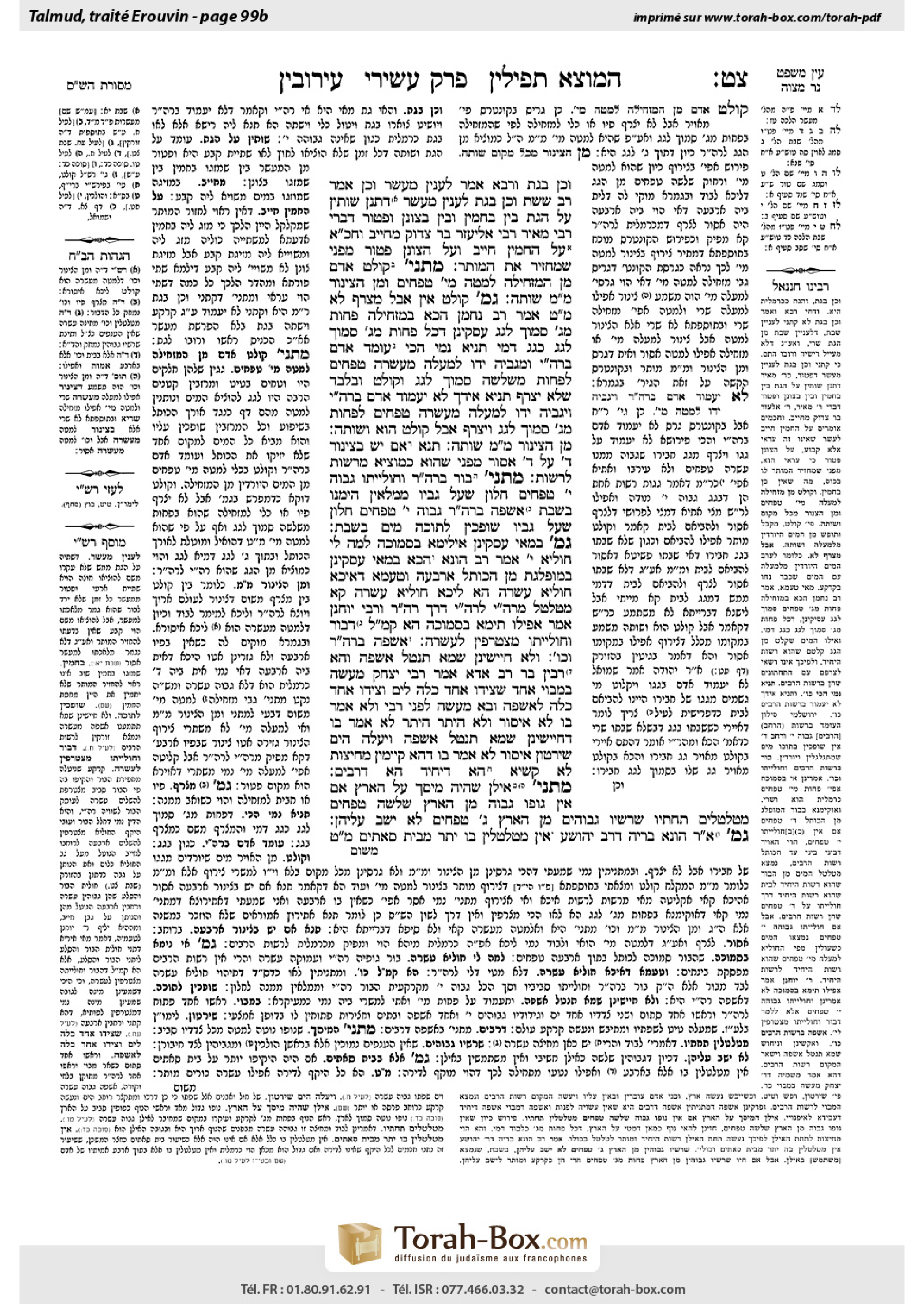
עירובין צ״ט ב · Aramaic and Hebrew text
וְכֵן בַּגַּת.
וְרָבָא אָמַר: לְעִנְיַן מַעֲשֵׂר. וְכֵן אָמַר רַב שֵׁשֶׁת: ״וְכֵן בַּגַּת״ — לְעִנְיַן מַעֲשֵׂר.
דִּתְנַן: שׁוֹתִין עַל הַגַּת, בֵּין בְּחַמִּין וּבֵין בְּצוֹנֵן, וּפָטוּר — דִּבְרֵי רַבִּי מֵאִיר. רַבִּי אֱלִיעֶזֶר בַּר צָדוֹק מְחַיֵּיב.
וַחֲכָמִים אוֹמְרִים: עַל הַחַמִּין חַיָּיב, וְעַל הַצּוֹנֵן פָּטוּר. מִפְּנֵי שֶׁמַּחֲזִיר אֶת הַמּוֹתָר.
מַתְנִי׳ קוֹלֵט אָדָם מִן הַמַּזְחֵילָה לְמַטָּה מֵעֲשָׂרָה טְפָחִים, וּמִן הַצִּינּוֹר מִכׇּל מָקוֹם שׁוֹתֶה.
גְּמָ׳ קוֹלֵט — אִין, אֲבָל מְצָרֵף — לָא. מַאי טַעְמָא? אָמַר רַב נַחְמָן: הָכָא בְּמַזְחֵילָה פָּחוֹת מִשְּׁלֹשָׁה סָמוּךְ לַגַּג עָסְקִינַן, דְּכׇל פָּחוֹת מִשְּׁלֹשָׁה סָמוּךְ לַגַּג, כְּגַג דָּמֵי.
תַּנְיָא נָמֵי הָכִי: עוֹמֵד אָדָם בִּרְשׁוּת הַיָּחִיד וּמַגְבִּיהַּ יָדוֹ לְמַעְלָה מֵעֲשָׂרָה טְפָחִים לְפָחוֹת מִשְּׁלֹשָׁה סָמוּךְ לַגַּג, וְקוֹלֵט, וּבִלְבַד שֶׁלֹּא יְצָרֵף.
תַּנְיָא אִידַּךְ: לֹא יַעֲמוֹד אָדָם בִּרְשׁוּת הַיָּחִיד וְיַגְבִּיהַּ יָדוֹ לְמַעְלָה מֵעֲשָׂרָה טְפָחִים לְפָחוֹת מִשְּׁלֹשָׁה סָמוּךְ לַגַּג וִיצָרֵף, אֲבָל קוֹלֵט הוּא וְשׁוֹתֶה.
מִן הַצִּינּוֹר מִכׇּל מָקוֹם שׁוֹתֶה. תָּנָא: אִם יֵשׁ בְּצִינּוֹר אַרְבָּעָה עַל אַרְבָּעָה — אָסוּר, מִפְּנֵי שֶׁהוּא כְּמוֹצִיא מֵרְשׁוּת לִרְשׁוּת.
מַתְנִי׳ בּוֹר בִּרְשׁוּת הָרַבִּים וְחוּלְיָיתוֹ גָּבוֹהַּ עֲשָׂרָה טְפָחִים, חַלּוֹן שֶׁעַל גַּבָּיו מְמַלְּאִין הֵימֶנּוּ בְּשַׁבָּת.
אַשְׁפָּה בִּרְשׁוּת הָרַבִּים גְּבוֹהָ עֲשָׂרָה טְפָחִים, חַלּוֹן שֶׁעַל גַּבָּיו שׁוֹפְכִין לְתוֹכָהּ מַיִם בְּשַׁבָּת.
גְּמָ׳ בְּמַאי עָסְקִינַן? אִילֵימָא בִּסְמוּכָה, לְמָה לִי חוּלְיָא עֲשָׂרָה?
אָמַר רַב הוּנָא: הָכָא בְּמַאי עָסְקִינַן? בְּמוּפְלֶגֶת מִן הַכּוֹתֶל אַרְבָּעָה.
וְטַעְמָא דְּאִיכָּא חוּלְיָא עֲשָׂרָה, הָא לֵיכָּא חוּלְיָא עֲשָׂרָה — קָא מְטַלְטֵל מֵרְשׁוּת הַיָּחִיד לִרְשׁוּת הַיָּחִיד דֶּרֶךְ רְשׁוּת הָרַבִּים.
וְרַבִּי יוֹחָנָן אָמַר: אֲפִילּוּ תֵּימָא בִּסְמוּכָה — הָא קָא מַשְׁמַע לַן דְּבוֹר וְחוּלְיָיתוֹ מִצְטָרְפִין לַעֲשָׂרָה.
אַשְׁפָּה בִּרְשׁוּת הָרַבִּים וְכוּ׳. וְלָא חָיְישִׁינַן שֶׁמָּא תִּנָּטֵל אַשְׁפָּה?
וְהָא רָבִין בַּר רַב אַדָּא אָמַר רַבִּי יִצְחָק: מַעֲשֶׂה בְּמָבוֹי אֶחָד שֶׁצִּידּוֹ אֶחָד כָּלֶה לַיָּם וְצִידּוֹ אֶחָד כָּלֶה לְאַשְׁפָּה, וּבָא מַעֲשֶׂה לִפְנֵי רַבִּי, וְלֹא אָמַר בּוֹ לֹא אִיסּוּר וְלֹא הֶיתֵּר.
הֶיתֵּר לֹא אָמַר בּוֹ — דְּחָיְישִׁינַן שֶׁמָּא תִּנָּטֵל אַשְׁפָּה, וְיַעֲלֶה הַיָּם שִׂירְטוֹן.
אִיסּוּר לֹא אָמַר בּוֹ — דְּהָא קָיְימִין מְחִיצוֹת.
לָא קַשְׁיָא: הָא — דְּיָחִיד, הָא — דְּרַבִּים.
מַתְנִי׳ אִילָן שֶׁהָיָה מֵיסֵךְ עַל הָאָרֶץ, אִם אֵין גּוּפוֹ גָּבוֹהַּ מִן הָאָרֶץ שְׁלֹשָׁה טְפָחִים — מְטַלְטְלִים תַּחְתָּיו.
שׇׁרָשָׁיו גְּבוֹהִים מִן הָאָרֶץ שְׁלֹשָׁה טְפָחִים — לֹא יֵשֵׁב עֲלֵיהֶן.
גְּמָ׳ אָמַר רַב הוּנָא בְּרֵיהּ דְּרַב יְהוֹשֻׁעַ: אֵין מְטַלְטְלִין בּוֹ יָתֵר מִבֵּית סָאתַיִם, מַאי טַעְמָא?
Eruvin 99b · English translation
And the same applies in a winepress. This winepress cannot be a private domain, as the first clause of the mishna already dealt with a private domain. The winepress must therefore be a karmelit, which proves that it is prohibited to drink from a karmelit while standing in a public domain.
And Rava said: This proof is not conclusive, as the words: The same applies in a winepress, do not refer to Shabbat but to the matter of the halakhot of tithes, as explained below. And similarly, Rav Sheshet said that the statement that the same applies in a winepress refers to the matter of tithes.
The Gemara clarifies this statement. As we learned in a mishna: One may drink grape juice directly on the winepress ab initio without tithing, whether the juice was diluted with hot water, even though he will then be unable to return the leftover wine to the press, as it would ruin all the wine in the press, or whether the juice was diluted with cold water, in which case he could return the leftover wine without ruining the rest, and he is exempt. Drinking that way is considered incidental drinking, and anything that is not a fixed meal is exempt from tithing. This is the statement of Rabbi Meir. Rabbi Eliezer bar Tzadok deems one obligated to tithe in both cases.
And the Rabbis say: There is a distinction between these two cases. When the juice is diluted with hot water, since one cannot return what is left of the juice to the press, he is obligated to tithe it, as this drinking is like fixed drinking for which one is obligated to tithe. However, when the juice is diluted with cold water, he is exempt from tithing it, because he can return the leftover juice to the press. Therefore, it is considered incidental drinking, which is exempt from tithing. The teaching of the mishna: The same applies to a winepress, is in accordance with the opinion of Rabbi Meir, as it teaches that that the leniency to drink without separating tithes applies only if the drinker’s head and most of his body are in the winepress.
MISHNA: A person standing in a public domain on Shabbat may catch water in a vessel from a gutter running along the side of a roof, if it is less than ten handbreadths off the ground, which is part of the public domain. And from a pipe that protrudes from the roof, one may drink in any manner, i.e., not only by catching the water in a vessel, but even by pressing his mouth directly against the spout.
GEMARA: A careful reading of the mishna indicates that to catch, yes, one may catch the water from a distance, but to press his hand or mouth to the gutter, no, that is prohibited. The Gemara asks: What is the reason for this distinction? Rav Naḥman said: Here, we are dealing with a gutter within three handbreadths of the roof, and the halakha is in accordance with the principle that anything within three handbreadths of a roof is considered like the roof itself, based on the principle of lavud, according to which two solid surfaces are considered joined if there is a gap of less than three handbreadths between them. Since the roof of the house is a private domain, one would be carrying from a private domain to a public domain, which is prohibited.
That ruling, that there is a distinction between catching water falling from a gutter and pressing one’s hand or mouth to it, was also taught in a baraita: A person may stand in a private domain and raise his hand above ten handbreadths, until it is within three handbreadths of the roof, and catch any water falling from his neighbor’s roof in a vessel, provided that he does not press his hand or mouth to the roof.
It was likewise taught in another baraita: A person may not stand in a private domain and raise his hand above ten handbreadths, to within three handbreadths of the roof, and press his hand to the gutter, but he may catch water falling from the gutter and drink.
It was stated in the mishna: But from a pipe one may drink in any manner, as it protrudes more than three handbreadths from the roof. A Sage taught in the Tosefta: If the pipe itself is four by four handbreadths wide, it is prohibited to stand in the public domain and press one’s hand or mouth to the water, because he is like one who carries from one domain to another domain, as the pipe is considered a domain in its own right.
MISHNA: With regard to a cistern in a public domain, with an embankment ten handbreadths high, i.e., the embankment constitutes a private domain by itself, if there is a window above the cistern, i.e., the window of an adjacent house is situated above the cistern, one may draw water from the cistern on Shabbat through the window, as it is permitted to carry from one private domain to another.
Similarly, with regard to a garbage dump in a public domain that is ten handbreadths high, which means it has the status of a private domain, if there is a window above the pile of refuse that abuts the garbage dump, one may throw water from the window onto the dump on Shabbat, as it is permitted to carry from one private domain to another.
GEMARA: The Gemara asks: With what are we dealing here? If you say we are dealing with a cistern that is adjacent to the wall of the house, i.e. the cistern and wall are separated by less than four handbreadths, why do I need the cistern’s embankment to be ten handbreadths high? Presumably the cistern is ten handbreadths deep, which makes it a private domain, and as it is too close to the house for the public domain to pass between them, one should be permitted to draw water from the cistern through the window, regardless of the height of the embankment.
Rav Huna said: With what are we dealing here? With a case where the cistern or garbage dump is four handbreadths removed from the wall of the house, i.e., a public domain separates the house from the cistern or heap. It is prohibited to carry from one private domain to another by way of a public domain. However, if the cistern’s embankment is ten handbreadths high, the one drawing the water transfers it by way of an area that is more than ten handbreadths above the public domain, which is an exempt domain.
And the reason that drawing the water is permitted is that there is an embankment of ten handbreadths; but if there is no embankment of ten handbreadths, it is prohibited, as this would involve moving objects from one private domain to another by way of the public domain.
And Rabbi Yoḥanan said: The above explanation is unnecessary. Even if you say that we are dealing with a cistern that is adjacent to the wall of the house, the mishna comes to teach us that a cistern and its embankment combine to complete the ten handbreadths required for a private domain, and it is not necessary that the embankment itself reach a height of ten handbreadths.
The mishna states: With regard to a garbage dump in a public domain that is ten handbreadths high, if there is a window above the heap, one may throw water from the window onto the heap on Shabbat. The Gemara asks: Aren’t we concerned that the entire garbage dump or part of it might be removed, turning the area into a public domain, and people will continue to throw water onto it on Shabbat?
But didn’t Ravin bar Rav Adda say that Rav Yitzḥak said: An incident occurred involving a certain alleyway, one of whose sides terminated in the sea, which closed it off on one side, and the other side of which terminated in a garbage dump. And the incident came before Rabbi Yehuda HaNasi for his ruling as to whether the alleyway has the status of an alleyway closed on both sides, and he did not say anything about it, either prohibition or permission.
The Gemara clarifies: Rabbi Yehuda HaNasi did not say about it that carrying in the alleyway is permitted, as we are concerned lest the garbage dump be removed from its present spot, leaving one side of the alleyway open, and we are likewise concerned that perhaps the sea will throw up sediment and recede. These sedimentary deposits will intervene between the end of the alleyway and the sea, thereby depriving the alleyway of one its partitions.
Similarly, he did not say about it that carrying in the alleyway was prohibited, as its partitions, the sea and the garbage dump, indeed exist, and it was certainly permitted at that time to carry in the alleyway. Apparently, there is indeed a concern that a garbage dump might be removed; why, then, does the same concern not apply to the case in the mishna?
The Gemara answers: This is not difficult. In this case, with regard to the alleyway between the garbage dump and the sea, we are concerned, as we are dealing with a private garbage dump, whose owner might change his mind and remove it; whereas in that case, i.e., the case in the mishna, it is referring to a public heap, which will certainly remain fixed in place.
MISHNA: With regard to a tree that was hanging over the ground, i.e., its branches hung down on all sides like a tent so that it threw a shadow on the ground, if the tips of its branches are no higher than three handbreadths from the ground, one may carry under it. This applies even if the tree is planted in a public domain, as the branches form partitions which turn the enclosed area into a private domain.
If its roots were three handbreadths higher than the ground, one may not sit on them, as it is prohibited to use a tree on Shabbat. Any part of a tree that is three handbreadths above the ground has the status of a tree with regard to this prohibition.
GEMARA: Rav Huna, son of Rav Yehoshua, said: One may not move objects in the area under the tree if it is more than two beit se’a. What is the reason for this prohibition?
Eruvin 99b · Traduction française (IA)
Et cela s'applique également dans une vigne. Cette vigne ne peut pas être un domaine privé, car la première clause de la mitsna a déjà traité d'un domaine privé. La vigne doit donc être un karmelit, ce qui prouve qu'il est interdit de boire du karmelit lorsqu'on se trouve dans un domaine public.
Et Rava a dit : cette preuve n'est pas concluante, car les mots : « Et cela s'applique également dans une vigne », ne se réfèrent pas à la Shabbat mais à la matière des halakhot des dîmes, comme expliqué ci-dessous. De même, Rav Sheshet a dit que l'affirmation que cela s'applique également dans une vigne se réfère à la matière des dîmes.
La Guemara clarifie cette affirmation. Comme nous avons appris dans une mitsna : on peut boire du jus de raisin directement sur la vigne dès le début sans dîmer, que le jus soit dilué avec de l'eau chaude, même s'il ne sera alors plus possible de rendre le reste du vin à la vigne, car cela ruinerait tout le vin de la vigne, ou que le jus soit dilué avec de l'eau froide, dans ce cas on pourrait rendre le reste du jus sans ruiner le reste, et on est exempt. Boire ainsi est considéré comme une consommation incidentelle, et tout ce qui n'est pas un repas fixe est exempt de dîmes. C'est l'opinion de Rabbi Meir. Rabbi Eliezer bar Tzadok considère qu'on est tenu de dîmer dans les deux cas.
Et les Sages disent : il y a une distinction entre ces deux cas. Lorsque le jus est dilué avec de l'eau chaude, puisqu'on ne peut pas rendre ce qui reste du jus à la presse, on est tenu de le dîmer, car cette consommation est comme une consommation fixe pour laquelle on est tenu de dîmer. Cependant, lorsque le jus est dilué avec de l'eau froide, on est exempt de dîmer, car on peut rendre le reste du jus à la presse. Par conséquent, cela est considéré comme une consommation incidentelle, exemptée de dîmes. L'enseignement de la mitsva : « Et cela s'applique également dans une vigne », s'accorde avec l'opinion de Rabbi Meir, car il enseigne que la facilité de boire sans séparer les dîmes s'applique uniquement si la tête et la plus grande partie du corps du buveur sont dans la vigne.
MITSVA : Une personne qui se trouve dans un domaine public le Shabbat peut capturer de l'eau dans un récipient provenant d'une gouttière située le long du toit, si elle est à moins de dix paumes du sol, ce qui fait partie du domaine public. Et d'un tuyau qui sort du toit, on peut boire de toute manière, c'est-à-dire pas seulement en capturant l'eau dans un récipient, mais même en plaçant directement sa bouche contre le robinet.
La Guemara souligne que la mitsva indique que capturer, oui, on peut capturer l'eau à distance, mais appuyer sa main ou sa bouche sur la gouttière, non, cela est interdit. La Guemara pose la question : quelle est la raison de cette distinction ? Rav Naḥman a dit : ici, nous parlons d'une gouttière à trois paumes du toit, et la halakha suit le principe selon lequel tout ce qui est à trois paumes du toit est considéré comme faisant partie du toit lui-même, selon le principe de lavud, selon lequel deux surfaces solides sont considérées comme jointes si la distance entre elles est inférieure à trois paumes. Puisque le toit de la maison est un domaine privé, on porterait de ce domaine privé vers un domaine public, ce qui est interdit.
Cette décision, selon laquelle il y a une distinction entre capturer l'eau tombant d'une gouttière et appuyer sa main ou sa bouche sur elle, a également été enseignée dans une baraïta : une personne peut se tenir dans un domaine privé et lever sa main au-dessus de dix paumes, jusqu'à ce qu'elle soit à trois paumes du toit, et capturer toute l'eau tombant du toit de son voisin dans un récipient, à condition qu'elle ne presse pas sa main ou sa bouche sur le toit.
Il a également été enseigné dans une autre baraïta : une personne ne peut pas se tenir dans un domaine privé et lever sa main au-dessus de dix paumes, jusqu'à ce qu'elle soit à trois paumes du toit, et appuyer sa main sur la gouttière, mais elle peut capturer l'eau tombant de la gouttière et boire.
Il a été dit dans la Michna : mais d'un tuyau, on peut boire de toute manière, car il dépasse plus de trois paumes du toit. Un Sage a enseigné dans la Tosefta : si le tuyau lui-même est large de quatre paumes par quatre paumes, il est interdit de se tenir dans un domaine public et d'appuyer sa main ou sa bouche sur l'eau, car on est comme celui qui transporte d'un domaine à un autre domaine, car le tuyau est considéré comme un domaine à part entière.
MICHNA: En ce qui concerne un cistern dans un domaine public, avec un talus de dix paumes de haut, c'est-à-dire que le talus constitue un domaine privé à lui seul, si une fenêtre est située au-dessus du cistern, c'est-à-dire que la fenêtre d'une maison adjacente est située au-dessus du cistern, on peut tirer de l'eau du cistern le Shabbat par la fenêtre, car il est permis de transporter d'un domaine privé à un autre domaine privé.
De même, en ce qui concerne un tas de détritus dans un domaine public qui est de dix paumes de haut, ce qui signifie qu'il a le statut d'un domaine privé, si une fenêtre est située au-dessus du tas de détritus qui est adjacente au tas de détritus, on peut jeter de l'eau par la fenêtre sur le tas de détritus le Shabbat, car il est permis de transporter d'un domaine privé à un autre domaine privé.
GUEMARA: La Guemara pose la question : avec quoi sommes-nous en train de traiter ici ? Si vous dites que nous traitons d'un cistern adjacent au mur de la maison, c'est-à-dire que le cistern et le mur sont séparés par moins de quatre paumes, pourquoi ai-je besoin que le talus du cistern soit de dix paumes de haut ? Presumably, le cistern est de dix paumes de profondeur, ce qui le rend un domaine privé, et comme il est trop proche de la maison pour que le domaine public passe entre eux, on devrait être autorisé à tirer de l'eau du cistern par la fenêtre, indépendamment de la hauteur du talus.
Rav Huna a dit : De quoi sommes-nous en train de parler ? D’un cas où le puits ou la montagne de détritus est à quatre paumes de distance du mur de la maison, c’est-à-dire qu’un domaine public sépare la maison du puits ou de la montagne. Il est interdit de porter d’un domaine privé à un autre par le biais d’un domaine public. Cependant, si le talus du puits est de dix paumes de haut, celui qui tire l’eau transfère l’eau par une zone qui est plus de dix paumes au-dessus du domaine public, ce qui est un domaine exempt.
Et la raison pour laquelle il est permis de tirer l’eau est qu’il y a un talus de dix paumes ; mais si aucun talus de dix paumes n’existe, il est interdit, car cela impliquerait de transporter des objets d’un domaine privé à un autre par le biais du domaine public.
Et Rabbi Yoḥanan a dit : L’explication ci-dessus n’est pas nécessaire. Même si vous dites que nous sommes en présence d’un puits adjacent au mur de la maison, la mitsna vient nous enseigner que le puits et son talus combinés suffisent à former les dix paumes nécessaires pour un domaine privé, et il n’est pas nécessaire que le talus lui-même atteigne une hauteur de dix paumes.
La mitsva stipule : En ce qui concerne une montagne de détritus dans un domaine public qui mesure dix paumes de haut, si une fenêtre se trouve au-dessus de la montagne, on peut jeter de l’eau depuis la fenêtre sur la montagne le sabbat. La Guemara pose la question : Ne craignons-nous pas que la montagne de détritus ou une partie d’elle soit retirée, transformant la zone en un domaine public, et que les gens continuent à jeter de l’eau dessus le sabbat ?
Mais n’a-t-il pas dit Ravin bar Rav Adda que Rav Yitzḥak a dit : Un incident s’est produit concernant un passage étroit, dont l’un des côtés se terminait à la mer, ce qui le fermait d’un côté, et l’autre côté se terminait dans une montagne de détritus. Et l’incident s’est produit devant Rabbi Yehuda HaNasi pour obtenir son avis sur le statut du passage étroit fermé des deux côtés, et il n’a dit rien à ce sujet, ni interdiction ni permission.
La Guemara clarifie : Rabbi Yehuda HaNasi n’a pas dit que le transport dans le passage étroit est permis, car nous craignons que la montagne de détritus ne soit retirée de son emplacement actuel, laissant un côté du passage étroit ouvert, et nous craignons également que la mer ne jette des dépôts sédimentaires et ne recule. Ces dépôts sédimentaires interviendront entre la fin du passage étroit et la mer, enlevant ainsi un des cloisons au passage étroit.
De même, il n’a pas dit que le transport dans le passage étroit était interdit, car ses cloisons, la mer et la montagne de détritus, existent effectivement, et il était certainement permis à ce moment-là de transporter dans le passage étroit. Apparemment, il y a effectivement une crainte que la montagne de détritus puisse être retirée ; pourquoi, alors, cette crainte ne s’applique-t-elle pas au cas de la mitsna ?
La Guemara répond : Ce n’est pas difficile. Dans ce cas, concernant le passage étroit entre la montagne de détritus et la mer, nous craignons, car nous sommes en présence d’une montagne de détritus privée, dont le propriétaire pourrait changer d’avis et la retirer ; tandis que dans le cas de la mitsna, il s’agit d’une montagne publique, qui restera certainement en place.
MITSNA : En ce qui concerne un arbre qui pendait au-dessus du sol, c’est-à-dire dont les branches pendaient de tous les côtés comme un abri, projetant une ombre sur le sol, si les pointes de ses branches ne sont pas plus hauts que trois paumes du sol, on peut porter sous lui. Cela s’applique même si l’arbre est planté dans un domaine public, car les branches forment des cloisons qui transforment la zone enclose en un domaine privé.
Si ses racines étaient trois paumes plus hauts que le sol, on ne peut pas s’asseoir dessus, car il est interdit d’utiliser un arbre le sabbat. Toute partie d’un arbre qui est trois paumes au-dessus du sol a le statut d’un arbre concernant cette interdiction.
GUEMARA : Rav Huna, fils de Rav Yehoshua, a dit : On ne peut pas déplacer des objets dans la zone sous l’arbre si elle est supérieure à deux beit se’a. Quelle est la raison de cette interdiction ?
Traduction française générée par IA à partir de l’édition anglaise de Sefaria. Vérifie toujours un passage avec le texte source.
Text from Sefaria: William Davidson Edition - Vocalized Aramaic (CC BY NC); William Davidson Edition - English (CC BY NC).