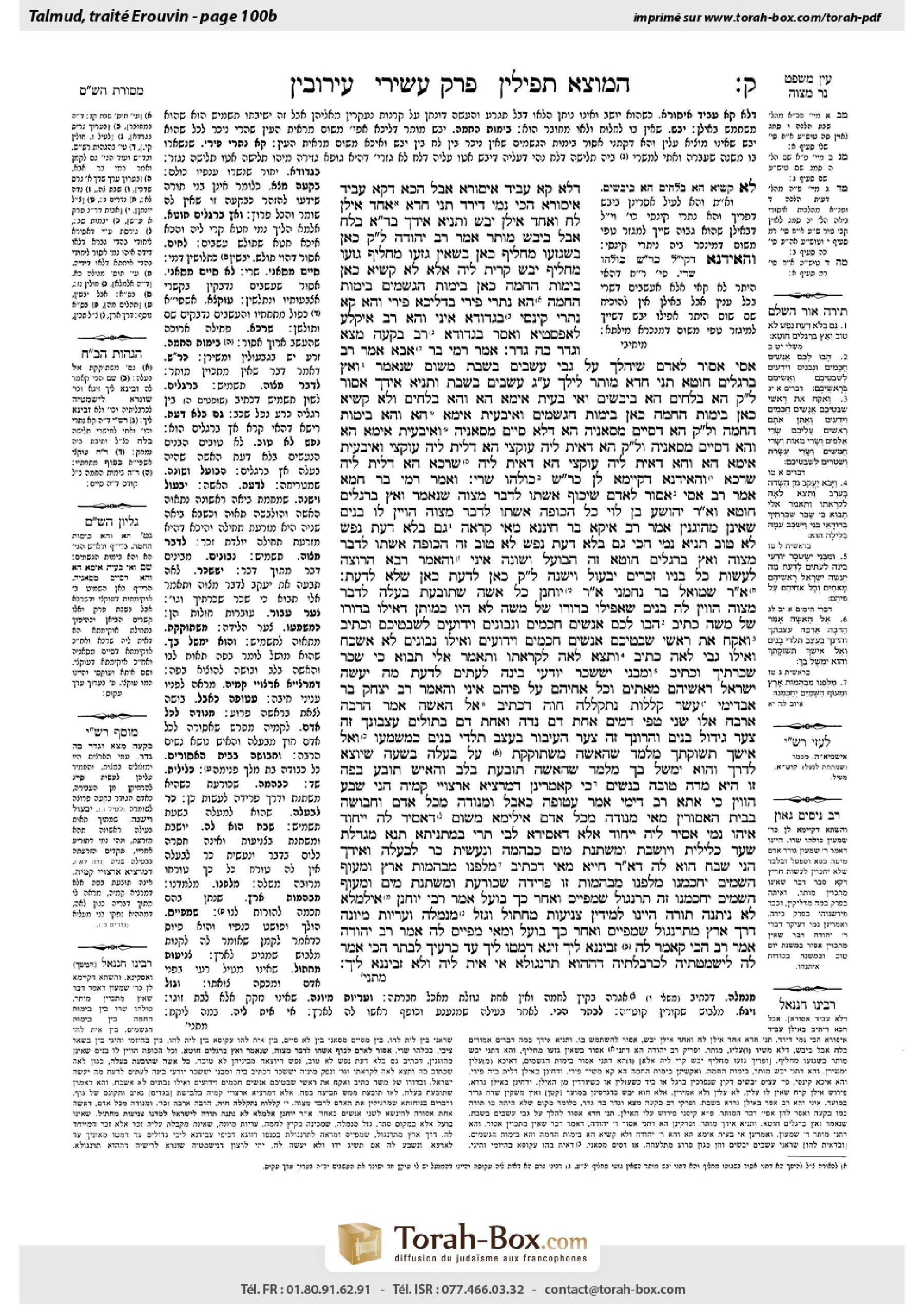
Eruvin 100b: Talmud study for Daf Yomi
Study the Talmud for Daf Yomi with scanned pages, Hebrew text, English translations from Sefaria and AI-generated French translations.
Passage selection and English or AI-generated French translation are available where the scan has annotations. Daf Study is independent of Torah-Box and Sefaria.
Browse Eruvin · עירובין · All tractatesEruvin 100b text and translations
This page of Eruvin includes the Aramaic text, an English translation and an AI-generated French translation, alongside the scan above.
עירובין ק׳ ב · Aramaic and Hebrew text
דְּלָא קָא עָבֵיד אִיסּוּרָא, אֲבָל הָכָא דְּקָא עָבֵיד אִיסּוּרָא, הָכִי נָמֵי דְּיֵרֵד.
תָּנֵי חֲדָא: אֶחָד אִילָן לַח וְאֶחָד אִילָן יָבֵשׁ, וְתַנְיָא אִידַּךְ: בַּמֶּה דְּבָרִים אֲמוּרִים — בְּלַח, אֲבָל בְּיָבֵשׁ — מוּתָּר.
אָמַר רַב יְהוּדָה, לָא קַשְׁיָא: כָּאן — בְּשֶׁגִּזְעוֹ מַחְלִיף, כָּאן — בְּשֶׁאֵין גִּזְעוֹ מַחְלִיף.
גִּזְעוֹ מַחְלִיף יָבֵשׁ קָרֵית לֵיהּ! אֶלָּא לָא קַשְׁיָא: כָּאן — בִּימוֹת הַחַמָּה, כָּאן — בִּימוֹת הַגְּשָׁמִים.
בִּימוֹת הַחַמָּה, הָא נָתְרִי פֵּירֵי! בִּדְלִיכָּא פֵּירֵי. וְהָא קָא נָתְרִי קִינְסֵי! בְּגִדּוּדָא.
אִינִי?! וְהָא רַב אִיקְּלַע לְאַפְסַטְיָא, וַאֲסַר בְּגִדּוּדָא! רַב בִּקְעָה מָצָא, וְגָדַר בָּהּ גָּדֵר.
אָמַר רָמֵי בַּר אַבָּא אָמַר רַב אַסִּי: אָסוּר לְאָדָם שֶׁיְּהַלֵּךְ עַל גַּבֵּי עֲשָׂבִים בְּשַׁבָּת, מִשּׁוּם שֶׁנֶּאֱמַר: ״וְאָץ בְּרַגְלַיִם חוֹטֵא״.
תָּנֵי חֲדָא: מוּתָּר לֵילֵךְ עַל גַּבֵּי עֲשָׂבִים בְּשַׁבָּת, וְתַנְיָא אִידַּךְ: אָסוּר. לָא קַשְׁיָא: הָא — בְּלַחִים, הָא — בִּיבֵשִׁים.
וְאִי בָּעֵית אֵימָא, הָא וְהָא בְּלַחִים, וְלָא קַשְׁיָא: כָּאן — בִּימוֹת הַחַמָּה, כָּאן — בִּימוֹת הַגְּשָׁמִים.
וְאִיבָּעֵית אֵימָא, הָא וְהָא בִּימוֹת הַחַמָּה, וְלָא קַשְׁיָא: הָא — דְּסָיֵים מְסָאנֵיהּ, הָא — דְּלָא סָיֵים מְסָאנֵיהּ.
וְאִיבָּעֵית אֵימָא: הָא וְהָא דְּסָיֵים מְסָאנֵיהּ, וְלָא קַשְׁיָא: הָא — דְּאִית לֵיהּ עוּקְצֵי, הָא — דְּלֵית לֵיהּ עוּקְצֵי.
וְאִיבָּעֵית אֵימָא, הָא וְהָא דְּאִית לֵיהּ עוּקְצֵי: הָא — דְּאִית לֵיהּ שְׁרָכָא, הָא — דְּלֵית לֵיהּ שְׁרָכָא.
וְהָאִידָּנָא דְּקַיְימָא לַן כְּרַבִּי שִׁמְעוֹן, כּוּלְּהוּ שְׁרֵי.
וְאָמַר רָמֵי בַּר חָמָא אָמַר רַב אַסִּי: אָסוּר לְאָדָם שֶׁיָּכוֹף אִשְׁתּוֹ לִדְבַר מִצְוָה, שֶׁנֶּאֱמַר: ״וְאָץ בְּרַגְלַיִם חוֹטֵא״.
וְאָמַר רַבִּי יְהוֹשֻׁעַ בֶּן לֵוִי: כׇּל הַכּוֹפֶה אִשְׁתּוֹ לִדְבַר מִצְוָה הָוְיָין לוֹ בָּנִים שֶׁאֵינָן מְהוּגָּנִין. אָמַר רַב אִיקָא בַּר חִינָּנָא, מַאי קְרָאָה: ״גַּם בְּלֹא דַעַת נֶפֶשׁ לֹא טוֹב״.
תַּנְיָא נָמֵי הָכִי: ״גַּם בְּלֹא דַעַת נֶפֶשׁ לֹא טוֹב״ — זֶה הַכּוֹפֶה אִשְׁתּוֹ לִדְבַר מִצְוָה. ״וְאָץ בְּרַגְלַיִם חוֹטֵא״ — זֶה הַבּוֹעֵל וְשׁוֹנֶה.
אִינִי?! וְהָאָמַר רָבָא: הָרוֹצֶה לַעֲשׂוֹת כׇּל בָּנָיו זְכָרִים יִבְעוֹל וְיִשְׁנֶה! לָא קַשְׁיָא: כָּאן — לְדַעַת, כָּאן — שֶׁלֹּא לְדַעַת.
אָמַר רַבִּי שְׁמוּאֵל בַּר נַחְמָנִי אָמַר רַבִּי יוֹחָנָן: כׇּל אִשָּׁה שֶׁתּוֹבַעַת בַּעְלָהּ לִדְבַר מִצְוָה הוֹוִין לָהּ בָּנִים שֶׁאֲפִילּוּ בְּדוֹרוֹ שֶׁל מֹשֶׁה לֹא הָיוּ כְּמוֹתָן. דְּאִילּוּ בְּדוֹרוֹ שֶׁל מֹשֶׁה כְּתִיב: ״הָבוּ לָכֶם אֲנָשִׁים חֲכָמִים וּנְבוֹנִים וִידוּעִים לְשִׁבְטֵיכֶם״, וּכְתִיב: ״וָאֶקַּח אֶת רָאשֵׁי שִׁבְטֵיכֶם אֲנָשִׁים חֲכָמִים וִידוּעִים״, וְאִילּוּ נְבוֹנִים לָא אַשְׁכַּח.
וְאִילּוּ גַּבֵּי לֵאָה כְּתִיב: ״וַתֵּצֵא לֵאָה לִקְרָאתוֹ וַתֹּאמֶר אֵלַי תָּבוֹא כִּי שָׂכוֹר שְׂכַרְתִּיךָ״, וּכְתִיב: ״וּמִבְּנֵי יִשָּׂשכָר יוֹדְעֵי בִינָה לַעִתִּים לָדַעַת מַה יַּעֲשֶׂה יִשְׂרָאֵל רָאשֵׁיהֶם מָאתַיִם וְכׇל אֲחֵיהֶם עַל פִּיהֶם״.
אִינִי?! וְהָאָמַר רַב יִצְחָק בַּר אַבְדִּימִי: עֶשֶׂר קְלָלוֹת נִתְקַלְּלָה חַוָּה, דִּכְתִיב:
״אֶל הָאִשָּׁה אָמַר הַרְבָּה אַרְבֶּה״, אֵלּוּ שְׁנֵי טִפֵּי דָמִים — אַחַת דַּם נִדָּה, וְאַחַת דַּם בְּתוּלִים. ״עִצְּבוֹנֵךְ״, זֶה צַעַר גִּידּוּל בָּנִים. ״וְהֵרוֹנֵךְ״, זֶה צַעַר הָעִיבּוּר. ״בְּעֶצֶב תֵּלְדִי בָּנִים״, כְּמַשְׁמָעוֹ.
״וְאֶל אִישֵׁךְ תְּשׁוּקָתֵךְ״, מְלַמֵּד שֶׁהָאִשָּׁה מִשְׁתּוֹקֶקֶת עַל בַּעְלָהּ בְּשָׁעָה שֶׁיּוֹצֵא לַדֶּרֶךְ. ״וְהוּא יִמְשׇׁל בָּךְ״, מְלַמֵּד שֶׁהָאִשָּׁה תּוֹבַעַת בַּלֵּב וְהָאִישׁ תּוֹבֵעַ בַּפֶּה. זוֹ הִיא מִדָּה טוֹבָה בַּנָּשִׁים.
כִּי קָאָמְרִינַן, דְּמַרְצְיָא אַרְצוֹיֵי קַמֵּיהּ.
הָנֵי שֶׁבַע הָוְויָן! כִּי אֲתָא רַב דִּימִי אָמַר: עֲטוּפָה כְּאָבֵל, וּמְנוּדָּה מִכׇּל אָדָם, וַחֲבוּשָׁה בְּבֵית הָאֲסוּרִין.
מַאי מְנוּדָּה מִכׇּל אָדָם? אִילֵּימָא מִשּׁוּם דַּאֲסִיר לַהּ יִיחוּד, אִיהוּ נָמֵי אֲסִיר לֵיהּ יִיחוּד. אֶלָּא דַּאֲסִירָא לְבֵי תְרֵי.
בְּמַתְנִיתָא תָּנָא: מְגַדֶּלֶת שֵׂעָר כְּלִילִית, וְיוֹשֶׁבֶת וּמַשְׁתֶּנֶת מַיִם כִּבְהֵמָה, וְנַעֲשֵׂית כַּר לְבַעְלָהּ.
וְאִידַּךְ? הָנֵי שֶׁבַח הוּא לָהּ.
דְּאָמַר רַבִּי חִיָּיא, מַאי דִּכְתִיב: ״מַלְּפֵנוּ מִבַּהֲמוֹת אָרֶץ וּמֵעוֹף הַשָּׁמַיִם יְחַכְּמֵנוּ״. ״מַלְּפֵנוּ מִבַּהֲמוֹת״ — זוֹ פְּרֵידָה, שֶׁכּוֹרַעַת וּמַשְׁתֶּנֶת מַיִם. ״וּמֵעוֹף הַשָּׁמַיִם יְחַכְּמֵנוּ״ — זֶה תַּרְנְגוֹל, שֶׁמְּפַיֵּיס וְאַחַר כָּךְ בּוֹעֵל.
אָמַר רַבִּי יוֹחָנָן: אִילְמָלֵא לֹא נִיתְּנָה תּוֹרָה, הָיִינוּ לְמֵידִין צְנִיעוּת מֵחָתוּל, וְגָזֵל מִנְּמָלָה, וַעֲרָיוֹת מִיּוֹנָה. דֶּרֶךְ אֶרֶץ מִתַּרְנְגוֹל — שֶׁמְּפַיֵּיס וְאַחַר כָּךְ בּוֹעֵל.
וּמַאי מְפַיֵּיס לַהּ? אָמַר רַב יְהוּדָה אָמַר רַב, הָכִי קָאָמַר לַהּ: זָבֵינְנָא לִיךְ זִיגָא דְּמָטוּ לִיךְ עַד כַּרְעָיךְ, לְבָתַר הָכִי אָמַר לַהּ: לִישְׁמַטְתֵּיהּ לְכַרְבַּלְתֵּיהּ דְּהָהוּא תַּרְנְגוֹלָא אִי אִית לֵיהּ וְלָא זָבֵינְנָא לִיךְ.
Eruvin 100b · English translation
where one does not commit a transgression by refraining from action. However, here, where one commits a transgression every additional moment he remains in the tree, indeed, he should descend from it.
The Gemara cites an apparent contradiction: It was taught in one baraita that both a green tree and a dry tree are included in the prohibition against climbing a tree, whereas it was taught in another baraita: In what case are these matters, that one may not climb a tree, stated? With regard to a green tree. But in the case of a dry one, it is permitted to climb it.
Rav Yehuda said: It is not difficult. Here, the baraita that includes a dry tree in the prohibition is referring to a tree whose stump sends out new shoots when cut; whereas there, the baraita that excludes a dry tree from the prohibition is referring to one whose stump does not send out new shoots.
The Gemara expresses surprise at this answer: You call a tree whose stump sends out new shoots dry? This tree is not dry at all. Rather, it is not difficult, as both baraitot deal with a dry tree whose stump will not send out any new shoots. However, here, the baraita that permits climbing a dry tree, is referring to the summer, when it is evident that the tree is dead; whereas there, the baraita that prohibits climbing the tree is referring to the rainy season, when many trees shed their leaves and it is not obvious which remain alive and which are dead.
The Gemara raises a difficulty: In the summer, the fruit of the previous year left on the dry tree will fall off when he climbs it, and climbing the tree should therefore be prohibited lest he come to pick the fruit. The Gemara answers: We are dealing here with a case where there is no fruit on the tree. The Gemara asks: But small branches will fall off when he climbs the tree, and once again this should be prohibited in case he comes to break them off. The Gemara answers: We are dealing here with a tree that has already been stripped of all its small branches.
The Gemara asks: Is that really so? But Rav arrived at a place called Apsetaya and prohibited its residents from climbing even a tree that had already been stripped of all its branches. The Gemara answers: In truth, no prohibition was involved, but Rav found an unguarded field, i.e., a place where transgression was widespread, and fenced it in. He added a stringency as a safeguard and prohibited an action that was fundamentally permitted.
Rami bar Abba said that Rav Asi said: It is prohibited for a person to walk on grass on Shabbat, due to the fact that it is stated: “And he who hastens with his feet sins” (Proverbs 19:2). This verse teaches that mere walking occasionally involves a sin, e.g., on Shabbat, when one might uproot the grass on which he walks.
The Gemara cites another apparent contradiction: It was taught in one baraita that it is permitted to walk on grass on Shabbat, and it was taught in another baraita that it is prohibited to do so. The Gemara answers: This is not difficult. This baraita is referring to green grass, which one might uproot, thereby transgressing the prohibition against reaping on Shabbat. That other baraita is referring to dry grass, which has already been cut off from its source of life, and therefore the prohibition of reaping is no longer in effect.
And if you wish, say instead that both baraitot are referring to green grass, and yet there is no difficulty: Here, the baraita that prohibits walking on grass is referring to the summer, when the grass includes seeds that might be dislodged by one’s feet, whereas there, the baraita that permits doing so is referring to the rainy season, when this problem does not exist.
And if you wish, say instead that both baraitot are referring to the summer, and it is not difficult: This baraita, which permits walking on grass, is referring to a case where one is wearing his shoes, whereas that other baraita, which prohibits it, deals with a situation where one is not wearing his shoes, as the grass might get entangled between his toes and be uprooted.
And if you wish, say instead that both baraitot are referring to a case where one is wearing his shoes, and nevertheless this is not difficult: This baraita prohibits walking on grass, as it involves a case where one’s shoe has a spike on which the grass might get caught and be uprooted, whereas that other baraita permits it, because it deals a case where one’s shoe does not have a spike.
And if you wish, say instead that both are referring to a case where the shoe has a spike, and it is not difficult: This baraita, which prohibits walking on grass, is referring to a case where the grass is long and entangled, and it can easily get caught on the shoe, whereas that other baraita is referring to a case where the grass is not long and entangled.
The Gemara concludes: And now, when we maintain that the halakha is in accordance with the opinion of Rabbi Shimon, who maintains that there is no liability for a prohibited act committed unwittingly during the performance of a permitted act, all of these scenarios are permitted, as here too, one’s intention is merely to walk and not to uproot grass on Shabbat.
The Gemara cites another halakha derived from the verse mentioned in the previous discussion. Rami bar Ḥama said that Rav Asi said: It is prohibited for a man to force his wife in the conjugal mitzva, i.e., sexual relations, as it is stated: “And he who hastens with his feet sins” (Proverbs 19:2). The term his feet is understood here as a euphemism for intercourse.
And Rabbi Yehoshua ben Levi said: Anyone who forces his wife to perform the conjugal mitzva will have unworthy children as a consequence. Rav Ika bar Ḥinnana said: What is the verse that alludes to this? “Also, that the soul without knowledge is not good” (Proverbs 19:2). If intercourse takes place without the woman’s knowledge, i.e., consent, the soul of the offspring will not be good.
That was also taught in a baraita: “Also, without knowledge the soul is not good”; this is one who forces his wife to perform the conjugal mitzva. “And he who hastens with his feet sins”; this is one who has intercourse with his wife and repeats the act in a manner that causes her pain or distress.
The Gemara is surprised by this teaching: Is that so? But didn’t Rava say: One who wants all his children to be males should have intercourse with his wife and repeat the act? The Gemara answers: This is not difficult: Here, where Rava issued this advice, he was referring to a husband who acts with his wife’s consent. There, the baraita that condemns this behavior is referring to one who proceeds without her consent.
Apropos relations between husband and wife, the Gemara cites that Rav Shmuel bar Naḥmani said that Rabbi Yoḥanan said: Any woman who demands of her husband that he fulfill his conjugal mitzva will have sons the likes of whom did not exist even in Moses’ generation. With regard to Moses’ generation, it is written: “Get you, wise men, and understanding, and well-known from each one of your tribes, and I will make them head over you” (Deuteronomy 1:13), and it is later written: “So I took the heads of your tribes, wise men, and well-known, and made them heads over you” (Deuteronomy 1:15). However, men possessing understanding, which is a more lofty quality than wisdom, Moses could not find any of these.
While with regard to Leah, it is written: “And Leah went out to meet him, and said, You must come in to me, for indeed I have hired you with my son’s mandrakes” (Genesis 30:16). Her reward for demanding that Jacob fulfill the conjugal mitzva with her was the birth of Issachar, and it is written: “And of the children of Issachar, men who had understanding of the times, to know what Israel ought to do; the heads of them were two hundred, and all their brethren were at their commandment” (I Chronicles 12:33).
The Gemara poses a question: Is that so? Is it proper for a woman to demand her conjugal rights from her husband? But didn’t Rav Yitzḥak bar Avdimi say: Eve was cursed with ten curses, due to the sin of the Tree of Knowledge, as it is written: “To the woman He said, I will greatly multiply your pain and your travail; in sorrow you shall bring forth children; and yet your desire shall be to your husband, and he shall rule over you” (Genesis 3:16)?
Rav Yitzḥak bar Avdimi proceeds to explain this verse. “To the woman He said: I will greatly multiply [harba arbe]”; these are the two drops of blood unique to a woman, which cause her suffering, one the blood of menstruation and the other one the blood of virginity. “Your pain”; this is the pain of raising children. “And your travail”; this is the pain of pregnancy. “In sorrow you shall bring forth children”; in accordance with its plain meaning, i.e., the pain of childbirth.
“And yet your desire shall be to your husband” teaches that the woman desires her husband, e.g., when he sets out on the road; “and he shall rule over you” teaches that the woman demands her husband in her heart but is too shy to voice her desire, but the man demands his wife verbally. Rav Yitzḥak bar Avdimi adds: This is a good trait in women, that they refrain from formulating their desire verbally. Apparently, it is improper for a woman to demand her conjugal rights from her husband.
The Gemara answers: When we say that a woman who demands her conjugal rights from her husband is praiseworthy, it does not mean she should voice her desires explicitly. Rather, it means that she should make herself pleasing to him, and he will understand what she wants on his own.
The Gemara analyzes the above statement with regard to Eve’s ten curses: Are they in fact ten? They are only seven. When Rav Dimi came from Eretz Yisrael to Babylonia, he said that the other curses are: A woman is wrapped like a mourner, i.e., she must cover her head; and she is ostracized from all people and incarcerated within a prison, as she typically spends all her time in the house.
The Gemara asks: What is the meaning of ostracized from all people? If you say this is because it is forbidden for her to seclude herself with a man, it is also forbidden for a man to seclude himself with women. Rather, it means that it is forbidden for her to marry two men, whereas a man can marry two women.
It was taught in a baraita that the three additional curses are: She grows her hair long like Lilit, a demon; she sits and urinates, like an animal; and serves as a pillow for her husband during relations.
And why doesn’t the other Sage include these curses? The Gemara answers: He maintains that these are praise for her, not pain, either because they are modest practices, e.g., urinating in a seated position, or because they add to her comfort, e.g., her bottom position during relations.
As Rabbi Ḥiyya said: What is the meaning of that which is written: “Who teaches us by the beasts of the earth, and makes us wiser by the birds of the sky” (Job 35:11)? He explains: “Who teaches us by the beasts of the earth”; this is the female mule, which crouches and urinates and from which we learn modesty. “And makes us wiser by the birds of the sky”; this is the rooster, which first cajoles the hen and then mates with it.
Similarly, Rabbi Yoḥanan said: Even if the Torah had not been given, we would nonetheless have learned modesty from the cat, which covers its excrement, and that stealing is objectionable from the ant, which does not take grain from another ant, and forbidden relations from the dove, which is faithful to its partner, and proper relations from the rooster, which first appeases the hen and then mates with it.
What does the rooster do to appease the hen? Rav Yehuda said that Rav said: Prior to mating, it spreads its wings as if to say this: I will buy you a coat that will reach down to your feet. After mating, the rooster bends its head as if to say this: May the crest of this rooster fall off if he has the wherewithal and does not buy you one. I simply have no money to do so.
Eruvin 100b · Traduction française (IA)
où l'on ne commet pas de transgression en se refrégrant à l'action. Cependant, ici, où l'on commet une transgression à chaque instant supplémentaire que l'on reste dans l'arbre, en effet, il devrait descendre de celui-ci.
La Guemara cite une contradiction apparente : Il a été enseigné dans une baraïta que tant un arbre vert qu'un arbre sec sont inclus dans l'interdiction de monter sur un arbre, tandis qu'il a été enseigné dans une autre baraïta : Dans quel cas ces choses, à savoir qu'on ne doit pas monter sur un arbre, sont-elles énoncées ? En ce qui concerne un arbre vert. Mais dans le cas d'un arbre sec, il est permis de monter dessus.
Rav Yéhuda a dit : Ce n'est pas difficile. Ici, la baraïta qui inclut un arbre sec dans l'interdiction fait référence à un arbre dont le tronc émet des pousses nouvelles lorsqu'il est coupé ; tandis que là, la baraïta qui exclut un arbre sec de l'interdiction fait référence à un arbre dont le tronc ne produit pas de nouvelles pousses.
La Guemara exprime une surprise à cet égard : Vous appelez un arbre dont le tronc émet des pousses nouvelles sec ? Cet arbre n'est pas du tout sec. Plutôt, ce n'est pas difficile, car les deux baraïtes traitent d'un arbre sec dont le tronc ne produit aucune nouvelle pousses. Cependant, ici, la baraïta qui permet de monter sur un arbre sec fait référence à l'été, lorsque l'arbre est clairement mort ; tandis que là, la baraïta qui interdit de monter sur l'arbre fait référence à la saison des pluies, lorsque beaucoup d'arbres perdent leurs feuilles et il n'est pas évident de savoir quels arbres sont vivants et quels sont morts.
La Guemara soulève une difficulté : L'été, les fruits de l'année précédente restés sur l'arbre sec tomberont lorsqu'on montera dessus, et monter sur l'arbre devrait donc être interdit de peur qu'on vienne à récolter les fruits. La Guemara répond : Nous traitons ici d'un cas où il n'y a pas de fruits sur l'arbre. La Guemara demande : Mais des petites branches tomberont lorsqu'on montera sur l'arbre, et à nouveau cela devrait être interdit au cas où l'on viendrait à les briser. La Guemara répond : Nous traitons ici d'un arbre qui a déjà été dépouillé de toutes ses petites branches.
La Guemara pose une question : Est-ce vraiment ainsi ? Mais Rav est arrivé à un lieu appelé Apsetaya et a interdit à ses habitants de monter même sur un arbre qui avait déjà été dépouillé de toutes ses branches. La Guemara répond : En réalité, il n'y avait pas de prohibition impliquée, mais Rav a trouvé un champ non gardé, c'est-à-dire un lieu où la transgression était répandue, et l'a entouré de clôture. Il a ajouté une stricte précaution et a interdit une action qui était fondamentalement permise.
Rami bar Abba a dit que Rav Asi a dit : Il est interdit à une personne de marcher sur l'herbe le sabbat, en raison du fait que cela est dit : « Et celui qui hâte ses pieds commet un péché » (Proverbes 19:2). Cette verset enseigne que marcher occasionnellement implique un péché, par exemple, le sabbat, lorsque l'on pourrait arracher l'herbe sur laquelle l'on marche.
La Guemara cite une autre contradiction apparente : Il a été enseigné dans une baraïta que c'est permis de marcher sur l'herbe le sabbat, et il a été enseigné dans une autre baraïta que c'est interdit de le faire. La Guemara répond : Ce n'est pas difficile. Cette baraïta fait référence à de l'herbe verte, que l'on pourrait arracher, en transgressant ainsi l'interdiction de moissonner le sabbat. Cette autre baraïta fait référence à de l'herbe sèche, qui a déjà été coupée de sa source de vie, et donc l'interdiction de moissonner n'est plus en vigueur.
Et si vous le souhaitez, dites plutôt que les deux baraïtes font référence à de l'herbe verte, et pourtant il n'y a pas de difficulté : Ici, la baraïta qui interdit de marcher sur l'herbe fait référence à l'été, lorsque l'herbe comprend des graines qui pourraient être délogées par les pieds, tandis que là, la baraïta qui permet de le faire fait référence à la saison des pluies, lorsque ce problème n'existe pas.
Et si vous le souhaitez, dites plutôt que les deux baraïtes font référence à l'été, et il n'y a pas de difficulté : cette baraïta, qui permet de marcher sur l'herbe, fait référence à un cas où l'on porte ses chaussures, tandis que cette autre baraïta, qui interdit cela, traite d'un cas où l'on ne porte pas ses chaussures, car l'herbe pourrait s'entrelacer entre les orteils et être arrachée.
Et si vous le souhaitez, dites plutôt que les deux baraïtes font référence à un cas où l'on porte ses chaussures, et pourtant cela n'est pas difficile : cette baraïta interdit de marcher sur l'herbe, car cela implique un cas où la chaussure a un éclat sur lequel l'herbe pourrait s'accrocher et être arrachée, tandis que cette autre baraïta permet cela, car elle traite d'un cas où la chaussure n'a pas d'éclat.
Et si vous le souhaitez, dites plutôt que les deux font référence à un cas où la chaussure a un éclat, et il n'y a pas de difficulté : cette baraïta, qui interdit de marcher sur l'herbe, fait référence à un cas où l'herbe est longue et entrelacée, et elle peut facilement s'accrocher à la chaussure, tandis que cette autre baraïta fait référence à un cas où l'herbe n'est pas longue et entrelacée.
La Guemara conclut : Et maintenant, lorsque nous maintenons que la halakha suit l'opinion de Rabbi Shimon, qui affirme qu'il n'y a pas de responsabilité pour une action interdite commise sans intention pendant l'exécution d'une action permise, tous ces cas sont permis, car ici aussi, l'intention est simplement de marcher et non d'arracher l'herbe le sabbat.
La Guemara cite une autre halakha dérivée du verset mentionné dans la discussion précédente. Rami bar Ḥama a dit que Rav Asi a dit : Il est interdit à un homme de forcer sa femme dans la mitsva conjugale, c'est-à-dire les relations sexuelles, car il est dit : « Et celui qui hâte ses pieds commet un péché » (Proverbes 19:2). Le terme « ses pieds » est compris ici comme un euphémisme pour les relations sexuelles.
Et Rabbi Yéhoshua ben Levi a dit : Celui qui force sa femme à accomplir la mitsva conjugale aura des enfants indignes. Rav Ika bar Ḥinnana a dit : Quel est le verset qui évoque cela ? « Et aussi, l'âme sans connaissance n'est pas bonne » (Proverbes 19:2). Si l'acte sexuel a lieu sans la connaissance, c'est-à-dire le consentement, de la femme, l'âme du descendant ne sera pas bonne.
Cela a également été enseigné dans une baraïta : « Et sans connaissance, l'âme n'est pas bonne » ; c'est celui qui force sa femme à accomplir la mitsva conjugale. « Et celui qui hâte ses pieds commet un péché » ; c'est celui qui a des relations sexuelles avec sa femme et répète l'acte de manière à la faire souffrir ou à la mettre en détresse.
La Guemara est surprise par cette enseignement : Est-ce ainsi ? Mais n'avait-il pas dit Rava : Celui qui veut que tous ses enfants soient des garçons doit avoir des relations sexuelles avec sa femme et répéter l'acte ? La Guemara répond : Ce n'est pas difficile : ici, où Rava donnait ce conseil, il faisait référence à un mari qui agit avec le consentement de sa femme. Là, la baraïta qui condamne ce comportement fait référence à celui qui agit sans son consentement.
À propos des relations entre mari et femme, la Guemara cite que Rav Shmuel bar Naḥmani a dit que Rabbi Yoḥanan a dit : Toute femme qui exige de son mari qu'il accomplisse la mitsva conjugale aura des fils comme on n'en a jamais vu même dans la génération de Moïse. En ce qui concerne la génération de Moïse, il est écrit : « Allez, sages hommes, et hommes de compréhension, et connus de chacun de vos tribus, et je ferai de vous des chefs » (Deutéronome 1:13), et plus tard : « Et je pris les chefs de vos tribus, sages hommes, et connus, et je les fis des chefs sur vous » (Deutéronome 1:15). Cependant, les hommes possédant une compréhension, qui est une qualité plus élevée que la sagesse, Moïse n'a pas trouvé un seul d'entre eux.
Concernant Rachel, il est écrit : « Et Rachel sortit pour le rencontrer, et dit : Viens en moi, car en effet j'ai acheté ton fils avec mes mandrakes » (Genèse 30:16). Son récompense pour exiger que Jacob accomplisse la mitsva conjugale avec elle fut la naissance d'Issachar, et il est écrit : « Et des enfants d'Issachar, des hommes ayant une compréhension des temps, savoir ce que doit faire Israël ; les chefs d'entre eux furent deux cents, et tous leurs frères étaient à leur commandement » (Chroniques 12:33).
La Guemara pose une question : Est-ce ainsi ? Est-il approprié qu'une femme exige ses droits conjugaux auprès de son mari ? Mais n'avait-il pas dit Rav Yitzḥak bar Avdimi : Ève fut maudite avec dix maux, à cause du péché de l'Arbre de la Connaissance, comme il est écrit : « À la femme Il dit : Je multiplierai grandement ta douleur et ton travail ; en souffrance tu donneras naissance aux enfants ; et cependant ton désir sera pour ton mari, et il régnera sur toi » (Genèse 3:16) ?
Rav Yitzḥak bar Avdimi poursuit pour expliquer ce verset. « À la femme, Il dit : Je multiplierai grandement [harba arbé] » ; ce sont les deux gouttes de sang uniques à la femme, qui causent sa souffrance, l'une le sang de la menstruation et l'autre le sang de la virginité. « Ta douleur » ; c'est la douleur de l'accouchement. « Et ton travail » ; c'est la douleur de la grossesse. « En souffrance tu donneras naissance aux enfants » ; selon sa signification littérale, c'est la douleur de l'accouchement.
« Et cependant ton désir sera pour ton mari » enseigne que la femme désire son mari, par exemple lorsqu'il part en voyage ; « et il régnera sur toi » enseigne que la femme désire son mari en son cœur mais est trop timide pour exprimer son désir, mais l'homme demande sa femme verbalement. Rav Yitzḥak bar Avdimi ajoute : C'est une bonne qualité chez les femmes, qu'elles refrérent à formuler leur désir verbalement. Apparemment, il est inapproprié qu'une femme exige ses droits conjugaux auprès de son mari.
La Guemara répond : Lorsque nous disons qu'une femme qui exige ses droits conjugaux auprès de son mari est louable, cela ne signifie pas qu'elle doive exprimer ses désirs explicitement. Plutôt, cela signifie qu'elle doit se rendre agréable à lui, et il comprendra lui-même ce qu'elle veut.
La Guemara examine l'affirmation ci-dessus concernant les dix maux d'Ève : sont-ils effectivement dix ? Ils sont seulement sept. Lorsque Rav Dimi est venu de la Terre d'Israël en Babylone, il a dit que les autres maux sont : Une femme est enveloppée comme une veuve, c'est-à-dire qu'elle doit couvrir sa tête ; et elle est exclue de tous les gens et emprisonnée, car elle passe généralement tout son temps à la maison.
La Guemara pose une question : Quelle est la signification d'« exclue de tous les gens » ? Si vous dites que c'est à cause de l'interdiction de se retirer avec un homme, c'est aussi interdit à un homme de se retirer avec des femmes. Plutôt, cela signifie qu'il est interdit à elle de se marier avec deux hommes, tandis qu'un homme peut se marier avec deux femmes.
Il a été enseigné dans une baraïta que les trois autres maux sont : Elle fait pousser ses cheveux longs comme Lilit, un démon ; elle s'assoit et urine, comme un animal ; et elle sert de coussin à son mari lors des relations sexuelles.
Et pourquoi le sage suivant ne cite-t-il pas ces malédictions ? La Guemara répond : Il affirme que ces pratiques sont des louanges pour elle, pas des douleurs, soit parce qu'elles sont des pratiques modestes, par exemple uriner assis, soit parce qu'elles augmentent son confort, par exemple sa position assise lors des relations sexuelles.
Comme Rabbi Ḥiyya a dit : Quelle est la signification de ce qui est écrit : « Qui nous enseigne par les bêtes de la terre, et nous rend plus sages par les oiseaux du ciel » (Job 35:11) ? Il explique : « Qui nous enseigne par les bêtes de la terre » ; c'est la mule femelle, qui s'accroupit et urine et d'où nous apprenons la modestie. « Et nous rend plus sages par les oiseaux du ciel » ; c'est le coq, qui d'abord séduit la poule et ensuite s'accouple avec elle.
De même, le maître Yochanan a dit : Même si la Torah n'avait pas été donnée, nous aurions tout de même appris la modestie du chat, qui cache ses déjections, et que le vol est répréhensible comme le fait la fourmi, qui ne prend pas de blé chez une autre fourmi, et les relations interdites comme la colombe, qui est fidèle à son compagnon, et les relations convenables comme le coq, qui d'abord apaise la poule et ensuite s'accouple avec elle.
Quel est l'acte du coq pour apaiser la poule ? Rav Yehuda a dit que Rav a dit : Avant de s'accoupler, il étend ses ailes comme pour dire : Je vais t'acheter une robe qui descendra jusqu'à tes pieds. Après l'accouplement, le coq baisse sa tête comme pour dire : Que la couronne de ce coq tombe si, ayant les moyens, il ne t'achète pas une robe. Je n'ai tout simplement pas d'argent pour le faire.
Traduction française générée par IA à partir de l’édition anglaise de Sefaria. Vérifie toujours un passage avec le texte source.
Text from Sefaria: William Davidson Edition - Vocalized Aramaic (CC BY NC); William Davidson Edition - English (CC BY NC).