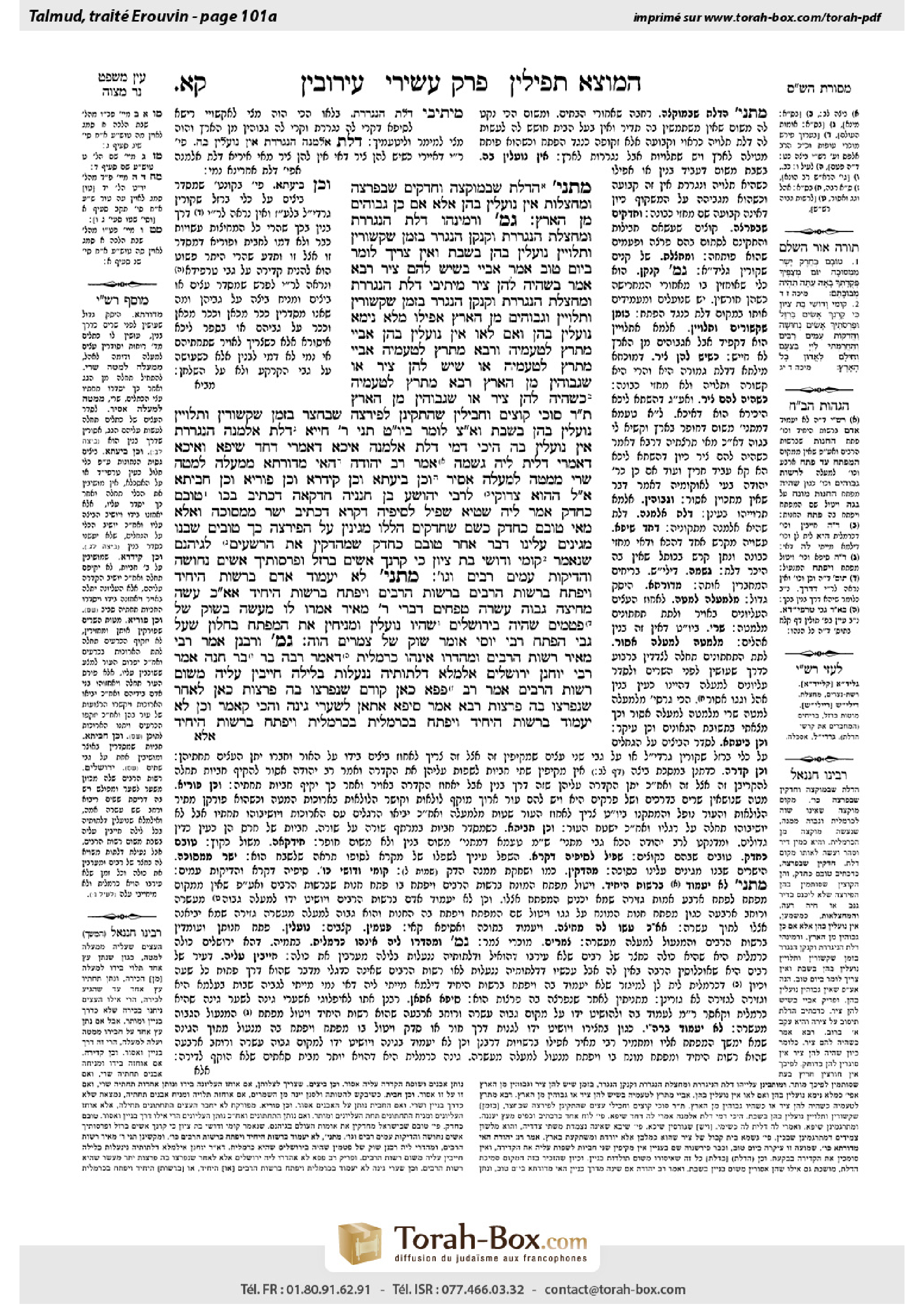
Eruvin 101a: Talmud study for Daf Yomi
Study the Talmud for Daf Yomi with scanned pages, Hebrew text, English translations from Sefaria and AI-generated French translations.
Passage selection and English or AI-generated French translation are available where the scan has annotations. Daf Study is independent of Torah-Box and Sefaria.
Browse Eruvin · עירובין · All tractatesEruvin 101a text and translations
This page of Eruvin includes the Aramaic text, an English translation and an AI-generated French translation, alongside the scan above.
עירובין ק״א א · Aramaic and Hebrew text
מַתְנִי׳ הַדֶּלֶת שֶׁבַּמּוּקְצֶה, וַחֲדָקִים שֶׁבַּפִּרְצָה, וּמַחְצָלוֹת — אֵין נוֹעֲלִין בָּהֶן אֶלָּא אִם כֵּן גְּבוֹהִים מִן הָאָרֶץ.
גְּמָ׳ וּרְמִינְהוּ: דֶּלֶת הַנִּגְרֶרֶת וּמַחְצֶלֶת הַנִּגְרֶרֶת, וְקַנְקַן הַנִּגְרָר, בִּזְמַן שֶׁקְּשׁוּרִין וּתְלוּיִין — נוֹעֲלִין בָּהֶן בְּשַׁבָּת, וְאֵין צָרִיךְ לוֹמַר בְּיוֹם טוֹב!
אָמַר אַבָּיֵי: בְּשֶׁיֵּשׁ לָהֶם צִיר, רָבָא אָמַר: בְּשֶׁהָיָה לָהֶן צִיר.
מֵיתִיבִי: דֶּלֶת הַנִּגְרֶרֶת, וּמַחְצֶלֶת הַנִּגְרֶרֶת, וְקַנְקַן הַנִּגְרָר, בִּזְמַן שֶׁקְּשׁוּרִין וּתְלוּיִין וּגְבוֹהִים מִן הָאָרֶץ אֲפִילּוּ מְלֹא נִימָא — נוֹעֲלִין בָּהֶן, וְאִם לָאו — אֵין נוֹעֲלִין בָּהֶן!
אַבָּיֵי מְתָרֵץ לְטַעְמֵיהּ, וְרָבָא מְתָרֵץ לְטַעְמֵיהּ. אַבָּיֵי מְתָרֵץ לְטַעְמֵיהּ: אוֹ שֶׁיֵּשׁ לָהֶן צִיר, אוֹ שֶׁגְּבוֹהִין מִן הָאָרֶץ. רָבָא מְתָרֵץ לְטַעְמֵיהּ: כְּשֶׁהָיָה לָהֶן צִיר, אוֹ שֶׁגְּבוֹהִין מִן הָאָרֶץ.
תָּנוּ רַבָּנַן: סוֹכֵי קוֹצִים וַחֲבִילִין שֶׁהִתְקִינָן לְפִירְצָה שֶׁבְּחָצֵר, בִּזְמַן שֶׁקְּשׁוּרִין וּתְלוּיִין — נוֹעֲלִין בָּהֶן בְּשַׁבָּת, וְאֵין צָרִיךְ לוֹמַר בְּיוֹם טוֹב.
תָּנֵי רַבִּי חִיָּיא: דֶּלֶת אַלְמָנָה הַנִּגְרֶרֶת — אֵין נוֹעֲלִין בָּהּ. הֵיכִי דָּמֵי דֶּלֶת אַלְמָנָה? אִיכָּא דְּאָמְרִי דְּחַד שִׁיפָא, וְאִיכָּא דְּאָמְרִי דְּלֵית לֵיהּ גַּשְׁמָה.
אָמַר רַב יְהוּדָה: הַאי מְדוּרְתָּא, מִמַּעְלָה לְמַטָּה — שְׁרֵי, מִמַּטָּה לְמַעְלָה — אֲסִיר.
וְכֵן בֵּיעֲתָא, וְכֵן קִידְרָא, וְכֵן פּוּרְיָא, וְכֵן חָבִיתָא.
אֲמַר לֵיהּ הָהוּא מִינָא לְרַבִּי יְהוֹשֻׁעַ בֶּן חֲנַנְיָה: חִדְקָאָה! דִּכְתִיב בְּכוּ ״טוֹבָם כְּחֵדֶק״. אֲמַר לֵיהּ: שָׁטְיָא, שְׁפֵיל לְסֵיפֵיהּ דִּקְרָא, דִּכְתִיב: ״יָשָׁר מִמְּסוּכָה״. וְאֶלָּא מַאי ״טוֹבָם כְּחֵדֶק״? כְּשֵׁם שֶׁחֲדָקִים הַלָּלוּ מְגִינִּין עַל הַפִּירְצָה, כָּךְ טוֹבִים שֶׁבָּנוּ מְגִינִּים עָלֵינוּ. דָּבָר אַחֵר: ״טוֹבָם כְּחֵדֶק״, שֶׁמְּהַדְּקִין אֶת אוּמּוֹת הָעוֹלָם לְגֵיהִנָּם, שֶׁנֶּאֱמַר: ״קוּמִי וָדוֹשִׁי בַת צִיּוֹן כִּי קַרְנֵךְ אָשִׂים בַּרְזֶל וּפַרְסוֹתַיִךְ אָשִׂים נְחוּשָׁה וַהֲדִיקּוֹת עַמִּים רַבִּים וְגוֹ׳״.
מַתְנִי׳ לֹא יַעֲמוֹד אָדָם בִּרְשׁוּת הַיָּחִיד וְיִפְתַּח בִּרְשׁוּת הָרַבִּים, בִּרְשׁוּת הָרַבִּים וְיִפְתַּח בִּרְשׁוּת הַיָּחִיד, אֶלָּא אִם כֵּן עָשָׂה מְחִיצָה גְּבוֹהָ עֲשָׂרָה טְפָחִים, דִּבְרֵי רַבִּי מֵאִיר.
אָמְרוּ לוֹ: מַעֲשֶׂה בְּשׁוּק שֶׁל פַּטָּמִים שֶׁהָיָה בִּירוּשָׁלַיִם, וְשֶׁהָיוּ נוֹעֲלִין וּמַנִּיחִין אֶת הַמַּפְתֵּחַ בַּחַלּוֹן שֶׁעַל גַּבֵּי הַפֶּתַח. רַבִּי יוֹסֵי אוֹמֵר: שׁוּק שֶׁל צַמָּרִים הֲוָה.
גְּמָ׳ וְרַבָּנַן, אָמַר רַבִּי מֵאִיר רְשׁוּת הָרַבִּים — וּמַהְדְּרוּ אִינְהוּ כַּרְמְלִית! דְּאָמַר רַבָּה בַּר בַּר חָנָה אָמַר רַבִּי יוֹחָנָן: יְרוּשָׁלַיִם אִלְמָלֵא דַּלְתוֹתֶיהָ נִנְעָלוֹת בַּלַּיְלָה — חַיָּיבִין עָלֶיהָ מִשּׁוּם רְשׁוּת הָרַבִּים.
אָמַר רַב פָּפָּא: כָּאן — קוֹדֶם שֶׁנִּפְרְצוּ בָּהּ פְּרָצוֹת, כָּאן — לְאַחַר שֶׁנִּפְרְצוּ בָּהּ פְּרָצוֹת.
רָבָא אָמַר: סֵיפָא אֲתָאן לְשַׁעֲרֵי גִינָּה, וְהָכִי קָאָמַר: וְכֵן לֹא יַעֲמוֹד בִּרְשׁוּת הַיָּחִיד וְיִפְתַּח בְּכַרְמְלִית, בְּכַרְמְלִית וְיִפְתַּח בִּרְשׁוּת הַיָּחִיד,
Eruvin 101a · English translation
MISHNA: With regard to the door to a rear court, i.e., a door that opens from a house to the courtyard situated behind it, which is typically not a proper door but merely a wooden board without hinges that closes off the doorway; and likewise bundles of thorns that seal a breach; and reed mats, one may not close an opening with them on Shabbat. This would be considered building or completing a building, unless they remain above the ground even when they are open.
GEMARA: And the Gemara raises a contradiction from a baraita: With regard to a door, or a mat, or a lattice [kankan] that drag along the ground and are used for closing up openings, when they are tied and suspended in place one may close an opening with them on Shabbat; and needless to say this is permitted on a Festival. According to the baraita, the critical factor is apparently that they must be tied and suspended, not that they have to be held up above the ground.
Abaye said: The baraita is referring to ones that have a hinge. As they are considered proper doors, closing them does not appear like building. Rava said: The baraita is referring even to doors that once had a hinge, even though they no longer have one. These partitions also bear the clear form of a door, and therefore one’s action does not have the appearance of building.
The Gemara raises an objection from another baraita: With regard to a door, or a mat, or a lattice that drag along the ground, when they are tied and suspended in place and they are held above the ground even by as little as a hairbreadth, one may close an opening with them. However, if they are not raised in this manner, one may not close an opening with them. Clearly, these doors must indeed be raised above the ground as well.
The Gemara answers: Abaye reconciles the objection in accordance with his reasoning, and Rava reconciles the objection in accordance with his reasoning. The Gemara elaborates: Abaye reconciles the objection in accordance with his reasoning by adding to the baraita: They must either have a hinge or be held above the ground. Rava likewise reconciles the objection in accordance with his reasoning, as he reads: They must have had a hinge or else be held above the ground.
The Sages taught a baraita: With regard to branches of thorn bushes or bundles of wood that were arranged so that they sealed off a breach in a courtyard, when they are tied and suspended in place, one may close an opening with them on Shabbat; and needless to say, this is permitted on a Festival.
Rabbi Ḥiyya taught a baraita: With regard to a widowed door that drags along the ground, one may not close an opening with it. The Gemara asks: What are the circumstances of a widowed door? Some say it refers to a door built from a single plank, which does not look like a door, and others say it is a door that does not have a lower doorsill (ge’onim) and that touches the ground when closed.
With regard to activities that are prohibited because of their similarity to building, the Gemara cites a teaching that Rav Yehuda said: When arranging a pile of wood for a fire on a Festival, if the logs are arranged from the top down, i.e., the upper logs are temporarily suspended in the air while the lower logs are inserted below them, it is permitted. However, if the wood is placed from the bottom up, it is prohibited, as the arrangement of wood in the regular manner is a form of building.
And the same applies to eggs that are to be arranged in a pile, and the same applies to a cauldron that is to be set down on a fire by means of supports, and the same applies to a bed that will be placed on its frame, and the same applies to barrels arranged in a cellar. In all these cases, the part that goes on top must be temporarily suspended in the air while the lower section is inserted beneath it.
With regard to bundles of thorns used to seal a breach, the Gemara cites a related incident: A certain heretic once said to Rabbi Yehoshua ben Ḥananya: Man of thorns! For it says about you: “The best of them is as a brier” (Micah 7:4), which indicates that even Israel’s best are merely thorns. He said to him: Fool, go down to the end of the verse: “The most upright is worse than a thorn hedge,” a derogatory expression meant as praise. Rather, what is the meaning of the best of them is as a brier? It means that just as these thorns protect a breach, so the best among us protect us. Alternatively: The best of them is as a brier [ḥedek] means that they grind [mehaddekin] the nations of the world into Gehenna, as it is stated: “Arise and thresh, O daughter of Zion, for I will make your horn iron, and I will make your hoofs brass, and you shall beat in pieces [vahadikot] many peoples; and you shall devote their gain to God, and their substance to the God of the whole earth” (Micah 4:13).
MISHNA: A person may not stand in the private domain and open a door located in the public domain with a key, lest he inadvertently transfer the key from one domain to the other. Likewise, one may not stand in the public domain and open a door in the private domain with a key, unless in the latter case he erected a partition ten handbreadths high around the door and stands inside it. This is the statement of Rabbi Meir.
The Rabbis said to him: There was an incident at the poultry dealers’ market in Jerusalem, where they would fatten fowl for slaughter (Rabbeinu Ḥananel), and they would lock the doors to their shops and place the key in the window that was over the door, which was more than ten handbreadths off the ground, and nobody was concerned about the possible violation of any prohibition. Rabbi Yosei says: That place was a market of wool dealers.
GEMARA: The Gemara asks: And those Rabbis, who cited the case of the poultry dealers of Jerusalem to rebut Rabbi Meir’s opinion, Rabbi Meir spoke to them about unlocking a door in a private domain while standing in the public domain, and they responded with an incident involving a karmelit. As Rabba bar bar Ḥana said that Rabbi Yoḥanan said: With regard to Jerusalem, were it not for the fact that its doors are locked at night, one would be liable for carrying in it on Shabbat, because its thoroughfares have the status of the public domain. However, since Jerusalem’s doors are typically locked, it is considered one large karmelit, which is subject to rabbinic prohibitions. How, then, could a proof be cited from the markets of Jerusalem with regard to the transfer of objects between a public domain and a private domain, which is prohibited by Torah law?
Rav Pappa said: Here, in the statement of Rabbi Yohanan, Jerusalem was considered a karmelit during the period before breaches were made in its walls. Its doors did not turn it into a public domain, as they were locked. Whereas there, the Rabbis in the mishna are referring to the time after breaches had been made in the walls, and it therefore acquired the status of a public domain.
Rava said: In the latter clause of the mishna we came to a different issue, i.e., the final section of the mishna is not designed to counter Rabbi Meir’s statement with regard to the public domain. Rather, it refers to the gates of a garden with an area greater than two beit se’a in size, whose legal status is that of a karmelit. Consequently, the mishna is saying as follows: And likewise, one may not stand in the private domain and open a door in a karmelit; neither may one stand in a karmelit and open a door in the private domain,
Eruvin 101a · Traduction française (IA)
MICHNA : Concernant la porte d'un cour intérieur, c'est-à-dire une porte qui s'ouvre d'une maison vers le cour situé derrière elle, qui n'est généralement pas une porte propre mais simplement une planche de bois sans gonds qui ferme l'ouverture ; de même pour les bouquets de buissons qui ferment une brèche, et les tapis de roseaux, on ne peut pas fermer une ouverture avec eux le sabbat. Cela serait considéré comme la construction ou la finition d'une construction, sauf s'ils restent au-dessus du sol même lorsqu'ils sont ouverts.
GUEMARA : Et la Guemara soulève une contradiction à partir d'une baraïta : Concernant une porte, ou un tapis, ou un grillage [kankan] qui traînent par terre et sont utilisés pour fermer des ouvertures, lorsqu'ils sont attachés et suspendus en place, on peut fermer une ouverture avec eux le sabbat ; et sans doute cela est permis lors d'un festival. Selon la baraïta, le facteur critique semble être qu'ils doivent être attachés et suspendus, pas qu'ils doivent être maintenus au-dessus du sol.
Abaye dit : La baraïta fait référence à ceux qui ont un gond. Comme ils sont considérés comme des portes propres, fermer ces portes ne semble pas comme une construction. Rava dit : La baraïta fait référence même aux portes qui avaient un gond, même si elles n'en ont plus un. Ces cloisons ont aussi une forme claire de porte, et donc l'action de quelqu'un ne semble pas comme une construction.
La Guemara soulève une objection tirée d'une autre baraïta : Concernant une porte, ou un tapis, ou un grillage qui traînent par terre, lorsqu'ils sont attachés et suspendus en place et qu'ils sont maintenus au-dessus du sol même d'une épaisseur de cheveu, on peut fermer une ouverture avec eux. Cependant, si ils ne sont pas ainsi soulevés, on ne peut pas fermer une ouverture avec eux. Évidemment, ces portes doivent être soulevées au-dessus du sol également.
La Guemara répond : Abaye résout l'objection selon son raisonnement, et Rava résout l'objection selon son raisonnement. La Guemara explique : Abaye résout l'objection selon son raisonnement en ajoutant à la baraïta : Ils doivent avoir un gond ou être maintenus au-dessus du sol. Rava fait de même pour résoudre l'objection selon son raisonnement, car il lit : Ils doivent avoir eu un gond ou être maintenus au-dessus du sol.
Les Sages enseignèrent une baraïta : Concernant les branches de buissons épineux ou les bouquets de bois qui étaient disposés de manière à fermer une brèche dans un jardin, lorsqu'ils sont attachés et suspendus en place, on peut fermer une ouverture avec eux le sabbat ; et sans doute cela est permis lors d'un festival.
Rabbi Ḥiyya enseigna une baraïta : Concernant une porte veuve qui traîne par terre, on ne peut pas fermer une ouverture avec elle. La Guemara demande : Quelles sont les circonstances d'une porte veuve ? Certains disent qu'il s'agit d'une porte constituée d'un seul plan, qui ne ressemble pas à une porte, et d'autres disent qu'il s'agit d'une porte qui n'a pas de seuil inférieur (ge'onim) et qui touche le sol lorsqu'elle est fermée.
Concernant les activités interdites en raison de leur ressemblance avec la construction, la Guemara cite un enseignement que Rav Yehuda a dit : Lorsqu'on dispose un tas de bois pour un feu lors d'un festival, si les troncs sont disposés du haut vers le bas, c'est-à-dire que les troncs supérieurs sont temporairement suspendus dans l'air tandis que les troncs inférieurs sont insérés en dessous d'eux, cela est permis. Cependant, si le bois est placé du bas vers le haut, cela est interdit, car la disposition normale du bois est une forme de construction.
Cela s'applique également aux œufs qui sont disposés en tas, et cela s'applique également à une marmite qui est placée sur un feu par des supports, et cela s'applique également à un lit qui sera placé sur son cadre, et cela s'applique également à des tonneaux disposés dans une cave. Dans tous ces cas, la partie qui est placée en haut doit être temporairement suspendue dans l'air tandis que la partie inférieure est insérée en dessous d'elle.
Concernant les bouquets de buissons utilisés pour sceller une brèche, la Guemara cite un incident lié : Un certain hérétique dit un jour à Rabbi Yehoshua ben Ḥananya : Homme de buissons ! Car il est dit à son sujet : « Le meilleur d'entre eux est comme un brier » (Micha 7:4), ce qui indique que même les meilleurs d'Israël sont simplement des buissons. Il lui répond : Fous, descends à la fin de la verset : « Le plus droit est pire qu'une haie de buissons », une expression dépréciative signifiant un éloge. Plutôt, que signifie « le meilleur d'entre eux est comme un brier » ? Cela signifie que ces buissons protègent une brèche, et ainsi les meilleurs parmi nous nous protègent. Alternativement : « Le meilleur d'entre eux est comme un brier [ḥedek] » signifie qu'ils écrasent [mehaddekin] les nations du monde dans l'Enfer, comme il est dit : « Lève-toi et écrase, ô fille de Sion, car je ferai ton cor en fer et ton sabot en bronze, et tu écraseras [vahadikot] beaucoup de peuples ; et tu dévoueras leur gain à Dieu, et leur richesse au Dieu de toute la terre » (Micha 4:13).
MICHNA : Une personne ne peut pas se tenir dans le domaine privé et ouvrir une porte située dans le domaine public avec une clé, de peur de transférer accidentellement la clé d'un domaine à l'autre. De même, on ne peut pas se tenir dans le domaine public et ouvrir une porte dans le domaine privé avec une clé, sauf dans ce dernier cas, si l'on a érigé une cloison de dix tefachim de haut autour de la porte et qu'on se tient à l'intérieur. C'est la déclaration de Rabbi Meir.
Les Rabbins dirent à lui : Il y avait un incident au marché des détaillants de volaille à Jérusalem, où ils élevaient des oiseaux pour la boucherie (Rabbeinu Ḥananel), et ils verrouillaient les portes de leurs boutiques et plaçaient la clé dans la fenêtre qui était au-dessus de la porte, ce qui était à plus de dix tefachim du sol, et personne ne s'inquiétait de la violation possible d'une interdiction. Rabbi Yosei dit : Ce lieu était un marché de détaillants de laine.
GUEMARA : La Guemara pose la question : Et ces Rabbins, qui citaient le cas des vendeurs de volailles de Jérusalem pour contredire l'opinion de Rabbi Meir, Rabbi Meir leur avait parlé de l'ouverture d'une porte dans un domaine privé alors qu'il se tenait dans un domaine public, et ils répondirent avec un cas concernant un karmelit. Comme Rabba bar bar Ḥana a dit que Rabbi Yoḥanan a dit : En ce qui concerne Jérusalem, si ses portes n'étaient pas verrouillées la nuit, on serait puni pour porter des objets le sabbat, car ses rues ont le statut d'un domaine public. Cependant, puisque les portes de Jérusalem sont généralement verrouillées, elle est considérée comme un seul karmelit, soumis aux interdits rabbiniques. Comment, alors, pouvait-on citer un cas concernant les marchés de Jérusalem en ce qui concerne le transfert d'objets entre un domaine public et un domaine privé, qui est interdit par la Loi divine ?
Rav Pappa dit : Ici, dans la déclaration de Rabbi Yohanan, Jérusalem était considérée comme un karmelit durant la période avant que des percées ne soient faites dans ses murs. Ses portes ne la transformaient pas en un domaine public, car elles étaient verrouillées. En revanche, là, les Rabbins dans la mitsna font référence à la période après que des percées aient été faites dans les murs, et elle a donc acquis le statut d'un domaine public.
Rava dit : Dans la dernière partie de la mitsna, nous abordons une question différente, c'est-à-dire la fin de la mitsna ne vise pas à contredire l'affirmation de Rabbi Meir concernant le domaine public. Elle fait référence plutôt aux portes d'un jardin dont la superficie est supérieure à deux beit se'a, dont le statut juridique est celui d'un karmelit. Ainsi, la mitsna dit ceci : Et de même, on ne peut pas se tenir dans un domaine privé et ouvrir une porte dans un karmelit ; on ne peut pas non plus se tenir dans un karmelit et ouvrir une porte dans un domaine privé,
Traduction française générée par IA à partir de l’édition anglaise de Sefaria. Vérifie toujours un passage avec le texte source.
Text from Sefaria: William Davidson Edition - Vocalized Aramaic (CC BY NC); William Davidson Edition - English (CC BY NC).