Eruvin 101b: Talmud study for Daf Yomi
Study the Talmud for Daf Yomi with scanned pages, Hebrew text, English translations from Sefaria and AI-generated French translations.
Passage selection and English or AI-generated French translation are available where the scan has annotations. Daf Study is independent of Torah-Box and Sefaria.
Browse Eruvin · עירובין · All tractatesEruvin 101b text and translations
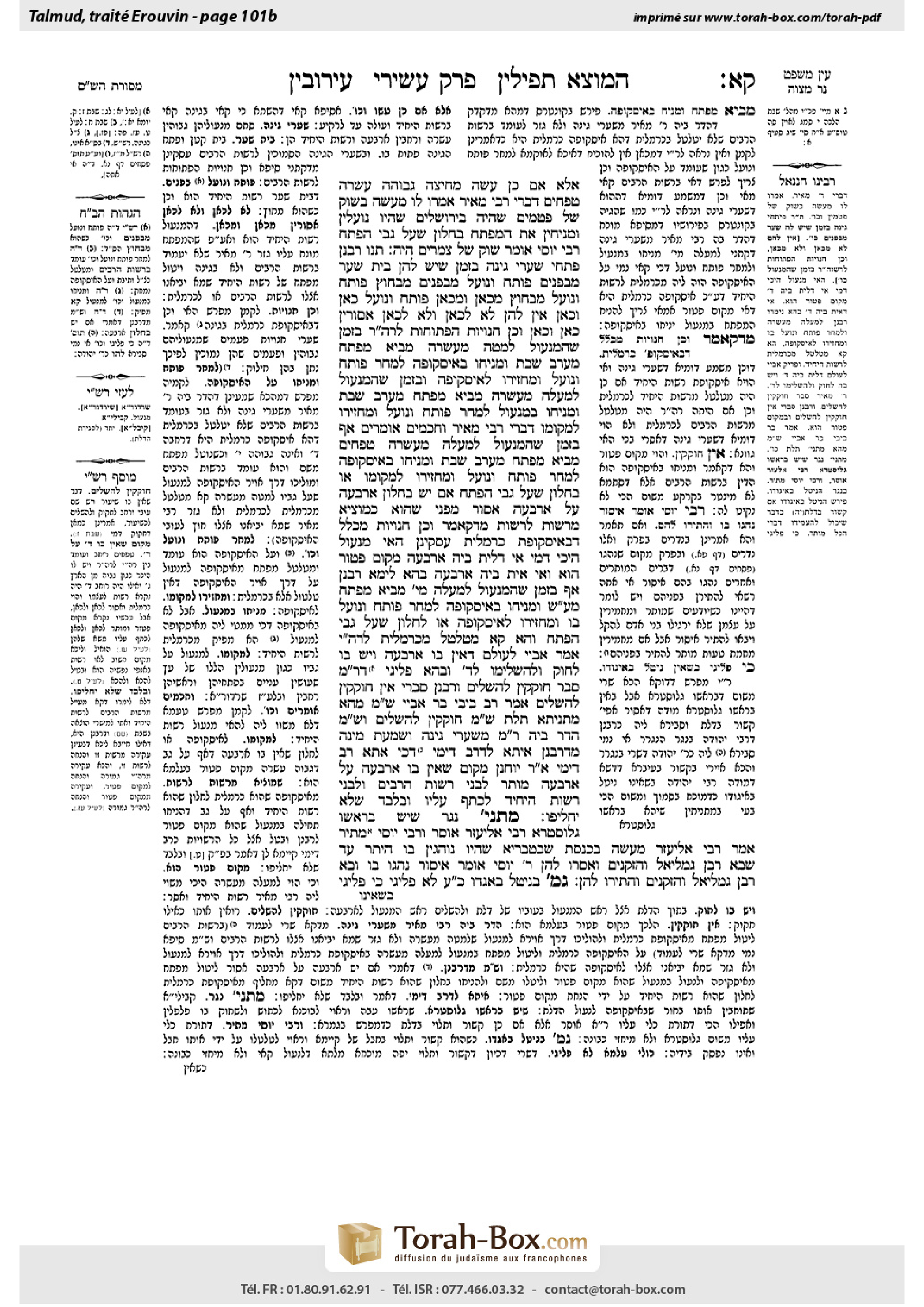
This page of Eruvin includes the Aramaic text, an English translation and an AI-generated French translation, alongside the scan above.
עירובין ק״א ב · Aramaic and Hebrew text
אֶלָּא אִם כֵּן עָשָׂה מְחִיצָה גְּבוֹהָה עֲשָׂרָה טְפָחִים, דִּבְרֵי רַבִּי מֵאִיר. אָמְרוּ לוֹ: מַעֲשֶׂה בְּשׁוּק שֶׁל פַּטָּמִים שֶׁהָיָה בִּירוּשָׁלַיִם, שֶׁהָיוּ נוֹעֲלִין וּמַנִּיחִין אֶת הַמַּפְתֵּחַ בַּחַלּוֹן שֶׁעַל גַּבֵּי הַפֶּתַח. רַבִּי יוֹסֵי אוֹמֵר: שׁוּק שֶׁל צַמָּרִים הָיָה.
תָּנוּ רַבָּנַן: פִּתְחֵי שַׁעֲרֵי גִינָּה, בִּזְמַן שֶׁיֵּשׁ לָהֶן בֵּית שַׁעַר מִבִּפְנִים — פּוֹתֵחַ וְנוֹעֵל מִבִּפְנִים, מִבַּחוּץ — פּוֹתֵחַ וְנוֹעֵל מִבַּחוּץ, מִכָּאן וּמִכָּאן — פּוֹתֵחַ וְנוֹעֵל כָּאן וְכָאן. אֵין לָהֶן לֹא לְכָאן וְלֹא לְכָאן — אֲסוּרִין כָּאן וְכָאן.
וְכֵן חֲנוּיוֹת הַפְּתוּחוֹת לִרְשׁוּת הָרַבִּים, בִּזְמַן שֶׁהַמַּנְעוּל לְמַטָּה מֵעֲשָׂרָה — מֵבִיא מַפְתֵּחַ מֵעֶרֶב שַׁבָּת וּמַנִּיחוֹ בָּאִיסְקוּפָּה, לְמָחָר פּוֹתֵחַ וְנוֹעֵל וּמַחְזִירוֹ לָאִיסְקוּפָּה.
וּבִזְמַן שֶׁהַמַּנְעוּל לְמַעְלָה מֵעֲשָׂרָה — מֵבִיא מַפְתֵּחַ מֵעֶרֶב שַׁבָּת וּמַנִּיחוֹ בַּמַּנְעוּל, לְמָחָר פּוֹתֵחַ וְנוֹעֵל וּמַחְזִירוֹ לִמְקוֹמוֹ, דִּבְרֵי רַבִּי מֵאִיר.
וַחֲכָמִים אוֹמְרִים: אַף בִּזְמַן שֶׁהַמַּנְעוּל לְמַעְלָה מֵעֲשָׂרָה טְפָחִים — מֵבִיא מַפְתֵּחַ מֵעֶרֶב שַׁבָּת, וּמַנִּיחוֹ בָּאִיסְקוּפָּה, לְמָחָר פּוֹתֵחַ וְנוֹעֵל וּמַחְזִירוֹ לִמְקוֹמוֹ, אוֹ בַּחַלּוֹן שֶׁעַל גַּבֵּי הַפֶּתַח.
אִם יֵשׁ בַּחַלּוֹן אַרְבָּעָה עַל אַרְבָּעָה — אָסוּר, מִפְּנֵי שֶׁהוּא כְּמוֹצִיא מֵרְשׁוּת לִרְשׁוּת.
מִדְּקָאָמַר: ״וְכֵן חֲנוּיוֹת״, מִכְּלָל דִּבְאִיסְקוּפַּת כַּרְמְלִית עָסְקִינַן. הַאי מַנְעוּל הֵיכִי דָּמֵי? אִי דְּלֵית בֵּיהּ אַרְבָּעָה, מְקוֹם פְּטוּר הוּא.
וְאִי אִית בֵּיהּ אַרְבָּעָה, בְּהָא לֵימָא רַבָּנַן: אַף בִּזְמַן שֶׁהַמַּנְעוּל לְמַעְלָה מֵעֲשָׂרָה מֵבִיא מַפְתֵּחַ מֵעֶרֶב שַׁבָּת וּמַנִּיחוֹ בָּאִיסְקוּפָּה, לְמָחָר פּוֹתֵחַ וְנוֹעֵל בּוֹ וּמַחְזִירוֹ לָאִיסְקוּפָּה אוֹ לַחַלּוֹן שֶׁעַל גַּבֵּי הַפֶּתַח? וְהָא קָא מְטַלְטֵל מִכַּרְמְלִית לִרְשׁוּת הַיָּחִיד!
אָמַר אַבָּיֵי: לְעוֹלָם דְּאֵין בּוֹ אַרְבָּעָה, וְיֵשׁ בּוֹ לָחוֹק וּלְהַשְׁלִימוֹ לְאַרְבָּעָה.
וּבְהָא פְּלִיגִי: דְּרַבִּי מֵאִיר סָבַר חוֹקְקִין לְהַשְׁלִים. וְרַבָּנַן סָבְרִי: אֵין חוֹקְקִין לְהַשְׁלִים.
אָמַר רַב בִּיבִי בַּר אַבָּיֵי, שְׁמַע מִינַּהּ מֵהָא מַתְנִיתָא תְּלָת: שְׁמַע מִינַּהּ חוֹקְקִין לְהַשְׁלִים. וּשְׁמַע מִינַּהּ הֲדַר בֵּיהּ רַבִּי מֵאִיר מִשַּׁעֲרֵי גִינָּה.
וְשָׁמְעַתְּ מִינַּהּ מִדְּרַבָּנַן אִיתָא לִדְרַב דִּימִי, דְּכִי אֲתָא רַב דִּימִי אָמַר רַבִּי יוֹחָנָן: מָקוֹם שֶׁאֵין בּוֹ אַרְבָּעָה עַל אַרְבָּעָה — מוּתָּר לִבְנֵי רְשׁוּת הָרַבִּים וְלִבְנֵי רְשׁוּת הַיָּחִיד לְכַתֵּף עָלָיו, וּבִלְבַד שֶׁלֹּא יַחֲלִיפוּ.
מַתְנִי׳ נֶגֶר שֶׁיֵּשׁ בְּרֹאשׁוֹ גְּלוֹסְטְרָא, רַבִּי אֱלִיעֶזֶר אוֹסֵר וְרַבִּי יוֹסֵי מַתִּיר.
אָמַר רַבִּי אֱלִיעֶזֶר: מַעֲשֶׂה בִּכְנֶסֶת שֶׁבִּטְבֶרְיָא שֶׁהָיוּ נוֹהֲגִין בּוֹ הֶיתֵּר, עַד שֶׁבָּא רַבָּן גַּמְלִיאֵל וְהַזְּקֵנִים וְאָסְרוּ לָהֶן. רַבִּי יוֹסֵי אוֹמֵר: אִיסּוּר נָהֲגוּ בּוֹ, וּבָא רַבָּן גַּמְלִיאֵל וְהַזְּקֵנִים וְהִתִּירוּ לָהֶן.
גְּמָ׳ בְּנִיטָּל בְּאִגְדּוֹ — כּוּלֵּי עָלְמָא לָא פְּלִיגִי. כִּי פְּלִיגִי
Eruvin 101b · English translation
unless he erected a partition ten handbreadths high around the door and stands inside it; this is the statement of Rabbi Meir. The Rabbis said to him: An incident occurred at the poultry dealers’ market in Jerusalem, as they would lock the doors to their shops and place the key in a window that was over the door, which was higher than ten handbreadths. Rabbi Yosei says: That place was a market of wool dealers.
The Sages taught a baraita: With regard to the entrances of garden gates that open into a public domain, when they have a gatehouse on the inside, which is a private domain, one may open and close them from within. This is because the lock, which is four handbreadths wide and ten handbreadths high, also constitutes a private domain. Consequently, the key may be passed from the gatehouse to the lock. However, they may not be opened or closed from without, as the key may not be passed from the public domain to the private domain of the lock. If the gatehouse is on the outside, one may open and close the doors from without, as once again both the lock and the gatehouse are private domains. They may not, however, be opened from within, as the key may not be passed from the garden, which is a karmelit, to the lock. If they have a gatehouse from here, from within, and there, from without, one may open and close the doors here and there. If they do not have a gatehouse; neither here nor there, it is prohibited to open or close the doors here and there, as one may not carry the key either in the public domain or in the garden.
And likewise, this is the halakha with regard to stores that open into the public domain: When the lock is below ten handbreadths off the ground, it is in the public domain. In that case, one may bring a key on Shabbat eve and place it on the threshold, whose legal status is that of a karmelit, and the following day he may open and close the door and return the key to the threshold.
And when the lock is above ten handbreadths off the ground, one may bring a key on Shabbat eve and place it in the lock. And the following day he may open and close the door and return the key to its place on top of the lock. This is the statement of Rabbi Meir.
And the Rabbis say: Even when the lock is above ten handbreadths off the ground, one may bring a key on Shabbat eve and place it on the threshold, and the following day he may open and close the door and return the key to its place on the threshold or in the window that is above the door.
However, if the window is four by four handbreadths and ten handbreadths above the ground, its status is that of a private domain, and it is therefore prohibited to place the key in the window, because it would be as though one is transferring the key from one domain, a karmelit, to another private domain.
The Gemara infers: From the fact that it is stated in the baraita: And similarly, stores, this proves by inference that we are dealing with a threshold that is a karmelit, as it would otherwise be prohibited to transfer the key from the threshold to the lock. If so, with regard to this lock, what are the circumstances? If there is not an area of four by four handbreadths in it, it does not have the status of a prohibited domain at all, and it is an exempt domain.
And if it is four by four handbreadths, and therefore a private domain, would the Rabbis say in that case: Even when the lock is above ten handbreadths off the ground, he may bring a key on Shabbat eve and place it in the threshold, and the following day he may open and close the door and return the key to the threshold or to a window above the door? Isn’t he moving an object from a karmelit to the private domain?
Abaye said: Actually, the lock is not four by four handbreadths, but there is enough space in the door surrounding it to carve out a hole that would complete its area to the requisite four handbreadths.
And this is their dispute: Rabbi Meir, who conforms to his standard line of reasoning, maintains that one carves out the space to complete it to four handbreadths. In other words, if a small opening is located in a place large enough for it to be widened, the place is viewed as though it had already been carved out, providing the opening with the larger dimensions. And the Rabbis conform to their standard line of reasoning, as they maintain that one does not carve out the space to complete it to four handbreadths. Consequently, the lock in its present condition is not large enough to constitute a place of significance, and it is therefore regarded as an exempt place.
Rav Beivai bar Abaye said: Learn from this baraita three halakhot: Learn from it that according to Rabbi Meir, we carve out to complete the necessary dimensions. And further learn from it that Rabbi Meir retracted his ruling with regard to garden gates. According to Rava, Rabbi Meir prohibited a man standing in a karmelit from opening a door in a private domain, and yet here he permits a similar case.
And learn from the statement of the Rabbis that the ruling of Rav Dimi is accepted. As when Rav Dimi came to Babylonia from Eretz Israel, he said that Rabbi Yoḥanan said: A place with an area that is less than four by four handbreadths and that is set apart from the surrounding area is an exempt domain with regard to carrying on Shabbat. Consequently, if the domain is located between a public domain and a private domain, it is permitted for both the people in the public domain and for the people in the private domain to adjust the burden onto their shoulders, provided that they do not exchange objects with one another. This ruling, that it is prohibited to exchange articles, is supported by the position of the Rabbis that it is prohibited to transfer the key from the threshold, which is a karmelit, via the lock, an exempt domain, to the private domain of the window, as one may not transfer an object from one prohibited domain to another, even via an exempt domain.
MISHNA: With regard to a bolt that secures a door in place and that has a thick knob [gelustera] at its end, a useful implement for a variety of purposes, the tanna’im disagree whether the bolt has the status of a vessel, and one may therefore close the door with it, or whether it is considered a cross beam, which would mean that doing so is classified as building. Rabbi Eliezer prohibits its use, and Rabbi Yosei permits it.
Rabbi Eliezer said: An incident occurred in a synagogue in Tiberias, where they were accustomed to treat use of this bolt as permitted, until Rabban Gamliel and the Elders came and prohibited it to them. Rabbi Yosei says that the opposite was the case: At first they were accustomed to treat use of this bolt as prohibited, and Rabban Gamliel and the Elders came and permitted it to them.
GEMARA: The Gemara narrows the dispute: If the bolt can be moved by the rope with which it is attached to the door, everyone agrees that it is considered part of the door, and one may secure the door with it. When Rabbi Yosei and Rabbi Eliezer disagree,
Eruvin 101b · Traduction française (IA)
sauf s'il a érigé une cloison de dix paumes de haut autour de la porte et s'est installé à l'intérieur ; c'est la déclaration du Rabbi Meïr. Les Sages dirent à lui : Il y a eu un incident au marché des vendeurs de volailles à Jérusalem, car ils verrouillaient les portes de leurs boutiques et posaient la clé dans une fenêtre située au-dessus de la porte, qui était plus haute que dix paumes. Rabbi Yosei dit : Ce lieu était un marché de vendeurs de laine.
Les Sages enseignèrent une baraïta : Concernant les entrées des portes de jardins qui s'ouvrent sur un domaine public, lorsqu'elles ont une maison d'entrée à l'intérieur, qui est un domaine privé, on peut ouvrir et fermer ces portes depuis l'intérieur. Cela est dû au fait que la serrure, qui est large de quatre paumes et haute de dix paumes, constitue également un domaine privé. Ainsi, la clé peut être transmise de la maison d'entrée à la serrure. Cependant, on ne peut pas les ouvrir ou fermer depuis l'extérieur, car la clé ne peut pas être transmise du domaine public au domaine privé de la serrure. Si la maison d'entrée est à l'extérieur, on peut ouvrir et fermer les portes depuis l'extérieur, car à nouveau, à la fois la serrure et la maison d'entrée sont des domaines privés. Cependant, on ne peut pas les ouvrir depuis l'intérieur, car la clé ne peut pas être transmise du jardin, qui est un karmelit, à la serrure. Si elles ont une maison d'entrée à l'intérieur et à l'extérieur, on peut ouvrir et fermer les portes à l'intérieur et à l'extérieur. Si elles n'ont pas de maison d'entrée ni à l'intérieur ni à l'extérieur, il est interdit d'ouvrir ou de fermer les portes à l'intérieur et à l'extérieur, car on ne peut pas transporter la clé ni dans le domaine public ni dans le jardin.
Et de même, c'est la halakha concernant les boutiques qui s'ouvrent sur le domaine public : Lorsque la serrure est située en dessous de dix paumes du sol, elle est dans le domaine public. Dans ce cas, on peut apporter une clé le soir du Shabbat et la placer sur le seuil, dont le statut juridique est celui d'un karmelit, et le lendemain on peut ouvrir et fermer la porte et rendre la clé au seuil.
Et lorsqu'elle est située au-dessus de dix paumes du sol, on peut apporter une clé le soir du Shabbat et la placer dans la serrure. Et le lendemain on peut ouvrir et fermer la porte et rendre la clé à sa place au-dessus de la serrure. C'est la déclaration du Rabbi Meïr.
Et les Sages dirent : Même lorsque la serrure est située au-dessus de dix paumes du sol, on peut apporter une clé le soir du Shabbat et la placer sur le seuil, et le lendemain on peut ouvrir et fermer la porte et rendre la clé au seuil ou à la fenêtre située au-dessus de la porte.
Cependant, si la fenêtre est de quatre par quatre paumes et située à dix paumes du sol, son statut est celui d'un domaine privé, et il est donc interdit de placer la clé dans la fenêtre, car cela serait comme si l'on transférait la clé d'un domaine, un karmelit, à un autre domaine privé.
La Guemara infère : D'après le fait que cela est mentionné dans la baraïta : Et de même, les boutiques, cela prouve par déduction que nous sommes en présence d'un seuil qui est un karmelit, car autrement il serait interdit de transférer la clé du seuil à la serrure. Si tel est le cas, concernant cette serrure, quels sont les circonstances ? Si elle ne possède pas une surface de quatre par quatre paumes, elle ne constitue pas un domaine interdit du tout, et elle est un domaine exempt.
Et si elle est de quatre par quatre paumes, et donc un domaine privé, les Sages diraient-ils dans ce cas : Même lorsque la serrure est située au-dessus de dix paumes du sol, on peut apporter une clé le soir du Shabbat et la placer sur le seuil, et le lendemain on peut ouvrir et fermer la porte et rendre la clé au seuil ou à la fenêtre située au-dessus de la porte ? N'est-ce pas transférer un objet d'un karmelit vers un domaine privé ?
Abaye dit : En réalité, la serrure n'est pas de quatre par quatre paumes, mais il y a suffisamment d'espace dans la porte autour d'elle pour y percer un trou qui permettrait d'atteindre les quatre paumes nécessaires.
Et c'est leur débat : Rabbi Meïr, qui suit sa ligne de raisonnement habituelle, maintient que l'on perce l'espace pour atteindre les quatre paumes. En d'autres termes, si une petite ouverture est située dans un lieu suffisamment grand pour être élargie, le lieu est considéré comme s'il avait déjà été percé, offrant à l'ouverture les dimensions nécessaires. Et les Sages suivent leur ligne de raisonnement habituelle, car ils maintiennent que l'on ne perce pas l'espace pour atteindre les four paumes. Ainsi, la serrure dans son état actuel n'est pas assez grande pour constituer un lieu important, et elle est donc considérée comme un lieu exempt.
Rav Béivai bar Abaye dit : Apprenez de cette baraïta trois halakhot : Apprenez que selon Rabbi Meïr, on perce pour atteindre les dimensions nécessaires. Et apprenez également que Rabbi Meïr a rétracté son avis concernant les portes de jardins. Selon Rava, Rabbi Meïr interdisait à un homme debout dans un karmelit d'ouvrir une porte dans un domaine privé, et pourtant ici il permet un cas similaire.
Et apprenez de la déclaration des Sages que la décision de Rav Dimi est acceptée. Car lorsque Rav Dimi est venu en Babylone depuis la Terre d'Israël, il a dit que Rabbi Yoḥanan a dit : Un lieu dont la surface est inférieure à quatre par quatre paumes et qui est séparé du domaine environnant est un domaine exempt concernant le transport le Shabbat. Ainsi, si le domaine est situé entre un domaine public et un domaine privé, il est permis aux gens du domaine public et aux gens du domaine privé d'ajuster le fardeau sur leurs épaules, à condition qu'ils ne transmettent pas d'objets les uns aux autres. Cette décision, qui interdit l'échange d'objets, est soutenue par la position des Sages qui interdisent de transférer la clé du seuil, qui est un karmelit, via la serrure, un domaine exempt, au domaine privé de la fenêtre, car on ne peut pas transférer un objet d'un domaine interdit à un autre, même via un domaine exempt.
MICHNA : Concernant un boulon qui ferme une porte et qui a un gros bouton [gelustera] à son extrémité, utile pour diverses utilisations, les tannaïm s'entendent sur le fait que ce boulon est considéré comme un objet ou comme une poutre transversale, et donc si l'on ferme la porte avec lui, cela est permis ou interdit. Rabbi Eliezer interdit son utilisation, et Rabbi Yosei l'autorise.
Rabbi Eliezer dit : Il y a eu un incident dans une synagogue de Tébérias, où on était habitué à considérer l'utilisation de ce boulon comme permise, jusqu'à ce que Rabban Gamliel et les Anciens viennent l'interdire. Rabbi Yosei dit que c'était l'inverse : d'abord on était habitué à considérer l'utilisation de ce boulon comme interdite, et Rabban Gamliel et les Anciens sont venus l'autoriser.
GUEMARA : La Guemara restreint le débat : Si le boulon peut être déplacé par la corde avec laquelle il est attaché à la porte, tout le monde convient qu'il est considéré comme faisant partie de la porte, et l'on peut le fermer avec lui. Lorsque Rabbi Yosei et Rabbi Eliezer s'entendent sur ce point,
Traduction française générée par IA à partir de l’édition anglaise de Sefaria. Vérifie toujours un passage avec le texte source.
Text from Sefaria: William Davidson Edition - Vocalized Aramaic (CC BY NC); William Davidson Edition - English (CC BY NC).