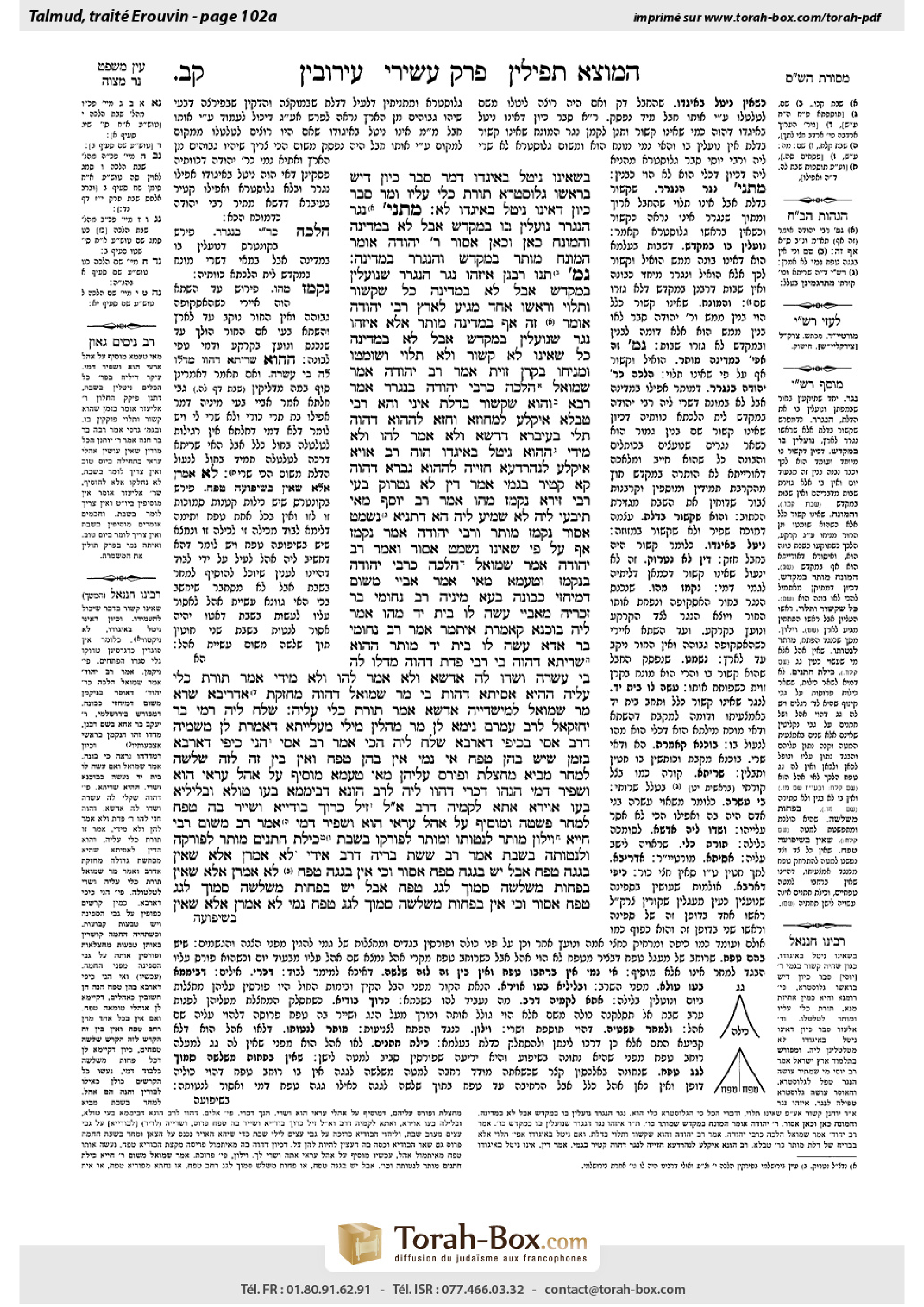
Eruvin 102a: Talmud study for Daf Yomi
Study the Talmud for Daf Yomi with scanned pages, Hebrew text, English translations from Sefaria and AI-generated French translations.
Passage selection and English or AI-generated French translation are available where the scan has annotations. Daf Study is independent of Torah-Box and Sefaria.
Browse Eruvin · עירובין · All tractatesEruvin 102a text and translations
This page of Eruvin includes the Aramaic text, an English translation and an AI-generated French translation, alongside the scan above.
עירובין ק״ב א · Aramaic and Hebrew text
בְּשֶׁאֵינוֹ נִיטָּל בְּאִיגְדּוֹ, דְּמָר סָבַר: כֵּיוָן דְּיֵשׁ בְּרֹאשׁוֹ גְּלוֹסְטְרָא — תּוֹרַת כְּלִי עָלָיו. וּמָר סָבַר: כֵּיוָן דְּאֵינוֹ נִיטָּל בְּאִיגְדּוֹ — לֹא.
מַתְנִי׳ נֶגֶר הַנִּגְרָר — נוֹעֲלִין בּוֹ בְּמִקְדָּשׁ, אֲבָל לֹא בִּמְדִינָה.
וְהַמּוּנָּח כָּאן וְכָאן — אָסוּר. רַבִּי יְהוּדָה אוֹמֵר: הַמּוּנָּח מוּתָּר בַּמִּקְדָּשׁ, וְהַנִּגְרָר בַּמְּדִינָה.
גְּמָ׳ תָּנוּ רַבָּנַן: אֵיזֶהוּ נֶגֶר הַנִּגְרָר שֶׁנּוֹעֲלִין בַּמִּקְדָּשׁ אֲבָל לֹא בַּמְּדִינָה — כׇּל שֶׁקָּשׁוּר וְתָלוּי, וְרֹאשׁוֹ אֶחָד מַגִּיעַ לָאָרֶץ. רַבִּי יְהוּדָה אוֹמֵר: זֶה אַף בַּמְּדִינָה מוּתָּר, אֶלָּא אֵיזֶהוּ נֶגֶר שֶׁנּוֹעֲלִין בַּמִּקְדָּשׁ אֲבָל לֹא בַּמְּדִינָה — כֹּל שֶׁאֵינוֹ לֹא קָשׁוּר וְלֹא תָּלוּי, וְשׁוֹמְטוֹ וּמַנִּיחוֹ בְּקֶרֶן זָוִית.
אָמַר רַב יְהוּדָה אָמַר שְׁמוּאֵל: הֲלָכָה כְּרַבִּי יְהוּדָה בְּנִגְרָר.
אָמַר רָבָא: וְהוּא שֶׁקָּשׁוּר בַּדֶּלֶת. אִינִי?! וְהָא רַבִּי טַבְלָא אִיקְּלַע לְמָחוֹזָא, וַחֲזָא לְהָהוּא דַּהֲוָה תְּלֵי בְּעִיבְרָא דְּדַשָּׁא וְלָא אֲמַר לְהוּ וְלָא מִידֵּי? הָהוּא נִיטָּל בְּאִיגְדּוֹ הֲוָה.
רַב אַוְיָא אִיקְּלַע לִנְהַרְדְּעָא, חַזְיֵיהּ לְהָהוּא גַּבְרָא דַּהֲוָה קָא קָטֵיר בְּגֶמִי. אֲמַר: דֵּין לָא נִטְרוֹק.
בָּעֵי רַבִּי זֵירָא: נִקְמַז, מַהוּ? אָמַר רַב יוֹסֵף: מַאי תִּיבְּעֵי לֵיהּ? לָא שְׁמִיעַ לֵיהּ הָא דְּתַנְיָא: נִשְׁמַט — אָסוּר, נִקְמַז — מוּתָּר. וְרַבִּי יְהוּדָה אָמַר: נִקְמַז, אַף עַל פִּי שֶׁאֵינוֹ נִשְׁמָט — אָסוּר.
וְאָמַר רַב יְהוּדָה אָמַר שְׁמוּאֵל: הֲלָכָה כְּרַבִּי יְהוּדָה בְּנִקְמַז. וְטַעְמָא מַאי? אָמַר אַבָּיֵי: מִשּׁוּם דְּמֶיחְזֵי כְּבוֹנֶה.
בְּעָא מִינֵּיהּ רַב נְחוּמִי בַּר זְכַרְיָה מֵאַבָּיֵי: עָשָׂה לוֹ בֵּית יָד, מַהוּ? אֲמַר לֵיהּ: בּוּכְנָא קָאָמְרַתְּ. אִיתְּמַר, אָמַר רַב נְחוּמִי בַּר אַדָּא: עָשָׂה לוֹ בֵּית יָד — מוּתָּר.
הָהוּא שָׁרִיתָא דַּהֲוָה בֵּי רַבִּי פְּדָת דַּהֲוָה מַדְלוּ לַהּ בֵּי עַשְׂרָה וְשָׁדוּ לַהּ אַדְּשָׁא, וְלָא אֲמַר לְהוּ וְלָא מִידֵּי. אֲמַר — תּוֹרַת כְּלִי עָלֶיהָ.
הָהִיא אֲסִיתָא דַּהֲוָת בֵּי מָר שְׁמוּאֵל דַּהֲוָה מַחְזֶקֶת אַדְרִיבָּא, שְׁרָא מָר שְׁמוּאֵל לְמִישְׁדְּיַיהּ אַדַּשָׁא. אֲמַר — תּוֹרַת כְּלִי עָלֶיהָ.
שְׁלַח לֵיהּ רָמֵי בַּר יְחֶזְקֵאל לְרַב עַמְרָם: נֵימָא לַן מָר מֵהָלֵין מִילֵּי מְעַלְּיָיתָא דַּאֲמַרְתְּ לַן מִשְּׁמֵיהּ דְּרַב אַסִּי בְּכִיפֵּי דְאַרְבָּא. שְׁלַח לֵיהּ, הָכִי אָמַר רַב אַסִּי: הָנֵי כִּיפֵּי דְאַרְבָּא בִּזְמַן שֶׁיֵּשׁ בָּהֶן טֶפַח, אִי נָמֵי אֵין בָּהֶן טֶפַח וְאֵין בֵּין זֶה לָזֶה שְׁלֹשָׁה — לְמָחָר מֵבִיא מַחְצֶלֶת וּפוֹרֵס עֲלֵיהֶן.
מַאי טַעְמָא — מוֹסִיף עַל אֹהֶל עֲרַאי הוּא, וְשַׁפִּיר דָּמֵי.
הָנְהוּ דִּכְרֵי דַּהֲווֹ לֵיהּ לְרַב הוּנָא, דְּבִימָמָא בְּעוֹ טוּלָּא וּבְלֵילְיָא בְּעוֹ אַוֵּירָא. אֲתָא לְקַמֵּיהּ דְּרַב.
אֲמַר לֵיהּ: זִיל כְּרוֹךְ בּוּדְיָיא, וְשַׁיַּיר בַּהּ טֶפַח, לִמְחַר פַּשְׁטַהּ וּמוֹסִיף עַל אֹהֶל עֲרַאי הוּא, וְשַׁפִּיר דָּמֵי.
אָמַר רַב מִשּׁוּם רַבִּי חִיָּיא: וִילוֹן מוּתָּר לִנְטוֹתוֹ וּמוּתָּר לְפוֹרְקוֹ בְּשַׁבָּת.
כִּילַּת חֲתָנִים מוּתָּר לְפוֹרְקָהּ וְלִנְטוֹתָהּ בְּשַׁבָּת. אָמַר רַב שֵׁשֶׁת בְּרֵיהּ דְּרַב אִידִי: לָא אֲמַרַן אֶלָּא שֶׁאֵין בְּגַגָּהּ טֶפַח, אֲבָל יֵשׁ בְּגַגָּהּ טֶפַח — אָסוּר.
וְכִי אֵין בְּגַגָּהּ טֶפַח, לָא אֲמַרַן אֶלָּא שֶׁאֵין בְּפָחוֹת מִשְּׁלֹשָׁה סָמוּךְ לַגַּג טֶפַח, אֲבָל יֵשׁ בְּפָחוֹת מִשְּׁלֹשָׁה סָמוּךְ לַגַּג טֶפַח — אָסוּר.
וְכִי אֵין בְּפָחוֹת מִשְּׁלֹשָׁה סָמוּךְ לַגַּג טֶפַח נָמֵי, לָא אֲמַרַן אֶלָּא שֶׁאֵין
Eruvin 102a · English translation
it is in a case where it cannot be picked up by its rope, as it is too thin to bear the weight of the bolt. As this Sage, Rabbi Yosei, maintains: Since it has a knob at its end, it has the status of a vessel, and one is therefore permitted to secure the door with it. And this Sage, Rabbi Eliezer, maintains: Since it cannot be picked up by its rope, no, it is not considered a proper vessel merely because of the knob, and consequently, its use is prohibited on Shabbat.
MISHNA: With regard to a bolt that is attached to the door, but owing to the length of the rope, it does not hang from the door but drags along the ground, one may lock a door with it in the Temple on Shabbat, as this is prohibited only by rabbinic decree, issued to enhance the character of Shabbat as a day of rest, and rabbinic decrees are not in effect in the Temple. However, one may not lock a door with this bolt in the country outside the Temple.
And with regard to one that is not tied at all but rests entirely on the ground, it is prohibited in both places, in and outside the Temple, as the use of this bolt is considered building. Rabbi Yehuda says: One that rests entirely on the ground is permitted in the Temple, and one that drags along the ground is permitted even in the rest of the country.
GEMARA: The Sages taught in a baraita: Which is the bolt that drags along the ground with which one may lock a door on Shabbat in the Temple but not in the rest of the country? Any that is tied to the door and suspended from it, while one end of the bolt reaches the ground. Rabbi Yehuda says: This type of bolt is permitted even in the rest of the country. Rather, which is the bolt with which one may lock a door in the Temple but not in the rest of the country? Any that is neither tied to the door nor suspended from it, but which one removes after use and places in a corner.
Rav Yehuda said that Shmuel said: The halakha is in accordance with the opinion of Rabbi Yehuda with regard to a bolt that is dragged. It is permitted to use this bolt on Shabbat even outside the Temple, but it is prohibited to use a bolt that rests on the ground, even in the Temple.
Rava said: And that is the case only if the bolt is tied to the door itself. The Gemara is surprised by this ruling: Is that really so? But didn’t Rabbi Tavla happen to come to Meḥoza and he saw a certain bolt that was suspended from the side of the door, and he did not say anything to the people there with regard to a prohibition? The Gemara rejects this contention: That bolt was one that could be picked up by its rope. Everyone agrees that a bolt of this kind may be used for locking a door on Shabbat even if it is not tied to the door itself.
The Gemara relates that Rav Avya once happened to come to Neharde’a and saw a certain person tying a bolt to a door with a reed. He said: This door may not be locked on Shabbat, as the bolt is not adequately fastened to it.
Rabbi Zeira raised the following dilemma: If the bolt was pressed into the ground through a hole in the threshold, what is the halakha? Is the use of this bolt considered building? Rav Yosef said: What is Rabbi Zeira’s dilemma? Has he not heard that which was taught in the Tosefta: If the bolt was altogether detached from the rope to which it had been tied, it is prohibited; but if it was pressed into the ground, it is permitted; and Rabbi Yehuda said: If it was pressed into the ground, even though it was not entirely detached from its rope, it is prohibited?
And Rav Yehuda said that Shmuel said: The halakha is in accordance with the opinion of Rabbi Yehuda with regard to a bolt that was pressed into the ground. The Gemara asks: And what is the reason that the Sages prohibited the use of a bolt that was pressed into the ground? Abaye said: They prohibited its use because it appears like building, as the bolt enters all the way into the ground.
Rav Neḥumei bar Zekharya raised a dilemma before Abaye: If one produced a handle for the bolt in order to hold it, but it was not tied to the door, what is the halakha? Abaye said to him: A pestle, you say? If it has a handle it is a proper utensil, which may be freely used according to all opinions. This teaching was stated also in the form of a direct statement: Rav Neḥumei bar Adda said: If he produced a handle for the bolt, it is permitted.
The Gemara relates that there was a certain cross beam in the house of Rabbi Pedat that was so heavy it took ten people to lift it, and they would place it against the door at night in order to secure it. And Rabbi Pedat did not say anything to them with regard to a possible prohibition. He said: I permit it because it has the status of a utensil. It appears like a utensil and it serves a distinct purpose; therefore, it may be used on Shabbat.
The Gemara further relates that there was a certain mortar in the house of Mar Shmuel that had a capacity of an adriva, which is equal to half a kor. Mar Shmuel permitted them to place it against the door to secure it. He said: It falls into the halakhic category of a utensil, and it may therefore be used to secure the door, as this is not regarded as building.
Rami bar Yeḥezkel sent a request to Rav Amram: Let the Master tell us some of those outstanding matters that you told us in the name of Rav Asi with regard to the arches of a boat upon which mats are draped as protection against the elements. Rav Amram sent back to him that Rav Asi said as follows: With regard to the arches of a boat, when they are a handbreadth wide, or even if they are not a handbreadth wide but there is less than three handbreadths between them, in which case the intervening space is regarded as filled in based on the principle of lavud, on the following day, i.e., on Shabbat, one may bring a mat and spread it over them.
What is the reason for this leniency? The reason is that this is considered adding to a temporary tent, and therefore one may well spread a mat over the arches. They themselves constitute a tent. Therefore, one who spreads a mat over them is merely adding to the temporary tent.
The Gemara further relates that Rav Huna had certain rams that required shade during the day and required air at night. He therefore sought a way for the pen to be covered by day but not at night, even on Shabbat. He came before Rav to seek his advice.
Rav said to him: Go, roll up the mats [budeya] that were spread out there for shade, but leave one handbreadth covered. On the following day, unroll the entire mat, which is considered adding to a temporary tent and which is permitted.
Rav said in the name of Rabbi Ḥiyya: With regard to a curtain put up for privacy, one is permitted to spread it out, and one is also permitted to dismantle it on Shabbat. As it is not a tent but merely a temporary wall, akin to a door, one does not violate a prohibition if it is not fixed firmly in place.
With regard to a bridal canopy, a curtain that is suspended over a bed and inclines outward in both directions, it is permitted both to dismantle it and to spread it on Shabbat. Rav Sheshet, son of Rav Idi, said: We said that this is permitted only where the curtain extends over the bed and falls on both sides in such a manner that the top of the curtain, the apex of the canopy, is less than a handbreadth wide. However, if its top is a handbreadth wide, i.e., if the curtain does not rise to a sharp point but extends horizontally for a handbreadth, after which it falls to the side, this handbreadth is regarded as a tent and is therefore prohibited.
And even where its horizontal top is not a handbreadth wide, we said this leniency only if its width is less than a handbreadth within three handbreadths from its top. However, if its width is a handbreadth within three handbreadths from its top, this handbreadth is considered a tent and it is therefore prohibited to spread it on Shabbat.
And even where it is less than a handbreadth wide within three handbreadths of its top, we said this leniency only where
Eruvin 102a · Traduction française (IA)
Il s'agit d'un cas où il ne peut être soulevé par sa corde, car il est trop fin pour porter le poids de la serrure. Selon ce Sage, Rabbi Yosei, il affirme que puisque la serrure a un manche à son extrémité, elle a le statut d'un ustensile, et l'on est donc autorisé à la fixer pour fermer la porte. Selon ce Sage, Rabbi Eliezer, il affirme que puisque la serrure ne peut être soulevée par sa corde, non, elle n'est pas considérée comme un ustensile approprié simplement à cause du manche, et par conséquent, son utilisation est interdite le sabbat.
MICHNA : En ce qui concerne une serrure attachée à la porte, mais en raison de la longueur de la corde, elle ne pend pas de la porte mais glisse au sol, l'on peut fermer la porte avec elle dans le Temple le sabbat, car cela est interdit uniquement par un décret rabbinique, émis pour améliorer la qualité du sabbat comme jour de repos, et les décrets rabbiniques ne sont pas en vigueur dans le Temple. Cependant, l'on ne peut pas fermer la porte avec cette serrure en dehors du Temple.
Et en ce qui concerne une serrure qui n'est pas attachée du tout mais repose entièrement au sol, elle est interdite à la fois à l'intérieur et à l'extérieur du Temple, car l'utilisation de cette serrure est considérée comme de la construction. Rabbi Yehuda dit : Une serrure qui repose entièrement au sol est permise dans le Temple, et une serrure qui glisse au sol est permise même dans le reste du pays.
GUEMARA : Les Sages ont enseigné dans une baraïta : Quelle est la serrure qui glisse au sol avec laquelle l'on peut fermer une porte le sabbat dans le Temple mais pas dans le reste du pays ? Toute serrure attachée à la porte et suspendue d'elle, tandis qu'une extrémité de la serrure atteint le sol. Rabbi Yehuda dit : Ce type de serrure est permis même dans le reste du pays. En réalité, quelle est la serrure avec laquelle l'on peut fermer une porte dans le Temple mais pas dans le reste du pays ? Toute serrure qui n'est ni attachée à la porte ni suspendue d'elle, mais que l'on retire après utilisation et qu'on place dans un coin.
Rav Yehuda a dit que Shmuel a dit : La halakha suit l'opinion de Rabbi Yehuda concernant une serrure qui glisse. Il est permis d'utiliser cette serrure le sabbat même en dehors du Temple, mais il est interdit d'utiliser une serrure qui repose au sol, même dans le Temple.
Rava a dit : Et cela est vrai uniquement si la serrure est attachée à la porte elle-même. La Guemara est surprise par cette décision : Est-ce vraiment ainsi ? Mais n'est-ce pas arrivé que Rabbi Tavla soit venu à Meḥoza et qu'il ait vu une certaine serrure suspendue du côté de la porte, et qu'il n'ait pas dit quoi que ce soit aux gens là-bas concernant une interdiction ? La Guemara rejette cette affirmation : Cette serrure était celle qui pouvait être soulevée par sa corde. Tout le monde convient que ce type de serrure peut être utilisé pour fermer une porte le sabbat même s'il n'est pas attaché à la porte elle-même.
La Guemara rapporte que Rav Avya est arrivé à Neharde’a et a vu une certaine personne attacher une serrure à une porte avec un roseau. Il a dit : Cette porte ne peut pas être verrouillée le sabbat, car la serrure n'est pas suffisamment fixée à elle.
Rabbi Zeira a soulevé le suivant dilemme : Si la serrure était enfoncée dans le sol à travers un trou dans le seuil, quelle est la halakha ? L'utilisation de cette serrure est-elle considérée comme de la construction ? Rav Yosef a dit : Quel est le dilemme de Rabbi Zeira ? N'a-t-il pas entendu ce qui a été enseigné dans la Tosefta : Si la serrure était totalement détachée de la corde à laquelle elle était attachée, elle est interdite ; mais si elle était enfoncée dans le sol, elle est permise ; et Rabbi Yehuda a dit : Si elle était enfoncée dans le sol, même s'il n'était pas totalement détachée de sa corde, elle est interdite ?
Et Rav Yehuda a dit que Shmuel a dit : La halakha suit l'opinion de Rabbi Yehuda concernant une serrure enfoncée dans le sol. La Guemara pose la question : Et quelle est la raison pour laquelle les Sages ont interdit l'utilisation d'une serrure enfoncée dans le sol ? Abaye a dit : Ils l'ont interdit parce qu'elle ressemble à de la construction, car la serrure pénètre tout le long dans le sol.
Rav Neḥumei bar Zekharya posa un dilemme devant Abaye : Si l'on a fabriqué un manche pour la serrure afin de la tenir, mais qu'elle n'était pas attachée à la porte, quelle est la halakha ? Abaye répondit à lui : Un pilon, tu dis ? Si elle a un manche, elle est un ustensile approprié, qui peut être utilisé librement selon toutes les opinions. Cet enseignement a été également formulé sous la forme d'une déclaration directe : Rav Neḥumei bar Adda dit : Si l'on a fabriqué un manche pour la serrure, elle est permise.
La Guemara rapporte qu'il y avait un certain montant dans la maison de Rabbi Pedat qui était si lourd qu'il fallait dix personnes pour le soulever, et ils le plaçaient contre la porte la nuit afin de la sécuriser. Et Rabbi Pedat n'a pas dit quoi que ce soit concernant une possible interdiction. Il dit : Je permets cela car il a le statut d'un ustensile. Il ressemble à un ustensile et il sert d'un but distinct ; par conséquent, il peut être utilisé le sabbat.
La Guemara rapporte également qu'il y avait un certain mortier dans la maison de Mar Shmuel qui avait une capacité d'un adriva, ce qui équivaut à la moitié d'un kor. Mar Shmuel permit qu'ils le placent contre la porte pour le sécuriser. Il dit : Il tombe dans la catégorie halakhique d'un ustensile, et il peut donc être utilisé pour sécuriser la porte, car cela n'est pas considéré comme de la construction.
Rami bar Yeḥezkel envoya une demande à Rav Amram : Fais-nous savoir quelques questions importantes que tu as racontées en nom de Rav Asi concernant les arches d'un bateau sur lesquelles des tapis sont posés comme protection contre les éléments. Rav Amram envoya à lui que Rav Asi dit comme suit : Concernant les arches d'un bateau, lorsqu'elles sont d'un tefach de large, ou même si elles ne sont pas d'un tefach de large mais qu'il y a moins de trois tefachim entre elles, dans le cas où l'espace entre elles est considéré comme comblé selon le principe de lavud, le lendemain, c'est-à-dire le sabbat, l'on peut apporter un tapis et le poser sur elles.
Quelle est la raison de cette leniavance ? La raison est que cela est considéré comme l'ajout à une tente temporaire, et par conséquent on peut bien tendre un tapis sur les arches. Elles elles-mêmes constituent une tente. Ainsi, celui qui tend un tapis sur elles n'ajoute qu'à la tente temporaire.
La Guemara rapporte ensuite que Rav Huna avait certains brebis qui avaient besoin d'ombre pendant la journée et avaient besoin d'air la nuit. Il cherchait donc un moyen pour que la basse-cour soit couverte pendant la journée mais pas la nuit, même le sabbat. Il alla donc devant Rav pour demander son avis.
Rav lui dit : Va, roule les tapis [budeya] qui étaient déployés là pour l'ombre, mais laisse une tefça couvert. Le lendemain, déploye l'ensemble du tapis, ce qui est considéré comme l'ajout à une tente temporaire et qui est permis.
Rav dit en nom de Rabbi Ḥiyya : En ce qui concerne un rideau dressé pour la priévé, on est autorisé à le déployer et à le démonter le sabbat. Comme ce n'est pas une tente mais simplement un mur temporaire, semblable à une porte, on ne viole pas une interdiction si ce n'est pas fixé fermement en place.
En ce qui concerne un décor de mariage, un rideau suspendu sur un lit et inclinant vers l'extérieur dans les deux sens, il est permis de le démonter et de le déployer le sabbat. Rav Sheshet, fils de Rav Idi, dit : Nous avons dit que cela est permis uniquement là où le rideau s'étend sur le lit et tombe des deux côtés de telle sorte que la partie supérieure du rideau, le sommet du décor, est moins large qu'un tefça. Cependant, si son sommet est un tefça large, c'est-à-dire si le rideau ne monte pas vers un point aigu mais s'étend horizontalement pour un tefça, après quoi il tombe sur les côtés, ce tefça est considéré comme une tente et est donc interdit.
Et même là où sa partie horizontale supérieure n'est pas un tefça large, nous avons dit cette leniency uniquement si sa largeur est inférieure à un tefça dans un rayon de trois tefças depuis son sommet. Cependant, si sa largeur est un tefça dans un rayon de trois tefças depuis son sommet, ce tefça est considéré comme une tente et il est donc interdit de le déployer le sabbat.
Et même là où elle est moins large qu'un tefça à trois tefças de son sommet, nous avons dit cette leniavance uniquement là où
Traduction française générée par IA à partir de l’édition anglaise de Sefaria. Vérifie toujours un passage avec le texte source.
Text from Sefaria: William Davidson Edition - Vocalized Aramaic (CC BY NC); William Davidson Edition - English (CC BY NC).