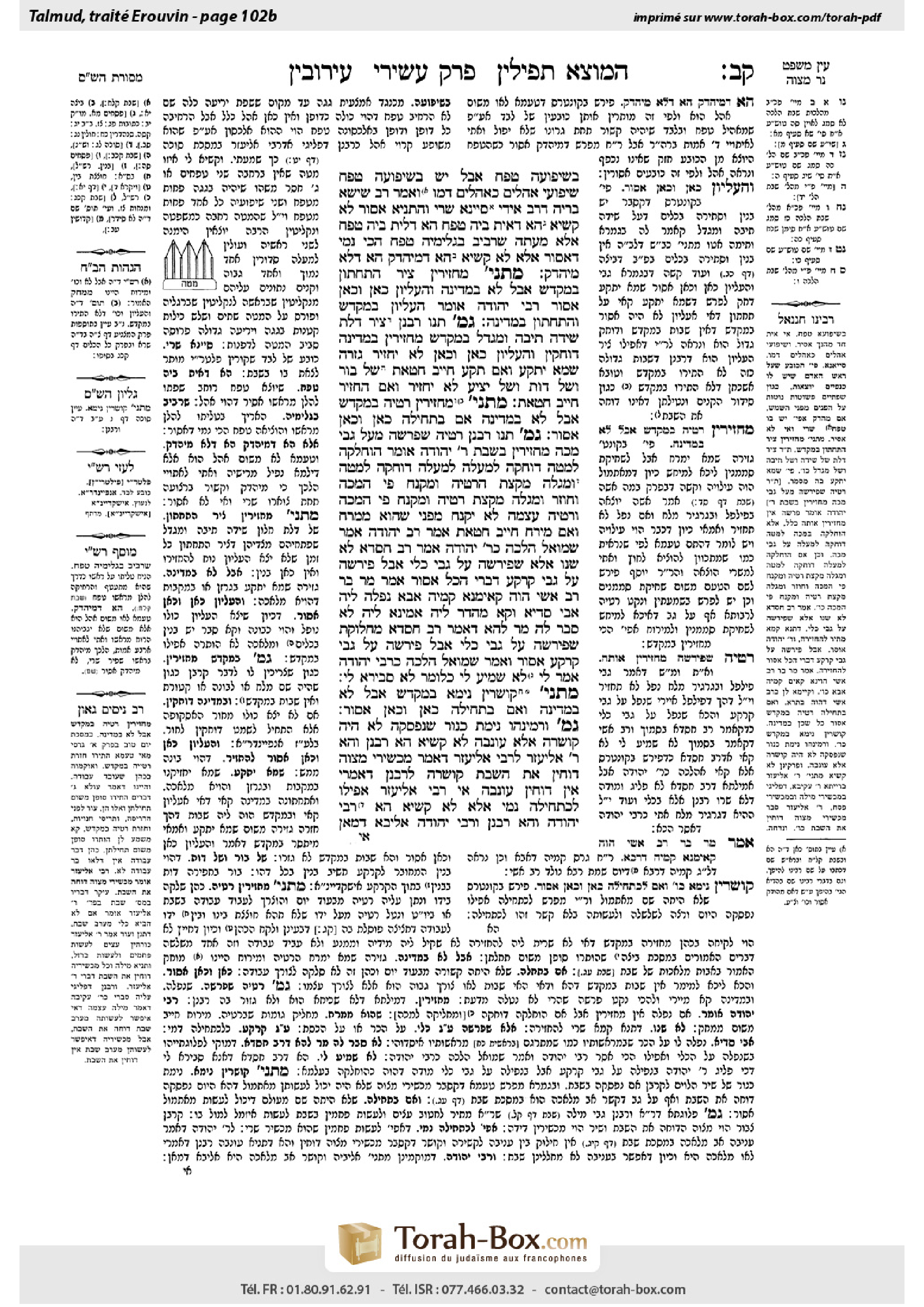
Eruvin 102b: Talmud study for Daf Yomi
Study the Talmud for Daf Yomi with scanned pages, Hebrew text, English translations from Sefaria and AI-generated French translations.
Passage selection and English or AI-generated French translation are available where the scan has annotations. Daf Study is independent of Torah-Box and Sefaria.
Browse Eruvin · עירובין · All tractatesEruvin 102b text and translations
This page of Eruvin includes the Aramaic text, an English translation and an AI-generated French translation, alongside the scan above.
עירובין ק״ב ב · Aramaic and Hebrew text
בְּשִׁיפּוּעָהּ טֶפַח, אֲבָל יֵשׁ בְּשִׁיפּוּעָהּ טֶפַח — שִׁיפּוּעֵי אֹהָלִים כְּאֹהָלִים דָּמוּ.
וְאָמַר רַב שִׁישָׁא בְּרֵיהּ דְּרַב אִידִי: סְיָינָא — שְׁרֵי. וְהָתַנְיָא אָסוּר! לָא קַשְׁיָא: הָא — דְּאִית בֵּיהּ טֶפַח, הָא — דְּלֵית בֵּיהּ טֶפַח.
אֶלָּא מֵעַתָּה: שַׁרְבֵּיב בִּגְלִימֵיהּ טֶפַח, הָכִי נָמֵי דְּאָסוּר?
אֶלָּא, לָא קַשְׁיָא: הָא — דְּמִיהַדַּק, הָא — דְּלָא מִיהַדַּק.
מַתְנִי׳ מַחְזִירִין צִיר הַתַּחְתּוֹן בַּמִּקְדָּשׁ, אֲבָל לֹא בַּמְּדִינָה. וְהָעֶלְיוֹן — כָּאן וְכָאן אָסוּר. רַבִּי יְהוּדָה אוֹמֵר: הָעֶלְיוֹן — בַּמִּקְדָּשׁ, וְהַתַּחְתּוֹן — בַּמְּדִינָה.
גְּמָ׳ תָּנוּ רַבָּנַן: צִיר דֶּלֶת שִׁידָּה תֵּיבָה וּמִגְדָּל, בַּמִּקְדָּשׁ — מַחֲזִירִין, בַּמְּדִינָה — דּוֹחֲקִין. וְהָעֶלְיוֹן — כָּאן וְכָאן לֹא יַחֲזִיר, גְּזֵרָה שֶׁמָּא יִתְקַע. וְאִם תָּקַע — חַיָּיב חַטָּאת.
שֶׁל בּוֹר וְשֶׁל דּוּת וְשֶׁל יָצִיעַ — לֹא יַחְזִיר, וְאִם הֶחְזִיר חַיָּיב חַטָּאת.
מַתְנִי׳ מַחְזִירִין רְטִיָּה בַּמִּקְדָּשׁ, אֲבָל לֹא בַּמְּדִינָה. אִם בַּתְּחִילָּה — כָּאן וְכָאן אָסוּר.
גְּמָ׳ תָּנוּ רַבָּנַן: רְטִיָּה שֶׁפֵּרְשָׁה מֵעַל גַּבֵּי מַכָּה — מַחְזִירִין בְּשַׁבָּת. רַבִּי יְהוּדָה אוֹמֵר: הוּחְלְקָה לְמַטָּה — דּוֹחֲקָהּ לְמַעְלָה, לְמַעְלָה — דּוֹחֲקָהּ לְמַטָּה, וּמְגַלֶּה מִקְצָת הָרְטִיָּה וּמְקַנֵּחַ פִּי הַמַּכָּה, וְחוֹזֵר וּמְגַלֶּה מִקְצָת רְטִיָּה וּמְקַנֵּחַ פִּי הַמַּכָּה.
וּרְטִיָּה עַצְמָהּ לֹא יְקַנֵּחַ, מִפְּנֵי שֶׁהוּא מְמָרֵחַ. וְאִם מֵירַח — חַיָּיב חַטָּאת.
אָמַר רַב יְהוּדָה אָמַר שְׁמוּאֵל: הֲלָכָה כְּרַבִּי יְהוּדָה. אָמַר רַב חִסְדָּא: לֹא שָׁנוּ אֶלָּא שֶׁפֵּירְשָׁה עַל גַּבֵּי כְּלִי, אֲבָל פֵּירְשָׁה עַל גַּבֵּי קַרְקַע — דִּבְרֵי הַכֹּל אָסוּר.
אָמַר מָר בַּר רַב אָשֵׁי: הֲוָה קָאֵימְנָא קַמֵּיהּ אַבָּא, נְפַלָה לֵיהּ אַבֵּי סַדְיָא, וְקָא מַהְדַּר לֵיהּ. אָמֵינָא לֵיהּ: לָא סָבַר לַהּ מָר לְהָא דְּאָמַר רַב חִסְדָּא: מַחְלוֹקֶת שֶׁפֵּירְשָׁה עַל גַּבֵּי כְּלִי, אֲבָל פֵּירְשָׁה עַל גַּבֵּי קַרְקַע — אָסוּר, וְאָמַר שְׁמוּאֵל: הֲלָכָה כְּרַבִּי יְהוּדָה!
אָמַר לִי: לָא שְׁמִיעַ לִי, כְּלוֹמַר לָא סְבִירָא לִי.
מַתְנִי׳ קוֹשְׁרִין נִימָא בַּמִּקְדָּשׁ, אֲבָל לֹא בַּמְּדִינָה. וְאִם בַּתְּחִילָּה — כָּאן וְכָאן אָסוּר.
גְּמָ׳ וּרְמִינְהוּ: נִימַת כִּנּוֹר שֶׁנִּפְסְקָה — לֹא הָיָה קוֹשְׁרָהּ אֶלָּא עוֹנְבָהּ! לָא קַשְׁיָא: הָא — רַבָּנַן, וְהָא — רַבִּי אֱלִיעֶזֶר.
לְרַבִּי אֱלִיעֶזֶר דְּאָמַר מַכְשִׁירֵי מִצְוָה דּוֹחִין אֶת הַשַּׁבָּת, קוֹשְׁרָהּ. לְרַבָּנַן דְּאָמְרִי אֵין דּוֹחִין, עוֹנְבָהּ.
אִי רַבִּי אֱלִיעֶזֶר, אֲפִילּוּ לְכַתְּחִילָּה נָמֵי!
אֶלָּא, לָא קַשְׁיָא: הָא — רַבִּי יְהוּדָה, וְהָא — רַבָּנַן.
וְרַבִּי יְהוּדָה אַלִּיבָּא דְּמַאן?
Eruvin 102b · English translation
its incline does not extend a handbreadth from the center to each side. However, if its incline extends a handbreadth from the center to the side, the halakha is that the inclines of tents are considered like tents, and it is therefore prohibited to suspend them.
And Rav Sheisha, son of Rav Idi, said: With regard to a stiff felt hat [sayna], it is permitted to wear it on Shabbat. The Gemara raises a difficulty: But wasn’t it taught in a baraita that wearing this hat is prohibited? The Gemara answers: It is not difficult. This baraita, which prohibits wearing a felt hat, is referring to a case where the hat extends a handbreadth from the person’s head and is therefore regarded as a tent; whereas that statement by Rav Sheisha, who permits doing so, is referring to a case where it does not extend a handbreadth from one’s head.
The Gemara is surprised at this answer: But if that is so, one who pulled his cloak a handbreadth beyond his head, is it also prohibited for him to do so? This is unreasonable, as it is an article of clothing, not a tent.
Rather, the previous explanation must be rejected, as the issue with regard to a felt hat is not whether it is considered a tent, but whether there is concern that one might come to carry it in the public domain if it falls from his head. This is not difficult; this statement of Rav Sheisha, which permits it, is referring to a case where the hat fits snugly on his head. There is no concern lest the hat fall and one will come to carry it; therefore it is permitted to wear it. Conversely, that baraita, which prohibits wearing this hat, is referring to a case where it does not fit snugly on his head. It is therefore liable to fall, and one might come to carry it in the public domain.
MISHNA: One may restore the lower hinge pin of the door of a carriage, box, or cupboard that becomes dislocated to its place on Shabbat in the Temple, as this action is prohibited by rabbinic decree, which is not in effect in the Temple; but it may not be restored to its place in the rest of the country. And restoring the upper hinge pin is prohibited in both places, as this is considered building, a labor prohibited by Torah law, which applies everywhere. Rabbi Yehuda says: Restoring the upper hinge pin to its place is permitted in the Temple, while one may restore the lower one to its place even in the rest of the country.
GEMARA: The Sages taught a baraita: With regard to the lower hinge pin of the door of a carriage, box, or cupboard, one may restore it to its place in the Temple; in the rest of the country one may only push it back into place, provided that it did not come out of its socket entirely. As for the upper hinge, one may not restore it in either place. This is prohibited as a preventive measure, lest one come to bang it in forcefully, thereby performing an actual labor prohibited by Torah law. And if he actually banged it in, he is liable to bring a sin-offering, as his action is considered building.
With regard to the hinge pin of the door of a pit, cistern, or an extension to a building, one may not restore it to its place at all. And if one restored it to its place, he is liable to bring a sin-offering. The above distinction applies only to movable utensils, whereas anything attached to the ground may certainly not be fixed in place, as this is regarded as prohibited building.
MISHNA: One may return to its place a bandage that became detached from a wound on Shabbat in the Temple. In the Temple, this is not prohibited as a preventive measure, lest one come to spread the ointment and thereby perform the prohibited labor of smoothing. However, one may not return a bandage to its place in the rest of the country. If one sought to apply the bandage for the first time to an untreated wound on Shabbat, it is prohibited in both places.
GEMARA: The Sages taught a baraita: With regard to a bandage that became detached from a wound, one may return it to its place on Shabbat in all cases. Rabbi Yehuda says: If it slipped downward, one may push it upward; if it slipped upward, one may push it downward. One may also uncover part of the bandage and clean the opening of the wound on one side, and then uncover another part of the bandage on the other side and clean the opening of the wound on that side.
However, one may not clean the bandage itself, because that would involve spreading the ointment, which is a subcategory of the prohibited labor of smoothing, and if one spread the ointment he is liable to bring a sin-offering. Actually restoring a bandage that was completely detached from the wound is prohibited in all cases.
Rav Yehuda said that Shmuel said: The halakha is in accordance with the opinion of Rabbi Yehuda. Rav Ḥisda said: The Sages taught that it is permitted to restore the bandage to the wound only where it became detached and fell onto a utensil, in which case one may immediately pick it up and replace it. However, if it became detached and fell onto the ground, everyone agrees it is prohibited, as this is considered as though one were bandaging the wound for the first time.
Mar bar Rav Ashi said: I was standing before Father, and his bandage fell onto a pillow and he replaced it. I said to him: Doesn’t the Master hold that which Rav Ḥisda said: The dispute is restricted to a case where the bandage became detached and fell onto a utensil, but if it became detached and fell onto the ground, everyone agrees that it is prohibited; and furthermore, Shmuel said: The halakha is in accordance with the opinion of Rabbi Yehuda, that it is prohibited to replace even a bandage that fell onto a utensil?
He said to me: I did not hear this teaching; that is to say, I do not agree with Rav Ḥisda’s interpretation that the dispute is only in a case where the bandage fell onto a utensil. Rather, they disagree even if it fell onto the ground, and the halakha is that the bandage may be restored to the wound.
MISHNA: One may tie up on Shabbat a string [nima] that came loose from a harp used in the Temple, but not in the rest of the country. And tying the string to the harp for the first time is prohibited both here and there.
GEMARA: And the Gemara raises a contradiction from a baraita: If a harp string broke, one would not tie it up with a knot, but fashion a bow. This teaching indicates that tying up a harp string is prohibited even in the Temple. The Gemara answers: It is not difficult; this baraita, which prohibits tying, was taught in accordance with the opinion of the Rabbis; and that mishna is in accordance with the opinion of Rabbi Eliezer.
The Gemara clarifies this answer: According to Rabbi Eliezer, who said that the preparations that enable the performance of a mitzva override the prohibitions of Shabbat, one may tie even the broken harp string, as this is for the purpose of the mitzva of accompanying the Temple service with music. However, according to the Rabbis, who say that preparations for a mitzva do not override Shabbat prohibitions, one may only fashion a bow.
The Gemara raises a difficulty: If in fact the mishna is in accordance with the opinion of Rabbi Eliezer, who permits facilitating performance of a mitzva even when it involves desecration of Shabbat, even in a case where the string did not break and one is tying it for the first time, this too should be permitted, as he is acting for the purpose of a mitzva.
Rather, the Gemara provides a different resolution of the contradiction: It is not difficult. This, the mishna that permits tying the broken string, was taught in accordance with the opinion of Rabbi Yehuda, who maintains that making a bow is considered tying, and there is no difference between the two actions; and that, the baraita that prohibits it, is in accordance with the opinion of the Rabbis, who rule that fashioning a bow is not prohibited by Torah law, and therefore it is permitted to fashion a bow.
The Gemara asks: And Rabbi Yehuda, in accordance with whose opinion did he express his view?
Eruvin 102b · Traduction française (IA)
sa déclivité ne s'étend pas d'un tefach du centre vers chaque côté. Cependant, si sa déclivité s'étend d'un tefach du centre vers le côté, la halakha est que les déclivités des tentes sont considérées comme des tentes, et il est donc interdit de les suspendre.
Et Rav Sheisha, fils de Rav Idi, a dit : En ce qui concerne un chapeau de laine [sayna], il est permis de le porter le sabbat. La Guemara soulève une difficulté : Mais n'était-il pas enseigné dans une baraïta que porter ce chapeau est interdit ? La Guemara répond : Ce n'est pas difficile. Cette baraïta, qui interdit de porter un chapeau de laine, fait référence à un cas où le chapeau s'étend d'un tefach de la tête de la personne et est donc considéré comme une tente ; tandis que cette déclaration de Rav Sheisha, qui permet cela, fait référence à un cas où il ne s'étend pas d'un tefach de la tête.
La Guemara est surprise par cette réponse : Mais si c'est ainsi, celui qui a tiré sa cape d'un tefach au-delà de sa tête, est-il aussi interdit de le faire ? Cela n'est pas raisonnable, car il s'agit d'un vêtement, pas d'une tente.
Plutôt, l'explication précédente doit être rejetée, car la question concernant le chapeau de laine ne porte pas sur le fait qu'il soit considéré comme une tente, mais sur le fait qu'il y ait une crainte qu'on vienne à le porter dans le domaine public si celui-ci tombe de sa tête. Ce n'est pas difficile ; cette déclaration de Rav Sheisha, qui permet cela, fait référence à un cas où le chapeau s'ajuste étroitement sur sa tête. Il n'y a pas de crainte qu'il tombe et qu'on vienne à le porter ; donc il est permis de le porter. À l'inverse, cette baraïta, qui interdit de porter ce chapeau, fait référence à un cas où il ne s'ajuste pas étroitement sur sa tête. Il est donc susceptible de tomber, et on pourrait venir à le porter dans le domaine public.
MICHNA : On peut rétablir le piquet inférieur de la porte d'un carrosse, d'une boîte ou d'un tiroir qui s'est détaché à sa place le sabbat dans le Temple, car cette action est interdite par un décret rabbinique, qui n'est pas en vigueur dans le Temple ; mais on ne peut pas le rétablir à sa place dans le reste du pays. Et rétablir le piquet supérieur est interdit dans les deux lieux, car cela est considéré comme la construction, un travail interdit par la Torah, qui s'applique partout. Rabbi Yehuda dit : Rétablir le piquet supérieur à sa place est permis dans le Temple, tandis qu'on peut rétablir le piquet inférieur à sa place même dans le reste du pays.
GUEMARA : Les Sages ont enseigné une baraïta : En ce qui concerne le piquet inférieur de la porte d'un carrosse, d'une boîte ou d'un tiroir, on peut le rétablir à sa place dans le Temple ; dans le reste du pays, on peut le remettre en place uniquement si celui-ci n'a pas entièrement quitté son logement. En ce qui concerne le piquet supérieur, on ne peut pas le rétablir dans aucun lieu. Cela est interdit comme mesure préventive, de peur qu'on vienne à le frapper fortement, ce qui constituerait un travail interdit par la Torah. Et si l'on a effectivement frappé le piquet, il est tenu de présenter un sacrifice expiatoire, car son action est considérée comme la construction.
En ce qui concerne le boulon de la porte d'un puits, d'un cistern ou d'une extension d'un bâtiment, on ne peut pas le rétablir à sa place du tout. Et si l'on a rétabli le boulon à sa place, il est tenu de présenter un sacrifice expiatoire. La distinction ci-dessus s'applique uniquement aux ustensiles mobiles, tandis que tout ce qui est fixé au sol peut certainement ne pas être rétabli, car cela est considéré comme une construction interdite.
MICHNA : On peut rétablir un pansement qui s'était détaché d'une plaie le sabbat dans le Temple. Dans le Temple, cela n'est pas interdit comme mesure préventive, de peur qu'on vienne à étaler le baume et ainsi effectuer le travail interdit de lissage. Cependant, on ne peut pas rétablir un pansement à sa place dans le reste du pays. Si l'on cherchait à appliquer le pansement pour la première fois à une plaie non traitée le sabbat, cela est interdit dans les deux lieux.
GUEMARA : Les Sages ont enseigné une baraïta : En ce qui concerne un pansement qui s'était détaché d'une plaie, on peut le rétablir à sa place le sabbat dans tous les cas. Rabbi Yehuda dit : Si celui-ci est tombé en bas, on peut le pousser en haut ; si celui-ci est tombé en haut, on peut le pousser en bas. On peut aussi dégager une partie du pansement et nettoyer l'ouverture de la plaie d'un côté, puis dégager une autre partie du pansement de l'autre côté et nettoyer l'ouverture de la plaie de ce côté-là.
Cependant, on ne peut pas nettoyer le pansement lui-même, car cela impliquerait d'étaler le baume, qui est une sous-catégorie du travail interdit de lissage, et si l'on étalait le baume, il serait tenu de présenter un sacrifice expiatoire. En réalité, rétablir un pansement complètement détaché de la plaie est interdit dans tous les cas.
Rav Yehuda a dit que Shmuel a dit : La halakha suit l'opinion de Rabbi Yehuda. Rav Ḥisda a dit : Les Sages ont enseigné que rétablir le pansement à la plaie est permis uniquement là où il s'est détaché et est tombé sur un ustensile, dans ce cas on peut immédiatement le ramasser et le remplacer. Cependant, si il s'est détaché et est tombé sur le sol, tout le monde convient qu'il est interdit, car cela est considéré comme si on bandageait la plaie pour la première fois.
Mar bar Rav Ashi a dit : J'étais devant mon père, et son pansement est tombé sur un coussin et il l'a remplacé. J'ai dit à lui : N'est-ce pas le Maître qui tient l'opinion que Rav Ḥisda a dit : Le débat est limité à un cas où le pansement s'est détaché et est tombé sur un ustensile, mais si il s'est détaché et est tombé sur le sol, tout le monde convient qu'il est interdit ; et de plus, Shmuel a dit : La halakha suit l'opinion de Rabbi Yehuda, que remplacer même un pansement tombé sur un ustensile est interdit ?
Il m'a dit : Je n'ai pas entendu cette enseignement ; c'est-à-dire que je ne suis pas d'accord avec l'interprétation de Rav Ḥisda selon laquelle le débat porte uniquement sur le cas où le pansement est tombé sur un ustensile. Plutôt, ils discutent même si le pansement est tombé sur le sol, et la halakha est que le pansement peut être rétabli à la plaie.
MICHNA : On Shabbat, on peut attacher une corde [nima] qui s'était détachée d'un harpique utilisé dans le Temple, mais pas ailleurs. Et attacher la corde au harpique pour la première fois est interdit tant ici que là-bas.
GUEMARA : La Guemara soulève une contradiction à partir d'une baraïta : Si une corde de harpique se brisait, on ne la recousait pas avec un nœud, mais on la transformait en arc. Cet enseignement indique que l'attache d'une corde de harpique est interdite même dans le Temple. La Guemara répond : Ce n'est pas difficile ; cette baraïta, qui interdit l'attache, a été enseignée selon l'opinion des Rabbins ; et cette Michna est selon l'opinion de Rabbi Eliezer.
La Guemara clarifie cette réponse : Selon Rabbi Eliezer, qui affirmait que les préparatifs permettant l'accomplissement d'une mitsva supplantent les prohibitions de Shabbat, on peut attacher même la corde brisée du harpique, car cela sert à l'accomplissement de la mitsva d'accompagner le service du Temple par la musique. Cependant, selon les Rabbins, qui affirment que les préparatifs pour une mitsva ne supplantent pas les prohibitions de Shabbat, on ne peut attacher qu'un arc.
La Guemara soulève une difficulté : Si en effet la Michna est selon l'opinion du Rabbi Eliezer, qui permet de faciliter l'accomplissement d'une mitsva même lorsqu'il s'agit de transgresser le Shabbat, même dans le cas où la corde n'a pas cassé et qu'on la noue pour la première fois, cela devrait aussi être permis, car il agit dans le but d'une mitsva.
Plutôt, la Guemara propose une résolution différente de la contradiction : Ce n'est pas difficile. Cette Michna qui permet de nouer la corde cassée a été enseignée selon l'opinion du Rabbi Yéhuda, qui considère que faire un nœud est considéré comme un nœud, et il n'y a pas de différence entre les deux actions ; et celle-ci, la baraïta qui l'interdit, est selon l'opinion des Rabbins, qui jugent que la fabrication d'un nœud n'est pas interdite par la loi toranique, et donc il est permis de fabriquer un nœud.
La Guemara demande : Et le Rabbi Yéhuda, selon l'opinion de qui a-t-il exprimé son avis ?
Traduction française générée par IA à partir de l’édition anglaise de Sefaria. Vérifie toujours un passage avec le texte source.
Text from Sefaria: William Davidson Edition - Vocalized Aramaic (CC BY NC); William Davidson Edition - English (CC BY NC).