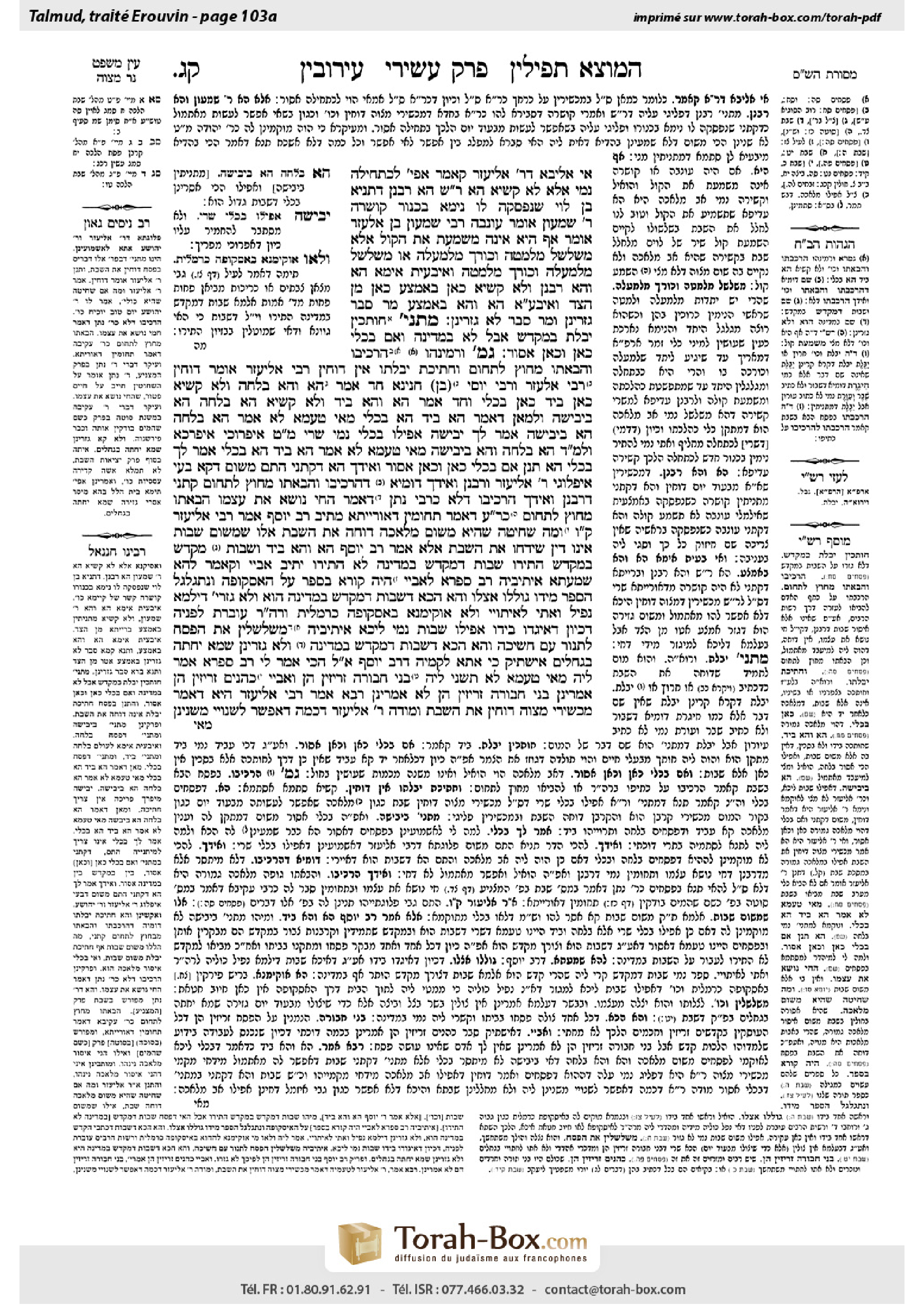
Eruvin 103a: Talmud study for Daf Yomi
Study the Talmud for Daf Yomi with scanned pages, Hebrew text, English translations from Sefaria and AI-generated French translations.
Passage selection and English or AI-generated French translation are available where the scan has annotations. Daf Study is independent of Torah-Box and Sefaria.
Browse Eruvin · עירובין · All tractatesEruvin 103a text and translations
This page of Eruvin includes the Aramaic text, an English translation and an AI-generated French translation, alongside the scan above.
עירובין ק״ג א · Aramaic and Hebrew text
אִי אַלִּיבָּא דְּרַבִּי אֱלִיעֶזֶר קָאָמַר, אֲפִילּוּ לְכַתְּחִילָּה נָמֵי.
אֶלָּא, לָא קַשְׁיָא: הָא — רַבִּי שִׁמְעוֹן, הָא — רַבָּנַן, דְּתַנְיָא: בֶּן לֵוִי שֶׁנִּפְסְקָה לוֹ נִימָא בְּכִנּוֹר — קוֹשְׁרָהּ, רַבִּי שִׁמְעוֹן אוֹמֵר: עוֹנְבָהּ.
רַבִּי שִׁמְעוֹן בֶּן אֶלְעָזָר אוֹמֵר: אַף הִיא אֵינָהּ מַשְׁמַעַת אֶת הַקּוֹל. אֶלָּא מְשַׁלְשֵׁל מִלְּמַטָּה וְכוֹרֵךְ מִלְּמַעְלָה, אוֹ מְשַׁלְשֵׁל מִלְּמַעְלָה וְכוֹרֵךְ מִלְּמַטָּה.
וְאִיבָּעֵית אֵימָא: הָא וְהָא רַבָּנַן, וְלָא קַשְׁיָא: כָּאן בָּאֶמְצַע, כָּאן מִן הַצַּד.
וְאִיבָּעֵית אֵימָא: הָא וְהָא בָּאֶמְצַע, מָר סָבַר: גָּזְרִינַן, וּמָר סָבַר: לָא גָּזְרִינַן.
מַתְנִי׳ חוֹתְכִין יַבֶּלֶת בַּמִּקְדָּשׁ, אֲבָל לֹא בִּמְדִינָה. וְאִם בִּכְלִי — כָּאן וְכָאן אָסוּר.
גְּמָ׳ וּרְמִינְהוּ: הֶרְכֵּיבוֹ, וַהֲבָאָתוֹ מִחוּץ לַתְּחוּם, וַחֲתִיכַת יַבַּלְתּוֹ — אֵין דּוֹחִין, רַבִּי אֱלִיעֶזֶר אוֹמֵר: דּוֹחִין!
רַבִּי אֶלְעָזָר וְרַבִּי יוֹסֵי (בֶּן) חֲנִינָא, חַד אָמַר: הָא וְהָא בְּלַחָה, וְלָא קַשְׁיָא: כָּאן — בַּיָּד, כָּאן — בִּכְלִי.
וְחַד אָמַר: הָא וְהָא בַּיָּד, וְלָא קַשְׁיָא: הָא — בְּלַחָה, הָא — בִּיבֵישָׁה.
וּלְמַאן דְּאָמַר ״הָא בַּיָּד הָא בִּכְלִי״, מַאי טַעְמָא לָא אָמַר ״הָא בְּלַחָה הָא בִּיבֵישָׁה״? אָמַר לָךְ: יְבֵישָׁה — אֲפִילּוּ בִּכְלִי נָמֵי שְׁרֵי, מַאי טַעְמָא? אִיפָּרוֹכֵי אִיפָּרְכָא.
וּלְמַאן דְּאָמַר ״הָא בְּלַחָה וְהָא בִּיבֵישָׁה״, מַאי טַעְמָא לָא אָמַר ״הָא בַּיָּד הָא בִּכְלִי״? אָמַר לָךְ: בִּכְלִי — הָא תְּנַן: אִם בִּכְלִי — כָּאן וְכָאן אָסוּר.
וְאִידָּךְ — הָא דְּקָתָנֵי הָתָם, מִשּׁוּם דְּקָא בָּעֵי אִיפְּלוֹגֵי רַבִּי אֱלִיעֶזֶר וְרַבָּנַן.
וְאִידָּךְ — דּוּמְיָא דְּהֶרְכֵּיבוֹ וַהֲבָאָתוֹ מִחוּץ לַתְּחוּם קָתָנֵי, דְּרַבָּנַן.
וְאִידָּךְ: הֶרְכֵּיבוֹ דְּלָא כְּרַבִּי נָתָן, דְּאָמַר: הַחַי נוֹשֵׂא אֶת עַצְמוֹ. הֲבָאָתוֹ מִחוּץ לַתְּחוּם כְּרַבִּי עֲקִיבָא, דְּאָמַר: תְּחוּמִין דְּאוֹרָיְיתָא.
מֵתִיב רַב יוֹסֵף: אָמַר רַבִּי אֱלִיעֶזֶר, קַל וָחוֹמֶר: וּמָה שְׁחִיטָה שֶׁהִיא מִשּׁוּם מְלָאכָה — דּוֹחָה אֶת הַשַּׁבָּת, אֵלּוּ, שֶׁמִּשּׁוּם שְׁבוּת — אֵינוֹ דִּין שֶׁיִּדְחוּ אֶת הַשַּׁבָּת?
אֶלָּא אָמַר רַב יוֹסֵף: הָא וְהָא בַּיָּד, וּשְׁבוּת מִקְדָּשׁ בַּמִּקְדָּשׁ — הִתִּירוּ, שְׁבוּת דְּמִקְדָּשׁ בַּמְּדִינָה — לֹא הִתִּירוּ.
יְתֵיב אַבָּיֵי וְקָאָמַר לְהָא שְׁמַעְתָּא. אֵיתִיבֵיהּ רַב סָפְרָא לְאַבָּיֵי: הָיָה קוֹרֵא בַּסֵּפֶר עַל הָאִסְקוּפָּה, וְנִתְגַּלְגֵּל הַסֵּפֶר מִיָּדוֹ — גּוֹלְלוֹ אֶצְלוֹ. וְהָא הָכָא דִּשְׁבוּת דְּמִקְדָּשׁ בַּמְּדִינָה הוּא, וְלָא גָּזְרִינַן דִּילְמָא נָפֵיל וְאָתֵי לְאֵיתוֹיֵי!
וְלָא אוֹקֵימְנָא בְּאִסְקוּפָּה כַּרְמְלִית וּרְשׁוּת הָרַבִּים עוֹבֶרֶת לְפָנֶיהָ, דְּכֵיוָן דְּאִיגְדּוֹ בְּיָדוֹ — אֲפִילּוּ שְׁבוּת נָמֵי לֵיכָּא?!
אֵיתִיבֵיהּ: מְשַׁלְשְׁלִין אֶת הַפֶּסַח לְתַנּוּר עִם חֲשֵׁיכָה. וְהָא הָכָא דִּשְׁבוּת דְּמִקְדָּשׁ בַּמְּדִינָה, וְלָא גָּזְרִינַן שֶׁמָּא יְחַתֶּה בַּגֶּחָלִים!
אִישְׁתִּיק. כִּי אֲתָא לְקַמֵּיהּ דְּרַב יוֹסֵף, אֲמַר לֵיהּ: הָכִי אָמַר לִי רַב סָפְרָא. אֲמַר לֵיהּ: מַאי טַעְמָא לָא תְּשַׁנֵּי לֵיהּ: בְּנֵי חֲבוּרָה זְרִיזִין הֵן.
וְאַבָּיֵי: ״כֹּהֲנִים זְרִיזִין הֵן״ — אָמְרִינַן, ״בְּנֵי חֲבוּרָה זְרִיזִין הֵן״ — לָא אָמְרִינַן.
רָבָא אָמַר: רַבִּי אֱלִיעֶזֶר הִיא, דְּאָמַר מַכְשִׁירֵי מִצְוָה דּוֹחִין אֶת הַשַּׁבָּת. וּמוֹדֶה רַבִּי אֱלִיעֶזֶר דְּכַמָּה דְּאֶפְשָׁר לְשַׁנּוֹיֵי מְשַׁנִּינַן.
Eruvin 103a · English translation
If he stated his ruling in accordance with the opinion of Rabbi Eliezer, why did he permit tying a bow only after the fact? It should also be permitted even ab initio, as Rabbi Eliezer maintains that preparations required for the performance of a mitzva override the prohibitions of Shabbat.
Rather, the Gemara rejects the previous explanation: It is not difficult; this baraita that deems tying prohibited is according to the opinion of Rabbi Shimon, while that mishna that rules that tying is permitted, is according to the opinion of the Rabbis. As it was taught in a baraita: If a string of the Levite’s harp was severed on Shabbat, he may tie it with a knot; Rabbi Shimon says: He may only form a bow. The Rabbis permit the preparations for a mitzva that could not have been performed before Shabbat, whereas Rabbi Shimon is stringent and prohibits even those preparations.
The Gemara continues its citation of the baraita. Rabbi Shimon ben Elazar says: Even if he ties a knot or a bow, the harp will not issue the proper sound, and he would therefore be committing a transgression without performing the mitzva in a fitting manner. Rather, he unwinds the string from the lower knob and winds it around the upper one, or he unwinds the string from the upper knob and winds it around the lower one, before tightening the string until it produces the proper note.
And if you wish, say instead that both sources were taught in accordance with the opinion of the Rabbis, who permit preparations for a mitzva that could not have been performed the day before, and even so it is not difficult; here, the mishna permits tying in a case where the string was severed in the middle, in which case the sound would be affected if the string were reconnected with a bow, whereas there, the baraita is referring to a string that was severed on the side near the end of the string, which can be fixed with a bow.
And if you wish, say instead that both sources are referring to a case where the string snapped in the middle, and the issue at hand is subject to a dispute between Rabbi Shimon and the Rabbis: One Sage, Rabbi Shimon, maintains in the baraita that it is prohibited even to tie a knot in the middle, as a decree, lest one unnecessarily tie a knot on the side as well. And the other Sage, the Rabbis, maintains in the mishna that we do not issue a decree of this kind.
MISHNA: A wart is an example of a blemish that temporarily disqualifies a priest from performing the Temple service, and disqualifies an animal from being offered on the altar; they regain their fitness once the wart is removed. Consequently, on Shabbat one may cut off a wart by hand in the Temple, as this constitutes a preparatory act required for the sacrificial service. However, he may not cut off a wart in the rest of the country. And if he seeks to cut off the wart with an instrument, it is prohibited in both places.
GEMARA: And the Gemara raises a contradiction from another mishna: When Passover eve occurs on Shabbat, the acts of carrying a Paschal lamb on one’s shoulders, bringing it to the Temple from outside the Shabbat boundary, and cutting off its wart to render it fit for the altar, do not override the prohibitions of Shabbat. Rabbi Eliezer, conforming to his standard opinion, says: They override the Shabbat prohibitions. The mishna in Eiruvin apparently contradicts the opinion of these Sages.
Rabbi Elazar and Rabbi Yosei ben Ḥanina suggested different resolutions to this difficulty: One said that both sources are referring to a moist wart, and it is not difficult. Here, the mishna permits removing the wart by hand. It is prohibited by rabbinic decree, as that is not the usual manner of performing the procedure. Whereas there, the mishna prohibits removal of the wart with an instrument by Torah law.
And the other one said that in both cases the wart is removed by hand, and it is not difficult. There, the mishna prohibits the removal of a moist wart, whereas here, the mishna is referring to a dry wart, the removal of which does not constitute a prohibited labor.
The Gemara raises a difficulty: And according to the one who said: This is referring to removal by hand, and that is referring to removal with an instrument; what is the reason that he did not say, as did his colleague: This is referring to a moist wart and that is referring to a dry one? The Gemara answers: He can say to you that with regard to a dry wart, it is permitted to remove it even with an instrument. What is the reason? As it crumbles on its own, cutting it is like cutting off dead skin.
And according to the one who said: This is referring to a moist wart and that is referring to a dry one, what is the reason that he did not say, like the other Sage: This is referring to removal by hand and that is referring to removal with an instrument? The Gemara answers: He can say to you that with regard to an instrument, we explicitly learned in the mishna: If he wishes to cut off the wart with an instrument, it is prohibited in both places. Consequently, it is unnecessary to teach again that it is prohibited to remove a wart with an instrument.
And the other Sage, how does he respond to this contention? He can say that the other mishna teaches this halakha there because it wants to record the dispute between Rabbi Eliezer and the Rabbis on this issue, i.e., to inform us that Rabbi Eliezer disagrees and permits cutting off the wart even with an instrument.
And the other Sage, how does he counter this reasoning? He can say that the tanna teaches the case of the wart parallel to the cases of carrying the animal and bringing it to the Temple from outside the Shabbat boundary, activities that are prohibited by rabbinic law. Consequently, the ruling involving a wart is also referring to cutting that is prohibited by rabbinic law, i.e., cutting by hand, not with an instrument.
And the other Sage maintains that these cases also involve Torah prohibitions. How so? With regard to carrying the animal, the mishna was taught not in accordance with the opinion of Rabbi Natan, who said: A living being carries itself, which means that carrying an animal on one’s shoulders is not considered carrying by Torah law, and is prohibited by rabbinic law. If we do not accept this opinion, one who carries the Paschal lamb transgresses the Torah prohibition against carrying an object four cubits in the public domain. As for the case of bringing the animal from outside the Shabbat boundary, the mishna was taught in accordance with the opinion of Rabbi Akiva, who said: Bringing an animal from outside the Shabbat boundaries is prohibited by Torah law.
Rav Yosef raised an objection against this explanation from a mishna. Rabbi Eliezer said that this halakha is an a fortiori inference: If slaughtering the Paschal lamb, which is prohibited due to the fact that it is a prohibited labor by Torah law, nonetheless overrides Shabbat in the Temple, with regard to these actions, i.e., carrying the animal, bringing it from outside the Shabbat boundary, and cutting off its wart, which are prohibited due to rabbinic decree, isn’t it right that they should override Shabbat? Evidently, the previous explanation must be rejected, as there too the mishna is referring to rabbinic prohibitions.
Rather, Rav Yosef said: Both sources are referring to a case where the wart is removed by hand, an activity that constitutes a rabbinic prohibition, and the contradiction can be resolved as follows: To transgress a rabbinic decree relating to the Temple within the confines of the Temple itself, they permitted doing so. However, to transgress a rabbinic decree relating to the Temple, in the country, they did not permit doing so. Consequently, although these procedures involving the Paschal lamb are prohibited due to rabbinic decree and are indeed related to the Temple service, since they are performed outside the Temple, the Sages did not permit their performance.
Abaye sat with the scholars and recited this halakha in the name of Rav Yosef. Rav Safra raised an objection to the opinion cited by Abaye from a mishna: If one was reading a scroll of the Bible while sitting on the threshold of his house, and the scroll rolled out of his hand, i.e., while he was holding one end, the scroll rolled open into the public domain, he may roll the scroll back to himself. And here, isn’t it a rabbinic decree involving a sacred scroll, which due to its sanctity should have the legal status of a rabbinic decree relating to the Temple with regard to an incident that occurred in the country. And yet we do not issue a decree prohibiting one to roll the scroll back to himself, lest the scroll fall and he will forget and come to bring it in from the public domain to a private domain. Apparently, the Sages did not impose a rabbinic prohibition with regard to matters relating to the Temple, even outside the Temple compound.
Abaye refutes this contention: Didn’t we already establish this mishna as referring to a threshold that is a karmelit, e.g., one that is four handbreadths wide but less than ten handbreadths high, and before which the public domain passes? As he holds one end of the scroll in his hand, it is not prohibited even by rabbinic decree. The reason is that even if the scroll fell from his hand and rolled into the public domain, and he were to carry it back from the public domain to the karmelit, he would not transgress a Torah prohibition.
Rav Safra raised an objection from a different mishna: One may lower the Paschal lamb into the oven on Shabbat eve just before nightfall, after its blood is sprinkled and it is brought outside the Temple for roasting. But here we are dealing with a violation of a rabbinic decree relating to the Temple that occurred in the country, and yet we do not issue a decree against lowering the sacrifice into the oven at that late hour lest one rake the coals to hasten the cooking. Once again, the mishna indicates that the Sages did not issue a rabbinic decree prohibiting an action related to the Temple service, even outside the Temple.
Abaye was silent and did not answer. When he came before Rav Yosef, he said to him: This is what Rav Safra said to me, contrary to your approach. Rav Yosef said to him: What is the reason that you didn’t answer him: Members of a group who joined together to prepare and partake of a single Paschal lamb, which, like all sacrifices, requires careful attention, are certainly vigilant and exacting in the performance of this mitzva. Consequently, there is less concern that they might commit a transgression than with regard to people in other circumstances. However, other rabbinic decrees relating to the Temple remain in effect outside the Temple.
The Gemara comments: And as for Abaye, why did he not accept this reasoning? He maintains that we say that only priests are vigilant, as they are constantly involved in the Temple service, and they will therefore not mistakenly commit a transgression. However, that members of a group of people who join together for a single Paschal lamb are vigilant, we do not say. As they are not accustomed to that level of watchfulness, they might forget.
Rava stated a different resolution of the contradiction between the two mishnayot: The mishna which permits the cutting of a wart, is according to Rabbi Eliezer, who said that the preparations for the performance of a mitzva override the prohibitions of Shabbat, and it is therefore permitted to cut the wart by hand. And if you say that in that case one should be permitted to do so with an instrument as well, Rabbi Eliezer concedes that as much as it is possible to alter the manner in which a procedure is performed to prevent violation of a Torah prohibition, we alter it, to emphasize that the day is Shabbat.
Eruvin 103a · Traduction française (IA)
Si l'on a déclaré sa décision conformément à l'opinion du Rabbi Eliezer, pourquoi a-t-il permis de faire un nœud seulement après coup ? Il aurait dû être permis dès le début, car le Rabbi Eliezer affirme que les préparatifs nécessaires à la performance d'une mitsva supplantent les interdits du Shabbat.
En réalité, la Guemara rejette cette explication précédente : Ce n'est pas difficile ; cette baraïta qui considère le nœud comme interdit est selon l'opinion du Rabbi Shimon, tandis que celle qui déclare le nœud permis est selon l'opinion des Rabbins. Comme il a été enseigné dans une baraïta : Si une corde du harp du Levite a été coupée le Shabbat, il peut la relier avec un nœud ; le Rabbi Shimon dit : Il peut seulement former un arc. Les Rabbins permettent les préparatifs pour une mitsva qui n'auraient pas pu être effectués avant le Shabbat, tandis que le Rabbi Shimon est strict et interdit même ces préparatifs.
La Guemara continue la citation de la baraïta. Le Rabbi Shimon ben Elazar dit : Même si l'on fait un nœud ou un arc, la harpe ne produira pas le son approprié, et l'on commettrait ainsi une transgression sans accomplir la mitsva de manière convenable. En réalité, il dénoue la corde du bas de l'arc et la tord autour du haut, ou il dénoue la corde du haut de l'arc et la tord autour du bas, avant de resserrer la corde jusqu'à ce qu'elle produise la note appropriée.
Et si vous le souhaitez, dites plutôt que les deux sources ont été enseignées selon l'opinion des Rabbins, qui permettent les préparatifs pour une mitsva qui n'auraient pas pu être effectués la veille, et même ainsi ce n'est pas difficile ; ici, la mishna permet le nœud dans le cas où la corde a été coupée au milieu, dans lequel cas le son serait affecté si la corde était reconnectée avec un arc, tandis que là, la baraïta fait référence à une corde coupée sur le côté près de la fin de la corde, qui peut être réparée avec un arc.
Et si vous le souhaitez, dites plutôt que les deux sources font référence à un cas où la corde a cassé au milieu, et la question en question est soumise à un débat entre le Rabbi Shimon et les Rabbins : Un Sage, le Rabbi Shimon, maintient dans la baraïta qu'il est interdit même de faire un nœud au milieu, comme un décret, de peur qu'on fasse un nœud sur le côté inutilement. Et l'autre Sage, les Rabbins, maintient dans la mishna que nous ne prononçons pas ce genre de décret.
MICHNA : Une verrue est un exemple de défaut temporaire qui disqualifie un prêtre de présenter le service du Temple, et qui disqualifie un animal d'être offert sur l'autel ; ils retrouvent leur aptitude une fois que la verrue est retirée. Par conséquent, le Shabbat, on peut couper une verrue à la main dans le Temple, car cela constitue un acte préparatoire nécessaire pour le service sacrificiel. Cependant, il ne peut pas couper une verrue ailleurs. Et s'il cherche à couper la verrue avec un instrument, cela est interdit dans les deux lieux.
GUEMARA : Et la Guemara soulève une contradiction avec une autre michna : Lorsque la veille de Pessah tombe un Shabbat, les actes de porter un agneau pascal sur ses épaules, d'apporter l'agneau au Temple depuis l'extérieur de la limite du Shabbat, et de couper la verrue pour le rendre propre à l'autel, ne supplantent pas les interdits du Shabbat. Le Rabbi Eliezer, conformément à son opinion habituelle, dit : Ils supplantent les interdits du Shabbat. La michna dans Eiruvin semble contredire l'opinion de ces Sages.
Le Rabbi Elazar et le Rabbi Yosei ben Ḥanina ont proposé différentes résolutions à cette difficulté : L'un a dit que les deux sources font référence à une verrue humide, et ce n'est pas difficile. Ici, la michna permet de retirer la verrue à la main. Il est interdit par un décret rabbinique, car ce n'est pas la manière habituelle d'effectuer cette procédure. Tandis que là, la michna interdit le retrait de la verrue avec un instrument par la loi de la Torah.
Et l'autre a dit que dans les deux cas la verrue est retirée à la main, et ce n'est pas difficile. Là, la michna interdit le retrait d'une verrue humide, tandis que ici, la michna fait référence à une verrue sèche, le retrait de laquelle ne constitue pas un travail interdit.
La Guemara soulève une difficulté : Et selon celui qui a dit : Cela fait référence au retrait à la main, et celui-là au retrait avec un instrument ; pourquoi n'a-t-il pas dit, comme son collègue, que cela fait référence à une verrue humide et celui-là à une verrue sèche ? La Guemara répond : Il peut dire à vous que concernant une verrue sèche, il est permis de la retirer même avec un instrument. Quelle est la raison ? Car elle se désintègre toute seule, et couper est comme couper la peau morte.
Et selon celui qui a dit : Cela fait référence à une verrue humide et celui-là à une verrue sèche, pourquoi n'a-t-il pas dit, comme l'autre Sage, que cela fait référence au retrait à la main et celui-là au retrait avec un instrument ? La Guemara répond : Il peut dire à vous que concernant un instrument, nous avons explicitement appris dans la mishna : Si l'on veut couper la verrue avec un instrument, cela est interdit dans les deux lieux. Par conséquent, il n'est pas nécessaire d'enseigner à nouveau que le retrait d'une verrue avec un instrument est interdit.
Et l'autre Sage, comment répond-il à cette contestation ? Il peut dire que la tanna enseigne ce halakha là car elle veut enregistrer le débat entre Rabbi Eliezer et les Rabbins sur cette question, c'est-à-dire nous informer que Rabbi Eliezer désaccorde et permet de couper la verrue même avec un instrument.
Et l'autre Sage, comment contredit-il ce raisonnement ? Il peut dire que le tanna enseigne le cas de la verrue parallèlement aux cas de transport de l'animal et d'apport de l'animal au Temple depuis l'extérieur de la limite du Shabbat, des activités interdites par un décret rabbinique. Par conséquent, la décision concernant la verrue fait également référence à un coupage interdit par un décret rabbinique, c'est-à-dire un coupage à la main, pas avec un instrument.
Et l'autre Sage affirme que ces cas impliquent également des prohibitions de la Torah. Comment cela se produit-il ? En ce qui concerne le transport de l'animal, la Michna a été enseignée sans suivre l'opinion de Rabbi Natan, qui disait : un être vivant se transporte lui-même, ce qui signifie que transporter un animal sur ses épaules n'est pas considéré comme un transport selon la loi de la Torah, mais est interdit par la loi rabbinique. Si nous ne reconnaissons pas cette opinion, celui qui transporte l'agneau pascal transgresse la prohibition de la Torah contre le transport d'un objet à quatre coudées dans le domaine public. En ce qui concerne le cas de l'apport de l'animal en dehors des limites du sabbat, la Michna a été enseignée selon l'opinion de Rabbi Akiva, qui disait : apporter un animal en dehors des limites du sabbat est interdit par la loi de la Torah.
Rav Yosef a soulevé une objection contre cette explication à partir d'une Michna. Rabbi Eliezer disait que cette halakha est une déduction a fortiori : Si l'abattage de l'agneau pascal, qui est interdit en raison de l'être un travail interdit selon la loi de la Torah, peut néanmoins annuler le sabbat dans le Temple, concernant ces actions, c'est-à-dire le transport de l'animal, l'apport en dehors des limites du sabbat et la coupe du bouton, qui sont interdits en raison d'un décret rabbinique, n'est-il pas juste qu'ils annulent le sabbat ? Évidemment, l'explication précédente doit être rejetée, car là aussi la Michna fait référence à des prohibitions rabbiniques.
Plutôt, Rav Yosef a dit : les deux sources font référence à un cas où le bouton est retiré à la main, une activité qui constitue une prohibition rabbinique, et la contradiction peut être résolue comme suit : Transgresser un décret rabbinique concernant le Temple à l'intérieur du Temple lui-même est permis, mais transgresser un décret rabbinique concernant le Temple en dehors du Temple n'est pas permis. Ainsi, bien que ces procédures concernant l'agneau pascal soient interdites en raison d'un décret rabbinique et soient effectivement liées au service du Temple, puisqu'elles sont exécutées en dehors du Temple, les Sages n'ont pas permis leur exécution.
Abaye s'est assis avec les savants et a récité cette halakha au nom de Rav Yosef. Rav Safra a soulevé une objection contre l'opinion citée par Abaye à partir d'une Michna : Si l'on lisait un rouleau de la Torah assis sur le seuil de sa maison, et que le rouleau tombait de sa main, c'est-à-dire pendant qu'il tenait l'une des extrémités, le rouleau s'ouvrait dans le domaine public, il pouvait rouler le rouleau vers lui. Et ici, n'est-ce pas un décret rabbinique concernant un rouleau sacré, dont la sainteté devrait avoir le statut juridique d'un décret rabbinique concernant le Temple en cas d'incident en dehors du Temple ? Et pourtant, nous ne décrétions pas d'interdire à l'individu de rouler le rouleau vers lui, de peur que le rouleau tombe et qu'il oublie et vienne le ramener du domaine public vers un domaine privé. Apparemment, les Sages n'ont pas imposé une prohibition rabbinique concernant les affaires liées au Temple, même en dehors du complexe du Temple.
Abaye réfute ce point : N'avons-nous pas déjà établi cette Michna comme faisant référence à un seuil qui est un karmelit, c'est-à-dire un seuil de quatre tefachim de large mais moins de dix tefachim de haut, devant lequel le domaine public passe ? Alors qu'il tient l'une des extrémités du rouleau, il n'est pas interdit même par un décret rabbinique. La raison est que même si le rouleau tombait de sa main et se retrouvait dans le domaine public, et qu'il devait le ramener du domaine public vers le karmelit, il ne commettrait pas une transgression de la Torah.
Rav Safra a soulevé une objection à partir d'une autre Michna : On peut descendre l'agneau pascal dans le four le soir du sabbat, juste avant la nuit, après que son sang ait été versé et qu'il ait été apporté en dehors du Temple pour la cuisson. Mais ici, nous sommes en présence d'une violation d'un décret rabbinique concernant le Temple qui s'est produite en dehors du Temple, et pourtant nous ne décrétions pas d'interdire de descendre la victime dans le four à cette heure tardive de peur qu'on fasse brûler les braises pour accélérer la cuisson. Une fois de plus, la Michna indique que les Sages n'ont pas émis un décret interdisant une action liée au service du Temple, même en dehors du Temple.
Abaye restait silencieux et ne répondait pas. Lorsqu'il est venu devant Rav Yosef, il lui a dit : C'est ce que Rav Safra m'a dit, contraire à votre approche. Rav Yosef a dit à lui : Quelle est la raison que vous n'avez pas répondu ? Les membres d'un groupe qui se sont réunis pour préparer et consommer un seul agneau pascal, qui, comme toutes les offrandes, nécessite une attention particulière, sont certainement vigilants et exigeants dans l'accomplissement de cette mitsva. Ainsi, il y a moins de crainte qu'ils commettent une transgression que par rapport aux gens dans d'autres circonstances. Cependant, d'autres décrets rabbiniques concernant le Temple restent en vigueur en dehors du Temple.
La Guemara commente : Et concernant Abaye, pourquoi n'a-t-il pas accepté cette raison ? Il affirme que nous disons que seul les prêtres sont vigilants, car ils sont constamment impliqués dans le service du Temple, et ils ne commettront donc pas par mégarde une transgression. Cependant, que les membres d'un groupe de personnes qui se réunissent pour un seul agneau pascal soient vigilants, nous ne le disons pas. Comme ils ne sont pas habitués à ce niveau de vigilance, ils pourraient oublier.
Rava a énoncé une autre résolution de la contradiction entre les deux Mishnayot : La Michna qui permet la coupe du bouton est selon l'opinion de Rabbi Eliezer, qui disait que les préparatifs pour l'accomplissement d'une mitsva annulent les prohibitions du sabbat, et il est donc permis de couper le bouton à la main. Et si vous dites que dans ce cas l'on devrait être permis de le faire avec un instrument également, Rabbi Eliezer reconnaît que dans la mesure où il est possible de modifier la manière d'accomplir une procédure pour éviter la violation d'une prohibition de la Torah, nous modifions cette manière, afin d'insister que la journée est sabbat.
Traduction française générée par IA à partir de l’édition anglaise de Sefaria. Vérifie toujours un passage avec le texte source.
Text from Sefaria: William Davidson Edition - Vocalized Aramaic (CC BY NC); William Davidson Edition - English (CC BY NC).