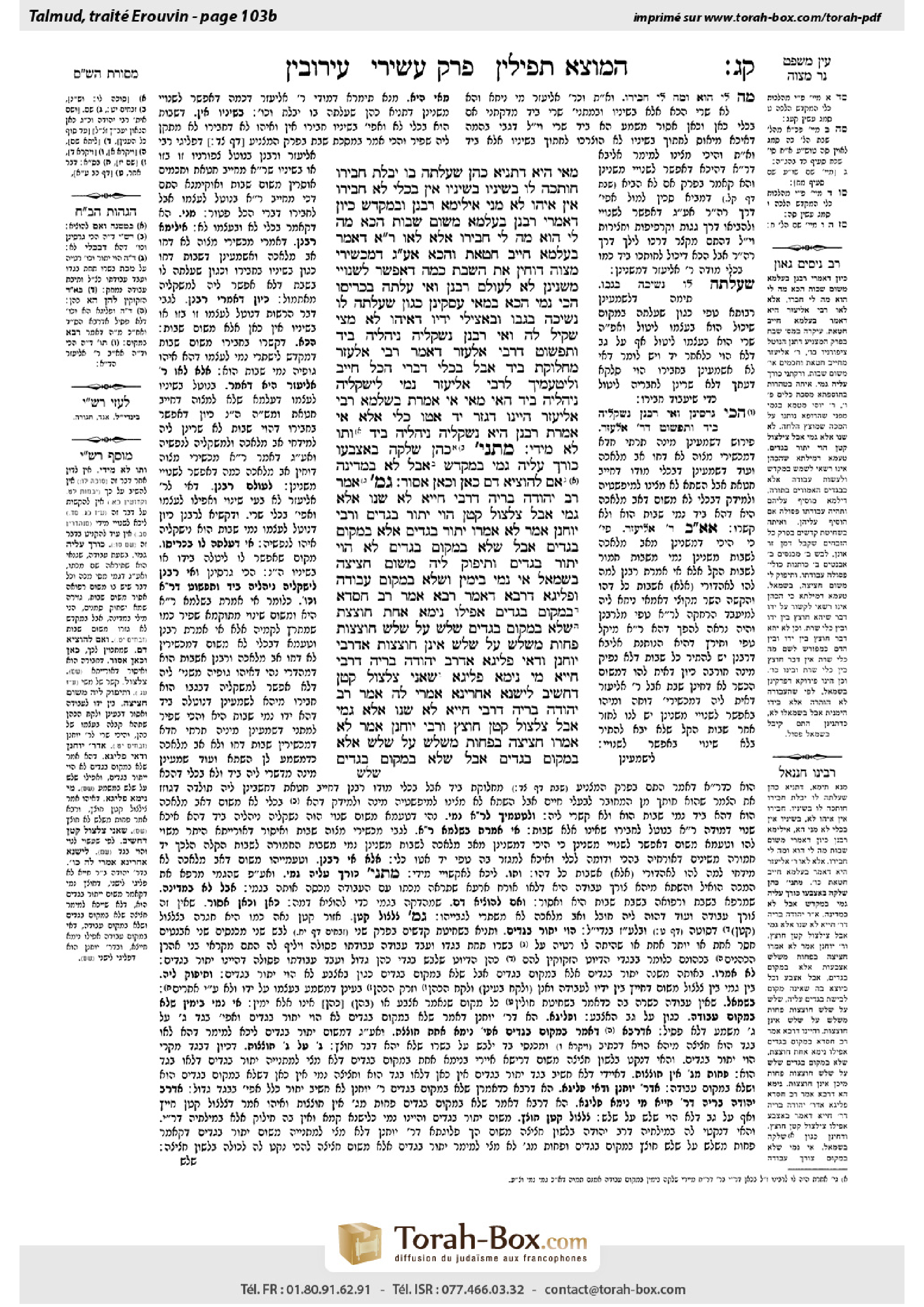
Eruvin 103b: Talmud study for Daf Yomi
Study the Talmud for Daf Yomi with scanned pages, Hebrew text, English translations from Sefaria and AI-generated French translations.
Passage selection and English or AI-generated French translation are available where the scan has annotations. Daf Study is independent of Torah-Box and Sefaria.
Browse Eruvin · עירובין · All tractatesEruvin 103b text and translations
This page of Eruvin includes the Aramaic text, an English translation and an AI-generated French translation, alongside the scan above.
עירובין ק״ג ב · Aramaic and Hebrew text
מַאי הִיא, דְּתַנְיָא: כֹּהֵן שֶׁעָלְתָה בּוֹ יַבֶּלֶת — חֲבֵירוֹ חוֹתְכָהּ לוֹ בְּשִׁינָּיו. בְּשִׁינָּיו — אִין, בִּכְלִי — לָא. חֲבֵירוֹ — אִין, אִיהוּ — לָא.
מַנִּי? אִילֵּימָא רַבָּנַן וּבַמִּקְדָּשׁ, כֵּיוָן דְּאָמְרִי רַבָּנַן בְּעָלְמָא מִשּׁוּם שְׁבוּת — הָכָא, מָה לִי הוּא מָה לִי חֲבֵירוֹ?
אֶלָּא לָאו, רַבִּי אֱלִיעֶזֶר דְּאָמַר בְּעָלְמָא חַיָּיב חַטָּאת, וְהָכָא אַף עַל גַּב דְּמַכְשִׁירֵי מִצְוָה דּוֹחִין אֶת הַשַּׁבָּת, כַּמָּה דְּאֶפְשָׁר לְשַׁנּוֹיֵי מְשַׁנִּינַן.
לָא: לְעוֹלָם רַבָּנַן, וְאִי עָלְתָה בִּכְרֵיסוֹ — הָכִי נָמֵי.
הָכָא בְּמַאי עָסְקִינַן? כְּגוֹן שֶׁעָלְתָה לוֹ נְשִׁיכָה בְּגַבּוֹ וּבְאַצִּילֵי יָדָיו, דְּאִיהוּ לָא מָצֵי שָׁקֵיל לַהּ.
וְאִי רַבָּנַן, נִשְׁקְלֵיהּ נִיהֲלֵיהּ בְּיָד, וְתִפְשׁוֹט דְּרַבִּי אֶלְעָזָר: דְּאָמַר רַבִּי אֶלְעָזָר מַחֲלוֹקֶת בַּיָּד, אֲבָל בִּכְלִי — דִּבְרֵי הַכֹּל חַיָּיב!
וְלִיטַעְמָיךְ, לְרַבִּי אֱלִיעֶזֶר נָמֵי לִישְׁקְלֵיהּ נִיהֲלֵיהּ בְּיָד! הַאי מַאי? אִי אָמְרַתְּ בִּשְׁלָמָא רַבִּי אֱלִיעֶזֶר — הַיְינוּ דְּגָזַר יָד אַטּוּ כְּלִי. אֶלָּא אִי אָמְרַתְּ רַבָּנַן הִיא — נִשְׁקְלֵיהּ נִיהֲלֵיהּ בְּיָד, וְתוּ לָא מִידֵּי.
מַתְנִי׳ כֹּהֵן שֶׁלָּקָה בְּאֶצְבָּעוֹ — כּוֹרֵךְ עָלֶיהָ גֶּמִי. בַּמִּקְדָּשׁ, אֲבָל לֹא בַּמְּדִינָה. אִם לְהוֹצִיא דָּם — כָּאן וְכָאן אָסוּר.
גְּמָ׳ אָמַר רַב יְהוּדָה בְּרֵיהּ דְּרַבִּי חִיָּיא: לֹא שָׁנוּ אֶלָּא גֶּמִי, אֲבָל צִלְצוֹל קָטָן — הָוֵי יִתּוּר בְּגָדִים.
וְרַבִּי יוֹחָנָן אָמַר: לֹא אָמְרוּ יִתּוּר בְּגָדִים אֶלָּא בִּמְקוֹם בְּגָדִים, אֲבָל שֶׁלֹּא בִּמְקוֹם בְּגָדִים — לָא הָוֵי יִתּוּר בְּגָדִים.
וְתִיפּוֹק לֵיהּ מִשּׁוּם חֲצִיצָה! בִּשְׂמֹאל.
אִי נָמֵי בְּיָמִין — וְשֶׁלֹּא בִּמְקוֹם עֲבוֹדָה.
וּפְלִיגָא דְּרָבָא, דְּאָמַר רָבָא אָמַר רַב חִסְדָּא: בִּמְקוֹם בְּגָדִים — אֲפִילּוּ נִימָא אַחַת חוֹצֶצֶת. שֶׁלֹּא בִּמְקוֹם בְּגָדִים, שָׁלֹשׁ עַל שָׁלֹשׁ — חוֹצְצוֹת, פָּחוֹת מִשָּׁלֹשׁ עַל שָׁלֹשׁ — אֵינָן חוֹצְצוֹת.
אַדְּרַבִּי יוֹחָנָן וַדַּאי פְּלִיגָא. אַדְּרַב יְהוּדָה בְּרֵיהּ דְּרַבִּי חִיָּיא מִי נֵימָא פְּלִיגָא?
שָׁאנֵי צִלְצוֹל קָטָן דַּחֲשִׁיב.
לִישָּׁנָא אַחֲרִינָא, אָמְרִי לַהּ: אָמַר רַב יְהוּדָה בְּרֵיהּ דְּרַבִּי חִיָּיא: לֹא שָׁנוּ אֶלָּא גֶּמִי, אֲבָל צִלְצוֹל קָטָן — חוֹצֵץ.
וְרַבִּי יוֹחָנָן אָמַר: לֹא אָמְרוּ חֲצִיצָה בְּפָחוֹת מִשָּׁלֹשׁ עַל שָׁלֹשׁ אֶלָּא בִּמְקוֹם בְּגָדִים, אֲבָל שֶׁלֹּא בִּמְקוֹם בְּגָדִים
Eruvin 103b · English translation
What is the source for this idea? As it was taught in a baraita: If a priest grew a wart, which temporarily disqualifies him from performing the service, his fellow priest may cut it off for him on Shabbat with his teeth. The Gemara infers: With his teeth, yes, this is permitted; but with an instrument, no, he may not do so. Likewise, for his fellow priest, yes, he may cut off his wart; but he himself, no, he may not cut off his own wart.
The Gemara inquires: According to whose opinion was this baraita taught? If you say it is in accordance with the opinion of the Rabbis, and the leniency is based on the principle that a rabbinic prohibition does not apply in the Temple, since the Rabbis say in general that biting off even one’s own nails or wart, and certainly those of another, is prohibited due to rabbinic decree, then in this case here, what is the difference to me whether it is the priest himself who cuts off the wart, or what is the difference to me whether it is another priest who cuts it off?
Rather, wasn’t it taught in accordance with the opinion of Rabbi Eliezer, who said that in general one is liable to bring a sin-offering for biting off his own nails or wart? And here, even though he maintains that preparations for a mitzva override the prohibitions of Shabbat, and it should therefore be permitted for him to cut off his own wart with an instrument, nevertheless, as much as it is possible to alter the procedure so that it does not entail the violation of a Torah prohibition, one alters, and biting off another person’s wart is prohibited due to rabbinic decree, not Torah law.
The Gemara rejects this contention: No, this is not necessarily the case. Actually, this baraita can be explained in accordance with the opinion of the Rabbis, and if the wart grew on his abdomen, or anywhere else easily removable by hand, so too, it is clear that according to the Rabbis there is no difference between himself and his fellow priest, and he may remove it himself.
However, here, we are dealing with a case where, the priest received a bite that developed into a wart on his back or on his elbow, from where he himself cannot remove it, but someone else can.
The Gemara asks: But if the baraita reflects the opinion of the Rabbis, the other priest should be permitted to remove the wart from him by hand, rather than with an instrument, and therefore one should resolve the dilemma in accordance with the teaching of Rabbi Elazar, as Rabbi Elazar said: The dispute between the Rabbis and Rabbi Eliezer with regard to the removal of one’s nails is limited to one who removed them by hand, but if he removed them with an instrument, everyone agrees that he is liable to bring a sin-offering.
The Gemara rejects this argument: And according to your reasoning, Rabbi Eliezer should also agree that he should be permitted to remove it for him by hand. The Gemara expresses surprise at this comment: What is the nature of this contention? Granted, if you say that it was taught in accordance with Rabbi Eliezer, this is why removing the wart by hand was decreed prohibited due to a preventive measure, lest he remove it with an instrument, as he maintains that removing a wart with an instrument is prohibited by the Torah. However, if you say it is according to the opinion of the Rabbis, he should be permitted to remove it for him by hand. And nothing more need be said, as it is clear that the baraita was taught in accordance with the opinion of Rabbi Eliezer.
MISHNA: With regard to a priest who was injured on his finger on Shabbat, he may temporarily wrap it with a reed so that his wound is not visible while he is serving in the Temple. This leniency applies in the Temple, but not in the country, as it also heals the wound, and medical treatment is prohibited on Shabbat due to rabbinic decree. If his intention is to draw blood from the wound or to absorb blood, it is prohibited in both places.
GEMARA: Rav Yehuda, son of Rabbi Ḥiyya, said: They taught that only a reed is permitted. However, a small sash is prohibited, as it would be considered an extra garment, and it is prohibited for a priest to add to the priestly garments prescribed by the Torah.
And Rabbi Yoḥanan said: They said that donning an extra garment is prohibited only if it is worn in a place on the priest’s body where the priestly garments are worn. But in a place where those garments are not worn, e.g., on his hand or the like, a sash that is tied there is not considered an extra garment.
The Gemara asks: And let him derive that both the reed and the sash are prohibited as an interposition. As the reed and sash interpose between the priest’s hand and the holy vessel, they should invalidate the service. The Gemara rejects this contention: Perhaps the wound is on the priest’s left hand, while the entire service is performed exclusively with his right hand. Consequently, a bandage on his left hand is not an interposition.
Alternatively, it is possible that the wound is on the priest’s right hand, but not in a place used in the service, which means the bandage does not interpose between his hand and the holy vessels used in the Temple service.
And this conclusion disputes the opinion of Rava, as Rava said that Rav Ḥisda said: In a place on the priest’s body where the priestly garments are worn, even one extra thread interposes and is prohibited, whereas in a place where the priestly garments are not worn, if the fabric was three fingerbreadths by three fingerbreadths, it interposes, but if it was less than three fingerbreadths by three fingerbreadths, it does not interpose.
The Gemara comments: This teaching certainly disagrees with the opinion of Rabbi Yoḥanan, as he maintains that the prohibition against interpositions does not apply at all in a place on the priest’s body where the priestly garments are not worn. However, shall we say that it also disagrees with the opinion of Rav Yehuda, son of Rabbi Ḥiyya, who prohibits even a sash smaller than three by three fingerbreadths?
The Gemara answers: Nothing can be proven from here, as a small sash is different, since it is significant, and it is therefore considered a garment even if it is less than three by three fingerbreadths.
According to another version, they reported this dispute as follows: Rav Yehuda, son of Rabbi Ḥiyya, said that they taught this leniency only with regard to a reed, but that a small sash interposes.
And Rabbi Yoḥanan said: They said that there is interposition with regard to an article that is less than three by three fingerbreadths only in a place where the priestly garments are worn. However, in a place where the priestly garments are not worn, the following distinction applies:
Eruvin 103b · Traduction française (IA)
Quelle est la source de cette idée ? Il a été enseigné dans une baraïta : Si un prêtre développe une verrue, qui le temporairement disqualifie de pratiquer le service, son prêtre collègue peut la couper pour lui le sabbat avec ses dents. La Guemara déduit : Avec ses dents, oui, cela est permis ; mais avec un instrument, non, il ne peut pas le faire. De même, pour son prêtre collègue, oui, il peut couper la verrue ; mais pour lui-même, non, il ne peut pas couper sa propre verrue.
La Guemara interroge : Selon l'opinion de qui a-t-on enseigné cette baraïta ? Si vous dites qu'elle est en conformité avec l'opinion des Rabbins, et que la lenienc est basée sur le principe que l'interdiction rabbinique ne s'applique pas dans le Temple, puisque les Rabbins disent en général que mordre ses propres ongles ou sa verrue, et certainement ceux d'un autre, est interdit par un décret rabbinique, alors dans ce cas-ci, quelle est la différence pour moi que ce soit le prêtre lui-même qui coupe la verrue, ou que ce soit un autre prêtre qui le fasse ?
Au contraire, n'a-t-il pas été enseigné selon l'opinion de Rabbi Eliezer, qui disait que l'on est tenu de présenter un sacrifice expiatoire pour mordre ses propres ongles ou sa verrue ? Et ici, même s'il maintient que les préparations pour une mitsva supplantent les interdits du sabbat, et qu'il devrait donc être permis à lui de couper sa propre verrue avec un instrument, néanmoins, autant que cela est possible de modifier la procédure afin qu'elle ne viole pas une interdiction de la Torah, on modifie, et mordre la verrue d'une autre personne est interdit par un décret rabbinique, pas par la loi de la Torah.
La Guemara rejette cette argumentation : Non, cela n'est pas nécessairement le cas. En réalité, cette baraïta peut être expliquée selon l'opinion des Rabbins, et si la verrue s'est développée sur son ventre, ou ailleurs facilement retirable à la main, alors aussi, il est clair que selon les Rabbins, il n'y a pas de différence entre lui et son prêtre collègue, et il peut la retirer lui-même.
Cependant, ici, nous sommes en présence d'un cas où le prêtre a reçu une morsure qui s'est développée en une verrue sur son dos ou sur son coude, d'où il ne peut pas la retirer lui-même, mais un autre prêtre peut le faire.
La Guemara interroge : Mais si la baraïta reflète l'opinion des Rabbins, le prêtre collègue devrait être autorisé à retirer la verrue du prêtre à la main plutôt qu'avec un instrument, et donc on devrait résoudre ce dilemme selon l'enseignement de Rabbi Eléazar, car Rabbi Eléazar a dit : Le débat entre les Rabbins et Rabbi Eliezer concernant la retrait de ses propres ongles est limité à celui qui les retire à la main, mais si il les retire avec un instrument, tout le monde convient qu'il est tenu de présenter un sacrifice expiatoire.
La Guemara rejette cet argument : Et selon votre raisonnement, le Rabbi Eliezer devrait aussi accepter qu'il soit autorisé à le retirer à la main. La Guemara exprime une surprise à ce commentaire : Quelle est la nature de ce débat ? En effet, si vous dites qu'il a été enseigné selon l'opinion du Rabbi Eliezer, c'est pourquoi retirer la verrue à la main a été décrété interdit par un préventif, de peur qu'il la retire avec un instrument, car il maintient que retirer une verrue avec un instrument est interdit par la Torah. Cependant, si vous dites qu'il est selon l'opinion des Rabbins, il devrait être autorisé à le retirer à la main. Et rien de plus n'a besoin d'être dit, car il est clair que la baraïta a été enseignée selon l'opinion du Rabbi Eliezer.
MICHNA : Concernant un prêtre qui s'est blessé sur son doigt le sabbat, il peut temporairement le bander avec un roseau afin que sa plaie ne soit pas visible lorsqu'il sert dans le Temple. Cette lenienc s'applique dans le Temple, mais pas dans le pays, car cela guérit aussi la plaie, et le soin médical est interdit le sabbat par un décret rabbinique. Si son intention est de tirer le sang de la plaie ou d'absorber le sang, cela est interdit à la fois dans le Temple et dans le pays.
GUEMARA : Rav Yéhouda, fils de Rabbi Chiyah, a dit : Ils ont enseigné que seul le roseau est permis. Cependant, un petit ceinture est interdit, car il serait considéré comme un vêtement supplémentaire, et il est interdit au prêtre d'ajouter à ses vêtements sacrés prescrits par la Torah.
Et Rabbi Yoḥanan a dit : Ils ont dit que porter un vêtement supplémentaire est interdit uniquement si on le porte sur une partie du corps du prêtre où les vêtements sacrés sont portés. Cependant, sur une partie où ces vêtements ne sont pas portés, par exemple sur sa main ou un tel, un ceinture qui y est attaché n'est pas considéré comme un vêtement supplémentaire.
La Guemara interroge : Et qu'il en dérive que tant le roseau que le ceinture sont interdits comme un interposition. Comme le roseau et le ceinture interposent entre la main du prêtre et le vaisseau sacré, ils devraient invalider le service. La Guemara rejette cette argumentation : Peut-être que la plaie est sur la main gauche du prêtre, tandis que l'ensemble du service est effectué exclusivement avec sa main droite. Ainsi, un bandage sur sa main gauche n'est pas un interposition.
Alternativement, il est possible que la plaie soit sur la main droite du prêtre, mais pas dans un endroit utilisé dans le service, ce qui signifie que le bandage ne interpose pas entre sa main et les vaisseaux sacrés utilisés dans le service du Temple.
Et cette conclusion contredit l'opinion de Rava, car Rava a dit que Rav Hizda a dit : Dans un endroit du corps du prêtre où les vêtements sacrés sont portés, même une seule fibre supplémentaire interpose et est interdite, tandis que dans un endroit où les vêtements sacrés ne sont pas portés, si la tissu était de trois doigts par trois doigts, il interpose, mais si c'était moins de trois doigts par trois doigts, il ne l'interpose pas.
La Guemara commente : Cet enseignement ne peut pas être en désaccord avec l'opinion du Rabbi Yoḥanan, car il affirme que l'interdiction concernant les interpositions ne s'applique pas du tout dans un endroit du corps du prêtre où les vêtements sacrés ne sont pas portés. Cependant, devons-nous dire qu'il s'oppose également à l'opinion de Rav Yehuda, fils du Rabbi Ḥiyya, qui interdit même un ceinturon plus petit que trois doigts par trois doigts ?
La Guemara répond : On ne peut rien déduire de cela, car un petit ceinturon est différent, car il est significatif, et il est donc considéré comme un vêtement même s'il est plus petit que trois doigts par trois doigts.
Selon une autre version, ils rapportent ce débat ainsi : Rav Yehuda, fils du Rabbi Ḥiyya, a dit qu'ils enseignent cette leniency uniquement concernant un roseau, mais qu'un petit ceinturon interpose.
Et Rabbi Yoḥanan a dit : Ils ont dit qu'il y a interposition concernant un objet dont les dimensions sont inférieures à trois doigts par trois doigts uniquement dans un endroit où les vêtements sacrés sont portés. Cependant, dans un endroit où les vêtements sacrés ne sont pas portés, la distinction suivante s'applique :
Traduction française générée par IA à partir de l’édition anglaise de Sefaria. Vérifie toujours un passage avec le texte source.
Text from Sefaria: William Davidson Edition - Vocalized Aramaic (CC BY NC); William Davidson Edition - English (CC BY NC).