Eruvin 10a: Talmud study for Daf Yomi
Study the Talmud for Daf Yomi with scanned pages, Hebrew text, English translations from Sefaria and AI-generated French translations.
Passage selection and English or AI-generated French translation are available where the scan has annotations. Daf Study is independent of Torah-Box and Sefaria.
Browse Eruvin · עירובין · All tractatesEruvin 10a text and translations
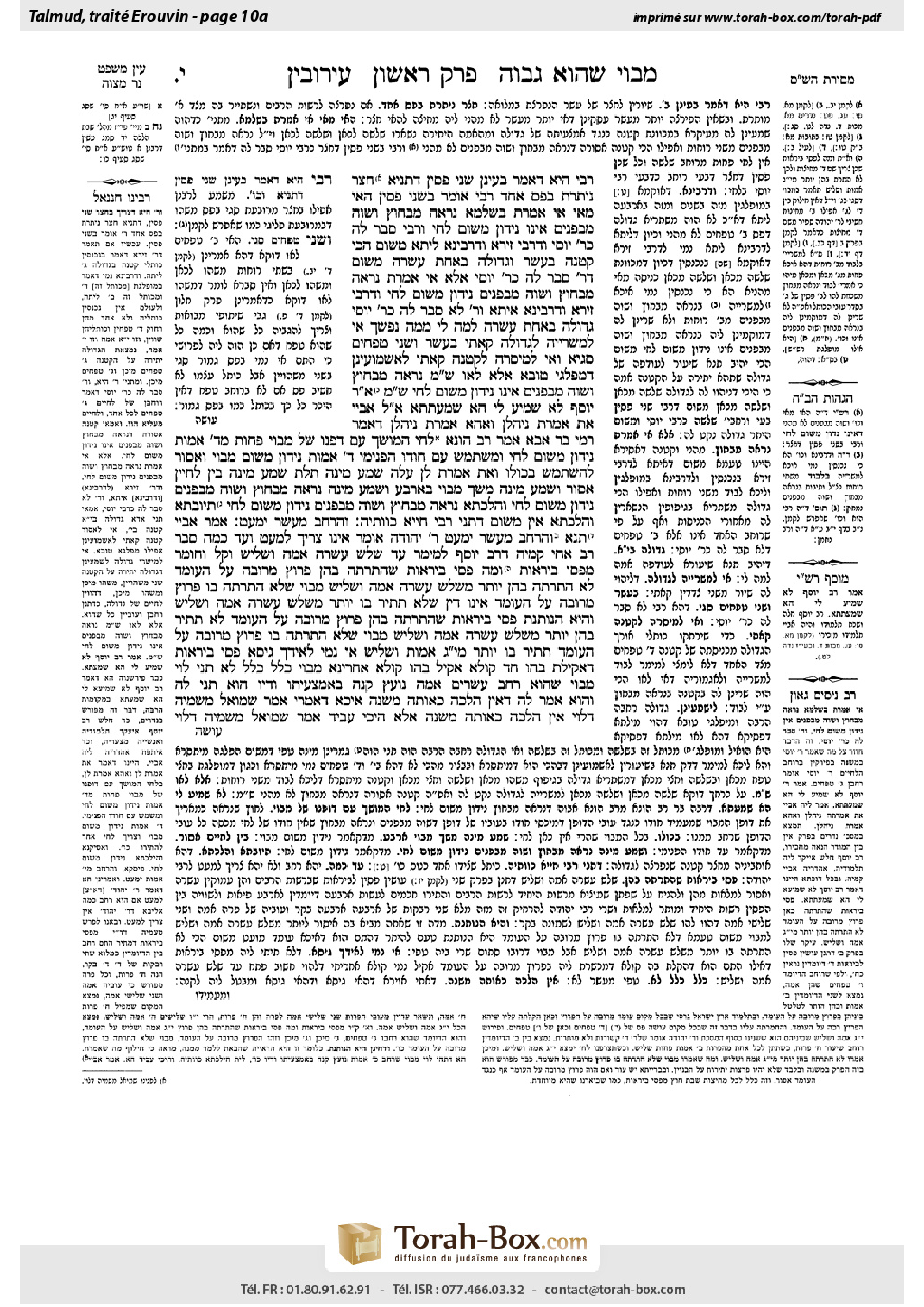
This page of Eruvin includes the Aramaic text, an English translation and an AI-generated French translation, alongside the scan above.
עירובין י׳ א · Aramaic and Hebrew text
רַבִּי הִיא, דְּאָמַר: בָּעִינַן שְׁנֵי פַּסִּין. דְּתַנְיָא: חָצֵר, נִיתֶּרֶת בְּפַס אֶחָד, רַבִּי אוֹמֵר: בִּשְׁנֵי פַּסִּין.
הַאי מַאי? אִי אָמְרַתְּ בִּשְׁלָמָא: נִרְאֶה מִבַּחוּץ וְשָׁוֶה מִבִּפְנִים — אֵינוֹ נִידּוֹן מִשּׁוּם לֶחִי, וְרַבִּי סָבַר לַהּ כְּרַבִּי יוֹסֵי, וּדְרַבִּי זֵירָא וּדְרָבִינָא לֵיתָא — מִשּׁוּם הָכִי קְטַנָּה בְּעֶשֶׂר וּגְדוֹלָה בְּאַחַת עֶשְׂרֵה, מִשּׁוּם דְּרַבִּי סָבַר לַהּ כְּרַבִּי יוֹסֵי.
אֶלָּא אִי אָמְרַתְּ: נִרְאֶה מִבַּחוּץ וְשָׁוֶה מִבִּפְנִים — נִידּוֹן מִשּׁוּם לֶחִי, וּדְרַבִּי זֵירָא וּדְרָבִינָא אִיתָא, וְרַבִּי לָא סָבַר לַהּ כְּרַבִּי יוֹסֵי — גְּדוֹלָה בְּאַחַת עֶשְׂרֵה לְמָה לִי?
מִמָּה נַפְשָׁךְ: אִי לְמִשְׁרְיַיהּ לִגְדוֹלָה קָאָתֵי — בְּעֶשֶׂר וּשְׁנֵי טְפָחִים סַגִּיא. וְאִי לְמֵיסְרַהּ לִקְטַנָּה קָאָתֵי — לְאַשְׁמוֹעִינַן דְּמַפְלְגִי טוּבָא.
אֶלָּא לָאו, שְׁמַע מִינַּהּ: נִרְאֶה מִבַּחוּץ וְשָׁוֶה מִבִּפְנִים — אֵינוֹ נִידּוֹן מִשּׁוּם לֶחִי. שְׁמַע מִינַּהּ.
אָמַר רַב יוֹסֵף: לָא שְׁמִיעַ לִי הָא שְׁמַעְתְּתָא.
אֲמַר לֵיהּ אַבָּיֵי: אַתְּ אֲמַרְתְּ נִיהֲלַן, וְאַהָא אֲמַרְתְּ נִיהֲלַן — דְּאָמַר רָמֵי בַּר אַבָּא אָמַר רַב הוּנָא: לֶחִי הַמּוֹשֵׁךְ עִם דׇּפְנוֹ שֶׁל מָבוֹי, פָּחוֹת מֵאַרְבַּע אַמּוֹת נִידּוֹן מִשּׁוּם לֶחִי, וּמִשְׁתַּמֵּשׁ עִם חוּדּוֹ הַפְּנִימִי. אַרְבַּע אַמּוֹת נִידּוֹן מִשּׁוּם מָבוֹי, וְאָסוּר לְהִשְׁתַּמֵּשׁ בְּכוּלּוֹ.
וְאַתְּ אֲמַרְתְּ לַן עֲלַהּ: שְׁמַע מִינַּהּ תְּלָת. שְׁמַע מִינַּהּ: בֵּין לְחָיַיִן אָסוּר. וּשְׁמַע מִינַּהּ: מֶשֶׁךְ מָבוֹי בְּאַרְבַּע. וּשְׁמַע מִינַּהּ: נִרְאֶה מִבַּחוּץ וְשָׁוֶה מִבִּפְנִים נִידּוֹן מִשּׁוּם לֶחִי.
וְהִלְכְתָא: נִרְאֶה מִבַּחוּץ וְשָׁוֶה מִבִּפְנִים — נִידּוֹן מִשּׁוּם לֶחִי. תְּיוּבְתָּא וְהִלְכְתָא?
אִין, מִשּׁוּם דְּתָנֵי רַבִּי חִיָּיא כְּווֹתֵיהּ.
וְהָרָחָב מֵעֶשֶׂר יְמַעֵט. אָמַר אַבָּיֵי, תָּנָא: וְהָרָחָב מֵעֶשֶׂר יְמַעֵט, רַבִּי יְהוּדָה אוֹמֵר: אֵינוֹ צָרִיךְ לְמַעֵט. וְעַד כַּמָּה?
סָבַר רַב אַחַי קַמֵּיהּ דְּרַב יוֹסֵף לְמֵימַר: עַד שְׁלֹשׁ עֶשְׂרֵה אַמָּה וּשְׁלִישׁ. וְקַל וָחוֹמֶר מִפַּסֵּי בִירָאוֹת.
וּמָה פַּסֵּי בִירָאוֹת שֶׁהִתַּרְתָּה בָּהֶן פָּרוּץ מְרוּבֶּה עַל הָעוֹמֵד — לֹא הִתַּרְתָּה בָּהֶן יוֹתֵר מִשְּׁלֹשׁ עֶשְׂרֵה אַמָּה וּשְׁלִישׁ, מָבוֹי שֶׁלֹּא הִתַּרְתָּה בּוֹ פָּרוּץ מְרוּבֶּה עַל הָעוֹמֵד, אֵינוֹ דִּין שֶׁלֹּא תַּתִּיר בּוֹ יוֹתֵר מִשְּׁלֹשׁ עֶשְׂרֵה אַמָּה וּשְׁלִישׁ?
וְהִיא הַנּוֹתֶנֶת: פַּסֵּי בִירָאוֹת שֶׁהִתַּרְתָּה בָּהֶן פָּרוּץ מְרוּבֶּה עַל הָעוֹמֵד — לֹא תַּתִּיר בָּהֶן יוֹתֵר מִשְּׁלֹשׁ עֶשְׂרֵה אַמָּה וּשְׁלִישׁ, מָבוֹי שֶׁלֹּא הִתַּרְתָּה בּוֹ פָּרוּץ מְרוּבֶּה עַל הָעוֹמֵד — תַּתִּיר בּוֹ יוֹתֵר מִשְּׁלֹשׁ עֶשְׂרֵה אַמּוֹת וּשְׁלִישׁ!
אִי נָמֵי לְאִידַּךְ גִּיסָא: פַּסֵּי בִירָאוֹת דְּאַקֵּילְתְּ בְּהוּ חַד קוּלָּא — אַקֵּיל בְּהוּ קוּלָּא אַחֲרִינָא, מָבוֹי כְּלָל כְּלָל לָא.
תָּנֵי לֵוִי: מָבוֹי שֶׁהוּא רָחָב עֶשְׂרִים אַמָּה, נוֹעַץ קָנֶה בְּאֶמְצָעִיתוֹ, וְדַיּוֹ. הוּא תָּנֵי לַהּ וְהוּא אָמַר לַהּ: דְּאֵין הֲלָכָה כְּאוֹתָהּ מִשְׁנָה. אִיכָּא דְאָמְרִי, אָמַר שְׁמוּאֵל מִשְּׁמֵיהּ דְּלֵוִי: אֵין הֲלָכָה כְּאוֹתָהּ מִשְׁנָה.
אֶלָּא הֵיכִי עָבֵיד? אָמַר שְׁמוּאֵל מִשְּׁמֵיהּ דְּלֵוִי:
Eruvin 10a · English translation
The Gemara answers: This mishna is in accordance with the opinion of Rabbi Yehuda HaNasi, who said that in order to permit carrying in a courtyard that was breached, we require two upright boards, one on either side of the breach. As it was taught in a baraita: If a courtyard was breached and opens into the public domain, and the width of the breach does not exceed ten cubits, it becomes permitted to carry there, even with only one upright board remaining on one side of the breach. Rabbi Yehuda HaNasi says: It is permitted only with two upright boards remaining, one on each side of the breach.
The Gemara rejects this entire explanation: What is this comparison? Granted, if you say that the legal status of a side post that is visible from the outside but appears to be even with the wall from the inside is not considered like that of a side post; and that Rabbi Yehuda HaNasi holds in accordance with the opinion of Rabbi Yosei that a side post or an upright board in a courtyard must be at least three handbreadths wide; and that the explanations of the mishna offered earlier by Rabbi Zeira and Ravina are not accepted; that is why there is significance to the fact that the small courtyard is ten cubits wide and the large one is eleven cubits wide. It is due to the fact that Rabbi Yehuda HaNasi holds in accordance with the opinion of Rabbi Yosei. Since Rabbi Yosei holds that a side post must be three handbreadths wide, we require that the two upright boards together measure six handbreadths, i.e., one cubit, which is the minimal difference in size between the two courtyards.
However, if you say that the legal status of a side post that is visible from the outside but appears to be even with the wall from the inside is considered like that of a side post; and that Rabbi Zeira’s and Ravina’s explanations are accepted as halakha; and that Rabbi Yehuda HaNasi does not hold in accordance with the opinion Rabbi Yosei, why do I need to explain that the large courtyard measures eleven cubits?
Whichever way you look at it, there is a difficulty: If the baraita is coming to permit one to carry in the large courtyard, then a width of ten cubits and two handbreadths suffices. These two handbreadths can be considered the upright boards that render the courtyard fit for one to carry within it. And if it is coming to teach a novel halakha according to Rabbi Yehuda HaNasi and prohibit one to carry in the small courtyard, it should teach us a case where the walls of the two courtyards are much farther removed from each other, rather than a case where they are only one cubit apart. Therefore, the second explanation cannot be accepted.
Rather, can we not conclude from the baraita that a side post that is visible from the outside but appears to be even with the wall from the inside is not considered to have the legal status of a side post? The Gemara concludes: Indeed, conclude from this.
Rav Yosef said: I did not hear this halakha of Rabba bar Rav Huna from my teachers. Rav Yosef had become ill and forgotten his learning, which is why he could not recall the halakha that a side post that is visible from the outside is considered to have the legal status of a side post.
His student Abaye said to him: You yourself told us this halakha, and it was with regard to this that you told it to us. As Rami bar Abba said that Rav Huna said: With regard to a side post that extends along the wall of an alleyway and beyond, in which case it appears from the inside to be a continuation of the wall but due to its narrow width it is clearly visible as a side post from the outside, if that side post is less than four cubits long it is considered to have the legal status of a side post. And one may use the alleyway up to the inner edge of the side post. However, if the side post itself extends four cubits, the alleyway has no side post and it is considered to have the legal status of an alleyway, and it is prohibited to utilize the entire alleyway.
And you said to us about this: Learn from this statement three halakhot with regard to eiruvin. Learn from it that in the area between the side posts it is prohibited to carry, as Rav Huna rules that one may use the alleyway only up to the inner edge of the side post. And learn from it that the minimal length of an alleyway is four cubits. And learn from it that a side post that is visible from the outside but appears to be even with the wall of the alleyway from the inside is considered to have the legal status of a side post.
The Gemara concludes: The halakha is that a side post that is visible from the outside but appears to be even with the wall from the inside is considered to have the legal status of a side post. The Gemara asks: It is possible that there is a conclusive refutation of this opinion, and it is also the halakha? This opinion was refuted earlier. Can the halakha then be decided in accordance with it?
The Gemara answers: Yes, it can because Rabbi Ḥiyya taught a baraita in accordance with it. Although the deductive analysis of the statements of other tanna’im led to different conclusions, the halakha relies on Rabbi Ḥiyya’s explicit statement.
The opening mishna states: If the entrance to an alleyway is wider than ten cubits, one must diminish its width. Abaye said that a Sage taught in the Tosefta: If the entrance to an alleyway is wider than ten cubits, one must diminish its width. Rabbi Yehuda says: He need not diminish it. The question arises: Until what width does Rabbi Yehuda still permit carrying in the alleyway?
Initially, Rav Aḥai thought to say before Rav Yosef: Up to thirteen and a third cubits. And he derived this figure through an a fortiori argument from upright boards surrounding a well. Rabbi Yehuda maintains that if one placed upright boards up to thirteen and a third cubits apart from one another, he may consider the partitioned area around the well as a private domain and therefore carry within it.
Rav Aḥai explains: Just as in the case of upright boards surrounding a well, where you permitted carrying, even though the boards form a partition where the breached segment is greater than the standing segment, you did not permit carrying within them if the gap between the boards is more than thirteen and a third cubits wide; in the case of an alleyway, where you did not permit carrying if the breached segment of its walls is greater than the standing segment, is it not right that you will not permit carrying within it if there is a gap more than thirteen and a third cubits wide?
But that reasoning provides support for a contrary conclusion as well. Just as in the case of upright boards surrounding a well, where you permitted carrying within them, even though the boards form a partition where the breached segment is greater than the standing segment, you will not extend the leniency and permit carrying within them, when the gap between the boards is more than thirteen and a third cubits; in an alleyway, where you were stringent and did not permit carrying when the breached segment is greater than the standing segment, in a case where most of the walls are standing, you will certainly permit carrying, even when the gap is more than thirteen and a third cubits.
Alternatively, one may argue to the contrary. One should be more stringent in the case of an alleyway. In the case of upright boards surrounding a well, with regard to which you were lenient and issued one leniency, be lenient and issue another leniency and maintain that a gap of up to thirteen and a third cubits still be considered an entrance. However, in the case of an alleyway, you should not be lenient at all. Therefore, there is no way to determine Rabbi Yehuda’s opinion with regard to the width of an alleyway entrance.
Levi taught a baraita with regard to reducing the width of an alleyway in order to render it fit for one to carry within it. If an alleyway is twenty cubits wide, one may stick a reed in the center of its entrance and that is sufficient to create two separate alleyways, each ten cubits wide. He taught this baraita, and he said about it that the halakha is not in accordance with that teaching, as the insertion of a reed is not effective in reducing the width. Some say that Shmuel said in the name of Levi: The halakha is not in accordance with that teaching.
The Gemara asks: Rather, how should one act in order to render an alleyway of that sort fit for one to carry within it? Shmuel said in the name of Levi:
Eruvin 10a · Traduction française (IA)
Le Guemara répond : Cette mitsva est selon l'opinion du Rabbi Yéhuda Hanassi, qui affirmait qu'il faut deux poutres verticales, l'une de chaque côté de la brèche, pour permettre le port dans un courtil percé. Comme il a été enseigné dans une baraïta : Si un courtil est percé et s'ouvre sur le domaine public, et que la largeur de la brèche ne dépasse pas dix coudées, il devient permis de porter là, même avec une seule poutre verticale restant du côté de la brèche. Le Rabbi Yéhuda Hanassi dit : Il est permis seulement avec deux poutres verticales restant, l'une de chaque côté de la brèche.
Le Guemara rejette cette explication entière : Quel est ce parallèle ? C'est certain, si vous dites que le statut juridique d'une poutre latérale visible de l'extérieur mais apparaissant être égale au mur de l'intérieur n'est pas considéré comme celui d'une poutre latérale ; et que le Rabbi Yéhuda Hanassi adopte l'opinion du Rabbi Yosei selon laquelle une poutre latérale ou une poutre verticale dans un courtil doit mesurer au moins trois tefachim de large ; et que les explications de la mitsva données précédemment par le Rabbi Zéira et le Ravina ne sont pas acceptées ; c'est pourquoi il y a de l'importance à ce que le petit courtil mesure dix coudées et le grand onze coudées. C'est en raison du fait que le Rabbi Yéhuda Hanassi adopte l'opinion du Rabbi Yosei. Puisque le Rabbi Yosei considère qu'une poutre latérale doit mesurer trois tefachim de large, nous exigeons que les deux poutres verticales ensemble mesurent six tefachim, c'est-à-dire un coudée, qui est la différence minimale de taille entre les deux courtils.
Cependant, si vous dites que le statut juridique d'une poutre latérale visible de l'extérieur mais apparaissant être égale au mur de l'intérieur est considéré comme celui d'une poutre latérale ; et que les explications du Rabbi Zéira et du Ravina sont acceptées comme halakha ; et que le Rabbi Yéhuda Hanassi ne suit pas l'opinion du Rabbi Yosei, pourquoi ai-je besoin d'expliquer que le grand courtil mesure onze coudées ?
Quel que soit le point de vue, il y a une difficulté : Si la baraïta vise à permettre le port dans le grand courtil, alors une largeur de dix coudées et deux tefachim suffit. Ces deux tefachim peuvent être considérés comme les poutres verticales qui rendent le courtil apte au port. Et si elle vise à enseigner une halakha nouvelle selon le Rabbi Yéhuda Hanassi et à interdire le port dans le petit courtil, elle devrait nous enseigner un cas où les murs des deux courtils sont beaucoup plus éloignés l'un de l'autre, plutôt qu'un cas où ils sont seulement un coudée l'un de l'autre. Ainsi, cette deuxième explication ne peut pas être acceptée.
Plutôt, ne pouvons-nous pas conclure de la baraïta que la poutre latérale visible de l'extérieur mais apparaissant être égale au mur de l'intérieur n'est pas considérée comme ayant le statut juridique d'une poutre latérale ? Le Guemara conclut : En effet, concluez-en ainsi.
Rav Yosef dit : Je n'ai pas entendu cette halakha de Rabba bar Rav Huna de mes maîtres. Rav Yosef avait été malade et avait oublié ses études, ce qui explique pourquoi il ne pouvait pas se souvenir de la halakha selon laquelle une poutre latérale visible de l'extérieur est considérée comme ayant le statut juridique d'une poutre latérale.
Son élève Abaye lui dit : Vous-même nous avez dit cette halakha, et c'est à ce sujet que vous l'avez dit. Comme Rami bar Abba a dit que Rav Huna a dit : Concernant une poutre latérale qui s'étend le long du mur d'un passage et au-delà, dans le cas où elle apparaît à l'intérieur comme une continuation du mur mais, en raison de sa largeur étroite, est clairement visible comme une poutre latérale de l'extérieur, si cette poutre latérale mesure moins de quatre coudées, elle est considérée comme ayant le statut juridique d'une poutre latérale. On peut utiliser le passage jusqu'à l'extrémité interne de la poutre latérale. Cependant, si la poutre latérale s'étend quatre coudées, le passage n'a pas de poutre latérale et est considéré comme ayant le statut juridique d'un passage, et il est interdit d'utiliser l'ensemble du passage.
Et vous avez dit à ce sujet : Apprenez de cette déclaration trois halakhot concernant les eiruvin. Apprenez-en une : que dans la zone entre les poutres latérales, il est interdit de porter, comme Rav Huna règle que l'on peut utiliser le passage seulement jusqu'à l'extrémité interne de la poutre latérale. Et apprenez-en une autre : que la longueur minimale d'un passage est de quatre coudées. Et apprenez-en une troisième : qu'une poutre latérale visible de l'extérieur mais apparaissant être égale au mur du passage de l'intérieur est considérée comme ayant le statut juridique d'une poutre latérale.
Le Guemara conclut : La halakha est que la poutre latérale visible de l'extérieur mais apparaissant être égale au mur de l'intérieur est considérée comme ayant le statut juridique d'une poutre latérale. Le Guemara pose la question : Il est possible qu'il y ait une réfutation définitive de cette opinion, et c'est aussi la halakha ? Cette opinion a été réfutée plus tôt. La halakha peut-elle alors être décidée selon elle ?
Le Guemara répond : Oui, parce que le Rabbi Chiyah a enseigné une baraïta selon cette opinion. Bien que l'analyse déductive des déclarations des tannaïm ait conduit à des conclusions différentes, la halakha repose sur l'affirmation explicite du Rabbi Chiyah.
La mitsna stipule : Si l'entrée d'un passage est plus large que dix coudées, on doit la réduire. Abaye dit que le Sage a enseigné dans la Tosefta : Si l'entrée d'un passage est plus large que dix coudées, on doit la réduire. Le Rabbi Yéhuda dit : Il n'a pas besoin de la réduire. La question se pose : Jusqu'à quelle largeur le Rabbi Yéhuda permet-il encore le port dans le passage ?
Initialement, Rav Aḥai pensait de dire devant Rav Yosef : Jusqu'à treize et un tiers coudées. Et il en déduisit cette mesure par un raisonnement a fortiori à partir des poutres entourant un puits. Rabbi Yéhuda affirme que si l'on place des poutres à treize et un tiers coudées l'une de l'autre, on peut considérer la zone divisée autour du puits comme un domaine privé et donc y porter des objets.
Rav Aḥai explique : Comme dans le cas des planches verticales entourant un puits, où l'on a permis le portage, même si les planches forment une cloison où la partie brisée est plus grande que la partie debout, l'on n'a pas permis le portage à l'intérieur d'elles si la largeur de l'ouverture entre les planches est supérieure à treize et un tiers coudées ; dans le cas d'un passage, où l'on n'a pas permis le portage si la partie brisée des murs est plus grande que la partie debout, n'est-il pas juste que l'on n'autorise pas le portage à l'intérieur si l'ouverture est supérieure à treize et un tiers coudées ?
Mais cette raisonnement fournit un soutien à une conclusion contraire. Comme dans le cas des planches verticales entourant un puits, où l'on a permis le portage à l'intérieur d'elles, même si les planches forment une cloison où la partie brisée est plus grande que la partie debout, l'on ne prolongera pas la leniency et l'on ne permettra pas le portage à l'intérieur d'elles, lorsque la largeur de l'ouverture entre les planches est supérieure à treize et un tiers coudées ; dans le cas d'un passage, où l'on a été strict et n'a pas permis le portage lorsque la partie brisée est plus grande que la partie debout, dans un cas où la majorité des murs sont debout, l'on autorisera certainement le portage, même lorsque l'ouverture est supérieure à treize et un tiers coudées.
Une autre voie peut être prise. On devrait être plus strict dans le cas d'un passage. Dans le cas des planches verticales entourant un puits, concernant lequel l'on a été leniant et a émis une leniency, l'on devrait être leniant et émettre une autre leniency et maintenir que la largeur d'une ouverture jusqu'à treize et un tiers coudées soit encore considérée comme une entrée. Cependant, dans le cas d'un passage, l'on ne devrait pas être leniant du tout. Ainsi, il n'y a aucun moyen de déterminer l'opinion de Rabbi Yehuda concernant la largeur d'une entrée de passage.
Lévi a enseigné une baraïta concernant la réduction de la largeur d'un passage afin de le rendre apte au portage. Si un passage est de vingt coudées de large, l'on peut insérer un roseau au centre de son entrée et cela suffit à créer deux passages distincts, chacun de dix coudées de large. Il a enseigné cette baraïta, et il a dit à propos de celle-ci que la halakha ne suit pas cette enseignement, car l'insertion d'un roseau n'est pas efficace pour réduire la largeur. Certains disent que Shmuel a dit au nom de Lévi : la halakha ne suit pas cette enseignement.
La Guemara demande : Plutôt, comment doit-on agir afin de rendre un passage de ce genre apte au portage ? Shmuel a dit au nom de Lévi :
Traduction française générée par IA à partir de l’édition anglaise de Sefaria. Vérifie toujours un passage avec le texte source.
Text from Sefaria: William Davidson Edition - Vocalized Aramaic (CC BY NC); William Davidson Edition - English (CC BY NC).