Eruvin 10b: Talmud study for Daf Yomi
Study the Talmud for Daf Yomi with scanned pages, Hebrew text, English translations from Sefaria and AI-generated French translations.
Passage selection and English or AI-generated French translation are available where the scan has annotations. Daf Study is independent of Torah-Box and Sefaria.
Browse Eruvin · עירובין · All tractatesEruvin 10b text and translations
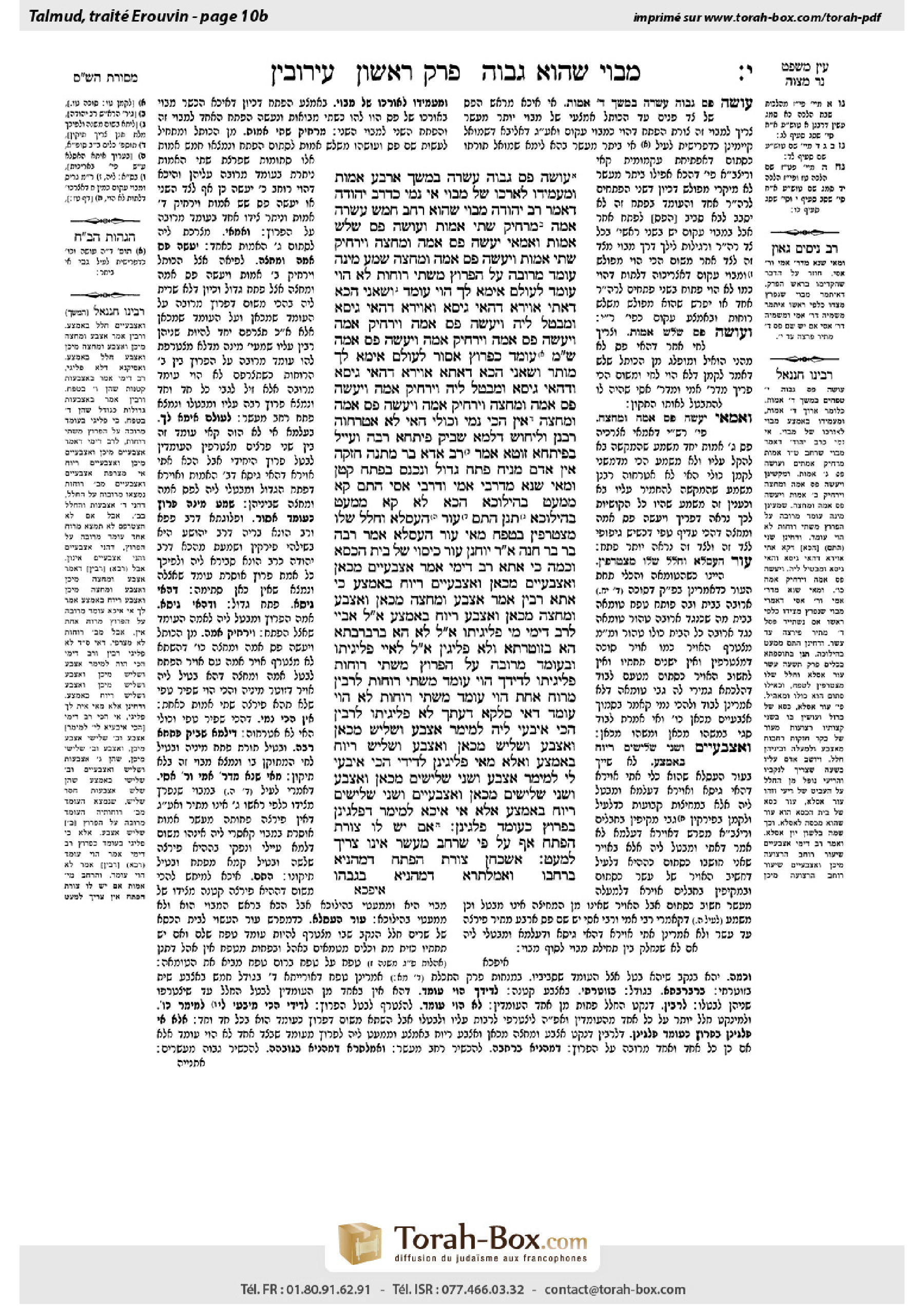
This page of Eruvin includes the Aramaic text, an English translation and an AI-generated French translation, alongside the scan above.
עירובין י׳ ב · Aramaic and Hebrew text
עוֹשֶׂה פַּס גָּבוֹהַּ עֲשָׂרָה בְּמֶשֶׁךְ אַרְבַּע אַמּוֹת, וּמַעֲמִידוֹ לְאׇרְכּוֹ שֶׁל מָבוֹי.
אִי נָמֵי כִּדְרַב יְהוּדָה, דְּאָמַר רַב יְהוּדָה: מָבוֹי שֶׁהוּא רָחָב חֲמֵשׁ עֶשְׂרֵה אַמָּה — מַרְחִיק שְׁתֵּי אַמּוֹת וְעוֹשֶׂה פַּס שָׁלֹשׁ אַמּוֹת.
וְאַמַּאי? יַעֲשֶׂה פַּס אַמָּה וּמֶחֱצָה, וְיַרְחִיק שְׁתֵּי אַמּוֹת, וְיַעֲשֶׂה פַּס אַמָּה וּמֶחֱצָה. שְׁמַע מִינַּהּ: עוֹמֵד מְרוּבֶּה עַל הַפָּרוּץ מִשְׁתֵּי רוּחוֹת לָא הָוֵי עוֹמֵד!
לְעוֹלָם אֵימָא לָךְ הָוֵי עוֹמֵד, וְשָׁאנֵי הָכָא, דְּאָתֵי אַוֵּירָא דְּהַאי גִּיסָא וְאַוֵּירָא דְּהַאי גִּיסָא וּמְבַטֵּל לֵיהּ.
וְיַעֲשֶׂה פַּס אַמָּה וְיַרְחִיק אַמָּה, וְיַעֲשֶׂה פַּס אַמָּה וְיַרְחִיק אַמָּה, וְיַעֲשֶׂה פַּס אַמָּה. שְׁמַע מִינַּהּ עוֹמֵד כְּפָרוּץ — אָסוּר!
לְעוֹלָם אֵימָא לָךְ — מוּתָּר, וְשָׁאנֵי הָכָא דְּאָתֵא אַוֵּירָא דְּהַאי גִּיסָא וּדְהַאי גִּיסָא וּמְבַטֵּל לֵיהּ.
וְיַרְחִיק אַמָּה וְיַעֲשֶׂה פַּס אַמָּה וּמֶחֱצָה, וְיַרְחִיק אַמָּה וְיַעֲשֶׂה פַּס אַמָּה וּמֶחֱצָה.
אִין הָכִי נָמֵי, וְכוּלֵּי הַאי לָא אַטְרְחוּהּ רַבָּנַן.
וְלֵיחוּשׁ דִּלְמָא שָׁבֵיק פִּיתְחָא רַבָּה, וְעָיֵיל בְּפִיתְחָא זוּטָא! אָמַר רַב אַדָּא בַּר מַתְנָה: חֲזָקָה אֵין אָדָם מַנִּיחַ פֶּתַח גָּדוֹל וְנִכְנָס בְּפֶתַח קָטָן.
וּמַאי שְׁנָא מִדְּרַבִּי אַמֵּי וּדְרַבֵּי אַסִּי?
הָתָם קָא מְמַעֵט בְּהִילּוּכָא. הָכָא לָא קָא מְמַעֵט בְּהִילּוּכָא.
תְּנַן הָתָם: עוֹר הָעַסְלָא וְחָלָל שֶׁלּוֹ — מִצְטָרְפִין בְּטֶפַח.
מַאי ״עוֹר הָעַסְלָא״? אָמַר רַבָּה בַּר בַּר חָנָה אָמַר רַבִּי יוֹחָנָן: עוֹר כִּיסּוּי שֶׁל בֵּית הַכִּסֵּא.
וְכַמָּה? כִּי אֲתָא רַב דִּימִי, אָמַר: אֶצְבָּעַיִים מִכָּאן, וְאֶצְבָּעַיִים מִכָּאן, וְאֶצְבָּעַיִים רֶיוַח בָּאֶמְצַע. כִּי אֲתָא רָבִין, אָמַר: אֶצְבַּע וּמֶחֱצָה מִכָּאן, וְאֶצְבַּע וּמֶחֱצָה מִכָּאן, וְאֶצְבַּע רֶיוַח בָּאֶמְצַע.
אֲמַר לֵיהּ אַבָּיֵי לְרַב דִּימִי: מִי פְּלִיגִיתוּ? אֲמַר לֵיהּ: לָא, הָא — בְּרַבְרְבָתָא, הָא — בְּזוּטְרָתָא, וְלָא פְּלִיגִין.
אֲמַר לֵיהּ: לָאיֵי, פְּלִיגִיתוּ, וּבְעוֹמֵד מְרוּבֶּה עַל הַפָּרוּץ מִשְׁתֵּי רוּחוֹת פְּלִיגִיתוּ. לְדִידָךְ הָוֵי עוֹמֵד מִשְׁתֵּי רוּחוֹת, לְרָבִין מֵרוּחַ אַחַת — הָוֵי עוֹמֵד, מִשְׁתֵּי רוּחוֹת — לָא הָוֵי עוֹמֵד.
דְּאִי סָלְקָא דַעְתָּךְ לָא פְּלִיגִיתוּ, לְרָבִין הָכִי אִיבְּעִי לֵיהּ לְמֵימַר: אֶצְבַּע וּשְׁלִישׁ מִכָּאן, וְאֶצְבַּע וּשְׁלִישׁ מִכָּאן, וְאֶצְבַּע וּשְׁלִישׁ רֶיוַח בָּאֶמְצַע.
וְאֶלָּא מַאי — פְּלִיגִינַן? לְדִידִי, הָכִי אִיבְּעִי לִי לְמֵימַר: אֶצְבַּע וּשְׁנֵי שְׁלִישִׁים מִכָּאן, וְאֶצְבַּע וּשְׁנֵי שְׁלִישִׁים מִכָּאן, וְאֶצְבָּעַיִים וּשְׁנֵי שְׁלִישִׁים רֶיוַח בָּאֶמְצַע.
אֶלָּא אִי אִיכָּא לְמֵימַר דִּפְלִגִינַן — בִּפָרוּץ כְּעוֹמֵד פְּלִגִינַן.
אִם יֵשׁ לוֹ צוּרַת הַפֶּתַח, אַף עַל פִּי שֶׁרָחָב מֵעֶשֶׂר — אֵינוֹ צָרִיךְ לְמַעֵט. אַשְׁכְּחַן צוּרַת הַפֶּתַח דְּמַהְנְיָא בְּרַחְבּוֹ, וַאֲמַלְתְּרָא דְּמַהְנְיָא בְּגׇבְהוֹ.
Eruvin 10b · English translation
One prepares a board ten handbreadths high with a length of four cubits and stands it lengthwise down the middle of the alleyway, and thereby forms two small alleyways at the entrance to the alleyway, neither of which is more than ten cubits wide.
Alternatively, one can act in accordance with the opinion of Rav Yehuda, as Rav Yehuda said: If an alleyway is fifteen cubits wide, how does one reduce its width? He distances himself two cubits from one of the walls of the alleyway and prepares a board three cubits wide, thereby leaving an opening of only ten cubits.
The Gemara asks: And why must one reduce the width in this manner? One could also prepare a board a cubit and a half wide, and distance himself two cubits, and then prepare another board a cubit and a half wide, leaving the alleyway with an opening of only ten cubits. Apparently, one may conclude from the fact that Rav Yehuda did not suggest this possibility that if the standing segment of a wall is greater than the breached segment only when one combines the standing segments from two directions, i.e., both sides of the breach, it is not considered as though the standing segment were greater.
The Gemara rejects this: Actually, I would say to you that ordinarily it is considered as standing even when one must combine the standing segments on the two sides of the breach. However, it is different here, as the air, i.e., the two cubit opening, of this one side of the far board and the air, i.e., the ten cubit opening, of this other side of the board come together and negate it. Therefore, in this case, the board that is farther from the wall cannot serve to close off the alleyway.
The Gemara suggests: And one could instead prepare a board one cubit wide and distance himself one cubit, and prepare another board of a cubit and distance himself one cubit, and prepare a third board of one cubit, thus ensuring that the open space is not greater than the standing segment on both sides. Apparently, since Rav Yehuda did not suggest this possibility, one may conclude from this that if the standing segment of a wall is equal to the breached segment, carrying in the alleyway is prohibited.
The Gemara rejects this assumption: Actually, I would say to you that ordinarily carrying is permitted in that case. But here it is different, since the air, the opening, on this side of the board and the air, the opening, on that side of the board come together and negate the effectiveness of the board.
The Gemara suggests: And one could distance himself one cubit from the wall, and prepare a board of a cubit and a half, and distance himself another cubit, and prepare another board of a cubit and a half. In this manner, one could diminish the width of the entrance of the alleyway to ten cubits.
The Gemara answers: Yes, it is indeed so; this would work equally as well. But the Sages did not burden him this much, requiring him to prepare two boards where one suffices.
The Gemara raises a new issue: But let us be concerned lest one abandon use of the larger entrance, which is ten cubits wide, and begin to enter the alleyway through the smaller entrance, which has a width of two cubits. This would negate the larger opening’s status as an entrance and render the alleyway unfit for one to carry within it, as it would no longer have an entrance with a side post. Rav Adda bar Mattana said: The presumption is that a person does not abandon a larger entrance and enter instead through a smaller entrance.
The Gemara raises a difficulty: And in what way is this different from the opinion of Rabbi Ami and Rabbi Asi, who maintain that in the case of an alleyway that is breached on its side wall close to its entrance, if the breach is large enough for one to enter through it, carrying in the alleyway is prohibited? There, too, such a breach should not be problematic, as a person does not abandon a larger entrance to enter through a smaller one.
The Gemara answers: There, in the case of Rabbi Ami and Rabbi Asi, the smaller entrance reduces his walking distance. If one approaches the alleyway from the side, the smaller entrance provides a shortcut, and therefore one might enter through it as well. However, here, in the case of the two entrances one two cubits and one ten cubits, it does not reduce his walking distance, as both openings are situated at the front of the alleyway.
The Gemara returns to the issue of the standing segment that is greater than the breached segment. We learned in the Tosefta there, in tractate Kelim: The leather covering of a stool [asla] and its hole join together to complete a handbreadth with regard to ritual impurity imparted by a tent over a corpse. Any person, vessel, or food that is beneath a covering that is at least a handbreadth in size together with a portion of a corpse of at least an olive-bulk becomes ritually impure with impurity imparted by a corpse. The baraita teaches that the leather covering of a stool and its hole combine to complete the measure of a handbreadth.
The Gemara asks: What is the leather covering of a stool referred to in the Tosefta? Rabba bar bar Ḥana said that Rav Yoḥanan said: The leather covering of a bathroom.
The Gemara asks: And how large can the hole be and still combine with the leather covering to complete the handbreadth? When Rav Dimi came from Eretz Yisrael to Babylonia, he said: Two fingers of leather from here, on one side, and two fingers of leather from here, on the other side, and a space of two fingers for the hole in the middle. However, when Ravin came from Eretz Yisrael to Babylonia, he said: A finger and a half of leather from here, and a finger and a half on the leather from here, and a space of a single finger for the hole in the middle.
Abaye said to Rav Dimi: Do the two of you, yourself and Ravin, disagree in principle? Rav Dimi said to him: No, rather this, Ravin’s statement, is referring to the large finger, i.e., the thumb, and this, my own statement, is referring to the small finger, the pinkie, and we do not disagree. Both were describing one handbreadth, which equals the width of four thumbs or six pinkies.
Abaye said to him: This is not so [la’ei]. You disagree, and you disagree with regard to the halakha in a case where the standing segment of a wall is greater than the breached segment only when one combines the standing segments from two directions, i.e., both sides of the breached segment. According to you, this wall is considered as standing, even when one must combine the standing segments from two directions. According to Ravin, if the standing segment on one side of the breach is greater, the wall is considered as standing; however, if the standing segment is greater only after combining the standing segments from the two directions, it is not considered as standing.
Abaye continues: For if it should enter your mind to say that you do not disagree, but simply refer to the same measures by different names, to express his opinion, Ravin should have said as follows: A finger and a third of leather from here, and a finger and a third of leather from here, and a space of a finger and a third for the hole in the middle. In this case, there would still be a handbreadth in total, but each side of leather alone would not be larger than the space in the middle. The fact that Ravin presented a case where the hole in the middle is smaller than the width of the leather on either side indicates that his dispute with Rav Dimi is a fundamental one.
Rav Dimi responds: Rather, what do you wish to say, that we disagree? If so, to express the opinion attributed to me, I should have said as follows: A finger and two thirds of leather from here, and a finger and two thirds of leather from here, and a space of two fingers and two thirds in the middle. This would provide a more striking case where, despite the fact that the breach is much greater than the standing segments on either of its sides, the two standing segments combine together so that the standing segments are considered greater than the breached segment.
Rather, if there is room to say that we disagree, our dispute relates to a different point, and we argue in the case where the breached segment is exactly equal to the standing segment on each side. According to Ravin, it is considered breached; while according to Rav Dimi, it is considered standing.
The Gemara returns to the mishna: If the entrance to the alleyway has an opening in the form of a doorway, then, even if it is wider than ten cubits, one need not diminish its width. The Gemara comments: We find that an opening in the form of a doorway is effective to permit carrying in an alleyway with regard to its width, i.e., when its entrance is more than ten cubits wide, and that a cornice is effective with regard to its height, i.e., when it is more than twenty cubits high.
Eruvin 10b · Traduction française (IA)
On prépare une planche de dix paumes de haut, de quatre coudées de long, et on la place de manière à ce que sa longueur soit orientée au milieu du passage, formant ainsi deux petits passages à l'entrée du passage, aucun d'eux ne mesurant plus de dix coudées de largeur.
Une autre possibilité est de suivre l'opinion de R. Yéhuda, comme il a dit : Si un passage est large de quinze coudées, comment réduit-on sa largeur ? Il se place à deux coudées d'un des murs du passage et prépare une planche de trois coudées de largeur, laissant ainsi une ouverture de seulement dix coudées.
La Guemara pose la question : Et pourquoi doit-on réduire la largeur ainsi ? On aurait pu aussi préparer une planche de un et demi coudées de largeur, se placer à deux coudées, et préparer une autre planche de un et demi coudées, laissant ainsi une ouverture de seulement dix coudées. Il semble que l'on puisse conclure du fait que R. Yéhuda n'a pas suggéré cette possibilité que si la partie debout du mur est plus grande que la partie percée, cela n'est considéré comme tel que lorsque l'on combine les parties debout des deux côtés de la percée, c'est-à-dire les deux côtés de la brèche, ce n'est pas considéré comme si la partie debout était plus grande.
La Guemara rejette cette possibilité : En réalité, je dirais à vous que normalement, cela est considéré comme debout même lorsque l'on doit combiner les parties debout des deux côtés de la brèche. Cependant, ici, c'est différent, car l'air, c'est-à-dire l'ouverture de ce côté de la planche lointaine, et l'air, c'est-à-dire l'ouverture de ce côté de la planche, se combinent et annulent cela. Ainsi, dans ce cas, la planche qui est plus éloignée du mur ne peut pas servir à fermer le passage.
La Guemara suggère : Et on pourrait plutôt préparer une planche d'une coudée de largeur, se placer à une coudée, et préparer une autre planche d'une coudée, se placer à une coudée, et préparer une troisième planche d'une coudée, ainsi assurant que l'espace ouvert ne soit pas plus grand que la partie debout des deux côtés. Il semble que l'on puisse conclure du fait que R. Yéhuda n'a pas suggéré cette possibilité que si la partie debout du mur est égale à la partie percée, le portage dans le passage est interdit.
La Guemara rejette cette hypothèse : En réalité, je dirais à vous que normalement le portage est permis dans ce cas. Cependant, ici, c'est différent, car l'air, l'ouverture, de ce côté de la planche et l'air, l'ouverture, de ce côté de la planche se combinent et annulent l'efficacité de la planche.
La Guemara suggère : Et l'on pourrait se tenir à une coudée du mur, préparer une planche d'une coudée et demi, se tenir à une autre coudée, et préparer une autre planche d'une coudée et demi. Ainsi, l'on pourrait réduire la largeur de l'entrée du passage à dix coudées.
La Guemara répond : Oui, c'est ainsi ; cela fonctionnerait tout aussi bien. Cependant, les Sages n'ont pas imposé une telle charge, exigeant qu'il prépare deux planches alors qu'une seule suffirait.
La Guemara soulève une nouvelle question : Mais on pourrait craindre que l'on abandonne l'usage de l'entrée plus large, qui mesure dix coudées, et commence à entrer dans le passage par l'entrée plus étroite, qui mesure deux coudées. Cela annulerait le statut de l'ouverture plus large comme entrée, rendant le passage inadapté pour le portage à l'intérieur, car il n'aurait plus d'entrée avec un poteau. R. Adda bar Mattana a dit : On suppose que la personne ne renonce pas à une entrée plus large pour entrer par une entrée plus étroite.
La Guemara soulève une difficulté : Et dans quelle mesure cela diffère-t-il de l'opinion de R. Ami et de R. Asi, qui maintiennent que dans le cas d'un passage percé dans son mur latéral près de son entrée, si la brèche est suffisamment grande pour permettre l'entrée, le portage dans le passage est interdit ? Là aussi, cette brèche ne devrait pas être problématique, car une personne ne renonce pas à une entrée plus large pour entrer par une plus petite.
La Guemara répond : Là, dans le cas de R. Ami et de R. Asi, la petite entrée réduit la distance de marche. Si l'on approche du passage du côté, la petite entrée offre un raccourci, et donc on pourrait entrer par là. Cependant, ici, dans le cas des deux entrées, une de deux coudées et une de dix coudées, cela ne réduit pas la distance de marche, car les deux ouvertures sont situées à l'avant du passage.
La Guemara revient à l'issue de la partie debout plus grande que la partie percée. Nous avons appris dans la Tosefta là, dans le traité Kelim : La couverture en cuir d'une chaise [asla] et son trou se combinent pour former une paume avec regard à l'impureté rituelle transmise par un tentoire sur un cadavre. Tout individu, objet ou nourriture qui est sous une couverture d'au moins une paume et une portion d'un cadavre d'au moins la quantité d'une olive devient impur par l'impureté transmise par un cadavre. La baraïta enseigne que la couverture en cuir d'une chaise et son trou se combinent pour former la mesure d'une paume.
La Guemara demande : De quelle couverture en cuir d'une chaise s'agit-il dans la Tosefta ? Rabbâ bar bar Ḥana a dit que R. Yōḥanan a dit : La couverture en cuir d'une salle de bain.
La Guemara demande : Et jusqu'à quelle taille peut être le trou et encore se combiner avec la couverture en cuir pour former une paume ? Quand R. Dimi est venu de la Terre d'Israël vers Babylone, il a dit : Deux doigts de cuir d'ici, d'un côté, et deux doigts de cuir d'ici, de l'autre côté, et un espace de deux doigts pour le trou au milieu. Cependant, quand R. Rina est venu de la Terre d'Israël vers Babylone, il a dit : Un et demi doigts de cuir d'ici, et un et demi doigts de cuir d'ici, et un espace d'un doigt pour le trou au milieu.
Abaye dit à Rava Dimi : Vous deux, vous-même et Rava Rina, divergez-vous en principe ? Rava Dimi répondit à lui : Non, plutôt, cette déclaration de Rava Rina fait référence à l'auriculaire, c'est-à-dire à l'index, et celle-ci, ma propre déclaration, fait référence à l'annulaire, le petit doigt, et nous ne divergeons pas. Les deux décrivaient une paume, qui équivaut à la largeur de quatre auriculaires ou six annulaires.
Abaye dit à lui : Ce n'est pas ainsi [la'ei]. Vous divergez, et vous divergez en matière de halakha dans un cas où le segment debout d'un mur est plus grand que le segment percé, uniquement lorsque l'on combine les segments debout des deux côtés, c'est-à-dire les deux côtés du segment percé. Selon vous, ce mur est considéré comme debout, même lorsque l'on doit combiner les segments debout des deux côtés. Selon Rava Rina, si le segment debout d'un côté du percement est plus grand, le mur est considéré comme debout ; cependant, si le segment debout est plus grand uniquement après avoir combiné les segments debouts des deux côtés, il n'est pas considéré comme debout.
Abaye continue : Si cela vous vient à l'esprit de dire que vous ne divergez pas, mais simplement que vous utilisez des noms différents pour exprimer la même mesure, afin d'exprimer son opinion, Rava Rina aurait dû dire comme suit : Un doigt et un tiers de cuir d'ici, et un doigt et un tiers de cuir d'ici, et un espace d'un doigt et un tiers pour le trou au milieu. Dans ce cas, il resterait une paume en totalité, mais chaque côté de cuir seul ne serait pas plus grand que l'espace au milieu. Le fait que Rava Rina ait présenté un cas où le trou au milieu est plus petit que la largeur du cuir des deux côtés indique que son débat avec Rava Dimi est fondamental.
Rava Dimi répondit : Plutôt, que voulez-vous dire, que nous divergeons ? Si c'est ainsi, afin d'exprimer l'opinion qui m'est attribuée, j'aurais dû dire comme suit : Un doigt et deux tiers de cuir d'ici, et un doigt et deux thirds de cuir d'ici, et un espace de deux doigts et deux tiers au milieu. Cela fournirait un cas plus marquant où, malgré le fait que le percement est bien plus grand que les segments debout des deux côtés, les deux segments debout combinés sont considérés comme plus grands que le percement.
Plutôt, si l'on peut dire que nous divergeons, notre débat concerne un point différent, et nous nous opposons dans le cas où le segment percé est exactement égal au segment debout des deux côtés. Selon Rava, il est considéré comme percé ; tandis que selon Rava Dimi, il est considéré comme debout.
La Guemara revient à la Michna : Si l'entrée du passage a une ouverture en forme de porte, alors, même si elle est plus large que dix coudées, on n'a pas besoin de la réduire en largeur. La Guemara commente : Nous trouvons qu'une ouverture en forme de porte est efficace pour permettre le transport dans un passage en matière de largeur, c'est-à-dire lorsque son entrée est plus large que dix coudées, et qu'un cornichon est efficace en matière de hauteur, c'est-à-dire lorsque sa hauteur est plus grande que vingt coudées.
Traduction française générée par IA à partir de l’édition anglaise de Sefaria. Vérifie toujours un passage avec le texte source.
Text from Sefaria: William Davidson Edition - Vocalized Aramaic (CC BY NC); William Davidson Edition - English (CC BY NC).