Eruvin 9b: Talmud study for Daf Yomi
Study the Talmud for Daf Yomi with scanned pages, Hebrew text, English translations from Sefaria and AI-generated French translations.
Passage selection and English or AI-generated French translation are available where the scan has annotations. Daf Study is independent of Torah-Box and Sefaria.
Browse Eruvin · עירובין · All tractatesEruvin 9b text and translations
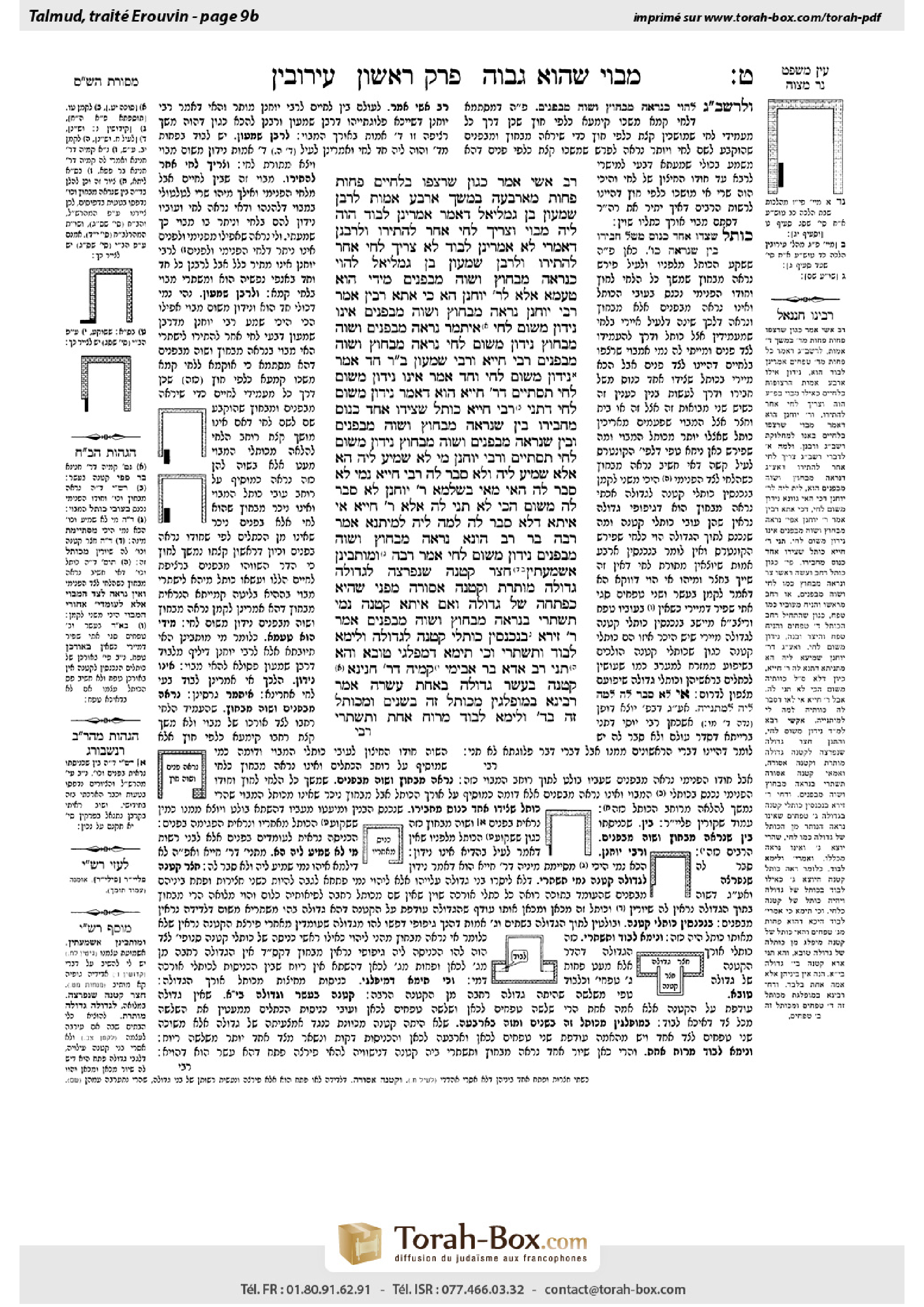
This page of Eruvin includes the Aramaic text, an English translation and an AI-generated French translation, alongside the scan above.
עירובין ט׳ ב · Aramaic and Hebrew text
רַב אָשֵׁי אָמַר: כְּגוֹן שֶׁרְצָפוֹ בִּלְחָיַיִם פָּחוֹת פָּחוֹת מֵאַרְבָּעָה בְּמֶשֶׁךְ אַרְבַּע אַמּוֹת.
לְרַבָּן שִׁמְעוֹן בֶּן גַּמְלִיאֵל דְּאָמַר: אָמְרִינַן לָבוּד — הָוֵה לֵיהּ מָבוֹי, וְצָרִיךְ לֶחִי אַחֵר לְהַתִּירוֹ. וּלְרַבָּנַן דְּאָמְרִי: לָא אָמְרִינַן לָבוּד — לֹא צָרִיךְ לֶחִי אַחֵר לְהַתִּירוֹ.
וּלְרִבֵּן שִׁמְעוֹן בֶּן גַּמְלִיאֵל, לֶהֱוֵי כְּנִרְאֶה מִבַּחוּץ וְשָׁוֶה מִבִּפְנִים!
מִידֵּי הוּא טַעְמָא אֶלָּא לְרַבִּי יוֹחָנָן, הָא כִּי אֲתָא רָבִין אָמַר רַבִּי יוֹחָנָן: נִרְאֶה מִבַּחוּץ וְשָׁוֶה מִבִּפְנִים אֵינוֹ נִידּוֹן מִשּׁוּם לֶחִי.
אִיתְּמַר: נִרְאֶה מִבִּפְנִים וְשָׁוֶה מִבַּחוּץ — נִידּוֹן מִשּׁוּם לֶחִי. נִרְאֶה מִבַּחוּץ וְשָׁוֶה מִבִּפְנִים, רַבִּי חִיָּיא וְרַבִּי שִׁמְעוֹן בְּרַבִּי, חַד אָמַר: נִידּוֹן מִשּׁוּם לֶחִי, וְחַד אָמַר: אֵינוֹ נִידּוֹן מִשּׁוּם לֶחִי.
תִּסְתַּיֵּים דְּרַבִּי חִיָּיא הוּא דְּאָמַר ״נִידּוֹן מִשּׁוּם לֶחִי״, דְּתָנֵי רַבִּי חִיָּיא: כּוֹתֶל שֶׁצִּידּוֹ אֶחָד כָּנוּס מֵחֲבֵירוֹ, בֵּין שֶׁנִּרְאֶה מִבַּחוּץ וְשָׁוֶה מִבִּפְנִים, וּבֵין שֶׁנִּרְאֶה מִבִּפְנִים וְשָׁוֶה מִבַּחוּץ נִידּוֹן מִשּׁוּם לֶחִי, תִּסְתַּיֵּים.
וְרַבִּי יוֹחָנָן מִי לָא שְׁמִיעַ לֵיהּ הָא?! אֶלָּא שְׁמִיעַ לֵיהּ וְלָא סָבַר לַהּ, רַבִּי חִיָּיא נָמֵי לָא סָבַר לַהּ!
הַאי מַאי?! בִּשְׁלָמָא רַבִּי יוֹחָנָן לָא סָבַר לַהּ — מִשּׁוּם הָכִי לָא תָּנֵי לַהּ. אֶלָּא רַבִּי חִיָּיא, אִי אִיתָא דְּלָא סָבַר לַהּ, לְמָה לֵיהּ לְמִיתְנָא?
אָמַר רַבָּה בַּר רַב הוּנָא: נִרְאֶה מִבַּחוּץ וְשָׁוֶה מִבִּפְנִים — נִידּוֹן מִשּׁוּם לֶחִי. אָמַר רַבָּה, וּמוֹתְבִינַן אַשְּׁמַעְתִּין: חָצֵר קְטַנָּה שֶׁנִּפְרְצָה לִגְדוֹלָה — גְּדוֹלָה מוּתֶּרֶת וּקְטַנָּה אֲסוּרָה, מִפְּנֵי שֶׁהִיא כְּפִתְחָהּ שֶׁל גְּדוֹלָה. וְאִם אִיתָא, קְטַנָּה נָמֵי תִּשְׁתְּרֵי בְּנִרְאֶה מִבַּחוּץ וְשָׁוֶה מִבִּפְנִים.
אָמַר רַבִּי זֵירָא: בְּנִכְנָסִין כּוֹתְלֵי קְטַנָּה לִגְדוֹלָה.
וְלֵימָא לָבוּד וְתִשְׁתְּרֵי!
וְכִי תֵּימָא דְּמַפְלְגִי טוּבָא? וְהָא תָּנֵי רַב אַדָּא בַּר אֲבִימִי קַמֵּיהּ דְּרַבִּי חֲנִינָא: קְטַנָּה, בְּעֶשֶׂר. גְּדוֹלָה, בְּאַחַת עֶשְׂרֵה!
אָמַר רָבִינָא: בְּמוּפְלָגִין מִכּוֹתֶל זֶה בִּשְׁנַיִם, וּמִכּוֹתֶל זֶה בְּאַרְבָּעָה.
וְלֵימָא לָבוּד מֵרוּחַ אַחַת, וְתִשְׁתְּרֵי.
Eruvin 9b · English translation
The Gemara provides an alternative explanation of Rabbi Yoḥanan’s statement. Rav Ashi said: According to Rabbi Yoḥanan, carrying in the area between the side posts is actually permitted. The dispute between Rabban Shimon ben Gamliel and the Rabbis concerning the principle of lavud is in a case where there was an alleyway that one lined with side posts, each positioned less than four handbreadths from the next, and the side posts extend for a length of four cubits.
According to Rabban Shimon ben Gamliel, who said that for a gap of up to four handbreadths we say that the principle of lavud applies, all the side posts are considered a single side post, and since the side post in that case is four cubits long, it is considered a separate alleyway; therefore, it requires an additional side post to permit carrying in it. And according to the Rabbis, who say that we do not say that the principle of lavud applies unless the gap is less than three handbreadths, this area does not require an additional side post to permit carrying within it.
The Gemara asks: And even according to the opinion of Rabban Shimon ben Gamliel, why is another side post required? Let it have the same legal status as a side post that is visible from the outside, protruding from the wall of the alleyway, but appears to be even with the wall from the inside. Since it is evident from the outside that it is a side post and not part of the building, carrying is permitted there.
The Gemara answers: As Rav Ashi’s reason is only according to the opinion of Rabbi Yoḥanan, when Ravin came from Eretz Yisrael to Babylonia, didn’t he say that Rabbi Yoḥanan said: If a side post is visible from the outside, protruding from the wall of the alleyway, but it appears to be even with the wall from the inside, it is not considered to have the legal status of a side post?
An amoraic dispute was stated: If a side post is visible from the inside, protruding from the wall of the alleyway, but it appears to be even with the wall from the outside, it is considered a side post. However, if a side post is visible from the outside protruding from the wall, but it appears to be even with the wall from the inside, there is a disagreement between Rabbi Ḥiyya and Rabbi Shimon, son of Rabbi Yehuda HaNasi, with regard to its status. One said: It is considered to have the legal status of a side post. And the other one said: It is not considered to have the legal status of a side post.
The Gemara clarifies: Conclude that Rabbi Ḥiyya is the one who said that it is considered to have the legal status of a side post, as Rabbi Ḥiyya taught: In the case of a wall at the entrance to an alleyway whose one side is more recessed than the other, whether the recess is visible from outside the alleyway but appears to be even from the inside, or the recess is visible from the inside but appears to be even from the outside, it is considered to have the legal status of a side post. The Gemara states: Indeed, conclude that Rabbi Ḥiyya is the one who said it has the legal status of a side post.
The Gemara rejects this conclusion: And Rabbi Yoḥanan, who explicitly said that a side post of that kind is not considered a side post, did he not hear this halakha? The Tosefta was widely known. Rather, he heard it, but he does not hold in accordance with it. Perhaps, then, Rabbi Ḥiyya also does not hold in accordance with it.
The Gemara answers: What is this comparison? Granted, Rabbi Yoḥanan does not hold in accordance with that halakha. That is why he did not teach it. But Rabbi Ḥiyya, if it is true that he does not hold in accordance with it, why would he teach it?
Rabba bar Rav Huna said: If a side post is visible from the outside, protruding from the wall of the alleyway, but appears to be even with the wall from the inside, it is considered to have the legal status of a side post. Rabba said: And we raise an objection to our own halakha from a mishna: With regard to a small courtyard that was breached along the entire length of one of its walls so that it opens into a large courtyard, in the large one it is permitted to carry and in the small one it is prohibited to carry. This is because the breach is considered an entrance of the large courtyard. The wall of the smaller courtyard was breached along its entire length, therefore there is no visible partition from inside the smaller courtyard. However, the partition is noticeable from the outside, i.e., in the large courtyard, since the breach is flanked on both sides by the remaining segments of the wall of the large courtyard. And if it is so, that a partition that is visible from the outside is considered a partition, carrying in the small courtyard should also be permitted in this case, as the wall is visible from the outside but appears to be even from the inside.
Rabbi Zeira said: This mishna is referring to a case where the walls of the small courtyard protrude into the large one, i.e., the breached wall of the small courtyard is not in line with the wall of the large one. Therefore, even when viewed from the outside there are no walls visible, and that is why carrying is prohibited there.
The Gemara asks: And let us say that the principle of lavud applies, and then carrying will be permitted even in the small courtyard. The ends of the breached wall should be considered attached to the side walls of the large courtyard, rendering the wall of the large courtyard visible. Then it will be permitted to carry in the small courtyard based on the principle governing side posts visible from the outside.
And if you say that the walls of the smaller courtyard are too separate from the walls of the larger courtyard, such that the distance between the walls is too great for the principle of lavud to apply, didn’t Rav Adda bar Avimi teach before Rabbi Ḥanina: The small courtyard of which they speak is referring even to one ten cubits wide; the large one is referring even to one eleven cubits wide? Apparently, this halakha applies even when the difference in width between the courtyards is a single cubit, which is six handbreadths. Assuming the small courtyard is located equidistant from the ends of the large courtyard, only three handbreadths separate it on each side from the wall of the large one. Therefore, the principle of lavud applies.
Ravina said: It is a case where the walls of the smaller courtyard are separated from this wall of the larger courtyard by two handbreadths and from this wall of the larger courtyard on the other side by four handbreadths. Since there is a distance of more than three handbreadths, the principle of lavud does not apply.
The Gemara asks: And let us say that the principle of lavud applies from one direction, then carrying will be permitted even in the small courtyard.
Eruvin 9b · Traduction française (IA)
La Guemara propose une autre explication de la déclaration du maître Yochanan. Rav Ashi dit : Selon Yochanan, porter dans la zone entre les poteaux latéraux est effectivement permis. Le débat entre Rabban Shimon ben Gamliel et les Rabbins concernant le principe de lavud est dans un cas où il y avait un passage qui était bordé de poteaux latéraux, chacun placé à moins de quatre tefachim de l'autre, et les poteaux latéraux s'étendent sur une longueur de quatre cubits.
Selon Rabban Shimon ben Gamliel, qui disait que pour un espace jusqu'à quatre tefachim nous disons que le principe de lavud s'applique, tous les poteaux latéraux sont considérés comme un seul poteau latéral, et puisque ce poteau est de quatre cubits de long, il est considéré comme un passage distinct ; par conséquent, il faut un poteau supplémentaire pour permettre le port. Et selon les Rabbins, qui disent que nous ne disons pas que le principe de lavud s'applique à moins que l'espace ne soit inférieur à trois tefachim, cette zone ne nécessite pas un poteau supplémentaire pour permettre le port.
La Guemara pose la question : Et même selon l'opinion de Rabban Shimon ben Gamliel, pourquoi un poteau supplémentaire est-il requis ? Que ce poteau ait le même statut juridique qu'un poteau visible de l'extérieur, sortant du mur du passage, mais qui semble être à même niveau avec le mur de l'intérieur. Puisque c'est évident de l'extérieur qu'il s'agit d'un poteau et non d'une partie du bâtiment, le port est permis là.
La Guemara répond : Comme la raison de Rav Ashi est uniquement selon l'opinion de Rabbi Yoḥanan, lorsque Ravin est venu d'Eretz Yisrael à Babylone, n'a-t-il pas dit que Rabbi Yoḥanan a dit : Si un poteau est visible de l'extérieur, sortant du mur du passage, mais semble être à même niveau avec le mur de l'intérieur, il n'est pas considéré comme ayant le statut juridique d'un poteau ?
Un débat entre les amoraim a été énoncé : Si un poteau est visible de l'intérieur, sortant du mur du passage, mais semble être à même niveau avec le mur de l'extérieur, il est considéré comme un poteau. Cependant, si un poteau est visible de l'extérieur, sortant du mur, mais semble être à même niveau avec le mur de l'intérieur, il y a un désaccord entre Rabbi Ḥiyya et Rabbi Shimon, fils de Rabbi Yehuda HaNasi, concernant son statut. L'un a dit : Il est considéré comme ayant le statut juridique d'un poteau. Et l'autre a dit : Il n'est pas considéré comme ayant le statut juridique d'un poteau.
La Guemara clarifie : Concluez que c'est Rabbi Ḥiyya qui a dit qu'il est considéré comme ayant le statut juridique d'un poteau, car Rabbi Ḥiyya a enseigné : Dans le cas d'un mur à l'entrée d'un passage dont un côté est plus reculé que l'autre, que le retrait soit visible de l'extérieur du passage mais semble être à même niveau de l'intérieur, ou que le retrait soit visible de l'intérieur mais semble être à même niveau de l'extérieur, il est considéré comme ayant le statut juridique d'un poteau. La Guemara dit : En effet, concluez que c'est Rabbi Ḥiyya qui a dit qu'il est considéré comme ayant le statut juridique d'un poteau.
La Guemara rejette cette conclusion : Et Rabbi Yochanan, qui a explicitement dit qu'un poteau de ce genre n'est pas considéré comme un poteau, n'a-t-il pas entendu cette halakha ? La Tosefta était largement connue. Plutôt, il l'a entendu, mais il ne suit pas cette opinion. Peut-être, alors, Rabbi Chiya ne suit pas non plus cette opinion.
La Guemara répond : Quel est ce parallèle ? Bien sûr, Rabbi Yochanan ne suit pas cette halakha. C'est pourquoi il ne l'a pas enseignée. Mais Rabbi Chiya, si c'est vrai qu'il ne suit pas cette halakha, pourquoi l'aurait-il enseignée ?
Rabba bar Rav Huna a dit : Si un poteau est visible de l'extérieur, sortant du mur du passage, mais semble être à même niveau avec le mur de l'intérieur, il est considéré comme ayant le statut juridique d'un poteau. Rabba a dit : Et nous soulevons une objection contre notre propre halakha à partir d'une mitsna : Concernant un petit cour de jardin qui a été percé le long de l'une de ses parois, de sorte qu'il s'ouvre dans un grand cour de jardin, il est permis de porter dans le grand cour de jardin et interdit de porter dans le petit. C'est parce que la percée est considérée comme une entrée du grand cour de jardin. La paroi du petit cour de jardin a été percée le long de toute sa longueur, donc il n'y a pas de paroi visible à l'intérieur du petit cour de jardin. Cependant, la paroi est visible de l'extérieur, c'est-à-dire dans le grand cour de jardin, puisque la percée est flanquée des deux côtés par les segments restants de la paroi du grand cour de jardin. Et si c'est ainsi, que la paroi visible de l'extérieur est considérée comme une paroi, le port dans le petit cour de jardin devrait également être permis dans ce cas, puisque la paroi est visible de l'extérieur mais semble être à même niveau de l'intérieur.
Rabbi Zeira a dit : Cette mitsva fait référence à un cas où les parois du petit cour de jardin s'insèrent dans le grand, c'est-à-dire que la paroi percée du petit cour de jardin n'est pas alignée avec la paroi du grand. Par conséquent, même lorsqu'on la regarde de l'extérieur, il n'y a pas de paroi visible, et c'est pourquoi le port est interdit là.
La Guemara pose la question : Et disons que le principe de lavud s'applique, et alors le port sera permis même dans le petit cour de jardin. Les extrémités de la paroi percée devraient être considérées comme attachées aux parois latérales du grand cour de jardin, rendant la paroi du grand cour de jardin visible. Alors, le port dans le petit cour de jardin devrait être permis en vertu du principe régissant les poteaux visibles de l'extérieur.
Et si vous dites que les murs du petit courtyard sont trop éloignés des murs du grand courtyard, de sorte que la distance entre les murs est trop grande pour que le principe de lavud s'applique, n’a-t-il pas Rav Adda bar Avimi enseigné devant Rabbi Ḥanina : Le petit courtyard dont ils parlent fait référence même à un courtyard de dix coudées de large ; le grand courtyard fait référence même à un courtyard de onze coudées de large ? Apparemment, cette halakha s'applique même lorsque la différence de largeur entre les courtyards est d'une seule coudée, soit six paumes. En supposant que le petit courtyard est situé à égale distance des extrémités du grand courtyard, il n'y a que trois paumes qui le séparent de chaque côté du mur du grand courtyard. Ainsi, le principe de lavud s'applique.
Ravina a dit : C’est un cas où les murs du petit courtyard sont séparés de ce mur du grand courtyard de deux paumes et de ce mur du grand courtyard de l’autre côté de quatre paumes. Puisque la distance est supérieure à trois paumes, le principe de lavud ne s’applique pas.
La Guemara pose la question : Et si nous disons que le principe de lavud s’applique dans une direction, alors le portage sera autorisé même dans le petit courtyard.
Traduction française générée par IA à partir de l’édition anglaise de Sefaria. Vérifie toujours un passage avec le texte source.
Text from Sefaria: William Davidson Edition - Vocalized Aramaic (CC BY NC); William Davidson Edition - English (CC BY NC).