Eruvin 11a: Talmud study for Daf Yomi
Study the Talmud for Daf Yomi with scanned pages, Hebrew text, English translations from Sefaria and AI-generated French translations.
Passage selection and English or AI-generated French translation are available where the scan has annotations. Daf Study is independent of Torah-Box and Sefaria.
Browse Eruvin · עירובין · All tractatesEruvin 11a text and translations
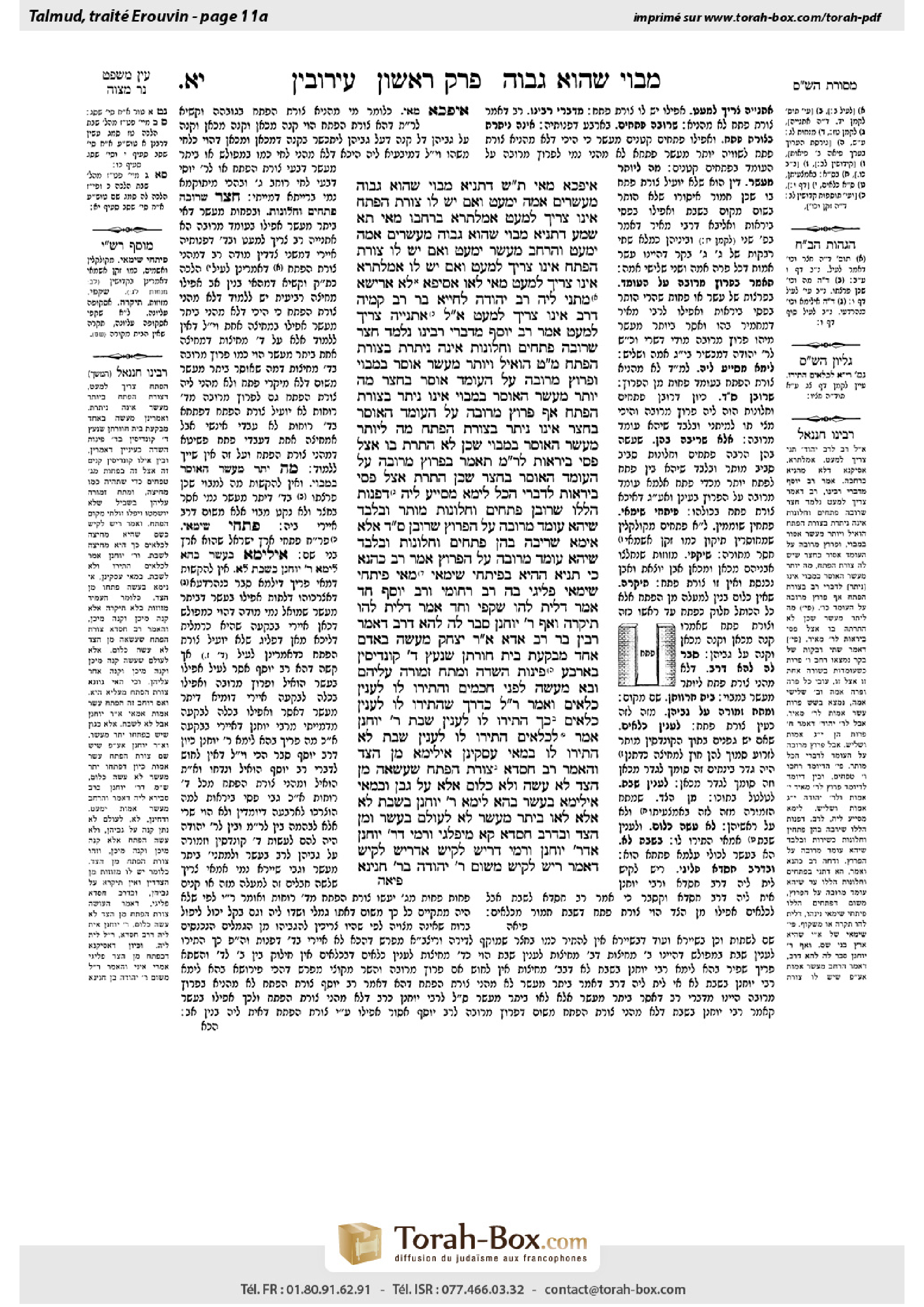
This page of Eruvin includes the Aramaic text, an English translation and an AI-generated French translation, alongside the scan above.
עירובין י״א א · Aramaic and Hebrew text
אִיפְּכָא מַאי?
תָּא שְׁמַע דְּתַנְיָא: מָבוֹי שֶׁהוּא גָּבוֹהַּ מֵעֶשְׂרִים אַמָּה יְמַעֵט, וְאִם יֵשׁ לוֹ צוּרַת הַפֶּתַח אֵינוֹ צָרִיךְ לְמַעֵט.
אֲמַלְתְּרָא בְּרׇחְבּוֹ מַאי? תָּא שְׁמַע, דְּתַנְיָא: מָבוֹי שֶׁהוּא גָּבוֹהַּ מֵעֶשְׂרִים אַמָּה יְמַעֵט, וְהָרָחָב מֵעֶשֶׂר יְמַעֵט, וְאִם יֵשׁ לוֹ צוּרַת הַפֶּתַח אֵינוֹ צָרִיךְ לְמַעֵט, וְאִם יֵשׁ לוֹ אֲמַלְתְּרָא אֵינוֹ צָרִיךְ לְמַעֵט.
מַאי לָאו אַסֵּיפָא: לָא, אַרֵישָׁא.
מַתְנֵי לֵיהּ רַב יְהוּדָה לְחִיָּיא בַּר רַב קַמֵּיהּ דְּרַב: אֵינוֹ צָרִיךְ לְמַעֵט. אֲמַר לֵיהּ: אַתְנְיֵיהּ, צָרִיךְ לְמַעֵט.
אָמַר רַב יוֹסֵף: מִדִּבְרֵי רַבֵּינוּ נִלְמַד: חָצֵר שֶׁרוּבָּהּ פְּתָחִים וְחַלּוֹנוֹת — אֵינָהּ נִיתֶּרֶת בְּצוּרַת הַפֶּתַח.
מַאי טַעְמָא — הוֹאִיל וְיוֹתֵר מֵעֶשֶׂר אוֹסֵר בְּמָבוֹי, וּפָרוּץ מְרוּבֶּה עַל הָעוֹמֵד אוֹסֵר בֶּחָצֵר. מָה יוֹתֵר מֵעֶשֶׂר הָאוֹסֵר בְּמָבוֹי — אֵינוֹ נִיתָּר בְּצוּרַת הַפֶּתַח, אַף פָּרוּץ מְרוּבֶּה עַל הָעוֹמֵד הָאוֹסֵר בֶּחָצֵר — אֵינוֹ נִיתָּר בְּצוּרַת הַפֶּתַח.
מָה לְיוֹתֵר מֵעֶשֶׂר הָאוֹסֵר בְּמָבוֹי — שֶׁכֵּן לֹא הִתַּרְתָּ בּוֹ אֵצֶל פַּסֵּי בִירָאוֹת לְרַבִּי מֵאִיר, תֹּאמַר בְּפָרוּץ מְרוּבֶּה עַל הָעוֹמֵד הָאוֹסֵר בֶּחָצֵר — שֶׁכֵּן הִתַּרְתָּ אֵצֶל פַּסֵּי בִירָאוֹת לְדִבְרֵי הַכֹּל.
לֵימָא מְסַיַּיע לֵיהּ: דְּפָנוֹת הַלָּלוּ שֶׁרוּבָּן פְּתָחִים וְחַלּוֹנוֹת מוּתָּר, וּבִלְבַד שֶׁיְּהֵא עוֹמֵד מְרוּבֶּה עַל הַפָּרוּץ.
שֶׁרוּבָּן סָלְקָא דַּעְתָּךְ? — אֶלָּא אֵימָא: שֶׁרִיבָּה בָּהֶן פְּתָחִים וְחַלּוֹנוֹת, וּבִלְבַד שֶׁיְּהֵא עוֹמֵד מְרוּבֶּה עַל הַפָּרוּץ.
אָמַר רַב כָּהֲנָא: כִּי תַּנְיָא הָהִיא — בְּפִיתְחֵי שִׁימָאֵי.
מַאי פִּיתְחֵי שִׁימָאֵי? פְּלִיגִי בַּהּ רַב רְחוּמִי וְרַב יוֹסֵף. חַד אָמַר: דְּלֵית לְהוּ שִׁקְפֵי, וְחַד אָמַר: דְּלֵית לְהוּ תִּיקְרָה.
וְאַף רַבִּי יוֹחָנָן סָבַר לַהּ לְהָא דְּרַב. דְּאָמַר רָבִין בַּר רַב אַדָּא אָמַר רַבִּי יִצְחָק: מַעֲשֶׂה בְּאָדָם אֶחָד מִבִּקְעַת בֵּית חוֹרְתָן שֶׁנָּעַץ אַרְבָּעָה קוּנְדֵּיסִין בְּאַרְבַּע פִּינּוֹת הַשָּׂדֶה, וּמָתַח זְמוֹרָה עֲלֵיהֶם. וּבָא מַעֲשֶׂה לִפְנֵי חֲכָמִים, וְהִתִּירוּ לוֹ לְעִנְיַן כִּלְאַיִם.
וְאָמַר רֵישׁ לָקִישׁ: כְּדֶרֶךְ שֶׁהִתִּירוּ לוֹ לְעִנְיַן כִּלְאַיִם כָּךְ הִתִּירוּ לוֹ לְעִנְיַן שַׁבָּת. רַבִּי יוֹחָנָן אָמַר: לְכִלְאַיִם הִתִּירוּ לוֹ, לְעִנְיַן שַׁבָּת לֹא הִתִּירוּ לוֹ.
בְּמַאי עָסְקִינַן? אִילֵימָא מִן הַצַּד, וְהָאָמַר רַב חִסְדָּא: צוּרַת הַפֶּתַח שֶׁעֲשָׂאָהּ מִן הַצַּד לֹא עָשָׂה וְלֹא כְלוּם.
אֶלָּא עַל גַּבָּן. וּבְמַאי? אִילֵימָא בְּעֶשֶׂר — בְּהָא לֵימָא רַבִּי יוֹחָנָן בְּשַׁבָּת לָא?!
אֶלָּא לָאו — בְּיָתֵר מֵעֶשֶׂר.
לָא, לְעוֹלָם בְּעֶשֶׂר וּמִן הַצַּד — וּבִדְרַב חִסְדָּא קָא מִיפַּלְגִי.
וּרְמִי דְּרַבִּי יוֹחָנָן אַדְּרַבִּי יוֹחָנָן, וּרְמִי דְּרֵישׁ לָקִישׁ אַדְּרֵישׁ לָקִישׁ, דְּאָמַר רֵישׁ לָקִישׁ מִשּׁוּם רַבִּי יְהוּדָה בְּרַבִּי חֲנִינָא:
Eruvin 11a · English translation
The Gemara asks: What is the halakha in the opposite situation? Does an opening in the form of a doorway also serve to permit carrying in an alleyway that is more than twenty cubits high?
The Gemara answers: Come and hear the answer to this question, as it was taught in a baraita: If the cross beam placed over the entrance to an alleyway is higher than twenty cubits, one must diminish its height, but if the entrance has an opening in the form of a doorway, he need not diminish it.
The Gemara asks: What is the effect of a cornice with regard to the need to diminish the alleyway’s width? Does the cornice render the alleyway fit for one to carry within it, even if the entrance is more than ten cubits wide? The Gemara answers: Come and hear an answer as it was taught in a baraita: If the cross beam placed over the entrance to an alleyway is higher than twenty cubits, one must diminish its height, and if the alleyway is wider than ten cubits, one must diminish its width. However, if the entrance to the alleyway has an opening in the form of a doorway, he need not diminish it, and, similarly, if it has a cornice, he need not diminish it.
The Gemara explains the proof it wishes to adduce from this baraita: What, is this statement with regard to the cornice not referring to the latter clause, i.e., the case of an alleyway that is wider than ten cubits, proving that a cornice can render an alleyway otherwise too wide fit for one to carry within it? The Gemara refutes this argument: No, this statement is referring to the first clause of the baraita, that a cornice is effective for an alleyway more than twenty cubits high, but it tells us nothing about one that is more than ten cubits wide.
With regard to the same issue, Rav Yehuda would teach the baraita to Ḥiyya bar Rav before Rav as follows: If the entrance to an alleyway that is wider than ten cubits has an opening in the form of a doorway, he need not diminish its width. Rav said to him: Teach him that the correct version of the baraita is: He must diminish its width.
Rav Yosef said: From the statement of our teacher, Rav, who said that the entrance to an alleyway must be diminished even if it has an opening in the form of a doorway, we will learn that with regard to a courtyard, the walls of which are mostly entrances and windows, it is not permitted to carry within it even by having an opening in the form of a doorway. Even if the entrances have an opening in the form of a doorway, this does not render a mostly breached courtyard wall into a closed wall.
What is the reason? Since an opening of more than ten cubits renders it prohibited for one to carry in an alleyway, and likewise when the breached segment of a wall that is greater than its standing segment renders it prohibited for one to carry in a courtyard, the following claim can be made: Just as, according to Rav, in the case of an opening more than ten cubits wide that renders it prohibited for one to carry in an alleyway, carrying in the alleyway is not permitted by the form of a doorway in the opening, so too a case where breached segment of a wall is greater than its standing segment that renders it prohibited for one to carry in a courtyard, carrying in the courtyard is not permitted by the form of a doorway in the opening.
The Gemara rejects this argument: What is the basis for comparison to an opening that is more than ten cubits wide that renders it prohibited for one to carry in an alleyway? It is not permitted by having an opening in the form of a doorway because you did not permit an opening of that size with regard to the case of upright boards surrounding a well, in accordance with the opinion of Rabbi Meir. Can you say the same in a case where the breached segment of a wall is greater than the standing segment that renders it prohibited for one to carry in a courtyard, that carrying in the courtyard will not be permitted by the form of a doorway? That situation is clearly not as severe a problem, as you permitted carrying with regard to upright boards surrounding a well according to everyone. Consequently, no comparison can be made between the case of an opening wider than ten cubits in an alleyway and a partition in which the breached segment is greater than the standing segment in a courtyard.
The Gemara suggests: Let us say that the following baraita supports this opinion that the form of a doorway is ineffective in a case where the breached segments of a wall are greater than its standing segments: With regard to the area enclosed by these walls that most of them consist of entrances and windows, it is permitted to carry on Shabbat therein, provided that the standing segments are greater than the breached segments.
The Gemara first analyzes the wording of the baraita: The Gemara analyzes the formulation of the baraita: Can it enter your mind that the baraita is referring to a case where most of the walls are entrances and windows? If so, the standing segments are not greater than the breached segments. Rather, emend the baraita: Carrying in the area enclosed by these walls to which he added many entrances and windows is permitted, provided that the standing segments are greater than the breached segments. Apparently, if the breached segments are greater than the standing segments, carrying is not permitted even if the breaches are in the form of doorways.
Rav Kahana said that his is not an absolute proof: When this baraita was taught, it was taught with regard to broken entrances [pitḥei shima’ei] that lack the proper form of doorways.
The Gemara asks: What are broken entrances? Rav Reḥumei and Rav Yosef disagreed on the matter. One said that they do not have proper doorposts, and the other one said that they do not have lintels above the openings.
The Gemara comments: And even Rabbi Yoḥanan holds that opinion of Rav, that an opening in the form of a doorway does not permit carrying if the opening is more than ten cubits wide. As Ravin bar Rav Adda said that Rabbi Yitzḥak said: There was an incident involving a person from the valley of Beit Ḥortan who stuck four poles [kunddeisin] into the ground in the four corners of his field, and stretched a vine over them, creating the form of a doorway on each side. He intended to seal the area so that he would be permitted to plant a vineyard in close proximity without creating a forbidden mixture of diverse kinds in a vineyard. And the case came before the Sages, and they permitted him to consider it sealed with regard to diverse kinds.
And Reish Lakish said: Just as they permitted him to consider it sealed with regard to diverse kinds, so too they permitted him to consider it sealed with regard to Shabbat, i.e., they permitted carrying within this area. Rabbi Yoḥanan said: With regard to diverse kinds, they permitted him to consider it sealed, however, with regard to Shabbat, they did not permit him to do so.
The Gemara clarifies: With what case are we dealing here? If you say that he draped the vines on the posts from the side, rather than on top of them, didn’t Rav Ḥisda say with regard to Shabbat: If one constructed an opening in the form of a doorway from the side, he has done nothing?
Rather, it must be that he set the vines on top of the posts. And in what circumstances did Rabbi Yoḥanan and Reish Lakish disagree? If you say that the posts were set at a distance of ten cubits from each other, would Rabbi Yoḥanan say in that case that with regard to Shabbat, they did not permit him to consider the area sealed? Everyone agrees that the form of a doorway is effective for an entrance that is only ten cubits wide.
Rather, isn’t it referring to a case where the posts were more than ten cubits apart? Apparently, Rabbi Yoḥanan agrees with Rav, that an opening in the form of a doorway does not permit carrying if the original opening is wider than ten cubits.
The Gemara refutes this proof: No, actually it is referring to a case where the posts were ten cubits apart, and the person attached the vines to the posts from the side. And Reish Lakish and Rabbi Yoḥanan disagree with regard to the opinion of Rav Ḥisda. Reish Lakish maintains that the form of a doorway is effective even when the horizontal cross beam is attached to the vertical posts from the side, and Rabbi Yoḥanan agrees with Rav Ḥisda that a form of a doorway is ineffective for the purpose of carrying on Shabbat when constructed in such a manner.
The Gemara comments: But it is possible to raise a contradiction between this statement of Rabbi Yoḥanan and another statement of Rabbi Yoḥanan; and it is possible to raise a contradiction between this statement of Reish Lakish and another statement of Reish Lakish. As Reish Lakish said in the name of Rabbi Yehuda, son of Rabbi Ḥanina:
Eruvin 11a · Traduction française (IA)
Le Guemara pose la question : Quel est le halakha dans le cas contraire ? Une ouverture ayant la forme d'une porte permet-elle de permettre le portage dans un passage dont la hauteur est supérieure à vingt coudées ?
Le Guemara répond : Viens écouter la réponse à cette question, comme il a été enseigné dans une baraïta : Si la traverse placée sur l'entrée d'un passage est plus haute que vingt coudées, il faut la diminuer en hauteur, mais si l'entrée a une ouverture ayant la forme d'une porte, il n'est pas nécessaire de la diminuer.
Le Guemara pose la question : Quel est l'effet d'un cornichon en ce qui concerne la nécessité de diminuer la largeur du passage ? Le cornichon rend-il le passage digne de portage, même si l'entrée est plus large que dix coudées ? Le Guemara répond : Viens écouter une réponse, comme il a été enseigné dans une baraïta : Si la traverse placée sur l'entrée d'un passage est plus haute que vingt coudées, il faut la diminuer en hauteur, et si le passage est plus large que dix coudées, il faut le diminuer en largeur. Cependant, si l'entrée du passage a une ouverture ayant la forme d'une porte, il n'est pas nécessaire de la diminuer, de même que si elle a un cornichon.
Le Guemara explique la preuve qu'il souhaite établir à partir de cette baraïta : Qu'est-ce que cette déclaration ne concerne pas le cornichon, ne fait-elle pas référence à la clause ultérieure, c'est-à-dire au cas d'un passage plus large que dix coudées, prouvant que le cornichon peut rendre un passage autrement trop large digne de portage ? Le Guemara réfute cet argument : Non, cette déclaration fait référence à la première clause de la baraïta, à savoir que le cornichon est efficace pour un passage plus haut que vingt coudées, mais elle nous apprend rien sur un passage plus large que dix coudées.
En ce qui concerne la même question, Rav Yehuda enseignait à Ḥiyya bar Rav avant Rav ainsi la baraïta : Si l'entrée d'un passage plus large que dix coudées a une ouverture ayant la forme d'une porte, il n'est pas nécessaire de la diminuer. Rav dit à lui : Enseigne-lui que la version correcte de la baraïta est : Il faut diminuer sa largeur.
Rav Yosef dit : D'après la déclaration de notre maître, Rav, qui a dit que l'entrée d'un passage doit être diminuée même si elle a une ouverture ayant la forme d'une porte, nous apprendrons que concernant un courtil dont les murs sont principalement des entrées et des fenêtres, il n'est pas permis de porter dedans même s'il a une ouverture ayant la forme d'une porte. Même si les entrées ont une ouverture ayant la forme d'une porte, cela ne rend pas un mur de courtil principalement percé en un mur fermé.
Quelle est la raison ? Puisque une ouverture supérieure à dix coudées rend interdit de porter dans un passage, de même que lorsque le segment percé d'un mur est supérieur à son segment vertical, cela rend interdit de porter dans un courtil, la suivante affirmation peut être faite : Tout comme, selon Rav, dans le cas d'une ouverture supérieure à dix coudées qui rend interdit de porter dans un passage, le portage dans le passage n'est pas permis par la forme d'une porte dans l'ouverture, de même, dans le cas où le segment percé d'un mur est supérieur à son segment vertical, le portage dans le courtil n'est pas permis par la forme d'une porte dans l'ouverture.
Le Guemara rejette cet argument : Quelle est la base de comparaison avec une ouverture supérieure à dix coudées qui rend interdit de porter dans un passage ? Elle n'est pas permise par la forme d'une porte dans l'ouverture, car vous n'avez pas permis une ouverture de cette taille concernant le cas de planches verticales entourant un puits, selon l'opinion de Rabbi Meir. Peux-tu dire la même chose dans le cas où le segment percé d'un mur est supérieur à son segment vertical, qui rend interdit de porter dans un courtil, que le portage dans le courtil ne sera pas permis par la forme d'une porte dans l'ouverture ? Cette situation n'est clairement pas aussi grave, car vous avez permis le portage concernant les planches verticales entourant un puits selon tout le monde. Ainsi, il n'y a pas de comparaison possible entre le cas d'une ouverture plus large que dix coudées dans un passage et un mur dont le segment percé est supérieur à son segment vertical dans un courtil.
Le Guemara suggère : Disons que la baraïta suivante soutient cette opinion selon laquelle la forme d'une porte est inefficace dans le cas où les segments percés d'un mur sont supérieurs à ses segments verticaux : Concernant la zone enclose par ces murs dont la plupart sont des entrées et des fenêtres, il est permis de transporter des objets le sabbat, à condition que les segments verticaux soient supérieurs aux segments percés.
Le Guemara analyse d'abord la formulation de la baraïta : Peut-on penser que la baraïta fait référence à un cas où la plupart des murs sont des entrées et des fenêtres ? Si c'est le cas, les segments verticaux ne sont pas supérieurs aux segments percés. Plutôt, corrige la baraïta : Le transport dans la zone enclose par ces murs à laquelle on a ajouté beaucoup d'entrées et de fenêtres est permis, à condition que les segments verticaux soient supérieurs aux segments percés. Apparemment, si les segments percés sont supérieurs aux segments verticaux, le transport n'est pas permis même si les percements sont en forme de porte.
Rav Kahana dit que ce n'est pas une preuve absolue : Lorsque cette baraïta a été enseignée, elle a été enseignée concernant des entrées brisées [pitḥei shima’ei] qui manquent de la forme correcte de porte.
Le Guemara pose la question : Quelles sont les entrées brisées ? Rav Reḥumei et Rav Yosef étaient d'avis divergents sur la question. L'un disait qu'elles n'avaient pas de poteaux de porte appropriés, et l'autre disait qu'elles n'avaient pas de linteaux au-dessus des ouvertures.
Le Guemara commente : Et même Rabbi Yoḥanan partage l'opinion de Rav, selon laquelle une ouverture en forme de porte ne permet pas le transport si l'ouverture est plus large de dix coudées. Ravin bar Rav Adda a dit que Rabbi Yitzḥak a dit : Il y avait un homme du vallon de Beit Ḥortan qui a planté quatre poteaux [kunddeisin] dans le sol aux quatre coins de son champ, et a tendu une vigne au-dessus d'eux, créant ainsi une forme de porte sur chaque côté. Il avait l'intention de sceller la zone afin de pouvoir planter un vignoble à proximité sans créer un mélange interdit de diverses espèces dans un vignoble. Et le cas est venu devant les Sages, et ils ont permis de considérer cette zone comme scellée en ce qui concerne les espèces diverses.
Et Reish Lakish a dit : Tout comme ils ont permis de considérer cette zone comme scellée en ce qui concerne les espèces diverses, ainsi aussi ils ont permis de considérer cette zone comme scellée en ce qui concerne le Shabbat, c'est-à-dire qu'ils ont permis le transport à l'intérieur de cette zone. Rabbi Yoḥanan a dit : En ce qui concerne les espèces diverses, ils ont permis de considérer cette zone comme scellée, toutefois, en ce qui concerne le Shabbat, ils n'ont pas permis de le faire.
Le Guemara clarifie : De quel cas s'agit-il ici ? Si vous dites qu'il a tendu les vignes sur les poteaux du côté plutôt que sur leur sommet, n'a-t-il pas dit Rav Ḥisda concernant le Shabbat : Si l'on construit une ouverture en forme de porte du côté, on n'a rien fait ?
Plutôt, il doit être que les vignes étaient posées sur le sommet des poteaux. Et dans quel cas Rabbi Yoḥanan et Reish Lakish s'opposaient-ils ? Si vous dites que les poteaux étaient distants de dix coudées l'un de l'autre, Rabbi Yoḥanan dirait-il dans ce cas que, concernant le Shabbat, ils n'ont pas permis de considérer la zone comme scellée ? Tout le monde convient que la forme d'une porte est efficace pour une entrée dont la largeur est de dix coudées seulement.
Plutôt, n'est-ce pas un cas où les poteaux étaient plus éloignés de dix coudées ? Apparemment, Rabbi Yoḥanan est d'accord avec Rav, selon lequel une ouverture en forme de porte ne permet pas le transport si l'ouverture originale est plus large de dix coudées.
Le Guemara réfute cette preuve : Non, en réalité, il s'agit d'un cas où les poteaux étaient distants de dix coudées, et la personne avait attaché les vignes aux poteaux du côté. Et Reish Lakish et Rabbi Yoḥanan s'opposent concernant l'opinion de Rav Ḥisda. Reish Lakish maintient que la forme d'une porte est efficace même lorsque la traverse horizontale est attachée aux poteaux verticaux du côté, et Rabbi Yoḥanan est d'accord avec Rav Ḥisda selon lequel une forme de porte n'est pas efficace pour le transport le Shabbat lorsqu'elle est construite ainsi.
Le Guemara observe : Mais il est possible de soulever une contradiction entre cette déclaration de Rabbi Yoḥanan et une autre déclaration de Rabbi Yoḥanan ; et il est possible de soulever une contradiction entre cette déclaration de Reish Lakish et une autre déclaration de Reish Lakish. Comme Reish Lakish a dit en nom de Rabbi Yehuda, fils de Rabbi Ḥanina :
Traduction française générée par IA à partir de l’édition anglaise de Sefaria. Vérifie toujours un passage avec le texte source.
Text from Sefaria: William Davidson Edition - Vocalized Aramaic (CC BY NC); William Davidson Edition - English (CC BY NC).