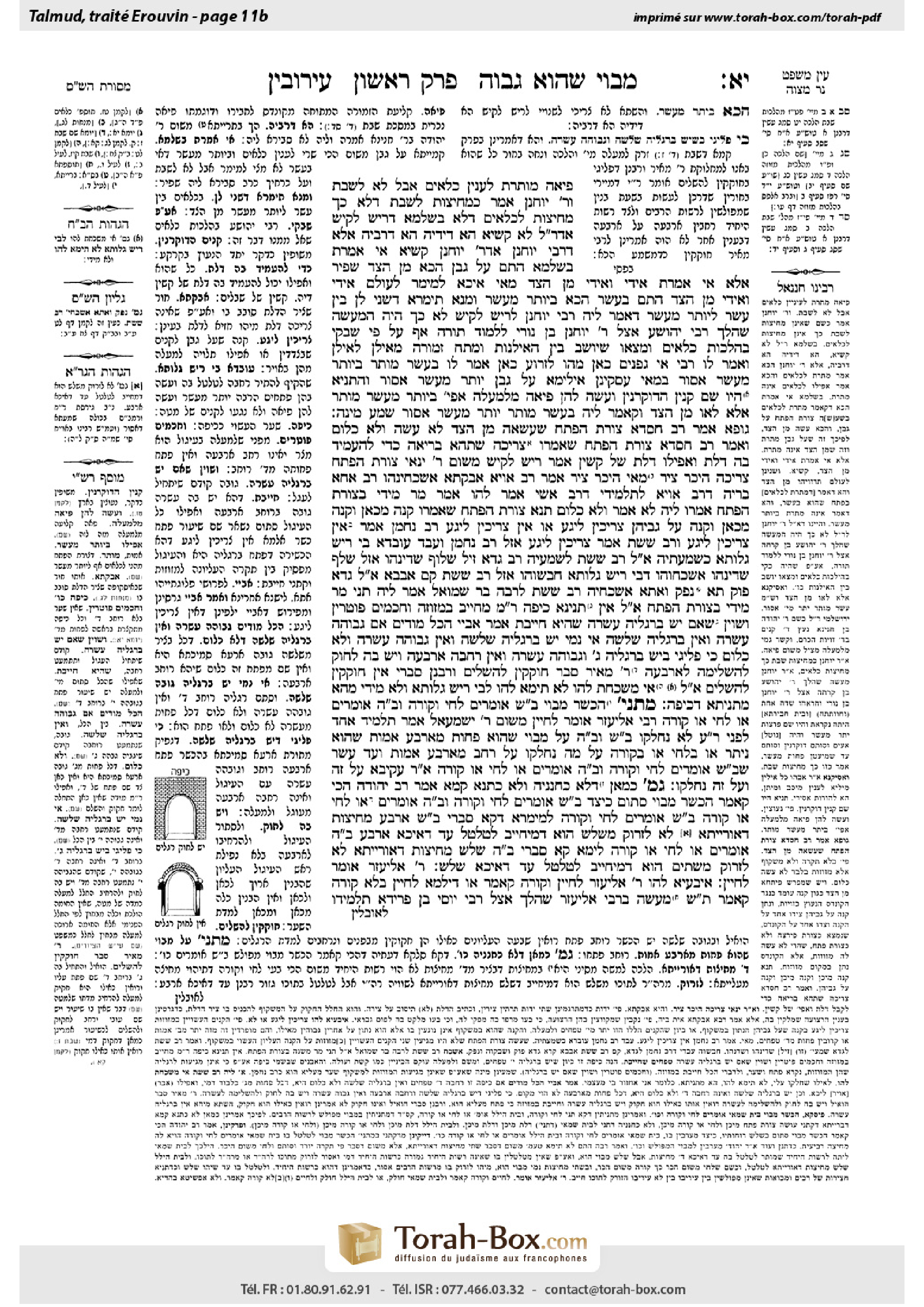
Eruvin 11b: Talmud study for Daf Yomi
Study the Talmud for Daf Yomi with scanned pages, Hebrew text, English translations from Sefaria and AI-generated French translations.
Passage selection and English or AI-generated French translation are available where the scan has annotations. Daf Study is independent of Torah-Box and Sefaria.
Browse Eruvin · עירובין · All tractatesEruvin 11b text and translations
This page of Eruvin includes the Aramaic text, an English translation and an AI-generated French translation, alongside the scan above.
עירובין י״א ב · Aramaic and Hebrew text
פֵּיאָה מוּתֶּרֶת לְעִנְיַן כִּלְאַיִם, אֲבָל לֹא לְשַׁבָּת. וְרַבִּי יוֹחָנָן אָמַר: כִּמְחִיצּוֹת לְשַׁבָּת דְּלָא, כָּךְ מְחִיצּוֹת לְכִלְאַיִם דְּלֹא.
בִּשְׁלָמָא דְּרֵישׁ לָקִישׁ אַדְּרֵישׁ לָקִישׁ לָא קַשְׁיָא: הָא — דִידֵיהּ, הָא — דְרַבֵּיהּ. אֶלָּא דְּרַבִּי יוֹחָנָן אַדְּרַבִּי יוֹחָנָן קַשְׁיָא!
אִי אָמְרַתְּ בִּשְׁלָמָא: הָתָם — עַל גַּבָּן, הָכָא — מִן הַצַּד, שַׁפִּיר. אֶלָּא אִי אָמְרַתְּ: אִידֵּי וְאִידֵּי מִן הַצַּד, מַאי אִיכָּא לְמֵימַר?
לְעוֹלָם, אִידֵּי וְאִידֵּי מִן הַצַּד: הָתָם — בְּעֶשֶׂר, הָכָא — בְּיוֹתֵר מֵעֶשֶׂר.
וּמְנָא תֵּימְרָא דְּשָׁנֵי לַן בֵּין עֶשֶׂר לְיוֹתֵר מֵעֶשֶׂר — דַּאֲמַר לֵיהּ רַבִּי יוֹחָנָן לְרֵישׁ לָקִישׁ: לֹא כָּךְ הָיָה הַמַּעֲשֶׂה, שֶׁהָלַךְ רַבִּי יְהוֹשֻׁעַ אֵצֶל רַבִּי יוֹחָנָן בֶּן נוּרִי לִלְמוֹד תּוֹרָה, אַף עַל פִּי שֶׁבָּקִי בְּהִלְכוֹת כִּלְאַיִם, וּמְצָאוֹ שֶׁיּוֹשֵׁב בֵּין הָאִילָנוֹת וּמָתַח זְמוֹרָה מֵאִילָן לְאִילָן. וְאָמַר לוֹ: רַבִּי, אִי גְּפָנִים כָּאן מַהוּ לִזְרוֹעַ כָּאן? אָמַר לוֹ: בְּעֶשֶׂר מוּתָּר, בְּיוֹתֵר מֵעֶשֶׂר אָסוּר.
בְּמַאי עָסְקִינַן? אִילֵימָא עַל גַּבָּן יוֹתֵר מֵעֶשֶׂר אָסוּר — וְהָתַנְיָא: הָיוּ שָׁם קָנִין הַדּוֹקְרָנִין וְעָשָׂה לָהֶן פֵּיאָה מִלְמַעְלָה, אֲפִילּוּ בְּיוֹתֵר מֵעֶשֶׂר מוּתָּר!
אֶלָּא לָאו מִן הַצַּד, וְקָאֲמַר לֵיהּ בְּעֶשֶׂר מוּתָּר, יוֹתֵר מֵעֶשֶׂר אָסוּר. שְׁמַע מִינַּהּ.
גּוּפָא, אָמַר רַב חִסְדָּא: צוּרַת הַפֶּתַח שֶׁעֲשָׂאָהּ מִן הַצַּד — לֹא עָשָׂה וְלֹא כְלוּם.
וְאָמַר רַב חִסְדָּא: צוּרַת הַפֶּתַח שֶׁאָמְרוּ, צְרִיכָה שֶׁתְּהֵא בְּרִיאָה כְּדֵי לְהַעֲמִיד בָּהּ דֶּלֶת, וַאֲפִילּוּ דֶּלֶת שֶׁל קַשִּׁין.
אָמַר רֵישׁ לָקִישׁ מִשּׁוּם רַבִּי יַנַּאי: צוּרַת הַפֶּתַח צְרִיכָה הֶיכֵּר צִיר. מַאי הֶיכֵּר צִיר? אָמַר רַב אַוְיָא: אַבְקָתָא.
אַשְׁכְּחִינְהוּ רַב אַחָא בְּרֵיהּ דְּרַב אַוְיָא לְתַלְמִידֵי דְּרַב אָשֵׁי, אֲמַר לְהוּ: אֲמַר מָר מִידֵּי בְּצוּרַת הַפֶּתַח? אֲמַרוּ לֵיהּ: לֹא אָמַר וְלֹא כְּלוּם.
תָּנָא: צוּרַת הַפֶּתַח שֶׁאָמְרוּ, קָנֶה מִכָּאן וְקָנֶה מִכָּאן וְקָנֶה עַל גַּבֵּיהֶן. צְרִיכִין לִיגַּע, אוֹ אֵין צְרִיכִין לִיגַּע? רַב נַחְמָן אָמַר: אֵין צְרִיכִין לִיגַּע. וְרַב שֵׁשֶׁת אָמַר: צְרִיכִין לִיגַּע.
אֲזַל רַב נַחְמָן וַעֲבַד עוֹבָדָא בֵּי רֵישׁ גָּלוּתָא כִּשְׁמַעְתֵּיהּ. אֲמַר לֵיהּ רַב שֵׁשֶׁת לְשַׁמָּעֵיהּ רַב גַּדָּא: זִיל, שְׁלוֹף שְׁדִינְהוּ. אֲזַל, שְׁלַף, שְׁדִינְהוּ. אַשְׁכְּחוּהוּ דְּבֵי רֵישׁ גָּלוּתָא, חַבְשׁוּהוּ. אֲזַל רַב שֵׁשֶׁת, קָם אַבָּבָא, אֲמַר לֵיהּ: גַּדָּא, פּוֹק תָּא! נְפַק וַאֲתָא.
אַשְׁכְּחֵיהּ רַב שֵׁשֶׁת לְרַבָּה בַּר שְׁמוּאֵל, אֲמַר לֵיהּ: תָּנֵי מָר מִידֵּי בְּצוּרַת הַפֶּתַח? אֲמַר לֵיהּ: אִין, תְּנֵינָא: כִּיפָּה, רַבִּי מֵאִיר מְחַיֵּיב בִּמְזוּזָה, וַחֲכָמִים פּוֹטְרִין. וְשָׁוִין שֶׁאִם יֵשׁ בְּרַגְלֶיהָ עֲשָׂרָה שֶׁהִיא חַיֶּיבֶת.
אָמַר אַבָּיֵי: הַכֹּל מוֹדִים אִם גְּבוֹהָה עֲשָׂרָה וְאֵין בְּרַגְלֶיהָ שְׁלֹשָׁה, אִי נָמֵי: יֵשׁ בְּרַגְלֶיהָ שְׁלֹשָׁה, וְאֵין גְּבוֹהָה עֲשָׂרָה — וְלֹא כְּלוּם.
כִּי פְּלִיגִי בְּיֵשׁ בְּרַגְלֶיהָ שְׁלֹשָׁה וּגְבוֹהָה עֲשָׂרָה, וְאֵין רְחָבָה אַרְבָּעָה, וְיֵשׁ בָּהּ לָחוֹק לְהַשְׁלִימָהּ לְאַרְבָּעָה.
רַבִּי מֵאִיר סָבַר: חוֹקְקִין לְהַשְׁלִים, וְרַבָּנַן סָבְרִי: אֵין חוֹקְקִין לְהַשְׁלִים.
אֲמַר לֵיהּ: אִי מַשְׁכַּחַתְּ לְהוּ — לָא תֵּימָא לְהוּ לְבֵי רֵישׁ גָּלוּתָא וְלָא מִידֵּי מֵהָא מַתְנִיתָא דְכִיפָּה.
מַתְנִי׳ הֶכְשֵׁר מָבוֹי, בֵּית שַׁמַּאי אוֹמְרִים: לֶחִי וְקוֹרָה, וּבֵית הִלֵּל אוֹמְרִים: אוֹ לֶחִי אוֹ קוֹרָה. רַבִּי אֱלִיעֶזֶר אוֹמֵר: לְחָיַיִן.
מִשּׁוּם רַבִּי יִשְׁמָעֵאל אָמַר תַּלְמִיד אֶחָד לִפְנֵי רַבִּי עֲקִיבָא: לֹא נֶחְלְקוּ בֵּית שַׁמַּאי וּבֵית הִלֵּל עַל מָבוֹי שֶׁהוּא פָּחוֹת מֵאַרְבַּע אַמּוֹת, שֶׁהוּא נִיתָּר אוֹ בְּלֶחִי אוֹ בְּקוֹרָה. עַל מָה נֶחְלְקוּ — עַל רָחָב מֵאַרְבַּע אַמּוֹת וְעַד עֶשֶׂר, שֶׁבֵּית שַׁמַּאי אוֹמְרִים: לֶחִי וְקוֹרָה, וּבֵית הִלֵּל אוֹמְרִים: אוֹ לֶחִי אוֹ קוֹרָה. אָמַר רַבִּי עֲקִיבָא: עַל זֶה וְעַל זֶה נֶחְלְקוּ.
גְּמָ׳ כְּמַאן? דְּלָא כַּחֲנַנְיָה וְלָא כְּתַנָּא קַמָּא.
אָמַר רַב יְהוּדָה, הָכִי קָאָמַר: הֶכְשֵׁר מָבוֹי סָתוּם כֵּיצַד? בֵּית שַׁמַּאי אוֹמְרִים: לֶחִי וְקוֹרָה, וּבֵית הִלֵּל אוֹמְרִים: אוֹ לֶחִי אוֹ קוֹרָה.
בֵּית שַׁמַּאי אוֹמְרִים: לֶחִי וְקוֹרָה, לְמֵימְרָא דְּקָא סָבְרִי בֵּית שַׁמַּאי: אַרְבַּע מְחִיצּוֹת דְּאוֹרָיְיתָא.
לָא, לִזְרוֹק — מִשָּׁלֹשׁ הוּא דְּמִיחַיַּיב, לְטַלְטֵל — עַד דְּאִיכָּא אַרְבַּע.
בֵּית הִלֵּל אוֹמְרִים אוֹ לֶחִי אוֹ קוֹרָה. לֵימָא קָא סָבְרִי בֵּית הִלֵּל שָׁלֹשׁ מְחִיצּוֹת דְּאוֹרָיְיתָא?
לָא, לִזְרוֹק — מִשְּׁתַּיִם הוּא דְּמִיחַיַּיב, לְטַלְטֵל — עַד דְּאִיכָּא שָׁלֹשׁ.
רַבִּי אֱלִיעֶזֶר אוֹמֵר לְחָיַיִן. אִיבַּעְיָא לְהוּ: רַבִּי אֱלִיעֶזֶר לְחָיַיִן וְקוֹרָה קָאָמַר, אוֹ דִילְמָא לְחָיַיִן בְּלֹא קוֹרָה קָאָמַר?
תָּא שְׁמַע: מַעֲשֶׂה בְּרַבִּי אֱלִיעֶזֶר שֶׁהָלַךְ אֵצֶל רַבִּי יוֹסֵי בֶּן פְּרִידָא תַּלְמִידוֹ
Eruvin 11b · English translation
A braid of vines plaited around poles to form a partition is permitted with regard to diverse kinds, i.e., it is considered a partition that renders planting grapevines in close proximity to other crops permitted, but not with regard to Shabbat. And Rabbi Yoḥanan said: Just as such a braid is not considered a partition with regard to Shabbat, so too it is not considered a partition with regard to diverse kinds. Their opinions in the dispute here apparently contradict their opinions in the dispute cited above.
Granted, the apparent contradiction between one statement of Reish Lakish and the other statement of Reish Lakish poses no difficulty, as this statement, according to which such a braid of vines is an effective partition even with regard to Shabbat, reflects his own opinion; that statement, according to which it is an effective partition only with regard to diverse kinds, reflects the opinion of his teacher, Rabbi Yehuda, son of Rabbi Ḥanina. However, the apparent contradiction between one statement of Rabbi Yoḥanan and the other statement of Rabbi Yoḥanan, poses a difficulty.
Granted, if you say that there, where Rabbi Yoḥanan ruled that a braid of vines is an effective partition with regard to diverse kinds, it is referring to a case where the vines were placed on top of the posts, while here, where he rules that it is ineffective even with regard to diverse kinds, it is referring to a case where they were attached to the posts from the side, it works out well. However, if you say that both this and that are cases where the vines were attached from the side, what is there to say?
The Gemara answers: Actually, both this and that are cases where the vines were attached to the side posts from the side. There, where Rabbi Yoḥanan ruled that the braid is an effective partition with regard to diverse kinds, it is referring to a case where the poles were only ten cubits apart; here, where he rules that it is ineffective even with regard to diverse kinds, it is referring to a case where the poles were more than ten cubits apart.
And from where do you say that we distinguish between an opening of ten cubits and an opening of more than ten cubits? As Rabbi Yoḥanan said to Reish Lakish: That is not the way that the incident transpired. As Rabbi Yehoshua went to Rabbi Yoḥanan ben Nuri to study Torah, even though Rabbi Yehoshua himself was an expert in the halakhot of diverse kinds and found him sitting among the trees, and Rabbi Yehoshua stretched a vine from one tree to another and said to him: Rabbi, if there are grapevines here, in the enclosed area, what is the halakha with regard to sowing diverse kinds of seeds here, on the other side of the partition? Rabbi Yoḥanan ben Nuri said to him: In a case where the trees are only ten cubits apart, it is permitted; however, where they are more than ten cubits apart, it is prohibited.
The Gemara clarifies the case: With what are we dealing here? If you say that the vines were placed on top of the trees, when they are more than ten cubits apart is it prohibited? But wasn’t it taught in a baraita with regard to diverse kinds: If there were forked reeds there and he plaited a braid of vines above them, then even if the reeds were set more than ten cubits apart, it is permitted? With regard to diverse kinds, the form of a doorway when properly constructed is certainly effective.
Rather, is it not referring to a case where he attached the vines to the trees from the side, and he is saying to him: In a case where the trees are only ten cubits apart, it is permitted; however, in a case where the trees are more than ten cubits apart, it is prohibited? The Gemara concludes: Indeed, learn from it that there is a distinction between poles that are ten cubits apart and poles that are more than ten cubits apart, and that this distinction resolves the contradiction between the two statements of Rabbi Yoḥanan.
The Gemara now examines the matter itself with regard to Rav Ḥisda’s statement cited above. Rav Ḥisda said: If one prepared an opening in the form of a doorway from the side, placing the horizontal cross beam to the sides, rather than on top, of the vertical posts, he has not done anything.
And Rav Ḥisda also said: The opening in the form of a doorway of which the Sages spoke must be strong enough to mount a door in it, and even if it is merely a flimsy door of straw.
Reish Lakish said in the name of Rabbi Yannai: The opening in the form of a doorway requires a mark in the doorpost for hinges. The Gemara asks: What is a mark for hinges? Rav Avya said: Loops [avkata] into which the hinge is inserted, so that it will be possible to mount a door in the doorway.
The Gemara relates that Rav Aḥa, the son of Rav Avya, once found the students of Rav Ashi and said to them: Did the Master, Rav Ashi, say anything with regard to an opening in the form of a doorway? They said to him: He said nothing, implying that an indication for hinges is unnecessary.
A Sage taught a baraita: The form of a doorway of which they spoke consists of a reed from here, on one side, and a reed from there, on the opposite side, and a reed on top of them. The Gemara asks: Need the lower reeds reach high enough to touch the upper reed, or do they not need to touch it? Rav Naḥman said: They do not need to touch it; and Rav Sheshet said: They need to touch it.
The Gemara relates that Rav Naḥman went ahead and performed an action in the house of the Exilarch in accordance with his own opinion. He constructed an opening in the form of a doorway such that the upper reed was not in contact with the lower reeds. Rav Sheshet said to his attendant, Rav Gadda: Go, remove those reeds and throw them away. The attendant went, removed the reeds, and threw them away. Members of the Exilarch’s court found him and imprisoned him for destroying the form of a doorway that permitted them to carry. Rav Sheshet went and stood at the door of the prison, and called out to him: Gadda, go out and come to me. The Exilarch’s men released him, and he went out and came to Rav Sheshet.
The Gemara relates that Rav Sheshet once found Rabba bar Shmuel and said to him: Did the Master teach anything with regard to the halakhot of the form of a doorway? He said to him: Yes, we learned in a baraita: With regard to an arched gateway, Rabbi Meir deems the owner obligated to affix a mezuza, and the Rabbis deem him exempt. However, they both agree that if its supports, the vertical sides of the gate before it arches, are ten handbreadths high, that the gate requires a mezuza.
In order to explain the dispute, Abaye said: Everyone agrees that if the entire arch is ten handbreadths high, but its supports are less than three handbreadths high, or, alternatively, if its supports are three handbreadths high but the entire arch is less than ten handbreadths high, the arch requires no mezuza at all. Both of these gateways lack the requisite parameters of the form of a doorway to require a mezuza.
Where they disagree is in a case where the supports are three handbreadths high and the entire arch is ten handbreadths high, and at the height of ten handbreadths the arch is less than four handbreadths wide; however, there is room to carve out the area to complete it to four handbreadths, so that the opening of the arch measures four handbreadths wide and ten handbreadths high.
Abaye explains the dispute: Rabbi Meir holds that one carves out the area to complete the four handbreadths, i.e., the arch is considered as though it has already been carved out, and the opening has the necessary dimensions. And the Rabbis hold that one does not carve out the arch to complete the four handbreadths. Since the opening is not actually four handbreadths wide at a height of ten handbreadths, no mezuza need be affixed. Rabba bar Shmuel indicates that everyone agrees that the lintel need not touch the doorposts of the entrance; if the arch’s opening were four handbreadths wide at a height of ten handbreadths, it would require a mezuza even though the ceiling is separated by the arch and does not touch the doorposts directly. So too, with regard to the form of a doorway, the upper reed need not touch the lower reeds, contrary to the opinion of Rav Sheshet.
Rav Sheshet said to Rabba bar Shmuel: If you find them, do not say to the members of the Exilarch’s household anything with regard to this baraita of an arched gateway, as it is proof against my opinion.
MISHNA: There is a basic dispute with regard to the method of rendering an alleyway fit for one to carry within it on Shabbat. Beit Shammai say: Both a side post and a cross beam are required. Beit Hillel say: Either a side post or a cross beam. Rabbi Eliezer says: Two side posts are required, one on each side of the alleyway.
In the name of Rabbi Yishmael, one student said before Rabbi Akiva: Beit Shammai and Beit Hillel did not disagree about an alleyway that is less than four cubits wide, as they both agree that carrying is rendered permitted by either a side post or a cross beam. With regard to what did they disagree? It is with regard to an alleyway that is wider than four cubits, and up to ten cubits wide; as Beit Shammai say: It requires both a side post and a cross beam. And Beit Hillel say: It requires either a side post or a cross beam. Rabbi Akiva said to the disciple: It is not so, as they disagree both about this case, i.e., an alleyway that is less than four cubits wide, and about that case, i.e., an alleyway that is between four and ten cubits wide.
GEMARA: Before clarifying the various opinions in the mishna, the Gemara seeks to determine: In accordance with whose opinion was this mishna taught? Apparently, it is neither in accordance with the opinion of Ḥananya, nor in accordance with the unattributed opinion of the first tanna of the baraita, who disagree about an alleyway that is open to a public domain on two opposite sides. The dispute is whether the form of a doorway on one end and a side post and a cross beam on the other end suffice to render it permitted for one to carry within it, or whether actual doors are required, at least on one end. However, they both agree that a side post and a cross beam alone are not effective. Since at this point the Gemara assumes that the dispute in the mishna between Beit Shammai and Beit Hillel applies to all alleyways, whether closed on one side or open on two opposite sides to the public domain, these opinions reflect an entirely different position.
Rav Yehuda said that this is what the mishna is saying: How is a closed alleyway rendered fit for one to carry within it on Shabbat? Beit Shammai say: It requires both a side post and a cross beam. And Beit Hillel say: Either a side post or a cross beam.
The Gemara discusses the basis of each opinion. Beit Shammai say: It requires both a side post and a cross beam. Is that to say that Beit Shammai hold that in order for an area to be considered a private domain, four partitions are required by Torah law? Since a side post with a cross beam qualifies as a partition, the fact that they do not permit carrying within an alleyway without a side post indicates that they maintain that a private domain requires four partitions.
The Gemara rejects this argument: No, there is no proof, as one cannot conclude the parameters for a private domain based on the number of walls required to permit carrying. As with regard to the Torah prohibition to throw an object into a private domain from the public domain, once an enclosed area has three partitions, one is liable by Torah law. However, to permit one to carry an object within a private domain, the Rabbis decreed that it is not permitted until there are partitions on all four sides.
The Gemara attempts to draw an inference from that which Beit Hillel say: Either a side post or a cross beam is required. Is that to say that Beit Hillel hold that at least three partitions are required by Torah law, and that an area with fewer is not considered a private domain?
The Gemara rejects this argument as well: No proof can be cited from here. With regard to the Torah prohibition to throw an object into a private domain from the public domain, once an enclosed area has merely two partitions, one is liable by Torah law. However, to permit one to carry an object within a private domain, the Rabbis decreed that it is not permitted until there are partitions on three sides. A cross beam and a side post do not function as partitions but merely as conspicuous markers, so that one does not mistakenly carry outside the alleyway.
We learned in the mishna that Rabbi Eliezer says: Two side posts are required. A dilemma was raised before the Sages: Did Rabbi Eliezer intend to say that two side posts and a cross beam are required, adding a stringency to Beit Shammai’s opinion, that in addition to the cross beam not one, but two side posts are required? Or perhaps he intended to say that two side posts without a cross beam are required.
Come and hear a resolution to this dilemma from that which was related in the Tosefta. There was an incident involving Rabbi Eliezer, who went to Rabbi Yosei ben Perida, his disciple,
Eruvin 11b · Traduction française (IA)
Un tapis de vigne tissé autour de poteaux pour former une cloison est permis concernant les diverses espèces, c'est-à-dire qu'il est considéré comme une cloison qui permet de planter des vigne à proximité d'autres cultures, mais pas concernant le Shabbat. Et Rabbi Yoḥanan a dit : Tout comme ce tapis de vigne n'est pas considéré comme une cloison concernant le Shabbat, de même il n'est pas considéré comme une cloison concernant les diverses espèces. Les opinions en conflit ici semblaient s'opposer à leurs opinions en conflit mentionnées ci-dessus.
Cela dit, la contradiction apparente entre l'une des déclarations de Reish Lakish et l'autre déclaration de Reish Lakish ne pose pas de difficulté, car cette déclaration, selon laquelle ce tapis de vigne est une cloison efficace même concernant le Shabbat, reflète son propre avis ; cette déclaration, selon laquelle il est une cloison efficace uniquement concernant les diverses espèces, reflète l'avis de son maître, Rabbi Yehuda, fils de Rabbi Ḥanina. Cependant, la contradiction apparente entre l'une des déclarations de Rabbi Yoḥanan et l'autre déclaration de Rabbi Yoḥanan pose un problème.
Cela dit, si vous dites que là, où Rabbi Yoḥanan a décidé que le tapis de vigne est une cloison efficace concernant les diverses espèces, il s'agit d'un cas où les vignes étaient placées sur les poteaux, tandis que ici, où il décide qu'il n'est pas efficace même concernant les diverses espèces, il s'agit d'un cas où elles étaient attachées aux poteaux du côté, cela s'explique bien. Cependant, si vous dites que les deux cas sont des cas où les vignes étaient attachées du côté, que dire alors ?
Le Guemara répond : En réalité, les deux cas sont des cas où les vignes étaient attachées aux poteaux latéraux du côté. Là, où Rabbi Yoḥanan a décidé que le tapis est une cloison efficace concernant les diverses espèces, il s'agit d'un cas où les poteaux étaient seulement à dix coudées de distance ; ici, où il décide qu'il n'est pas efficace même concernant les diverses espèces, il s'agit d'un cas où les poteaux étaient plus de dix coudées de distance.
Et d'où dites-vous que nous distinguons entre une ouverture de dix coudées et une ouverture de plus de dix coudées ? Comme Rabbi Yoḥanan a dit à Reish Lakish : Ce n'est pas ainsi que l'incident s'est produit. Comme Rabbi Yehoshua est allé chez Rabbi Yoḥanan ben Nuri pour étudier la Torah, même si Rabbi Yehoshua lui-même était un expert dans les halakhot des diverses espèces et l'a trouvé assis parmi les arbres, et Rabbi Yehoshua a tendu une vigne d'un arbre à l'autre et a dit à lui : Rabbi, si des vignerons sont ici, dans l'espace clos, quelle est la halakha concernant la plantation de diverses espèces ici, de l'autre côté de la cloison ? Rabbi Yoḥanan ben Nuri a dit à lui : Dans un cas où les arbres sont seulement à dix coudées de distance, cela est permis ; cependant, où ils sont plus de dix coudées de distance, cela est interdit.
Le Guemara clarifie le cas : Avec quoi nous nous occupons ici ? Si vous dites que les vignes étaient placées sur les arbres, et que lorsqu'ils sont plus de dix coudées de distance, cela est interdit ? Mais n'avait-il pas été enseigné dans une baraïta concernant les diverses espèces : Si des roseaux tordus étaient là et qu'il avait tissé un tapis de vigne au-dessus d'eux, alors même si les roseaux étaient placés à plus de dix coudées de distance, cela est permis ? Concernant les diverses espèces, la forme d'une porte correctement construite est certainement efficace.
Plutôt, n'est-ce pas un cas où il a attaché les vignes aux arbres du côté, et il dit à lui : Dans un cas où les arbres sont seulement à dix coudées de distance, cela est permis ; cependant, dans un cas où les arbres sont plus de dix coudées de distance, cela est interdit ? La Guemara conclut : En effet, apprenez-en que la distinction entre des poteaux à dix coudées de distance et des poteaux à plus de dix coudées de distance existe, et que cette distinction résout le conflit entre les deux déclarations de Rabbi Yoḥanan.
La Guemara examine maintenant la question elle-même concernant la déclaration de Rav Ḥisda mentionnée ci-dessus. Rav Ḥisda a dit : Si l'on a préparé une ouverture en forme de porte du côté, en plaçant la traverse horizontale aux côtés, plutôt que sur le haut, des poteaux verticaux, il n'a pas fait quoi que ce soit.
Et Rav Ḥisda a aussi dit : L'ouverture en forme de porte dont les Sages parlaient doit être suffisamment solide pour y monter une porte, et même si c'est simplement une porte légère en paille.
Reish Lakish a dit en nom de Rabbi Yannai : L'ouverture en forme de porte exige une marque dans le montant pour les gonds. Le Guemara demande : Qu'est-ce qu'une marque pour les gonds ? Rav Avya a dit : Des boucles [avkata] dans lesquelles le gond est inséré, afin qu'il soit possible de monter une porte dans l'ouverture.
Le Guemara rapporte que Rav Aḥa, fils de Rav Avya, a un jour trouvé les élèves de Rav Ashi et a dit à eux : Le Maître, Rav Ashi, a-t-il dit quelque chose concernant une ouverture en forme de porte ? Ils lui ont répondu : Il a dit rien, ce qui implique que l'indication pour les gonds n'est pas nécessaire.
Un Sage a enseigné une baraïta : La forme de porte dont ils parlaient consiste en un roseau d'ici, d'un côté, et un roseau d'ailleurs, de l'autre côté, et un roseau au-dessus d'eux. Le Guemara demande : Les roseaux inférieurs doivent-ils atteindre suffisamment haut pour toucher le roseau supérieur, ou ne doivent-ils pas le toucher ? Rav Naḥman a dit : Ils n'ont pas besoin de le toucher ; et Rav Sheshet a dit : Ils doivent le toucher.
La Guemara rapporte que Rav Naḥman est allé plus loin et a accompli une action dans la maison de l'Exilarch selon son propre avis. Il a construit une ouverture en forme de porte de sorte que la poutre supérieure ne touchait pas les poutres inférieures. Rav Sheshet a dit à son serviteur, Rav Gadda : Va, retire ces poutres et jette-les loin. Le serviteur est allé, a retiré les poutres et les a jetées. Des membres du tribunal de l'Exilarch l'ont trouvé et l'ont emprisonné pour avoir détruit la forme de porte qui leur permettait de porter des objets. Rav Sheshet est allé se poster devant la porte de la prison et a appelé à haute voix : Gadda, sors et viens vers moi. Les hommes de l'Exilarch l'ont libéré, et il est sorti et est venu vers Rav Sheshet.
La Guemara rapporte que Rav Sheshet a un jour trouvé Rabba bar Shmuel et lui a dit : Le Maître a-t-il enseigné quelque chose concernant les halakhot de la forme de porte ? Il lui a répondu : Oui, nous avons appris dans une baraïta : Concernant une porte en arc, Rabbi Meir considère que l'owner est tenu de fixer une mezuza, et les Rabbins considèrent qu'il est exempt. Cependant, ils s'accordent tous deux sur le fait que si ses supports, les côtés verticaux de la porte avant l'arc, sont hauts de dix tefachim, la porte exige une mezuza.
Pour expliquer le désaccord, Abaye a dit : Tout le monde s'accorde sur le fait que si l'ensemble de l'arc est haut de dix tefachim, mais ses supports sont inférieurs à trois tefachim, ou, alternativement, si ses supports sont hauts de trois tefachim mais l'ensemble de l'arc est inférieur à dix tefachim, l'arc n'exige pas de mezuza du tout. Ces deux portes manquent des paramètres requis de la forme de porte pour exiger une mezuza.
C'est là qu'ils divergent dans le cas où les supports sont hauts de trois tefachim et l'ensemble de l'arc est haut de dix tefachim, et à la hauteur de dix tefachim, l'arc est moins large de quatre tefachim ; cependant, il y a de la place pour tailler la zone afin de le compléter à quatre tefachim, de sorte que l'ouverture de l'arc mesure quatre tefachim de large et dix tefachim de haut.
Abaye explique le désaccord : Rabbi Meir considère que l'on taille la zone pour compléter les quatre tefachim, c'est-à-dire que l'arc est considéré comme s'il avait déjà été taillé, et l'ouverture a les dimensions nécessaires. Et les Rabbins considèrent que l'on ne taille pas l'arc pour le compléter aux quatre tefachim. Puisque l'ouverture n'est pas réellement large de quatre tefachim à la hauteur de dix tefachim, une mezuza n'a pas besoin d'être fixée. Rabba bar Shmuel indique que tout le monde s'accorde sur le fait que le linteau n'a pas besoin de toucher les montants de la porte d'entrée ; si l'ouverture de l'arc était large de quatre tefachim à la hauteur de dix tefachim, elle exigerait une mezuza même si le plafond est séparé par l'arc et ne touche pas directement les montants. De même, concernant la forme de porte, la poutre supérieure n'a pas besoin de toucher les poutres inférieures, contrairement à l'avis de Rav Sheshet.
Rav Sheshet a dit à Rabba bar Shmuel : Si tu les trouves, ne dis pas aux membres de la maison de l'Exilarch quoi que ce soit concernant cette baraïta de porte en arc, car cela sert de preuve contre mon avis.
MICHNA : Il existe un désaccord fondamental concernant la méthode de rendre une allée apte à la portée d'objets le sabbat. Beit Shammai disent : Un montant latéral et une traverse sont requis. Beit Hillel disent : Soit un montant latéral, soit une traverse. Rabbi Eliezer dit : Deux montants latéraux sont requis, un de chaque côté de l'allée.
Dans le nom de Rabbi Yishmael, un disciple a dit devant Rabbi Akiva : Beit Shammai et Beit Hillel n'ont pas divergé concernant une allée moins large de quatre cubits, car ils s'accordent sur le fait que la portée d'objets est rendue permise par soit un montant latéral, soit une traverse. À propos de quoi divergent-ils ? C'est à propos d'une allée plus large que quatre cubits, jusqu'à dix cubits. Beit Shammai disent : Elle exige à la fois un montant latéral et une traverse. Et Beit Hillel disent : Elle exige soit un montant latéral, soit une traverse. Rabbi Akiva a dit au disciple : Ce n'est pas ainsi, car ils divergent à la fois concernant ce cas, c'est-à-dire une allée moins large de quatre cubits, et concernant celui-ci, c'est-à-dire une allée entre quatre et dix cubits.
GUEMARA : Avant de clarifier les divers avis dans la Michna, la Guemara cherche à déterminer : Selon quel avis a été enseignée cette Michna ? Apparemment, ce n'est ni selon l'avis de Ḥananya, ni selon l'avis non attribué du premier tanna de la baraïta, qui divergent concernant une allée ouverte vers le domaine public sur deux côtés opposés. Le désaccord est sur le fait que la forme d'une porte sur un côté et un montant latéral et une traverse sur l'autre côté suffise à rendre l'endroit permis pour porter des objets, ou si des portes réelles sont nécessaires, au moins sur un côté. Cependant, ils s'accordent tous deux sur le fait que les montants latéraux et la traverse seuls ne sont pas efficaces. Puisque, à ce point, la Guemara suppose que le désaccord dans la Michna entre Beit Shammai et Beit Hillel s'applique à toutes les allées, qu'elles soient fermées d'un côté ou ouvertes sur deux côtés vers le domaine public, ces avis reflètent une position entièrement différente.
Rav Yehuda a dit que c'est ce que la Michna dit : Comment rendre une allée fermée propre à porter des objets le sabbat ? Beit Shammai disent : Elle exige à la fois un montant latéral et une traverse. Et Beit Hillel disent : Soit un montant latéral, soit une traverse.
La Guemara discute de la base de chaque avis. Beit Shammai disent : Elle exige à la fois un montant latéral et une traverse. Est-ce pour dire que Beit Shammai considèrent que pour qu'un lieu soit considéré comme un domaine privé, quatre partitions sont nécessaires selon la loi divine ? Puisque un montant latéral avec une traverse constitue une partition, le fait qu'ils ne permettent pas de porter des objets dans une allée sans montant latéral indique qu'ils maintiennent que le domaine privé exige quatre partitions.
La Guemara rejette cet argument : Non, il n'y a pas de preuve, car on ne peut pas conclure les limites d'un domaine privé en se basant sur le nombre de murs requis pour permettre le port. Comme la Torah interdit de jeter un objet d'un domaine public dans un domaine privé, dès qu'une aire enclose possède trois parois, on est puni selon la loi divine. Cependant, afin de permettre le port d'un objet dans un domaine privé, les Sages ont décrété que cela n'est pas permis jusqu'à ce qu'il y ait des parois sur les quatre côtés.
La Guemara tente d'extraire une conséquence de ce que dit Beit Hillel : Soit un poteau latéral, soit une poutre transversale est nécessaire. Est-ce que cela signifie que Beit Hillel considère que trois parois sont nécessaires selon la loi divine, et qu'une aire avec moins de trois parois n'est pas considérée comme un domaine privé ?
La Guemara rejette cet argument également : on ne peut pas en tirer de preuve. En ce qui concerne la Torah interdisant de jeter un objet d'un domaine public dans un domaine privé, dès qu'une aire enclose possède seulement deux parois, on est puni selon la loi divine. Cependant, afin de permettre le port d'un objet dans un domaine privé, les Sages ont décrété que cela n'est pas permis jusqu'à ce qu'il y ait des parois sur trois côtés. Une poutre et un poteau latéral ne fonctionnent pas comme des parois, mais servent simplement de marques visibles, afin qu'on ne porte pas par erreur en dehors de la cour.
Nous avons appris dans la Michna que Rabbi Eliezer dit : Deux poteaux latéraux sont nécessaires. Un dilemme a été soulevé devant les Sages : Voulait-il dire que deux poteaux latéraux et une poutre transversale sont nécessaires, ajoutant une stricteur à l'opinion de Beit Shammai, à savoir que, en plus de la poutre, deux poteaux latéraux sont nécessaires ? Ou bien voulait-il simplement dire que deux poteaux latéraux sans poutre transversale sont nécessaires ?
Venez écouter une résolution à ce dilemme à partir de ce qui a été rapporté dans la Tosefta. Il y avait un incident concernant Rabbi Eliezer, qui est allé chez Rabbi Yosei ben Perida, son disciple,
Traduction française générée par IA à partir de l’édition anglaise de Sefaria. Vérifie toujours un passage avec le texte source.
Text from Sefaria: William Davidson Edition - Vocalized Aramaic (CC BY NC); William Davidson Edition - English (CC BY NC).