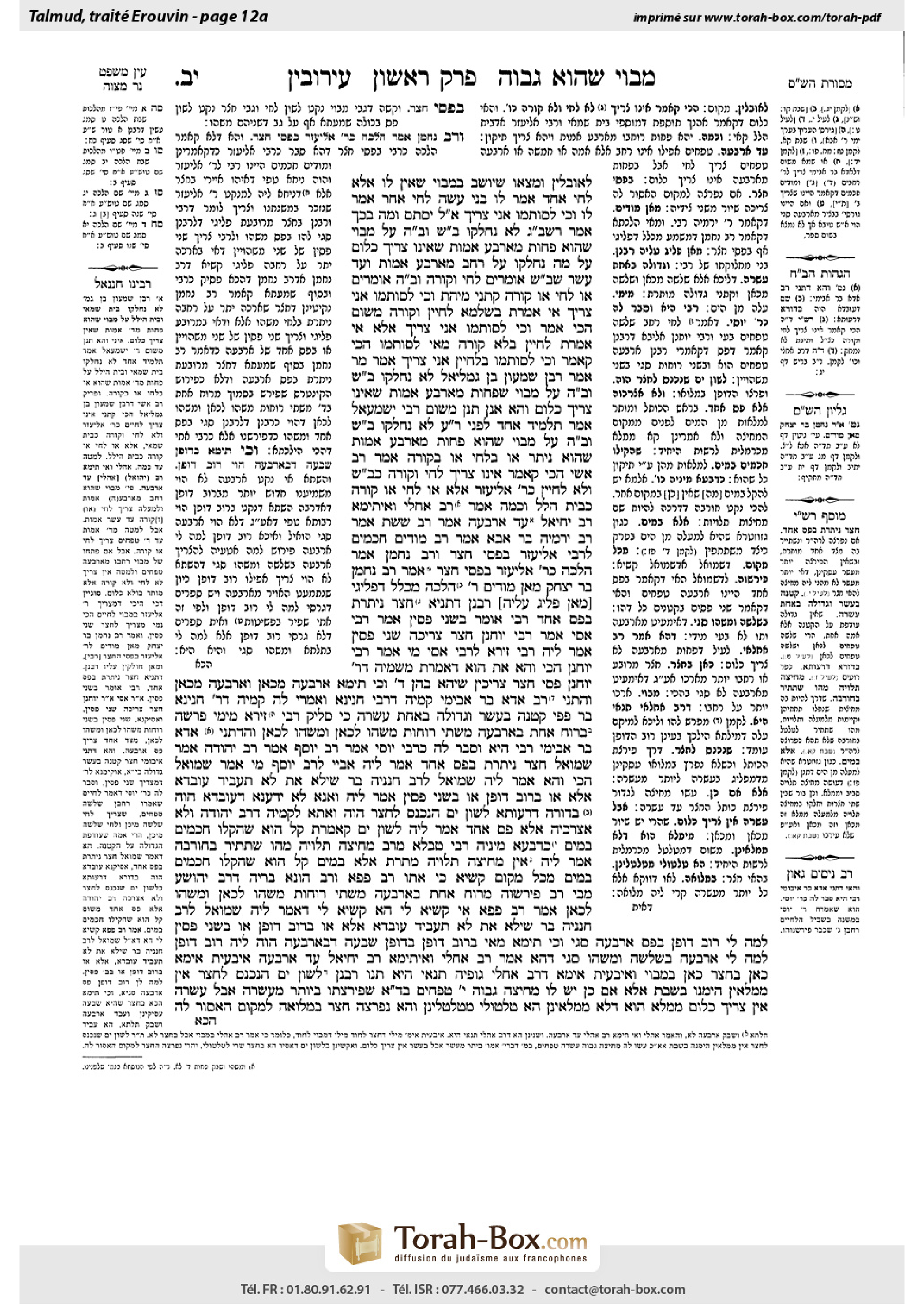
Eruvin 12a: Talmud study for Daf Yomi
Study the Talmud for Daf Yomi with scanned pages, Hebrew text, English translations from Sefaria and AI-generated French translations.
Passage selection and English or AI-generated French translation are available where the scan has annotations. Daf Study is independent of Torah-Box and Sefaria.
Browse Eruvin · עירובין · All tractatesEruvin 12a text and translations
This page of Eruvin includes the Aramaic text, an English translation and an AI-generated French translation, alongside the scan above.
עירובין י״ב א · Aramaic and Hebrew text
לְאוֹבָלִין וּמְצָאוֹ שֶׁיּוֹשֵׁב בְּמָבוֹי שֶׁאֵין לוֹ אֶלָּא לֶחִי אֶחָד. אָמַר לוֹ: בְּנִי, עֲשֵׂה לֶחִי אַחֵר. אָמַר לוֹ: וְכִי לְסוֹתְמוֹ אֲנִי צָרִיךְ? אָמַר לוֹ יִסָּתֵם, וּמָה בְּכָךְ.
אָמַר רַבָּן שִׁמְעוֹן בֶּן גַּמְלִיאֵל: לֹא נֶחְלְקוּ בֵּית שַׁמַּאי וּבֵית הִלֵּל עַל מָבוֹי שֶׁהוּא פָּחוֹת מֵאַרְבַּע אַמּוֹת שֶׁאֵינוֹ צָרִיךְ כְּלוּם, עַל מָה נֶחְלְקוּ, עַל רָחָב מֵאַרְבַּע אַמּוֹת וְעַד עֶשֶׂר. שֶׁבֵּית שַׁמַּאי אוֹמְרִים: לֶחִי וְקוֹרָה, וּבֵית הִלֵּל אוֹמְרִים: אוֹ לֶחִי אוֹ קוֹרָה.
קָתָנֵי מִיהַת ״וְכִי לְסוֹתְמוֹ אֲנִי צָרִיךְ״, אִי אָמְרַתְּ בִּשְׁלָמָא לְחָיַיִן וְקוֹרָה — מִשּׁוּם הָכִי אָמַר ״וְכִי לְסוֹתְמוֹ אֲנִי צָרִיךְ״. אֶלָּא אִי אָמְרַתְּ לְחָיַיִן בְּלֹא קוֹרָה — מַאי לְסוֹתְמוֹ?
הָכִי קָאָמַר: וְכִי לְסוֹתְמוֹ בִּלְחָיַיִן אֲנִי צָרִיךְ?
אָמַר מָר: אָמַר רַבָּן שִׁמְעוֹן בֶּן גַּמְלִיאֵל: לֹא נֶחְלְקוּ בֵּית שַׁמַּאי וּבֵית הִלֵּל עַל מָבוֹי שֶׁפָּחוֹת מֵאַרְבַּע אַמּוֹת שֶׁאֵינוֹ צָרִיךְ כְּלוּם. וְהָא אֲנַן תְּנַן: מִשּׁוּם רַבִּי יִשְׁמָעֵאל אָמַר תַּלְמִיד אֶחָד לִפְנֵי רַבִּי עֲקִיבָא: לֹא נֶחְלְקוּ בֵּית שַׁמַּאי וּבֵית הִלֵּל עַל מָבוֹי שֶׁהוּא פָּחוֹת מֵאַרְבַּע אַמּוֹת שֶׁהוּא נִיתָּר אוֹ בְּלֶחִי אוֹ בְּקוֹרָה!
אָמַר רַב אָשֵׁי, הָכִי קָאָמַר: אֵינוֹ צָרִיךְ לֶחִי וְקוֹרָה כְּבֵית שַׁמַּאי, וְלֹא לְחָיַיִן כְּרַבִּי אֱלִיעֶזֶר, אֶלָּא: אוֹ לֶחִי אוֹ קוֹרָה, כְּבֵית הִלֵּל.
וְכַמָּה? אָמַר רַב אַחְלַי: וְאִיתֵּימָא רַב יְחִיאֵל: עַד אַרְבָּעָה.
אָמַר רַב שֵׁשֶׁת אָמַר רַב יִרְמְיָה בַּר אַבָּא אָמַר רַב: מוֹדִים חֲכָמִים לְרַבִּי אֱלִיעֶזֶר בְּפַסֵּי חָצֵר. וְרַב נַחְמָן אָמַר: הֲלָכָה כְּרַבִּי אֱלִיעֶזֶר בְּפַסֵּי חָצֵר.
אָמַר רַב נַחְמָן בַּר יִצְחָק: מַאן מוֹדִים? — רַבִּי. הֲלָכָה מִכְּלָל דִּפְלִיגִי, [מַאן פְּלִיג עֲלֵיהּ] — רַבָּנַן. דְּתַנְיָא: חָצֵר נִיתֶּרֶת בְּפַס אֶחָד. רַבִּי אוֹמֵר: בִּשְׁנֵי פַסִּין.
אָמַר רַבִּי אַסִּי אָמַר רַבִּי יוֹחָנָן: חָצֵר צְרִיכָה שְׁנֵי פַסִּין. אֲמַר לֵיהּ רַבִּי זֵירָא לְרַבִּי אַסִּי: מִי אָמַר רַבִּי יוֹחָנָן הָכִי? וְהָא אַתְּ הוּא דְּאָמְרַתְּ מִשְּׁמֵיהּ דְּרַבִּי יוֹחָנָן: פַּסֵּי חָצֵר צְרִיכִין שֶׁיְּהֵא בָּהֶן אַרְבָּעָה. וְכִי תֵּימָא: אַרְבָּעָה מִכָּאן וְאַרְבָּעָה מִכָּאן —
וְהָתָנֵי רַב אַדָּא בַּר אֲבִימִי קַמֵּיהּ דְּרַבִּי חֲנִינָא, וְאָמְרִי לַהּ קַמֵּיהּ דְּרַבִּי חֲנִינָא בַּר פַּפִּי: קְטַנָּה בְּעֶשֶׂר, וּגְדוֹלָה בְּאַחַת עֶשְׂרֵה!
כִּי סָלֵיק רַבִּי זֵירָא מִיַּמֵּי פָּרְשַׁהּ: בָּרוּחַ אַחַת בְּאַרְבָּעָה, מִשְׁתֵּי רוּחוֹת — מַשֶּׁהוּ לְכָאן וּמַשֶּׁהוּ לְכָאן.
וְהָדְתָנֵי אַדָּא בַּר אֲבִימִי — רַבִּי הִיא, וְסָבַר לַהּ כְּרַבִּי יוֹסֵי.
אָמַר רַב יוֹסֵף אָמַר רַב יְהוּדָה אָמַר שְׁמוּאֵל: חָצֵר נִיתֶּרֶת בְּפַס אֶחָד. אֲמַר לֵיהּ אַבָּיֵי לְרַב יוֹסֵף: מִי אָמַר שְׁמוּאֵל הָכִי? וְהָא אֲמַר לֵיהּ שְׁמוּאֵל לְרַב חֲנַנְיָה בַּר שֵׁילָא: אַתְּ לָא תַּעֲבֵיד עוֹבָדָא אֶלָּא אוֹ בְּרוֹב דּוֹפֶן אוֹ בִּשְׁנֵי פַסִּין!
אֲמַר לֵיהּ: וַאֲנָא לָא יָדַעְנָא, דְּעוֹבָדָא הֲוָה בְּדוּרָה דִרְעוּתָא, לְשׁוֹן יָם הַנִּכְנָס לְחָצֵר הֲוָה. וַאֲתָא לְקַמֵּיהּ דְּרַב יְהוּדָה, וְלָא אַצְרְכֵיהּ אֶלָּא פַּס אֶחָד.
אֲמַר לֵיהּ: לְשׁוֹן יָם קָאָמְרַתְּ, קַל הוּא שֶׁהֵקֵלּוּ חֲכָמִים בְּמַיִם.
כְּדִבְעָא מִינֵּיהּ רַבִּי טַבְלָא מֵרַב: מְחִיצָה תְּלוּיָה, מַהוּ שֶׁתַּתִּיר בְּחוּרְבָּה? אֲמַר לֵיהּ: אֵין מְחִיצָה תְּלוּיָה מַתֶּרֶת אֶלָּא בְּמַיִם, קַל הוּא שֶׁהֵקֵלּוּ חֲכָמִים בְּמַיִם.
מִכׇּל מָקוֹם קַשְׁיָא.
כִּי אֲתוֹ רַב פָּפָּא וְרַב הוּנָא בְּרֵיהּ דְּרַב יְהוֹשֻׁעַ מִבֵּי רַב פֵּירְשׁוּהָ: מֵרוּחַ אַחַת — בְּאַרְבָּעָה, מִשְׁתֵּי רוּחוֹת — מַשֶּׁהוּ לְכָאן וּמַשֶּׁהוּ לְכָאן.
אָמַר רַב פָּפָּא: אִי קַשְׁיָא לִי — הָא קַשְׁיָא לִי, דַּאֲמַר לֵיהּ שְׁמוּאֵל לְרַב חֲנַנְיָה בַּר שֵׁילָא: אַתְּ לָא תַּעֲבֵיד עוֹבָדָא אֶלָּא אוֹ בְּרוֹב דּוֹפֶן אוֹ בִּשְׁנֵי פַסִּין.
לְמָה לִי רוֹב דּוֹפֶן? בְּפַס אַרְבָּעָה סַגִּי! וְכִי תֵּימָא מַאי בְּרוֹב דּוֹפֶן בְּדוֹפֶן שִׁבְעָה, דִּבְאַרְבְּעָה הֲוָה לֵיהּ רוֹב דּוֹפֶן, לְמָה לִי אַרְבָּעָה? בִּשְׁלֹשָׁה וּמַשֶּׁהוּ סַגִּי! דְּהָא אָמַר רַב אַחְלַי וְאִיתֵּימָא רַב יְחִיאֵל: עַד אַרְבָּעָה!
אִיבָּעֵית אֵימָא: כָּאן — בְּחָצֵר, כָּאן — בְּמָבוֹי, וְאִיבָּעֵית אֵימָא: דְּרַב אַחְלַי גּוּפֵיהּ תַּנָּאֵי הִיא.
תָּנוּ רַבָּנַן: לְשׁוֹן יָם הַנִּכְנָס לְחָצֵר — אֵין מְמַלְּאִין הֵימֶנּוּ בְּשַׁבָּת אֶלָּא אִם כֵּן יֵשׁ לוֹ מְחִיצָה גָּבוֹהַּ עֲשָׂרָה טְפָחִים. בַּמֶּה דְּבָרִים אֲמוּרִים — שֶׁפִּירְצָתוֹ בְּיוֹתֵר מֵעֲשָׂרָה, אֲבָל עֲשָׂרָה — אֵין צָרִיךְ כְּלוּם.
מִמְלָא הוּא דְּלָא מְמַלְּאִינַן, הָא טַלְטוֹלֵי מְטַלְטְלִינַן. וְהָא נִפְרְצָה חָצֵר בִּמְלוֹאָהּ לְמָקוֹם הָאָסוּר לָהּ!
Eruvin 12a · English translation
at the town of Ovelin, and found him dwelling in an alleyway that had only one side post. He said to him: My son, set up another side post. Rabbi Yosei said to him: Am I required to close it up? Rabbi Eliezer said to him: Let it be closed up; what does it matter?
We learned in that same Tosefta: Rabban Shimon ben Gamliel said: Beit Shammai and Beit Hillel did not disagree about an alleyway whose width is less than four cubits, as they both agree that this alleyway does not require anything to render it permitted for one to carry within it. About what did they disagree? About an alleyway that is wider than four cubits, and up to ten cubits; as Beit Shammai say: It is permitted to carry within it only if there is both a side post and a cross beam, and Beit Hillel say: It requires either a side post or a cross beam.
The Gemara explains the proof from this Tosefta. In any case, it teaches: Rabbi Yosei ben Perida said to Rabbi Eliezer: Am I required to seal it? Granted, if you say that Rabbi Eliezer requires two side posts and a cross beam, for that reason the disciple said: Am I required to seal it? However, if you say that he requires side posts without a cross beam, what is the meaning of to seal it? The entrance to the alleyway remains open from above.
The Gemara rejects this argument: No absolute proof can be cited from here, as perhaps this is what he is saying: Am I required to seal it with side posts?
The Master said in the Tosefta: Rabban Shimon ben Gamliel said that Beit Shammai and Beit Hillel do not disagree about an alleyway whose width is less than four cubits, as they both agree that it does not require anything to render it permitted to carry within it. But didn’t we learn in the mishna: A certain disciple said before Rabbi Akiva in the name of Rabbi Yishmael: Beit Shammai and Beit Hillel did not disagree about an alleyway whose width is less than four cubits, as they both agree that carrying in an alleyway of that sort is permitted by either a side post or a cross beam. How could Rabban Shimon ben Gamliel have said that according to Beit Shammai and Beit Hillel even that minimal action is unnecessary?
Rav Ashi said: This is what Rabban Shimon ben Gamliel is saying. It neither requires both a side post and a cross beam, in accordance with the opinion of Beit Shammai, nor does it require two side posts, in accordance with the opinion of Rabbi Eliezer; rather, it requires either a side post or a cross beam, in accordance with the statement of Beit Hillel with regard to a large alleyway. When it said that Rabban Shimon ben Gamliel does not require anything, it meant anything more than that required by Beit Hillel.
The Gemara asks: And how narrow must an alleyway be so that it would not require even a side post, according to all opinions? Rav Aḥlei said, and some say it was Rav Yeḥiel who said: Up to a width of four handbreadths, the alleyway requires nothing in order to render it permitted for one to carry within it.
Rav Sheshet said that Rav Yirmeya bar Abba said that Rav said: The Rabbis concede to Rabbi Eliezer with regard to the upright boards of a courtyard. That is to say, the Rabbis disagree with Rabbi Eliezer only about the number of side posts needed to permit carrying within an alleyway. However, they agree that if a courtyard was breached into the public domain, it can be considered closed only if upright boards of wall, similar to side posts, remain on both sides of the breach. But Rav Naḥman said: The halakha is in accordance with the opinion of Rabbi Eliezer with regard to the upright boards of wall that are required in a courtyard.
Rav Naḥman bar Yitzḥak said: Who are the Rabbis to whom Rav referred when he stated that they concede to Rabbi Eliezer? He was referring to Rabbi Yehuda HaNasi. Furthermore, as Rav Naḥman said that the halakha is in accordance with the opinion of Rabbi Eliezer, one can learn by inference that the Sages dispute this issue as well. Who are the ones who disagree with Rabbi Yehuda HaNasi? It is the Rabbis, as it was taught in a baraita: In a courtyard that was breached into the public domain, with the width of the breach not exceeding ten cubits, it is permitted to carry if one upright board remains on one side of the breach. Rabbi Yehuda HaNasi says: It is permitted only if there remain two upright boards, one on each side of the breach.
Rabbi Asi said that Rabbi Yoḥanan said: A courtyard that was breached requires two upright boards of wall on either side of the breach, in accordance with the opinion of Rabbi Yehuda HaNasi. Rabbi Zeira said to Rabbi Asi: Did Rabbi Yoḥanan really say that? But weren’t you the one who said in the name of Rabbi Yoḥanan: The upright boards in a courtyard must be four handbreadths wide? This indicates that only one board is necessary. And if you say that Rabbi Yoḥanan requires one upright four handbreadths board from here, one side of the breach, and one upright four handbreadths board from there, the other side of the breach, this is difficult.
But didn’t Rav Adda bar Avimi teach the following baraita before Rabbi Ḥanina, and some say it was before Rabbi Ḥanina bar Pappi, with regard to the halakha governing a small courtyard that was breached along its entire length into a large courtyard. The baraita teaches that the residents of the large courtyard may use their courtyard even if the small courtyard has a width of ten cubits, and the large one has a width of eleven cubits. In this case, the difference between the length of the smaller courtyard and that of the larger courtyard is only one cubit, i.e., six handbreadths. Therefore, there cannot be upright boards of four handbreadths on each side, as together they would amount to more than a cubit.
The Gemara resolves this difficulty: When Rabbi Zeira ascended from his sea travels, he explained the contradiction between the statements of Rav Yoḥanan in the following manner: If there is a upright board in only one direction, it must be four handbreadths, however, if there are upright boards from two directions, it suffices if there is any amount here, on one side, and any amount there, on the other side.
And that which Adda bar Avimi taught with regard to the difference in size between the two courtyards is not universally accepted, as according to Rabbi Zeira it is sufficient if one courtyard is four handbreadths larger than the other. Rather, it is in accordance with the view of Rabbi Yehuda HaNasi, who requires two upright boards of wall in a breached courtyard. And furthermore, Rabbi Yehuda HaNasi holds in accordance with the opinion of Rabbi Yosei, who says that a side post must be at least three handbreadths wide. Consequently, the two upright boards together must be at least six handbreadths, which is why the minimum difference between the smaller and the larger courtyards is a cubit.
Rav Yosef said that Rav Yehuda said that Shmuel said: A breached courtyard is permitted if one upright board of wall remains on one side of the breach. Abaye said to Rav Yosef: Did Shmuel really say this? But didn’t Shmuel say to Rav Ḥananya bar Sheila: You must not perform an action, i.e., issue a ruling to permit carrying in a breached courtyard, unless there remains standing either the majority of the wall or two upright boards on either side of the breach.
Rav Yosef said to Abaye: I do not know how to resolve this contradiction. All I know is that there was an incident in a shepherds’ village with regard to a narrow inlet of the sea that penetrated a courtyard, breaching one of its walls in its entirety, and the matter came before Rav Yehuda, and he required only one upright board of wall to remain in order to permit it.
Abaye said to Rav Yosef: You speak of a narrow inlet of the sea, but an inlet is different and nothing can be derived from that case, for we know that this is a leniency in which the Sages lessened the requirements in cases involving water. In these cases, the Sages did not require properly constructed partitions, but were satisfied with inferior ones.
The Gemara supports the assertion that the Sages were more lax with regard to water from the following dilemma that Rabbi Tavla raised before Rav: Does a suspended partition permit carrying in a ruin? Do we say that the remnants of the walls that are suspended in the air are considered as if they descend to the ground, closing off the area so that it is regarded as a private domain? Rav said to him: A suspended partition of this kind permits carrying only in the case of water; this is a leniency in which the Sages lessened the requirements in cases involving water.
The Gemara continues: In any case, it is difficult. The contradiction between the conflicting statements of Shmuel remains unresolved.
The Gemara resolves the difficulty: When Rav Pappa and Rav Huna, son of Rav Yehoshua, came from the house of their teacher, they explained the contradiction in the following manner: If there is an upright board from only one direction, it must be of four handbreadths; but if there are upright boards from two directions, i.e., both sides of the breach, it suffices if there is a bit here, on one side, and bit here, on the other side.
Rav Pappa said: If this issue is difficult for me to understand, this is my difficulty: For Shmuel said to Rav Ḥananya bar Sheila: You must not perform an action, i.e., issue a ruling to permit carrying in a breached courtyard, unless there remains standing either most of the wall or two upright boards on either side of the breach.
The Gemara asks: Why do I need most of the wall? An upright board of four handbreadths should suffice. The Gemara further explains the difficulty: And if you say, what is the meaning of most of the wall mentioned here? It is referring to the special case where the wall is seven handbreadths wide, so that four handbreadths constitutes most of the wall, this too is difficult. Even if the wall is seven handbreadths wide, why do I require an upright board of four handbreadths to seal? Three handbreadths and any amount should suffice, as Rav Aḥlei, and some say it was Rav Yeḥiel who said: A narrow alleyway up to four handbreadths wide requires nothing at all. Here too, after sealing up slightly more than three handbreadths, the remaining gap that remains is less than four handbreadths, so nothing further should be required.
The Gemara answers: If you wish, say that here, the statement of Shmuel is referring to a courtyard, where even a breach of less than four handbreadths requires action. There, the statement of Rav Aḥlei, is referring to an alleyway. And if you wish, say that the statement of Rav Aḥlei is itself subject to a dispute between the tanna’im.
The Sages taught the following baraita: With regard to a narrow inlet of the sea that enters into a courtyard, partially breaching one of its walls, one may not fill water from it on Shabbat. The inlet is a karmelit, from which it is prohibited to carry into a private domain, e.g. a courtyard. This is the halakha unless there is a partition ten handbreadths high at one side of the wall’s breach, which would incorporate the inlet as part of the courtyard. In what case is this statement said? Where the breach through which the water enters is more than ten cubits wide; but if it is only ten cubits wide, nothing is required.”
The Gemara asks: The baraita indicates that one may not fill water from the inlet because that would involve carrying from a karmelit into a private domain, but in the courtyard itself one may indeed carry. But isn’t the courtyard breached along its entirety, i.e., more than ten cubits, into a place that is prohibited to it? Since it is prohibited to carry to or from the inlet, it should also be prohibited to carry within the courtyard itself.
Eruvin 12a · Traduction française (IA)
À la ville d'Ovelin, et le trouva habitant dans un passage qui avait seulement un poteau latéral. Il lui dit : Mon fils, établis un autre poteau latéral. Rabbi Yosei lui dit : Ai-je l'obligation de le fermer ? Rabbi Eliezer lui dit : Il doit être fermé ; qu'importe ?
Nous avons appris dans la même Tosefta : Rabban Shimon ben Gamliel dit : Beit Shammai et Beit Hillel n'ont pas discuté sur un passage dont la largeur est inférieure à quatre coudées, car ils s'accordent sur le fait que ce passage ne nécessite rien pour être permis à la portée d'un porteur. À propos de quoi ont-ils discuté ? À propos d'un passage plus large que quatre coudées, jusqu'à dix coudées ; car Beit Shammai disent : Il est permis de porter dedans seulement s'il y a à la fois un poteau latéral et une traverse, et Beit Hillel disent : Il nécessite soit un poteau latéral, soit une traverse.
La Guemara explique la preuve tirée de cette Tosefta. En tout cas, elle enseigne : Rabbi Yosei ben Perida dit à Rabbi Eliezer : Ai-je l'obligation de le fermer ? Admettons que vous disiez que Rabbi Eliezer exige deux poteaux latéraux et une traverse, pour cette raison le disciple dit : Ai-je l'obligation de le fermer ? Cependant, si vous disiez qu'il exige des poteaux latéraux sans traverse, quelle est la signification de fermer ? L'entrée du passage reste ouverte du haut.
La Guemara rejette cet argument : Aucune preuve absolue ne peut être tirée d'ici, car peut-être c'est ce qu'il dit : Ai-je l'obligation de le fermer avec des poteaux latéraux ?
Le Maître a dit dans la Tosefta : Rabban Shimon ben Gamliel dit que Beit Shammai et Beit Hillel n'ont pas discuté sur un passage dont la largeur est inférieure à quatre coudées, car ils s'accordent sur le fait qu'il ne nécessite rien pour être permis à la portée d'un porteur. Mais n'avons-nous pas appris dans la mitsva : Un disciple dit devant Rabbi Akiva en nom de Rabbi Yishmael : Beit Shammai et Beit Hillel n'ont pas discuté sur un passage dont la largeur est inférieure à quatre coudées, car ils s'accordent sur le fait que la portée dans un passage de ce genre est permise soit par un poteau latéral, soit par une traverse. Comment Rabban Shimon ben Gamliel a-t-il pu dire que selon Beit Shammai et Beit Hillel même cette action minimale n'est pas nécessaire ?
Rav Ashi dit : C'est ce que Rabban Shimon ben Gamliel dit. Il ne nécessite ni les deux poteaux latéraux et la traverse selon l'opinion de Beit Shammai, ni deux poteaux latéraux selon l'opinion de Rabbi Eliezer ; plutôt, il nécessite soit un poteau latéral, soit une traverse selon l'affirmation de Beit Hillel concernant un passage large. Lorsqu'il a dit que Rabban Shimon ben Gamliel ne nécessitait rien, cela signifiait que rien n'était nécessaire au-delà de ce que requiert Beit Hillel.
La Guemara pose la question : Et combien doit être étroit un passage pour ne pas nécessiter même un poteau latéral, selon toutes les opinions ? Rav Aḥlei dit, et certains disent que c'était Rav Yeḥiel qui a dit : Jusqu'à une largeur de quatre tefachim, le passage ne nécessite rien pour être permis à la portée d'un porteur.
Rav Sheshet dit que Rav Yirmeya bar Abba dit que Rav dit : Les Sages reconnaissent Rabbi Eliezer concernant les poteaux droits d'un jardin. C'est-à-dire, les Sages ne s'accordent avec Rabbi Eliezer que concernant le nombre de poteaux latéraux nécessaires pour permettre la portée dans un passage. Cependant, ils s'accordent sur le fait que si un jardin a été percé dans le domaine public, il peut être considéré comme fermé seulement si des poteaux droits de mur, semblables aux poteaux latéraux, restent des deux côtés de la percée. Mais Rav Naḥman dit : La halakha suit l'opinion de Rabbi Eliezer concernant les poteaux droits de mur nécessaires dans un jardin.
Rav Naḥman bar Yitzḥak dit : Qui sont les Sages auxquels Rav faisait référence lorsqu'il a dit qu'ils reconnaissent Rabbi Eliezer ? Il faisait référence à Rabbi Yehuda HaNasi. De plus, comme Rav Naḥman dit que la halakha suit l'opinion de Rabbi Eliezer, on peut en déduire que les Sages discutent également de cette question. Qui sont ceux qui s'opposent à Rabbi Yehuda HaNasi ? Ce sont les Sages, car il a été enseigné dans une baraïta : Dans un jardin percé dans le domaine public, avec la largeur de la percée ne dépassant pas dix coudées, il est permis de porter si un poteau droit reste d'un côté de la percée. Rabbi Yehuda HaNasi dit : Il est permis seulement si deux poteaux droits restent, l'un de chaque côté de la percée.
Rabbi Asi dit que Rabbi Yoḥanan dit : Un jardin percé nécessite deux poteaux droits de mur des deux côtés de la percée, selon l'opinion de Rabbi Yehuda HaNasi. Rabbi Zeira dit à Rabbi Asi : Rabbi Yoḥanan a vraiment dit cela ? Mais n'étais-tu pas toi-même celui qui a dit en nom de Rabbi Yoḥanan : Les poteaux droits d'un jardin doivent être de quatre tefachim de large ? Cela indique qu'un seul poteau suffit. Et si tu dis que Rabbi Yoḥanan exige un poteau droit de quatre tefachim d'un côté de la percée, et un autre poteau droit de quatre tefachim de l'autre côté, cela est difficile.
Mais n'avons-nous pas appris avant Rabbi Ḥanina, et certains disent avant Rabbi Ḥanina bar Pappi, par Rav Adda bar Avimi, concernant la halakha concernant un petit jardin percé le long de toute sa longueur dans un grand jardin. La baraïta enseigne que les habitants du grand jardin peuvent utiliser leur jardin même si le petit jardin a une largeur de dix coudées, et le grand a une largeur de onze coudées. Dans ce cas, la différence entre la longueur du petit jardin et celle du grand jardin est seulement une coudée, c'est-à-dire six tefachim. Par conséquent, il ne peut pas y avoir des poteaux droits de quatre tefachim de chaque côté, car ensemble ils représenteraient plus d'une coudée.
La Guemara résout cette difficulté : Quand Rabbi Zéira est descendu de ses voyages en mer, il a expliqué la contradiction entre les déclarations de Rav Yochanan de la manière suivante : Si un plan de mur est dressé dans une seule direction, il doit mesurer quatre tefachim, cependant, si des plans de mur sont dressés dans deux directions, il suffit qu'il y ait une quantité ici, d'un côté, et une quantité là, de l'autre côté.
Et ce que Adda bar Avimi a enseigné concernant la différence de taille entre les deux courtyards n'est pas universellement accepté, car selon Rabbi Zéira, il suffit que l'un des courtyards soit quatre tefachim plus grand que l'autre. En réalité, c'est selon la vue de Rabbi Yéhuda HaNasi, qui exige deux plans de mur dans un courtyard percé. De plus, Rabbi Yéhuda HaNasi suit l'opinion de Rabbi Yosei, qui dit qu'un poteau latéral doit mesurer au moins trois tefachim de large. Ainsi, les deux plans de mur ensemble doivent mesurer au moins six tefachim, ce qui explique pourquoi la différence minimale entre le petit et le grand courtyard est un cubit.
Rav Yosef a dit que Rav Yéhuda a dit que Shmuel a dit : Un courtyard percé est permis si un plan de mur reste debout d'un côté de la percée. Abaye a dit à Rav Yosef : Shmuel a vraiment dit cela ? Mais n'a-t-il pas dit à Rav Hananya bar Sheila : Vous ne devez pas agir, c'est-à-dire émettre un avis permettant le port dans un courtyard percé, à moins qu'il ne reste debout la majorité du mur ou deux plans de mur des deux côtés de la percée.
Rav Yosef a dit à Abaye : Je ne sais pas comment résoudre cette contradiction. Tout ce que je sais, c'est qu'il y avait un incident dans un village de bergers concernant un petit détroit de la mer qui pénétrait dans une cour, percé entièrement un de ses murs, et la question a été soumise à Rav Yéhuda, et il exigeait seulement qu'un seul mur vertical reste debout pour permettre cela.
Abaye a dit à Rav Yosef : Vous parlez d'un petit détroit de la mer, mais un détroit est différent et rien ne peut être déduit de ce cas, car nous savons que c'est une leniency dans laquelle les Sages ont allégé les exigences dans les cas impliquant l'eau. Dans ces cas, les Sages n'exigeaient pas de paritions correctement construites, mais étaient satisfaits de paritions inférieures.
La Guemara soutient l'affirmation que les Sages étaient plus laxistes concernant l'eau à partir du dilemme que Rabbi Tavla a soulevé devant Rav : Une parition suspendue permet-elle le port dans une ruine ? Disons-nous que les restes des murs suspendus dans l'air sont considérés comme s'ils descendaient jusqu'au sol, fermant ainsi la zone de manière à être considérée comme un domaine privé ? Rav a dit à lui : Une parition suspendue de ce genre permet le port uniquement dans le cas de l'eau ; c'est une leniency dans laquelle les Sages ont allégé les exigences dans les cas impliquant l'eau.
La Guemara continue : En tout cas, c'est difficile. La contradiction entre les déclarations contraires de Shmuel reste sans solution.
La Guemara résout cette difficulté : Quand Rav Pappa et Rav Huna, fils de Rav Yéhoshua, sont revenus de la maison de leur maître, ils ont expliqué la contradiction de la manière suivante : Si un plan de mur est dressé dans une seule direction, il doit mesurer quatre tefachim ; mais si des plans de mur sont dressés dans deux directions, c'est-à-dire des deux côtés de la percée, il suffit qu'il y ait un peu ici, d'un côté, et un peu là, de l'autre côté.
Rav Pappa a dit : Si cette question me pose difficulté, voici ma difficulté : Pour Shmuel a dit à Rav Hananya bar Sheila : Vous ne devez pas agir, c'est-à-dire émettre un avis permettant le port dans un courtyard percé, à moins qu'il ne reste debout la majorité du mur ou deux plans de mur des deux côtés de la percée.
La Guemara demande : Pourquoi ai-je besoin de la majorité du mur ? Un plan de mur de quatre tefachim devrait suffire. La Guemara explique davantage la difficulté : Et si vous dites, quelle est la signification de la majorité du mur mentionnée ici ? Cela fait référence au cas spécial où le mur mesure sept tefachim de large, de sorte que quatre tefachim constituent la majorité du mur, ce qui est également difficile. Même si le mur mesure sept tefachim de large, pourquoi ai-je besoin d'un plan de mur de quatre tefachim pour le sceller ? Trois tefachim et une quantité quelconque devraient suffire, selon Rav Aḥlei, et certains disent que c'était Rav Yéhiel qui a dit : Un petit passage jusqu'à quatre tefachim de large ne nécessite rien du tout. Ici aussi, après avoir scellé légèrement plus de trois tefachim, le passage restant est inférieur à quatre tefachim, donc rien ne devrait être requis davantage.
La Guemara répond : Si vous le souhaitez, dites que ici, la déclaration de Shmuel fait référence à un courtyard, où même une percée inférieure à quatre tefachim exige une action. Là, la déclaration de Rav Aḥlei fait référence à un passage. Et si vous le souhaitez, dites que la déclaration de Rav Aḥlei est elle-même sujette à un débat entre les tannaïm.
Les Sages ont enseigné la suivante baraïta : Concernant un petit détroit de la mer qui entre dans un courtyard, partiellement percé un de ses murs, on ne peut pas remplir de l'eau à partir de lui le sabbat. Le détroit est un karmelit, d'où il est interdit de porter dans un domaine privé, par exemple un courtyard. C'est la halakha à moins qu'il n'y ait une partition de dix tefachim de haut d'un côté de la percée, ce qui intégrerait le détroit comme faisant partie du courtyard. Dans quel cas cette déclaration est-elle dite ? Lorsque la percée par laquelle l'eau entre est plus de dix tefachim de large ; mais si elle est seulement dix tefachim de large, rien n'est requis.
Le Guemara pose la question : La baraïta indique que l'on ne peut pas remplir l'eau depuis l'entrée, car cela impliquerait de porter de la karmelit dans un domaine privé, mais dans le courtil lui-même, on peut effectivement porter. Mais ne serait-ce pas que le courtil est percé sur toute sa longueur, c'est-à-dire plus de dix coudées, dans un lieu interdit ? Puisque porter vers ou depuis l'entrée est interdit, il devrait aussi être interdit de porter à l'intérieur du courtil lui-même.
Traduction française générée par IA à partir de l’édition anglaise de Sefaria. Vérifie toujours un passage avec le texte source.
Text from Sefaria: William Davidson Edition - Vocalized Aramaic (CC BY NC); William Davidson Edition - English (CC BY NC).