Eruvin 12b: Talmud study for Daf Yomi
Study the Talmud for Daf Yomi with scanned pages, Hebrew text, English translations from Sefaria and AI-generated French translations.
Passage selection and English or AI-generated French translation are available where the scan has annotations. Daf Study is independent of Torah-Box and Sefaria.
Browse Eruvin · עירובין · All tractatesEruvin 12b text and translations
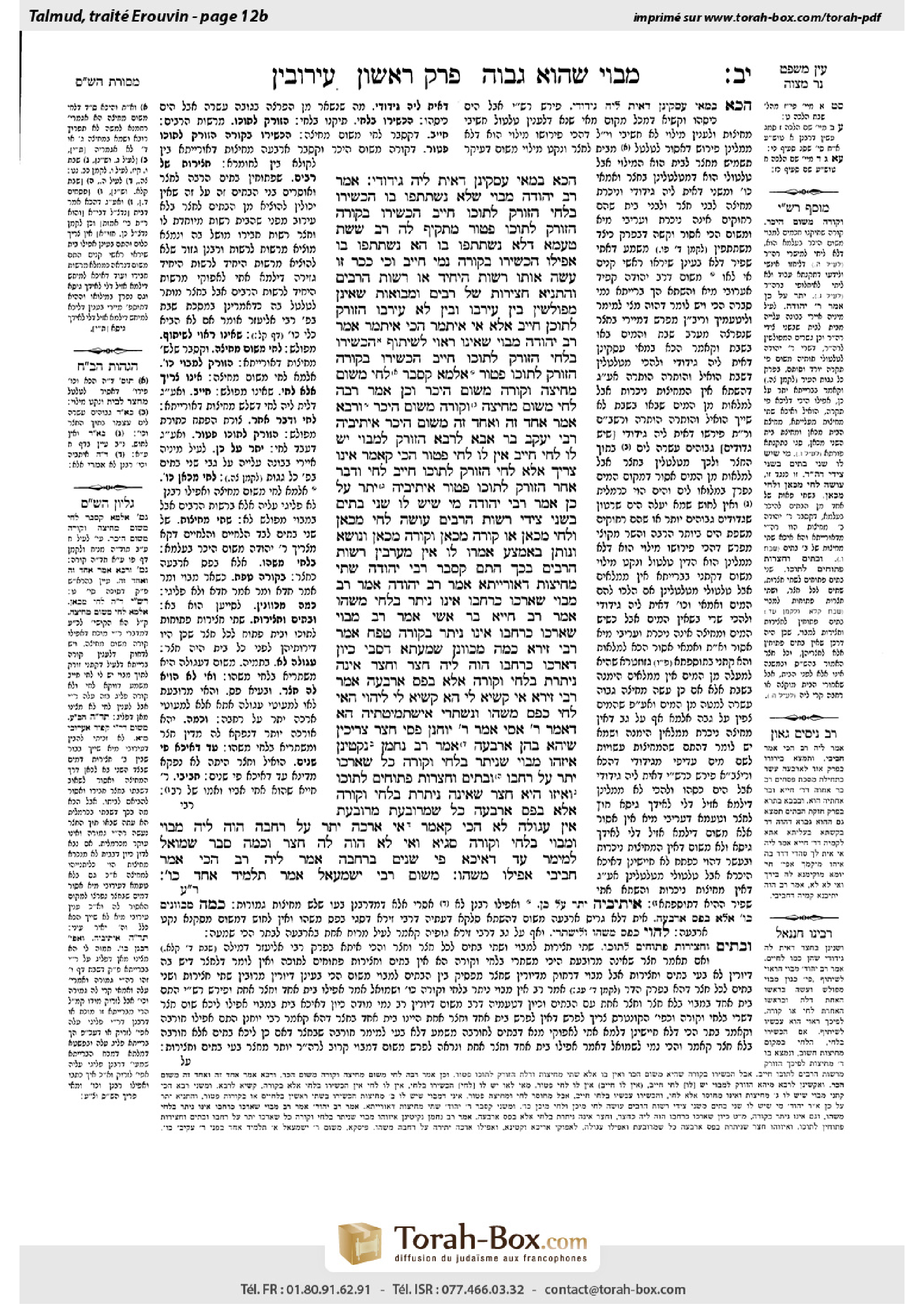
This page of Eruvin includes the Aramaic text, an English translation and an AI-generated French translation, alongside the scan above.
עירובין י״ב ב · Aramaic and Hebrew text
הָכָא בְמַאי עָסְקִינַן — דְּאִית לֵיהּ גִּידּוּדֵי.
אָמַר רַב יְהוּדָה: מָבוֹי שֶׁלֹּא נִשְׁתַּתְּפוּ בּוֹ, הִכְשִׁירוֹ בְּלֶחִי, הַזּוֹרֵק לְתוֹכוֹ — חַיָּיב, הִכְשִׁירוֹ בְּקוֹרָה — הַזּוֹרֵק לְתוֹכוֹ פָּטוּר.
מַתְקֵיף לַהּ רַב שֵׁשֶׁת: טַעְמָא דְּלֹא נִשְׁתַּתְּפוּ בּוֹ, הָא נִשְׁתַּתְּפוּ בּוֹ אֲפִילּוּ הִכְשִׁירוֹ בְּקוֹרָה נָמֵי חַיָּיב?! וְכִי כִּכָּר זוֹ עֹשָׂה אוֹתוֹ רְשׁוּת הַיָּחִיד אוֹ רְשׁוּת הָרַבִּים?
וְהָתַנְיָא: חֲצֵירוֹת שֶׁל רַבִּים וּמְבוֹאוֹת שֶׁאֵינָן מְפוּלָּשִׁין, בֵּין עֵירְבוּ וּבֵין לֹא עֵירְבוּ הַזּוֹרֵק לְתוֹכָן חַיָּיב!
אֶלָּא אִי אִיתְּמַר, הָכִי אִיתְּמַר: אָמַר רַב יְהוּדָה: מָבוֹי שֶׁאֵינוֹ רָאוּי לְשִׁיתּוּף, הִכְשִׁירוֹ בְּלֶחִי — הַזּוֹרֵק לְתוֹכוֹ חַיָּיב, הִכְשִׁירוֹ בְּקוֹרָה — הַזּוֹרֵק לְתוֹכוֹ פָּטוּר.
אַלְמָא קָסָבַר: לֶחִי מִשּׁוּם מְחִיצָה וְקוֹרָה מִשּׁוּם הֶיכֵּר. וְכֵן אָמַר רַבָּה: לֶחִי מִשּׁוּם מְחִיצָה וְקוֹרָה מִשּׁוּם הֶיכֵּר. וְרָבָא אָמַר: אֶחָד זֶה וְאֶחָד זֶה מִשּׁוּם הֶיכֵּר.
אֵיתִיבֵיהּ רַבִּי יַעֲקֹב בַּר אַבָּא לְרָבָא: הַזּוֹרֵק לְמָבוֹי, יֵשׁ לוֹ לֶחִי — חַיָּיב, אֵין לוֹ לֶחִי — פָּטוּר!
הָכִי קָאָמַר: אֵינוֹ צָרִיךְ אֶלָּא לֶחִי, הַזּוֹרֵק לְתוֹכוֹ — חַיָּיב, לֶחִי וְדָבָר אַחֵר — הַזּוֹרֵק לְתוֹכוֹ פָּטוּר.
אֵיתִיבֵיהּ, יָתֵר עַל כֵּן אָמַר רַבִּי יְהוּדָה: מִי שֶׁיֵּשׁ לוֹ שְׁנֵי בָתִּים בִּשְׁנֵי צִידֵּי רְשׁוּת הָרַבִּים, עוֹשֶׂה לֶחִי מִכָּאן וְלֶחִי מִכָּאן, אוֹ קוֹרָה מִכָּאן וְקוֹרָה מִכָּאן, וְנוֹשֵׂא וְנוֹתֵן בָּאֶמְצַע.
אָמְרוּ לוֹ: אֵין מְעָרְבִין רְשׁוּת הָרַבִּים בְּכָךְ!
הָתָם קָסָבַר רַבִּי יְהוּדָה: שְׁתֵּי מְחִיצּוֹת דְּאוֹרָיְיתָא.
אָמַר רַב יְהוּדָה אָמַר רַב: מָבוֹי שֶׁאׇרְכּוֹ כְּרׇחְבּוֹ אֵינוֹ נִיתָּר בְּלֶחִי מַשֶּׁהוּ. אָמַר רַב חִיָּיא בַּר אָשֵׁי אָמַר רַב: מָבוֹי שֶׁאׇרְכּוֹ כְּרׇחְבּוֹ אֵינוֹ נִיתָּר בְּקוֹרָה טֶפַח.
אָמַר רַבִּי זֵירָא: כַּמָּה מְכַוְּונָן שְׁמַעְתָּא דְסָבֵי. כֵּיוָן דְּאׇרְכּוֹ כְּרׇחְבּוֹ — הָוֵה לֵיהּ חָצֵר, וְחָצֵר אֵינָהּ נִיתֶּרֶת בְּלֶחִי וְקוֹרָה, אֶלָּא בְּפַס אַרְבָּעָה.
אָמַר רַבִּי זֵירָא: אִי קַשְׁיָא לִי, הָא קַשְׁיָא לִי: לֶיהֱוֵי הַאי לֶחִי כְּפַס מַשֶּׁהוּ, וְנִשְׁתְּרֵי!
אִישְׁתְּמִיטְתֵּיהּ הָא דְּאָמַר רַבִּי אַסִּי אָמַר רַבִּי יוֹחָנָן: פַּסֵּי חָצֵר צְרִיכִין שֶׁיְּהֵא בָּהֶן אַרְבָּעָה.
אָמַר רַב נַחְמָן: נָקְטִינַן, אֵיזֶהוּ מָבוֹי שֶׁנִּיתָּר בְּלֶחִי וְקוֹרָה — כֹּל שֶׁאׇרְכּוֹ יָתֵר עַל רׇחְבּוֹ וּבָתִּים וַחֲצֵרוֹת פְּתוּחִים לְתוֹכוֹ, וְאֵיזוֹ הִיא חָצֵר שֶׁאֵינָהּ נִיתֶּרֶת בְּלֶחִי וְקוֹרָה אֶלָּא בְּפַס אַרְבָּעָה — כֹּל שֶׁמְּרוּבַּעַת.
מְרוּבַּעַת אִין, עֲגוּלָּה לָא?! הָכִי קָאָמַר: אִי אׇרְכָּהּ יָתֵר עַל רׇחְבָּהּ — הָוֵה לֵיהּ מָבוֹי, וּמָבוֹי בְּלֶחִי וְקוֹרָה סַגִּיא, וְאִי לָא — הָוֵה לַהּ חָצֵר.
וְכַמָּה? סָבַר שְׁמוּאֵל לְמֵימַר: עַד דְּאִיכָּא פִּי שְׁנַיִם בְּרׇחְבָּהּ. אֲמַר לֵיהּ רַב, הָכִי אָמַר חֲבִיבִי: אֲפִילּוּ מַשֶּׁהוּ.
מִשּׁוּם רַבִּי יִשְׁמָעֵאל אָמַר תַּלְמִיד אֶחָד כּוּ׳.
Eruvin 12b · English translation
The Gemara answers: With what are we dealing here in this baraita? It is a case where the wall has not been fully breached, but rather remnants of the wall remain on each side (Rabbeinu Ḥananel; Rif).
Rav Yehuda said: If several courtyards open onto a common alleyway, the residents of the houses in the courtyards are prohibited to carry in the alleyway, unless the alleyway is rendered fit for one to carry within it by placing a side post or a cross beam at its entrance, and by the inhabitants of each courtyard placing food in a common area for the duration of Shabbat, symbolically converting the entire alleyway into a single household. It is prohibited to carry in an alleyway that the residents did not merge. Nevertheless, if the alleyway was rendered fit by means of a side post placed at its entrance, one who throws an object into it from the public domain is liable; the side post functions as a partition, and the alleyway is deemed a full-fledged private domain. If, however, the alleyway was rendered fit by means of a cross beam, one who throws an object into it from the public domain is exempt; the cross beam functions only as a conspicuous marker. It is not considered a partition that renders the alleyway a private domain.
Rav Sheshet strongly objects to this due to the following: The reason that one is exempt in the latter case is due to the fact the residents of the alleyway did not merge. By inference, if they did in fact merge, one would be liable even if the alleyway was rendered fit by way of a cross beam. This, however, is difficult. One can ask: Does this loaf, through which the residents joined together to form a single household, render the alleyway a private domain or a public domain?
But wasn’t it taught in a baraita: Courtyards shared by many and alleyways that are not open on two opposite sides, whether the residents established an eiruv or did not establish an eiruv, one who throws an object into them from the public domain is liable. This seems to contrary to Rav Yehuda’s statement.
Rather, if it was stated, it was stated as follows. Rav Yehuda said: In the case of an alleyway that is not fit for merging, i.e., an alleyway that is open on two opposite sides, if the alleyway was rendered fit for one to carry within it by means of a side post, one who throws an object into it from the public domain is liable. In that case, the side post is considered a third partition, and since the alleyway is closed on three sides it is deemed a private domain. If, however, the alleyway was rendered fit for one to carry within in by means of a cross beam, one who throws an object into it is exempt.
Apparently, Rav Yehuda holds that a side post functions as a partition, whereas a cross beam functions as a conspicuous marker but is not considered a partition. And, so too, Rabba said: A side post functions as a partition, whereas a cross beam functions as a conspicuous marker. But Rava said: Both this, the side post, and that, the cross beam, function as a conspicuous marker.
Rabbi Ya’akov bar Abba raised an objection to Rava from the following baraita: One who throws an object from the public domain into an alleyway, if the alleyway has a side post, he is liable; if it does not have a side post he is exempt. This shows that a side post is considered a proper partition.
Rava replied: This is what the baraita is saying: If the alleyway is closed on one side such that it requires only a side post in order to permit carrying within in, one who throws an object into it from the public domain is liable because the alleyway already has three partitions and is therefore a proper private domain according to Torah law. However, if the alleyway requires a side post and something else in order to permit carrying within it, one who throws an object into it from the public domain is exempt because the alleyway has only two partitions and is therefore not considered a private domain.
He raised an additional objection to Rava from the following baraita. Furthermore, Rabbi Yehuda said: The halakha is as follows with regard to one who has two houses opposite each other on two sides of the public domain, if he chooses, he may create a private domain for himself in the area of the public domain. He may place a ten-handbreadth high side post from here, perpendicular to the public domain. This creates a symbolic wall which, in the halakhot of alleyways, has the legal status of a wall. And, he may place an additional post from here, on the other side, and that has the same legal status as if he closed the public domain on all of its sides. Or, he can implement a different solution appropriate for alleyways by placing a beam extending from here, from one end of one house, to the end of the house opposite it. This creates a symbolic partition across the width of the street. And, he may place a beam extending from here, from the other side of the house. According to Rabbi Yehuda, in that way, one is permitted to carry objects and place them in the area between the symbolic partitions, as he would in a private domain.
The Rabbis said to him: One may not place an eiruv in the public domain in that way. One who seeks to transform a public domain into a private domain must place actual partitions. Apparently, according to Rabbi Yehuda, the side posts function as partitions in the public domain, creating a private domain between the two houses. It follows from this that a side post is in fact deemed a proper partition, contrary to Rava’s statement.
The Gemara answers: This is not the reason behind Rabbi Yehuda’s statement. Rather, there Rabbi Yehuda holds that by Torah law two partitions suffice to constitute a private domain, and he requires side posts only as a conspicuous marker. Therefore, Rava’s position cannot be disproved from this source either.
Rav Yehuda said that Rav said: Unlike other alleyways, carrying within an alleyway whose length is equal to its width is not permitted by means of a side post of minimal width. Like a courtyard, carrying within it is permitted only by means of an upright board four handbreadths wide. Rav Ḥiyya bar Ashi said in the name of Rav: Carrying within an alleyway whose length is equal to its width is not permitted by a cross beam with the width of a handbreadth.
Rabbi Zeira said: How precise are the traditions of the Elders. He explains: Since the length of the alleyway is equal to its width, it is regarded like a courtyard, and carrying within a courtyard is not permitted by means of a side post or a cross beam, but only by means of an upright board of four handbreadths.
Rabbi Zeira said: Nonetheless, if this issue is difficult for me to understand, this is my difficulty: Let this side post be considered like an upright board of minimal width and permit carrying within the alleyway, just as an upright board permits carrying in a breached courtyard.
The Gemara explains that this is incorrect, as that which Rabbi Asi said that Rabbi Yoḥanan said escaped Rabbi Zeira’s attention: The upright boards of a courtyard must be four handbreadths wide, whereas a side post may be of minimal size.
Rav Naḥman said: We have a tradition that states: What is the type of alleyway in which carrying is permitted by means of a side post or a cross beam? Any alleyway whose length is greater than its width and has houses and courtyards opening into it. And what is the type of courtyard in which carrying is not permitted by means of a side post or a cross beam, but by an upright board of four handbreadths? Any courtyard that is square.
The Gemara wonders: If it is square, then yes, is it considered a courtyard? If it is round, no, is it not considered a courtyard? The Gemara makes a correction: This is what it is saying: If its length is greater than its width, it is considered an alleyway, and for an alleyway a side post or a cross beam suffices; but if its length is not greater than its width, i.e., it is square, it is considered a courtyard.
The Gemara asks: And by how much must its length exceed its width so that it can be considered an alleyway? Shmuel thought at first to say: It is not considered an alleyway unless its length is double its width, until Rav said to him: My uncle [ḥavivi], Rav Ḥiyya, said this: Even if its length is greater than its width by only a minimal amount, the halakhot of an alleyway apply to it.
We learned in the mishna: A certain disciple said before Rabbi Akiva in the name of Rabbi Yishmael, etc.
Eruvin 12b · Traduction française (IA)
Le Guemara répond : De quoi sommes-nous en train de parler dans cette baraïta ? Il s'agit d'un cas où le mur n'a pas été entièrement percé, mais où des restes du mur subsistent de chaque côté (Rabbeinou Ḥananel ; Rif).
Rav Yéhuda a dit : Si plusieurs courtyards s'ouvrent sur un même passage, les habitants des maisons des courtyards sont interdits de porter dans le passage, à moins que le passage ne soit rendu apte à la portée par la mise d'une poutre transversale ou d'un poteau latéral à son entrée, et par la mise en commun par les habitants de chaque courtil d'aliments dans un espace commun pendant le sabbat, symboliquement transformant l'ensemble du passage en une seule maison. Il est interdit de porter dans un passage que les habitants n'ont pas fusionné. Cependant, si le passage a été rendu apte par un poteau latéral placé à son entrée, celui qui jette un objet dedans depuis le domaine public est responsable ; le poteau latéral fonctionne comme une cloison, et le passage est considéré comme un domaine privé complet. Si, en revanche, le passage a été rendu apte par une poutre transversale, celui qui jette un objet dedans depuis le domaine public est exempt ; la poutre transversale fonctionne uniquement comme un marqueur visible. Elle n'est pas considérée comme une cloison qui rend le passage un domaine privé.
Rav Sheshét s'oppose fortement à cela en raison du suivant : La raison pour laquelle l'on est exempt dans le cas précédent est que les habitants du passage n'ont pas fusionné. Par conséquent, si ils ont effectivement fusionné, l'on serait responsable même si le passage a été rendu apte par une poutre transversale. Cependant, cela est difficile. On peut demander : Ce pain, par lequel les habitants se sont unis pour former une seule maison, rend-il le passage un domaine privé ou un domaine public ?
Mais n'était-il pas enseigné dans une baraïta : Les courtyards partagés par plusieurs et les passages qui ne sont pas ouverts sur deux côtés opposés, qu'ils aient établi un eiruv ou non, celui qui jette un objet dedans depuis le domaine public est responsable. Cela semble contredire l'affirmation de Rav Yéhuda.
Plutôt, si cela a été dit, cela a été dit ainsi. Rav Yéhuda a dit : Dans le cas d'un passage qui n'est pas apte à la fusion, c'est-à-dire un passage ouvert sur deux côtés opposés, si le passage a été rendu apte à la portée par un poteau latéral, celui qui jette un objet dedans depuis le domaine public est responsable. Dans ce cas, le poteau latéral est considéré comme une troisième cloison, et puisque le passage est fermé sur trois côtés, il est considéré comme un domaine privé. Si, en revanche, le passage a été rendu apte à la portée par une poutre transversale, celui qui jette un objet dedans est exempt.
Apparemment, Rav Yéhuda considère que le poteau latéral fonctionne comme une cloison, tandis que la poutre transversale fonctionne comme un marqueur visible mais n'est pas considérée comme une cloison. De même, Rabba a dit : Le poteau latéral fonctionne comme une cloison, tandis que la poutre transversale fonctionne comme un marqueur visible. Mais Rava a dit : Les deux, le poteau latéral et la poutre transversale, fonctionnent comme des marqueurs visibles.
Rabbi Ya’akov bar Abba souleva une objection contre Rava à partir de la suivante baraïta : Celui qui jette un objet du domaine public dans un passage, si le passage a un poteau latéral, il est responsable ; s'il n'a pas de poteau latéral, il est exempt. Cela montre que le poteau latéral est considéré comme une cloison appropriée.
Rava répondit : C'est ce que la baraïta dit : Si le passage est fermé sur un côté de sorte qu'il suffit d'un poteau latéral pour permettre la portée, celui qui jette un objet dedans depuis le domaine public est responsable, car le passage a déjà trois cloisons et est donc un domaine privé conforme à la loi divine. Cependant, si le passage nécessite un poteau latéral et quelque chose d'autre pour permettre la portée, celui qui jette un objet dedans depuis le domaine public est exempt, car le passage a seulement deux cloisons et n'est donc pas considéré comme un domaine privé.
Il a soulevé une autre objection contre Rava à partir de la suivante baraïta. De plus, Rabbi Yéhuda a dit : La halakha est la suivante concernant celui qui a deux maisons face à face sur les deux côtés du domaine public, s'il le souhaite, il peut créer un domaine privé pour lui-même dans la zone du domaine public. Il peut placer un poteau latéral de dix tefachim de haut depuis ici, perpendiculaire au domaine public. Cela crée une cloison symbolique, qui, dans les halakhot des passages, a le statut juridique d'une cloison. Et il peut placer un autre poteau depuis ici, sur l'autre côté, et cela a le même statut juridique que si le domaine public était fermé sur tous ses côtés. Ou, il peut mettre en œuvre une autre solution appropriée pour les passages en plaçant une poutre s'étendant depuis ici, d'un bout d'une maison à l'autre bout de la maison opposée. Cela crée une cloison symbolique à travers la largeur de la rue. Et il peut placer une poutre s'étendant depuis ici, de l'autre côté de la maison. Selon Rabbi Yéhuda, ainsi, on est autorisé à porter des objets et les placer dans la zone entre les cloisons symboliques, comme on le ferait dans un domaine privé.
Les Rabbins lui dirent : On ne peut pas placer un eiruv dans le domaine public de cette manière. Celui qui cherche à transformer un domaine public en un domaine privé doit placer des cloisons réelles. Apparemment, selon Rabbi Yéhuda, les poteaux latéraux fonctionnent comme des cloisons dans le domaine public, créant un domaine privé entre les deux maisons. Il en découle que le poteau latéral est en effet considéré comme une cloison appropriée, contrairement à l'affirmation de Rava.
Le Guemara répond : Ce n'est pas la raison de l'affirmation de Rabbi Yéhuda. Plutôt, Rabbi Yéhuda considère que, selon la loi divine, deux cloisons suffisent pour constituer un domaine privé, et il exige les poteaux latéraux uniquement comme un marqueur visible. Par conséquent, la position de Rava ne peut pas être infirmée à partir de cette source non plus.
Rav Yehuda a dit que Rav avait dit : Contrairement aux autres ruelles, le transport dans une ruelle dont la longueur est égale à sa largeur n'est pas permis par l'intermédiaire d'une poutre latérale de largeur minimale. Comme un cour d'entrée, le transport à l'intérieur est permis uniquement par l'intermédiaire d'une poutre verticale de quatre tefachim de largeur. Rav Ḥiyya bar Ashi a dit en nom de Rav : Le transport dans une ruelle dont la longueur est égale à sa largeur n'est pas permis par l'intermédiaire d'une poutre transversale de la largeur d'un tefach.
Rabbi Zeira a dit : Combien les traditions des Anciens sont précises. Il explique : Puisque la longueur de la ruelle est égale à sa largeur, elle est considérée comme un cour d'entrée, et le transport à l'intérieur d'un cour d'entrée n'est pas permis par l'intermédiaire d'une poutre latérale ou d'une poutre transversale, mais uniquement par l'intermédiaire d'une poutre verticale de quatre tefachim de largeur.
Rabbi Zeira a dit : Cependant, si cette question me pose difficulté, voici ma difficulté : Faisons considérer cette poutre latérale comme une poutre verticale de largeur minimale et permettons le transport dans la ruelle, tout comme une poutre verticale permet le transport dans un cour d'entrée percé.
La Guemara explique que cela est incorrect, car ce que Rabbi Asi a dit que Rabbi Yoḥanan avait dit a échappé à l'attention de Rabbi Zeira : Les poutres verticales d'un cour d'entrée doivent être de quatre tefachim de largeur, tandis que la poutre latérale peut être de taille minimale.
Rav Naḥman a dit : Nous avons une tradition qui stipule : Quel est le type de passage où le transport est permis grâce à un poteau latéral ou une poutre transversale ? Tout passage dont la longueur est supérieure à sa largeur et qui possède des maisons et des courtyards s'ouvrant sur lui. Et quel est le type de courtille où le transport n'est pas permis grâce à un poteau latéral ou une poutre transversale, mais grâce à une planche verticale de quatre tefachim ? Tout courtille carré.
Le Guemara se demande : Si c'est carré, alors oui, est-ce considéré comme un courtille ? Si c'est rond, non, est-ce considéré comme un courtille ? Le Guemara corrige : C'est ce qu'il dit : Si sa longueur est supérieure à sa largeur, on le considère comme un passage, et pour un passage, un poteau latéral ou une poutre transversale suffit ; mais si sa longueur n'est pas supérieure à sa largeur, c'est-à-dire s'il est carré, on le considère comme un courtille.
Le Guemara pose la question : De combien la longueur doit-elle dépasser la largeur pour être considérée comme un passage ? Shmuel pensait d'abord dire : On ne considère pas un passage à moins que sa longueur ne soit double de sa largeur, jusqu'à ce que Rav dise à lui : Mon oncle [ḥavivi], Rav Ḥiyya, a dit cela : Même si sa longueur est supérieure à sa largeur seulement d'une quantité minimale, les halakhot d'un passage s'appliquent à elle.
Nous avons appris dans la michna : Un disciple dit devant Rabbi Akiva en nom de Rabbi Yishmael, etc.
Traduction française générée par IA à partir de l’édition anglaise de Sefaria. Vérifie toujours un passage avec le texte source.
Text from Sefaria: William Davidson Edition - Vocalized Aramaic (CC BY NC); William Davidson Edition - English (CC BY NC).