Eruvin 13a: Talmud study for Daf Yomi
Study the Talmud for Daf Yomi with scanned pages, Hebrew text, English translations from Sefaria and AI-generated French translations.
Passage selection and English or AI-generated French translation are available where the scan has annotations. Daf Study is independent of Torah-Box and Sefaria.
Browse Eruvin · עירובין · All tractatesEruvin 13a text and translations
This page of Eruvin includes the Aramaic text, an English translation and an AI-generated French translation, alongside the scan above.
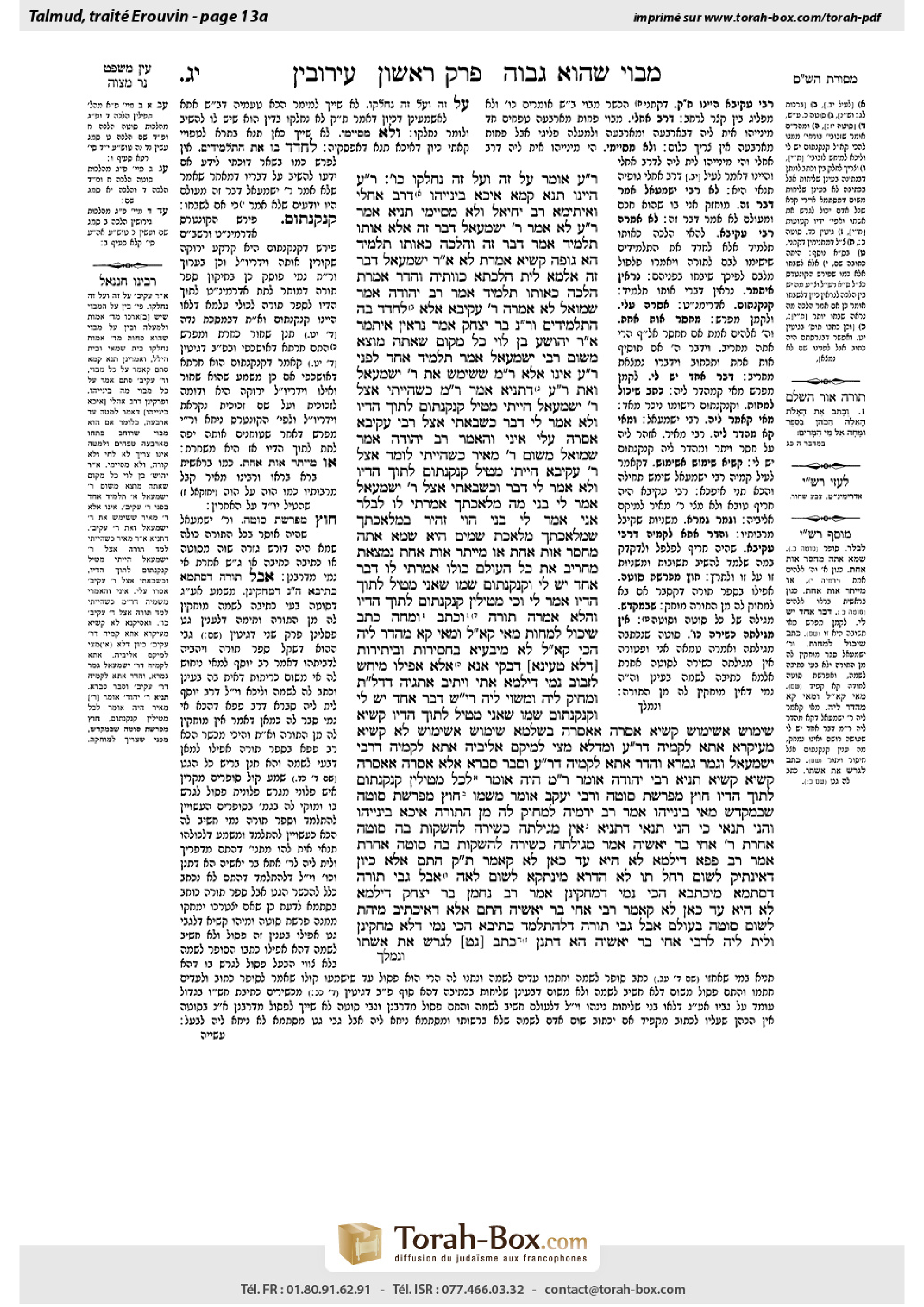
עירובין י״ג א · Aramaic and Hebrew text
רַבִּי עֲקִיבָא אוֹמֵר: עַל זֶה וְעַל זֶה נֶחְלְקוּ כּוּ׳.
רַבִּי עֲקִיבָא הַיְינוּ תַּנָּא קַמָּא! אִיכָּא בֵּינַיְיהוּ דְּרַב אַחְלַי, וְאִיתֵּימָא רַב יְחִיאֵל. וְלָא מְסַיְּימִי.
תַּנְיָא, אָמַר רַבִּי עֲקִיבָא: לָא אָמַר רַבִּי יִשְׁמָעֵאל דָּבָר זֶה, אֶלָּא אוֹתוֹ תַּלְמִיד אָמַר דָּבָר זֶה, וַהֲלָכָה כְּאוֹתוֹ תַּלְמִיד.
הָא גּוּפַהּ קַשְׁיָא: אָמְרַתְּ ״לָא אָמַר רַבִּי יִשְׁמָעֵאל דָּבָר זֶה״ — אַלְמָא לֵית הִלְכְתָא כְּווֹתֵיהּ, וַהֲדַר אָמְרַתְּ: ״הֲלָכָה כְּאוֹתוֹ תַּלְמִיד״!
אָמַר רַב יְהוּדָה אָמַר שְׁמוּאֵל: לֹא אֲמָרָהּ רַבִּי עֲקִיבָא אֶלָּא לְחַדֵּד בָּהּ הַתַּלְמִידִים.
וְרַב נַחְמָן בַּר יִצְחָק אָמַר: נִרְאִין אִיתְּמַר.
אָמַר רַבִּי יְהוֹשֻׁעַ בֶּן לֵוִי: כׇּל מָקוֹם שֶׁאַתָּה מוֹצֵא ״מִשּׁוּם רַבִּי יִשְׁמָעֵאל אָמַר תַּלְמִיד אֶחָד לִפְנֵי רַבִּי עֲקִיבָא״ — אֵינוֹ אֶלָּא רַבִּי מֵאִיר, שֶׁשִּׁימֵּשׁ אֶת רַבִּי יִשְׁמָעֵאל וְאֶת רַבִּי עֲקִיבָא.
דְּתַנְיָא, אָמַר רַבִּי מֵאִיר: כְּשֶׁהָיִיתִי אֵצֶל רַבִּי יִשְׁמָעֵאל הָיִיתִי מֵטִיל קַנְקַנְתּוֹם לְתוֹךְ הַדְּיוֹ, וְלֹא אָמַר לִי דָּבָר. כְּשֶׁבָּאתִי אֵצֶל רַבִּי עֲקִיבָא, אֲסָרָהּ עָלַי.
אִינִי?! וְהָאָמַר רַב יְהוּדָה אָמַר שְׁמוּאֵל מִשּׁוּם רַבִּי מֵאִיר: כְּשֶׁהָיִיתִי לוֹמֵד אֵצֶל רַבִּי עֲקִיבָא הָיִיתִי מֵטִיל קַנְקַנְתּוֹם לְתוֹךְ הַדְּיוֹ, וְלֹא אָמַר לִי דָּבָר. וּכְשֶׁבָּאתִי אֵצֶל רַבִּי יִשְׁמָעֵאל, אָמַר לִי: בְּנִי, מָה מְלַאכְתֶּךָ? אָמַרְתִּי לוֹ: לַבְלָר אֲנִי. אָמַר לִי: בְּנִי, הֱוֵי זָהִיר בִּמְלַאכְתֶּךָ, שֶׁמְּלַאכְתְּךָ מְלֶאכֶת שָׁמַיִם הִיא, שֶׁמָּא אַתָּה מְחַסֵּר אוֹת אַחַת אוֹ מְיַיתֵּר אוֹת אַחַת — נִמְצֵאתָ מַחֲרִיב אֶת כָּל הָעוֹלָם כּוּלּוֹ.
אָמַרְתִּי לוֹ: דָּבָר אֶחָד יֵשׁ לִי וְ׳קַנְקַנְתּוֹם׳ שְׁמוֹ, שֶׁאֲנִי מֵטִיל לְתוֹךְ הַדְּיוֹ. אָמַר לִי: וְכִי מְטִילִין קַנְקַנְתּוֹם לְתוֹךְ הַדְּיוֹ? וַהֲלֹא אָמְרָה תּוֹרָה: ״וְכָתַב וּמָחָה״, כְּתָב שֶׁיָּכוֹל לִמָּחוֹת.
מַאי קָאֲמַר לֵיהּ, וּמַאי קָא מְהַדַּר לֵיהּ?
הָכִי קָאֲמַר לֵיהּ: לָא מִיבַּעְיָא בַּחֲסֵירוֹת וּבִיתֵירוֹת [דְּלָא טָעֵינָא] — דְּבָקִי אֲנָא, אֶלָּא אֲפִילּוּ מֵיחַשׁ לִזְבוּב נָמֵי, דִּילְמָא אָתֵי וְיָתֵיב אַתָּגֵיהּ דְּדָלֶת וּמָחֵיק לֵיהּ וּמְשַׁוֵּי לֵיהּ רֵישׁ — דָּבָר אֶחָד יֵשׁ לִי וְקַנְקַנְתּוֹם שְׁמוֹ שֶׁאֲנִי מֵטִיל לְתוֹךְ הַדְּיוֹ.
קַשְׁיָא שִׁימּוּשׁ אַשִּׁימּוּשׁ, קַשְׁיָא אֲסָרָהּ אַאֲסָרָהּ.
בִּשְׁלָמָא שִׁימּוּשׁ אַשִּׁימּוּשׁ לָא קַשְׁיָא: מֵעִיקָּרָא אֲתָא לְקַמֵּיהּ דְּרַבִּי עֲקִיבָא, וּמִדְּלָא מָצֵי לְמֵיקַם אַלִּיבֵּיהּ — אֲתָא לְקַמֵּיהּ דְּרַבִּי יִשְׁמָעֵאל, וּגְמַר גְּמָרָא, וַהֲדַר אֲתָא לְקַמֵּיהּ דְּרַבִּי עֲקִיבָא, וּסְבַר סְבָרָא.
אֶלָּא אֲסָרָהּ אַאֲסָרָהּ קַשְׁיָא! קַשְׁיָא.
תַּנְיָא רַבִּי יְהוּדָה אוֹמֵר, רַבִּי מֵאִיר הָיָה אוֹמֵר: לַכֹּל מְטִילִין קַנְקַנְתּוֹם לְתוֹךְ הַדְּיוֹ, חוּץ מִפָּרָשַׁת סוֹטָה. וְרַבִּי יַעֲקֹב אוֹמֵר מִשְּׁמוֹ: חוּץ מִפָּרָשַׁת סוֹטָה שֶׁבַּמִּקְדָּשׁ.
מַאי בֵּינַיְיהוּ? אָמַר רַב יִרְמְיָה: לִמְחוֹק לָהּ מִן הַתּוֹרָה אִיכָּא בֵּינַיְיהוּ.
וְהָנֵי תַנָּאֵי כִי הָנֵי תַנָּאֵי, דְּתַנְיָא: אֵין מְגִילָּתָהּ כְּשֵׁירָה לְהַשְׁקוֹת בָּהּ סוֹטָה אַחֶרֶת. רַבִּי אַחַי בַּר יֹאשִׁיָּה אָמַר: מְגִילָּתָהּ כְּשֵׁירָה לְהַשְׁקוֹת בָּהּ סוֹטָה אַחֶרֶת.
אָמַר רַב פָּפָּא: דִּילְמָא לָא הִיא. עַד כָּאן לָא קָאָמַר תַּנָּא קַמָּא הָתָם — אֶלָּא כֵּיוָן דְּאִינְּתִיק לְשׁוּם רָחֵל תּוּ לָא הָדְרָא מִינַּתְקָא לְשׁוּם לֵאָה, אֲבָל גַּבֵּי תּוֹרָה דִּסְתָמָא מִיכַּתְבָא, הָכִי נָמֵי דְּמָחֲקִינַן.
אָמַר רַב נַחְמָן בַּר יִצְחָק, דִּילְמָא לָא הִיא: עַד כָּאן לָא קָאָמַר רַבִּי אַחַי בַּר יֹאשִׁיָּה הָתָם — אֶלָּא דְּאִיכְּתִיב מִיהַת לְשׁוּם סוֹטָה בָּעוֹלָם, אֲבָל גַּבֵּי תּוֹרָה, דִּלְהִתְלַמֵּד כְּתִיבָא — הָכִי נָמֵי דְּלָא מֵחַקְיָנָן.
וְלֵית לֵיהּ לְרַבִּי אַחַי בַּר יֹאשִׁיָּה הָא דִּתְנַן: כָּתַב [גֵּט] לְגָרֵשׁ אֶת אִשְׁתּוֹ,
Eruvin 13a · English translation
The mishna relates that a student recited a halakha before Rabbi Akiva, and he did not accept the student’s version of the dispute between Beit Shammai and Beit Hillel, as Rabbi Akiva said: They disagree about this, an alleyway less than four cubits wide, and about that, an alleyway more than four cubits wide.
The Gemara asks: In that case, the opinion of Rabbi Akiva is identical with the opinion first tanna of the mishna, as he too holds that Beit Shammai and Beit Hillel disagree in all cases, irrespective of the width of the alleyway. The Gemara answers: There is a practical difference between them with regard to the halakha stated by Rav Aḥlai, and some say it was Rav Yeḥiel, that an alleyway less than four handbreadths wide requires no corrective action. However, their respective opinions are not defined; which tanna accepts the view of Rav Aḥlai and which tanna rejects it cannot be determined.
It was taught in a baraita that Rabbi Akiva said: Rabbi Yishmael did not state this matter, as it is unlikely that Rabbi Yishmael would err in this manner; rather, it was that disciple who stated that matter on his own, and the halakha is in accordance with the opinion of that disciple.
With regard to that baraita the Gemara asks: This baraita itself is difficult. You stated initially that Rabbi Yishmael did not state this matter; apparently the halakha is not in accordance with the opinion of the disciple. And then you said: The halakha is in accordance with the opinion of that disciple.
Rav Yehuda said that Shmuel said: Rabbi Akiva said that the halakha is in accordance with that disciple only to sharpen the minds of his students with his statement. Seeking to encourage his students to suggest novel opinions, he praised that disciple before them but did not actually rule in accordance with the disciple’s opinion.
And Rav Naḥman bar Yitzḥak said, in another attempt to resolve the contradiction: The statement of the disciple appears to be reasonable was stated. Although Rabbi Yishmael himself did not make that statement, the statement of the disciple is reasonable.
Rabbi Yehoshua ben Levi said: Anywhere that you find a statement introduced with: A certain disciple said before Rabbi Akiva in the name of Rabbi Yishmael, it is none other than Rabbi Meir, who was the student who served both Rabbi Yishmael and Rabbi Akiva.
As it was taught in a baraita that Rabbi Meir said: When I was a student with Rabbi Yishmael, I used to put iron sulfate [kankantom] into the ink with which I wrote Torah scrolls, and he did not say anything to me. When I came to study with Rabbi Akiva, he prohibited me from doing so.
The Gemara challenges this statement: Is that so? Didn’t Rav Yehuda say that Shmuel said in the name of Rabbi Meir: When I studied with Rabbi Akiva as his disciple, I used to put iron sulfate into the ink, and he did not say anything to me. But when I came to study with Rabbi Yishmael, he said to me: My son, what is your vocation? I replied: I am a scribe [lavlar] who writes Torah scrolls. He said to me: My son, be careful in your vocation, as your vocation is heavenly service, and care must be taken lest you omit a single letter or add a single letter out of place, and you will end up destroying the whole world in its entirety. Addition or omission of a single letter can change the meaning from truth [emet] to death [met].
I said to him: I have one substance called iron sulfate, which I place into the ink, and therefore I am not concerned. He said to me: May one place iron sulfate into the ink? Didn’t the Torah state with regard to sota: “And the priest shall write these curses in a book, and he shall blot them out into the water of bitterness” (Numbers 5:23)? The Torah requires writing that can be blotted out.
The Gemara clarifies elements of the conversation: What is Rabbi Yishmael saying to Rabbi Meir, and what is he answering him? Rabbi Meir’s response with regard to iron sulfate does not seem to address Rabbi Yishmael’s comments with regard to omissions and additions.
The Gemara explains that this is what Rabbi Meir is saying to Rabbi Yishmael: There is no need to mention defective and plene words, as I am an expert; however, even with regard to the concern that a fly might come and land on the crown of the letter dalet and blot it out and render it a reish, thereby changing the meaning of the word, I am not concerned, as I have a substance called iron sulfate that I place into the ink so that it will not be erased.
Nevertheless, there is a difficulty between service and service, as one source states that Rabbi Meir initially served Rabbi Akiva, whereas the other source states that he served Rabbi Yishmael first. There is a difficulty between the words he prohibited it in the baraita, which is referring to Rabbi Akiva, and he prohibited it in the statement of Rav Yehuda, which is referring to Rabbi Yishmael.
The Gemara comments: Granted, there is no difficulty between the accounts in the two sources with regard to service and service, as it can be suggested as follows: Rabbi Meir initially came to study before Rabbi Akiva, and since he was unable to comprehend the teachings in accordance with his opinion, he came before Rabbi Yishmael and studied the tradition, and again came before Rabbi Akiva and studied logical analysis. After studying the basic principles from Rabbi Yishmael, he was able to understand the more complex teachings of Rabbi Akiva.
Having reconciled the first difficulty, the Gemara continues: However, the difficulty with regard to whether Rabbi Akiva prohibited iron sulfate or Rabbi Yishmael prohibited it remains difficult. The Gemara notes: It indeed remains difficult; no answer was found.
The Gemara continues the discussion of iron sulfate. It was taught in a baraita: Rabbi Yehuda says that Rabbi Meir would say: One may place iron sulfate into the ink that is to be used for all sacred writings, except for the writing of the Torah passage with regard to a sota, as it must be possible to erase that writing. Rabbi Ya’akov says in his name: Except for the writing of the Torah passage with regard to a sota used in the Temple in the ordeal to determine the guilt or innocence of the wife suspected of adultery.
The Gemara asks: What is the difference between their opinions, i.e., what is their point of dispute? The Gemara answers: Rav Yirmeya said: The difference between their opinions is whether it is permissible to erase the passage of a sota from a Torah scroll. The tanna’im of the baraita disagree whether or not a section taken from a Torah scroll may be used for this purpose, or whether a special scroll must be written for use in the ordeal of the sota.
And those tanna’im disagree in the same dispute as these tanna’im, as it was taught in a baraita: A scroll that was written for one woman suspected of infidelity but was not used, her scroll is not fit to prepare the water to give to another sota to drink. However, Rabbi Aḥai bar Yoshiya said: Her scroll is fit to be used to prepare the water to give another sota to drink. The legal status of a Torah scroll, which is not written for a particular sota, should be the same.
Rav Pappa said: Perhaps that is not the case, as the two circumstances are not comparable. The first tanna of the baraita stated his opinion that one woman’s scroll may not be used for another woman only there; since it had originally been designated in the name of one woman, e.g., Rachel, it cannot then be designated in the name of another woman, e.g., Leah. However, in the case of a Torah scroll, which is written with no particular person in mind, he too may say that we may erase it to be used for another woman, and it is not disqualified because it was not written in her name.
Furthermore, Rav Naḥman bar Yitzḥak said in another attempt to resolve the matter: Perhaps it is not so, as an additional distinction exists between the two cases: Rabbi Aḥai bar Yoshiya stated his opinion that the first woman’s scroll may be used for another woman only there because at least, in that case, it was written for a particular sota in the world. However, in the case of a Torah scroll, which was written for study, he too would agree that we do not erase it.
The Gemara asks: And does Rabbi Aḥai bar Yoshiya not hold in accordance with that which we learned in a mishna: If one wrote a bill of divorce to divorce his wife,
Eruvin 13a · Traduction française (IA)
La Michna rapporte que l'étudiant a récité une halakha devant Rabbi Akiva, et il n'a pas accepté la version de l'étudiant concernant le débat entre Beit Shammai et Beit Hillel, car Rabbi Akiva disait : Ils divergent sur cela, un passage d'escalier moins large de quatre cubits, et sur cela, un passage d'escalier plus large de quatre cubits.
Le Guemara pose la question : Dans ce cas, l'opinion de Rabbi Akiva est identique à celle du premier tanna de la Michna, car il considère également que Beit Shammai et Beit Hillel divergent sur tous les cas, indépendamment de la largeur du passage d'escalier. Le Guemara répond : Il existe une différence pratique entre eux concernant la halakha énoncée par Rav Aḥlai, et certains disent qu'il s'agissait de Rav Yeḥiel, selon laquelle un passage d'escalier moins large de quatre paumes ne nécessite pas d'action corrective. Cependant, leurs opinions respectives ne sont pas définies ; on ne peut pas déterminer quel tanna accepte l'opinion de Rav Aḥlai et quel tanna la rejette.
Il a été enseigné dans une baraïta que Rabbi Akiva disait : Rabbi Yishmael n'a pas énoncé cette question, car il est peu probable qu'il ait commis une erreur de cette manière ; plutôt, c'était ce disciple qui a énoncé cette question à sa manière, et la halakha suit l'opinion de ce disciple.
Concernant cette baraïta, la Guemara pose la question : Cette baraïta elle-même est difficile. Vous avez dit initialement que Rabbi Yishmael n'avait pas énoncé cette matière ; apparemment la halakha ne suit pas l'opinion du tanna. Et puis vous dites : La halakha suit l'opinion de ce tanna.
Rav Yehuda a dit que Shmuel a dit : Rabbi Akiva disait que la halakha suit l'opinion de ce tanna uniquement pour affûter l'esprit de ses élèves avec cette déclaration. En cherchant à encourager ses élèves à proposer des opinions nouvelles, il a loué ce tanna devant eux mais n'a pas réellement décidé en faveur de l'opinion du tanna.
Et Rav Naḥman bar Yitzḥak a dit, dans une autre tentative pour résoudre la contradiction : La déclaration du tanna semble raisonnable. Bien que Rabbi Yishmael lui-même n'ait pas fait cette déclaration, la déclaration du tanna est raisonnable.
Rabbi Yehoshua ben Levi a dit : Partout où vous trouvez une déclaration introduite par : Un certain disciple a dit devant Rabbi Akiva en nom de Rabbi Yishmael, ce n'est autre que Rabbi Meir, qui était l'étudiant qui a suivi à la fois Rabbi Yishmael et Rabbi Akiva.
Comme il a été enseigné dans une baraïta que Rabbi Meir a dit : Quand j'étais disciple de Rabbi Yishmael, j'utilisais de l'oxyde de fer [kankantom] dans l'encre avec laquelle j'écrivais les scrolls de la Torah, et il n'a pas dit quoi que ce soit à mon sujet. Quand je suis venu étudier avec Rabbi Akiva, il m'a interdit de le faire.
Le Guemara conteste cette déclaration : Est-ce ainsi ? N'a pas dit Rav Yehuda que Shmuel a dit en nom de Rabbi Meir : Quand j'ai étudié avec Rabbi Akiva comme son disciple, j'utilisais de l'oxyde de fer dans l'encre, et il n'a pas dit quoi que ce soit à mon sujet. Mais quand je suis venu étudier avec Rabbi Yishmael, il m'a dit : Mon fils, quelle est ta profession ? J'ai répondu : Je suis un scribe [lavlar] qui écrit des scrolls de la Torah. Il m'a dit : Mon fils, sois prudent dans ta profession, car ta profession est un service céleste, et il faut prendre garde afin de ne pas omettre une seule lettre ou ajouter une seule lettre à l'endroit incorrect, et tu finirais par détruire le monde entier. L'omission ou l'ajout d'une seule lettre peut changer le sens d'une vérité [emet] en mort [met].
J'ai dit à lui : J'ai une substance appelée oxyde de fer que j'utilise dans l'encre, et par conséquent je ne m'inquiète pas. Il m'a dit : Est-ce permis d'utiliser de l'oxyde de fer dans l'encre ? N'a-t-on pas dit dans la Torah concernant la sota : « Et le prêtre écrira ces malédictions dans un livre, et il les effacera dans l'eau de l'amertume » (Nombres 5:23) ? La Torah exige une écriture qui peut être effacée.
Le Guemara clarifie les éléments de la conversation : Quel est le discours de Rabbi Yishmael à Rabbi Meir, et quelle est la réponse de Rabbi Meir ? La réponse de Rabbi Meir concernant l'oxyde de fer ne semble pas répondre aux commentaires de Rabbi Yishmael concernant les omissions et les additions.
Le Guemara explique que c'est ce que Rabbi Meir dit à Rabbi Yishmael : Il n'est pas nécessaire de mentionner les mots défectueux et pléni, car je suis un expert ; cependant, même concernant la crainte qu'un moustique vienne se poser sur le sommet de la lettre dalet et l'efface, le rendant en reish, modifiant ainsi le sens du mot, je ne m'inquiète pas, car j'ai une substance appelée oxyde de fer que j'utilise dans l'encre afin qu'elle ne soit pas effacée.
Cependant, il existe une difficulté entre les services et les services, car une source affirme que Rabbi Meir a d'abord étudié auprès de Rabbi Akiva, tandis que l'autre source affirme qu'il a d'abord étudié auprès de Rabbi Yishmael. Il existe une difficulté entre les paroles où il interdit cela dans la baraïta, qui fait référence à Rabbi Akiva, et où il interdit cela dans la déclaration de Rav Yehuda, qui fait référence à Rabbi Yishmael.
Le Guemara commente : C'est vrai, il n'y a pas de difficulté entre les sources concernant les services et les services, car on peut suggérer cela : Rabbi Meir a d'abord étudié auprès de Rabbi Akiva, et puisqu'il n'avait pas pu comprendre les enseignements selon son opinion, il est venu auprès de Rabbi Yishmael et a étudié la tradition, et à nouveau auprès de Rabbi Akiva et a étudié l'analyse logique. Après avoir étudié les principes fondamentaux auprès de Rabbi Yishmael, il a pu comprendre les enseignements plus complexes de Rabbi Akiva.
Ayant résolu la première difficulté, le Guemara continue : Cependant, la difficulté concernant le fait que Rabbi Akiva ait interdit l'oxyde de fer ou Rabbi Yishmael l'ait interdit reste difficile. Le Guemara note : Il reste effectivement difficile ; aucune réponse n'a été trouvée.
La Guemara poursuit la discussion sur le sulfate de fer. Il a été enseigné dans une baraïta : Rabbi Yéhuda dit que Rabbi Méir disait : On peut placer du sulfate de fer dans l’encre utilisée pour toutes les écritures sacrées, sauf pour l’écriture du passage de la Torah concernant la sota, car il faut qu’il soit possible d’effacer cette écriture. Rabbi Yaakov dit en son nom : Sauf pour l’écriture du passage de la Torah concernant la sota utilisée dans le Temple dans l’ordeal pour déterminer la culpabilité ou l’innocence de la femme soupçonnée d’adultère.
La Guemara demande : Quelle est la différence entre leurs opinions, c’est-à-dire quel est leur point de débat ? La Guemara répond : Rav Yirmeyah dit : La différence entre leurs opinions est de savoir si l’effacement du passage de la sota d’un rouleau de la Torah est permis. Les tannaïm de la baraïta divergent sur le fait que si une section tirée d’un rouleau de la Torah peut être utilisée à cette fin ou si un rouleau spécial doit être écrit pour l’ordeal de la sota.
Et ces tannaïm divergent dans le même débat que ceux-ci, car il a été enseigné dans une baraïta : Un rouleau écrit pour une femme soupçonnée d’adultère mais non utilisé, ne peut pas être utilisé pour préparer l’eau à donner à une autre sota à boire. Cependant, Rabbi Acha bar Yosséa dit : Son rouleau est adapté à être utilisé pour préparer l’eau à donner à une autre sota à boire. Le statut juridique d’un rouleau de la Torah, qui n’est pas écrit à l’intention d’une sota particulière, devrait être le même.
Rav Pappa dit : Peut-être que ce n’est pas le cas, car les deux cas ne sont pas comparables. Le premier tanna de la baraïta a exprimé son opinion selon laquelle le rouleau d’une femme ne peut être utilisé pour une autre femme que là où il était initialement désigné en son nom, par exemple Rachel, et ne peut donc plus être désigné en son nom pour une autre femme, par exemple Léa. Cependant, dans le cas d’un rouleau de la Torah, qui est écrit sans personne particulière en tête, il pourrait aussi dire que l’on peut l’effacer pour être utilisé pour une autre femme, et il n’est pas disqualifié car il n’a pas été écrit en son nom.
De plus, Rav Naḥman bar Yitzḥak a dit dans une autre tentative de résoudre cette question : Peut-être que ce n’est pas ainsi, car une distinction supplémentaire existe entre les deux cas : Rabbi Acha bar Yosséa a exprimé son opinion selon laquelle le rouleau de la première femme peut être utilisé pour une autre femme uniquement là où il était écrit à l’intention d’une sota particulière dans le monde. Cependant, dans le cas d’un rouleau de la Torah, qui a été écrit pour l’étude, il serait d’accord pour dire qu’on ne l’efface pas.
La Guemara demande : Et Rabbi Acha bar Yosséa ne tient-il pas compte de ce que nous avons appris dans une mitsna : Si l’on écrit un acte de divorce pour divorcer sa femme,
Traduction française générée par IA à partir de l’édition anglaise de Sefaria. Vérifie toujours un passage avec le texte source.
Text from Sefaria: William Davidson Edition - Vocalized Aramaic (CC BY NC); William Davidson Edition - English (CC BY NC).