Eruvin 13b: Talmud study for Daf Yomi
Study the Talmud for Daf Yomi with scanned pages, Hebrew text, English translations from Sefaria and AI-generated French translations.
Passage selection and English or AI-generated French translation are available where the scan has annotations. Daf Study is independent of Torah-Box and Sefaria.
Browse Eruvin · עירובין · All tractatesEruvin 13b text and translations
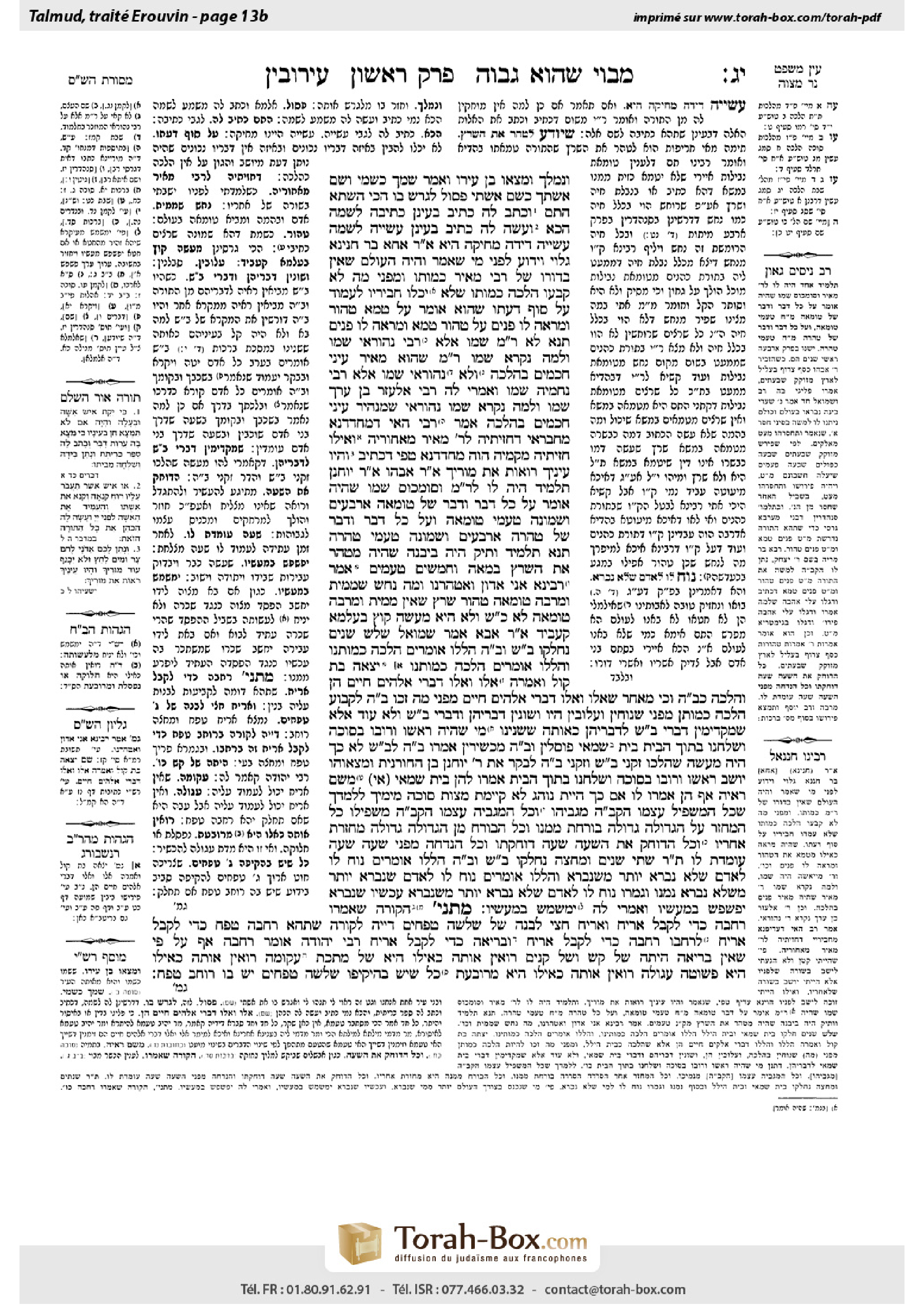
This page of Eruvin includes the Aramaic text, an English translation and an AI-generated French translation, alongside the scan above.
עירובין י״ג ב · Aramaic and Hebrew text
וְנִמְלַךְ וּמְצָאוֹ בֶּן עִירוֹ וְאָמַר: שִׁמְךָ כִּשְׁמִי וְשֵׁם אִשְׁתְּךָ כְּשֵׁם אִשְׁתִּי — פָּסוּל לְגָרֵשׁ בּוֹ!
הָכִי הַשְׁתָּא? הָתָם ״וְכָתַב לָהּ״ כְּתִיב — בָּעִינַן כְּתִיבָה לִשְׁמָהּ, הָכָא ״וְעָשָׂה לָהּ״ כְּתִיב — בָּעִינַן עֲשִׂיָּיה לִשְׁמָהּ, עֲשִׂיָּיה דִידַהּ מְחִיקָה הִיא.
אָמַר רַבִּי אַחָא בַּר חֲנִינָא: גָּלוּי וְיָדוּעַ לִפְנֵי מִי שֶׁאָמַר וְהָיָה הָעוֹלָם שֶׁאֵין בְּדוֹרוֹ שֶׁל רַבִּי מֵאִיר כְּמוֹתוֹ, וּמִפְּנֵי מָה לֹא קָבְעוּ הֲלָכָה כְּמוֹתוֹ? שֶׁלֹּא יָכְלוּ חֲבֵירָיו לַעֲמוֹד עַל סוֹף דַּעְתּוֹ. שֶׁהוּא אוֹמֵר עַל טָמֵא טָהוֹר וּמַרְאֶה לוֹ פָּנִים, עַל טָהוֹר טָמֵא וּמַרְאֶה לוֹ פָּנִים.
תָּנָא: לֹא רַבִּי מֵאִיר שְׁמוֹ אֶלָּא רַבִּי נְהוֹרַאי שְׁמוֹ, וְלָמָּה נִקְרָא שְׁמוֹ רַבִּי מֵאִיר? שֶׁהוּא מֵאִיר עֵינֵי חֲכָמִים בַּהֲלָכָה. וְלֹא נְהוֹרַאי שְׁמוֹ אֶלָּא רַבִּי נְחֶמְיָה שְׁמוֹ, וְאָמְרִי לַהּ רַבִּי אֶלְעָזָר בֶּן עֲרָךְ שְׁמוֹ, וְלָמָּה נִקְרָא שְׁמוֹ נְהוֹרַאי? שֶׁמַּנְהִיר עֵינֵי חֲכָמִים בַּהֲלָכָה.
אָמַר רַבִּי: הַאי דִּמְחַדַּדְנָא מֵחַבְרַאי דַּחֲזִיתֵיהּ לְרַבִּי מֵאִיר מֵאֲחוֹרֵיהּ, וְאִילּוּ חֲזִיתֵיהּ מִקַּמֵּיהּ הֲוָה מְחַדַּדְנָא טְפֵי — דִּכְתִיב: ״וְהָיוּ עֵינֶיךָ רוֹאוֹת אֶת מוֹרֶיךָ״.
אָמַר רַבִּי אֲבָהוּ אָמַר רַבִּי יוֹחָנָן: תַּלְמִיד הָיָה לוֹ לְרַבִּי מֵאִיר וְסוֹמְכוֹס שְׁמוֹ, שֶׁהָיָה אוֹמֵר עַל כׇּל דָּבָר וְדָבָר שֶׁל טוּמְאָה אַרְבָּעִים וּשְׁמוֹנֶה טַעֲמֵי טוּמְאָה, וְעַל כׇּל דָּבָר וְדָבָר שֶׁל טׇהֳרָה אַרְבָּעִים וּשְׁמוֹנֶה טַעֲמֵי טׇהֳרָה.
תָּנָא: תַּלְמִיד וָתִיק הָיָה בְּיַבְנֶה שֶׁהָיָה מְטַהֵר אֶת הַשֶּׁרֶץ בְּמֵאָה וַחֲמִשִּׁים טְעָמִים.
אָמַר רָבִינָא, אֲנִי אָדוּן וַאֲטַהֲרֶנּוּ: וּמָה נָחָשׁ שֶׁמֵּמִית וּמַרְבֶּה טוּמְאָה — טָהוֹר, שֶׁרֶץ שֶׁאֵין מֵמִית וּמַרְבֶּה טוּמְאָה — לֹא כׇּל שֶׁכֵּן!
וְלָא הִיא — מַעֲשֶׂה קוֹץ בְּעָלְמָא קָעָבֵיד.
אָמַר רַבִּי אַבָּא אָמַר שְׁמוּאֵל: שָׁלֹשׁ שָׁנִים נֶחְלְקוּ בֵּית שַׁמַּאי וּבֵית הִלֵּל, הַלָּלוּ אוֹמְרִים: הֲלָכָה כְּמוֹתֵנוּ, וְהַלָּלוּ אוֹמְרִים: הֲלָכָה כְּמוֹתֵנוּ. יָצְאָה בַּת קוֹל וְאָמְרָה: אֵלּוּ וָאֵלּוּ דִּבְרֵי אֱלֹהִים חַיִּים הֵן, וַהֲלָכָה כְּבֵית הִלֵּל.
וְכִי מֵאַחַר שֶׁאֵלּוּ וָאֵלּוּ דִּבְרֵי אֱלֹהִים חַיִּים, מִפְּנֵי מָה זָכוּ בֵּית הִלֵּל לִקְבּוֹעַ הֲלָכָה כְּמוֹתָן? מִפְּנֵי שֶׁנּוֹחִין וַעֲלוּבִין הָיוּ, וְשׁוֹנִין דִּבְרֵיהֶן וְדִבְרֵי בֵּית שַׁמַּאי, וְלֹא עוֹד אֶלָּא שֶׁמַּקְדִּימִין דִּבְרֵי בֵּית שַׁמַּאי לְדִבְרֵיהֶן.
כְּאוֹתָהּ שֶׁשָּׁנִינוּ: מִי שֶׁהָיָה רֹאשׁוֹ וְרוּבּוֹ בַּסּוּכָּה וְשֻׁלְחָנוֹ בְּתוֹךְ הַבַּיִת, בֵּית שַׁמַּאי פּוֹסְלִין וּבֵית הִלֵּל מַכְשִׁירִין. אָמְרוּ בֵּית הִלֵּל לְבֵית שַׁמַּאי: לֹא כָּךְ הָיָה מַעֲשֶׂה, שֶׁהָלְכוּ זִקְנֵי בֵּית שַׁמַּאי וְזִקְנֵי בֵּית הִלֵּל לְבַקֵּר אֶת רַבִּי יוֹחָנָן בֶּן הַחוֹרָנִית וּמְצָאוּהוּ יוֹשֵׁב רֹאשׁוֹ וְרוּבּוֹ בַּסּוּכָּה וְשֻׁלְחָנוֹ בְּתוֹךְ הַבַּיִת. אָמְרוּ לָהֶן בֵּית שַׁמַּאי: אִי מִשָּׁם רְאָיָה?! אַף הֵן אָמְרוּ לוֹ: אִם כָּךְ הָיִיתָ נוֹהֵג, לֹא קִיַּימְתָּ מִצְוַת סוּכָּה מִיָּמֶיךָ.
לְלַמֶּדְךָ שֶׁכׇּל הַמַּשְׁפִּיל עַצְמוֹ — הַקָּדוֹשׁ בָּרוּךְ הוּא מַגְבִּיהוֹ, וְכׇל הַמַּגְבִּיהַּ עַצְמוֹ — הַקָּדוֹשׁ בָּרוּךְ הוּא מַשְׁפִּילוֹ. כׇּל הַמְחַזֵּר עַל הַגְּדוּלָּה — גְּדוּלָּה בּוֹרַחַת מִמֶּנּוּ, וְכׇל הַבּוֹרֵחַ מִן הַגְּדוּלָּה — גְּדוּלָּה מְחַזֶּרֶת אַחֲרָיו, וְכׇל הַדּוֹחֵק אֶת הַשָּׁעָה — שָׁעָה דּוֹחַקְתּוֹ, וְכׇל הַנִּדְחֶה מִפְּנֵי שָׁעָה — שָׁעָה עוֹמֶדֶת לוֹ.
תָּנוּ רַבָּנַן: שְׁתֵּי שָׁנִים וּמֶחֱצָה נֶחְלְקוּ בֵּית שַׁמַּאי וּבֵית הִלֵּל. הַלָּלוּ אוֹמְרִים: נוֹחַ לוֹ לְאָדָם שֶׁלֹּא נִבְרָא יוֹתֵר מִשֶּׁנִּבְרָא, וְהַלָּלוּ אוֹמְרִים: נוֹחַ לוֹ לְאָדָם שֶׁנִּבְרָא יוֹתֵר מִשֶּׁלֹּא נִבְרָא. נִמְנוּ וְגָמְרוּ: נוֹחַ לוֹ לְאָדָם שֶׁלֹּא נִבְרָא יוֹתֵר מִשֶּׁנִּבְרָא, עַכְשָׁיו שֶׁנִּבְרָא — יְפַשְׁפֵּשׁ בְּמַעֲשָׂיו. וְאָמְרִי לַהּ: יְמַשְׁמֵשׁ בְּמַעֲשָׂיו.
מַתְנִי׳ הַקּוֹרָה שֶׁאָמְרוּ רְחָבָה כְּדֵי לְקַבֵּל אָרִיחַ. וְאָרִיחַ, חֲצִי לְבֵנָה שֶׁל שְׁלֹשָׁה טְפָחִים. דַּיָּיהּ לַקּוֹרָה שֶׁתְּהֵא רְחָבָה טֶפַח כְּדֵי לְקַבֵּל אָרִיחַ לְרׇחְבּוֹ.
רְחָבָה כְּדֵי לְקַבֵּל אָרִיחַ וּבְרִיאָה כְּדֵי לְקַבֵּל אָרִיחַ. רַבִּי יְהוּדָה אוֹמֵר: רְחָבָה אַף עַל פִּי שֶׁאֵין בְּרִיאָה. הָיְתָה שֶׁל קַשׁ וְשֶׁל קָנִים — רוֹאִין אוֹתָהּ כְּאִילּוּ הִיא שֶׁל מַתֶּכֶת.
עֲקוּמָּה — רוֹאִין אוֹתָהּ כְּאִילּוּ הִיא פְּשׁוּטָה, עֲגוּלָּה — רוֹאִין אוֹתָהּ כְּאִילּוּ הִיא מְרוּבַּעַת. כֹּל שֶׁיֵּשׁ בְּהֶיקֵּיפוֹ שְׁלֹשָׁה טְפָחִים יֵשׁ בּוֹ רוֹחַב טֶפַח.
Eruvin 13b · English translation
but later reconsidered and did not divorce her, and a resident of his city found him and said: Your name is the same as my name, and your wife’s name is the same as my wife’s name, and we reside in the same town; give me the bill of divorce, and I will use it to divorce my wife, then this document is invalid to divorce with it? Apparently, a man may not divorce his wife with a bill of divorce written for another woman, and the same should apply to the scroll of a sota.
The Gemara rejects this argument: How can you compare the two cases? There, with regard to a bill of divorce, it is written: “And he shall write for her” (Deuteronomy 24:1), and therefore we require writing it in her name, specifically for her; whereas here, with regard to a sota, it is written: “And he shall perform with her all this ritual” (Numbers 5:30), and therefore we require performance in her name. In her case, the performance is erasure; however, writing of the scroll need not be performed specifically for her.
On the topic of Rabbi Meir and his Torah study, the Gemara cites an additional statement. Rabbi Aḥa bar Ḥanina said: It is revealed and known before the One Who spoke and the world came into being that in the generation of Rabbi Meir there was no one of the Sages who is his equal. Why then didn’t the Sages establish the halakha in accordance with his opinion? It is because his colleagues were unable to ascertain the profundity of his opinion. He was so brilliant that he could present a cogent argument for any position, even if it was not consistent with the prevalent halakha. As he would state with regard to a ritually impure item that it is pure, and display justification for that ruling, and likewise he would state with regard to a ritually pure item that it is impure, and display justification for that ruling. The Sages were unable to distinguish between the statements that were halakha and those that were not.
It was taught in a baraita: Rabbi Meir was not his name; rather, Rabbi Nehorai was his name. And why was he called by the name Rabbi Meir? It was because he illuminates [meir] the eyes of the Sages in matters of the halakha. And Rabbi Nehorai was not the name of the tanna known by that name; rather, Rabbi Neḥemya was his name, and some say: Rabbi Elazar ben Arakh was his name. And why was he called by the name Rabbi Nehorai? It is because he enlightens [manhir] the eyes of the Sages in matters of the halakha.
The Gemara relates that Rabbi Yehuda HaNasi said: The fact that I am more incisive than my colleagues is due to the fact that I saw Rabbi Meir from behind, i.e., I sat behind him when I was his student. Had I seen him from the front, I would be even more incisive, as it is written: “And your eyes shall see your teacher” (Isaiah 30:20). Seeing the face of one’s teacher increases one’s understanding and sharpens one’s mind.
And the Gemara stated that Rabbi Abbahu said that Rabbi Yoḥanan said: Rabbi Meir had a disciple, and his name was Sumakhus, who would state with regard to each and every matter of ritual impurity forty-eight reasons in support of the ruling of impurity, and with regard to each and every matter of ritual purity forty-eight reasons in support of the ruling of purity.
It was taught in a baraita: There was a distinguished disciple at Yavne who could with his incisive intellect purify the creeping animal, explicitly deemed ritually impure by the Torah, adducing one hundred and fifty reasons in support of his argument.
Ravina said: I too will deliberate and purify it employing the following reasoning: And just as a snake that kills people and animals and thereby increases ritual impurity in the world, as a corpse imparts impurity through contact, through being carried, and by means of a tent, is ritually pure and transmits no impurity, a creeping animal that does not kill and does not increase impurity in the world, all the more so should it be pure.
The Gemara rejects this: And it is not so; that is not a valid a fortiori argument, as it can be refuted. A snake is performing a mere act of a thorn. A thorn causes injury and even death; nevertheless, it is not ritually impure. The same applies to a snake, and therefore this a fortiori argument is rejected.
Rabbi Abba said that Shmuel said: For three years Beit Shammai and Beit Hillel disagreed. These said: The halakha is in accordance with our opinion, and these said: The halakha is in accordance with our opinion. Ultimately, a Divine Voice emerged and proclaimed: Both these and those are the words of the living God. However, the halakha is in accordance with the opinion of Beit Hillel.
The Gemara asks: Since both these and those are the words of the living God, why were Beit Hillel privileged to have the halakha established in accordance with their opinion? The reason is that they were agreeable and forbearing, showing restraint when affronted, and when they taught the halakha they would teach both their own statements and the statements of Beit Shammai. Moreover, when they formulated their teachings and cited a dispute, they prioritized the statements of Beit Shammai to their own statements, in deference to Beit Shammai.
As in the mishna that we learned: In the case of one whose head and most of his body were in the sukka, but his table was in the house, Beit Shammai deem this sukka invalid; and Beit Hillel deem it valid. Beit Hillel said to Beit Shammai: Wasn’t there an incident in which the Elders of Beit Shammai and the Elders of Beit Hillel went to visit Rabbi Yoḥanan ben HaḤoranit, and they found him sitting with his head and most of his body in the sukka, but his table was in the house? Beit Shammai said to them: From there do you seek to adduce a proof? Those visitors, too, said to him: If that was the manner in which you were accustomed to perform the mitzva, you have never fulfilled the mitzva of sukka in all your days. It is apparent from the phrasing of the mishna that when the Sages of Beit Hillel related that the Elders of Beit Shammai and the Elders of Beit Hillel visited Rabbi Yoḥanan ben HaḤoranit, they mentioned the Elders of Beit Shammai before their own Elders.
This is to teach you that anyone who humbles himself, the Holy One, Blessed be He, exalts him, and anyone who exalts himself, the Holy One, Blessed be He, humbles him. Anyone who seeks greatness, greatness flees from him, and, conversely, anyone who flees from greatness, greatness seeks him. And anyone who attempts to force the moment and expends great effort to achieve an objective precisely when he desires to do so, the moment forces him too, and he is unsuccessful. And conversely, anyone who is patient and yields to the moment, the moment stands by his side, and he will ultimately be successful.
The Sages taught the following baraita: For two and a half years, Beit Shammai and Beit Hillel disagreed. These say: It would have been preferable had man not been created than to have been created. And those said: It is preferable for man to have been created than had he not been created. Ultimately, they were counted and concluded: It would have been preferable had man not been created than to have been created. However, now that he has been created, he should examine his actions that he has performed and seek to correct them. And some say: He should scrutinize his planned actions and evaluate whether or not and in what manner those actions should be performed, so that he will not sin.
MISHNA: The cross beam, which the Sages stated may be used to render an alleyway fit for one to carry within it, must be wide enough to receive and hold a small brick. And this small brick is half a large brick, which measures three handbreadths, i.e., a handbreadth and a half. It is sufficient that the cross beam will be a handbreadth in width, not a handbreadth and a half, enough to hold a small brick across its width.
And the cross beam must be wide enough to hold a small brick and also sturdy enough to hold a small brick and not collapse. Rabbi Yehuda says: If it is wide enough to hold the brick, even though it is not sturdy enough to actually support it, it is sufficient. Therefore, even if the cross beam is made of straw or reeds, one considers it as though it were made of metal.
If the cross beam is curved, so that a small brick cannot rest on it, one considers it as though it were straight; if it is round, one considers it as though it were square. The following principle was stated with regard to a round cross beam: Any beam with a circumference of three handbreadths is a handbreadth in width, i.e., in diameter.
Eruvin 13b · Traduction française (IA)
mais il a finalement réfléchi et n’a pas divorcé d’elle, et un habitant de sa ville l’a trouvé et a dit : Ton nom est le même que le mien, et le nom de ta femme est le même que celui de ma femme, et nous habitons dans la même ville ; donne-moi le document de divorce, et je l’utiliserai pour divorcer ma femme, alors ce document est-il invalide pour divorcer ? Apparemment, un homme ne peut pas divorcer sa femme avec un document de divorce écrit pour une autre femme, et la même chose s’applique au rouleau de la sota.
La Guemara rejette cet argument : Comment peux-tu comparer ces deux cas ? Là, concernant le document de divorce, il est écrit : « Et il écrira pour elle » (Deutéronome 24:1), et donc nous exigeons qu’il soit écrit en son nom, spécifiquement pour elle ; tandis que là, concernant la sota, il est écrit : « Et il accomplira avec elle toutes ces cérémonies » (Nombres 5:30), et donc nous exigeons qu’il soit accompli en son nom. Dans ce cas, l’accomplissement est l’effacement ; cependant, l’écriture du rouleau n’a pas besoin d’être accomplie spécifiquement pour elle.
Sur le sujet de Rabbi Meir et son étude de la Torah, la Guemara cite une autre déclaration. Rabbi Acha bar Chanina a dit : Il est révélé et connu devant celui qui a parlé et que le monde est entré en être que dans la génération de Rabbi Meir, il n’y avait personne parmi les Sages qui soit son égal. Pourquoi alors les Sages n’ont-ils pas établi la halakha selon son avis ? C’est parce que ses collègues n’ont pas pu déterminer la profondeur de son avis. Il était si brillant qu’il pouvait présenter un argument convaincant pour toute position, même si celle-ci ne correspondait pas à la halakha dominante. Comme il disait concernant un objet rituellement impur qu’il est pur, et présentait une justification pour cette décision, de même il disait concernant un objet rituellement pur qu’il est impur, et présentait une justification pour cette décision. Les Sages n’ont pas pu distinguer entre les déclarations qui étaient halakha et celles qui ne l’étaient pas.
Il a été enseigné dans une baraïta : Rabbi Meir n'était pas son nom ; plutôt, Rabbi Nehorai était son nom. Et pourquoi l'appelait-on par le nom Rabbi Meir ? C'est parce qu'il éclaire [meir] les yeux des Sages dans les affaires de la halakha. Et Rabbi Nehorai n'était pas le nom du tanna connu sous ce nom ; plutôt, Rabbi Néhémia était son nom, et certains disent : Rabbi Eléazar ben Arakh était son nom. Et pourquoi l'appelait-on par le nom Rabbi Nehorai ? C'est parce qu'il éclaire [manhir] les yeux des Sages dans les affaires de la halakha.
La Guemara rapporte que Rabbi Yéhouda HaNasi a dit : Le fait que je sois plus aigu que mes collègues est dû au fait que j'ai vu Rabbi Meir de dos, c'est-à-dire que j'ai été assis derrière lui lorsque j'étais son élève. Si j'avais vu son visage, je serais encore plus aigu, car il est écrit : « Et tes yeux verront ton maître » (Isaïe 30:20). Voir le visage de son maître augmente la compréhension et affûté l'esprit.
Et la Guemara a dit que Rabbi Abbahu a dit que Rabbi Yoḥanan a dit : Rabbi Meir avait un disciple, et son nom était Sumakhus, qui disait concernant chaque affaire de souillure rituelle quarante-huit raisons en faveur de la décision de souillure, et concernant chaque affaire de pureté rituelle quarante-huit raisons en faveur de la décision de pureté.
Il a été enseigné dans une baraïta : Il y avait un disciple distingué à Yavne qui pouvait, avec son esprit aigu, purifier l’animal rampant, explicitement déclaré souillé rituellement par la Torah, établissant cent cinquante raisons en faveur de son argument.
Ravina a dit : Je aussi je réfléchirai et le purifierai en utilisant le raisonnement suivant : Et tout comme un serpent qui tue les gens et les animaux et qui augmente ainsi la souillure rituelle dans le monde, comme un cadavre transmet la souillure par le contact, par le transport et par le moyen d’un tente, est pur et ne transmet aucune souillure, un animal rampant qui ne tue pas et qui ne augmente pas la souillure dans le monde, tout autant devrait-il être pur.
La Guemara rejette cela : Et ce n’est pas ainsi ; ce n’est pas un argument a fortiori valide, car il peut être réfuté. Un serpent est un simple acte d’une épine. Une épine cause une blessure et même la mort ; néanmoins, elle n’est pas souillante rituellement. Le même cas s’applique à un serpent, et donc cet argument a fortiori est rejeté.
Rabbi Abba a dit que Shmuel a dit : Pendant trois ans, Beit Shammai et Beit Hillel ont disputé. Ils disaient : La halakha est selon notre opinion, et ils disaient : La halakha est selon notre opinion. Finalement, une Voix Divine est sortie et a proclamé : Les deux et les deux sont les paroles du Dieu vivant. Cependant, la halakha est selon l’opinion de Beit Hillel.
La Guemara pose la question : Puisque les deux et les deux sont les paroles du Dieu vivant, pourquoi Beit Hillel a-t-il été privilégié à avoir la halakha établie selon leur opinion ? La raison est qu’ils étaient agréables et tolérants, montrant de la retenue lorsqu’ils étaient offensés, et lorsqu’ils enseignaient la halakha, ils enseignaient à la fois leurs propres déclarations et celles de Beit Shammai. De plus, lorsqu’ils formaient leurs enseignements et citaient une dispute, ils priorisaient les déclarations de Beit Shammai par rapport à leurs propres déclarations, en hommage à Beit Shammai.
Comme dans la mitsva que nous avons appris : Dans le cas d'une personne dont la tête et la plus grande partie de son corps étaient dans la sukka, mais sa table était dans la maison, Beit Shammai considère cette sukka comme invalide ; Beit Hillel la considère comme valide. Beit Hillel a dit à Beit Shammai : N'y a-t-il pas eu un incident où les anciens de Beit Shammai et les anciens de Beit Hillel sont allés rendre visite à Rabbi Yoḥanan ben HaḤoranit, et ils l'ont trouvé assis avec sa tête et la plus grande partie de son corps dans la sukka, mais sa table dans la maison ? Beit Shammai a répondu à ceux-ci : De là, vous voulez tirer une preuve ? Ces visiteurs ont dit à lui : Si c'était la manière dont vous étiez habitué à accomplir la mitsva, vous n'avez jamais accompli la mitsva de sukka durant toute votre vie. Il est évident, à partir de la formulation de la mitsva, que lorsque les sages de Beit Hillel ont mentionné que les anciens de Beit Shammai et les anciens de Beit Hillel avaient rendu visite à Rabbi Yoḥanan ben HaḤoranit, ils ont mentionné d'abord les anciens de Beit Shammai avant leurs propres anciens.
Cela est pour vous apprendre que celui qui se humilie, le Saint, le Très Haut, le fait s'élever, et celui qui s'élève, le Saint, le Très Haut, le humilie. Celui qui cherche la grandeur, la grandeur s'éloigne de lui, et, inversement, celui qui fuit la grandeur, la grandeur le suit. Et celui qui tente de forcer le moment et dépense d'énormes efforts pour atteindre un objectif précisément lorsqu'il le désire, le moment le force également, et il échoue. Et inversement, celui qui est patient et se soumet au moment, le moment est à ses côtés, et il finira par réussir.
Les Sages ont enseigné la suivante baraïta : Beit Shammai et Beit Hillel ont été en désaccord pendant deux et demi ans. Ils disaient : Il aurait été préférable que l'homme n'ait pas été créé plutôt que de l'être. Et ceux-ci disaient : Il est préférable que l'homme ait été créé plutôt que ne l'être pas. Finalement, ils ont été comptés et ont conclu : Il aurait été préférable que l'homme n'ait pas été créé plutôt que de l'être. Cependant, maintenant qu'il a été créé, il devrait examiner ses actions qu'il a accomplies et chercher à les corriger. Et certains disaient : Il devrait examiner ses actions prévues et évaluer si et dans quelle mesure ces actions devraient être accomplies, afin de ne pas pécher.
MICHNA : La poutre transversale, que les Sages ont déclaré pouvoir être utilisée pour rendre un passage adapté à la portée, doit être suffisamment large pour recevoir et soutenir un petit pavé. Et ce petit pavé est la moitié d'un grand pavé, qui mesure trois paumes, c'est-à-dire une paume et demi. Il suffit que la poutre transversale ait une largeur d'une paume, pas une paume et demi, suffisante pour soutenir un petit pavé à travers sa largeur.
Et la poutre transversale doit être suffisamment large pour soutenir un petit pavé et suffisamment solide pour soutenir un petit pavé sans s'effondrer. Rabbi Yehuda dit : Si elle est suffisamment large pour soutenir le pavé, même si elle n'est pas suffisamment solide pour le supporter effectivement, elle est suffisante. Ainsi, même si la poutre transversale est faite de paille ou de roseaux, on la considère comme si elle était faite de métal.
Si la poutre transversale est courbée, de sorte qu'un petit briquet ne peut pas y reposer, on la considère comme si elle était droite ; si elle est ronde, on la considère comme si elle était carrée. Le principe suivant a été énoncé concernant une poutre transversale ronde : toute poutre dont la circonférence est de trois paumes est une paume en largeur, c'est-à-dire en diamètre.
Traduction française générée par IA à partir de l’édition anglaise de Sefaria. Vérifie toujours un passage avec le texte source.
Text from Sefaria: William Davidson Edition - Vocalized Aramaic (CC BY NC); William Davidson Edition - English (CC BY NC).