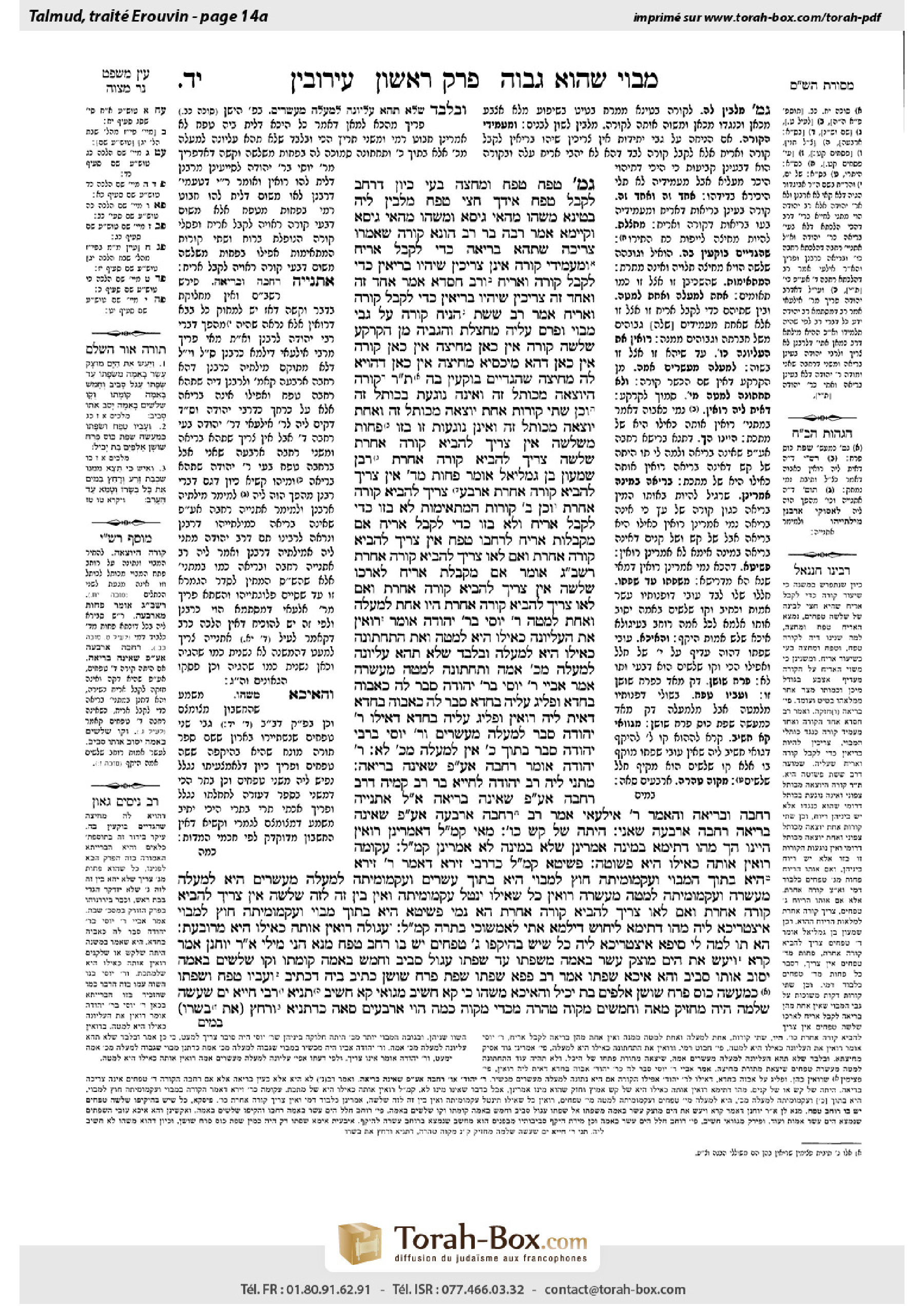
Eruvin 14a: Talmud study for Daf Yomi
Study the Talmud for Daf Yomi with scanned pages, Hebrew text, English translations from Sefaria and AI-generated French translations.
Passage selection and English or AI-generated French translation are available where the scan has annotations. Daf Study is independent of Torah-Box and Sefaria.
Browse Eruvin · עירובין · All tractatesEruvin 14a text and translations
This page of Eruvin includes the Aramaic text, an English translation and an AI-generated French translation, alongside the scan above.
עירובין י״ד א · Aramaic and Hebrew text
גְּמָ׳ טֶפַח, טֶפַח וּמֶחֱצָה בָּעֵי!
כֵּיוָן דְּרָחָב לְקַבֵּל טֶפַח, אִידַּךְ חֲצִי טֶפַח מְלַבֵּין לֵיהּ בְּטִינָא מַשֶּׁהוּ מֵהַאי גִּיסָא וּמַשֶּׁהוּ מֵהַאי גִּיסָא, וְקָיְימָא.
אָמַר רַבָּה בַּר רַב הוּנָא: קוֹרָה שֶׁאָמְרוּ — צְרִיכָה שֶׁתְּהֵא בְּרִיאָה כְּדֵי לְקַבֵּל אָרִיחַ, וּמַעֲמִידֵי קוֹרָה — אֵינָן צְרִיכִין שֶׁיִּהְיוּ בְּרִיאִין כְּדֵי לְקַבֵּל קוֹרָה וְאָרִיחַ. וְרַב חִסְדָּא אָמַר: אֶחָד זֶה וְאֶחָד זֶה צְרִיכִין שֶׁיִּהְיוּ בְּרִיאִין כְּדֵי לְקַבֵּל קוֹרָה וְאָרִיחַ.
אָמַר רַב שֵׁשֶׁת: הִנִּיחַ קוֹרָה עַל גַּבֵּי מָבוֹי, וּפָרַס עָלֶיהָ מַחְצֶלֶת וְהִגְבִּיהַּ מִן הַקַּרְקַע שְׁלֹשָׁה — קוֹרָה אֵין כָּאן מְחִיצָה אֵין כָּאן. קוֹרָה אֵין כָּאן — דְּהָא מִיכַּסְּיָא. מְחִיצָה אֵין כָּאן — דְּהָוְיָא לַהּ מְחִיצָה שֶׁהַגְּדָיִים בּוֹקְעִין בָּהּ.
תָּנוּ רַבָּנַן: קוֹרָה הַיּוֹצְאָה מִכּוֹתֶל זֶה וְאֵינָהּ נוֹגַעַת בְּכוֹתֶל זֶה, וְכֵן שְׁתֵּי קוֹרוֹת אַחַת יוֹצְאָה מִכּוֹתֶל זֶה וְאַחַת יוֹצְאָה מִכּוֹתֶל זֶה וְאֵינָן נוֹגְעוֹת זוֹ בָּזוֹ, פָּחוֹת מִשְּׁלֹשָׁה — אֵין צָרִיךְ לְהָבִיא קוֹרָה אַחֶרֶת. שְׁלֹשָׁה — צָרִיךְ לְהָבִיא קוֹרָה אַחֶרֶת.
רַבָּן שִׁמְעוֹן בֶּן גַּמְלִיאֵל אוֹמֵר: פָּחוֹת מֵאַרְבַּע — אֵין צָרִיךְ לְהָבִיא קוֹרָה אַחֶרֶת, אַרְבַּע — צָרִיךְ לְהָבִיא קוֹרָה אַחֶרֶת.
וְכֵן שְׁתֵּי קוֹרוֹת הַמַּתְאִימוֹת, לֹא בְּזוֹ כְּדֵי לְקַבֵּל אָרִיחַ וְלֹא בָּזוֹ כְּדֵי לְקַבֵּל אָרִיחַ, אִם מְקַבְּלוֹת אָרִיחַ לְרׇחְבּוֹ טֶפַח — אֵין צָרִיךְ לְהָבִיא קוֹרָה אַחֶרֶת, וְאִם לָאו — צָרִיךְ לְהָבִיא קוֹרָה אַחֶרֶת.
רַבָּן שִׁמְעוֹן בֶּן גַּמְלִיאֵל אוֹמֵר: אִם מְקַבֶּלֶת אָרִיחַ לְאׇרְכּוֹ שְׁלֹשָׁה — אֵין צָרִיךְ לְהָבִיא קוֹרָה אַחֶרֶת, וְאִם לָאו — צָרִיךְ לְהָבִיא קוֹרָה אַחֶרֶת.
הָיוּ אַחַת לְמַעְלָה וְאַחַת לְמַטָּה, רַבִּי יוֹסֵי בְּרַבִּי יְהוּדָה אוֹמֵר: רוֹאִין אֶת הָעֶלְיוֹנָה כְּאִילּוּ הִיא לְמַטָּה, וְאֶת הַתַּחְתּוֹנָה כְּאִילּוּ הִיא לְמַעְלָה, וּבִלְבַד שֶׁלֹּא תְּהֵא עֶלְיוֹנָה לְמַעְלָה מֵעֶשְׂרִים אַמָּה וְתַחְתּוֹנָה לְמַטָּה מֵעֲשָׂרָה.
אָמַר אַבָּיֵי: רַבִּי יוֹסֵי בְּרַבִּי יְהוּדָה סָבַר לַהּ כַּאֲבוּהּ בַּחֲדָא, וּפְלִיג עֲלֵיהּ בַּחֲדָא. סָבַר לַהּ כַּאֲבוּהּ בַּחֲדָא — דְּאִית לֵיהּ רוֹאִין.
וּפְלִיג עֲלֵיהּ בַּחֲדָא — דְּאִילּוּ רַבִּי יְהוּדָה סָבַר: לְמַעְלָה מֵעֶשְׂרִים, וְרַבִּי יוֹסֵי בְּרַבִּי יְהוּדָה סָבַר: בְּתוֹךְ עֶשְׂרִים אִין, לְמַעְלָה מֵעֶשְׂרִים לָא.
רַבִּי יְהוּדָה אוֹמֵר: רְחָבָה אַף עַל פִּי שֶׁאֵינָהּ בְּרִיאָה. מַתְנֵי לֵיהּ רַב יְהוּדָה לְחִיָּיא בַּר רַב קַמֵּיהּ דְּרַב: רְחָבָה אַף עַל פִּי שֶׁאֵינָהּ בְּרִיאָה. אֲמַר לֵיהּ: אַתְנְיֵיהּ, רְחָבָה וּבְרִיאָה.
וְהָאָמַר רַבִּי אִילְעַאי אָמַר רַב: רְחָבָה אַרְבָּעָה, אַף עַל פִּי שֶׁאֵינָהּ בְּרִיאָה! רְחָבָה אַרְבָּעָה שָׁאנֵי.
הָיְתָה שֶׁל קַשׁ כּוּ׳. מַאי קָא מַשְׁמַע לַן, דְּאָמְרִינַן רוֹאִין — הַיְינוּ הָךְ!
מַהוּ דְּתֵימָא: בְּמִינָהּ אָמְרִינַן, שֶׁלֹּא בְּמִינָהּ — לָא אָמְרִינַן. קָא מַשְׁמַע לַן.
עֲקוּמָּה רוֹאִין אוֹתָהּ כְּאִילּוּ הִיא פְּשׁוּטָה. פְּשִׁיטָא! קָא מַשְׁמַע לַן כִּדְרַבִּי זֵירָא. דְּאָמַר רַבִּי זֵירָא: הִיא בְּתוֹךְ הַמָּבוֹי וְעַקְמוּמִיתָהּ חוּץ לַמָּבוֹי, הִיא בְּתוֹךְ עֶשְׂרִים וְעַקְמוּמִיתָהּ לְמַעְלָה מֵעֶשְׂרִים, הִיא לְמַעְלָה מֵעֲשָׂרָה וְעַקְמוּמִיתָהּ לְמַטָּה מֵעֲשָׂרָה, רוֹאִין כׇּל שֶׁאִילּוּ יִנָּטֵל עַקְמוּמִיתָהּ וְאֵין בֵּין זֶה לָזֶה שְׁלֹשָׁה — אֵין צָרִיךְ לְהָבִיא קוֹרָה אַחֶרֶת, וְאִם לָאו — צָרִיךְ לְהָבִיא קוֹרָה אַחֶרֶת.
הָא נָמֵי פְּשִׁיטָא! הִיא בְּתוֹךְ מָבוֹי וְעַקְמוּמִיתָהּ חוּץ לַמָּבוֹי אִיצְטְרִיכָא לֵיהּ. מַהוּ דְּתֵימָא: לֵיחוּשׁ דִּילְמָא אָתֵי לְאִמְּשׁוֹכֵי בָּתְרַהּ. קָא מַשְׁמַע לַן.
עֲגוּלָּה רוֹאִין אוֹתָהּ כְּאִילּוּ הִיא מְרוּבַּעַת. הָא תּוּ לְמָה לִי? סֵיפָא אִיצְטְרִיכָא לֵיהּ: כֹּל שֶׁיֵּשׁ בְּהֶיקֵּפוֹ שְׁלֹשָׁה טְפָחִים יֵשׁ בּוֹ רֹחַב טֶפַח.
מְנָא הָנֵי מִילֵּי? אָמַר רַבִּי יוֹחָנָן, אָמַר קְרָא: ״וַיַּעַשׂ אֶת הַיָּם מוּצָק עֶשֶׂר בָּאַמָּה מִשְּׂפָתוֹ עַד שְׂפָתוֹ עָגֹל סָבִיב וְחָמֵשׁ בָּאַמָּה קוֹמָתוֹ וְקָו שְׁלֹשִׁים בָּאַמָּה יָסוֹב אוֹתוֹ סָבִיב״.
וְהָא אִיכָּא שְׂפָתוֹ?!
אָמַר רַב פָּפָּא: שְׂפָתוֹ שְׂפַת פֶּרַח שׁוֹשָׁן כְּתִיב בֵּיהּ, דִּכְתִיב: ״וְעׇבְיוֹ טֶפַח וּשְׂפָתוֹ כְּמַעֲשֵׂה כּוֹס פֶּרַח שׁוֹשָׁן אַלְפַּיִם בַּת יָכִיל״.
וְהָאִיכָּא מַשֶּׁהוּ! כִּי קָא חָשֵׁיב — מִגַּוַּאי קָא חָשֵׁיב.
תַּנְיָא רַבִּי חִיָּיא: יָם שֶׁעָשָׂה שְׁלֹמֹה הָיָה מַחֲזִיק מֵאָה וַחֲמִשִּׁים מִקְוֵה טׇהֳרָה. מִכְּדִי, מִקְוֶה כַּמָּה הָוֵי — אַרְבָּעִים סְאָה, כִּדְתַנְיָא: ״וְרָחַץ אֶת בְּשָׂרוֹ
Eruvin 14a · English translation
GEMARA: The Gemara questions the statement in the mishna with regard to the minimum width of the cross beam: A handbreadth? A handbreadth and a half is required, as a small brick is a handbreadth and a half wide.
The Gemara answers: Since the cross beam is wide enough to receive and hold a handbreadth, one can affix the remaining half handbreadth with plaster, a small amount on this side and a small amount on that side, and the brick will stand in place.
Rabba bar Rav Huna said: The cross beam of which the Sages spoke must be sturdy enough to receive and hold a small brick; however, the supports of the cross beam need not be sturdy enough to receive and hold a cross beam and a small brick. Criteria were established for the cross beam itself, which renders the alleyway fit for one to carry within it; criteria were not established for its supports. Rav Ḥisda disagreed and said: Both this, the beam, and that, its supports, must be sturdy enough to hold a cross beam and a small brick.
Rav Sheshet said: If one placed a cross beam over the entrance of an alleyway, and draped a mat over it, and raised the lower end of the mat three handbreadths from the ground, there is neither a cross beam here, nor is there a partition here to render the alleyway fit for one to carry within it. There is neither a cross beam here, as it is obscured and therefore inconspicuous. Nor is there a partition here, as it is a partition that is more than three handbreadths off the ground through which goats can pass, and therefore it does not have the legal status of a partition.
Our Sages taught in the Tosefta: If a cross beam projects from this wall of an alleyway but does not touch that wall opposite, and similarly, if there are two cross beams, one projecting from this wall and one projecting from that wall opposite, and they do not touch one another, if there is a gap of less than three handbreadths between the beam and the wall, or between the two beams respectively, one need not bring another cross beam to render the alleyway fit for one to carry within it, as they are considered joined based on the principle of lavud. However, if there is a gap of three handbreadths, one must bring another cross beam.
Rabban Shimon ben Gamliel says: If the gap is less than four handbreadths, one need not bring another cross beam. However, if it is four handbreadths, he must bring another cross beam, as in his opinion the principle of lavud applies to a gap up to four handbreadths wide.
And similarly, if two matching, extremely narrow cross beams are placed alongside each other, even though there is not sufficient width in this beam to receive a small brick, and there is not sufficient width in that beam, if the two beams together can receive a small brick along its handbreadth width, one need not bring another cross beam to render the alleyway fit for one to carry within it; but if not, one is required to bring another cross beam.
Rabban Shimon ben Gamliel says: If the two cross beams can receive a small brick along its length, which is three handbreadths, one need not bring another cross beam, but if not, one must bring another cross beam.
If these two narrow cross beams are placed one above and one below, Rabbi Yosei, son of Rabbi Yehuda, says: One considers the upper one as though it were below, and the lower one as though it were above, i.e., close together. If the two together are fit to hold a small brick, they render the alleyway fit for one to carry within it, although they are not actually close to each other, provided that the upper cross beam is not above twenty cubits and the lower one is not below ten handbreadths, between which a cross beam renders an alleyway fit for one to carry within it.
Abaye said: Rabbi Yosei, son of Rabbi Yehuda, holds in accordance with the opinion of his father with regard to one matter, and disagrees with his opinion with regard to one matter. He holds in accordance with the opinion of his father in one matter, as he is of the opinion that the principle: One considers, applies. Just as Rabbi Yehuda stated in the mishna that the cross beam is considered as though it were sturdy even though it is not, his son, Rabbi Yosei, holds that one considers two cross beams placed apart as though they were adjacent.
And Rabbi Yosei disagrees with his father’s opinion with regard to one matter. While Rabbi Yehuda holds that a cross beam renders an alleyway fit for one to carry within it even if it is higher than twenty cubits, Rabbi Yosei, son of Rabbi Yehuda, holds: Within twenty cubits, yes, it renders the alleyway fit for one to carry within it; above twenty, it does not.
It was stated in the mishna that Rabbi Yehuda says: It suffices if the cross beam is wide enough to hold a small brick, even though it is not sturdy enough to actually support it. Rav Yehuda taught this clause of the mishna to Ḥiyya bar Rav in the presence of Rav: It suffices if the cross beam is wide enough to hold a small brick, even though it is not sturdy enough to actually support it. Rav said to him: Teach it to him as follows: Wide enough and sturdy enough to hold a small brick.
The Gemara challenges this statement: Didn’t Rabbi Elai say that Rav said: A cross beam that is four handbreadths wide renders an alleyway fit for one to carry within it even if it is not sturdy enough to hold a small brick? The Gemara answers: A cross beam that is four handbreadths wide is different, as a beam of that width is considered a roof and not a beam. It is considered as though the edge of the roof descended and constituted an actual partition, not merely a conspicuous distinction.
It was stated in the mishna: Even if the cross beam is made of straw or reeds, one considers it as though it were made of metal. The Gemara asks: What is the mishna teaching us? If it is teaching that we say one considers the cross beam as though it were fit to bear a brick, then this clause is the same as the previous clause in the mishna: Wide enough even though it is not sturdy enough.
The Gemara answers: There is a novel point here, lest you say that with regard to a cross beam made of material that other beams of its own kind are sturdy, e.g., wood, we say that even the flimsiest of cross beams is considered sturdy. However, with regard to a cross beam made of material that only beams not of its own kind are sturdy, e.g., straw, which can never support a brick, we do not say that one considers the cross beam as if it were made of metal. Therefore, the mishna teaches us that there is no difference between the cases.
It was taught in the mishna: If the cross beam is curved, one considers it as though it were straight. The Gemara challenges: That is obvious. The Gemara answers that this is in accordance with the opinion of Rabbi Zeira, as Rabbi Zeira said: If the cross beam is inside the alleyway, and its curved section is outside the alleyway; or it is within twenty cubits of the ground, and its curved section is above twenty cubits; or it is above ten handbreadths, and its curved section is below ten handbreadths, meaning that the curved part of the beam is outside the area where a cross beam is effective, one considers the situation: In any case where, were the curved section outside the area where a cross beam is effective removed, there would not be a gap of three handbreadths between this effective part of the cross beam and that effective part of the cross beam, one need not bring another cross beam. And if not, if the gap would be greater, he must bring another cross beam.
The Gemara comments: That too is obvious, as the curved portion of the cross beam is considered as though it were straight. The Gemara explains: In a case where the cross beam is inside the alleyway and its curved portion is outside the alleyway, it was necessary for him to teach the halakha. Lest you say: Let us be concerned that he will come to be drawn after it and carry in the area where the curvature extends beyond the alleyway, Rabbi Zeira teaches us that this is not a concern.
The mishna continues: If the cross beam is round, one considers it as though it were square. The Gemara asks: Why do I need this clause as well? Similar cases were already taught in the mishna. The Gemara answers: It was necessary to teach the last clause of this section, i.e., the principle that any circle with a circumference of three handbreadths is a handbreadth in diameter.
The Gemara asks: From where are these matters, this ratio between circumference and diameter, derived? Rabbi Yoḥanan said that the verse said with regard to King Solomon: “And he made a molten sea, ten cubits from the one brim to the other: It was round all about, and its height was five cubits; and a line of thirty cubits did circle it round about” (I Kings 7:23).
The Gemara asks: But isn’t there its brim that must be taken into account? The diameter of the sea was measured from the inside, and if its circumference was measured from the outside, this ratio is no longer accurate.
Rav Pappa said: With regard to its brim, it is written that the brim is as the petals of a lily, as stated in the verse: “And it was a handbreadth thick; and its brim was wrought as the brim of a cup, as the petals of a lily; it contained two thousand bat” (I Kings 7:26). The brim was very thin.
The Gemara asks: But nevertheless, isn’t there the minimal amount of the thickness of the brim? The Gemara answers: When one calculates the circumference, he calculates from the inside.
Rabbi Ḥiyya taught in a baraita: The sea that Solomon fashioned contained a volume of one hundred and fifty baths of ritual purification. The Gemara asks: After all, with regard to a ritual bath, how much is its volume? It is forty se’a, as it was taught in a baraita: And he shall bathe his flesh
Eruvin 14a · Traduction française (IA)
GUEMARA : La Guemara questionne l'affirmation de la Michna concernant la largeur minimale de la traverse : une paume ? Une paume et demi est nécessaire, car une petite pierre est large d'une paume et demi.
La Guemara répond : Puisque la traverse est suffisamment large pour recevoir et tenir une paume, on peut fixer la moitié restante avec du plâtre, une petite quantité de ce côté et une petite quantité de l'autre côté, et la pierre restera en place.
Rabba bar Rav Huna a dit : La traverse dont les Sages parlaient doit être suffisamment solide pour recevoir et tenir une petite pierre ; cependant, les supports de la traverse n'ont pas besoin d'être suffisamment solides pour recevoir et tenir une traverse et une petite pierre. Des critères ont été établis pour la traverse elle-même, ce qui rend l'allée propre à la portée ; des critères n'ont pas été établis pour ses supports. Rav Ḥisda a contesté et a dit : À la fois cette traverse et ses supports doivent être suffisamment solides pour tenir une traverse et une petite pierre.
Rav Sheshet a dit : Si l'on place une traverse sur l'entrée d'une allée, et qu'on y suspend un tapis, et qu'on élève l'extrémité inférieure du tapis de trois paumes au-dessus du sol, il n'y a ni traverse ici, ni mur ici qui rende l'allée propre à la portée. Il n'y a pas de traverse ici, car elle est occultée et donc peu visible. Il n'y a pas non plus de mur ici, car c'est un mur qui est à plus de trois paumes au-dessus du sol par lequel les boucs peuvent passer, et donc il ne possède pas le statut juridique d'un mur.
Nos Sages ont enseigné dans la Tosefta : Si une traverse dépasse de ce mur d'une allée mais ne touche pas le mur opposé, et de même, si deux traverses, l'une dépasse de ce mur et l'autre de l'autre mur opposé, et qu'elles ne se touchent pas, si la distance entre la traverse et le mur, ou entre les deux traverses, est inférieure à trois paumes, on n'a pas besoin d'apporter une autre traverse pour rendre l'allée propre à la portée, car elles sont considérées comme jointes selon le principe de lavud. Cependant, si la distance est de trois paumes, on doit apporter une autre traverse.
Rabban Shimon ben Gamliel dit : Si la distance est inférieure à quatre paumes, on n'a pas besoin d'apporter une autre traverse. Cependant, si elle est de quatre paumes, il faut apporter une autre traverse, car selon son avis, le principe de lavud s'applique à une distance de jusqu'à quatre paumes de large.
Et de même, si deux traverses étroites et identiques sont placées côte à côte, même si la largeur de cette traverse n'est pas suffisante pour recevoir une petite pierre, et que celle-ci n'est pas non plus suffisante, si les deux traverses ensemble peuvent recevoir une petite pierre sur leur largeur de paume, on n'a pas besoin d'apporter une autre traverse pour rendre l'allée propre à la portée ; mais si ce n'est pas le cas, on doit apporter une autre traverse.
Rabban Shimon ben Gamliel dit : Si les deux traverses peuvent recevoir une petite pierre sur leur longueur, qui est de trois paumes, on n'a pas besoin d'apporter une autre traverse, mais si ce n'est pas le cas, on doit apporter une autre traverse.
Si ces deux traverses étroites sont placées l'une au-dessus et l'autre en dessous, Rabbi Yosei, fils de Rabbi Yehuda, dit : On considère la traverse supérieure comme si elle était en dessous, et la traverse inférieure comme si elle était au-dessus, c'est-à-dire proches l'une de l'autre. Si les deux traverses ensemble sont adaptées pour tenir une petite pierre, elles rendent l'allée propre à la portée, même si elles ne sont pas effectivement proches l'une de l'autre, à condition que la traverse supérieure ne soit pas au-dessus de vingt coudées et que la traverse inférieure ne soit pas en dessous de dix paumes, entre lesquelles une traverse rend l'allée propre à la portée.
Abaye a dit : Rabbi Yosei, fils de Rabbi Yehuda, suit l'opinion de son père concernant une question, et conteste son opinion concernant une autre question. Il suit l'opinion de son père concernant une question, car il est de l'avis que le principe : On considère, s'applique. Tout comme Rabbi Yehuda a affirmé dans la mitsna que la traverse est considérée comme solide même si elle ne l'est pas, son fils, Rabbi Yosei, considère deux traverses placées à distance l'une de l'autre comme si elles étaient adjacentes.
Et Rabbi Yosei conteste l'opinion de son père concernant une question. Bien que Rabbi Yehuda considère que la traverse rend l'allée propre à la portée même si elle est plus haute que vingt coudées, Rabbi Yosei, fils de Rabbi Yehuda, considère : Dans les vingt coudées, oui, elle rend l'allée propre à la portée ; au-delà, non.
Il a été dit dans la mitsna que Rabbi Yehuda dit : Il suffit que la traverse soit large assez pour tenir une petite pierre, même si elle n'est pas solide assez pour la supporter effectivement. Rav Yehuda a enseigné cette clause de la mitsna à Ḥiyya bar Rav en présence de Rav : Il suffit que la traverse soit large assez pour tenir une petite pierre, même si elle n'est pas solide assez pour la supporter effectivement. Rav a dit à lui : Enseigne-le-lui ainsi : Large et solide assez pour tenir une petite pierre.
La Guemara conteste cette affirmation : N’a-t-il pas dit Rabbi Elai que Rav a dit : Une traverse de quatre paumes de large rend l’allée propre à la portée, même si elle n’est pas solide assez pour tenir une petite pierre ? La Guemara répond : Une traverse de quatre paumes de large est différente, car une telle traverse est considérée comme un toit et non une traverse. Elle est considérée comme si la bordure du toit descendait et constituait un mur réel, et non simplement une distinction visible.
Il a été dit dans la Michna : Même si la traverse est faite de paille ou de roseaux, on la considère comme si elle était faite de métal. La Guemara pose la question : Qu'enseigne la Michna ? Si elle enseigne que nous disons qu'on considère la traverse comme si elle était adaptée à porter une pierre, alors cette clause est identique à la clause précédente de la Michna : suffisamment large même si elle n'est pas assez solide.
La Guemara répond : Il y a un point nouveau ici, afin que vous ne disiez pas que, concernant une traverse faite de matériaux dont d'autres traverses de même type sont solides, par exemple le bois, nous disons que même la traverse la plus fragile est considérée comme solide. Cependant, concernant une traverse faite de matériaux dont seules les traverses d'autres types sont solides, par exemple la paille, qui ne peut jamais supporter une pierre, nous ne disons pas qu'on considère la traverse comme si elle était faite de métal. Ainsi, la mitsna nous enseigne qu'il n'y a pas de différence entre ces cas.
Il a été enseigné dans la mitsna : Si la traverse est courbée, on la considère comme si elle était droite. La Guemara conteste : Cela est évident. La Guemara répond que cela est selon l'opinion de Rabbi Zéira, car Rabbi Zéira a dit : Si la traverse est à l'intérieur du passage et sa partie courbée est à l'extérieur du passage ; ou si elle est à moins de vingt coudées du sol et sa partie courbée est au-dessus de vingt coudées ; ou si elle est au-dessus de dix tefachim et sa partie courbée est en dessous de dix tefachim, c'est-à-dire que la partie courbée de la traverse est en dehors de la zone où une traverse est efficace, on considère la situation : Dans tout cas où, si la partie courbée en dehors de la zone où une traverse est efficace était enlevée, il ne resterait pas un espace de trois tefachim entre cette partie efficace de la traverse et cette autre partie efficace de la traverse, on n'a pas besoin d'apporter une autre traverse. Et si ce n'est pas le cas, c'est-à-dire si l'espace serait plus grand, il faut apporter une autre traverse.
La Guemara commente : Cela est également évident, car la partie courbée de la traverse est considérée comme si elle était droite. La Guemara explique : Dans le cas où la traverse est à l'intérieur du passage et sa partie courbée est à l'extérieur du passage, il était nécessaire de lui enseigner la halakha. Afin que vous ne disiez pas : Nous devons avoir peur qu'il vienne à suivre cette traverse et à porter dans la zone où la courbure dépasse le passage, Rabbi Zéira nous enseigne que cela n'est pas une préoccupation.
La mitsva continue : Si la traverse est ronde, on la considère comme si elle était carrée. La Guemara pose la question : Pourquoi ai-je besoin de cette clause également ? Des cas similaires ont déjà été enseignés dans la mitsva. La Guemara répond : Il était nécessaire d'enseigner la dernière clause de cette section, c'est-à-dire le principe selon lequel tout cercle dont le périmètre est de trois tefachim est un tefach en diamètre.
La Guemara pose la question : D'où proviennent ces matières, ce rapport entre le périmètre et le diamètre ? Rabbi Yochanan a dit que la parabole a dit concernant le roi Salomon : « Et il fit un bassin de métal fondu, dix coudées de l'un des rebords à l'autre : il était rond tout autour, et sa hauteur était cinq coudées ; et une ligne de trente coudées faisait le tour » (I Rois 7:23).
La Guemara pose la question : Mais n'y a-t-il pas son rebord qui doit être pris en compte ? Le diamètre de la mer était mesuré à l'intérieur, et si son périmètre était mesuré à l'extérieur, ce rapport n'est plus précis.
Rav Pappa a dit : Concernant son rebord, il est écrit que le rebord est comme les pétales d'une lis, comme indiqué dans la parole : « Et il était d'un tefach d'épaisseur ; et son rebord était façonné comme le rebord d'une coupe, comme les pétales d'une lis ; il contenait deux mille bat » (I Rois 7:26). Le rebord était très fin.
La Guemara pose la question : Mais néanmoins, n'y a-t-il pas la quantité minimale d'épaisseur du rebord ? La Guemara répond : Lorsqu'on calcule le périmètre, on le calcule à l'intérieur.
Rabbi Chiyaa a enseigné dans une baraïta : Le bassin que Salomon a façonné contenait un volume de cent cinquante baths de purification. La Guemara pose la question : Après tout, concernant un bassin de purification, quel est son volume ? Il est de quarante se'ah, comme il a été enseigné dans une baraïta : Et il devra se laver sa chair
Traduction française générée par IA à partir de l’édition anglaise de Sefaria. Vérifie toujours un passage avec le texte source.
Text from Sefaria: William Davidson Edition - Vocalized Aramaic (CC BY NC); William Davidson Edition - English (CC BY NC).