Eruvin 14b: Talmud study for Daf Yomi
Study the Talmud for Daf Yomi with scanned pages, Hebrew text, English translations from Sefaria and AI-generated French translations.
Passage selection and English or AI-generated French translation are available where the scan has annotations. Daf Study is independent of Torah-Box and Sefaria.
Browse Eruvin · עירובין · All tractatesEruvin 14b text and translations
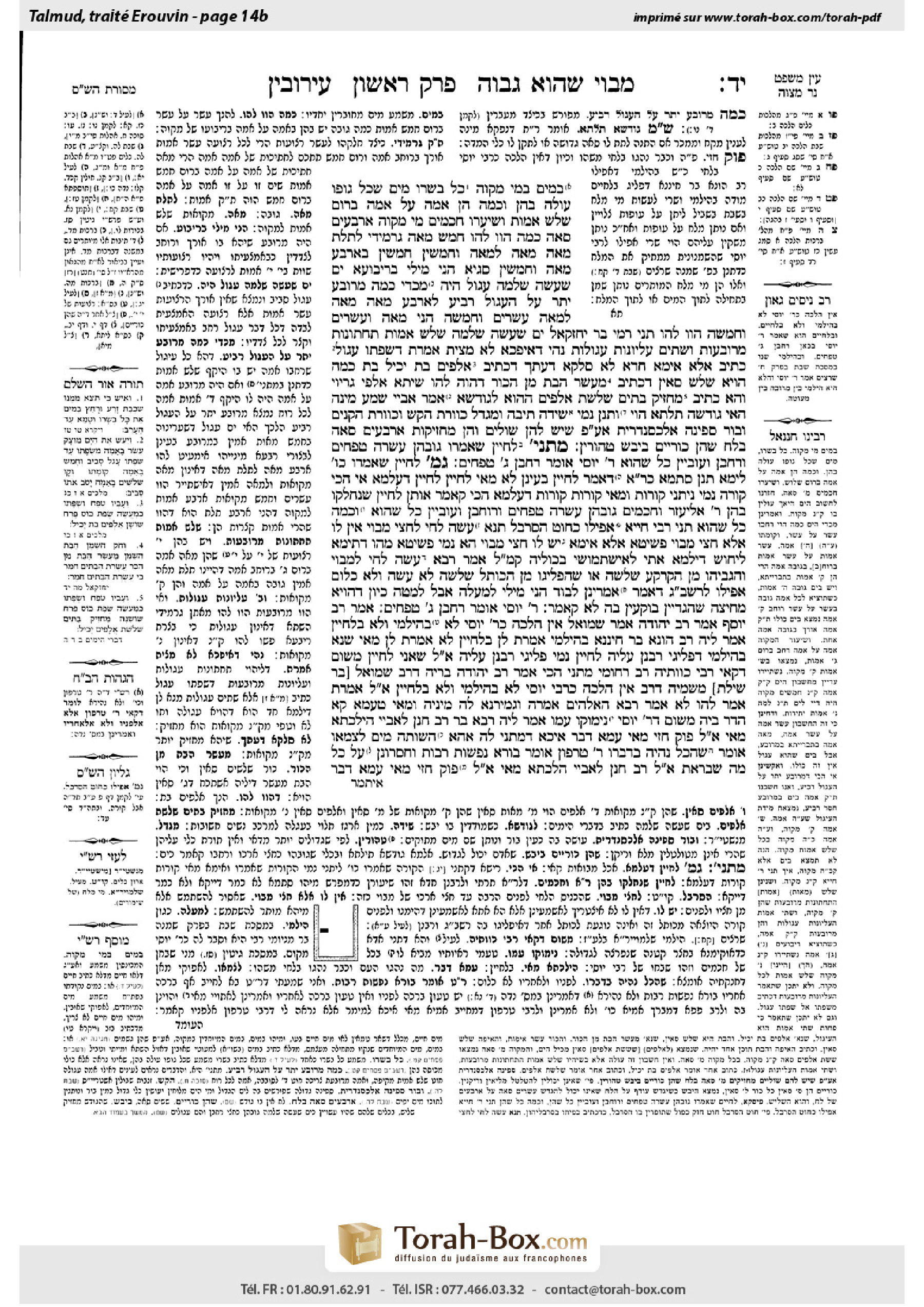
This page of Eruvin includes the Aramaic text, an English translation and an AI-generated French translation, alongside the scan above.
עירובין י״ד ב · Aramaic and Hebrew text
בְּמַיִם״ — בְּמֵי מִקְוֶה. ״כׇּל בְּשָׂרוֹ״ — מַיִם שֶׁכׇּל גּוּפוֹ עוֹלֶה בָּהֶן, וְכַמָּה הֵן? אַמָּה עַל אַמָּה בְּרוּם שָׁלֹשׁ אַמּוֹת. וְשִׁיעֲרוּ חֲכָמִים, מֵי מִקְוֶה אַרְבָּעִים סְאָה.
כַּמָּה הָווּ לְהוּ? חֲמֵשׁ מְאָה גַּרְמִידֵי, לִתְלָת מְאָה — מְאָה, לְמֵאָה וְחַמְשִׁין — חַמְשִׁין. בְּאַרְבַּע מְאָה וְחַמְשִׁין סַגִּיא!
הָנֵי מִילֵּי בְּרִיבּוּעָא — יָם שֶׁעָשָׂה שְׁלֹמֹה עָגוֹל הָיָה.
מִכְּדֵי, כַּמָּה מְרוּבָּע יָתֵר עַל הֶעָגוֹל? רְבִיעַ. לְאַרְבַּע מְאָה — מְאָה, לְמֵאָה — עֶשְׂרִים וַחֲמִשָּׁה. הָנֵי מֵאָה וְעֶשְׂרִים וַחֲמִשָּׁה הָווּ לְהוּ!
תָּנֵי רָמֵי בַּר יְחֶזְקֵאל: יָם שֶׁעָשָׂה שְׁלֹמֹה, שָׁלֹשׁ אַמּוֹת תַּחְתּוֹנוֹת מְרוּבָּעוֹת, וּשְׁתַּיִם עֶלְיוֹנוֹת עֲגוּלּוֹת.
נְהִי דְּאִיפְּכָא לָא מָצֵית אָמְרַתְּ — דִּ״שְׂפָתוֹ עָגוֹל״ כְּתִיב, אֶלָּא אֵימָא חֲדָא!
לָא סָלְקָא דַּעְתָּךְ, דִּכְתִיב: ״אַלְפַּיִם בַּת יָכִיל״. ״בַּת״ כַּמָּה הָוְיָא — שָׁלֹשׁ סְאִין, דִּכְתִיב: ״מַעְשַׂר הַבַּת מִן הַכּוֹר״, דְּהָוֵה לְהוּ שִׁיתָּא אַלְפֵי גְּרִיוֵי.
וְהָא כְּתִיב: ״מַחֲזִיק בַּתִּים שְׁלֹשֶׁת אֲלָפִים״? הָהוּא לְגוּדְשָׁא.
אָמַר אַבָּיֵי, שְׁמַע מִינַּהּ: הַאי גּוּדְשָׁה, תִּלְתָּא הָוֵי. וּתְנַן נָמֵי: שִׁידָּה תֵּיבָה וּמִגְדָּל, כַּוֶּורֶת הַקַּשׁ וְכַוֶּורֶת הַקָּנִים, וּבוֹר סְפִינָה אֲלֶכְּסַנְדְּרִית, אַף עַל פִּי שֶׁיֵּשׁ לָהֶן שׁוּלַיִם וְהֵן מַחֲזִיקוֹת אַרְבָּעִים סְאָה בַּלַּח, שֶׁהֵן כּוֹרַיִים בַּיָּבֵשׁ — טְהוֹרִין.
מַתְנִי׳ לְחָיַיִן שֶׁאָמְרוּ — גּוֹבְהָן עֲשָׂרָה טְפָחִים, וְרׇחְבָּן וְעוֹבְיָין כׇּל שֶׁהוּא. רַבִּי יוֹסֵי אוֹמֵר: רׇחְבָּן שְׁלֹשָׁה טְפָחִים.
גְּמָ׳ לְחָיַיִן שֶׁאָמְרוּ כּוּ׳. לֵימָא תְּנַן סְתָמָא כְּרַבִּי אֱלִיעֶזֶר, דְּאָמַר לְחָיַיִן בָּעִינַן?
לָא, מַאי לְחָיַיִן — לְחָיַיִן דְּעָלְמָא. אִי הָכִי, קוֹרָה נָמֵי — נִיתְנֵי קוֹרוֹת, וּמַאי קוֹרוֹת: קוֹרוֹת דְּעָלְמָא!
הָכִי קָאָמַר: אוֹתָן לְחָיַיִן שֶׁנֶּחְלְקוּ בָּהֶן רַבִּי אֱלִיעֶזֶר וַחֲכָמִים — גּוֹבְהָן עֲשָׂרָה טְפָחִים, וְרוֹחְבָּן וְעוֹבְיָין כׇּל שֶׁהוּא. וְכַמָּה כׇּל שֶׁהוּא, תָּנֵי רַבִּי חִיָּיא: אֲפִילּוּ כְּחוּט הַסַּרְבָּל.
תָּנָא עָשָׂה לֶחִי לַחֲצִי מָבוֹי אֵין לוֹ אֶלָּא חֲצִי מָבוֹי. פְּשִׁיטָא! אֶלָּא אֵימָא: יֵשׁ לוֹ חֲצִי מָבוֹי. הָא נָמֵי פְּשִׁיטָא! מַהוּ דְּתֵימָא: לֵיחוּשׁ דִּילְמָא אָתֵי לְאִישְׁתַּמּוֹשֵׁי בְּכוּלֵּיהּ, קָא מַשְׁמַע לַן.
אָמַר רָבָא: עָשָׂה לֶחִי לְמָבוֹי וְהִגְבִּיהוֹ מִן הַקַּרְקַע שְׁלֹשָׁה, אוֹ שֶׁהִפְלִיגוֹ מִן הַכּוֹתֶל שְׁלֹשָׁה — לֹא עָשָׂה וְלֹא כְלוּם. אֲפִילּוּ לְרַבָּן שִׁמְעוֹן בֶּן גַּמְלִיאֵל דְּאָמַר אָמְרִינַן לָבוּד — הָנֵי מִילֵּי לְמַעְלָה, אֲבָל לְמַטָּה, כֵּיוָן דְּהָוְיָא מְחִיצָה שֶׁהַגְּדָיִין בּוֹקְעִין בָּהּ — לָא קָאָמַר.
רַבִּי יוֹסֵי אוֹמֵר רׇחְבָּן שְׁלֹשָׁה טְפָחִים. אָמַר רַב יוֹסֵף אָמַר רַב יְהוּדָה אָמַר שְׁמוּאֵל: אֵין הֲלָכָה כְּרַבִּי יוֹסֵי לֹא בְּהֵילְמֵי וְלֹא בִּלְחָיַיִן.
אֲמַר לֵיהּ רַב הוּנָא בַּר חִינָּנָא: בְּהֵילְמֵי אֲמַרְתְּ לַן, בִּלְחָיַיִן לָא אֲמַרְתְּ לַן? מַאי שְׁנָא בְּהֵילְמֵי — דִּפְלִיגִי רַבָּנַן עֲלֵיהּ, לְחָיַיִן נָמֵי — פְּלִיגִי רַבָּנַן עֲלֵיהּ. אֲמַר לֵיהּ: שָׁאנֵי לְחָיַיִן, מִשּׁוּם דְּקָאֵי רַבִּי כְּווֹתֵיהּ.
רַב רְחוּמִי מַתְנֵי הָכִי: אָמַר רַב יְהוּדָה בְּרֵיהּ דְּרַב שְׁמוּאֵל [בַּר שִׁילַת] מִשְּׁמֵיהּ דְּרַב: אֵין הֲלָכָה כְּרַבִּי יוֹסֵי לֹא בְּהֵילְמֵי וְלֹא בִּלְחָיַיִן. אֲמַר לֵיהּ: אָמַרְתְּ? אֲמַר לְהוּ: לָא. אָמַר רָבָא: הָאֱלֹהִים! אַמְרַהּ, וּגְמִירְנָא לַהּ מִינֵּיהּ. וּמַאי טַעְמָא קָא הָדַר בֵּיהּ? מִשּׁוּם דְּרַבִּי יוֹסֵי נִימּוּקוֹ עִמּוֹ.
אֲמַר לֵיהּ רָבָא בַּר רַב חָנָן לְאַבָּיֵי: הִילְכְתָא מַאי? אֲמַר לֵיהּ: פּוֹק חֲזִי מַאי עַמָּא דָבַר.
אִיכָּא דְּמַתְנֵי לַהּ אַהָא: הַשּׁוֹתֶה מַיִם לִצְמָאוֹ, אוֹמֵר: ״שֶׁהַכֹּל נִהְיָה בִּדְבָרוֹ״. רַבִּי טַרְפוֹן אוֹמֵר: ״בּוֹרֵא נְפָשׁוֹת רַבּוֹת וְחֶסְרוֹנָן עַל כָּל מַה שֶּׁבָּרָאתָ״. אֲמַר לֵיהּ רַב חָנָן לְאַבָּיֵי: הִלְכְתָא מַאי? אֲמַר לֵיהּ: פּוֹק חֲזִי מַאי עַמָּא דָבַר.
Eruvin 14b · English translation
in water; specifically in the water of a ritual bath. The expression “all his flesh” (Leviticus 15:16) teaches that one must immerse in water that his whole body can enter at once. And how much is that? A cubit by a cubit by the height of three cubits. And the Sages calculated that the volume of water necessary for a ritual bath of this size is forty se’a.
The Gemara now calculates how many ritual baths should have been contained in Solomon’s Sea. The volume of the sea was five hundred cubic cubits, as it was ten cubits in length, ten cubits in width, and five cubits in height. The minimum volume of a ritual bath is three cubic cubits. Therefore, three hundred cubic cubits is the volume of a hundred ritual baths, and one hundred and fifty cubic cubits is the volume of another fifty ritual baths. Consequently, four hundred and fifty cubic cubits are enough to contain a hundred and fifty ritual baths; but the volume of the sea was five hundred.
The Gemara answers that there is an error in the calculation: These calculations with regard to the volume of the sea would apply to a square, but the sea fashioned by Solomon was round, and its volume was therefore smaller.
The Gemara continues to ask: Now, how much larger is a square of ten-by-ten cubits than a circle with a diameter of ten cubits? A quarter. Consequently, four hundred cubic cubits of our original calculation must be reduced to three hundred, which is the volume of one hundred ritual baths; and the remaining hundred cubits must be reduced to seventy-five, which is the volume of twenty-five ritual baths. According to this calculation, Solomon’s Sea was the size of only one hundred and twenty-five ritual baths, not one hundred and fifty as stated above.
In answer to this question, Rami bar Yeḥezkel taught as follows: In the sea that Solomon fashioned, the three lower cubits were square and the upper two were round. Consequently, the three lower cubits of the sea contained the volume of a hundred ritual baths, and its upper two cubits contained the volume of fifty ritual baths, for a total of one hundred and fifty ritual baths.
The Gemara comments: Although you cannot say the opposite, that the bottom of the sea was round, as it is written in the verse that its brim was round; you can, however, say that only one cubit on top was round.
The Gemara rejects this possibility: This cannot enter your mind, as it is written with regard to the sea: “And it was a handbreadth thick, and its brim was wrought like the brim of a cup, like the petals of a lily; it contained two thousand bat” (i Kings 7:26). How much is the measure of a bat? Three se’a, as the verse states: “Concerning the ordinance of oil, the bat of oil, you shall offer the tenth part of a bat out of the kor, which is a ḥomer of ten bat, for ten bat are a ḥomer” (Ezekiel 45:14). This proves that the bat is a tenth of a kor, or three se’a, as a kor is thirty se’a. Consequently, the sea, which contained two thousand bat, contained six thousand se’a, the volume of exactly one hundred and fifty ritual baths.
The Gemara asks: Isn’t it written elsewhere with regard to Solomon’s Sea: “It received and held three thousand bat” (ii Chronicles 4:5)? The Gemara answers: That is referring to the heaped measure of dry goods that the sea could hold, as dry goods can be heaped above the brim.
Abaye said: Learn from it that the surplus of dry goods in a vessel relative to liquids is one-third of the contents of the vessel. We also learned the same thing in the following mishna: A carriage, a box, and a cupboard, a round straw barrel, and a round barrel made of reeds, and the cistern of an Alexandrian ship, which is a large vessel placed on a boat and filled with potable water, although these vessels have bottoms, i.e., they are receptacles, since they have a capacity of forty se’a of liquid, which is the equivalent of two kor of dry goods, they are ritually pure. Even if they come into contact with a source of ritual impurity, they do not become impure. Beyond a certain size, containers are no longer considered vessels and, consequently, cannot become ritually impure. This mishna states clearly that a vessel that holds forty se’a of liquids can hold two kor, or sixty se’a, of dry goods.
MISHNA: The side posts the Sages spoke of with regard to rendering an alleyway fit for one to carry within it, their height must be at least ten handbreadths, and their width and thickness may be any amount. Rabbi Yosei says: Their width must be at least three handbreadths.
GEMARA: We learned in the mishna: The side posts the Sages spoke of, etc. The Gemara asks: Shall we say the mishna taught an unattributed ruling in accordance with the opinion of Rabbi Eliezer, who said that in order to permit carrying in an alleyway, we require two side posts?
The Gemara responds: No; what is meant by the plural term side posts? Side posts in general, and not those required by a single alleyway. The Gemara asks: If so, let the previous mishna also teach the halakha of a cross beam with the plural term cross beams, and we would say: What is meant by the plural term cross beams? Cross beams in general.
The Gemara answers that this is what the mishna is saying: Those side posts that Rabbi Eliezer and the Sages disagreed about, of which Rabbi Eliezer required two and the Sages sufficed with one, their height must be at least ten handbreadths, and their width and thickness may be any amount. The Gemara asks: And how much is any amount? Rabbi Ḥiyya taught: Even as small as the string used to tie a coat.
It was taught in a Tosefta: With regard to one who erected a side post for half an alleyway, i.e., he put it up halfway down the alleyway rather than at its entrance, he has the right to carry only in the inner half of the alleyway, but not in the outer half. The Gemara asks: That is obvious; what novel element was introduced here? Rather, say: He may carry in the inner half of the alleyway even though there is no side post at the entrance to the alleyway. The Gemara asks: That too is obvious. The Gemara explains that nonetheless there is a novelty here: Lest you say that we should be concerned that if it is permitted to carry in the inner half one might come to use the entire alleyway, the Tosefta teaches that carrying in the inner half is permitted.
Rava said: With regard to one who erected a side post in an alleyway and raised it three handbreadths from the ground, or distanced it three handbreadths from the wall, he has not done anything, as it is not a valid side post. Even according to the opinion of Rabban Shimon ben Gamliel, who said: We say that objects separated by a gap of up to four handbreadths are considered connected, that applies only above, e.g., to a cross beam that does not reach the wall of the alleyway; but below, since it is a partition through which goats can pass, as a goat can pass through an opening three handbreadths high, even he did not say that they are considered connected.
We learned in the mishna that Rabbi Yosei says: The width of the side posts must be at least three handbreadths. Rav Yosef said that Rav Yehuda said that Shmuel said: The halakha is not in accordance with the opinion of Rabbi Yosei, not with regard to preparing salt brine [hilmei] on Shabbat, and not with regard to side posts.
Rav Huna bar Ḥinana said to him: With regard to brine you told us that the halakha is not in accordance with the opinion of Rabbi Yosei, but with regard to side posts you did not tell us this; perhaps you have forgotten that the halakha is in accordance with his view in that case. Rav Yosef asked: What is different about brine, with regard to which the Sages disagree with Rabbi Yosei? In the case of side posts also the Sages disagree with him, and therefore the halakha should not be in accordance with his view in either case. Rav Huna bar Ḥinana said to him: Side posts are different, as Rabbi Yehuda HaNasi holds in accordance with the opinion of Rabbi Yosei, and therefore the halakha may be decided in accordance with their jointly held position.
The Gemara reports that Rav Raḥumei taught this version of the previous discussion: Rav Yehuda, the son of Rav Shmuel bar Sheilat, said in the name of Rav: The halakha is not in accordance with the opinion of Rabbi Yosei, not with regard to brine and not with regard to side posts. At some later point, someone said to him: Did you really say this? He said to them: No. Rava said, reinforcing his words with an oath: By God! He did in fact say this, and I learned it from him, but he later retracted this ruling. And what is the reason he retracted it? Due to the well-known principle that Rabbi Yosei’s reasoning [nimmuko] is with him, and the halakha follows his opinion even against the majority view.
Rava bar Rav Ḥanan said to Abaye: What is the accepted halakha with regard to the width of a side post? He said to him: Go out and observe what the people are doing; it is common practice to rely on a side post of minimal width.
The Gemara notes that there are those who taught that this answer was given with regard to this discussion: One who drinks water to quench his thirst recites the following blessing prior to drinking: By Whose word all things came to be. Rabbi Tarfon disagrees and says he recites the blessing: Who creates the many forms of life and their needs, for all that You have created. Rav Ḥanan said to Abaye: What is the halakha? He said to him: Go out and observe what the people are doing; the customary practice is to say: By Whose word all things came to be.
Eruvin 14b · Traduction française (IA)
dans l'eau ; spécifiquement dans l'eau d'un bain rituel. L'expression « toute sa chair » (Lévitique 15:16) enseigne que l'on doit se baigner dans de l'eau dont tout le corps peut entrer à la fois. Et combien est-ce ? Un cubit par un cubit par la hauteur de trois cubits. Et les Sages ont calculé que le volume d'eau nécessaire pour un bain rituel de cette taille est quarante se'a.
Le Guemara calcule maintenant combien de bains rituels auraient pu être contenus dans la mer de Salomon. Le volume de la mer était de cinq cents cubits cubes, car elle mesurait dix cubits de long, dix cubits de large et cinq cubits de haut. Le volume minimum d'un bain rituel est trois cubits cubes. Ainsi, trois cents cubits cubes constituent le volume de cent bains rituels, et cent cinquante cubits cubes celui de cinquante bains rituels. Par conséquent, quatre cent cinquante cubits cubes suffisent à contenir cent cinquante bains rituels ; mais le volume de la mer était de cinq cents.
Le Guemara répond que l'erreur dans le calcul réside dans le fait que ces calculs concernant le volume de la mer s'appliquent à un carré, mais la mer façonnée par Salomon était ronde, et son volume était donc plus petit.
Le Guemara poursuit en posant la question : Combien un carré de dix par dix cubits est-il plus grand qu’un cercle de dix cubits de diamètre ? Un quart. Ainsi, quatre cents cubits cubes de notre calcul initial doivent être réduits à trois cents, qui constituent le volume de cent bains rituels ; et les cent cubits restants doivent être réduits à soixante-quinze, qui constituent le volume de vingt-cinq bains rituels. Selon ce calcul, la mer de Salomon avait la taille de seulement cent vingt-cinq bains rituels, pas cent cinquante comme indiqué ci-dessus.
En réponse à cette question, Rami bar Yéhézqel enseigna ainsi : Dans la mer que Salomon façonna, les trois cubits inférieurs étaient carrés et les deux supérieurs étaient ronds. Ainsi, les trois cubits inférieurs de la mer contenaient le volume de cent bains rituels, et ses deux cubits supérieurs celui de cinquante bains rituels, pour un total de cent cinquante bains rituels.
Le Guemara commente : Bien que vous ne puissiez pas dire le contraire, c’est-à-dire que le fond de la mer était rond, car il est écrit dans la versette que son rebord était rond ; vous pouvez cependant dire que seul un cubit au sommet était rond.
Le Guemara rejette cette possibilité : Cela ne doit pas entrer dans votre esprit, car il est écrit concernant la mer : « Et elle était d'un tefach d'épaisseur, et son rebord était façonné comme le rebord d'une coupe, comme les pétales d'une lis ; elle contenait deux mille bat » (1 Rois 7:26). Combien mesure un bat ? Trois se'a, car la versette dit : « Concernant l'ordre de l'huile, le bat d'huile, vous offirez dixième d'un bat du kor, qui est un ḥomer de dix bat, pour dix bat sont un ḥomer » (Ez 45:14). Cela prouve que le bat est un dixième d'un kor, ou trois se'a, car un kor est trente se'a. Ainsi, la mer, qui contenait deux mille bat, contenait six mille se'a, le volume exact de cent cinquante bains rituels.
Le Guemara pose la question : N'est-il pas écrit ailleurs concernant la mer de Salomon : « Elle recevait et contenait trois mille bat » (2 Chron 4:5) ? Le Guemara répond : Cela fait référence à la mesure amassée de denrées sèches que la mer pouvait contenir, car les denrées sèches peuvent être amassées au-dessus du rebord.
Abaye dit : Apprenez-en que le surplus de denrées sèches dans un récipient par rapport aux liquides est un tiers du contenu du récipient. Nous avons également appris la même chose dans la suivante mishna : Une charrette, une boîte, un armoire, un baril de paille rond, et un baril rond en roseaux, et le cistern de navire alexandrin, qui est un grand récipient placé sur un bateau et rempli d'eau potable, bien que ces récipients aient des fonds, c'est-à-dire qu'ils sont des récipients, car ils ont une capacité de quarante se'a de liquide, ce qui équivaut à deux kor de denrées sèches, ils sont considérés comme purs. Même s'ils entrent en contact avec une source de souillure rituelle, ils ne deviennent pas souillés. Au-delà d'une certaine taille, les récipients ne sont plus considérés comme des récipients et, par conséquent, ne peuvent pas devenir souillés. Cette mishna indique clairement qu'un récipient qui contient quarante se'a de liquide peut contenir deux kor, ou soixante se'a, de denrées sèches.
MICHNA : Les poteaux latéraux dont les Sages parlaient concernant la rendre une allée propre à porter dedans, leur hauteur doit être d'au moins dix tefachim, et leur largeur et leur épaisseur peuvent être n'importe quelle quantité. Rabbi Yosei dit : leur largeur doit être d'au moins trois tefachim.
GUEMARA : Nous avons appris dans la mishna : Les poteaux latéraux dont les Sages parlaient, etc. Le Guemara pose la question : Devons-nous dire que la mishna enseignait une décision non attribuée selon l'opinion de Rabbi Eliezer, qui disait qu'il fallait deux poteaux latéraux pour permettre le port dans une allée ?
Le Guemara répond : Non ; à quoi fait référence le terme pluriel de poteaux latéraux ? Les poteaux latéraux en général, et non ceux requis par une seule allée. Le Guemara pose la question : Si c'est ainsi, laissons la mishna précédente aussi enseigner la halakha de la poutre avec le terme pluriel de poutres, et nous dirions : à quoi fait référence le terme pluriel de poutres ? Les poutres en général.
Le Guemara répond que c'est ce que la Michna dit : Ces poteaux latéraux dont Rabbi Eliezer et les Sages se sont disputés, dont Rabbi Eliezer exigeait deux et les Sages suffisaient à un, leur hauteur doit être d'au moins dix tefachim, et leur largeur et leur épaisseur peuvent être n'importe quelle quantité. Le Guemara pose la question : Et quelle quantité est-ce que n'importe quelle quantité ? Rabbi Ḥiyya enseigna : Même aussi petit qu'une corde utilisée pour attacher une veste.
Il a été enseigné dans une Tosefta : Concernant celui qui a dressé un poteau latéral pour la moitié d'un passage, c'est-à-dire qu'il l'a dressé au milieu du passage plutôt que à son entrée, il a le droit de porter uniquement dans la moitié intérieure du passage, mais pas dans la moitié extérieure. La Guemara demande : Cela est évident ; quel élément nouveau a-t-on introduit ici ? Plutôt, disons : Il peut porter dans la moitié intérieure du passage même s'il n'y a pas de poteau latéral à l'entrée du passage. La Guemara demande : Cela aussi est évident. La Guemara explique que néanmoins il y a un nouveauté ici : afin que vous ne disiez pas que nous devons avoir peur que si porter dans la moitié intérieure est permis, on viendrait à utiliser tout le passage, la Tosefta enseigne que porter dans la moitié intérieure est permis.
Rava a dit : Concernant celui qui a dressé un poteau latéral dans un passage et l'a élevé trois tefachim au-dessus du sol, ou l'a distancé de trois tefachim du mur, il n'a pas accompli quelque chose, car ce n'est pas un poteau latéral valide. Même selon l'opinion de Rabban Shimon ben Gamliel, qui disait : Nous disons que les objets séparés par un espace d'au plus quatre tefachim sont considérés comme connectés, cela s'applique uniquement au-dessus, c'est-à-dire à une poutre qui ne touche pas le mur du passage ; mais en dessous, puisque c'est une partition par laquelle les boucs peuvent passer, car un bouc peut passer par une ouverture de trois tefachim de haut, même lui n'a pas dit qu'ils sont considérés comme connectés.
Nous avons appris dans la mishna que Rabbi Yosei dit : La largeur des poteaux latéraux doit être d'au moins trois tefachim. Rav Yosef a dit que Rav Yehuda a dit que Shmuel a dit : La halakha n'est pas en conformité avec l'opinion de Rabbi Yosei, ni concernant la préparation de la saumure [hilmei] le sabbat, ni concernant les poteaux latéraux.
Rav Huna bar Ḥinana said to him: With regard to brine you told us that the halakha is not in accordance with the opinion of Rabbi Yosei, but with regard to side posts you did not tell us this; perhaps you have forgotten that the halakha is in accordance with his view in that case. Rav Yosef asked: What is different about brine, with regard to which the Sages disagree with Rabbi Yosei? In the case of side posts also the Sages disagree with him, and therefore the halakha should not be in accordance with his view in either case. Rav Huna bar Ḥinana said to him: Side posts are different, as Rabbi Yehuda HaNasi holds in accordance with the opinion of Rabbi Yosei, and therefore the halakha may be decided in accordance with their jointly held position.
The Guemara reports that Rav Raḥumei taught this version of the previous discussion: Rav Yehuda, the son of Rav Shmuel bar Sheilat, said in the name of Rav: The halakha is not in accordance with the opinion of Rabbi Yosei, not with regard to brine and not with regard to side posts. At some later point, someone said to him: Did you really say this? He said to them: No. Rava said, reinforcing his words with an oath: By God! He did in fact say this, and I learned it from him, but he later retracted this ruling. And what is the reason he retracted it? Due to the well-known principle that Rabbi Yosei’s reasoning [nimmuko] is with him, and the halakha follows his opinion even against the majority view.
Rava bar Rav Ḥanan said to Abaye: What is the accepted halakha with regard to the width of a side post? He said to him: Go out and observe what the people are doing; it is common practice to rely on a side post of minimal width.
La Guemara note que certains ont enseigné que cette réponse a été donnée concernant cette discussion : Celui qui boit de l'eau pour étancher sa soif récite la prière suivante avant de boire : Par la Parole dont toutes choses sont venues à être. Rabbi Tarfon s'oppose et dit qu'il récite la prière : Celui qui crée les nombreuses formes de vie et leurs besoins, car toutes choses que Vous avez créées. Rav Ḥanan a dit à Abaye : Quelle est la halakha ? Il lui a répondu : Sortez et observez ce que les gens font ; la coutume est de dire : Par la Parole dont toutes choses sont venues à être.
Traduction française générée par IA à partir de l’édition anglaise de Sefaria. Vérifie toujours un passage avec le texte source.
Text from Sefaria: William Davidson Edition - Vocalized Aramaic (CC BY NC); William Davidson Edition - English (CC BY NC).