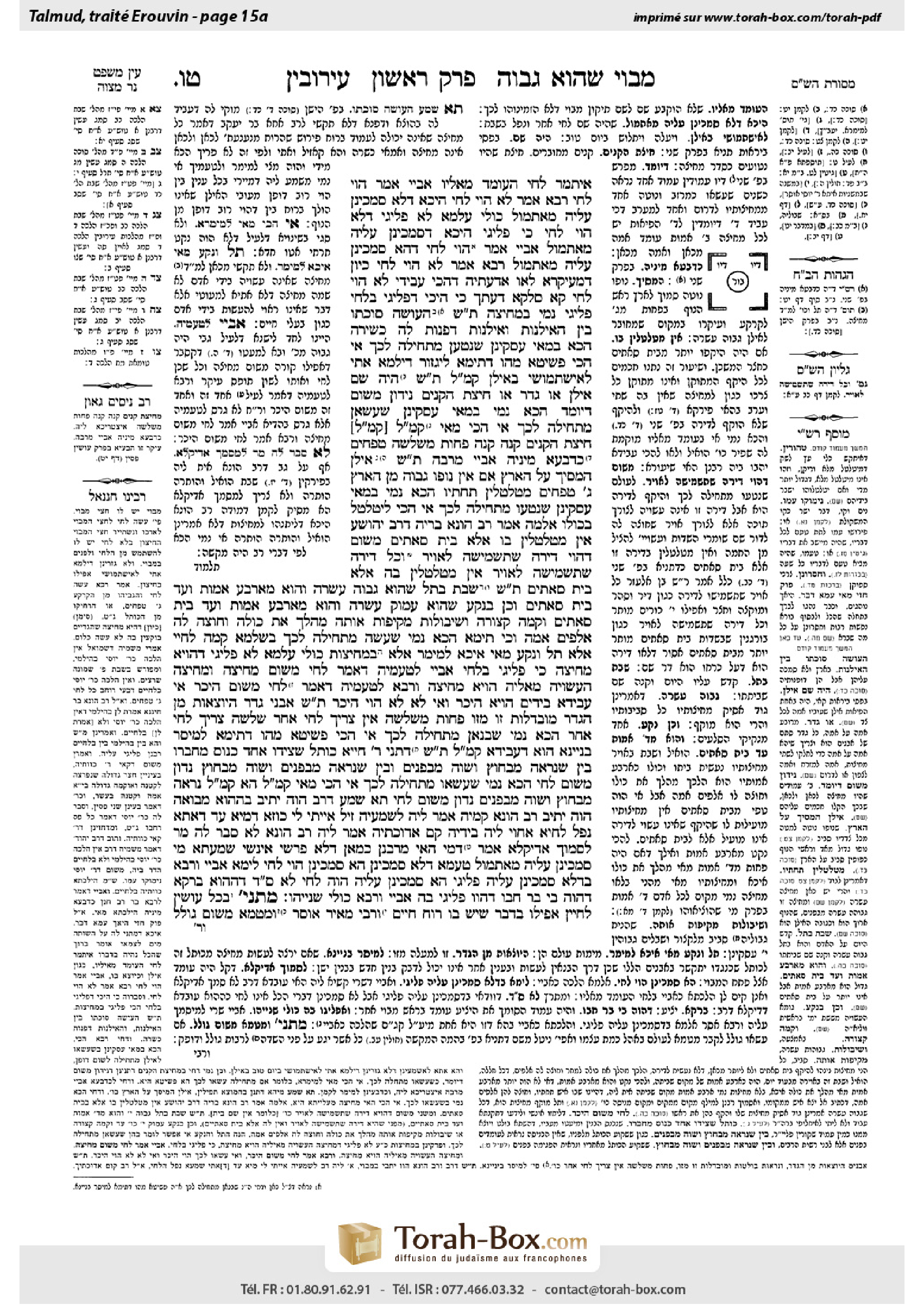
Eruvin 15a: Talmud study for Daf Yomi
Study the Talmud for Daf Yomi with scanned pages, Hebrew text, English translations from Sefaria and AI-generated French translations.
Passage selection and English or AI-generated French translation are available where the scan has annotations. Daf Study is independent of Torah-Box and Sefaria.
Browse Eruvin · עירובין · All tractatesEruvin 15a text and translations
This page of Eruvin includes the Aramaic text, an English translation and an AI-generated French translation, alongside the scan above.
עירובין י״ה א · Aramaic and Hebrew text
אִיתְּמַר: לֶחִי הָעוֹמֵד מֵאֵלָיו, אַבָּיֵי אָמַר: הָוֵי לֶחִי, רָבָא אָמַר: לָא הָוֵי לֶחִי.
הֵיכָא דְּלָא סָמְכִינַן עֲלֵיהּ מֵאֶתְמוֹל, כּוּלֵּי עָלְמָא לָא פְּלִיגִי דְּלָא הָוֵי לֶחִי. כִּי פְּלִיגִי הֵיכָא דְּסָמְכִינַן עֲלֵיהּ מֵאֶתְמוֹל. אַבָּיֵי אָמַר: הָוֵי לֶחִי, דְּהָא סָמְכִינַן עֲלֵיהּ מֵאֶתְמוֹל. רָבָא אָמַר: לָא הָוֵי לֶחִי, כֵּיוָן דְּמֵעִיקָּרָא לָאו אַדַּעְתֵּיהּ דְּהָכִי עֲבִידִי, לָא הָוֵי לֶחִי.
קָא סָלְקָא דַּעְתָּךְ כִּי הֵיכִי דִּפְלִיגִי בְּלֶחִי פְּלִיגִי נָמֵי בִּמְחִיצָה.
תָּא שְׁמַע: הָעוֹשֶׂה סוּכָּתוֹ בֵּין הָאִילָנוֹת וְאִילָנוֹת דְּפָנוֹת לָהּ — כְּשֵׁירָה. הָכָא בְּמַאי עָסְקִינַן, שֶׁנְּטָעָן מִתְּחִילָּה לְכָךְ. אִי הָכִי פְּשִׁיטָא! מַהוּ דְּתֵימָא: לִיגְזוֹר דִּילְמָא אָתֵי לְאִישְׁתַּמּוֹשֵׁי בְּאִילָן, קָא מַשְׁמַע לַן.
תָּא שְׁמַע: הָיָה שָׁם אִילָן אוֹ גָּדֵר אוֹ חִיצַת הַקָּנִים — נִידּוֹן מִשּׁוּם דְּיוֹמָד!
הָכָא נָמֵי, בְּמַאי עָסְקִינַן — שֶׁעֲשָׂאָן מִתְּחִילָּה לְכָךְ. אִי הָכִי מַאי קָא מַשְׁמַע לַן? [קָא מַשְׁמַע לַן], חִיצַת הַקָּנִים קָנֶה קָנֶה פָּחוֹת מִשְּׁלֹשָׁה טְפָחִים, כְּדִבְעָא מִינֵּיהּ אַבָּיֵי מֵרַבָּה.
תָּא שְׁמַע: אִילָן הַמֵּסֵיךְ עַל הָאָרֶץ, אִם אֵין נוֹפוֹ גָּבוֹהַּ מִן הָאָרֶץ שְׁלֹשָׁה טְפָחִים — מְטַלְטְלִין תַּחְתָּיו. הָכָא נָמֵי, בְּמַאי עָסְקִינַן — שֶׁנְּטָעוֹ מִתְּחִילָּה לְכָךְ.
אִי הָכִי, לִיטַלְטֵל בְּכוּלּוֹ! אַלְּמָה אָמַר רַב הוּנָא בְּרֵיהּ דְּרַב יְהוֹשֻׁעַ: אֵין מְטַלְטְלִין בּוֹ אֶלָּא בֵּית סָאתַיִם.
מִשּׁוּם דְּהָוֵי דִּירָה שֶׁתַּשְׁמִישָׁהּ לַאֲוִיר, וְכׇל דִּירָה שֶׁתַּשְׁמִישָׁהּ לַאֲוִיר, אֵין מְטַלְטְלִין בָּהּ אֶלָּא בֵּית סָאתַיִם.
תָּא שְׁמַע: שָׁבַת בְּתֵל שֶׁהוּא גָּבוֹהַּ עֲשָׂרָה וְהוּא מֵאַרְבַּע אַמּוֹת וְעַד בֵּית סָאתַיִם, וְכֵן בְּנֶקַע שֶׁהוּא עָמוֹק עֲשָׂרָה, וְהוּא מֵאַרְבַּע אַמּוֹת וְעַד בֵּית סָאתַיִם, וְקָמָה קְצוּרָה וְשִׁיבּוֹלוֹת מַקִּיפוֹת אוֹתָהּ — מְהַלֵּךְ אֶת כּוּלָּהּ וְחוּצָה לָהּ אַלְפַּיִם אַמָּה.
וְכִי תֵּימָא הָכָא נָמֵי שֶׁעָשָׂה מִתְּחִילָּה לְכָךְ, בִּשְׁלָמָא קָמָה לְחַיֵּי, אֶלָּא תֵּל וָנֶקַע — מַאי אִיכָּא לְמֵימַר?
אֶלָּא: בִּמְחִיצוֹת כּוּלֵּי עָלְמָא לָא פְּלִיגִי דְּהָוְיָא מְחִיצָה, כִּי פְּלִיגִי — בְּלֶחִי. אַבָּיֵי לְטַעְמֵיהּ דְּאָמַר: לֶחִי מִשּׁוּם מְחִיצָה, וּמְחִיצָּה הָעֲשׂוּיָה מֵאֵלֶיהָ הָוְיָא מְחִיצָה. וְרָבָא לְטַעְמֵיהּ דְּאָמַר: לֶחִי מִשּׁוּם הֶיכֵּר, אִי עֲבִידָא בְּיָדַיִם הָוְיָא הֶיכֵּר, וְאִי לָא לָא הָוֵי הֶיכֵּר.
תָּא שְׁמַע: אַבְנֵי גָדֵר הַיּוֹצְאוֹת מִן הַגָּדֵר מוּבְדָּלוֹת זוֹ מִזּוֹ פָּחוֹת מִשְּׁלֹשָׁה, אֵין צָרִיךְ לֶחִי אַחֵר. שְׁלֹשָׁה — צָרִיךְ לֶחִי אַחֵר.
הָכָא נָמֵי שֶׁבְּנָאָן מִתְּחִילָּה לְכָךְ. אִי הָכִי, פְּשִׁיטָא! מַהוּ דְּתֵימָא לְמֵיסַר בִּנְיָינָא הוּא דַּעֲבִידָא. קָא מַשְׁמַע לַן.
תָּא שְׁמַע, דְּתָנֵי רַבִּי חִיָּיא: כּוֹתֶל שֶׁצִּידּוֹ אֶחָד כָּנוּס מֵחֲבֵרוֹ, בֵּין שֶׁנִּרְאֶה מִבַּחוּץ וְשָׁוֶה מִבִּפְנִים, וּבֵין שֶׁנִּרְאֶה מִבִּפְנִים וְשָׁוֶה מִבַּחוּץ — נִדּוֹן מִשּׁוּם לֶחִי.
הָכָא נָמֵי שֶׁעֲשָׂאוֹ מִתְּחִילָּה לְכָךְ. אִי הָכִי, מַאי קָא מַשְׁמַע לַן? הָא קָא מַשְׁמַע לַן: נִרְאֶה מִבַּחוּץ וְשָׁוֶה מִבִּפְנִים — נִדּוֹן מִשּׁוּם לֶחִי.
תָּא שְׁמַע: דְּרַב הֲוָה יָתֵיב בְּהָהוּא מְבוֹאָה, הֲוָה יָתֵיב רַב הוּנָא קַמֵּיהּ. אֲמַר לֵיהּ לְשַׁמָּעֵיהּ: זִיל אַיְיתִי לִי כּוּזָא דְמַיָּא. עַד דַּאֲתָא, נְפַל לֶחְיָא. אַחְוִי לֵיהּ בִּידֵיהּ קָם אַדּוּכְתֵּיהּ. אֲמַר לֵיהּ רַב הוּנָא: לָא סָבַר לַהּ מָר לִסְמוֹךְ אַדִּיקְלָא? אָמַר: דָּמֵי הַאי מֵרַבָּנַן כְּמַאן דְּלָא פָּרְשִׁי אִינָשֵׁי שְׁמַעְתָּא, מִי סָמְכִינַן עֲלֵיהּ מֵאֶתְמוֹל?
טַעְמָא — דְּלָא סָמְכִינַן, הָא סָמְכִינַן — הָוֵי לֶחִי.
לֵימָא אַבָּיֵי וְרָבָא בִּדְלָא סָמְכִינַן עֲלֵיהּ פְּלִיגִי, הָא סָמְכִינַן עֲלֵיהּ — הָוֵה לֶחִי. לָא סָלְקָא דַּעְתָּךְ, דְּהָהוּא בַּרְקָא דַּהֲוָה בֵּי בַּר חָבוּ דַּהֲווֹ פְּלִיגִי בַּהּ אַבָּיֵי וְרָבָא כּוּלֵּי שְׁנַיְיהוּ.
מַתְנִי׳ בַּכֹּל עוֹשִׂין לְחָיַיִן אֲפִילּוּ בְּדָבָר שֶׁיֵּשׁ בּוֹ רוּחַ חַיִּים, וְרַבִּי מֵאִיר אוֹסֵר. וּמְטַמֵּא מִשּׁוּם גּוֹלֵל,
Eruvin 15a · English translation
It was stated that the amora’im disagreed about a side post that stands by itself, i.e., a side post at the entrance to an alleyway that was not put there for the express purpose of permitting one to carry on Shabbat. Abaye said: It is a valid side post. Rava said: It is not a valid side post.
The Gemara first narrows the scope of the dispute: In a place where the inhabitants of the alleyway did not rely on it from yesterday, e.g., the alleyway had another side post that fell down on Shabbat, all agree that it is not a valid side post. Where they disagree is in a case where they relied on it from yesterday. Abaye said: It is a valid side post, as they relied on it from yesterday. Rava said: It is not a valid side post; since it was not originally erected for this purpose, it is not considered a valid side post.
The Gemara comments: It might enter your mind to say that just as they disagree with regard to a side post, they also disagree with regard to whether a partition that was not erected to serve that function is considered a valid partition.
Come and hear a proof based upon what we learned in the following mishna: With regard to one who makes his sukka among the trees, and the trees serve as its walls, it is a valid sukka. This proves that the trees function as partitions even though they were not erected for this purpose. The Gemara responds: With what are we dealing here, in this mishna? To a case where he planted the trees from the outset for this purpose. The Gemara asks: If so, it is obvious that the trees constitute valid walls. The Gemara answers: Lest you say the Sages should issue a decree to prohibit using a sukka with trees as its walls, due to a concern that perhaps one will come to use the tree on the Festival and detach a branch or leaf in the process, the mishna therefore teaches us that no such decree was made and the sukka is permitted.
The Gemara tries to present another proof. Come and hear a proof from a baraita: If there was a tree there, or a fence, or a barrier of reeds that are interconnected and form a hedge, it is judged to be a valid double post, i.e., it qualifies as a partition suitable to enclose a public well, as will be explained below. This indicates that a partition not constructed to serve as a partition is nonetheless valid.
The Gemara rejects this proof: Here, too, with what are we dealing? With a case where one constructed them from the outset for this purpose. The Gemara asks: If so, what does it teach us; is it not obvious that it is a valid double post? The Gemara answers: It teaches us that a barrier of reeds is a valid partition if the distance between one reed and the next is less than three handbreadths, as Abaye raised this dilemma to Rabba, and the baraita teaches that it is valid.
The Gemara suggests another proof. Come and hear a proof from the following mishna: With regard to a tree whose branches hang over from a height of greater than ten handbreadths and reach almost to the ground, if the ends of its branches are not higher than three handbreadths from the ground, one may carry under it; the branches constitute partitions all around, and it is therefore permissible to carry in the enclosed area. The Gemara responds: Here, too, with what are we dealing? With a case where he planted the tree from the outset for this purpose.
The Gemara asks: If so, it should be permitted to carry in all of it no matter how large the area. Why, then, did Rav Huna, the son of Rav Yehoshua, say: One may only carry under the tree if its branches enclose an area no larger than two beit se’a, i.e., five thousand square cubits? If the area is larger, it is not considered a courtyard, and carrying there is prohibited. This indicates that the branches are not considered full-fledged partitions.
The Gemara answers: The reason that carrying is permitted only if the enclosed area is less than this size is because it is a dwelling whose use is for the open air beyond it, i.e., it is used by guards who are watching the fields beyond it, rather than as an independent dwelling place, and the halakha with regard to any dwelling whose use is for the open air beyond it is that one may carry in it only if its area is no larger than two beit se’a.
The Gemara suggests another proof. Come and hear that which was taught in the following baraita: With regard to one who established his Shabbat abode on a mound that was ten handbreadths high and its area was anywhere from four cubits to the two beit se’a; and similarly, one who established his Shabbat abode in a natural cavity of a rock that is ten handbreadths deep and its area was anywhere from four cubits to two beit se’a; and similarly, one who established his Shabbat abode in a field of reaped grain, and rows of stalks ten handbreadths high that have not been reaped surround it, serving as a partition enclosing the reaped area, he may walk in the entire enclosed area, and outside it an additional two thousand cubits. This indicates that a partition not specifically constructed to serve as a partition is nonetheless valid.
And if you say that here, too, it is a case where he made it from the outset for this purpose, there is a difficulty. Granted, in the case of the grain, this answer is all right; but with regard to a mound and a cavity, what can be said? They were there from time immemorial and were not constructed to serve as partitions.
Rather, the Gemara rejects its previous argument and explains: With regard to partitions, all agree that a partition that stands by itself is a partition, despite the fact that it was not erected for that purpose. Where they disagree is with regard to a side post. Abaye follows his usual line of reasoning, as he said that a side post serves as a partition, and a partition that stands by itself is a valid partition. And Rava follows his usual line of reasoning, as he said that a side post serves as a conspicuous marker. Therefore, if it was made with a person’s hands for that purpose, it is considered a conspicuous marker; and if not, it is not considered a conspicuous marker.
The Gemara now attempts to prove which side is correct according to this version of the dispute. Come and hear a proof from the Tosefta: With regard to stones of a wall that protrude from the wall and are separated from each other by less than three handbreadths, there is no need for another side post in order to permit carrying in the alleyway; the protruding stones join together to form a side post. However, if they are separated by three handbreadths, there is a need for another side post. This indicates that a side post is valid even if it was not erected for that purpose.
The Gemara rejects this proof: Here, too, we are dealing with a case where one built them from the outset for this purpose. The Gemara comments: If so, it is obvious that the side post is valid. The Gemara explains: Lest you say that it was only in order to connect the building to another building that he built the wall with protruding stones, it teaches us that it is a valid side post. We are not concerned that onlookers might assume that the wall was not originally built as a side post.
The Gemara suggests another proof: Come and hear the following Tosefta taught by Rabbi Ḥiyya: A wall, one side of which is more recessed than the other, whether the indentation is visible from the outside and the wall looks even from the inside, or it is visible from the inside and the wall looks even from the outside, it is considered a side post. This indicates that a side post is valid even if it was not erected for that purpose.
The Gemara answers: Here, too, it is a case where one fashioned it from the outset for this purpose, to serve as a side post. The Gemara asks: If so, what does it teach us? The Gemara answers: This teaches us that a side post that is visible from the outside and looks even with the wall from the inside is considered a side post, although this view is not universally accepted.
The Gemara suggests another proof: Come and hear the following story: Rav was sitting in a certain alleyway, and Rav Huna was sitting before him. He said to his attendant: Go, bring me a small pitcher of water. By the time he came back with the water, the side post at the entrance to the alleyway had fallen. Rav signaled to him with his hand that he should stop, and the attendant stood in his place. Rav Huna said to Rav: Doesn’t the Master hold that it is permissible to rely on the palm tree located at the entrance to this alleyway as a side post? Rav said: This scholar, Rav Huna, is comparable to one who does not know the teachings of the Sages. Did we rely on the palm tree from yesterday? Since we did not, carrying in the alleyway is not permitted.
Based on Rav’s response, the Gemara argues as follows: The reason that the palm tree could not serve as a side post is because we did not rely on the palm tree from yesterday. This indicates that had we relied on it, it would be a valid side post, thus proving that a side post that was not erected for that purpose is nonetheless valid, in accordance with the opinion of Abaye.
The Gemara suggests: Shall we say that Abaye and Rava disagree only in a case where they did not rely on it before Shabbat, but in a case where they did rely on it, all agree it is a valid side post? The Gemara answers: This should not enter your mind, as there was a certain balcony [barka] that was in the house of Bar Ḥavu that Abaye and Rava disagreed about their entire lives. The residents of the alleyway began relying on a pillar upon which the balcony rested as their side post. Since Abaye and Rava disagreed about this case, it is clear that their disagreement applies even when the residents had relied on the item as a side post from before Shabbat.
MISHNA: One may construct side posts from anything, even a living creature, provided that it was properly attached to the entrance of the alleyway, and Rabbi Meir prohibits using a living creature as a side post. The mishna continues with a similar dispute: Even a living creature imparts ritual impurity if it used as the covering of a grave.
Eruvin 15a · Traduction française (IA)
Il a été dit que les amoraïm étaient en désaccord sur un poteau latéral qui se trouve seul, c'est-à-dire un poteau latéral à l'entrée d'un passage qui n'a pas été mis là à l'origine pour permettre de porter sur le Sabbat. Abaye a dit : C'est un poteau latéral valide. Rava a dit : Ce n'est pas un poteau latéral valide.
Le Guemara commence par restreindre le champ de ce débat : Dans un lieu où les habitants du passage n'ont pas eu recours à lui hier, par exemple, le passage avait un autre poteau latéral qui s'est effondré le Sabbat, tous s'accordent sur le fait qu'il n'est pas un poteau latéral valide. Le point de désaccord est dans le cas où ils ont eu recours à lui hier. Abaye a dit : C'est un poteau latéral valide, car ils ont eu recours à lui hier. Rava a dit : Ce n'est pas un poteau latéral valide ; puisqu'il n'a pas été érigé à cet effet, il n'est pas considéré comme un poteau latéral valide.
Le Guemara commente : Il pourrait entrer en votre esprit de dire que tout comme ils sont en désaccord sur un poteau latéral, ils sont également en désaccord sur le fait qu'une partition qui n'a pas été érigée à cet effet est considérée comme une partition valide.
Venez écouter une preuve tirée de ce que nous avons appris dans la suivante mitsva : Concernant celui qui fait son sukka parmi les arbres, et les arbres servent de ses murs, c'est une sukka valide. Cela prouve que les arbres fonctionnent comme des partitions même s'ils n'ont pas été érigés à cet effet. Le Guemara répond : Avec quels objets sommes-nous en train de travailler, dans cette mitsva ? Avec un cas où l'on a planté les arbres dès le départ à cet effet. Le Guemara demande : Si c'est ainsi, il est évident que les arbres constituent des murs valides. Le Guemara répond : Pour éviter que vous ne disiez que les Sages devraient émettre un décret interdisant l'utilisation d'une sukka avec des arbres comme murs, en raison de la crainte qu'on vienne à utiliser l'arbre pendant le Festival et à détacher une branche ou une feuille en cours d'opération, la mitsva nous apprend donc que tel décret n'a pas été émis et que la sukka est permise.
Le Guemara tente de présenter une autre preuve. Venez écouter une preuve tirée d'une baraïta : Si il y avait un arbre, ou un mur, ou un obstacle de roseaux qui sont interconnectés et forment un haie, il est jugé comme un poteau double, c'est-à-dire qu'il convient comme une partition pour entourer un puits public, comme cela sera expliqué plus loin. Cela indique que une partition non construite à cet effet est néanmoins valide.
Le Guemara rejette cette preuve : Ici aussi, avec quels objets sommes-nous en train de travailler ? Avec un cas où l'on a construit cela dès le départ à cet effet. Le Guemara demande : Si c'est ainsi, que nous apprend-il ? N'est-ce pas évident qu'il s'agit d'un poteau double valide ? Le Guemara répond : Il nous apprend que les roseaux forment une partition valide si la distance entre un roseau et l'autre est inférieure à trois tefachim, comme Abaye a soulevé ce dilemme à Rabba, et la baraïta nous apprend qu'il est valide.
Le Guemara suggère une autre preuve. Venez écouter une preuve tirée de la suivante mitsna : Concernant un arbre dont les branches pendent d'une hauteur supérieure à dix tefachim et atteignent presque le sol, si les extrémités de ses branches ne sont pas plus hautes que trois tefachim du sol, on peut porter sous lui ; les branches constituent des partitions autour, et il est donc permis de porter dans l'espace enclos. Le Guemara répond : Ici aussi, avec quels objets sommes-nous en train de travailler ? Avec un cas où l'on a planté l'arbre dès le départ à cet effet.
Le Guemara demande : Si c'est ainsi, il devrait être permis de porter dans tout cela, quel que soit la taille de l'espace. Pourquoi alors Rav Huna, fils de Rav Yéhoshua, a-t-il dit : On peut porter sous l'arbre seulement si ses branches enclosent une surface ne dépassant pas deux beit se'a, c'est-à-dire cinq mille coudées carrées ? Si la surface est plus grande, elle n'est pas considérée comme un cour d'entrée, et porter là est interdit. Cela indique que les branches ne sont pas considérées comme des partitions pleinement valides.
Le Guemara répond : La raison pour laquelle porter est permis seulement si la surface enclose est inférieure à cette taille est parce que c'est une demeure dont l'usage est pour l'espace ouvert au-delà, c'est-à-dire qu'elle est utilisée par des gardes qui surveillent les champs au-delà, plutôt que comme une demeure indépendante, et la halakha concernant toute demeure dont l'usage est pour l'espace ouvert au-delà est que l'on peut porter dedans seulement si sa surface ne dépasse pas deux beit se'a.
Le Guemara suggère une autre preuve. Venez écouter ce qui a été enseigné dans la baraïta suivante : Concernant celui qui a établi son abode du Sabbat sur un monticule de dix tefachim de haut, dont la surface était entre quatre coudées et deux beit se'a ; et de même, celui qui a établi son abode du Sabbat dans une cavité naturelle d'une roche de dix tefachim de profondeur, dont la surface était entre quatre coudées et deux beit se'a ; et de même, celui qui a établi son abode du Sabbat dans un champ de blé récolté, et des rangées de tiges de dix tefachim de haut qui n'ont pas été récoltées l'entourent, servant de partition entourant la zone récoltée, il peut marcher dans toute la zone enclose, et en dehors d'elle, deux mille coudées supplémentaires. Cela indique qu'une partition non spécifiquement construite à cet effet est néanmoins valide.
Et si vous dites que ici aussi, c'est un cas où il l'a fait dès le départ à cet effet, il y a une difficulté. En effet, dans le cas du blé, cette réponse est acceptable ; mais concernant un monticule et une cavité, que peut-on dire ? Ils étaient là depuis toujours et n'ont pas été construits à cet effet.
Plutôt, le Guemara rejette son argument précédent et explique : Concernant les partitions, tous s'accordent sur le fait qu'une partition qui se trouve seule est une partition, même s'il n'a pas été érigé à cet effet. Le point de désaccord est concernant un poteau latéral. Abaye suit sa ligne de raisonnement habituelle, car il a dit qu'un poteau latéral sert de partition, et une partition qui se trouve seule est une partition valide. Et Rava suit sa ligne de raisonnement habituelle, car il a dit qu'un poteau latéral sert de marque visible. Ainsi, si elle a été faite avec les mains d'une personne à cet effet, elle est considérée comme une marque visible ; et si non, elle n'est pas considérée comme une marque visible.
La Guemara tente maintenant de prouver quel côté a raison selon cette version du débat. Viens écouter une preuve tirée de la Tosefta : En ce qui concerne des pierres d’un mur qui dépassent du mur et sont séparées les unes des autres de moins de trois tefachim, il n’est pas nécessaire d’un autre poteau latéral pour permettre le transport dans l’allée ; les pierres dépassantes forment ensemble un poteau latéral. Cependant, si elles sont séparées de trois tefachim, il faut un autre poteau latéral. Cela montre qu’un poteau latéral est valide même s’il n’a pas été érigé à cet effet.
La Guemara rejette cette preuve : ici aussi, nous sommes en présence d’un cas où l’on a construit cela dès le départ à cet effet. La Guemara commente : Si c’est ainsi, il est évident que le poteau latéral est valide. La Guemara explique : afin que vous ne disiez pas qu’il a été construit uniquement pour relier un bâtiment à un autre, il nous apprend que c’est un poteau latéral valide. Nous ne craignons pas que les passants puissent penser que le mur n’a pas été construit initialement comme poteau latéral.
La Guemara suggère une autre preuve : Viens écouter la Tosefta suivante enseignée par Rabbi Ḥiyya : Un mur dont une des faces est plus reculée que l’autre, que l’indentation soit visible de l’extérieur et que le mur semble droit de l’intérieur, ou que l’indentation soit visible de l’intérieur et que le mur semble droit de l’extérieur, est considéré comme un poteau latéral. Cela montre qu’un poteau latéral est valide même s’il n’a pas été érigé à cet effet.
La Guemara répond : ici aussi, il s’agit d’un cas où l’on a conçu cela dès le départ à cet effet, pour servir de poteau latéral. La Guemara pose la question : si c’est ainsi, que nous apprend cette Tosefta ? La Guemara répond : cela nous apprend que le poteau latéral visible de l’extérieur et qui semble droit avec le mur de l’intérieur est considéré comme un poteau latéral, même si cette vue n’est pas universellement acceptée.
La Guemara suggère une autre preuve : viens écouter l’histoire suivante : Rav était assis dans une certaine allée, et Rav Huna était assis devant lui. Il a dit à son serviteur : va, apporte-moi un petit récipient d’eau. Lorsque celui-ci est revenu avec l’eau, le poteau latéral à l’entrée de l’allée avait chuté. Rav a fait signe à l’aide de sa main pour qu’il s’arrête, et le serviteur est resté à sa place. Rav Huna a dit à Rav : le Maître ne considère-t-il pas que l’on peut compter sur le palmier à l’entrée de cette allée comme poteau latéral ? Rav a répondu : ce savant, Rav Huna, est comparable à celui qui ne connaît pas les enseignements des Sages. A-t-on compté sur le palmier hier ? puisque non, le transport dans l’allée n’est pas permis.
Sur la base de la réponse de Rav, la Guemara argumente comme suit : la raison pour laquelle le palmier ne pouvait pas servir de poteau latéral est que nous n’avons pas compté sur le palmier hier. cela montre que si nous avions compté sur lui, il aurait été un poteau latéral valide, prouvant ainsi que le poteau latéral qui n’a pas été érigé à cet effet est tout de même valide, conformément à l’opinion d’Abaye.
La Guemara suggère : devons-nous dire que Abaye et Rava ne s’opposent que dans le cas où ils n’ont pas utilisé cela avant le sabbat, mais dans le cas où ils ont utilisé cela, tous s’accordent sur le fait qu’il s’agit d’un poteau latéral valide ? La Guemara répond : cela ne devrait pas entrer dans votre esprit, car il existait un certain balcon [barka] dans la maison de Bar Ḥavu que Abaye et Rava disputaient toute leur vie. Les habitants de l’allée avaient commencé à utiliser une colonne sur laquelle reposait le balcon comme poteau latéral. Puisque Abaye et Rava disputaient ce cas, il est clair que leur désaccord s’applique même lorsque les habitants avaient déjà utilisé l’objet comme poteau latéral avant le sabbat.
MICHNA : On peut construire des poteaux latéraux à partir de n’importe quoi, même un être vivant, à condition qu’il soit correctement attaché à l’entrée de l’allée, et Rabbi Meir interdit d’utiliser un être vivant comme poteau latéral. La mishna continue avec un débat similaire : même un être vivant transmet l’impureté rituelle s’il est utilisé comme couverture d’un tombeau.
Traduction française générée par IA à partir de l’édition anglaise de Sefaria. Vérifie toujours un passage avec le texte source.
Text from Sefaria: William Davidson Edition - Vocalized Aramaic (CC BY NC); William Davidson Edition - English (CC BY NC).