Eruvin 15b: Talmud study for Daf Yomi
Study the Talmud for Daf Yomi with scanned pages, Hebrew text, English translations from Sefaria and AI-generated French translations.
Passage selection and English or AI-generated French translation are available where the scan has annotations. Daf Study is independent of Torah-Box and Sefaria.
Browse Eruvin · עירובין · All tractatesEruvin 15b text and translations
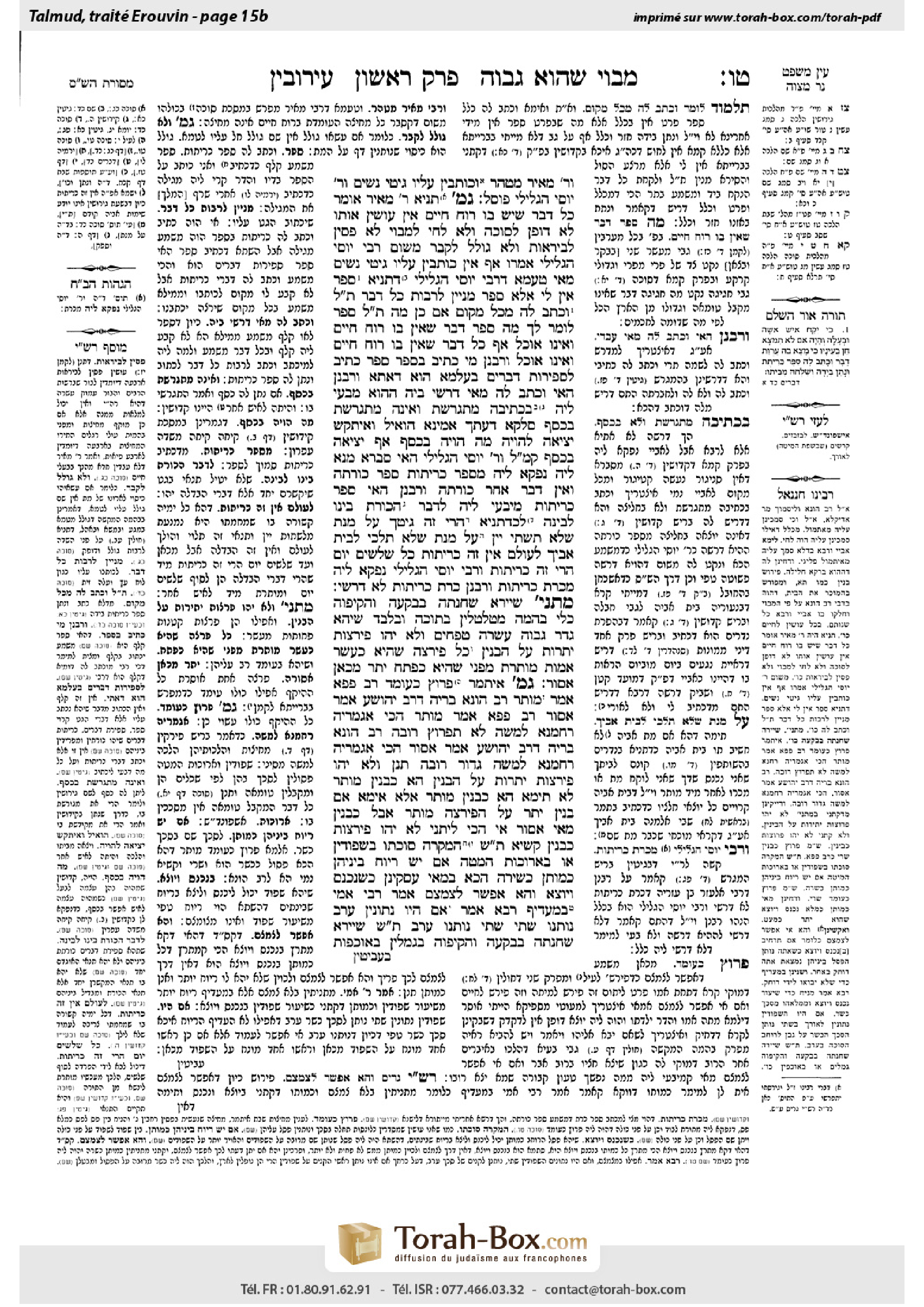
This page of Eruvin includes the Aramaic text, an English translation and an AI-generated French translation, alongside the scan above.
עירובין י״ה ב · Aramaic and Hebrew text
וְרַבִּי מֵאִיר מְטַהֵר. וְכוֹתְבִין עָלָיו גִּיטֵּי נָשִׁים, וְרַבִּי יוֹסֵי הַגְּלִילִי פּוֹסֵל.
גְּמָ׳ תַּנְיָא, רַבִּי מֵאִיר אוֹמֵר: כָּל דָּבָר שֶׁיֵּשׁ בּוֹ רוּחַ חַיִּים אֵין עוֹשִׂין אוֹתוֹ לֹא דּוֹפֶן לְסוּכָּה וְלֹא לֶחִי לְמָבוֹי, לֹא פַּסִּין לְבֵירָאוֹת וְלֹא גּוֹלֵל לְקֶבֶר. מִשּׁוּם רַבִּי יוֹסֵי הַגְּלִילִי אָמְרוּ: אַף אֵין כּוֹתְבִין עָלָיו גִּיטֵּי נָשִׁים.
מַאי טַעְמָא דְּרַבִּי יוֹסֵי הַגְּלִילִי, דְּתַנְיָא: ״סֵפֶר״, אֵין לִי אֶלָּא סֵפֶר. מִנַּיִין לְרַבּוֹת כָּל דָּבָר? תַּלְמוּד לוֹמַר ״וְכָתַב לָהּ״, מִכׇּל מָקוֹם. אִם כֵּן מָה תַּלְמוּד לוֹמַר ״סֵפֶר״? לוֹמַר לָךְ: מָה סֵפֶר דָּבָר שֶׁאֵין בּוֹ רוּחַ חַיִּים וְאֵינוֹ אוֹכֶל, אַף כָּל דָּבָר שֶׁאֵין בּוֹ רוּחַ חַיִּים וְאֵינוֹ אוֹכֶל.
וְרַבָּנַן? מִי כְּתִיב ״בְּסֵפֶר״? ״סֵפֶר״ כְּתִיב, לִסְפִירוּת דְּבָרִים בְּעָלְמָא הוּא דַּאֲתָא.
וְרַבָּנַן, הַאי ״וְכָתַב לָהּ״ מַאי דָּרְשִׁי בֵּיהּ? הָהוּא מִבְּעֵי לֵיהּ: בִּכְתִיבָה מִתְגָּרֶשֶׁת, וְאֵינָהּ מִתְגָּרֶשֶׁת בְּכֶסֶף. סָלְקָא דַּעְתָּךְ אָמֵינָא: הוֹאִיל וְאִיתַּקַּשׁ יְצִיאָה לַהֲוָיָה — מָה הֲוָיָה בְּכֶסֶף, אַף יְצִיאָה בְּכֶסֶף. קָא מַשְׁמַע לַן.
וְרַבִּי יוֹסֵי הַגְּלִילִי, הַאי סְבָרָא מְנָא לֵיהּ? נָפְקָא לֵיהּ מִ״סֵּפֶר כְּרִיתוּת״: סֵפֶר כּוֹרְתָהּ, וְאֵין דָּבָר אַחֵר כּוֹרְתָהּ.
וְרַבָּנַן, הַאי ״סֵפֶר כְּרִיתוּת״ מִיבְּעֵי לֵיהּ לְדָבָר הַכּוֹרֵת בֵּינוֹ לְבֵינָהּ. לְכִדְתַנְיָא: הֲרֵי זֶה גִּיטֵּךְ עַל מְנָת שֶׁלֹּא תִּשְׁתִּי יַיִן, עַל מְנָת שֶׁלֹּא תֵּלְכִי לְבֵית אָבִיךְ לְעוֹלָם — אֵין זֶה כְּרִיתוּת. כָּל שְׁלֹשִׁים יוֹם — הֲרֵי זֶה כְּרִיתוּת.
וְרַבִּי יוֹסֵי הַגְּלִילִי, נָפְקָא לֵיהּ מִ״כָּרֵת״ ״כְּרִיתוּת״.
וְרַבָּנַן ״כָּרֵת״ ״כְּרִיתוּת״ לָא דָּרְשִׁי.
מַתְנִי׳ שְׁיָירָא שֶׁחָנְתָה בְּבִקְעָה וְהִקִּיפוּהָ כְּלֵי בְהֵמָה — מְטַלְטְלִין בְּתוֹכָהּ. וּבִלְבַד שֶׁיְּהֵא גָּדֵר גָּבוֹהַּ עֲשָׂרָה טְפָחִים, וְלֹא יְהוּ פִּירְצוֹת יְתֵרוֹת עַל הַבִּנְיָן.
כָּל פִּירְצָה שֶׁהִיא כְּעֶשֶׂר אַמּוֹת מוּתֶּרֶת, מִפְּנֵי שֶׁהִיא כְּפֶתַח. יָתֵר מִכָּאן — אָסוּר.
גְּמָ׳ אִיתְּמַר, פָּרוּץ כְּעוֹמֵד — רַב פָּפָּא אָמַר: מוּתָּר, רַב הוּנָא בְּרֵיהּ דְּרַב יְהוֹשֻׁעַ אָמַר: אָסוּר.
רַב פָּפָּא אָמַר מוּתָּר: הָכִי אַגְמְרֵיהּ רַחֲמָנָא לְמֹשֶׁה — לָא תִּפְרוֹץ רוּבָּה. רַב הוּנָא בְּרֵיהּ דְּרַב יְהוֹשֻׁעַ אָמַר אָסוּר: הָכִי אַגְמְרֵיהּ רַחֲמָנָא לְמֹשֶׁה — גְּדוֹר רוּבָּה.
תְּנַן: וְלֹא יְהוּ פִּירְצוֹת יְתֵרוֹת עַל הַבִּנְיָן. הָא כַּבִּנְיָן — מוּתָּר?!
לָא תֵּימָא הָא כַּבִּנְיָן מוּתָּר, אֶלָּא אֵימָא: אִם בִּנְיָן יָתֵר עַל הַפִּירְצָה — מוּתָּר.
אֲבָל כַּבִּנְיָן, מַאי — אָסוּר? אִי הָכִי לִיתְנֵי ״לֹא יְהוּ פִּירְצוֹת כַּבִּנְיָן״! קַשְׁיָא.
תָּא שְׁמַע: הַמְקָרֶה סוּכָּתוֹ בְּשַׁפּוּדִין אוֹ בַּאֲרוּכּוֹת הַמִּטָּה, אִם יֵשׁ רֶיוַח בֵּינֵיהֶן כְּמוֹתָן — כְּשֵׁירָה!
הָכָא בְּמַאי עָסְקִינַן: כְּשֶׁנִּכְנָס וְיוֹצֵא.
וְהָא אֶפְשָׁר לְצַמְצֵם?
אָמַר רַבִּי אַמֵּי: בְּמַעֲדִיף.
רָבָא אָמַר: אִם הָיוּ נְתוּנִין עֵרֶב — נוֹתְנוֹ שְׁתִי, שְׁתִי — נוֹתְנוֹ עֵרֶב.
תָּא שְׁמַע: שְׁיָירָא שֶׁחָנְתָה בְּבִקְעָה וְהִקִּיפוּהָ בִּגְמַלִּין, בְּאוּכָּפוֹת,
Eruvin 15b · English translation
But Rabbi Meir deems it pure. Likewise, one may write women’s bills of divorce on anything, even a living creature. But Rabbi Yosei HaGelili invalidates a bill of divorce written on a living creature.
GEMARA: It was taught in a baraita that Rabbi Meir says: An animate object may neither be used as a wall for a sukka, nor as a side post for an alleyway, nor as one of the upright boards surrounding a well, nor as the covering of a grave. They said in the name of Rabbi Yosei HaGelili: Nor may one write women’s bills of divorce on it.
The Gemara asks: What is the reason for Rabbi Yosei HaGelili’s opinion? As it was taught in a baraita with regard to the verse: “When a man takes a wife, and marries her, then it comes to pass if she finds no favor in his eyes, because he has found some unseemly thing in her; that he write her a scroll of severance and give it in her hand, and send her out of his house” (Deuteronomy 24:1): From the word scroll, I have derived that only a scroll is valid. From where is it derived to include all objects as valid materials upon which a bill of divorce may be written? The Torah states: “That he write her,” in any case, i.e., any surface upon which the formula can be written. If so, why does the verse state “scroll”? To tell you that a bill of divorce must be written on a surface like a scroll: Just as a scroll is neither alive nor food, so too, a bill of divorce may be written on any object that is neither alive nor food. That is why Rabbi Yosei HaGelili invalidates a bill of divorce written on a living being.
The Gemara asks: And how do the Rabbis, who disagree and say that a bill of divorce may be written even on a living creature or on food, interpret the verse? They contend: Is the verse written: “Let him write for her in the scroll [basefer],” indicating the only type of surface on which the bill of divorce may be written? No, scroll [sefer] is written, which comes to teach that a mere account of the matters [sefirot devarim] is required. In other words, sefer is referring not to the surface on which a bill of divorce must be written, but rather to the essence of the bill of divorce. The verse teaches that the bill of divorce must contain particular content.
The Gemara continues: And what do the Rabbis derive from the phrase “that he write her”? The Gemara answers: That phrase is required to teach the principle that a woman is divorced only by means of writing, i.e., a bill of divorce, and she is not divorced by means of money. It might have entered your mind to say: Since in the verse, leaving marriage, i.e., divorce, is juxtaposed to becoming married, i.e., betrothal, then, just as becoming married is effected with money, so too, leaving marriage may be effected with money. Therefore, the Torah teaches us: “That he write for her”; divorce can be effected only with a written bill of divorce.
The Gemara asks: And Rabbi Yosei HaGelili, from where does he derive this reasoning, that a woman cannot be divorced with money? The Gemara answers: He derives it from the phrase: A scroll of severance, which teaches that a scroll, i.e., a written document, severs her from her husband and nothing else severs her from him.
The Gemara continues: And the Rabbis explain that this phrase: A scroll of severance, is required to teach that a bill of divorce must be a matter that severs all connection between him and her. As it was taught in a baraita: If a man says to his wife: This is your bill of divorce, on condition that you will never drink wine, or on condition that you will never go to your father’s house, that is not severance; the bill of divorce is not valid. If a bill of divorce imposes a condition upon the woman that permanently binds her to her husband, her relationship with her husband has not been completely severed, which is a prerequisite for divorce. If, however, he imposes a condition for the duration of thirty days, or any other limited period of time, that is severance, and the bill of divorce is valid, as the relationship will be completely terminated at the end of the thirty-day period.
And Rabbi Yosei HaGelili derives that a condition without a termination point invalidates the divorce from the fact that instead of using the term karet, the verse uses the more expanded term keritut. Inasmuch as both terms denote severance, using the longer term teaches us two things: Divorce can be effected only by means of writing and not through money, and divorce requires total severance.
And as for the Rabbis, they do not derive anything from the expansion of karet to keritut.
MISHNA: If a caravan camped in a valley, i.e., an open space not enclosed by walls, and the travelers enclosed their camp with partitions made of the animals’ equipment, e.g., saddles and the like, one may carry inside the enclosed area, provided that the resultant partition will be a fence ten handbreadths high, and that there will not be breaches in the partition greater than the built segment.
Any breach that is approximately ten cubits wide is permitted and does not invalidate the partition because it is considered like an entrance. However, if one of the breaches is greater than ten cubits, it is prohibited to carry anywhere in the enclosed area.
GEMARA: It is stated that the amora’im disagree about the case where the breached segment of the partition equals the standing portion. Rav Pappa said: It is permitted to carry within that enclosure. Rav Huna, son of Rav Yehoshua, said: It is prohibited.
The Gemara explains: Rav Pappa said: It is permitted. This is what the Merciful One taught Moses: Do not breach the majority of the partition; as long as the greater part is not breached, it is considered a partition. Rav Huna, son of Rav Yehoshua, said: It is prohibited. This is what the Merciful One taught Moses: Circumscribe the greater part; if the greater part is not enclosed, it is not a partition.
We learned in the mishna: And there will not be breaches in the partition greater than the built segment. Only then would carrying be permitted in the enclosed area. By inference, if the breaches equal the built segment, it is permitted. This presents a difficulty for Rav Huna, son of Rav Yehoshua.
The Gemara responds: Do not say: By inference if they equal the built segment, it is permitted; rather, say: If the built segment is greater than the breach, it is permitted to carry in the enclosed area.
The Gemara continues: However, according to that way of understanding the mishna, if the breach equals the built segment, what is the halakha? Is carrying prohibited? If so, let the mishna teach that carrying is permitted, provided that the breaches do not equal the built segment. It can be inferred from this that if the breaches are greater than the built segment, it is certainly prohibited. The Gemara concludes: Indeed, this poses a difficulty to the opinion of Rav Huna, son of Rav Yehoshua.
The Gemara cites a proof to support Rav Pappa’s opinion. Come and hear that which the mishna taught about the halakhot of sukka: With regard to one who roofed his sukka with metal skewers or with bed posts, both of which are unfit for sukka roofing because they are susceptible to ritual impurity, if there is space between them, equal to their width, filled with materials valid for sukka roofing, the sukka is valid. Apparently, with regard to roofing, if the valid materials equal the invalid, the sukka is valid. Similarly, if the built segment of an enclosure equals the breached segment, it is a valid enclosure for the purpose of carrying on Shabbat. This supports Rav Pappa’s opinion against that of Rav Huna, son of Rav Yehoshua.
The Gemara contests this conclusion. With what are we dealing here? It is with a case where the skewers can be inserted and extracted easily. In other words, the case of the mishna in Sukka is not one where there are equal amounts of valid and invalid roofing. It is referring to a case where there is additional space between the skewers, which allows for their easy insertion and removal. Consequently, the space filled by the valid roofing is greater than that filled by the skewers.
The Gemara asks: Isn’t it possible to be precise? Couldn’t the mishna in Sukka be understood as describing a case where the gaps between the skewers equal the width of the skewers? That understanding supports the opinion of Rav Pappa, who maintains that when the valid segment precisely equals the invalid segment, the whole is valid.
Rabbi Ami said: This mishna is referring to a case where one adds roofing, so that the area of the valid roofing is greater than that of the skewers.
Rava said: This is referring to a case where if the skewers were placed crosswise to the sukka, he should place the valid roofing lengthwise, and similarly, if the skewers were placed lengthwise, he should place the valid roofing crosswise, ensuring that there is more valid than invalid roofing.
The Gemara seeks to adduce a proof in support of the opinion of Rav Huna, son of Rav Yehoshua: Come and hear that which was taught in a baraita: If a caravan camped in a field, and the travelers surrounded their camp with camels that were made to crouch down, or with their saddles,
Eruvin 15b · Traduction française (IA)
Mais le Rabbi Meïr considère cela comme pur. De même, on peut écrire les certificats de divorce des femmes sur n'importe quoi, même sur un être vivant. Mais le Rabbi Yosei HaGelili annule un certificat de divorce écrit sur un être vivant.
GUEMARA : Il a été enseigné dans une baraïta que le Rabbi Meïr dit : Un objet animé ne peut être utilisé comme mur pour une succah, ni comme poteau latéral pour un passage, ni comme l'un des panneaux entourant un puits, ni comme couverture d'une tombe. Ils ont dit en nom du Rabbi Yosei HaGelili : On ne peut pas non plus y écrire les certificats de divorce des femmes.
La Guemara pose la question : Quel est le fondement de l'opinion du Rabbi Yosei HaGelili ? Comme il a été enseigné dans une baraïta concernant la parole : « Quand un homme prend une femme, et l'épouse, alors il arrive que si elle ne lui plaît pas, parce qu'il a trouvé quelque chose de laid en elle ; il écrive à sa femme un rouleau de séparation et le lui donne, et l'envoie dehors de sa maison » (Deutéronome 24:1) : De la parole « rouleau », j'ai déduit que seul un rouleau est valide. D'où vient qu'on inclut tous les objets comme matériaux valides pour écrire un certificat de divorce ? La Torah dit : « Qu'il écrive à sa femme », en tout cas, c'est-à-dire n'importe quelle surface sur laquelle on peut écrire la formule. Si c'est ainsi, pourquoi la Torah dit-elle « rouleau » ? Pour t'indiquer que le certificat de divorce doit être écrit sur une surface semblable à un rouleau : Tout comme un rouleau n'est ni vivant ni nourriture, de même, un certificat de divorce peut être écrit sur n'importe quel objet qui n'est ni vivant ni nourriture. C'est pourquoi le Rabbi Yosei HaGelili annule un certificat de divorce écrit sur un être vivant.
La Guemara pose la question : Et comment les Rabbins, qui s'opposent et disent que le certificat de divorce peut être écrit même sur un être vivant ou sur de la nourriture, interprètent-ils la parole ? Ils contestent : La parole dit-elle : « Qu'il écrive pour elle dans le rouleau [sefer] », indiquant le seul type de surface sur laquelle le certificat de divorce peut être écrit ? Non, « rouleau [sefer] » est écrit, ce qui vient enseigner que seul un résumé des affaires [sefirot devarim] est requis. En d'autres termes, « sefer » ne désigne pas la surface sur laquelle le certificat de divorce doit être écrit, mais plutôt l'essence du certificat de divorce. La parole enseigne que le certificat de divorce doit contenir un contenu particulier.
La Guemara continue : Et qu'en déduit-on des mots « qu'il écrive pour elle » ? La Guemara répond : Ces mots sont requis pour enseigner le principe que la femme est divorcée uniquement par écrit, c'est-à-dire par un certificat de divorce, et elle n'est pas divorcée par l'argent. Il pourrait t'entrer en tête de dire : Puisque dans la parole, le divorce, c'est-à-dire la séparation, est juxtaposé à l'union, c'est-à-dire le mariage, alors, tout comme l'union est effectuée avec de l'argent, de même, la séparation peut être effectuée avec de l'argent. C'est pourquoi la Torah nous enseigne : « Qu'il écrive pour elle » ; le divorce peut être effectué uniquement par un certificat écrit.
La Guemara pose la question : Et le Rabbi Yosei HaGelili, d'où déduit-il cette raisonnement, que la femme ne peut être divorcée avec de l'argent ? La Guemara répond : Il le déduit de la parole : « Un rouleau de séparation », ce qui enseigne que le rouleau, c'est-à-dire un document écrit, sépare sa femme de son mari et rien d'autre ne la sépare de lui.
La Guemara continue : Et les Rabbins expliquent que cette expression : « Un rouleau de séparation », est nécessaire pour enseigner que le certificat de divorce doit être une affaire qui coupe toute connexion entre lui et elle. Comme il a été enseigné dans une baraïta : Si un homme dit à sa femme : « C'est ton certificat de divorce, à condition que tu ne boiras jamais de vin, ou à condition que tu ne vas jamais chez ton père », cela n'est pas une séparation ; le certificat de divorce n'est pas valide. Si le certificat de divorce impose une condition à la femme qui l'attache définitivement à son mari, leur relation n'a pas été entièrement rompue, ce qui est un prérequis pour le divorce. Si, cependant, il impose une condition pour une durée limitée, par exemple trente jours ou toute autre période limitée, cela est une séparation, et le certificat de divorce est valide, car la relation sera entièrement terminée à la fin de la période de trente jours.
Et le Rabbi Yosei HaGelili déduit que la condition sans point de fin invalide le divorce du fait que, au lieu d'utiliser le terme karet, la parole utilise le terme plus développé keritut. En effet, puisque les deux termes désignent la séparation, l'utilisation du terme plus long nous enseigne deux choses : le divorce peut être effectué uniquement par écrit et non par l'argent, et le divorce exige une séparation totale.
Et quant aux Rabbins, ils ne déduisent rien de l'expansion de karet à keritut.
MICHNA : Si un convoi s'était installé dans un vallon, c'est-à-dire un espace ouvert non entouré de murs, et les voyageurs avaient entouré leur camp avec des cloisons faites des équipements des animaux, par exemple des selle et le genre, on peut porter à l'intérieur de l'enceinte, à condition que la cloison résultante soit un mur de dix paumes de haut, et qu'il n'y ait pas de brèches dans la cloison plus grandes que la partie construite.
Toute brèche d'environ dix coudées de large est permise et ne rend pas invalide la cloison, car elle est considérée comme une entrée. Cependant, si l'une des brèches est plus grande que dix coudées, il est interdit de porter quelque part dans l'enceinte.
GUEMARA : Il est dit que les amoraïm s'opposent sur le cas où la brèche de la cloison est égale à la partie debout. Rav Pappa dit : Il est permis de porter à l'intérieur de cette enceinte. Rav Huna, fils de Rav Yéhoshua, dit : Il est interdit.
La Guemara explique : Rav Pappa dit : Il est permis. C'est ce que l'Éternel a enseigné à Moïse : Ne brise pas la majorité de la cloison ; tant que la partie majoritaire n'est pas brisée, elle est considérée comme une cloison. Rav Huna, fils de Rav Yéhoshua, dit : Il est interdit. C'est ce que l'Éternel a enseigné à Moïse : Encadre la majorité ; si la majorité n'est pas encadrée, ce n'est pas une cloison.
Nous avons appris dans la Michna : Il ne sera pas permis de transporter dans l'espace clos si les ouvertures du partage sont supérieures à la partie construite. Seulement alors le transport sera autorisé dans l'espace clos. Par conséquent, si les ouvertures sont égales à la partie construite, cela est permis. Cela pose un problème pour Rav Huna, fils de Rav Yéhoshua.
La Guemara répond : N'entendez pas cela comme une déduction : si les ouvertures sont égales à la partie construite, cela est permis ; plutôt, dites : si la partie construite est supérieure aux ouvertures, le transport est autorisé dans l'espace clos.
La Guemara continue : Cependant, selon cette manière d'interpréter la Michna, si les ouvertures sont égales à la partie construite, quelle est la halakha ? Le transport est-il interdit ? Si c'est le cas, la Michna devrait enseigner que le transport est autorisé, à condition que les ouvertures ne soient pas égales à la partie construite. On peut en déduire que si les ouvertures sont supérieures à la partie construite, cela est certainement interdit. La Guemara conclut : En effet, cela pose un problème pour l'opinion de Rav Huna, fils de Rav Yéhoshua.
La Guemara cite une preuve pour soutenir l'opinion de Rav Pappa. Venez écouter ce que la Michna a enseigné concernant les halakhot de la sukkah : concernant celui qui a recouvert sa sukkah avec des piques en métal ou avec des poteaux de lit, qui sont tous deux inadaptés pour le toit de la sukkah car ils sont sujets à l'impureté rituelle, si l'espace entre eux est égal à leur largeur et rempli de matériaux adaptés pour le toit de la sukkah, la sukkah est valide. Apparemment, concernant le toit, si les matériaux valides sont égaux aux matériaux invalides, la sukkah est valide. De même, si la partie construite d'un enclos est égale à la partie ouverte, l'enclos est valide pour le transport le sabbat. Cela soutient l'opinion de Rav Pappa contre celle de Rav Huna, fils de Rav Yéhoshua.
La Guemara conteste cette conclusion. De quoi est-il question ici ? Il s'agit d'un cas où les piques peuvent être insérées et retirées facilement. En d'autres termes, le cas de la Michna dans la sukkah n'est pas celui où il y a une quantité égale de matériaux valides et invalides. Il s'agit d'un cas où il y a un espace supplémentaire entre les piques, permettant leur insertion et leur retrait facilement. Par conséquent, l'espace rempli par le toit valide est supérieur à celui rempli par les piques.
La Guemara demande : N'est-il pas possible d'être précis ? Ne pourrait-on pas interpréter la Michna de la sukkah comme décrivant un cas où les espaces entre les piques sont égaux à la largeur des piques ? Cette interprétation soutient l'opinion de Rav Pappa, qui maintient que lorsque la partie valide est exactement égale à la partie invalide, l'ensemble est valide.
Rabbi Ami a dit : Cette mitsva fait référence à un cas où l'on ajoute un toit, de sorte que la surface du toit valide est supérieure à celle des piques.
Rava a dit : Il s'agit d'un cas où si les piques sont placées transversalement par rapport à la sukkah, il faut placer le toit valide longitudinalement, et de même, si les piques sont placées longitudinalement, il faut placer le toit valide transversalement, en veillant à ce qu'il y ait plus de toit valide que d'invalides.
La Guemara cherche à établir une preuve en faveur de l'opinion de Rav Huna, fils de Rav Yéhoshua : Venez écouter ce qui a été enseigné dans une baraïta : Si un convoi s'est installé dans un champ, et les voyageurs ont entouré leur camp avec des chameaux qui sont restés couchés, ou avec leurs selle,
Traduction française générée par IA à partir de l’édition anglaise de Sefaria. Vérifie toujours un passage avec le texte source.
Text from Sefaria: William Davidson Edition - Vocalized Aramaic (CC BY NC); William Davidson Edition - English (CC BY NC).