Eruvin 16a: Talmud study for Daf Yomi
Study the Talmud for Daf Yomi with scanned pages, Hebrew text, English translations from Sefaria and AI-generated French translations.
Passage selection and English or AI-generated French translation are available where the scan has annotations. Daf Study is independent of Torah-Box and Sefaria.
Browse Eruvin · עירובין · All tractatesEruvin 16a text and translations
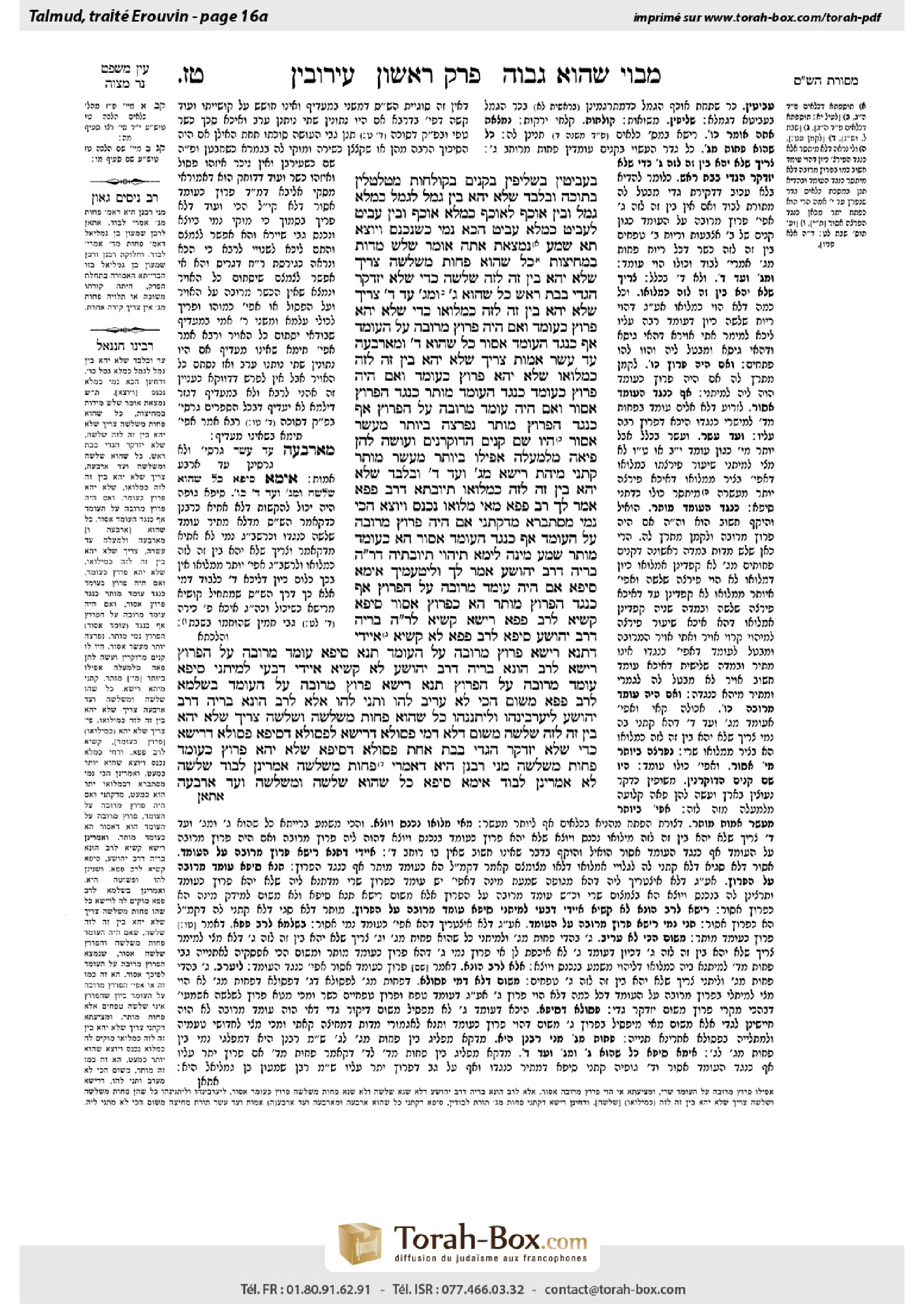
This page of Eruvin includes the Aramaic text, an English translation and an AI-generated French translation, alongside the scan above.
עירובין י״ו א · Aramaic and Hebrew text
בַּעֲבִיטִין, בִּשְׁלִיפִין, בְּקָנִים, בְּקוֹלָחוֹת — מְטַלְטְלִין בְּתוֹכָהּ, וּבִלְבַד שֶׁלֹּא יְהֵא בֵּין גָּמָל לְגָמָל כִּמְלֹא גָּמָל, וּבֵין אוּכָּף לְאוּכָּף כִּמְלֹא אוּכָּף, וּבֵין עָבִיט לְעָבִיט כִּמְלֹא עָבִיט!
הָכָא נָמֵי כְּשֶׁנִּכְנָס וְיוֹצֵא.
תָּא שְׁמַע: נִמְצֵאתָ אַתָּה אוֹמֵר, שָׁלֹשׁ מִדּוֹת בִּמְחִיצוֹת: כֹּל שֶׁהוּא פָּחוֹת מִשְּׁלֹשָׁה, צָרִיךְ שֶׁלֹּא יְהֵא בֵּין זֶה לָזֶה שְׁלֹשָׁה, כְּדֵי שֶׁלֹּא יִזְדַּקֵּר הַגְּדִי בְּבַת רֹאשׁ.
כֹּל שֶׁהוּא שְׁלֹשָׁה, וּמִשְּׁלֹשָׁה עַד אַרְבָּעָה, צָרִיךְ שֶׁלֹּא יְהֵא בֵּין זֶה לָזֶה כִּמְלוֹאוֹ, כְּדֵי שֶׁלֹּא יְהֵא פָּרוּץ כְּעוֹמֵד. וְאִם הָיָה פָּרוּץ מְרוּבֶּה עַל הָעוֹמֵד — אַף כְּנֶגֶד הָעוֹמֵד אָסוּר.
כֹּל שֶׁהוּא אַרְבָּעָה, וּמֵאַרְבָּעָה עַד עֶשֶׂר אַמּוֹת, צָרִיךְ שֶׁלֹּא יְהֵא בֵּין זֶה לָזֶה כִּמְלוֹאוֹ, שֶׁלֹּא יְהֵא פָּרוּץ כְּעוֹמֵד. וְאִם הָיָה פָּרוּץ כְּעוֹמֵד, כְּנֶגֶד הָעוֹמֵד — מוּתָּר, כְּנֶגֶד הַפָּרוּץ — אָסוּר. וְאִם הָיָה עוֹמֵד מְרוּבֶּה עַל הַפָּרוּץ — אַף כְּנֶגֶד הַפָּרוּץ מוּתָּר.
נִפְרְצָה בְּיוֹתֵר מֵעֶשֶׂר — אָסוּר, הָיוּ שָׁם קָנִים הַדּוֹקְרָנִים וְעוֹשֶׂה לָהֶן פֵּיאָה מִלְמַעְלָה, אֲפִילּוּ בְּיוֹתֵר מֵעֶשֶׂר מוּתָּר.
קָתָנֵי מִיהַת רֵישָׁא מִשְּׁלֹשָׁה עַד אַרְבָּעָה, וּבִלְבַד שֶׁלֹּא יְהֵא בֵּין זֶה לָזֶה כִּמְלוֹאוֹ, תְּיוּבְתָּא דְּרַב פָּפָּא!
אָמַר לְךָ רַב פָּפָּא: מַאי מְלוֹאוֹ — נִכְנָס וְיוֹצֵא.
הָכִי נָמֵי מִסְתַּבְּרָא מִדְּקָתָנֵי: אִם הָיָה פָּרוּץ מְרוּבֶּה עַל הָעוֹמֵד — אַף כְּנֶגֶד הָעוֹמֵד אָסוּר. הָא כְּעוֹמֵד — מוּתָּר. שְׁמַע מִינַּהּ.
לֵימָא תֶּיהְוֵי תְּיוּבְתֵּיהּ דְּרַב הוּנָא בְּרֵיהּ דְּרַב יְהוֹשֻׁעַ? אָמַר לָךְ: וְלִיטַעְמָיךְ, אֵימָא סֵיפָא: אִם הָיָה עוֹמֵד מְרוּבֶּה עַל הַפָּרוּץ, אַף כְּנֶגֶד הַפָּרוּץ מוּתָּר. הָא כַּפָּרוּץ — אָסוּר!
סֵיפָא קַשְׁיָא לְרַב פָּפָּא, רֵישָׁא קַשְׁיָא לְרַב הוּנָא בְּרֵיהּ דְּרַב יְהוֹשֻׁעַ.
סֵיפָא לְרַב פָּפָּא לָא קַשְׁיָא: אַיְּידֵי דִּתְנָא רֵישָׁא ״פָּרוּץ מְרוּבֶּה עַל הָעוֹמֵד״, תְּנָא סֵיפָא ״עוֹמֵד מְרוּבֶּה עַל הַפָּרוּץ״.
רֵישָׁא לְרַב הוּנָא בְּרֵיהּ דְּרַב יְהוֹשֻׁעַ לָא קַשְׁיָא: אַיְּידֵי דְבָעֵי לְמִיתְנֵי סֵיפָא ״עוֹמֵד מְרוּבֶּה עַל הַפָּרוּץ״, תְּנָא רֵישָׁא ״פָּרוּץ מְרוּבֶּה עַל הָעוֹמֵד״.
בִּשְׁלָמָא לְרַב פָּפָּא, מִשּׁוּם הָכִי לָא עָרֵיב לְהוּ וְתָנֵי לְהוּ.
אֶלָּא לְרַב הוּנָא בְּרֵיהּ דְּרַב יְהוֹשֻׁעַ — לִיעָרְבִינְהוּ וְלִיתְנִנְהוּ: כׇּל שֶׁהוּא פָּחוֹת מִשְּׁלֹשָׁה, וּשְׁלֹשָׁה — צָרִיךְ שֶׁלֹּא יְהֵא בֵּין זֶה לָזֶה שְׁלֹשָׁה!
מִשּׁוּם דְּלָא דָּמֵי פְּסוּלָא דְרֵישָׁא לִפְסוּלָא דְסֵיפָא. פְּסוּלָא דְרֵישָׁא — כְּדֵי שֶׁלֹּא יִזְדַּקֵּר הַגְּדִי בְּבַת אַחַת, פִּסּוּלָא דְסֵיפָא — שֶׁלֹּא יְהֵא פָּרוּץ כָּעוֹמֵד.
פָּחוֹת מִשְּׁלֹשָׁה מַנִּי — רַבָּנַן הִיא, דְּאָמְרִי: פָּחוֹת מִשְּׁלֹשָׁה אָמְרִינַן לָבוּד, שְׁלֹשָׁה לָא אָמְרִינַן לָבוּד.
אֵימָא סֵיפָא: כׇּל שֶׁהוּא שְׁלֹשָׁה, וּמִשְּׁלֹשָׁה וְעַד אַרְבָּעָה —
Eruvin 16a · English translation
or with saddle cushions [avitin], or with wheat sheaves, or with boards, or with stalks [kolaḥot], one may carry within the enclosed area, provided that there is no camel-length gap between one camel and another, or a saddle-length gap between one saddle and another, or a cushion-length gap between one cushion and another. Apparently, from this baraita it can be understood that if the breach is equal to the standing segment, it is not a valid enclosure.
The Gemara rejects this conclusion. Here, too, it is referring to gaps through which the various objects can easily be inserted and extracted, so that the breached segment is in fact slightly greater than that of the standing segment.
The Gemara cites yet another proof: Come and hear that which was taught in the Tosefta in tractate Kilayim: Ultimately, you say that there are three measures for partitions. These partitions form a barrier that demarcates between vines and seeds. They are needed to render permitted the sowing of a field with diverse kinds of seeds. In the case of any partition consisting of boards that are each less than three handbreadths wide, it is necessary that there will not be a gap of three handbreadths between this board and that, so that a goat would not be able to leap headlong through it unimpeded. If the gap is wider than three handbreadths, i.e., wide enough that a goat can leap through it, the boards are not considered joined and it is not considered a partition.
In the case of any partition that consists of boards that are three handbreadths wide, as well as boards from three to four handbreadths wide, the gap between the boards may be greater than three handbreadths. Nonetheless, it is necessary that there will not be a gap equal to the full width of a board between one board and the next, so that the breached segment will not equal the standing segment. And if the breached segment is greater than the standing segment, it is prohibited to sow another species, even in the area opposite the standing segment, as the breached segment invalidates the entire partition.
With regard to any partition that consists of boards that are four handbreadths wide, as well as boards from four handbreadths to ten cubits wide, it is necessary that there not be a gap the full width of a board between one board and the next, so that the breached segment will not equal the standing segment. And if the breached segment equals the standing segment, then in the area opposite the standing segment, it is permitted to sow other species, as there is a partition there; however, in the area facing the breached segment it is prohibited. And if the sum of the standing segments is greater than the sum of the breached segments, sowing other species is permitted, even in the area opposite the breached part.
However, if, the partition was breached more than ten cubits, sowing diverse kinds is prohibited, as a breach of more than ten cubits invalidates the entire partition. But if there were pronged stakes stuck in the ground there, and one made them a braid [pe’a] of straw above them in the form of a doorway, even if the stakes were set more than ten cubits apart, sowing is permitted. The form of a doorway renders the partition valid, even if there is a breach wider than ten cubits.
The Gemara explains how the passage from the Tosefta of tractate Kilayim supports the opinion of Rav Huna, son of Rav Yehoshua, contrary to that of Rav Pappa. In any case, the first clause of the Tosefta teaches that if each of the boards that make up the partition is from three to four handbreadths wide, sowing other species is permitted, provided that there is not a gap the full width of a board between one board and the next. This is a conclusive refutation of the opinion of Rav Pappa, who permits carrying when the breach equals the standing segment of the partition.
Rav Pappa could have said to you: What does the baraita mean by a gap the full width of a board? It means a gap through which the board could easily be inserted and extracted, which is a gap slightly wider than the board itself.
The Gemara comments: So too, it stands to reason, from the fact that the Tosefta teaches later: If the breached segment is greater than the standing segment, it is prohibited to sow another species, even in the area opposite the standing portion. By inference, if the breached segment equals the standing segment, sowing other species is in fact permitted. The Gemara concludes: Indeed, learn from here proof for the opinion of Rav Pappa.
The Gemara asks: Let us say that this conclusion is a conclusive refutation of the opinion of Rav Huna, son of Rav Yehoshua. The Gemara rejects this: Rav Huna, son of Rav Yehoshua, could have said to you: And according to your reasoning, say the latter clause of the Tosefta as follows: If the sum of the standing segment is greater than the sum of the breached segment, sowing other species is permitted even in the area opposite the breached segment. This clause indicates that if the breached segment equals the standing segment, sowing other species is prohibited.
The Gemara points out that that analysis of the baraita leads to the conclusion that the latter clause poses a difficulty for Rav Pappa’s opinion; the first clause poses a difficulty for the opinion of Rav Huna, son of Rav Yehoshua.
The Gemara answers: The latter clause poses no difficulty to Rav Pappa. Since the first clause taught the expression: If the sum of the breached segment is greater than the sum of the standing segment, the latter clause of the baraita taught the parallel expression: If the sum of the standing segment is greater than the sum of the breached segment, even though the latter formulation is imprecise, as the same halakha applies even if the two are equal.
Similarly, the Gemara explains that the first clause does not pose a difficulty to Rav Huna, son of Rav Yehoshua. Since the baraita sought to teach the expression in the latter clause: If the sum of the standing segments is greater than the sum of the breached segments, in the first clause taught the parallel expression: If the sum of the breached segments is greater than the sum of the standing segments, even though this formulation is imprecise, as the same halakha applies even if the two are equal.
The Gemara continues: Granted, according to Rav Pappa, who permits carrying in the case where the breaches equal the standing segments, the baraita makes sense, as for that reason the tanna did not combine the case of boards less than three handbreadths wide with the case of boards three handbreadths wide and teach them in a single clause. According to Rav Pappa, there is a significant difference between the two situations. In a case where the boards are less than three handbreadths wide, the partition is invalid if there is a gap of three handbreadths between one bar and the next. However, if the boards are precisely three handbreadths wide, the partition is valid unless there is a gap of more than three handbreadths between them.
However, according to Rav Huna, son of Rav Yehoshua, who considers a partition invalid when its breached segments are equal to its standing segments, the baraita should have combined the case of boards less than three handbreadths wide with the case of boards exactly three handbreadths wide and taught them in the following single clause: Any partition made of boards less than three handbreadths wide or exactly three handbreadths wide, it is necessary that there not be a gap of three handbreadths between one board and another. According to Rav Huna, son of Rav Yehoshua, if a partition with boards three handbreadths wide is to be valid, the gap must be less than three handbreadths.
The Gemara explains why the two cases were not combined according to Rav Huna, son of Rav Yehoshua. It is because the disqualification in the first clause is not similar to the disqualification in the latter clause. The reason for the disqualification in the first clause is because a valid partition must be constructed so that a goat would not be able to jump through the gap in one leap; the reason for the disqualification in the latter clause, where the boards are three handbreadths wide, is so that the breached segments will equal the combined standing segments. In practice, just as in the case of boards less than three handbreadths wide, the gap must be less than three handbreadths, so too, in the case of boards three handbreadths wide, the gap must also be less than three handbreadths. However, in terms of underlying reasoning, the case of boards three handbreadths wide must be categorized in the second grouping in the Tosefta, not the first. Therefore, no proof can be cited from here, neither in support of the opinion of Rav Pappa nor in support of the opinion of Rav Huna, son of Rav Yehoshua.
The Gemara briefly discusses the ruling cited in the Tosefta that a breach of less than three handbreadths does not invalidate a partition. In accordance with whose opinion is that ruling? It is in accordance with the opinion of the Rabbis, who say: In the case of a gap less than three handbreadths, we say, i.e., we apply, the principle of lavud, and the partitions are considered joined; however, if the gap is three handbreadths, we do not say lavud.
Say the latter clause with regard to a partition of boards as follows: In the case of any partition whose boards are three handbreadths wide, and any partition whose boards are from three to four handbreadths wide,
Eruvin 16a · Traduction française (IA)
ou avec des coussins de selle [avitin], ou avec des gerbes de blé, ou avec des planches, ou avec des tiges [kolaḥot], on peut porter à l'intérieur de l'enceinte, à condition qu'il n'y ait pas un espace équivalent à la longueur d'un chameau entre un chameau et l'autre, ou un espace équivalent à la longueur d'un coussin de selle entre un coussin de selle et l'autre, ou un espace équivalent à la longueur d'un coussin entre un coussin et l'autre. Apparemment, à partir de ce baraïta, on peut comprendre que si la brèche est égale à la partie debout, elle ne constitue pas une enceinte valide.
La Guemara rejette cette conclusion. Ici aussi, il s'agit d'espaces par lesquels les divers objets peuvent facilement être insérés et retirés, de sorte que la brèche est en fait légèrement plus grande que la partie debout.
La Guemara cite une autre preuve : Venez écouter ce qui a été enseigné dans la Tosefta du traité Kilayim : Finalement, vous dites qu'il y a trois mesures pour les partages. Ces partages forment une barrière qui délimite entre les vignes et les semences. Ils sont nécessaires pour permettre la plantation d'un champ avec diverses sortes de semences. Dans le cas d'un partage constitué de planches dont chacune a une largeur inférieure à trois tefachim, il est nécessaire que l'espace entre cette planche et celle-ci ne soit pas supérieur à trois tefachim, de sorte qu'un bouc ne puisse pas sauter à travers sans entrave. Si l'espace est plus large que trois tefachim, c'est-à-dire suffisamment large pour que le bouc puisse y sauter, les planches ne sont pas considérées comme jointes et le partage n'est pas considéré comme valide.
Dans le cas d'une clôture constituée de planches de trois tefachim de large, ainsi que de planches de trois à quatre tefachim de large, l'espace entre les planches peut être supérieur à trois tefachim. Cependant, il est nécessaire que l'espace entre une planche et l'autre ne soit pas égal à la largeur totale d'une planche, de sorte que la brèche ne soit pas égale à la partie debout. Et si la brèche est supérieure à la partie debout, il est interdit de semer une autre espèce, même dans la zone opposée à la partie debout, car la brèche invalide l'ensemble de la clôture.
Concernant tout partage constitué de planches de quatre tefachim de large, ainsi que de planches de quatre tefachim à dix coudées de large, il est nécessaire que l'espace entre une planche et l'autre ne soit pas égal à la largeur totale d'une planche, de sorte que la brèche ne soit pas égale à la partie debout. Et si la brèche est égale à la partie debout, alors dans la zone opposée à la partie debout, il est permis de semer d'autres espèces, car il y a un partage là-bas ; toutefois, dans la zone face à la brèche, il est interdit. Et si la somme des parties debout est supérieure à la somme des brèches, la plantation d'autres espèces est permise, même dans la zone opposée à la partie brûlée.
Cependant, si le partage a été percé d'une brèche supérieure à dix coudées, la plantation d'espèces diverses est interdite, car une brèche supérieure à dix coudées invalide l'ensemble du partage. Mais si des pieux en forme de crochets sont plantés dans le sol et qu'on a fait un portail en paille au-dessus d'eux, même si les pieux sont espacés de plus de dix coudées, la plantation est permise. La forme d'un portail rend le partage valide, même s'il y a une brèche plus large que dix coudées.
La Guemara explique comment le passage de la Tosefta du traité Kilayim soutient l'opinion de Rav Huna, fils de Rav Yéhoshua, contraire à celle de Rav Pappa. En tout cas, la première clause de la Tosefta enseigne que si chaque planche qui compose le partage a une largeur entre trois et quatre tefachim, la plantation d'autres espèces est permise, à condition qu'il n'y ait pas un espace équivalent à la largeur d'une planche entre une planche et l'autre. Cela constitue une réfutation concluante de l'opinion de Rav Pappa, qui permet le transport lorsque la brèche est égale à la partie debout du partage.
Rav Pappa pourrait avoir dit : Que signifie la baraïta par un espace équivalent à la largeur d'une planche ? Cela signifie un espace par lequel la planche pourrait facilement être insérée et retirée, c'est-à-dire un espace légèrement plus large que la planche elle-même.
La Guemara commente : De même, il est logique d'en déduire que, du fait que la Tosefta enseigne plus tard : Si la brèche est supérieure à la partie debout, il est interdit de semer d'autres espèces, même dans la zone opposée à la partie debout. Par conséquent, si la brèche est égale à la partie debout, la plantation d'autres espèces est en fait permise. La Guemara conclut : En effet, apprenez-en la preuve pour l'opinion de Rav Pappa.
La Guemara pose la question : Disons que cette conclusion est une réfutation concluante de l'opinion de Rav Huna, fils de Rav Yéhoshua. La Guemara rejette cela : Rav Huna, fils de Rav Yéhoshua, pourrait avoir dit : Et selon votre raisonnement, dites que la dernière clause de la Tosefta s'exprime ainsi : Si la somme des parties debout est supérieure à la somme des brèches, la plantation d'autres espèces est permise même dans la zone opposée à la partie brûlée. Cette clause indique que si la brèche est égale à la partie debout, la plantation d'autres espèces est interdite.
La Guemara souligne que cette analyse de la baraïta conduit à la conclusion que la dernière clause pose un problème pour l'opinion de Rav Pappa ; la première clause pose un problème pour l'opinion de Rav Huna, fils de Rav Yéhoshua.
La Guemara répond : La dernière clause ne pose pas de problème pour l'opinion de Rav Pappa. Puisque la première clause a enseigné l'expression : Si la somme de la brèche est supérieure à la somme de la partie debout, la dernière clause de la baraïta a enseigné l'expression parallèle : Si la somme de la partie debout est supérieure à la somme de la brèche, même si cette formulation est imprecise, car la même halakha s'applique même si les deux sont égales.
De même, la Guemara explique que la première clause ne pose pas de difficulté pour Rav Huna, fils de Rav Yéhoshua. En effet, la baraïta visait à enseigner l'expression de la deuxième clause : Si la somme des segments debout est supérieure à la somme des segments brisés, la première clause enseignait une expression parallèle : Si la somme des segments brisés est supérieure à la somme des segments debout, même si cette formulation est imprecise, car la même halakha s'applique même si les deux sont égaux.
La Guemara continue : Cela étant, selon Rav Pappa, qui autorise le transport dans le cas où les fissures sont égales aux segments debout, la baraïta a un sens, car c'est pour cette raison que le tanna n'a pas combiné le cas de planches moins de trois tefachim de large avec celui de planches exactement trois tefachim de large et ne les a pas enseignés dans une seule clause. Selon Rav Pappa, il y a une différence significative entre les deux situations. Dans le cas où les planches sont moins de trois tefachim de large, la cloison est invalide s'il y a une ouverture de trois tefachim entre une planche et la suivante. Cependant, si les planches sont exactement trois tefachim de large, la cloison est valide à moins qu'il n'y ait une ouverture supérieure à trois tefachim entre elles.
Cependant, selon Rav Huna, fils de Rav Yéhoshua, qui considère une cloison comme invalide lorsque ses segments brisés sont égaux à ses segments debout, la baraïta aurait dû combiner le cas de planches moins de trois tefachim de large avec celui de planches exactement trois tefachim de large et les enseigner dans la clause suivante : Toute cloison constituée de planches moins de trois tefachim de large ou exactement trois tefachim de large, il est nécessaire que l'ouverture entre une planche et une autre ne soit pas de trois tefachim. Selon Rav Huna, fils de Rav Yéhoshua, si une cloison avec des planches de trois tefachim de large doit être valide, l'ouverture doit être inférieure à trois tefachim.
La Guemara explique pourquoi les deux cas n'ont pas été combinés selon Rav Huna, fils de Rav Yéhoshua. C'est parce que la disqualification de la première clause n'est pas semblable à celle de la deuxième clause. La raison de la disqualification de la première clause est que la cloison doit être construite de manière à ce qu'un bouc ne puisse pas sauter à travers l'ouverture en un seul saut ; la raison de la disqualification de la deuxième clause, où les planches sont de trois tefachim de large, est afin que les segments brisés soient égaux à la somme des segments debout. En pratique, tout comme dans le cas de planches moins de trois tefachim de large, l'ouverture doit être inférieure à trois tefachim, de même, dans le cas de planches de trois tefachim de large, l'ouverture doit également être inférieure à trois tefachim. Cependant, en termes de raisonnement sous-jacent, le cas de planches de trois tefachim de large doit être classé dans le deuxième groupe de la Tosefta, pas dans le premier. Par conséquent, aucun argument ne peut être invoqué à partir de là, ni en faveur de l'opinion de Rav Pappa, ni en faveur de l'opinion de Rav Huna, fils de Rav Yéhoshua.
La Guemara discute brièvement de la décision citée dans la Tosefta selon laquelle une ouverture inférieure à trois tefachim ne rend pas invalide une cloison. Selon l'opinion de qui est cette décision ? C'est selon l'opinion des Rabbins, qui disent : Dans le cas d'une ouverture inférieure à trois tefachim, nous disons, c'est-à-dire nous appliquons, le principe de lavud, et les cloisons sont considérées comme jointes ; cependant, si l'ouverture est de trois tefachim, nous ne disons pas lavud.
Dites la deuxième clause concernant une cloison de planches comme suit : Dans le cas de toute cloison dont les planches sont de trois tefachim de large, et toute cloison dont les planches sont de trois à quatre tefachim de large,
Traduction française générée par IA à partir de l’édition anglaise de Sefaria. Vérifie toujours un passage avec le texte source.
Text from Sefaria: William Davidson Edition - Vocalized Aramaic (CC BY NC); William Davidson Edition - English (CC BY NC).