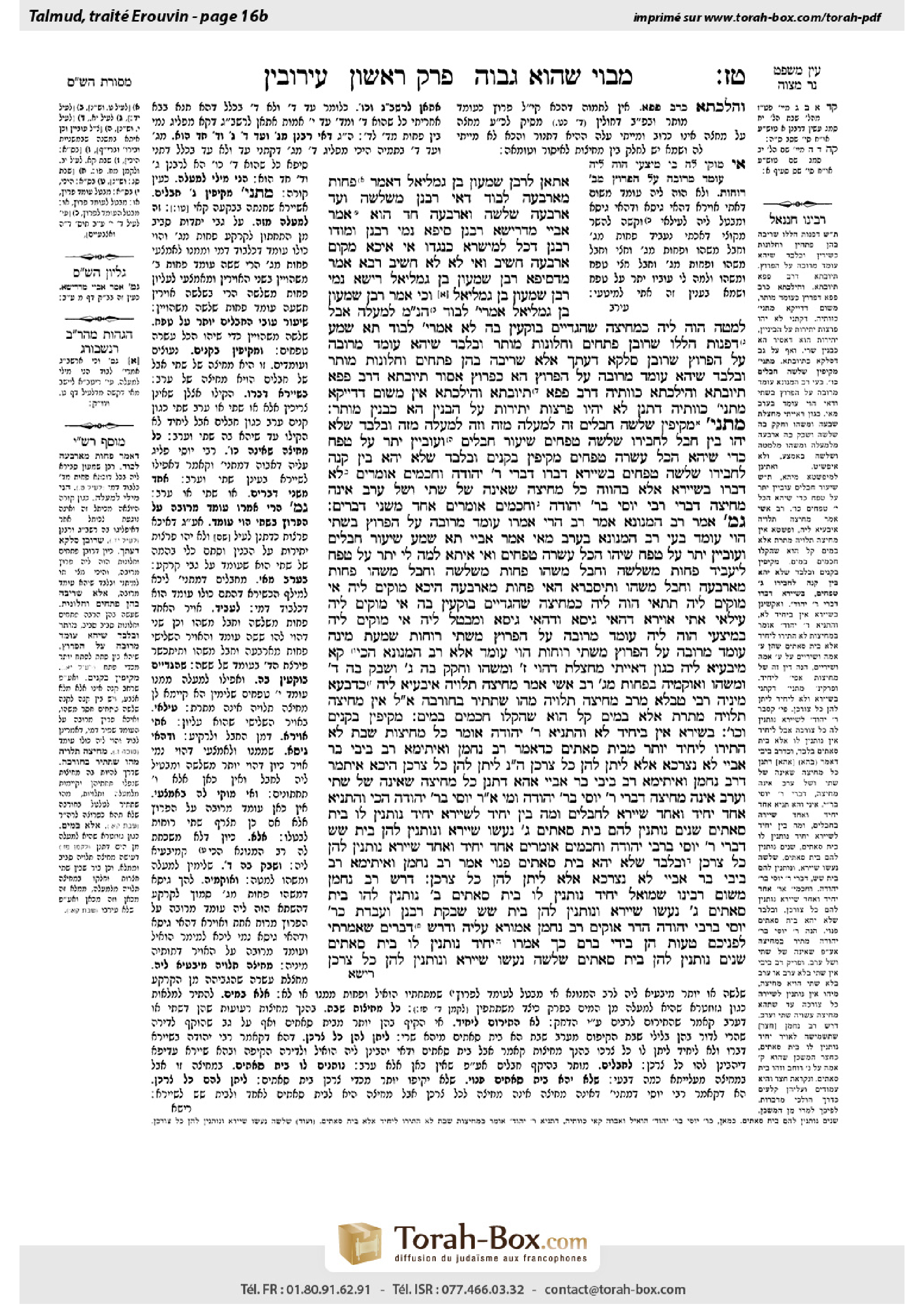
Eruvin 16b: Talmud study for Daf Yomi
Study the Talmud for Daf Yomi with scanned pages, Hebrew text, English translations from Sefaria and AI-generated French translations.
Passage selection and English or AI-generated French translation are available where the scan has annotations. Daf Study is independent of Torah-Box and Sefaria.
Browse Eruvin · עירובין · All tractatesEruvin 16b text and translations
This page of Eruvin includes the Aramaic text, an English translation and an AI-generated French translation, alongside the scan above.
עירובין י״ו ב · Aramaic and Hebrew text
אֲתָאן לְרַבָּן שִׁמְעוֹן בֶּן גַּמְלִיאֵל דְּאָמַר: פָּחוֹת מֵאַרְבָּעָה לָבוּד. דְּאִי רַבָּנַן: מִשְּׁלֹשָׁה וְעַד אַרְבָּעָה? שְׁלֹשָׁה וְאַרְבָּעָה חַד הוּא.
אָמַר אַבָּיֵי: מִדְּרֵישָׁא רַבָּנַן, סֵיפָא נָמֵי רַבָּנַן, וּמוֹדוּ רַבָּנַן דְּכׇל לְמִישְׁרֵא כְּנֶגְדּוֹ, אִי אִיכָּא מָקוֹם אַרְבָּעָה — חֲשִׁיב, וְאִי לָא — לָא חֲשִׁיב.
רָבָא אָמַר: מִדְּסֵיפָא רַבָּן שִׁמְעוֹן בֶּן גַּמְלִיאֵל, רֵישָׁא נָמֵי רַבָּן שִׁמְעוֹן בֶּן גַּמְלִיאֵל. וְכִי אָמַר רַבָּן שִׁמְעוֹן בֶּן גַּמְלִיאֵל אָמְרִינַן לָבוּד — הָנֵי מִילֵּי לְמַעְלָה, אֲבָל לְמַטָּה, הָוֵה לֵיהּ כִּמְחִיצָה שֶׁהַגְּדָיִים בּוֹקְעִין בָּהּ — לָא אָמְרִינַן: לָבוּד.
תָּא שְׁמַע: דְּפָנוֹת הַלָּלוּ שֶׁרוּבָּן פְּתָחִים וְחַלּוֹנוֹת מוּתָּר, וּבִלְבַד שֶׁיְּהֵא עוֹמֵד מְרוּבֶּה עַל הַפָּרוּץ.
״שֶׁרוּבָּן״, סָלְקָא דַּעְתָּךְ?! אֶלָּא: שֶׁרִיבָּה בָּהֶן פְּתָחִים וְחַלּוֹנוֹת מוּתָּר, וּבִלְבַד שֶׁיְּהֵא עוֹמֵד מְרוּבֶּה עַל הַפָּרוּץ.
הָא כַּפָּרוּץ אָסוּר, תְּיוּבְתָּא דְּרַב פָּפָּא תְּיוּבְתָּא. וְהִילְכְתָא כְּווֹתֵיהּ דְּרַב פָּפָּא.
תְּיוּבְתָּא וְהִילְכְתָא?! אִין, מִשּׁוּם דְּדַיְיקָא מַתְנִיתִין כְּווֹתֵיהּ. דִּתְנַן: לֹא יִהְיוּ פְּרָצוֹת יְתֵירוֹת עַל הַבִּנְיָן. הָא כַּבִּנְיָן מוּתָּר.
מַתְנִי׳ מַקִּיפִין שְׁלֹשָׁה חֲבָלִים זֶה לְמַעְלָה מִזֶּה, וָזֶה לְמַעְלָה מִזֶּה, וּבִלְבַד שֶׁלֹּא יְהוּ בֵּין חֶבֶל לַחֲבֵירוֹ שְׁלֹשָׁה טְפָחִים.
שִׁיעוּר חֲבָלִים וְעוֹבְיָין יָתֵר עַל טֶפַח, כְּדֵי שֶׁיְּהֵא הַכֹּל עֲשָׂרָה טְפָחִים.
מַקִּיפִין בְּקָנִים, וּבִלְבַד שֶׁלֹּא יְהֵא בֵּין קָנֶה לַחֲבֵירוֹ שְׁלֹשָׁה טְפָחִים.
בִּשְׁיָירָא דִּבְּרוּ, דִּבְרֵי רַבִּי יְהוּדָה. וַחֲכָמִים אוֹמְרִים: לֹא דִּבְּרוּ בִּשְׁיָירָא, אֶלָּא בַּהוֹוֶה.
כׇּל מְחִיצָה שֶׁאֵינָהּ שֶׁל שְׁתִי וְשֶׁל עֵרֶב — אֵינָהּ מְחִיצָה, דִּבְרֵי רַבִּי יוֹסֵי בְּרַבִּי יְהוּדָה. וַחֲכָמִים אוֹמְרִים: אֶחָד מִשְּׁנֵי דְּבָרִים.
גְּמָ׳ אָמַר רַב הַמְנוּנָא אָמַר רַב: הֲרֵי אָמְרוּ, עוֹמֵד מְרוּבֶּה עַל הַפָּרוּץ בִּשְׁתִי — הָוֵי עוֹמֵד. בָּעֵי רַב הַמְנוּנָא: בְּעֵרֶב מַאי?
אָמַר אַבָּיֵי, תָּא שְׁמַע: שִׁיעוּר חֲבָלִים וְעוֹבְיָין יָתֵר עַל טֶפַח, שֶׁיְּהוּ הַכֹּל עֲשָׂרָה טְפָחִים. וְאִי אִיתָא — לְמָה לִי יָתֵר עַל טֶפַח?
לֶיעְבֵּיד פָּחוֹת מִשְּׁלֹשָׁה וְחֶבֶל מַשֶּׁהוּ, פָּחוֹת מִשְּׁלֹשָׁה וְחֶבֶל מַשֶּׁהוּ, פָּחוֹת מֵאַרְבָּעָה וְחֶבֶל מַשֶּׁהוּ.
וְתִיסְבְּרָא? הַאי פָּחוֹת מֵאַרְבָּעָה הֵיכָא מוֹקֵים לֵיהּ? אִי מוֹקֵים לֵיהּ תַּתַּאי, הָוֵה לֵיהּ כִּמְחִיצָה שֶׁהַגְּדָיִים בּוֹקְעִין בָּהּ.
אִי מוֹקֵים לֵיהּ עִילַּאי, אָתֵי אַוֵּירָא דְּהַאי גִּיסָא וּדְהַאי גִּיסָא וּמְבַטֵּל לֵיהּ.
אִי מוֹקֵים לֵיהּ בְּמִיצְעֵי, הָוֵה לֵיהּ עוֹמֵד מְרוּבֶּה עַל הַפָּרוּץ מִשְׁתֵּי רוּחוֹת. שָׁמְעַתְּ מִינַּהּ עוֹמֵד מְרוּבֶּה עַל הַפָּרוּץ מִשְׁתֵּי רוּחוֹת הָוֵי עוֹמֵד!
אֶלָּא רַב הַמְנוּנָא הָכִי קָא מִיבַּעְיָא לֵיהּ: כְּגוֹן דְּאַיְיתִי מַחְצֶלֶת דְּהָוֵי שִׁבְעָה וּמַשֶּׁהוּ, וַחֲקַק בַּהּ שְׁלֹשָׁה, וּשְׁבַק בַּהּ אַרְבָּעָה וּמַשֶּׁהוּ, וְאוֹקְמֵיהּ בְּפָחוֹת מִשְּׁלֹשָׁה.
רַב אָשֵׁי אָמַר: מְחִיצָה תְּלוּיָה אִיבַּעְיָא לֵיהּ. כְּדִבְעָא מִינֵּיהּ רַבִּי טַבְלָא מֵרַב: מְחִיצָה תְּלוּיָה מַהוּ שֶׁתַּתִּיר בְּחוּרְבָּה? אֲמַר לֵיהּ: אֵין מְחִיצָה תְּלוּיָה מַתֶּרֶת אֶלָּא בַּמַּיִם, קַל הוּא שֶׁהֵקֵלּוּ חֲכָמִים בְּמַיִם.
מַקִּיפִין בְּקָנִים וְכוּ׳. בִּשְׁיָרָא אִין, בְּיָחִיד לָא? וְהָתַנְיָא, רַבִּי יְהוּדָה אוֹמֵר: כׇּל מְחִיצּוֹת שַׁבָּת לֹא הִתִּירוּ לְיָחִיד יוֹתֵר מִבֵּית סָאתַיִם.
כִּדְאָמַר רַב נַחְמָן וְאִיתֵּימָא רַב בִּיבִי בַּר אַבָּיֵי: לָא נִצְרְכָא אֶלָּא לִיתֵּן לָהֶן כׇּל צָרְכָּן, הָכָא נָמֵי לִיתֵּן לָהֶן כׇּל צָרְכָּן.
הֵיכָא אִיתְּמַר דְּרַב נַחְמָן וְאִיתֵּימָא רַב בִּיבִי בַּר אַבָּיֵי? אַהָא דִּתְנַן: כׇּל מְחִיצָה שֶׁאֵינָהּ שֶׁל שְׁתִי וָעֵרֶב אֵינָהּ מְחִיצָה, דִּבְרֵי רַבִּי יוֹסֵי בְּרַבִּי יְהוּדָה.
וּמִי אָמַר רַבִּי יוֹסֵי בְּרַבִּי יְהוּדָה הָכִי? וְהָתַנְיָא: אֶחָד יָחִיד וְאֶחָד שְׁיָירָא לַחֲבָלִים. וּמָה בֵּין יָחִיד לִשְׁיָירָא? יָחִיד נוֹתְנִין לוֹ בֵּית סָאתַיִם, שְׁנַיִם נוֹתְנִין לָהֶם בֵּית סָאתַיִם, שְׁלֹשָׁה נַעֲשׂוּ שְׁיָירָא וְנוֹתְנִין לָהֶן בֵּית שֵׁשׁ. דִּבְרֵי רַבִּי יוֹסֵי בְּרַבִּי יְהוּדָה.
וַחֲכָמִים אוֹמְרִים: אֶחָד יָחִיד וְאֶחָד שְׁיָירָא נוֹתְנִין לָהֶן כׇּל צָרְכָּן, וּבִלְבַד שֶׁלֹּא יְהֵא בֵּית סָאתַיִם פָּנוּי!
אָמַר רַב נַחְמָן וְאִיתֵּימָא רַב בִּיבִי בַּר אַבָּיֵי: לָא נִצְרְכָא, אֶלָּא לִיתֵּן לָהֶן כׇּל צָרְכָּן.
דָּרַשׁ רַב נַחְמָן מִשּׁוּם רַבֵּינוּ שְׁמוּאֵל: יָחִיד — נוֹתְנִין לוֹ בֵּית סָאתַיִם, שְׁנַיִם — נוֹתְנִין לְהוּ בֵּית סָאתַיִם, שְׁלֹשָׁה — נַעֲשׂוּ שְׁיָירָא וְנוֹתְנִין לָהֶן בֵּית שֵׁשׁ.
שָׁבַקְתְּ רַבָּנַן וְעָבְדַתְּ כְּרַבִּי יוֹסֵי בְּרַבִּי יְהוּדָה?
הֲדַר אוֹקֵים רַב נַחְמָן אָמוֹרָא עֲלֵיהּ וּדְרַשׁ: דְּבָרִים שֶׁאָמַרְתִּי לִפְנֵיכֶם טָעוּת הֵן בְּיָדִי. בְּרַם כָּךְ אָמְרוּ: יָחִיד — נוֹתְנִין לוֹ בֵּית סָאתַיִם, שְׁנַיִם — נוֹתְנִין לָהֶן בֵּית סָאתַיִם, שְׁלֹשָׁה — נַעֲשׂוּ שְׁיָירָא וְנוֹתְנִין לָהֶן כָּל צָרְכָּן.
Eruvin 16b · English translation
we have arrived at the opinion of Rabban Shimon ben Gamliel, who said: Concerning any gap less than four handbreadths wide, the principle of lavud is applied. As had it been taught in accordance with the opinion of the Rabbis, why does the baraita list from three to four handbreadths as a separate category? In the case of both three and four handbreadths, the halakha is one and the same: The principle of lavud does not apply from three handbreadths upward.
Abaye said: From the fact that the first clause is in accordance with the opinion of the Rabbis, the latter clause must also be in accordance with the opinion of the Rabbis. And the Rabbis concede that with regard to any case where the halakha permits sowing other species in the area opposite the standing portion, if there is an area of four handbreadths, it is considered a significant partition, which permits sowing; and if not, it is not considered a significant partition and does not permit sowing. Accordingly, there is a difference between a fence of three handbreadths and one of four handbreadths, as even the Rabbis concede that a fence of four handbreadths is more significant.
Rava said: From the fact that the latter clause is in accordance with the opinion of Rabban Shimon ben Gamliel, the first clause must also be in accordance with the opinion of Rabban Shimon ben Gamliel. And when Rabban Shimon ben Gamliel said that we say the principle of lavud in the case of a gap up to four handbreadths wide, this applies above, off the ground, e.g., in the case of a cross beam suspended at a distance from the wall. However, below, near the ground, it is like a partition through which goats can pass, and therefore he too agrees that we do not say the principle of lavud in that case.
The Gemara returns to the dispute with regard to a breach equal to the standing segments of a partition and cites another proof. Come and hear that which was taught in the following baraita: With regard to an area enclosed by these walls, in a case where most of them consist of entrance and windows, it is permitted to carry on Shabbat within the area, provided that the standing segments are greater than the breached segments.
The Gemara analyzes the formulation of the baraita: Can it enter your mind that the baraita is referring to a case where most of the walls are entrances and windows? If so, the standing segments are certainly not greater than the breached segments. Rather, emend the baraita as follows: Carrying in the area enclosed by these walls, to which one added many entrances and windows, is permitted, provided that the standing segments are greater than the breached segments.
The Gemara draws an inference: If the standing segments equal the breached segments, carrying is prohibited in that enclosure. This is a conclusive refutation of the opinion of Rav Pappa. The Gemara concludes: Indeed, it is a conclusive refutation. Nevertheless, the halakha is in accordance with the opinion of Rav Pappa.
The Gemara wonders: A conclusive refutation and the halakha? The Gemara answers: Yes, that is the case, because the precise reading of the mishna is in accordance with the opinion of Rav Pappa. As we learned in the mishna the following phrase: Provided…there will not be breaches in the partition greater than the built segment. This is clearly indicating that if the breached segments are equal to the built segments, carrying is permitted, as maintained by Rav Pappa.
MISHNA: If a caravan is camped in a field, and the travelers seek to construct partitions to render the area fit for one to carry within it on Shabbat, one surrounds the area with three ropes, one above another, and a third one above the other two. One is permitted to carry within the circumscribed area provided that there will not be a gap of three handbreadths between one rope and the next.
The measure of the ropes and their combined thickness must be greater than a handbreadth, so that the entire partition, consisting of three ropes and the empty spaces between them, will be ten handbreadths high.
Alternatively, one may surround the area with boards that stand upright, provided that there will not be a gap of three handbreadths between one board and the next.
When the Sages issued this ruling, they spoke exclusively of a caravan; this is the statement of Rabbi Yehuda, who maintains that a partition of this kind, which consists of only horizontal or vertical elements, is permitted exclusively in exigent circumstances. Otherwise, full-fledged partitions are required. However, the Rabbis say: They spoke of a caravan in the mishna only because they spoke in the present, citing the most typical case. Those traveling in caravans were typically unable to erect full-fledged partitions, so they would surround their camps with ropes or boards. However, the halakha in the mishna applies in all cases.
The mishna cites an additional dispute: Any partition that is not constructed of both warp and woof, i.e., vertical and horizontal elements, is not a partition; this is the statement of Rabbi Yosei, son of Rabbi Yehuda. He holds that the vertical boards and the horizontal ropes are not considered a partition, even in the exigent circumstances of a caravan. However, the Rabbis say: One of the two elements, either vertical or horizontal, is sufficient.
GEMARA: Rav Hamnuna said that Rav said: It was concluded in the previous mishna that the Rabbis said that in the case of a partition that consists only of warp, i.e., vertical, elements, if the standing segment of the partition is greater than the breached segment, the fence is considered standing. Rav Hamnuna raised a dilemma: What is the halakha in the case of a partition that consists only of woof, i.e., horizontal, elements? Is it also considered standing if the standing segment is greater than the breached segment, or not?
Abaye said: Come and hear a resolution to this dilemma from the mishna: The measure of the ropes and their combined thickness must be greater than a handbreadth, so that the entire partition will be ten handbreadths high. And if it is so that, in a case where the standing segment is greater than the breached segment, the partition is considered standing even in the case of a fence that consists of horizontal elements, why do I need ropes with a combined thickness of greater than a handbreadth?
Instead, let one leave a space slightly less than three handbreadths, and place a rope of any size, leave another space slightly less than three handbreadths, and place another rope of any size, leave a third space slightly less than four handbreadths, and place a third rope of any size. The ropes between which there is a space less than three handbreadths should be considered joined, based on the principle of lavud. The entire partition should be considered standing because the standing segment, measuring six handbreadths, is greater than the breached segment, which measures four handbreadths.
The Gemara presents a difficulty: And how can you understand that this would be effective? Where does he position the space of slightly less than four handbreadths? If he positions it at the bottom, its legal status is like that of a partition through which goats pass, which is not a valid partition.
If he positions it at the top, then the air on this side, above the uppermost rope, and on that side, below that rope, come and negate it. As there are more than three handbreadths between them the upper and lower ropes, they are not joined together based on the principle of lavud. The four handbreadths below the uppermost rope and the airspace above it combine to negate the connection.
If he positions it in the middle, then the standing segment of the partition is greater than the breached segment, provided that the standing portions on the two sides of the breach are combined. However, if each side is considered separately, the breach is greater than the standing portion. If it is nevertheless deemed a partition, conclude from it that even if the standing segment is greater than the breached segment only when the standing segments on the two sides of the breach are combined, the partition is considered standing. However, that circumstance was raised as a dilemma and remained unresolved.
Rather, Rav Hamnuna raised the following dilemma: What is the halakha in a case where one brought a mat that is seven handbreadths and any additional amount, and carved in it a hole three handbreadths wide, and left four handbreadths above the hole and any additional amount below it, and positioned the mat less than three handbreadths off the ground?
Rav Ashi said: The dilemma he raised is with regard to the legal status of a ten-handbreadth partition suspended off the ground. That dilemma is similar to that which Rabbi Tavla raised as a dilemma before Rav: Does a suspended partition act as if it were a partition that reaches the ground and render it permitted for one to carry in a ruin? Rav said to him: A suspended partition renders it permitted for one to carry only when it is suspended over water, as there is a leniency introduced by the Sages with regard to water.
We learned in the mishna: One may surround the area with boards that stand upright, provided there will not be a gap of three handbreadths between one board and the next. Rabbi Yehuda said that this leniency, which allows the establishment of a partition consisting exclusively of horizontal or vertical elements, was stated only with regard to a caravan. The Gemara infers: With regard to a caravan, yes, it is permitted; with regard to an individual, no, it is not permitted. Wasn’t it taught in a baraita: Rabbi Yehuda says: With regard to all unsteady partitions of Shabbat, e.g., those consisting exclusively of horizontal or vertical elements, the Sages did not permit their use for an individual if the space that they enclose is greater than two beit se’a? This indicates that, for an area of up to two beit se’a, Rabbi Yehuda permits these partitions even for an individual.
The Gemara answers: Rabbi Yehuda’s statement in the mishna can be understood in accordance with that which Rav Naḥman, and some say it was Rav Beivai bar Abaye, said with regard to a different statement: This halakha was necessary only in order to provide those traveling in the caravan with space to satisfy all their needs. Here, too, in the mishna, Rabbi Yehuda’s statement can be understood as coming to provide those traveling in the caravan with space to satisfy all their needs. In other words, Rabbi Yehuda does not dispute the fundamental effectiveness of a partition of this kind, even for an individual. When he says that the halakha applies solely to a caravan, he means that it applies only in the case of a caravan, regardless of the size of the area in question. However, in the case of an individual, a partition of that kind is effective only if it encloses an area up to two beit se’a.
The Gemara asks: Where was this statement of Rav Naḥman, and some say of Rav Beivai bar Abaye, stated? It was stated with regard to this ruling at the end of the mishna: Any partition that is not made of both vertical and horizontal elements is not a partition; this is the statement of Rabbi Yosei, son of Rabbi Yehuda.
The Gemara asks: Did Rabbi Yosei, son of Rabbi Yehuda, actually say this? Wasn’t it taught in a baraita: For both an individual and a caravan, partitions made of ropes are effective? And what, then, is the difference between an individual and a caravan? With regard to an individual, the halakha provides him with an area of two beit se’a, in which he may carry by virtue of partitions of this kind. With regard to two individuals as well, the halakha provides them with an area of two beit se’a. Three individuals assume the legal status of a caravan, and the halakha provides each of them with an area of two beit se’a, for a total of six beit se’a. This is the statement of Rabbi Yosei, son of Rabbi Yehuda.
And the Rabbis say: With regard to both an individual and those traveling in a caravan, one provides them with space to satisfy all their needs, provided that there will not be an unoccupied space of two beit se’a. They may not enclose an area that is two beit se’a larger than the space that they require. Apparently, Rabbi Yosei, son of Rabbi Yehuda, relies on the ruling that ropes render an area fit for one to carry within it, even for an individual.
Rav Naḥman, and some say it was Rav Beivai bar Abaye, said: The opinion of Rabbi Yosei, son of Rabbi Yehuda, in the mishna was necessary only to provide them with the space to satisfy all their needs in the case of a properly constructed partition consisting of both horizontal and vertical elements. A partition consisting of exclusively horizontal or vertical elements renders an area of six beit se’a fit for one to carry within it, only in the case of a caravan.
Rav Naḥman taught in the name of Rabbeinu Shmuel: With regard to an individual, the halakha provides him with an area of two beit se’a. With regard to two individuals, the halakha provides them with an area of two beit se’a as well. Three individuals assume the legal status of a caravan, and the halakha provides each of them with an area of two beit se’a, for a total of six beit se’a.
Rav Naḥman was asked: Did you abandon the majority opinion of the Rabbis and act in accordance with the individual opinion of Rabbi Yosei, son of Rabbi Yehuda?
Rav Naḥman then placed a speaker standing over him, and taught: The matters that I stated before you are an error on my part. Indeed, this is what the Rabbis said: With regard to an individual, the halakha provides him with an area of two beit se’a. With regard to two individuals, the halakha provides them with an area of two beit se’a as well. Three individuals assume the legal status of a caravan, and the halakha provides them with space to satisfy all their needs.
Eruvin 16b · Traduction française (IA)
nous arrivons à l'opinion de Rabban Shimon ben Gamliel, qui dit : concernant tout espace de moins de quatre tefachim de largeur, le principe de lavud s'applique. Si cela avait été enseigné conformément à l'opinion des Rabbins, pourquoi la baraïta classe-t-elle de trois à quatre tefachim comme une catégorie séparée ? Dans le cas des trois et des quatre tefachim, la halakha est la même : le principe de lavud ne s'applique pas à partir de trois tefachim.
Abaye dit : du fait que la première clause correspond à l'opinion des Rabbins, la seconde clause doit aussi correspondre à l'opinion des Rabbins. Et les Rabbins reconnaissent que concernant tout cas où la halakha permet de semer d'autres espèces dans la zone opposée à la partie érigée, si une zone de quatre tefachim existe, elle est considérée comme une partition significative, permettant la sémence ; et si non, elle n'est pas considérée comme une partition significative et ne permet pas la sémence. Ainsi, il y a une différence entre une clôture de trois tefachim et une clôture de quatre tefachim, car même les Rabbins reconnaissent que la clôture de quatre tefachim est plus significative.
Rava dit : du fait que la seconde clause correspond à l'opinion de Rabban Shimon ben Gamliel, la première clause doit aussi correspondre à l'opinion de Rabban Shimon ben Gamliel. Et lorsque Rabban Shimon ben Gamliel dit que nous appliquons le principe de lavud dans le cas d'un espace jusqu'à quatre tefachim de largeur, cela s'applique au-dessus du sol, par exemple dans le cas d'une poutre suspendue à distance du mur. Cependant, en dessous, près du sol, cela ressemble à une clôture par laquelle les chèvres peuvent passer, et donc il reconnaît aussi que nous ne disons pas le principe de lavud dans ce cas.
La Guemara reprend la dispute concernant une brèche égale aux segments érigés d'une clôture et cite une autre preuve. Vient entendre ce qui a été enseigné dans la baraïta suivante : concernant une zone enclose par ces murs, dans le cas où la plupart d'entre eux sont des entrées et des fenêtres, il est permis de porter à l'intérieur de la zone le sabbat, à condition que les segments érigés soient supérieurs aux segments brisés.
La Guemara analyse la formulation de la baraïta : peut-il entrer en votre esprit que la baraïta fait référence à un cas où la plupart des murs sont des entrées et des fenêtres ? Si c'est le cas, les segments érigés ne sont certainement pas supérieurs aux segments brisés. Plutôt, corrigez la baraïta comme suit : porter dans la zone enclose par ces murs, à laquelle on a ajouté beaucoup d'entrées et de fenêtres, est permis, à condition que les segments érigés soient supérieurs aux segments brisés.
La Guemara tire une conséquence : si les segments érigés sont égaux aux segments brisés, le port est interdit dans cette enclosure. C'est une réfutation concluante de l'opinion de Rav Pappa. La Guemara conclut : en effet, c'est une réfutation concluante. Cependant, la halakha suit l'opinion de Rav Pappa.
La Guemara se demande : une réfutation concluante et la halakha ? La Guemara répond : oui, c'est le cas, car la lecture précise de la mishna correspond à l'opinion de Rav Pappa. Comme nous avons appris dans la mishna la phrase suivante : à condition que... il n'y ait pas de brèches dans la clôture supérieures au segment construit. Cela indique clairement que si les segments brisés sont égaux aux segments construits, le port est permis, comme maintenu par Rav Pappa.
MICHNA : Si un convoi est campé dans un champ, et que les voyageurs souhaitent construire des clôtures pour rendre la zone adaptée à porter le sabbat, on entoure la zone de trois cordes, l'une au-dessus de l'autre, et une troisième au-dessus des deux autres. On est autorisé à porter à l'intérieur de la zone délimitée à condition qu'il n'y ait pas d'espace de trois tefachim entre une corde et l'autre.
La mesure des cordes et leur épaisseur combinée doit être supérieure à un tefach, de sorte que la clôture complète, composée de trois cordes et des espaces entre elles, soit de dix tefachim de haut.
Une alternative consiste à entourer la zone avec des planches verticales, à condition qu'il n'y ait pas d'espace de trois tefachim entre une planche et l'autre.
Lorsque les Sages ont rendu cette décision, ils parlaient exclusivement d'un convoi ; c'est la déclaration de Rabbi Yehuda, qui maintient que cette clôture, composée uniquement d'éléments horizontaux ou verticaux, est permise uniquement en cas d'urgence. Sinon, des clôtures complètes sont nécessaires. Cependant, les Rabbins disent : ils parlaient d'un convoi dans la mishna uniquement parce qu'ils parlaient du présent, en citant le cas le plus typique. Ceux qui voyageaient en convoi étaient généralement incapables d'ériger des clôtures complètes, donc ils entouraient leurs camps avec des cordes ou des planches. Cependant, la halakha de la mishna s'applique à tous les cas.
La mishna cite un autre débat : toute clôture qui n'est pas construite à la fois de composants verticaux et horizontaux n'est pas considérée comme une clôture ; c'est la déclaration de Rabbi Yosei, fils de Rabbi Yehuda. Il maintient que les planches verticales et les cordes horizontales ne sont pas considérées comme une clôture, même en cas d'urgence pour un convoi. Cependant, les Rabbins disent : l'un des deux éléments, soit vertical soit horizontal, suffit.
GUEMARA : Rav Hamnuna dit que Rav dit : il a été conclu dans la précédente mishna que les Rabbins disent que dans le cas d'une clôture composée uniquement d'éléments verticaux, c'est-à-dire de composants verticaux, si le segment érigé de la clôture est supérieur au segment brisé, la clôture est considérée comme érigée. Rav Hamnuna a soulevé un dilemme : quelle est la halakha dans le cas d'une clôture composée uniquement d'éléments horizontaux, c'est-à-dire de composants horizontaux ? Est-elle aussi considérée comme érigée si le segment érigé est supérieur au segment brisé, ou non ?
Abaye dit : Viens écouter une solution à ce dilemme tirée de la Michna : La mesure des cordes et leur épaisseur combinée doit être supérieure à un tefach, afin que la paroi complète soit haute de dix tefachim. Et si c'est le cas où le segment debout est supérieur au segment brisé, la paroi est considérée comme debout même dans le cas d'une clôture composée d'éléments horizontaux, pourquoi ai-je besoin de cordes dont l'épaisseur combinée soit supérieure à un tefach ?
Au contraire, laissez un espace légèrement inférieur à trois tefachim, et placez une corde de toute taille, laissez un autre espace légèrement inférieur à trois tefachim, et placez une autre corde de toute taille, laissez un troisième espace légèrement inférieur à quatre tefachim, et placez une troisième corde de toute taille. Les cordes entre lesquelles il y a un espace inférieur à trois tefachim doivent être considérées comme jointes, selon le principe de lavud. La paroi doit être considérée comme debout car le segment debout, mesurant six tefachim, est supérieur au segment brisé, mesurant quatre tefachim.
Le Guemara présente un difficulté : Comment peut-on comprendre que cela soit efficace ? Où place-t-il l'espace légèrement inférieur à quatre tefachim ? Si il le place en bas, son statut juridique est celui d'une paroi par laquelle des béliers passent, ce qui n'est pas une paroi valide.
Si on le place en haut, alors l'air de ce côté, au-dessus de la corde supérieure, et de ce côté, en dessous de cette corde, vient le négativer. Comme il y a plus de trois tefachim entre les cordes supérieure et inférieure, elles ne sont pas jointes selon le principe de lavud. Les quatre tefachim en dessous de la corde supérieure et l'air au-dessus d'elle combinés viennent négativer la connexion.
Si on le place au milieu, alors le segment debout de la paroi est supérieur au segment brisé, à condition que les segments debout des deux côtés du point de rupture soient combinés. Cependant, si chaque côté est considéré séparément, le point de rupture est supérieur au segment debout. Si cela est toutefois considéré comme une paroi, concluez-en que même si le segment debout est supérieur au segment brisé uniquement lorsque les segments debout des deux côtés du point de rupture sont combinés, la paroi est considérée comme debout. Cependant, cette situation a été soulevée comme un dilemme et reste sans résolution.
Au contraire, Rav Hamnuna a soulevé le suivant dilemme : Quel est le halakha dans le cas où l'on apporte une tente de sept tefachim et toute quantité supplémentaire, et qu'on y fait un trou de trois tefachim de large, et qu'on laisse quatre tefachim au-dessus du trou et toute quantité supplémentaire en dessous, et qu'on place la tente à moins de trois tefachim du sol ?
Rav Ashi dit : Le dilemme qu'il a soulevé concerne le statut juridique d'une paroi de dix tefachim suspendue au-dessus du sol. Ce dilemme est semblable à celui que Rabbi Tavla a soulevé comme dilemme devant Rav : Une paroi suspendue agit-elle comme si elle atteignait le sol et permettait de porter des objets dans un lieu abandonné ? Rav a répondu à lui : Une paroi suspendue permet de porter des objets uniquement lorsqu'elle est suspendue au-dessus de l'eau, car les Sages ont introduit une allègement concernant l'eau.
Nous avons appris dans la Michna : On peut entourer la zone avec des planches debout, à condition qu'il n'y ait pas un espace de trois tefachim entre une planche et l'autre. Rabbi Yehuda a dit que cette leniency, qui permet l'établissement d'une paroi composée uniquement d'éléments horizontaux ou verticaux, a été énoncée uniquement concernant un caravane. Le Guemara infère : Concernant un caravane, oui, cela est permis ; concernant un individu, non, cela n'est pas permis. N'était-il pas enseigné dans une baraïta : Rabbi Yehuda dit : Concernant toutes les parois instables du Shabbat, c'est-à-dire celles composées uniquement d'éléments horizontaux ou verticaux, les Sages n'ont pas permis leur utilisation pour un individu si l'espace qu'elles enclosent est supérieur à deux beit se'a ? Cela indique que, pour une zone jusqu'à deux beit se'a, Rabbi Yehuda permet ces parois même pour un individu.
Le Guemara répond : La déclaration de Rabbi Yehuda dans la mitsna peut être comprise en conformité avec celle que Rav Naḥman, et certains disent que c'était Rav Beivai bar Abaye, a dite concernant une autre déclaration : Cette halakha était nécessaire uniquement afin de permettre aux voyageurs du caravane d'avoir un espace pour satisfaire tous leurs besoins. Ici aussi, dans la mitsna, la déclaration de Rabbi Yehuda peut être comprise comme visant à permettre aux voyageurs du caravane d'avoir un espace pour satisfaire tous leurs besoins. En d'autres termes, Rabbi Yehuda ne conteste pas l'efficacité fondamentale d'une paroi de ce type, même pour un individu. Lorsqu'il dit que la halakha s'applique uniquement au caravane, il veut dire qu'elle s'applique uniquement dans le cas du caravane, indépendamment de la taille de la zone en question. Cependant, dans le cas d'un individu, une paroi de ce type est efficace uniquement si elle enclose une zone jusqu'à deux beit se'a.
Le Guemara demande : Où a été déclarée cette déclaration de Rav Naḥman, et certains disent de Rav Beivai bar Abaye ? Elle a été déclarée concernant cette décision à la fin de la mitsna : Toute paroi qui n'est pas faite des deux types d'éléments, vertical et horizontal, n'est pas une paroi ; c'est la déclaration de Rabbi Yosei, fils de Rabbi Yehuda.
Le Guemara demande : Rabbi Yosei, fils de Rabbi Yehuda, a-t-il vraiment dit cela ? N'était-il pas enseigné dans une baraïta : Pour un individu et un caravane, les parois faites de cordes sont efficaces ? Et qu'est-ce alors, la différence entre un individu et un caravane ? Concernant un individu, la halakha lui donne un espace de deux beit se'a, dans lequel il peut porter grâce à ces parois. Concernant deux individus également, la halakha leur donne un espace de deux beit se'a. Trois individus prennent le statut juridique d'un caravane, et la halakha donne à chacun d'eux un espace de deux beit se'a, pour un total de six beit se'a. C'est la déclaration de Rabbi Yosei, fils de Rabbi Yehuda.
Et les Rabbins disent : Concernant un individu et ceux voyageant en caravane, on leur fournit un espace pour satisfaire toutes leurs besoins, à condition qu'il n'y ait pas un espace non occupé de deux beit se'a. Ils ne peuvent pas enfermer une surface supérieure de deux beit se'a à l'espace dont ils ont besoin. Apparemment, Rabbi Yosei, fils de Rabbi Yehuda, s'appuie sur la décision selon laquelle les cordes rendent une surface adaptée à porter dedans, même pour un individu.
Rav Naḥman, et certains disent que c'était Rav Beivai bar Abaye, a dit : L'opinion de Rabbi Yosei, fils de Rabbi Yehuda, dans la Michna était nécessaire uniquement pour leur fournir un espace pour satisfaire toutes leurs besoins dans le cas d'une partition correctement construite comprenant à la fois des éléments horizontaux et verticaux. Une partition composée uniquement d'éléments horizontaux ou verticaux rend une surface de six beit se'a adaptée à porter dedans, uniquement dans le cas d'une caravane.
Rav Naḥman a enseigné en nom de Rabbeinu Shmuel : Concernant un individu, la halakha lui fournit une surface de deux beit se'a. Concernant deux individus, la halakha leur fournit une surface de deux beit se'a également. Trois individus prennent le statut juridique d'une caravane, et la halakha fournit à chacun d'eux une surface de deux beit se'a, pour un total de six beit se'a.
Rav Naḥman a été interrogé : As-tu abandonné l'opinion majoritaire des Rabbins et agis-tu selon l'opinion individuelle de Rabbi Yosei, fils de Rabbi Yehuda ?
Rav Naḥman a alors placé un haut-parleur sur lui, et a enseigné : Ce que j'ai dit avant vous est une erreur de ma part. En effet, c'est ce que les Rabbins ont dit : Concernant un individu, la halakha lui fournit une surface de deux beit se'a. Concernant deux individus, la halakha leur fournit une surface de deux beit se'a également. Trois individus prennent le statut juridique d'une caravane, et la halakha fournit à chacun d'eux un espace pour satisfaire toutes leurs besoins.
Traduction française générée par IA à partir de l’édition anglaise de Sefaria. Vérifie toujours un passage avec le texte source.
Text from Sefaria: William Davidson Edition - Vocalized Aramaic (CC BY NC); William Davidson Edition - English (CC BY NC).