Eruvin 17a: Talmud study for Daf Yomi
Study the Talmud for Daf Yomi with scanned pages, Hebrew text, English translations from Sefaria and AI-generated French translations.
Passage selection and English or AI-generated French translation are available where the scan has annotations. Daf Study is independent of Torah-Box and Sefaria.
Browse Eruvin · עירובין · All tractatesEruvin 17a text and translations
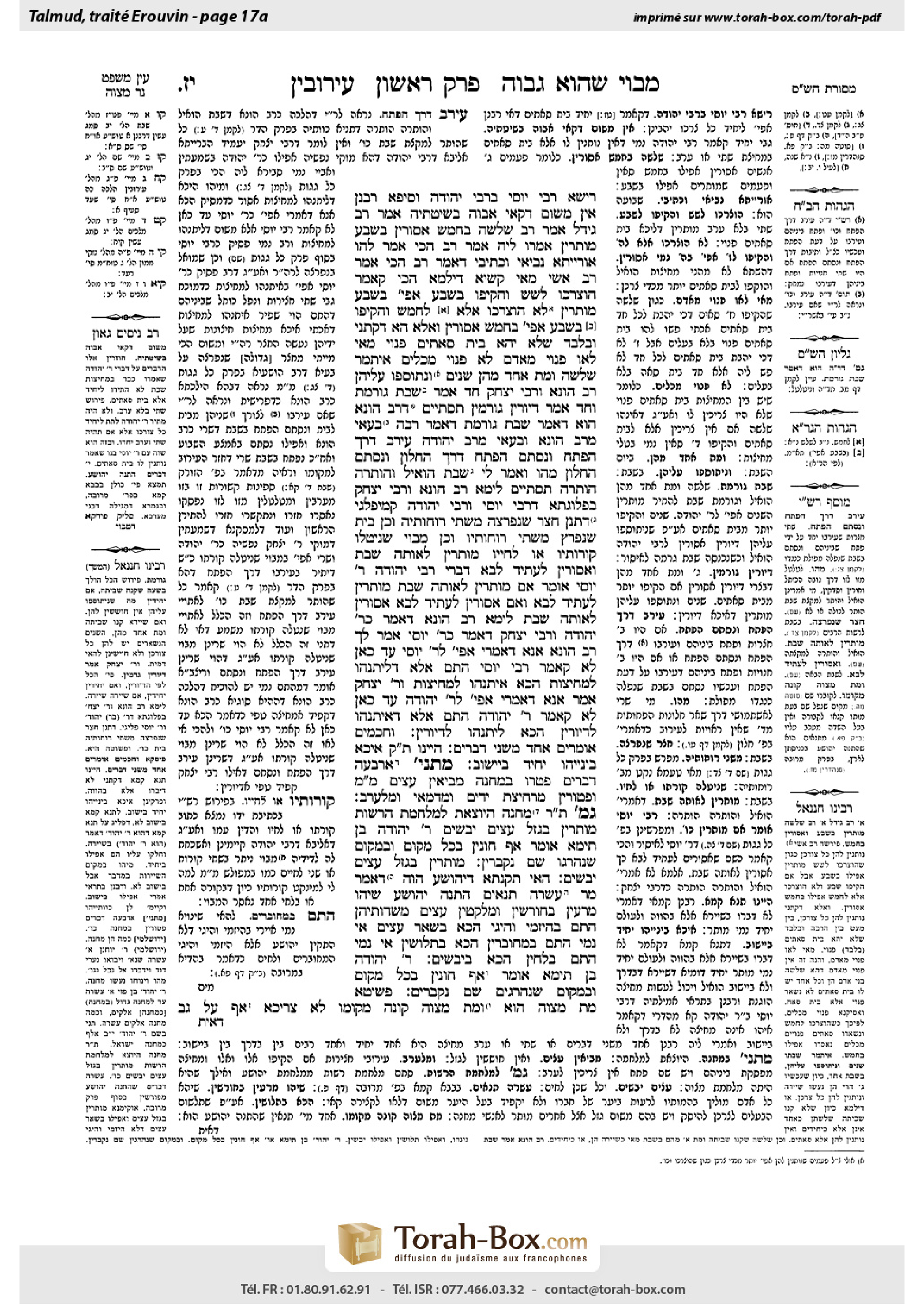
This page of Eruvin includes the Aramaic text, an English translation and an AI-generated French translation, alongside the scan above.
עירובין י״ז א · Aramaic and Hebrew text
רֵישָׁא רַבִּי יוֹסֵי בְּרַבִּי יְהוּדָה וְסֵיפָא רַבָּנַן?!
אִין, מִשּׁוּם דְּקָאֵי אֲבוּהּ בְּשִׁיטְתֵיהּ.
אָמַר רַב גִּידֵּל אָמַר רַב: שְׁלֹשָׁה בְּחָמֵשׁ — אֲסוּרִין, בְּשֶׁבַע מוּתָּרִין. אֲמַרוּ לֵיהּ: אֲמַר רַב הָכִי? אֲמַר לְהוּ: אוֹרָיְיתָא נְבִיאֵי וּכְתִיבֵי דַּאֲמַר רַב הָכִי!
אָמַר רַב אָשֵׁי: מַאי קַשְׁיָא? דִּילְמָא הָכִי קָאָמַר: הוּצְרְכוּ לְשֵׁשׁ וְהִקִּיפוּ בְּשֶׁבַע — אֲפִילּוּ בְּשֶׁבַע מוּתָּרִין. לֹא הוּצְרְכוּ אֶלָּא לְחָמֵשׁ וְהִקִּיפוּ בְּשֶׁבַע — אֲפִילּוּ בְּחָמֵשׁ אֲסוּרִין.
וְאֶלָּא הָא דְּקָתָנֵי: ״וּבִלְבַד שֶׁלֹּא יְהֵא בֵּית סָאתַיִם פָּנוּי״ — מַאי לָאו, פָּנוּי מֵאָדָם? לָא, פָּנוּי מִכֵּלִים.
אִיתְּמַר: שְׁלֹשָׁה וּמֵת אֶחָד מֵהֶן, שְׁנַיִם וְנִתּוֹסְפוּ עֲלֵיהֶן — רַב הוּנָא וְרַבִּי יִצְחָק, חַד אָמַר: שַׁבָּת גּוֹרֶמֶת, וְחַד אָמַר: דָּיוֹרִין גּוֹרְמִין.
תִּסְתַּיֵּים דְּרַב הוּנָא הוּא דְּאָמַר שַׁבָּת גּוֹרֶמֶת. דְּאָמַר רַבָּה: בְּעַאי מֵרַב הוּנָא, וּבְעַאי מֵרַב יְהוּדָה: עֵירַב דֶּרֶךְ הַפֶּתַח וְנִסְתַּם הַפֶּתַח, דֶּרֶךְ הַחַלּוֹן וְנִסְתַּם הַחַלּוֹן, מַהוּ? וְאָמַר לִי: שַׁבָּת הוֹאִיל וְהוּתְרָה — הוּתְּרָה. תִּסְתַּיֵּים.
לֵימָא רַב הוּנָא וְרַבִּי יִצְחָק בִּפְלוּגְתָּא דְּרַבִּי יוֹסֵי וְרַבִּי יְהוּדָה קָמִיפַּלְגִי? דִּתְנַן: חָצֵר שֶׁנִּפְרְצָה מִשְׁתֵּי רוּחוֹתֶיהָ, וְכֵן בַּיִת שֶׁנִּפְרַץ מִשְׁתֵּי רוּחוֹתָיו, וְכֵן מָבוֹי שֶׁנִּיטְּלוּ קוֹרוֹתָיו אוֹ לְחָיָיו — מוּתָּרִין לְאוֹתָהּ שַׁבָּת וַאֲסוּרִין לֶעָתִיד לָבֹא, דִּבְרֵי רַבִּי יְהוּדָה.
רַבִּי יוֹסֵי אוֹמֵר: אִם מוּתָּרִין לְאוֹתָהּ שַׁבָּת — מוּתָּרִין לֶעָתִיד לָבֹא, וְאִם אֲסוּרִין לֶעָתִיד לָבֹא — אֲסוּרִין לְאוֹתָהּ שַׁבָּת.
לֵימָא רַב הוּנָא דְּאָמַר כְּרַבִּי יְהוּדָה וְרַבִּי יִצְחָק דְּאָמַר כְּרַבִּי יוֹסֵי?
אָמַר לְךָ רַב הוּנָא: אֲנָא דַּאֲמַרִי אֲפִילּוּ לְרַבִּי יוֹסֵי, עַד כָּאן לָא קָאָמַר רַבִּי יוֹסֵי הָתָם — אֶלָּא דְּלֵיתַנְהוּ לִמְחִיצוֹת, הָכָא — אִיתַנְהוּ לִמְחִיצוֹת.
וְרַבִּי יִצְחָק אָמַר: אֲנָא דַּאֲמַרִי אֲפִילּוּ לְרַבִּי יְהוּדָה, עַד כָּאן לָא קָאָמַר רַבִּי יְהוּדָה הָתָם — אֶלָּא דְּאִיתַנְהוּ לְדָיוֹרִין, הָכָא — לֵיתַנְהוּ לְדָיוֹרִין.
וַחֲכָמִים אוֹמְרִים אֶחָד מִשְּׁנֵי דְּבָרִים. הַיְינוּ תַּנָּא קַמָּא?
אִיכָּא בֵּינַיְיהוּ יָחִיד בַּיִּישּׁוּב.
מַתְנִי׳ אַרְבָּעָה דְּבָרִים פָּטְרוּ בַּמַּחֲנֶה: מְבִיאִין עֵצִים מִכׇּל מָקוֹם, וּפְטוּרִין מֵרְחִיצַת יָדַיִם, וּמִדְּמַאי, וּמִלְּעָרֵב.
גְּמָ׳ תָּנוּ רַבָּנַן: מַחֲנֶה הַיּוֹצֵאת לְמִלְחֶמֶת הָרְשׁוּת מוּתָּרִין בְּגֶזֶל עֵצִים יְבֵשִׁים. רַבִּי יְהוּדָה בֶּן תֵּימָא אוֹמֵר: אַף חוֹנִין בְּכׇל מָקוֹם. וּבִמְקוֹם שֶׁנֶּהֶרְגוּ שָׁם נִקְבָּרִין.
מוּתָּרִין בְּגֶזֶל עֵצִים יְבֵשִׁים. הַאי תַּקַּנְתָּא דִּיהוֹשֻׁעַ הֲוָה? דְּאָמַר מָר, עֲשָׂרָה תְּנָאִים הִתְנָה יְהוֹשֻׁעַ: שֶׁיְּהוּ מַרְעִין בָּחוֹרָשִׁין, וּמְלַקְּטִין עֵצִים מִשְּׂדוֹתֵיהֶן!
הָתָם — בְּהִיזְמֵי וְהִיגֵי, הָכָא — בִּשְׁאָר עֵצִים.
אִי נָמֵי: הָתָם — בִּמְחוּבָּרִין, הָכָא — בִּתְלוּשִׁין.
אִי נָמֵי: הָתָם — בְּלַחִין, הָכָא — בִּיבֵשִׁים.
רַבִּי יְהוּדָה בֶּן תֵּימָא אוֹמֵר: אַף חוֹנִין בְּכׇל מָקוֹם, וּבִמְקוֹם שֶׁנֶּהֱרָגִים שָׁם נִקְבָּרִים. פְּשִׁיטָא, מֵת מִצְוָה הוּא, וּמֵת מִצְוָה קוֹנֶה מְקוֹמוֹ!
לָא צְרִיכָא, אַף עַל גַּב
Eruvin 17a · English translation
The Gemara asks: Is that to say that the first clause of Rav Naḥman’s ruling is in accordance with the opinion of Rabbi Yosei, son of Rabbi Yehuda, and the latter clause is in accordance with the opinion of the Rabbis?
The Gemara answers: Yes, because his father, Rabbi Yehuda, holds in accordance with his opinion with regard to areas enclosed for the sake of an individual. This being the case, their opinion on this matter is that of the many.
Rav Giddel said that Rav said: At times, for three people it is prohibited to carry even in an area of five beit se’a; at times, it is permitted for them to carry even in an area of seven beit se’a. These statements appear irreconcilable, and his colleagues said to him: Did Rav actually say that? He said to them: I swear by the Torah, the Prophets, and the Writings, that Rav said so.
Rav Ashi said: What is the difficulty here? Perhaps this is what he is saying: If they needed six beit se’a, and they enclosed seven, they are permitted to carry even in all seven, as one empty beit se’a does not render it prohibited for one to carry in the rest of the area. If, however, they needed only five beit se’a, and they enclosed seven, carrying even in five is prohibited, as there is an unoccupied space of two beit se’a.
The Gemara asks: However, with regard to that which the baraita is teaching, that the partition renders the area fit for one to carry within it provided that there will not be an unoccupied space of two beit se’a, what, is it not in fact referring to space unoccupied by people? In other words, isn’t the baraita teaching that the enclosed area may not be two beit se’a larger than a measure of two beit se’a per person? Accordingly, if three people enclosed an area of seven beit se’a, it should always be permitted for them to carry there, as they are entitled to six beit se’a and only one beit se’a is unoccupied. The Gemara answers: No, it means unoccupied by utensils. Although they would be entitled to six beit se’a if needed, since they need only five in practice and a space of two beit se’a remains unoccupied, the effectiveness of the partitions is negated and carrying therein is prohibited.
It is stated: If there were three people in a caravan and one of them died on Shabbat, or if there were two people, and others were added to them on Shabbat, Rav Huna and Rabbi Yitzḥak disagree with regard to the area in which they are permitted to carry on Shabbat. One said: Shabbat determines the status of the area. The halakha is determined in accordance with the prevailing situation at the onset of Shabbat. And one said that the residents, i.e., the actual number of people present at any given moment, determine the status.
The Gemara comments: Conclude that it is Rav Huna who said that Shabbat determines the status, as Rabba said: I raised a dilemma before Rav Huna, and I raised a dilemma before Rav Yehuda with regard to the following case: If one established an eiruv to join one courtyard to another via a certain opening and that opening was sealed on Shabbat, or if one established an eiruv via a certain window and that window was sealed on Shabbat, what is the halakha? Can one continue to rely on this eiruv and carry from one courtyard to the other via other entrances? And he said to me: Since it was permitted to carry from courtyard to courtyard at the onset of Shabbat, it was permitted and remains so until Shabbat’s conclusion. The Gemara comments: Indeed, conclude that it is Rav Huna who maintains the determining factor is Shabbat, not the residents.
The Gemara asks: Let us say that Rav Huna and Rabbi Yitzḥak are disagreeing in the earlier dispute of the tanna’im Rabbi Yosei and Rabbi Yehuda. As we learned in a mishna: If during Shabbat a courtyard was breached from two of its sides, or if a house was breached from two of its sides, or if an alleyway’s cross beams or side posts were removed, it is permitted to carry within them on that Shabbat, but it is prohibited to do so in the future; this is the statement of Rabbi Yehuda.
Rabbi Yosei says: If it is permitted to carry there on that Shabbat, it is also permitted to do so in the future. However, if it is prohibited to carry there in the future, it is also prohibited to do so on that Shabbat. Since it is prohibited to carry there in the future, it is also prohibited to carry there on that Shabbat. This opinion disputes the principle that since it is permitted at the onset of Shabbat it remains permitted.
Let us say that it is Rav Huna who stated his opinion in accordance with the opinion of Rabbi Yehuda, and he held that the situation at the onset of Shabbat determines the halakhic status. And it is Rabbi Yitzḥak who stated his opinion in accordance with the opinion of Rabbi Yosei.
The Gemara rejects this explanation. Rav Huna could have said to you: It is I who stated my opinion even in accordance with the opinion of Rabbi Yosei. Rabbi Yosei stated his opinion only there, in a case where there are no longer partitions intact; however, here there are partitions intact. Since the status of the area is dependent upon the existence of partitions, he would also agree that carrying is permitted in this case.
And Rabbi Yitzḥak could have said to you: It is I who stated my opinion even in accordance with the opinion of Rabbi Yehuda. Rabbi Yehuda stated his opinion only there, in a case where there are residents. However, here, there are no remaining residents that are alive, so he too would prohibit carrying.
We learned in the mishna: However, the Rabbis say: One of the two elements, either vertical or horizontal, is sufficient. The Gemara asks: This is identical to the opinion of the first tanna of the mishna. What did the Rabbis add?
The Gemara answers: There is a practical halakhic difference between them with regard to an individual in a settlement. The first tanna does not allow one to rely on a partition of this type ab initio, whereas the Rabbis permit doing so in all cases.
MISHNA: The Sages exempted a soldier in a military camp in four matters: One may bring wood for kindling from any place with no concern that he is stealing wood from its owners; and one is exempt from ritual washing of the hands before eating; and one is exempt from the separation of tithes from doubtfully tithed produce [demai], i.e., produce purchased from an am ha’aretz, one who is not diligent in separating tithes; and one is exempt from establishing an eiruv.
GEMARA: The Sages taught in a Tosefta: With regard to a military camp that goes out to wage an optional war, it is permitted for the soldiers to steal dry wood. Rabbi Yehuda ben Teima says: They may also encamp in any location, even if they damage the field in which they are encamped. And in the place where they were killed, there they are buried and the owner of the site cannot object, as moving the corpse for burial elsewhere dishonors the dead.
The Gemara analyzes this Tosefta. What is the novelty in the following statement: They are permitted to steal dry wood? This was an ordinance enacted by Joshua, as the Master said in a baraita: There is a tradition that Joshua stipulated ten conditions with the Jewish people as they entered Eretz Yisrael, among them that one may graze his animals in woods belonging to others without objection, and one may gather wood for his own use from their fields.
The Gemara answers: There, Joshua’s ordinance permitted gathering various types of shrubs [hizmei] and thorns [higei], with regard to which people are not particular; here, the ordinance in the mishna pertaining to a military camp is referring to other types of wood.
Alternatively: There, Joshua’s ordinance referred to gathering thorns still attached to the ground, as removing those thorns benefits the field’s owner. Here, however, the mishna is referring to gathering thorns that are already detached.
Alternatively: There, Joshua’s ordinance referred to gathering moist thorns. Owners are not particular about them because they are not immediately suitable for kindling. Here, the mishna is referring even to dry thorns.
It was taught in the Tosefta that Rabbi Yehuda ben Teima says: They may also encamp in any place, and in the place where they were killed, there they are buried. The Gemara raises a difficulty: This is obvious, as a body of a dead soldier is considered to be a corpse with no one to bury it [met mitzva], and the principle is that a met mitzva acquires its place. In other words, the body must be interred where it is found, and the owner of the field cannot prevent burial.
The Gemara answers: No, this ostensibly obvious statement is indeed necessary to teach that this principle applies in the case of a military camp, even though
Eruvin 17a · Traduction française (IA)
La Guemara pose la question : Est-ce que cela signifie que la première partie de la décision de Rav Naḥman s'inscrit dans l'opinion de Rabbi Yosei, fils de Rabbi Yehuda, et que la seconde partie s'inscrit dans l'opinion des Sages ?
La Guemara répond : Oui, car son père, Rabbi Yehuda, adopte son opinion concernant les espaces enclos pour une personne. Cela étant, leur opinion sur cette question est celle des nombreux.
Rav Giddel a dit que Rav a dit : Parfois, pour trois personnes, il est interdit de porter même dans un espace de cinq beit se’a ; parfois, il est permis de porter même dans un espace de sept beit se’a. Ces déclarations semblent incompatibles, et ses collègues lui ont demandé : Rav a-t-il vraiment dit cela ? Il a répondu : Je jure par la Torah, les Prophètes et les Ecritures, que Rav a dit ainsi.
Rav Ashi a dit : Quel est le problème ici ? Peut-être que c'est ce qu'il dit : Si ils avaient besoin de six beit se’a et qu'ils ont enclos sept, ils sont autorisés à porter même dans les sept, car un beit se’a vide ne rend pas l'ensemble interdit à la portée. En revanche, si ils avaient besoin de seulement cinq beit se’a et qu'ils ont enclos sept, porter même dans cinq est interdit, car il y a un espace non occupé de deux beit se’a.
La Guemara pose la question : Cependant, concernant ce que la baraïta enseigne, à savoir que la partition rend l'espace adapté à la portée à condition qu'il n'y ait pas un espace non occupé de deux beit se’a, qu'est-ce que cela ne signifie pas en fait par rapport à un espace non occupé par les gens ? En d'autres termes, n'est-ce pas que la baraïta enseigne que l'espace enclos ne doit pas être deux beit se’a plus grand qu'une mesure de deux beit se’a par personne ? Ainsi, si trois personnes enclosent un espace de sept beit se’a, cela devrait toujours être permis de porter là, car ils sont autorisés à six beit se’a et seulement un beit se’a est non occupé. La Guemara répond : Non, cela signifie un espace non occupé par des ustensiles. Bien qu'ils soient autorisés à six beit se’a si nécessaire, puisqu'ils ont besoin de seulement cinq en pratique et qu'un espace de deux beit se’a reste non occupé, l'efficacité des partitions est nulle et la portée y est interdite.
Il est dit : Si trois personnes étaient dans un convoi et l'une d'entre elles est morte le sabbat, ou si deux personnes étaient présentes et d'autres se sont joints à eux le sabbat, Rav Huna et Rabbi Yitzḥak sont en désaccord concernant l'espace où ils sont autorisés à porter le sabbat. L'un a dit : Le sabbat détermine le statut de l'espace. La halakha est déterminée selon la situation au début du sabbat. L'autre a dit que les résidents, c'est-à-dire le nombre réel de personnes présentes à tout moment, détermine le statut.
La Guemara commente : Concluez que c'est Rav Huna qui a dit que le sabbat détermine le statut, comme Rabba a dit : J'ai posé un dilemme devant Rav Huna, et j'ai posé un dilemme devant Rav Yehuda concernant le cas suivant : Si l'on a établi un eiruv pour relier un courtil à un autre via une ouverture particulière et que cette ouverture a été scellée le sabbat, ou si l'on a établi un eiruv via une fenêtre particulière et que cette fenêtre a été scellée le sabbat, quelle est la halakha ? Peut-on continuer à compter sur cet eiruv et porter d'un courtil à l'autre via d'autres entrées ? Et il a dit à moi : Puisque porter d'un courtil à l'autre était permis au début du sabbat, il était permis et reste ainsi jusqu'à la fin du sabbat. La Guemara commente : En effet, concluez que c'est Rav Huna qui maintient que le déterminant est le sabbat, pas les résidents.
La Guemara pose la question : Disons que Rav Huna et Rabbi Yitzḥak sont en désaccord dans le débat des tannaïm Rabbi Yosei et Rabbi Yehuda. Comme nous avons appris dans une mitsna : Si durant le sabbat un courtil a été percé de deux côtés, ou si une maison a été percée de deux côtés, ou si les poutres ou les poteaux latéraux d'un passage ont été retirés, il est permis de porter à l'intérieur durant ce sabbat, mais il est interdit de le faire à l'avenir ; c'est l'opinion de Rabbi Yehuda.
Rabbi Yosei dit : Si il est permis de porter là durant ce sabbat, il est également permis de le faire à l'avenir. Cependant, si il est interdit de porter là à l'avenir, il est également interdit de le faire durant ce sabbat. Puisque il est interdit de porter là à l'avenir, il est également interdit de porter là durant ce sabbat. Cette opinion contredit le principe que puisque il est permis au début du sabbat, il reste permis.
Disons que c'est Rav Huna qui a exprimé son opinion conformément à l'opinion de Rabbi Yehuda, et qu'il considérait que la situation au début du sabbat détermine le statut halakhique. Et c'est Rabbi Yitzḥak qui a exprimé son opinion conformément à l'opinion de Rabbi Yosei.
La Guemara rejette cette explication. Rav Huna aurait pu dire à vous : C'est moi qui ai exprimé mon opinion même conformément à l'opinion de Rabbi Yosei. Rabbi Yosei a exprimé son opinion uniquement dans un cas où il n'y a plus de partitions intactes ; cependant, ici, il y a des partitions intactes. Puisque le statut de l'espace dépend de l'existence des partitions, il aurait également accepté que la portée soit permise dans ce cas.
Et Rabbi Yitzḥak aurait pu dire à vous : C'est moi qui ai exprimé mon opinion même conformément à l'opinion de Rabbi Yehuda. Rabbi Yehuda a exprimé son opinion uniquement dans un cas où il y a des résidents. Cependant, ici, il n'y a plus de résidents vivants, donc il interdirait également la portée.
Nous avons appris dans la Michna : Cependant, les Sages disent : L'un des deux éléments, soit vertical soit horizontal, est suffisant. La Guemara pose la question : Cela est identique à l'opinion du premier tanna de la Michna. Qu'est-ce que les Sages ont ajouté ?
La Guemara répond : Il existe une différence halakhique pratique entre eux concernant un individu dans une communauté. Le premier tanna ne permet pas de se fier à un tel partage dès le début, tandis que les Sages autorisent cela dans tous les cas.
MICHNA : Les Sages ont exempté un soldat dans un camp militaire de quatre choses : on peut ramasser du bois pour allumer un feu n'importe où sans craindre de voler du bois à ses propriétaires ; et on est exempt de la purification rituelle des mains avant de manger ; et on est exempt de la séparation des dîmes des produits douteux [demai], c'est-à-dire des produits achetés auprès d'un am ha'aretz, celui qui n'est pas vigilant dans la séparation des dîmes ; et on est exempt d'établir un eiruv.
GUEMARA : Les Sages ont enseigné dans une Tosefta : Concernant un camp militaire qui sort pour mener une guerre optionnelle, il est permis aux soldats de voler du bois sec. Rabbi Yehuda ben Teima dit : Ils peuvent également s'installer n'importe où, même s'ils endommagent le champ où ils campent. Et dans le lieu où ils ont été tués, là ils sont enterrés et le propriétaire du site ne peut pas s'opposer, car déplacer le corps pour l'enterrement ailleurs déshonore les morts.
La Guemara analyse cette Tosefta. Quelle est la nouveauté dans l'affirmation suivante : Ils sont autorisés à voler du bois sec ? C'était une ordonnance édictée par Josué, comme le Maître a dit dans une baraïta : Il existe une tradition selon laquelle Josué a stipulé dix conditions avec le peuple juif lorsqu'ils sont entrés en Eretz Yisrael, parmi elles que l'on peut laisser paître ses animaux dans les bois appartenant aux autres sans objection, et qu'on peut ramasser du bois pour son propre usage dans leurs champs.
La Guemara répond : Là, l'ordonnance de Josué permettait de ramasser divers types de buissons [hizmei] et d'épines [higei], concernant lesquels les gens ne sont pas exigeants ; ici, l'ordonnance de la mishna concernant un camp militaire fait référence à d'autres types de bois.
Autrement dit : Là, l'ordonnance de Josué faisait référence à la collecte d'épines encore attachées au sol, car l'enlèvement de ces épines est bénéfique pour le propriétaire du champ. Ici, cependant, la mishna fait référence à la collecte d'épines déjà détachées.
Autrement dit : Là, l'ordonnance de Josué faisait référence à la collecte d'épines humides. Les propriétaires ne sont pas exigeants à leur égard car elles ne sont pas immédiatement adaptées à l'allumage. Ici, cependant, la Michna fait référence même aux épines sèches.
Il a été enseigné dans la Tosefta que Rabbi Yehuda ben Teima dit : Ils peuvent également s'installer n'importe où, et dans le lieu où ils ont été tués, là ils sont enterrés. La Guemara soulève une difficulté : Cela est évident, car un corps de soldat mort est considéré comme un cadavre dont personne ne doit l'enterrer [met mitsva], et le principe est que le met mitsva acquiert sa place. En d'autres termes, le corps doit être enterré là où il est trouvé, et le propriétaire du champ ne peut pas empêcher l'enterrement.
La Guemara répond : Non, cette affirmation évidente n'est pas superflue, mais elle est nécessaire pour enseigner que ce principe s'applique dans le cas d'un camp militaire, même si
Traduction française générée par IA à partir de l’édition anglaise de Sefaria. Vérifie toujours un passage avec le texte source.
Text from Sefaria: William Davidson Edition - Vocalized Aramaic (CC BY NC); William Davidson Edition - English (CC BY NC).