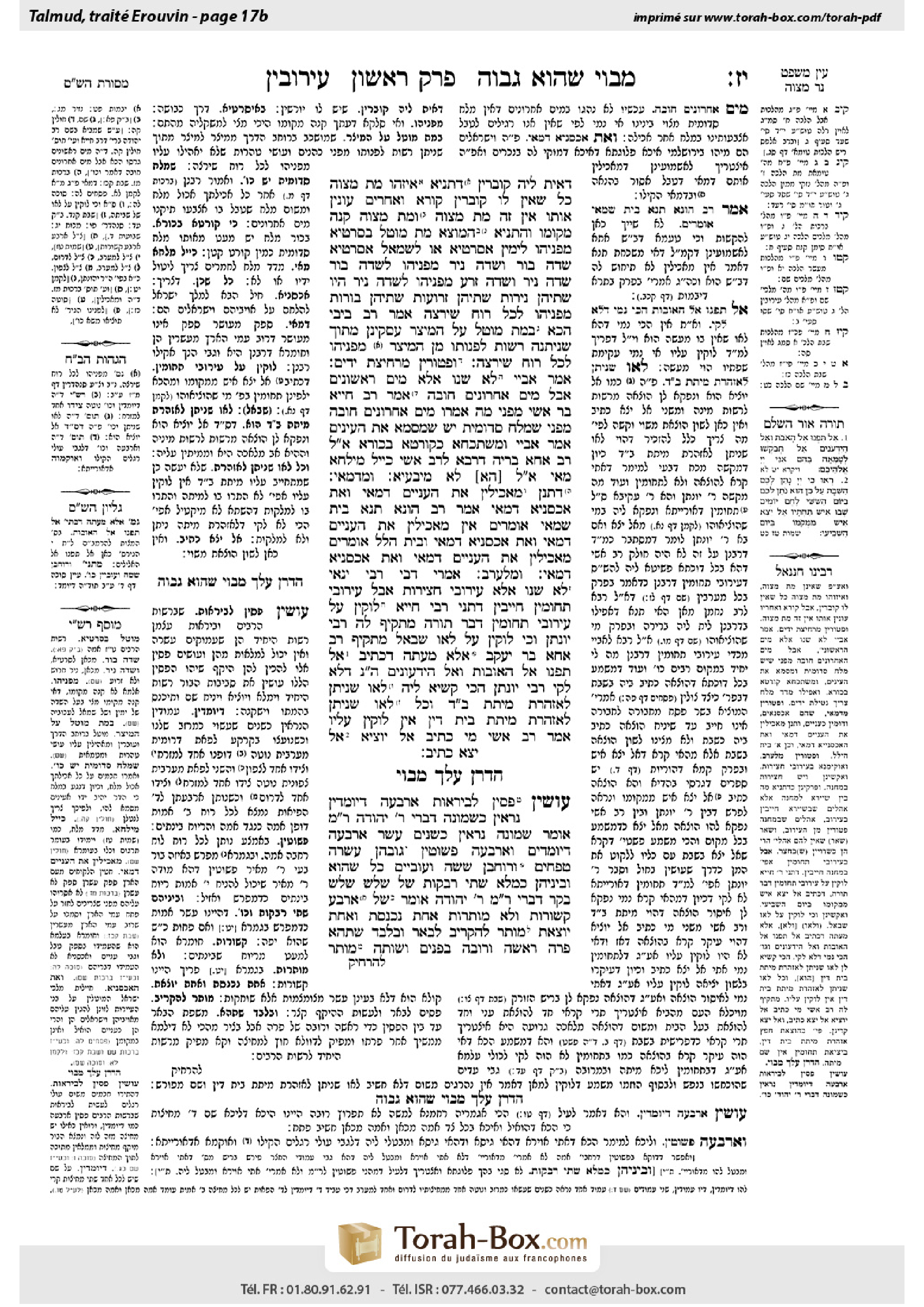
Eruvin 17b: Talmud study for Daf Yomi
Study the Talmud for Daf Yomi with scanned pages, Hebrew text, English translations from Sefaria and AI-generated French translations.
Passage selection and English or AI-generated French translation are available where the scan has annotations. Daf Study is independent of Torah-Box and Sefaria.
Browse Eruvin · עירובין · All tractatesEruvin 17b text and translations
This page of Eruvin includes the Aramaic text, an English translation and an AI-generated French translation, alongside the scan above.
עירובין י״ז ב · Aramaic and Hebrew text
דְּאִית לֵיהּ קוֹבְרִין, דְּתַנְיָא: אֵיזֶהוּ מֵת מִצְוָה? כֹּל שֶׁאֵין לוֹ קוֹבְרִין. קוֹרֵא וַאֲחֵרִים עוֹנִין אוֹתוֹ — אֵין זֶה מֵת מִצְוָה.
וּמֵת מִצְוָה קָנָה מְקוֹמוֹ? וְהָתַנְיָא: הַמּוֹצֵא מֵת מוּטָל בִּסְרַטְיָא — מְפַנֵּיהוּ לִימִין אִסְרַטְיָא אוֹ לִשְׂמֹאל אִסְרַטְיָא.
שְׂדֵה בוּר וּשְׂדֵה נִיר — מְפַנֵּיהוּ לִשְׂדֵה בוּר. שְׂדֵה נִיר וּשְׂדֵה זֶרַע — מְפַנֵּיהוּ לִשְׂדֵה נִיר. הָיוּ שְׁתֵּיהֶן נִירוֹת, שְׁתֵּיהֶן זְרוּעוֹת, שְׁתֵּיהֶן בּוּרוֹת — מְפַנֵּהוּ לְכׇל רוּחַ שֶׁיִּרְצֶה!
אָמַר רַב בִּיבִי: הָכָא בְּמֵת מוּטָּל עַל הַמֵּיצַר עָסְקִינַן. מִתּוֹךְ שֶׁנִּיתְּנָה רְשׁוּת לְפַנּוֹתוֹ מִן הַמֵּיצַר — מְפַנֵּיהוּ לְכׇל רוּחַ שֶׁיִּרְצֶה.
וּפְטוּרִין מֵרְחִיצַת יָדַיִם. אָמַר אַבָּיֵי: לֹא שָׁנוּ אֶלָּא מַיִם רִאשׁוֹנִים, אֲבָל מַיִם אַחֲרוֹנִים חוֹבָה.
אָמַר רַב חִיָּיא בַּר אָשֵׁי: מִפְּנֵי מָה אָמְרוּ מַיִם אַחֲרוֹנִים חוֹבָה? מִפְּנֵי שֶׁמֶּלַח סְדוֹמִית יֵשׁ, שֶׁמְּסַמֵּא אֶת הָעֵינַיִם.
אָמַר אַבָּיֵי: וּמִשְׁתַּכְחָא כְּקוּרְטָא בְּכוֹרָא. אֲמַר לֵיהּ רַב אַחָא בְּרֵיהּ דְּרָבָא לְרַב אָשֵׁי: כָּיֵיל מִילְחָא, מַאי? אֲמַר לֵיהּ: [הָא] לָא מִיבַּעְיָא.
וּמִדְּמַאי. דִּתְנַן: מַאֲכִילִין אֶת הָעֲנִיִּים דְּמַאי וְאֶת אַכְסַנְיָא דְּמַאי. אָמַר רַב הוּנָא: תָּנָא, בֵּית שַׁמַּאי אוֹמְרִים: אֵין מַאֲכִילִין אֶת הָעֲנִיִּים דְּמַאי וְאֶת אַכְסַנְיָא דְּמַאי, וּבֵית הִלֵּל אוֹמְרִים: מַאֲכִילִין אֶת הָעֲנִיִּים דְּמַאי וְאֶת אַכְסַנְיָא דְּמַאי.
וּמִלְּעָרֵב. אָמְרִי דְּבֵי רַבִּי יַנַּאי: לֹא שָׁנוּ אֶלָּא עֵירוּבֵי חֲצֵירוֹת, אֲבָל עֵירוּבֵי תְּחוּמִין חַיָּיבִין.
דְּתָנֵי רַבִּי חִיָּיא: לוֹקִין עַל עֵירוּבֵי תְּחוּמִין דְּבַר תּוֹרָה.
מַתְקֵיף לַהּ רַבִּי יוֹנָתָן: וְכִי לוֹקִין עַל לָאו שֶׁבְּ״אַל״? מַתְקֵיף רַב אַחָא בַּר יַעֲקֹב: אֶלָּא מֵעַתָּה דִּכְתִיב: ״אַל תִּפְנוּ אֶל הָאוֹבוֹת וְאֶל הַיִּדְּעוֹנִים״, הָכִי נָמֵי דְּלָא לָקֵי?!
רַבִּי יוֹנָתָן הָכִי קַשְׁיָא לֵיהּ: לָאו שֶׁנִּיתַּן לְאַזְהָרַת מִיתַת בֵּית דִּין. וְכׇל לָאו שֶׁנִּיתַּן לְאַזְהָרַת מִיתַת בֵּית דִּין — אֵין לוֹקִין עָלָיו.
אָמַר רַב אָשֵׁי: מִי כְּתִיב ״אַל יוֹצִיא״? ״אַל יֵצֵא״ כְּתִיב.
הֲדַרַן עֲלָךְ מָבוֹי
מַתְנִי׳ עוֹשִׂין פַּסִּין לְבֵירָאוֹת.
אַרְבָּעָה דְּיוֹמְדִין נִרְאִין כִּשְׁמוֹנָה, דִּבְרֵי רַבִּי יְהוּדָה. רַבִּי מֵאִיר אוֹמֵר: שְׁמוֹנָה נִרְאִין כִּשְׁנֵים עָשָׂר — אַרְבָּעָה דְּיוֹמְדִים וְאַרְבָּעָה פְּשׁוּטִין.
גּוֹבְהָן עֲשָׂרָה טְפָחִים, וְרוֹחְבָּן שִׁשָּׁה וְעוֹבְיָים כׇּל שֶׁהוּא. וּבֵינֵיהֶן כִּמְלֹא שְׁתֵּי רְבָקוֹת שֶׁל שָׁלֹשׁ שָׁלֹשׁ בָּקָר, דִּבְרֵי רַבִּי מֵאִיר.
רַבִּי יְהוּדָה אוֹמֵר: שֶׁל אַרְבַּע, קְשׁוּרוֹת וְלֹא מוּתָּרוֹת, אַחַת נִכְנֶסֶת וְאַחַת יוֹצֵאת.
מוּתָּר לְהַקְרִיב לַבְּאֵר, וּבִלְבַד שֶׁתְּהֵא פָּרָה רֹאשָׁהּ וְרוּבָּהּ בִּפְנִים וְשׁוֹתָה.
מוּתָּר
Eruvin 17b · English translation
there are people available to bury it. As it was taught in a baraita: Which is the corpse that is considered a met mitzva?Any corpse that has no one available to bury it. If, however, the deceased has friends or relatives to tend to his burial, his corpse is not considered a met mitzva. Likewise, if the body is in a place where if one calls out, others can answer him, this is not a met mitzva. The Tosefta teaches a novel ruling applicable to the case of a military camp: A solider is buried where he was killed, even if the conditions for met mitzva are not met there.
With regard to the halakha itself, the Gemara asks: And does a met mitzva actually acquire its place? Wasn’t it taught in a baraita: One who finds a corpse laid out on a main street evacuates it for burial either to the right of the street or to the left of the street, but it may not be buried under the main street itself?
If one can move the corpse either to an uncultivated field or to a plowed field, he evacuates it to the uncultivated field. If the choice is between a plowed field and a sown field, he evacuates it to the plowed field. If both fields are plowed, or if both are sown, or if both are uncultivated, he evacuates it to any side that he wishes to move it. Apparently, a met mitzva is not necessarily buried where it is found. It may be moved elsewhere.
Rav Beivai said: Here we are dealing with a corpse laid out across on the side of a public path, and it stretches across the path and reaches the other side. Were the corpse buried there, it would prohibit passage by priests. Since permission was already granted to evacuate it from the side of a public path, one may evacuate it to any side he wishes. If, however, the corpse was in a field, moving it would be prohibited.
We learned in the mishna that in a military camp one is exempt from ritual washing of the hands. Abaye said: They taught this exemption only with regard to first waters, i.e., hand-washing before eating. However, final waters, i.e., hand-washing after eating and before reciting Grace after Meals, is an obligation even in a military camp.
Rav Ḥiyya bar Ashi said: For what reason did the Sages say that the final waters are an obligation? It is due to the fact that there is the presence of Sodomite salt, which blinds the eyes even in a small amount. Since Sodomite salt could remain on one’s hands, one must wash them after eating. This obligation is binding even in a camp because soldiers are also obligated to maintain their health.
Abaye said: And this type of dangerous salt is present in the proportion of a single grain [korta] in an entire kor of innocuous salt. Rav Aḥa, son of Rava, said to Rav Ashi: If one measured salt and came into contact with Sodomite salt not during mealtime, what is the halakha? Is there an obligation to wash his hands afterward? He said to him: It was unnecessary to say this, as he is certainly obligated to do so.
The mishna continues: And in a military camp, one is exempt from the separation of tithes from doubtfully tithed produce [demai]. As we learned in a mishna: One may feed the poor demai, and one may also feed quartered soldiers [akhsanya] demai. Rav Huna said: A tanna taught in a baraita: Beit Shammai say that one may neither feed the poor demai, nor may one feed quartered soldiers demai. And Beit Hillel say that one may feed the poor demai, and one may also feed quartered soldiers demai.
We learned in the mishna: And in a military camp, one is exempt from establishing an eiruv. The Sages of the school of Rabbi Yannai said: They taught that this exemption applies only with regard to the joining of houses in courtyards. However, even those in a military encampment are obligated to establish an eiruv if they desire to effect a joining of Shabbat boundaries, whereby one extends the Shabbat limits beyond which one may not walk on Shabbat.
As Rabbi Ḥiyya taught a baraita: One is flogged by Torah law for going beyond the Shabbat limit if there is no joining of Shabbat boundaries. The Torah states: “No man shall go out [al yetze] of his place on the seventh day” (Exodus 16:29). Since this is a Torah prohibition, leniency is possible only in life-threatening circumstances.
Rabbi Yonatan strongly objects: Is one flogged for violating a prohibition that is expressed in the Torah with the negative al, rather than the negative lo? Rav Aḥa bar Ya’akov strongly objects to the question: If what you say is so, with regard to that which is written: “Turn you not [al] unto the ghosts, nor unto familiar spirits” (Leviticus 19:31), is the halakha there too that one is not flogged?
Rather, this is the difficulty for Rabbi Yonatan: The prohibition against overstepping the Shabbat limits is a prohibition that was given primarily as a warning of court-imposed capital punishment, i.e., a prohibition which, under certain conditions, is punishable by the death and not merely by lashes, as is the case with most prohibitions. In fact, the prohibition against carrying objects out to the public domain is derived from that same verse, and one who violates that prohibition is liable for execution by the court. And this principle applies: Any prohibition that was given primarily as a warning of court-imposed capital punishment one is not flogged, even if the death penalty does not apply in that particular case.
Rav Ashi said: Is it written in the Torah: No man shall carry out [yotzi], indicating a prohibition against carrying objects from one domain to another on Shabbat? “No man shall go out [yetze]” is written. Indeed, according to its plain meaning, the verse deals exclusively with the prohibition of going beyond the Shabbat limits and not with the prohibition of carrying out. Everyone agrees that there is no death penalty administered by the court in overstepping the Shabbat limit.
MISHNA: One may arrange upright boards [passin] around a well in the public domain in order to permit drawing water from the well on Shabbat. A well is usually at least four handbreadths wide and ten handbreadths deep. Therefore, it is considered a private domain, and it is prohibited to draw water from it on Shabbat, as that would constitute a violation of the prohibition to carry from a private domain into a public one. The Sages therefore instituted that a virtual partition may be built in the area surrounding the well, so that the enclosed area could be considered a private domain, thus permitting use of the well and carrying of the water within the partitioned area.
In this specific instance, the Sages demonstrated special leniency and did not require a proper partition to enclose the entire area. For this purpose, it suffices if there are four double posts [deyomadin] that look like eight single posts, i.e., four corner pieces, each comprised of two posts joined together at right angles; this is the statement of Rabbi Yehuda. Rabbi Meir says: There must be eight posts that look like twelve. How so? There must be four double posts, one in each corner, with four plain posts, one between each pair of double posts.
The height of the double posts must be at least ten handbreadths, their width must be six handbreadths, and their thickness may be even a minimal amount. And between them, i.e., between the posts, there may be a gap the size of two teams [revakot] of three oxen each; this is the statement of Rabbi Meir.
Rabbi Yehuda disagrees and says: There may be a slightly larger gap, the size of two teams of four oxen each, and this gap is measured with the cows being tied together and not untied, and with the minimal space necessary for one team to be entering while the other one is leaving.
It is permitted to bring the posts closer to the well, provided that the enclosed area is large enough for a cow to stand with its head and the majority of its body inside the partitioned space while it drinks.
It is permitted
Eruvin 17b · Traduction française (IA)
Il y a des personnes disponibles pour l'enterrer. Comme il a été enseigné dans une baraïta : Quel est le cadavre considéré comme un met mitsva ? Tout cadavre dont personne n'est disponible pour l'enterrer. Cependant, si le défunt a des amis ou des parents pour s'occuper de son enterrement, son cadavre n'est pas considéré comme un met mitsva. De même, si le corps est dans un lieu où, si l'on appelle, d'autres peuvent répondre, ce n'est pas un met mitsva. La Tosefta enseigne une décision nouvelle applicable au cas d'un camp militaire : Un soldat est enterré là où il est mort, même si les conditions du met mitsva ne sont pas remplies là.
En ce qui concerne la halakha elle-même, le Guemara pose la question : Et un met mitsva acquiert-il réellement sa place ? N'avait-il pas été enseigné dans une baraïta : Celui qui trouve un cadavre étendu sur une rue principale l'évacue pour l'enterrement à droite de la rue ou à gauche de la rue, mais il ne peut pas être enterré sous la rue principale elle-même ?
Si l'on peut déplacer le cadavre soit vers un champ non cultivé, soit vers un champ cultivé, on l'évacue vers le champ non cultivé. Si le choix est entre un champ cultivé et un champ semé, on l'évacue vers le champ cultivé. Si les deux champs sont cultivés, ou si les deux sont semés, ou si les deux sont non cultivés, on l'évacue vers n'importe quel côté qu'on souhaite déplacer. Apparemment, un met mitsva n'est pas nécessairement enterré là où il est trouvé. Il peut être déplacé ailleurs.
Rav Beivai a dit : Ici, nous sommes en présence d'un cadavre étendu sur le côté d'une voie publique, et il s'étend sur la voie et atteint l'autre côté. Si le cadavre était enterré là, il interdirait la passage aux prêtres. Puisque l'autorisation a déjà été donnée pour l'évacuer du côté d'une voie publique, on peut l'évacuer vers n'importe quel côté qu'on souhaite. Cependant, si le cadavre était dans un champ, son déplacement serait interdit.
Nous avons appris dans la mishna que dans un camp militaire, on est dispensé de la purification rituelle des mains. Abaye a dit : Ils ont enseigné cette dispense uniquement concernant les eaux premières, c'est-à-dire la purification des mains avant de manger. Cependant, les eaux finales, c'est-à-dire la purification des mains après avoir mangé et avant de réciter la Bérit après le repas, constituent une obligation même dans un camp militaire.
Rav Ḥiyya bar Ashi a dit : Pour quelle raison les Sages ont-ils dit que les eaux finales constituent une obligation ? C'est en raison de la présence du sel de Sodome, qui aveugle les yeux même en petite quantité. Puisque le sel de Sodome pourrait rester sur les mains, il faut se laver les mains après avoir mangé. Cette obligation est applicable même dans un camp, car les soldats sont également tenus de maintenir leur santé.
Abaye a dit : Et ce type de sel dangereux est présent dans la proportion d'une seule graine [korta] dans un kor de sel inoffensif. Rav Aḥa, fils de Rava, a dit à Rav Ashi : Si l'on a mesuré du sel et qu'on a été en contact avec du sel de Sodome en dehors d'un repas, quelle est la halakha ? Y a-t-il une obligation de se laver les mains après ? Il a dit à lui : Il n'était pas nécessaire de dire cela, car il est certainement tenu de le faire.
La mishna continue : Et dans un camp militaire, on est dispensé de la séparation des dîmes des produits douteux [demai]. Comme nous avons appris dans une mishna : On peut nourrir les pauvres demai, et on peut aussi nourrir les soldats partagés [akhsanya] demai. Rav Huna a dit : Un tanna a enseigné dans une baraïta : Beit Shammai disent que l'on ne peut ni nourrir les pauvres demai, ni nourrir les soldats partagés demai. Et Beit Hillel disent que l'on peut nourrir les pauvres demai, et l'on peut aussi nourrir les soldats partagés demai.
Nous avons appris dans la mishna : Et dans un camp militaire, on est dispensé d'établir un eiruv. Les Sages de la maison de Rabbi Yannai ont dit : Ils ont enseigné que cette dispense s'applique uniquement concernant la jonction des maisons dans les courtyards. Cependant, même ceux dans un camp militaire sont tenus d'établir un eiruv s'ils souhaitent effectuer la jonction des limites de Shabbat, permettant ainsi d'étendre les limites de Shabbat au-delà desquelles on ne peut pas marcher le sabbat.
Comme Rabbi Ḥiyya a enseigné une baraïta : On est fouetté par la Torah pour avoir dépassé la limite du sabbat si l'on n'a pas établi la jonction des limites du sabbat. La Torah dit : « Nul homme ne sortira [al yetze] de son lieu le septième jour » (Exode 16:29). Puisque c'est une prohibition de la Torah, la leniété est possible uniquement en cas de danger de vie.
Rabbi Yonatan s'oppose fermement : Est-on fouetté pour violer une prohibition exprimée dans la Torah avec le négatif al, plutôt que le négatif lo ? Rav Aḥa bar Ya’akov s'oppose fermement à la question : Si ce que vous dites est vrai, concernant ce qui est écrit : « Tournez-vous pas [al] vers les esprits, ni vers les esprits familiers » (Lévitique 19:31), la halakha est-elle aussi que l'on n'est pas fouetté ?
Plutôt, c'est la difficulté pour Rabbi Yonatan : La prohibition de dépasser les limites du sabbat est une prohibition donnée principalement comme avertissement d'une peine de mort imposée par le tribunal, c'est-à-dire une prohibition qui, sous certaines conditions, est punissable par la mort et non seulement par des fessées, comme c'est le cas pour la plupart des prohibitions. En fait, la prohibition de porter des objets vers le domaine public est tirée de cette même versette, et celui qui enfreint cette prohibition est punissable par l'exécution par le tribunal. Et ce principe s'applique : toute prohibition donnée principalement comme avertissement d'une peine de mort imposée par le tribunal, l'on n'est pas fouetté, même si la peine de mort ne s'applique pas dans ce cas particulier.
Rav Ashi a dit : Est-il écrit dans la Torah : « Nul homme ne sortira [yetze] », indiquant une prohibition de porter des objets d'un domaine à un autre le sabbat ? « Nul homme ne sortira [yetze] » est écrit. En effet, selon son sens littéral, le verset concerne uniquement la prohibition de sortir au-delà des limites du sabbat et non la prohibition de porter des objets. Tout le monde convient qu'il n'y a pas de peine de mort administrée par le tribunal pour dépasser la limite du sabbat.
MICHNA : On peut dresser des planches verticales [passin] autour d'un puits dans le domaine public afin de permettre de tirer de l'eau du puits le sabbat. Un puits est généralement d'au moins quatre tefachim de large et de dix tefachim de profondeur. Il est donc considéré comme un domaine privé, et il est interdit de tirer de l'eau de ce puits le sabbat, car cela constituerait une violation de la prohibition de transporter de domaine privé vers un domaine public. Les Sages ont donc institué que l'on puisse construire une barrière virtuelle dans la zone autour du puits, de sorte que l'espace enclos puisse être considéré comme un domaine privé, permettant ainsi l'utilisation du puits et le transport de l'eau à l'intérieur de cette barrière.
Dans ce cas précis, les Sages ont montré une certaine leniété et n'ont pas exigé une barrière complète pour entourer toute la zone. Pour cela, il suffit qu'il y ait quatre poteaux doubles [deyomadin] qui ressemblent à huit poteaux simples, c'est-à-dire quatre éléments aux angles, chacun composé de deux poteaux joints à angle droit ; c'est la déclaration de Rabbi Yéhuda. Rabbi Méir dit : Il faut huit poteaux qui ressemblent à douze. Comment cela ? Il faut quatre poteaux doubles, un dans chaque coin, avec quatre poteaux simples, un entre chaque paire de poteaux doubles.
La hauteur des poteaux doubles doit être d'au moins dix tefachim, leur largeur doit être de six tefachim, et leur épaisseur peut même être minimale. Et entre eux, c'est-à-dire entre les poteaux, il peut y avoir une ouverture de la taille de deux équipes [revakot] de trois bœufs chacune ; c'est la déclaration de Rabbi Méir.
Rabbi Yéhuda désaccorde et dit : On peut avoir une ouverture légèrement plus grande, de la taille de deux équipes de quatre bœufs chacune, et cette ouverture est mesurée avec les bœufs attachés ensemble et non détachés, et avec l'espace minimal nécessaire pour qu'une équipe entre tandis que l'autre en sort.
Il est permis de rapprocher les poteaux du puits, à condition que l'espace enclos soit suffisamment grand pour que la tête et la majorité du corps d'un bœuf puissent être à l'intérieur de l'espace enclos pendant qu'il boit.
Il est permis
Traduction française générée par IA à partir de l’édition anglaise de Sefaria. Vérifie toujours un passage avec le texte source.
Text from Sefaria: William Davidson Edition - Vocalized Aramaic (CC BY NC); William Davidson Edition - English (CC BY NC).