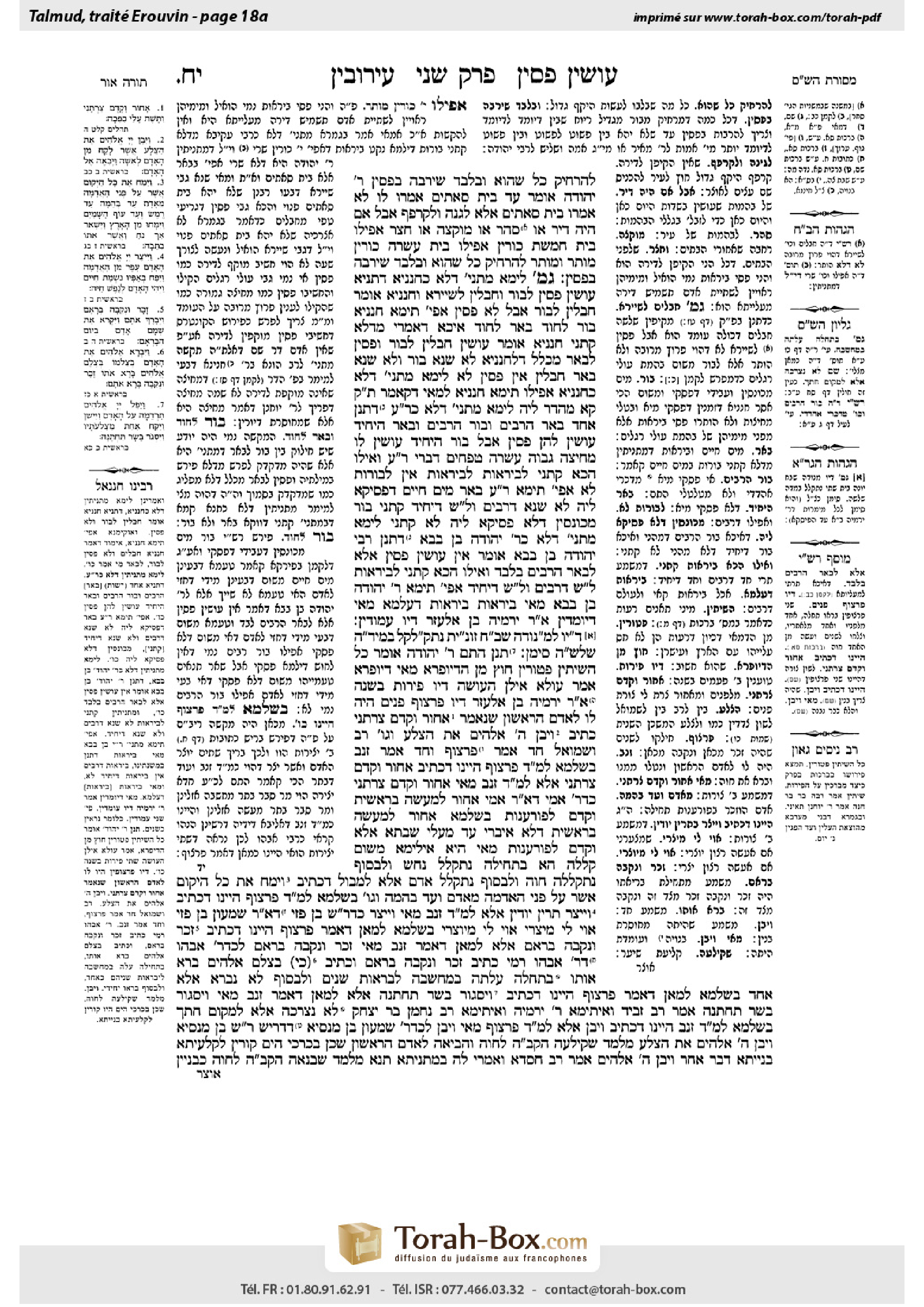
Eruvin 18a: Talmud study for Daf Yomi
Study the Talmud for Daf Yomi with scanned pages, Hebrew text, English translations from Sefaria and AI-generated French translations.
Passage selection and English or AI-generated French translation are available where the scan has annotations. Daf Study is independent of Torah-Box and Sefaria.
Browse Eruvin · עירובין · All tractatesEruvin 18a text and translations
This page of Eruvin includes the Aramaic text, an English translation and an AI-generated French translation, alongside the scan above.
עירובין י״ח א · Aramaic and Hebrew text
לְהַרְחִיק כׇּל שֶׁהוּא, וּבִלְבַד שֶׁיַּרְבֶּה בְּפַסִּין. רַבִּי יְהוּדָה אוֹמֵר: עַד בֵּית סָאתַיִם.
אָמְרוּ לוֹ: לֹא אָמְרוּ בֵּית סָאתַיִם אֶלָּא לְגִנָּה וּלְקַרְפֵּף, אֲבָל אִם הָיָה דִּיר אוֹ סַהַר אוֹ מוּקְצֶה אוֹ חָצֵר — אֲפִילּוּ בֵּית חֲמֵשֶׁת כּוֹרִין, אֲפִילּוּ בֵּית עֲשָׂרָה כּוֹרִין מוּתָּר. וּמוּתָּר לְהַרְחִיק כׇּל שֶׁהוּא, וּבִלְבַד שֶׁיַּרְבֶּה בְּפַסִּין.
גְּמָ׳ לֵימָא מַתְנִיתִין דְּלָא כַּחֲנַנְיָא, דְּתַנְיָא: עוֹשִׂין פַּסִּין לְבוֹר וַחֲבָלִין לִשְׁיָירָא. וַחֲנַנְיָא אוֹמֵר: חֲבָלִין לְבוֹר, אֲבָל לֹא פַּסִּין.
אֲפִילּוּ תֵּימָא חֲנַנְיָא בּוֹר לְחוּד בְּאֵר לְחוּד.
אִיכָּא דְּאָמְרִי: מִדְּלָא קָתָנֵי ״חֲנַנְיָא אוֹמֵר: עוֹשִׂין חֲבָלִין לְבוֹר וּפַסִּין לִבְאֵר״, מִכְּלָל דְּלַחֲנַנְיָא לָא שְׁנָא בּוֹר וְלָא שְׁנָא בְּאֵר — חֲבָלִין אִין, פַּסִּין לָא. לֵימָא מַתְנִיתִין דְּלָא כַּחֲנַנְיָא?
אֲפִילּוּ תֵּימָא חֲנַנְיָא, לְמַאי דְּקָאָמַר תַּנָּא קַמָּא — קָא מַהְדַּר לֵיהּ.
לֵימָא מַתְנִיתִין דְּלָא כְּרַבִּי עֲקִיבָא? דִּתְנַן: אֶחָד בְּאֵר הָרַבִּים וּבוֹר הָרַבִּים וּבְאֵר הַיָּחִיד עוֹשִׂין לָהֶן פַּסִּין. אֲבָל בּוֹר הַיָּחִיד — עוֹשִׂין לוֹ מְחִיצָה גָּבוֹהַּ עֲשָׂרָה טְפָחִים, דִּבְרֵי רַבִּי עֲקִיבָא.
וְאִילּוּ הָכָא קָתָנֵי: לְבֵירָאוֹת. לְבֵירָאוֹת — אִין, לְבוֹרוֹת לָא.
אֲפִילּוּ תֵּימָא רַבִּי עֲקִיבָא, בְּאֵר מַיִם חַיִּים דִּפְסִיקָא לֵיהּ, לָא שְׁנָא דְּרַבִּים וְלָא שְׁנָא דְּיָחִיד — קָתָנֵי. בּוֹר מְכוּנָּסִין דְּלָא פְּסִיקָא לֵיהּ — לָא קָתָנֵי.
לֵימָא מַתְנִיתִין דְּלָא כְּרַבִּי יְהוּדָה בֶּן בָּבָא, דִּתְנַן: רַבִּי יְהוּדָה בֶּן בָּבָא אוֹמֵר: אֵין עוֹשִׂין פַּסִּין אֶלָּא לִבְאֵר הָרַבִּים בִּלְבַד, וְאִילּוּ הָכָא קָתָנֵי לְבֵירָאוֹת — לָא שְׁנָא דְּרַבִּים וְלָא שְׁנָא דְּיָחִיד!
אֲפִילּוּ תֵּימָא רַבִּי יְהוּדָה בֶּן בָּבָא, מַאי בֵּירָאוֹת — בֵּירָאוֹת דְּעָלְמָא.
מַאי דְּיוֹמְדִין? אָמַר רַבִּי יִרְמְיָה בֶּן אֶלְעָזָר: דְּיוֹ עַמּוּדִין.
דְּיוֹ לִמְנוּדֶּה שֶׁבַח זוֹנִית נִתְקַלְקֵל בְּמִידָּה שְׁלֹשָׁה סִימָן.
תְּנַן הָתָם, רַבִּי יְהוּדָה אוֹמֵר: כֹּל הַשִּׁיתִין פְּטוּרִין, חוּץ מִן הַדְּיוֹפְרָא. מַאי דְּיוֹפְרָא? אָמַר עוּלָּא: אִילָן הָעוֹשֶׂה דְּיוֹ פֵּירוֹת בַּשָּׁנָה.
אָמַר רַבִּי יִרְמְיָה בֶּן אֶלְעָזָר: דְּיוֹ פַּרְצוּף פָּנִים הָיָה לוֹ לְאָדָם הָרִאשׁוֹן, שֶׁנֶּאֱמַר: ״אָחוֹר וָקֶדֶם צַרְתָּנִי״. כְּתִיב: ״וַיִּבֶן ה׳ אֱלֹהִים אֶת הַצֵּלָע וְגוֹ׳״, רַב וּשְׁמוּאֵל: חַד אָמַר פַּרְצוּף, וְחַד אָמַר זָנָב.
בִּשְׁלָמָא לְמַאן דְּאָמַר פַּרְצוּף — הַיְינוּ דִּכְתִיב ״אָחוֹר וָקֶדֶם צַרְתָּנִי״. אֶלָּא לְמַאן דְּאָמַר זָנָב — מַאי ״אָחוֹר וָקֶדֶם צַרְתָּנִי״?
כִּדְרַבִּי אַמֵּי, דְּאָמַר רַבִּי אַמֵּי: אָחוֹר לְמַעֲשֵׂה בְרֵאשִׁית, וָקֶדֶם לְפוּרְעָנוּת.
בִּשְׁלָמָא אָחוֹר לְמַעֲשֵׂה בְרֵאשִׁית — דְּלָא אִיבְּרִי עַד מַעֲלֵי שַׁבְּתָא, אֶלָּא וָקֶדֶם לְפוּרְעָנוּת מַאי הִיא? אִילֵּימָא מִשּׁוּם קְלָלָה — הָא בַּתְּחִילָּה נִתְקַלֵּל נָחָשׁ, וּלְבַסּוֹף נִתְקַלְּלָה חַוָּה, וּלְבַסּוֹף נִתְקַלֵּל אָדָם!
אֶלָּא לַמַּבּוּל, דִּכְתִיב: ״וַיִּמַח אֶת כׇּל הַיְקוּם אֲשֶׁר עַל פְּנֵי הָאֲדָמָה מֵאָדָם וְעַד בְּהֵמָה וְגוֹ׳״.
בִּשְׁלָמָא לְמַאן דְּאָמַר פַּרְצוּף, הַיְינוּ דִּכְתִיב ״וַיִּיצֶר״ תְּרֵין יוֹדִין. אֶלָּא לְמַאן דְּאָמַר זָנָב — מַאי ״וַיִּיצֶר״?
כִּדְרַבִּי שִׁמְעוֹן בֶּן פַּזִּי, דְּאָמַר רַבִּי שִׁמְעוֹן בֶּן פַּזִּי: אוֹי לִי מִיִּצְרִי, אוֹי לִי מִיּוֹצְרִי.
בִּשְׁלָמָא לְמַאן דְּאָמַר פַּרְצוּף, הַיְינוּ דִּכְתִיב ״זָכָר וּנְקֵבָה בְּרָאָם״. אֶלָּא לְמַאן דְּאָמַר זָנָב — מַאי ״זָכָר וּנְקֵבָה בְּרָאָם״?
לְכִדְרַבִּי אֲבָהוּ. דְּרַבִּי אֲבָהוּ רָמֵי, כְּתִיב: ״זָכָר וּנְקֵבָה בְּרָאָם״, וּכְתִיב: ״(כִּי) בְּצֶלֶם אֱלֹהִים בָּרָא אוֹתוֹ״. בַּתְּחִלָּה עָלְתָה בְּמַחְשָׁבָה לִבְראוֹת שְׁנַיִם, וּלְבַסּוֹף לֹא נִבְרָא אֶלָּא אֶחָד.
בִּשְׁלָמָא לְמַאן דְּאָמַר פַּרְצוּף, הַיְינוּ דִּכְתִיב: ״וַיִּסְגּוֹר בָּשָׂר תַּחְתֶּנָּה״, אֶלָּא לְמַאן דְּאָמַר זָנָב — מַאי ״וַיִּסְגּוֹר בָּשָׂר תַּחְתֶּנָּה״?
אָמַר רַב זְבִיד, וְאִיתֵּימָא רַבִּי יִרְמְיָה, וְאִיתֵּימָא רַב נַחְמָן בַּר יִצְחָק: לֹא נִצְרְכָה אֶלָּא לִמְקוֹם חֲתָךְ.
בִּשְׁלָמָא לְמַאן דְּאָמַר זָנָב, הַיְינוּ דִּכְתִיב: ״וַיִּבֶן״, אֶלָּא לְמַאן דְּאָמַר פַּרְצוּף — מַאי ״וַיִּבֶן״?
לְכִדְרַבִּי שִׁמְעוֹן בֶּן מְנַסְיָא. דְּדָרֵישׁ רַבִּי שִׁמְעוֹן בֶּן מְנַסְיָא: ״וַיִּבֶן ה׳ אֱלֹהִים אֶת הַצֵּלָע״ — מְלַמֵּד שֶׁקִּילְּעָהּ הַקָּדוֹשׁ בָּרוּךְ הוּא לְחַוָּה וֶהֱבִיאָהּ לְאָדָם הָרִאשׁוֹן, שֶׁכֵּן בִּכְרַכֵּי הַיָּם קוֹרִין לְקַלָּעִיתָא בַּנָּיְיתָא.
דָּבָר אַחֵר: ״וַיִּבֶן ה׳ אֱלֹהִים״, אָמַר רַב חִסְדָּא, וְאָמְרִי לַהּ בְּמַתְנִיתָא תָּנָא: מְלַמֵּד שֶׁבְּנָאָהּ הַקָּדוֹשׁ בָּרוּךְ הוּא לְחַוָּה כְּבִנְיָין
Eruvin 18a · English translation
to distance the boards from the well and expand the enclosed area by any amount, i.e., as much as one wishes, provided that he increases the number of upright boards between the double posts. Rabbi Yehuda says: The partitioned area may be expanded up to an area of two beit se’a, which is an area of five thousand square cubits.
The Rabbis said to him: They only spoke of an area of two beit se’a with regard to a garden or an enclosure used for storing wood, scrap, and the like [karpef]. But if it was a pen [dir], or a stable [sahar], or a backyard, or a courtyard in front of the house, even if it had an area of five beit kor or even ten beit kor, it is permitted. And it is permitted to distance the boards and expand the enclosed area by any amount, provided that one increases the upright boards between the double posts.
GEMARA: The Gemara suggests: Let us say that the mishna is not in accordance with the opinion of Ḥananya, as it was taught in a baraita: One may arrange upright boards around a water cistern and ropes around a caravan. Ḥananya disagrees and says: One may set up ropes for a cistern, but not upright boards.
The Gemara rejects this suggestion: Even if you say that the mishna was taught in accordance with the opinion of Ḥananya, a cistern of collected rain water has a discrete law, as the water will eventually be consumed and the upright boards will become unnecessary; and a well of spring water has a discrete law, as the water is constantly renewed and the upright boards will remain useful.
Some say a different version of the previous passage: From the fact that the baraita does not teach: Ḥananya says: One may set up ropes around a water cistern and boards around a well, by inference, according to the opinion of Ḥananya, there is no difference between a cistern and a well. In both cases, ropes are indeed permitted, whereas upright boards are not. Let us say the mishna is not in accordance with the opinion of Ḥananya.
The Gemara rejects this argument: Even if you say that the mishna was taught in accordance with the opinion of Ḥananya, he was only replying to that which the first tanna had said; since the first tanna had spoken only of a cistern, there was no need for Ḥananya to fully clarify his own position and distinguish between a cistern and a well.
The Gemara further suggests: Let us say the mishna is not in accordance with the opinion of Rabbi Akiva. As we learned in a mishna: In each of the cases of a public well, a public cistern, and a private well, one may arrange upright boards for them, but in the case of a private cistern, one must establish a proper partition for it ten handbreadths high; this is the statement of Rabbi Akiva.
Whereas here in the mishna it teaches: One may arrange upright boards for a well, from which one may infer that for a well, yes, it is permitted to use posts, but for a cistern, no, it is not permitted. This is opposed to Rabbi Akiva’s opinion, which maintains that posts may be arranged for a public cistern.
The Gemara rejects this argument as well: Even if you say that the mishna is in accordance with the opinion of Rabbi Akiva, the tanna of the mishna teaches the case of a well of spring water, which he can teach in a distinct manner because there is no difference whether it belongs to the public and there is no difference whether it belongs to an individual, as it is always permitted. However, he did not teach the case of a cistern containing collected rain water, which he could not teach in a distinct manner because there is a difference between a public cistern and a private one. However, it cannot be proven from here that he disagrees with Rabbi Akiva.
The Gemara further suggests: Let us say the mishna is not in accordance with the opinion of Rabbi Yehuda ben Bava, as we learned in a mishna: Rabbi Yehuda ben Bava says: One may only arrange upright boards for a public well, whereas here the mishna states: For wells. The plural term implies that there is no difference if the well belongs to the public, and there is no difference if the well belongs to an individual.
The Gemara also rejects this line of reasoning: Even if you say that the mishna is in accordance with Rabbi Yehuda ben Bava, to what is the mishna referring when it says wells? It is referring to wells in general, but the tanna means to include only public wells.
The mishna had mentioned double posts [deyomadin]: The Gemara asks: What are deyomadin? Rabbi Yirmeya ben Elazar said: Two [deyo] posts [amudin], which are put together to create a single corner piece.
Having cited Rabbi Yirmeya ben Elazar’s statement with reference to the prefix deyo, the Gemara cites other statements of his. Two, to one who was ostracized, praise, nourishment, ruin, attribute, three, are mnemonics for the following statements by Rabbi Yirmeya ben Elazar.
We learned there in a mishna: Rabbi Yehuda says: All inferior figs are exempt from being tithed, even if they are of doubtfully tithed produce [demai], as even if the seller is an am ha’aretz, he must certainly have already separated tithes from them, since the loss incurred by tithing is negligible, except for deyufra. The Gemara asks: What is deyufra? Ulla said: A tree that yields two [deyo] harvests of fruit [peirot] each year.
Rabbi Yirmeya ben Elazar also said: Adam was first created with two [deyo] faces, one male and the other female. As it is stated: “You have formed me behind and before, and laid Your hand upon me” (Psalms 139:5). Similarly, it is written: “And the tzela, which the Lord, God, had taken from the man, He made a woman, and brought her unto the man” (Genesis 2:22). Rav and Shmuel disagree over the meaning of the word tzela: One said: It means a female face, from which God created Eve; and one said: Adam was created with a tail [zanav], which God removed from him and from which He created Eve.
The Gemara asks: Granted, according to the one who says that tzela means face; it is understandable that it is written: “You have formed me [tzartani] behind and before.” However, according to the one who says that tzela means tail, what is meant by the verse: “You have formed me [tzartani] behind and before”?
The Gemara answers that this verse is to be understood as bearing a moral message, in accordance with the opinion of Rabbi Ami, as Rabbi Ami said: Behind means Adam was created at the end of the act of creation; and before means that he was first for punishment.
The Gemara asks: Granted, it is understandable that Adam was behind, or last, in the act of creation, meaning that he was not created until the sixth day, Shabbat eve. However, before, or first, for punishment, what does this mean? If you say that he was punished first because of the curse pronounced in the wake of the sin involving the Tree of Knowledge, there is a difficulty. Wasn’t the snake was cursed first, and afterward Eve was cursed, and only at the end was Adam cursed?
Rather, this refers to the punishment of the Flood, as it is written: “And He blotted out every living substance which was upon the face of the ground, both man and cattle, creeping things and fowl of the heaven” (Genesis 7:23). This indicates that the punishment began with man.
The Gemara asks: Granted, according to the one who said that Eve was originally a face or side of Adam; it is understandable that it is written: “Then the Lord God formed [vayyitzer] man” (Genesis 2:7). Vayyitzer is written with a double yod, one for Adam and one for Eve. However, according to the one who said that Eve was created from a tail, what is conveyed by spelling vayyitzer with a double yod?
The Gemara responds: This is interpreted homiletically, in accordance with the opinion of Rabbi Shimon ben Pazi, as Rabbi Shimon ben Pazi said: This comes to emphasize that which one says to himself in every circumstance: Woe unto me from my evil inclination [yetzer] if I perform the will of my Maker, and woe to me from my Maker [Yotzri] if I perform the will of my inclination.
The Gemara asks: Granted, according to the one who said that Eve was a face, it is understandable that it is written: “Male and female, He created them, and blessed them, and called their name Man in the day when they were created” (Genesis 5:2), which indicates that from the very beginning of their creation, He fashioned two faces, one for the male and the other for the female. However, according to the one who said that Eve was created from a tail, what is the meaning of the verse: “Male and female, He created them”?
The Gemara answers: It can be explained in accordance with the opinion of Rabbi Abbahu, as Rabbi Abbahu raised a contradiction between the verses: On the one hand it is written: “Male and female, He created them,” in the plural, and on the other hand it is written: “So God created man in His own image, for in the image of God He created him” (Genesis 1:27), in the singular. At first, the thought entered God’s mind to create two, and ultimately, only one was actually created.
The Gemara asks: Granted, according to the one who said that Eve was a face, it is understandable that it is written: “And He took one of his sides and closed up the flesh in its place” (Genesis 2:21). However, according to the one who said that Eve was created from a tail, what is meant by the verse: “And He closed up the flesh in its place”?
Rav Zevid said, and some say it was Rabbi Yirmeya, and some say it was Rav Naḥman bar Yitzḥak: It was necessary to say that the fleshed closed up only with regard to the place of the incision.
The Gemara challenges the other opinion: Granted, according to the one who said that Eve was created from a tail; it is understandable that it is written: “And the Lord God built the tzela” (Genesis 2:22), as it was a completely new building. However, according to the one who said that Eve was a complete face or side, what is the meaning of: “And He built”? What needed to be built?
The Gemara responds: This must be interpreted homiletically, in accordance with the opinion of Rabbi Shimon ben Menasya, as Rabbi Shimon ben Menasya interpreted homiletically the verse: “And the Lord God built the tzela.” This verse teaches that the Holy One, Blessed be He, braided for Eve her hair, and then brought her to Adam, as in the coastal towns, they call braiding hair building.
Alternatively, the verse: “And the Lord God built,” can be understood as a description of Eve’s basic shape, as Rav Ḥisda said, and some say it is taught in a baraita: This verse teaches that the Holy One, Blessed be He, built Eve like the structure
Eruvin 18a · Traduction française (IA)
pour distancer les planches du puits et étendre la zone enclose d'une quantité quelconque, c'est-à-dire autant qu'on le souhaite, à condition qu'on augmente le nombre de planches verticales entre les poteaux doubles. Rabbi Yéhuda dit : La zone enclose peut être étendue jusqu'à une surface de deux beit se’a, ce qui correspond à cinq mille coudées carrées.
Les Rabbins lui dirent : Ils parlaient seulement de deux beit se’a concernant un jardin ou une enceinte utilisée pour stocker du bois, des débris et de semblables [karpef]. Mais si c'était un enclos [dir], ou un écurie [sahar], ou un jardin arrière, ou une cour devant la maison, même si sa surface était de cinq beit kor ou même de dix beit kor, cela est permis. Et il est permis de distancer les planches et d'étendre la zone enclose d'une quantité quelconque, à condition qu'on augmente le nombre de planches verticales entre les poteaux doubles.
GUEMARA : La Guemara suggère : Disons que la mitsna ne suit pas l'opinion de Hananya, comme il a été enseigné dans une baraïta : On peut disposer des planches autour d'un cistern et des cordes autour d'un convoi. Hananya désaccorde et dit : On peut disposer des cordes autour d'un cistern, mais pas des planches.
La Guemara rejette cette suggestion : Même si vous dites que la Michna a été enseignée selon l'opinion de Hananya, un cistern d'eau de pluie a une loi distincte, car l'eau sera finalement consommée et les planches deviendront inutiles ; et un puits d'eau de source a une loi distincte, car l'eau est constamment renouvelée et les planches resteront utiles.
Certains disent une version différente du passage précédent : D'après le fait que la baraïta ne dit pas : Hananya dit : On peut disposer des cordes autour d'un cistern et des planches autour d'un puits, par déduction, selon l'opinion de Hananya, il n'y a pas de différence entre un cistern et un puits. Dans les deux cas, les cordes sont permises, tandis que les planches ne le sont pas. Disons que la Michna ne suit pas l'opinion de Hananya.
La Guemara rejette cet argument : Même si vous dites que la Michna a été enseignée selon l'opinion de Hananya, il répondait seulement à ce que le premier tanna avait dit ; puisque le premier tanna avait parlé seulement d'un cistern, il n'y avait pas besoin que Hananya clarifie pleinement sa propre position et distingue entre un cistern et un puits.
La Guemara suggère davantage : Disons que la mitsva ne suit pas l'opinion de Rabbi Akiva. Comme nous avons appris dans une mitsna : Dans chaque cas d'un puits public, d'un cistern public et d'un puits privé, on peut disposer des planches verticales, mais dans le cas d'un cistern privé, on doit établir une paroi appropriée de dix tefachim de haut ; c'est l'opinion de Rabbi Akiva.
Alors que dans la mitsna, on enseigne : On peut disposer des planches verticales pour un puits, d'où l'on peut déduire que pour un puits, oui, il est permis d'utiliser des poteaux, mais pour un cistern, non, il n'est pas permis. Cela s'oppose à l'opinion de Rabbi Akiva, qui maintient que des poteaux peuvent être disposés pour un cistern public.
La Guemara rejette également cet argument : Même si vous dites que la mitsva suit l'opinion de Rabbi Akiva, le tanna de la mitsna enseigne le cas d'un puits d'eau de source, qu'il peut enseigner de manière distincte car il n'y a pas de différence si le puits appartient au public ou à un individu, car il est toujours permis. Cependant, il n'a pas enseigné le cas d'un cistern contenant de l'eau de pluie, qu'il ne pouvait enseigner de manière distincte car il y a une différence entre un cistern public et un cistern privé. Cependant, il ne peut pas être prouvé d'ici qu'il s'oppose à Rabbi Akiva.
La Guemara suggère davantage : Disons que la mitsna ne suit pas l'opinion de Rabbi Yéhuda ben Bava, comme nous avons appris dans une mitsna : Rabbi Yéhuda ben Bava dit : On peut seulement disposer des planches verticales pour un puits public, alors que la mitsna dit : Pour les puits. Le terme pluriel implique qu'il n'y a pas de différence si le puits appartient au public, et qu'il n'y a pas de différence si le puits appartient à un individu.
La Guemara rejette également cette ligne de raisonnement : Même si vous dites que la mitsna suit l'opinion de Rabbi Yéhuda ben Bava, à quoi fait référence la mitsna lorsqu'elle dit puits ? Elle fait référence aux puits en général, mais le tanna entend inclure seulement les puits publics.
La mitsna avait mentionné les poteaux doubles [deyomadin] : La Guemara pose la question : Quels sont les deyomadin ? Rabbi Yirmeya ben Elazar dit : Deux [deyo] poteaux [amudin], qui sont mis ensemble pour former un seul angle.
Ayant cité la déclaration de Rabbi Yirmeya ben Elazar concernant le préfixe deyo, la Guemara cite d'autres déclarations de lui. Deux, à celui qui était ostracisé, louange, nourriture, ruine, attribut, trois, sont des mnémoniques pour les déclarations suivantes de Rabbi Yirmeya ben Elazar.
Nous avons appris là-bas dans une mitsva : Rabbi Yéhuda dit : Tous les figues inférieures sont exemptes de partage, même s'ils sont de produit douteux [demai], car même si le vendeur est un am ha’aretz, il a certainement déjà séparé les dixièmes d'eux, car la perte causée par le partage est négligeable, sauf pour deyufra. La Guemara pose la question : Qu'est-ce que deyufra ? Ulla dit : Un arbre qui produit deux [deyo] récoltes de fruits [peirot] chaque année.
Rabbi Yirmeya ben Elazar a également dit : Adam a été créé d'abord avec deux [deyo] visages, un masculin et l'autre féminin. Comme il est dit : « Vous avez formé moi derrière et devant, et mis ta main sur moi » (Psaumes 139:5). De même, il est écrit : « Et la tzela, que l'Éternel, Dieu, avait prise du homme, il fit une femme, et la présenta au homme » (Genèse 2:22). Rav et Shmuel s'opposent sur la signification du mot tzela : l'un dit : cela signifie un visage féminin, d'où Dieu a créé Ève ; l'autre dit : Adam a été créé avec une queue [zanav], que Dieu a retirée de lui et d'où il a créé Ève.
La Guemara pose la question : Admis que celui qui dit que tzela signifie face a raison, il est compréhensible que l'on lise : « Tu as formé [tzartani] devant et derrière. » Cependant, selon celui qui dit que tzela signifie queue, que signifie la parole : « Tu as formé [tzartani] devant et derrière » ?
La Guemara répond que cette parole est à comprendre comme portant un message moral, conformément à l'opinion de Rabbi Ami, comme Rabbi Ami a dit : « Devant signifie que l'homme a été créé à la fin de l'acte de création ; et derrière signifie qu'il fut d'abord pour la punition. »
La Guemara pose la question : Admis qu'il est compréhensible que l'homme ait été derrière, ou dernier, dans l'acte de création, c'est-à-dire qu'il n'a été créé qu'au sixième jour, la veille du sabbat. Cependant, avant, ou premier, pour la punition, que cela signifie-t-il ? Si l'on dit qu'il fut puni d'abord à cause de la malédiction prononcée après le péché lié à l'arbre de la connaissance, il y a une difficulté. N'était-ce pas la serpente qui fut maudite en premier, puis Ève, et seulement à la fin Adam ?
Au contraire, cela fait référence à la punition de la Déluge, comme il est écrit : « Et il effaça toute créature vivante qui était sur la face de la terre, hommes et bêtes, créatures rampantes et oiseaux du ciel » (Genèse 7:23). Cela indique que la punition a commencé par l'homme.
La Guemara pose la question : Admis que selon celui qui dit que Ève était initialement une face ou un côté d'Adam, il est compréhensible que l'on lise : « Et l'Éternel Dieu forma [vayyitzer] l'homme » (Genèse 2:7). Vayyitzer est écrit avec une double yod, une pour Adam et une pour Ève. Cependant, selon celui qui dit que Ève fut créée d'une queue, que signifie l'écriture de vayyitzer avec une double yod ?
La Guemara répond : Cela est interprété homiletiquement, conformément à l'opinion de Rabbi Shimon ben Pazi, comme Rabbi Shimon ben Pazi a dit : Cela sert à souligner ce que l'on dit à soi-même dans chaque circonstance : Malheur à moi à cause de mon penchant mauvais [yetzer] si je fais la volonté de mon Créateur, et malheur à moi à cause de mon Créateur [Yotzri] si je fais la volonté de mon penchant.
La Guemara pose la question : Admis que selon celui qui dit que Ève était une face, il est compréhensible que l'on lise : « Homme et femme, il les créa, et les bénit, et leur donna le nom d'Adam le jour où ils furent créés » (Genèse 5:2), ce qui indique que dès le début de leur création, Il a façonné deux visages, un pour l'homme et un pour la femme. Cependant, selon celui qui dit que Ève fut créée d'une queue, que signifie la parole : « Homme et femme, il les créa » ?
La Guemara répond : Cela peut être expliqué conformément à l'opinion de Rabbi Abbahu, comme Rabbi Abbahu a soulevé une contradiction entre les versets : D'un côté, il est écrit : « Homme et femme, il les créa » (Genèse 5:2), au pluriel, et de l'autre côté, il est écrit : « Et Dieu créa l'homme à son image, à l'image de Dieu il le créa » (Genèse 1:27), au singulier. À l'origine, l'idée de Dieu était de créer deux, mais finalement, seul un fut effectivement créé.
La Guemara pose la question : Admis que selon celui qui dit que Ève était une face, il est compréhensible que l'on lise : « Et il prit une de ses côtés et referma la chair à sa place » (Genèse 2:21). Cependant, selon celui qui dit que Ève fut créée d'une queue, que signifie la parole : « Et il referma la chair à sa place » ?
Rav Zevid a dit, et certains disent que c'était Rabbi Yirmeya, et d'autres que c'était Rav Naḥman bar Yitzḥak : Il était nécessaire de dire que la chair referma seulement en ce qui concerne la place de la incision.
La Guemara conteste l'autre opinion : Admis que selon celui qui dit que Ève fut créée d'une queue, il est compréhensible que l'on lise : « Et l'Éternel Dieu construisit la tzela » (Genèse 2:22), car c'était une construction entièrement nouvelle. Cependant, selon celui qui dit que Ève était une face ou un côté complet, que signifie : « Et il construisit » ? Qu'avait besoin d'être construit ?
La Guemara répond : Cela doit être interprété homiletiquement, conformément à l'opinion de Rabbi Shimon ben Menasya, comme Rabbi Shimon ben Menasya a interprété homiletiquement le verset : « Et l'Éternel Dieu construisit la tzela. » Ce verset enseigne que le Saint, le Très Haut, a tressé les cheveux d'Ève, puis l'a amenée à Adam, comme dans les villes côtières, on appelle tresser les cheveux la construction.
Autrement, le verset : « Et l'Éternel Dieu forma », peut être compris comme décrivant la forme de base d'Ève, comme l'a dit Rav Ḥisda, et certains disent qu'il est enseigné dans une baraïta : Ce verset enseigne que le Saint, le Très Haut, forma Ève selon la structure
Traduction française générée par IA à partir de l’édition anglaise de Sefaria. Vérifie toujours un passage avec le texte source.
Text from Sefaria: William Davidson Edition - Vocalized Aramaic (CC BY NC); William Davidson Edition - English (CC BY NC).