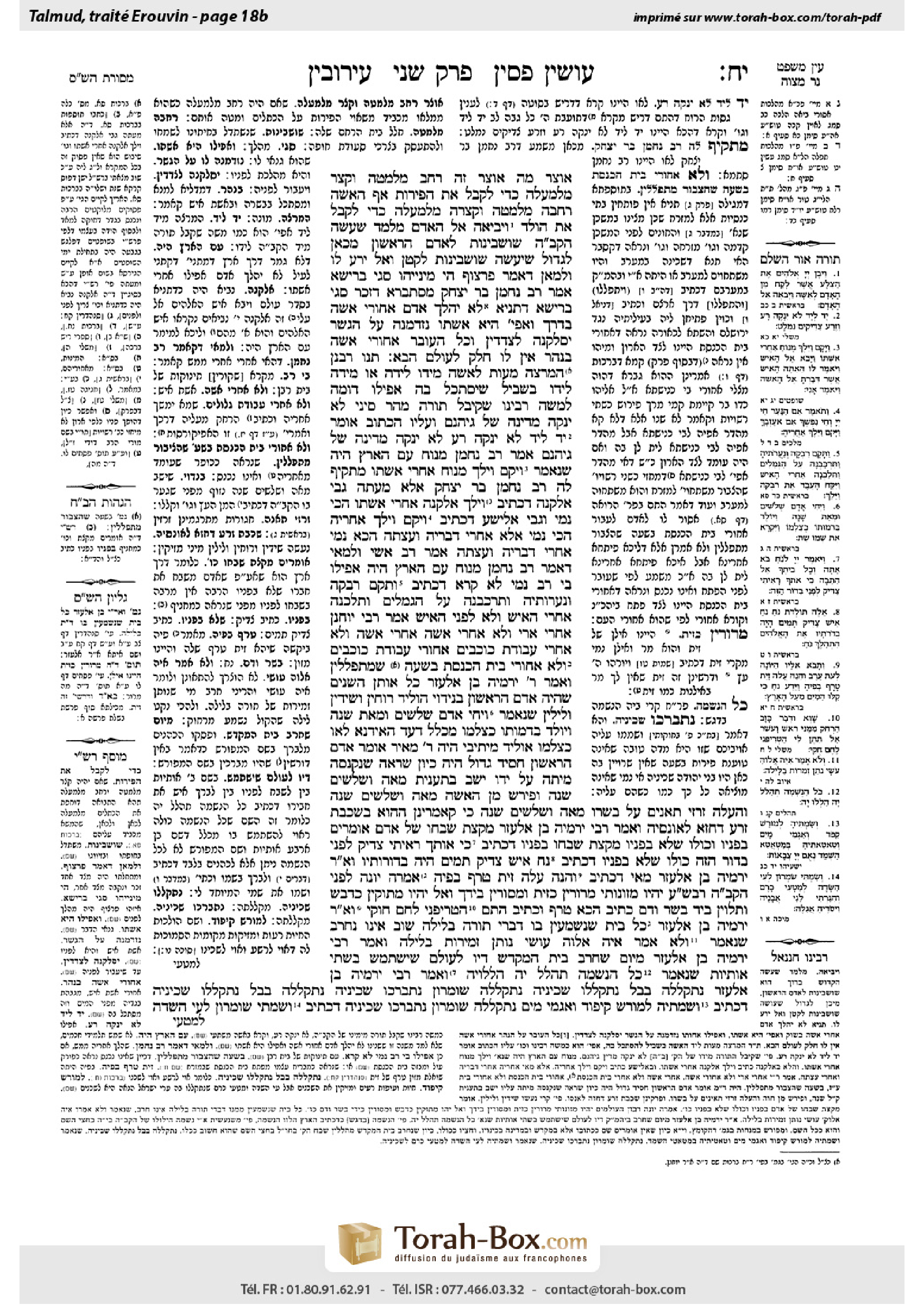
Eruvin 18b: Talmud study for Daf Yomi
Study the Talmud for Daf Yomi with scanned pages, Hebrew text, English translations from Sefaria and AI-generated French translations.
Passage selection and English or AI-generated French translation are available where the scan has annotations. Daf Study is independent of Torah-Box and Sefaria.
Browse Eruvin · עירובין · All tractatesEruvin 18b text and translations
This page of Eruvin includes the Aramaic text, an English translation and an AI-generated French translation, alongside the scan above.
עירובין י״ח ב · Aramaic and Hebrew text
אוֹצָר, מָה אוֹצָר זֶה רָחָב מִלְּמַטָּה וְקָצָר מִלְמַעְלָה כְּדֵי לְקַבֵּל אֶת הַפֵּירוֹת — אַף הָאִשָּׁה רְחָבָה מִלְּמַטָּה וּקְצָרָה מִלְמַעְלָה כְּדֵי לְקַבֵּל אֶת הַוָּלָד.
״וַיְבִיאֶהָ אֶל הָאָדָם״ — מְלַמֵּד שֶׁעָשָׂה הַקָּדוֹשׁ בָּרוּךְ הוּא שׁוֹשְׁבִינוּת לָאָדָם הָרִאשׁוֹן, מִכָּאן לַגָּדוֹל שֶׁיַּעֲשֶׂה שׁוֹשְׁבִינוּת לַקָּטָן וְאַל יֵרַע לוֹ.
וּלְמַאן דְּאָמַר פַּרְצוּף, הֵי מִינַּיְיהוּ סָגֵי בְּרֵישָׁא? אָמַר רַב נַחְמָן בַּר יִצְחָק: מִסְתַּבְּרָא דְּזָכָר סָגֵי בְּרֵישָׁא, דְּתַנְיָא: לֹא יְהַלֵּךְ אָדָם אֲחוֹרֵי אִשָּׁה בַּדֶּרֶךְ, וַאֲפִילּוּ הִיא אִשְׁתּוֹ. נִזְדַּמְּנָה עַל הַגֶּשֶׁר יְסַלְּקֶנָּה לִצְדָדִין. וְכׇל הָעוֹבֵר אֲחוֹרֵי אִשָּׁה בַּנָּהָר — אֵין לוֹ חֵלֶק לָעוֹלָם הַבָּא.
תָּנוּ רַבָּנַן: הַמַּרְצֶה מָעוֹת לְאִשָּׁה מִיָּדוֹ לְיָדָהּ אוֹ מִיָּדָהּ לְיָדוֹ בִּשְׁבִיל שֶׁיִּסְתַּכֵּל בָּהּ, אֲפִילּוּ דּוֹמֶה לְמֹשֶׁה רַבֵּינוּ שֶׁקִּיבֵּל תּוֹרָה מֵהַר סִינַי — לֹא יִנָּקֶה מִדִּינָהּ שֶׁל גֵּיהִנָּם. וְעָלָיו הַכָּתוּב אוֹמֵר: ״יָד לְיָד לֹא יִנָּקֶה רָע״ — לֹא יִנָּקֶה מִדִּינָהּ שֶׁל גֵּיהִנָּם.
אָמַר רַב נַחְמָן: מָנוֹחַ עַם הָאָרֶץ הָיָה, שֶׁנֶּאֱמַר: ״וַיָּקׇם וַיֵּלֶךְ מָנוֹחַ אַחֲרֵי אִשְׁתּוֹ״.
מַתְקֵיף לַהּ רַב נַחְמָן בַּר יִצְחָק: אֶלָּא מֵעַתָּה, גַּבֵּי אֶלְקָנָה דִּכְתִיב: ״וַיֵּלֶךְ אֶלְקָנָה אַחֲרֵי אִשְׁתּוֹ״, הָכִי נָמֵי? וְגַבֵּי אֱלִישָׁע דִּכְתִיב: ״וַיָּקׇם וַיֵּלֶךְ אַחֲרֶיהָ״, הָכִי נָמֵי?
אֶלָּא: אַחֲרֵי דְּבָרֶיהָ וַעֲצָתָהּ, הָכָא נָמֵי — אַחֲרֵי דְּבָרֶיהָ וַעֲצָתָהּ.
אָמַר רַב אָשֵׁי: וּלְמַאי דְּאָמַר רַב נַחְמָן מָנוֹחַ עַם הָאָרֶץ הָיָה, אֲפִילּוּ בֵּי רַב נָמֵי לָא קְרָא. דִּכְתִיב: ״וַתָּקׇם רִבְקָה וְנַעֲרוֹתֶיהָ וַתִּרְכַּבְנָה עַל הַגְּמַלִּים וַתֵּלַכְנָה אַחֲרֵי הָאִישׁ״, וְלָא לִפְנֵי הָאִישׁ.
אָמַר רַבִּי יוֹחָנָן: אַחֲרֵי אֲרִי וְלֹא אַחֲרֵי אִשָּׁה. אַחֲרֵי אִשָּׁה וְלֹא אַחֲרֵי עֲבוֹדָה זָרָה. אֲחוֹרֵי עֲבוֹדָה זָרָה וְלֹא אֲחוֹרֵי בֵּית הַכְּנֶסֶת בְּשָׁעָה שֶׁמִּתְפַּלְּלִין.
וְאָמַר רַבִּי יִרְמְיָה בֶּן אֶלְעָזָר: כָּל אוֹתָן הַשָּׁנִים שֶׁהָיָה אָדָם הָרִאשׁוֹן בְּנִידּוּי, הוֹלִיד רוּחִין וְשֵׁידִין וְלִילִין, שֶׁנֶּאֱמַר: ״וַיְחִי אָדָם שְׁלֹשִׁים וּמְאַת שָׁנָה וַיּוֹלֶד בִּדְמוּתוֹ כְּצַלְמוֹ״, מִכְּלָל דְּעַד הָאִידָּנָא לָאו כְּצַלְמוֹ אוֹלֵיד.
מֵיתִיבִי, הָיָה רַבִּי מֵאִיר אוֹמֵר: אָדָם הָרִאשׁוֹן חָסִיד גָּדוֹל הָיָה, כֵּיוָן שֶׁרָאָה שֶׁנִּקְנְסָה מִיתָה עַל יָדוֹ, יָשַׁב בְּתַעֲנִית מֵאָה שְׁלֹשִׁים שָׁנָה, וּפֵירַשׁ מִן הָאִשָּׁה מֵאָה שְׁלֹשִׁים שָׁנָה, וְהֶעֱלָה זִרְזֵי תְּאֵנִים עַל בְּשָׂרוֹ מֵאָה שְׁלֹשִׁים שָׁנָה.
כִּי קָאָמְרִינַן הָהוּא, בְּשִׁכְבַת זֶרַע דַּחֲזָא לְאוּנְסֵיהּ.
וְאָמַר רַבִּי יִרְמְיָה בֶּן אֶלְעָזָר: מִקְצָת שִׁבְחוֹ שֶׁל אָדָם אוֹמְרִים בְּפָנָיו, וְכוּלּוֹ שֶׁלֹּא בְּפָנָיו. מִקְצָת שִׁבְחוֹ בְּפָנָיו, דִּכְתִיב: ״כִּי אוֹתְךָ רָאִיתִי צַדִּיק לְפָנַי בַּדּוֹר הַזֶּה״,
כּוּלּוֹ שֶׁלֹּא בְּפָנָיו, דִּכְתִיב: ״נֹחַ אִישׁ צַדִּיק תָּמִים הָיָה בְּדוֹרוֹתָיו״.
וְאָמַר רַבִּי יִרְמְיָה בֶּן אֶלְעָזָר, מַאי דִּכְתִיב: ״וְהִנֵּה עֲלֵה זַיִת טָרָף בְּפִיהָ״ — אָמְרָה יוֹנָה לִפְנֵי הַקָּדוֹשׁ בָּרוּךְ הוּא: רִבּוֹנוֹ שֶׁל עוֹלָם, יִהְיוּ מְזוֹנוֹתַי מְרוֹרִין כְּזַיִת וּמְסוּרִין בְּיָדְךָ, וְאַל יִהְיוּ מְתוּקִין כִּדְבַשׁ וּתְלוּיִן בְּיַד בָּשָׂר וָדָם. כְּתִיב הָכָא ״טָרָף״, וּכְתִיב הָתָם ״הַטְרִיפֵנִי לֶחֶם חוּקִּי״.
וְאָמַר רַבִּי יִרְמְיָה בֶּן אֶלְעָזָר: כׇּל בַּיִת שֶׁנִּשְׁמָעִין בּוֹ דִּבְרֵי תוֹרָה בַּלַּיְלָה, שׁוּב אֵינוֹ נֶחְרָב, שֶׁנֶּאֱמַר: ״וְלֹא אָמַר אַיֵּה אֱלוֹהַּ עוֹשָׂי נוֹתֵן זְמִירוֹת בַּלָּיְלָה״.
וְאָמַר רַבִּי יִרְמְיָה בֶּן אֶלְעָזָר: מִיּוֹם שֶׁחָרַב בֵּית הַמִּקְדָּשׁ, דַּיּוֹ לָעוֹלָם שֶׁיִּשְׁתַּמֵּשׁ בִּשְׁתֵּי אוֹתִיּוֹת, שֶׁנֶּאֱמַר: ״כֹּל הַנְּשָׁמָה תְּהַלֵּל יָהּ הַלְלוּיָהּ״.
וְאָמַר רַבִּי יִרְמְיָה בֶּן אֶלְעָזָר: נִתְקַלְּלָה בָּבֶל — נִתְקַלְּלוּ שְׁכֵינֶיהָ, נִתְקַלְּלָה שׁוֹמְרוֹן — נִתְבָּרְכוּ שְׁכֵינֶיהָ. נִתְקַלְּלָה בָּבֶל נִתְקַלְּלוּ שְׁכֵינֶיהָ — דִּכְתִיב: ״וְשַׂמְתִּיהָ לְמוֹרַשׁ קִיפּוֹד וְאַגְמֵי מָיִם״. נִתְקַלְּלָה שׁוֹמְרוֹן נִתְבָּרְכוּ שְׁכֵינֶיהָ — דִּכְתִיב: ״וְשַׂמְתִּי שׁוֹמְרוֹן לְעִי הַשָּׂדֶה
Eruvin 18b · English translation
of a storehouse. Just as a storehouse is built wide on the bottom and narrow on top, in order to hold produce without collapsing, so too a woman is created wide on the bottom and narrow on top, in order to hold the fetus.
The Gemara cites an exposition of the end of the previously cited verse: “And brought her unto the man” (Genesis 2:22). This verse teaches that the Holy One, Blessed be He, was Adam the first man’s best man, attending to all his wedding needs and bringing his wife to him. From here we learn that a greater individual should serve as a best man for a lesser individual and should not feel bad about it as something beneath his dignity.
The Gemara asks: And according to the one who says that Eve was a face or side of Adam, which one of them walked in front? Rav Naḥman bar Yitzḥak said: It is reasonable to say that the male walked in front, as this is proper behavior, as it was taught in a baraita: A man should not walk behind a woman on a path, even if she is his wife. If she happens upon him on a bridge, he should walk quickly in order to catch up to her and consequently move her to his side, so that she will not walk before him. And anyone who walks behind a woman in a river, where she has to lift up her skirt in order to cross, has no share in the World-to-Come.
The Sages taught: With regard to one who counts out money for a woman from his hand into her hand or from her hand into his hand, in order to look upon her, even if in other matters he is like Moses our teacher, who received the Torah from Mount Sinai, he will not be absolved from the punishment of Gehenna. The verse says about him: “Hand to hand, the evil man shall not go unpunished” (Proverbs 11:21). One who hands money from his hand to her hand, even if he received the Torah from God’s hand to his own, like Moses, he will not be absolved from the punishment of Gehenna, which is called evil.
Rav Naḥman said: From the following verse, it is known that Samson’s father, Manoah, was an ignoramus, as it is stated: “And Manoah arose, and went after his wife” (Judges 13:11), which shows that he was unfamiliar with the principle that one must not walk behind a woman.
Rav Naḥman bar Yitzḥak strongly objects to this: If that is so, if the verse relating to Manoah is understood literally, what will one say about the verse with regard to Elkana, the father of the prophet Samuel, as it is written: “And Elkana walked after his wife.” Does this verse mean that Elkana was also an ignorant person? And what of the verse with regard to the prophet Elisha, as it is written: “And the mother of the child said: As the Lord lives, and as your soul lives, I will not leave you; and he arose and followed her” (ii Kings 4:30). Does this verse mean that Elisha was also an uneducated person?
Rather, certainly each of these verses means that he followed her words and advice. If so, here too, the verse concerning Manoah may be similarly interpreted. He did not literally walk behind his wife, but rather he followed her words and advice.
Rav Ashi said: And according to what Rav Naḥman said, that Manoah was an ignoramus, he did not even read the basic Torah stories that children learn in school. As it is written: “Rebecca arose, and her damsels, and they rode upon the camels, and followed the man” (Genesis 24:61); they followed him and did not walk before the man.
On this topic, Rabbi Yoḥanan said: It is preferable to walk behind a lion, and not behind a woman. And it is preferable to walk behind a woman and not behind idolatry. When a procession honoring idolatry is passing in the street, it is better to walk behind a woman than appear to be accompanying the idolatry. It is preferable to walk behind idolatry and not behind a synagogue at a time of prayer. By walking behind a synagogue at a time of prayer and not entering, one appears as though he were denying the God to Whom the congregation is directing its prayers.
Having cited an aggadic statement of Rabbi Yirmeya ben Elazar, the Gemara cites other statements of his: Rabbi Yirmeya ben Elazar said: All those years during which Adam was ostracized for the sin involving the Tree of Knowledge, he bore spirits, demons, and female demons, as it is stated: “And Adam lived a hundred and thirty years, and begot a son in his own likeness, after his image, and called his name Seth” (Genesis 5:3). By inference, until now, the age of one hundred thirty, he did not bear after his image, but rather bore other creatures.
The Gemara raises an objection from a baraita: Rabbi Meir would say: Adam the first man was very pious. When he saw that death was imposed as a punishment because of him, he observed a fast for a hundred thirty years, and he separated from his wife for a hundred thirty years, and wore belts [zarzei] of fig leaves on his body as his only garment for a hundred thirty years. If so, how did he father demons into the world?
The Gemara answers: When Rabbi Yirmeya made his statement, he meant that those destructive creatures were formed from the semen that Adam accidentally emitted, which brought the destructive creatures into being.
And Rabbi Yirmeya ben Elazar further said: Only some of a person’s praise should be said in his presence, and all of it may be said not in his presence. Only some of his praise should be said in his presence, as it is written: “And the Lord said to Noah, come, you and all your house into the ark, for you have I seen righteous before Me in this generation” (Genesis 7:1).
And all of it may be said not in his presence, as it is written: “These are the generations of Noah; Noah was a righteous man, and perfect in his generations, and Noah walked with God” (Genesis 6:9). When not referring to him in his presence, God refers to Noah as a righteous and perfect man.
And Rabbi Yirmeya ben Elazar also said: What is the meaning of that which is written: “And the dove came in to him in the evening, and lo, in her mouth was an olive leaf, plucked off [taraf]; so Noah knew that the waters were abated from off the earth” (Genesis 8:11)? The dove said before the Holy One, Blessed be He: Master of the Universe, let my food be bitter as an olive but given into Your hand, and let it not be sweet as honey but dependent upon flesh and blood. He adds this explanation: Here it is written: Taraf. And there it is written: “Remove far from me falsehood and lies; give me neither poverty nor riches; feed me [hatrifeni] my allotted portion” (Proverbs 30:8).
And Rabbi Yirmeya ben Elazar also said: Any house in which the words of Torah are heard at night will never be destroyed, as it is stated: “But none says: Where is God my Maker, Who gives songs in the night” (Job 35:10). The verse implies that one who sings songs of Torah in his house at night will not need to lament the destruction of his home.
And Rabbi Yirmeya ben Elazar further said: From the day that the Temple was destroyed, it is enough for the world to use in its praise of God, or in greeting one another with the name of God, only two letters of the Tetragrammaton, namely yod and heh, as it is stated: “Let everything that has breath praise the Lord [Yah]. Halleluya” (Psalms 150:6), without mentioning the full name of God, comprised of four letters.
And Rabbi Yirmeya ben Elazar also said: When Babylonia was cursed, its neighbors were cursed along with it. When Samaria was cursed, its neighbors were blessed. He explains: When Babylonia was cursed, its neighbors were cursed, as it is written: “I will also make it a possession for wild birds, and pools of water” (Isaiah 14:23), and the arrival of predatory animals brings harm to the surrounding neighbors as well. When Samaria was cursed, its neighbors were blessed, as it is written: “Therefore I will turn Samaria into a heap of rubble in the field
Eruvin 18b · Traduction française (IA)
d'un entrepôt. Comme un entrepôt est construit large en bas et étroit en haut, afin de contenir les récoltes sans s'effondrer, de même une femme est créée large en bas et étroite en haut, afin de contenir le fœtus.
La Guemara cite une interprétation de la fin de la versette précédemment citée : « Et il la conduisit à l'homme » (Genèse 2:22). Cette versette enseigne que l'Éternel, béni soit-Il, fut le témoin de Adam, le premier homme, prenant soin de tous ses besoins de mariage et conduisant sa femme à lui. D'où l'on tire que l'individu supérieur devrait être témoin pour un individu inférieur et ne pas se sentir humilié à ce sujet.
La Guemara pose la question : Et selon celui qui dit que Ève était un visage ou un côté d'Adam, lequel d'entre eux marchait en avant ? Rav Naḥman bar Yitzḥak dit : Il est raisonnable de dire que l'homme marchait en avant, car c'est le comportement approprié, comme il est enseigné dans une baraïta : Un homme ne doit pas marcher derrière une femme sur un chemin, même si elle est sa femme. Si elle le croise sur un pont, il doit marcher rapidement pour la rattraper et ainsi la faire passer à son côté, afin qu'elle ne marche pas devant lui. Et celui qui marche derrière une femme dans un fleuve, où elle doit lever sa robe pour traverser, n'aura pas sa part dans le monde à venir.
Les Sages enseignent : Concernant celui qui compte de l'argent pour une femme, en donnant de sa main à sa main ou de sa main à sa main, afin de la regarder, même s'il est comme Moïse notre maître, qui a reçu la Torah du mont Sinaï, il ne sera pas exempt de la punition de l'Enfer. La versette dit à son sujet : « De la main à la main, l'homme mauvais ne restera pas impuni » (Proverbes 11:21). Celui qui donne de l'argent de sa main à sa main, même s'il a reçu la Torah de la main de Dieu à sa propre main, comme Moïse, ne sera pas exempt de la punition de l'Enfer, qui est appelée mauvais.
Rav Naḥman dit : D'après la versette suivante, on sait que le père de Samson, Manoah, était un ignorant, car il est dit : « Et Manoah se leva, et alla après sa femme » (Juges 13:11), ce qui montre qu'il ne connaissait pas le principe de ne pas marcher derrière une femme.
Rav Naḥman bar Yitzḥak s'oppose fermement à cela : Si c'est ainsi, et si la versette concernant Manoah est comprise littéralement, que dira-t-on de la versette concernant Elkana, le père du prophète Samuel, comme il est écrit : « Et Elkana marcha après sa femme » ? Cette versette signifie-t-elle que Elkana était également un ignorant ? Et que dire de la versette concernant le prophète Elie, comme il est écrit : « Et la mère du garçon dit : Comme l'Éternel vit, et comme votre âme vit, je ne vous quitterai pas ; et il se leva et la suivit » (II Rois 4:30). Cette versette signifie-t-elle que Elie était également un homme peu instruit ?
Plutôt, certainement, chacune de ces versets signifie qu'il suivait ses paroles et ses conseils. Si c'est ainsi, ici aussi, la versette concernant Manoah peut être interprétée de la même manière. Il n'a pas littéralement marché derrière sa femme, mais plutôt il a suivi ses paroles et ses conseils.
Rav Ashi dit : Et selon ce que dit Rav Naḥman, que Manoah était un ignorant, il n'avait même pas lu les histoires de la Torah que les enfants apprennent à l'école. Comme il est écrit : « Rebecca se leva, et ses servantes, et elles montèrent sur les chameaux, et suivirent l'homme » (Genèse 24:61) ; elles le suivirent et ne marchèrent pas devant l'homme.
Sur ce sujet, Rabbi Yoḥanan dit : Il est préférable de marcher derrière un lion, et non derrière une femme. Et il est préférable de marcher derrière une femme et non derrière l'idolâtrie. Lorsqu'une procession honorant l'idolâtrie passe dans la rue, il est préférable de marcher derrière une femme plutôt que d'apparaître comme s'on accompagnait l'idolâtrie. Il est préférable de marcher derrière l'idolâtrie et non derrière une synagogue lors de la prière. En marchant derrière une synagogue lors de la prière et sans entrer, on a l'air de nier le Dieu auquel la congrégation dirige ses prières.
Ayant cité une déclaration agagique de Rabbi Yirmeya ben Elazar, la Guemara cite d'autres déclarations de lui : Rabbi Yirmeya ben Elazar dit : Tous les ans durant lesquels Adam fut exclu pour le péché lié à l'Arbre de la Connaissance, il portait des esprits, des démons et des démones féminines, comme il est dit : « Et Adam vécut cent trente ans, et engendra un fils à son image, selon son semblance, et nomma son nom Seth » (Genèse 5:3). Par déduction, jusqu'à présent, à l'âge de cent trente, il ne portait pas selon son image, mais plutôt d'autres créatures.
La Guemara soulève un objet d'une baraïta : Rabbi Meir disait : Adam, le premier homme, était très pieux. Lorsqu'il vit que la mort était imposée en tant que punition à cause de lui, il observa un jeûne pendant cent trente ans, et il s'éloigna de sa femme pendant cent trente ans, et porta des ceintures de feuilles de fig sur son corps comme seul vêtement pendant cent trente ans. Si c'est ainsi, comment a-t-il pu engendrer des démons dans le monde ?
La Guemara répond : Lorsque Rabbi Yirmeya a fait cette déclaration, il voulait dire que ces créatures destructrices furent formées à partir du sperme que Adam avait accidentellement émis, ce qui a conduit à la création de ces créatures destructrices.
Et Rabbi Yirmeya ben Elazar a dit de plus : Seule une partie des louanges d'une personne devrait être dite en sa présence, et toutes peuvent être dites en son absence. Seule une partie de ses louanges devrait être dite en sa présence, comme il est écrit : « Et l'Éternel dit à Noé, viens, toi et toute ta maison dans l'arca, car tu es celui que je vois juste devant moi dans cette génération » (Genèse 7:1).
Et toutes peuvent être dites en son absence, comme il est écrit : « Ces sont les généalogies de Noé ; Noé était un homme juste, et parfait dans ses générations, et Noé marcha avec Dieu » (Genèse 6:9). Lorsqu'on ne fait pas référence à lui en sa présence, Dieu désigne Noé comme un homme juste et parfait.
Et Rabbi Yirmeya ben Elazar a aussi dit : Quel est le sens de ce qui est écrit : « Et la tourde entra dans la nuit, et voici, dans sa bouche était une feuille d'olivier, arrachée [taraf] ; ainsi Noé sut que les eaux s'étaient retirées de la terre » (Genèse 8:11) ? La tourde dit devant le Saint, béni soit-Il : Seigneur du Monde, que mon aliment soit amer comme une olive mais mis entre Tes mains, et qu'il ne soit pas doux comme du miel mais dépendant de chair et de sang. Il ajoute cette explication : Ici il est écrit : Taraf. Et là il est écrit : « Éloigne de moi la fausseté et les mensonges ; donne-moi ni la pauvreté ni la richesse ; nourris-moi [hatrifeni] ma portion assignée » (Proverbes 30:8).
Et Rabbi Yirmeya ben Elazar a aussi dit : Toute maison dans laquelle les paroles de la Torah sont entendues la nuit ne sera jamais détruite, comme il est dit : « Mais personne ne dit : Où est Dieu, mon Créateur, Qui chante des chants la nuit » (Job 35:10). La versette implique que celui qui chante des chants de Torah dans sa maison la nuit ne devra pas pleurer la destruction de sa maison.
Et Rabbi Yirmeya ben Elazar a encore dit : Depuis le jour où le Temple a été détruit, il suffit au monde d'utiliser dans son éloge de Dieu, ou dans l'embrassade mutuelle avec le nom de Dieu, seulement deux lettres du Tetragrammaton, à savoir la yod et la heh, comme il est dit : « Que tout ce qui a un souffle loue l'Éternel [Yah]. Halleluya » (Psaumes 150:6), sans mentionner le nom complet de Dieu, composé de quatre lettres.
Et Rabbi Yirmeya ben Elazar a aussi dit : Lorsque Babylone a été maudite, ses voisins ont été maudits avec elle. Lorsque Samarie a été maudite, ses voisins ont été bénis. Il explique : Lorsque Babylone a été maudite, ses voisins ont été maudits, comme il est écrit : « Je ferai aussi de cela une possession pour les oiseaux de proie, et des étangs d'eau » (Isaïe 14:23), et l'arrivée des animaux de proie apporte un malheur aux voisins environnants également. Lorsque Samarie a été maudite, ses voisins ont été bénis, comme il est écrit : « Aussi je tournerai Samarie en une montagne de ruines dans le champ »
Traduction française générée par IA à partir de l’édition anglaise de Sefaria. Vérifie toujours un passage avec le texte source.
Text from Sefaria: William Davidson Edition - Vocalized Aramaic (CC BY NC); William Davidson Edition - English (CC BY NC).