Eruvin 19a: Talmud study for Daf Yomi
Study the Talmud for Daf Yomi with scanned pages, Hebrew text, English translations from Sefaria and AI-generated French translations.
Passage selection and English or AI-generated French translation are available where the scan has annotations. Daf Study is independent of Torah-Box and Sefaria.
Browse Eruvin · עירובין · All tractatesEruvin 19a text and translations
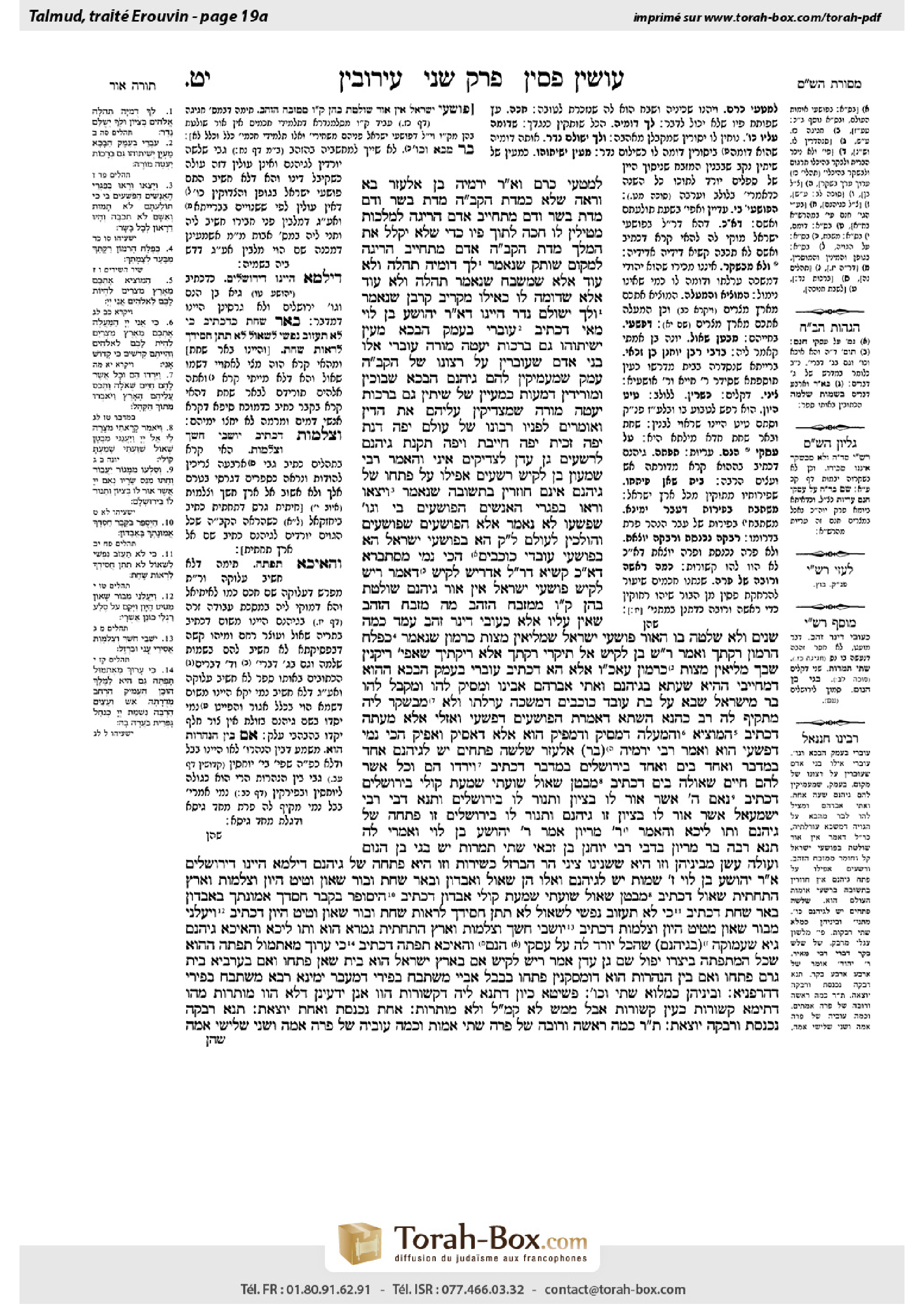
This page of Eruvin includes the Aramaic text, an English translation and an AI-generated French translation, alongside the scan above.
עירובין י״ט א · Aramaic and Hebrew text
לְמַטָּעֵי כָרֶם״.
וְאָמַר רַבִּי יִרְמְיָה בֶּן אֶלְעָזָר: בֹּא וּרְאֵה שֶׁלֹּא כְּמִדַּת הַקָּדוֹשׁ בָּרוּךְ הוּא מִדַּת בָּשָׂר וְדָם. מִדַּת בָּשָׂר וָדָם, מִתְחַיֵּיב אָדָם הֲרִיגָה לַמַּלְכוּת — מְטִילִין לוֹ חַכָּה לְתוֹךְ פִּיו כְּדֵי שֶׁלֹּא יְקַלֵּל אֶת הַמֶּלֶךְ.
מִדַּת הַקָּדוֹשׁ בָּרוּךְ הוּא, אָדָם מִתְחַיֵּיב הֲרִיגָה לַמָּקוֹם — שׁוֹתֵק, שֶׁנֶּאֱמַר: ״לְךָ דוּמִיָּה תְהִלָּה״, וְלֹא עוֹד אֶלָּא שֶׁמְּשַׁבֵּחַ, שֶׁנֶּאֱמַר: ״תְּהִלָּה״. וְלֹא עוֹד אֶלָּא שֶׁדּוֹמֶה לוֹ כְּאִילּוּ מַקְרִיב קׇרְבָּן, שֶׁנֶּאֱמַר: ״וּלְךָ יְשׁוּלַּם נֶדֶר״.
הַיְינוּ דְּאָמַר רַבִּי יְהוֹשֻׁעַ בֶּן לֵוִי: מַאי דִּכְתִיב ״עוֹבְרֵי בְּעֵמֶק הַבָּכָא מַעְיָן יְשִׁיתוּהוּ גַּם בְּרָכוֹת יַעְטֶה מוֹרֶה״.
״עוֹבְרֵי״ — אֵלּוּ בְּנֵי אָדָם שֶׁעוֹבְרִין עַל רְצוֹנוֹ שֶׁל הַקָּדוֹשׁ בָּרוּךְ הוּא. ״עֵמֶק״ — שֶׁמַּעֲמִיקִין לָהֶם גֵּיהִנָּם. ״הַבָּכָא״ — שֶׁבּוֹכִין וּמוֹרִידִין דְּמָעוֹת כְּמַעְיָין שֶׁל שִׁיתִין. ״גַּם בְּרָכוֹת יַעְטֶה מוֹרֶה״ — שֶׁמַּצְדִּיקִין עֲלֵיהֶם אֶת הַדִּין, וְאוֹמְרִים לְפָנָיו: רִבּוֹנוֹ שֶׁל עוֹלָם, יָפֶה דַּנְתָּ, יָפֶה זִכֵּיתָ, יָפֶה חִיַּיבְתָּ, וְיָפֶה תִּקַּנְתָּ גֵּיהִנָּם לָרְשָׁעִים גַּן עֵדֶן לַצַּדִּיקִים.
אִינִי?! וְהָאָמַר רַבִּי שִׁמְעוֹן בֶּן לָקִישׁ: רְשָׁעִים אֲפִילּוּ עַל פִּתְחוֹ שֶׁל גֵּיהִנָּם אֵינָם חוֹזְרִין בִּתְשׁוּבָה, שֶׁנֶּאֱמַר: ״וְיָצְאוּ וְרָאוּ בְּפִגְרֵי הָאֲנָשִׁים הַפּוֹשְׁעִים בִּי וְגוֹ׳״, ״שֶׁפָּשְׁעוּ״ לֹא נֶאֱמַר, אֶלָּא ״הַפּוֹשְׁעִים״ — שֶׁפּוֹשְׁעִים וְהוֹלְכִין לְעוֹלָם!
לָא קַשְׁיָא: הָא — בְּפוֹשְׁעֵי יִשְׂרָאֵל, הָא — בְּפוֹשְׁעֵי אוּמּוֹת הָעוֹלָם.
הָכִי נָמֵי מִסְתַּבְּרָא, דְּאִם כֵּן קַשְׁיָא דְּרֵישׁ לָקִישׁ אַדְּרֵישׁ לָקִישׁ. דְּאָמַר רֵישׁ לָקִישׁ: פּוֹשְׁעֵי יִשְׂרָאֵל אֵין אוּר גֵּיהִנָּם שׁוֹלֶטֶת בָּהֶן, קַל וָחוֹמֶר מִמִּזְבַּח הַזָּהָב.
מָה מִזְבַּח הַזָּהָב, שֶׁאֵין עָלָיו אֶלָּא כְּעוֹבִי דִּינַר זָהָב, עָמַד כַּמָּה שָׁנִים וְלֹא שָׁלְטָה בּוֹ הָאוּר. פּוֹשְׁעֵי יִשְׂרָאֵל, שֶׁמְּלֵיאִין מִצְוֹת כְּרִמּוֹן, שֶׁנֶּאֱמַר: ״כְּפֶלַח הָרִמּוֹן רַקָּתֵךְ״, וְאָמַר רַבִּי שִׁמְעוֹן בֶּן לָקִישׁ: אַל תִּיקְרֵי ״רַקָּתֵךְ״ אֶלָּא ״רֵיקָתֵיךְ״, שֶׁאֲפִילּוּ רֵיקָנִין שֶׁבָּךְ מְלֵיאִין מִצְוֹת כְּרִמּוֹן — עַל אַחַת כַּמָּה וְכַמָּה.
אֶלָּא הָא דִּכְתִיב: ״עוֹבְרֵי בְּעֵמֶק הַבָּכָא״, הָהוּא דִּמְחַיְּיבִי הָהִיא שַׁעְתָּא בְּגֵיהִנָּם, וְאָתֵי אַבְרָהָם אָבִינוּ וּמַסֵּיק לְהוּ וּמְקַבֵּל לְהוּ. בַּר מִיִּשְׂרָאֵל שֶׁבָּא עַל הַגּוֹיָה, דְּמָשְׁכָה עׇרְלָתוֹ וְלָא מְבַשְׁקַר לֵיהּ.
מַתְקֵיף לַהּ רַב כָּהֲנָא: הַשְׁתָּא דְּאָמְרַתְּ ״הַפּוֹשְׁעִים״ — דְּפָשְׁעִי וְאָזְלִי, אֶלָּא מֵעַתָּה דִּכְתִיב ״הַמּוֹצִיא״ וְ״הַמַּעֲלֶה״ — דְּמַסֵּיק וּדְמַפֵּיק הוּא?! אֶלָּא דְּאַסֵּיק וְאַפֵּיק, הָכִי נָמֵי — דְּפָשְׁעִי הוּא.
וְאָמַר רַבִּי יִרְמְיָה (בַּר) אֶלְעָזָר: שְׁלֹשָׁה פְּתָחִים יֵשׁ לַגֵּיהִנָּם, אֶחָד בַּמִּדְבָּר וְאֶחָד בַּיָּם וְאֶחָד בִּירוּשָׁלַיִם. בַּמִּדְבָּר, דִּכְתִיב: ״וַיֵּרְדוּ הֵם וְכׇל אֲשֶׁר לָהֶם חַיִּים שְׁאוֹלָה״.
בַּיָּם, דִּכְתִיב: ״מִבֶּטֶן שְׁאוֹל שִׁוַּעְתִּי שָׁמַעְתָּ קוֹלִי״.
בִּירוּשָׁלַיִם, דִּכְתִיב: ״נְאֻם ה׳ אֲשֶׁר אוּר לוֹ בְּצִיּוֹן וְתַנּוּר לוֹ בִּירוּשָׁלִָים״. וְתָנָא דְּבֵי רַבִּי יִשְׁמָעֵאל: ״אֲשֶׁר אוּר לוֹ בְּצִיּוֹן״ — זוֹ גֵּיהִנָּם, ״וְתַנּוּר לוֹ בִּירוּשָׁלַיִם״ — זוֹ פִּתְחָהּ שֶׁל גֵּיהִנָּם.
וְתוּ לֵיכָּא? וְהָאָמַר רַבִּי מָרִיּוֹן אָמַר רַבִּי יְהוֹשֻׁעַ בֶּן לֵוִי, וְאָמְרִי לַהּ תָּנָא רַבָּה בַּר מָרִיּוֹן בִּדְבֵי רַבִּי יוֹחָנָן בֶּן זַכַּאי: שְׁתֵּי תְמָרוֹת יֵשׁ בְּגֵי בֶּן הִנּוֹם וְעוֹלֶה עָשָׁן מִבֵּינֵיהֶן, וְזוֹ הִיא שֶׁשָּׁנִינוּ: צִינֵי הַר הַבַּרְזֶל כְּשֵׁירוֹת, וְזוֹ הִיא פִּתְחָהּ שֶׁל גֵּיהִנָּם! — דִּילְמָא הַיְינוּ דִּירוּשָׁלַיִם.
אָמַר רַבִּי יְהוֹשֻׁעַ בֶּן לֵוִי: שִׁבְעָה שֵׁמוֹת יֵשׁ לְגֵיהִנָּם, וְאֵלּוּ הֵן: שְׁאוֹל, וַאֲבַדּוֹן, וּבְאֵר שַׁחַת, וּבוֹר שָׁאוֹן, וְטִיט הַיָּוֵן, וְצַלְמָוֶת, וְאֶרֶץ הַתַּחְתִּית.
שְׁאוֹל, דִּכְתִיב: ״מִבֶּטֶן שְׁאוֹל שִׁוַּעְתִּי שָׁמַעְתָּ קוֹלִי״. אֲבַדּוֹן, דִּכְתִיב: ״הַיְסוּפַּר בַּקֶּבֶר חַסְדֶּךָ אֱמוּנָתְךָ בָּאֲבַדּוֹן״. בְּאֵר שַׁחַת, דִּכְתִיב: ״כִּי לֹא תַעֲזוֹב נַפְשִׁי לִשְׁאוֹל לֹא תִתֵּן חֲסִידְךָ לִרְאוֹת שָׁחַת״. וּבוֹר שָׁאוֹן וָטִיט הַיָּוֵן, דִּכְתִיב: ״וַיַּעֲלֵנִי מִבּוֹר שָׁאוֹן מִטִּיט הַיָּוֵן״. וְצַלְמָוֶת, דִּכְתִיב: ״יוֹשְׁבֵי חוֹשֶׁךְ וְצַלְמָוֶת״. ״וְאֶרֶץ הַתַּחְתִּית״ — גְּמָרָא הוּא.
וְתוּ לֵיכָּא? וְהָאִיכָּא ״גֵּיהִנָּם״! — גֵּיא שֶׁעֲמוּקָּה (בְּגֵיהִנָּם), שֶׁהַכֹּל יוֹרֵד לָהּ עַל עִסְקֵי הִנָּם.
וְהָאִיכָּא ״תׇּפְתֶּה״, דִּכְתִיב: ״כִּי עָרוּךְ מֵאֶתְמוּל תׇּפְתֶּה״, הָהוּא שֶׁכׇּל הַמִּתְפַּתֶּה בְּיִצְרוֹ יִפּוֹל שָׁם.
גַּן עֵדֶן. אָמַר רֵישׁ לָקִישׁ: אִם בְּאֶרֶץ יִשְׂרָאֵל הוּא — בֵּית שְׁאָן פִּתְחוֹ, וְאִם בַּעֲרַבְיָא — בֵּית גֶּרֶם פִּתְחוֹ, וְאִם בֵּין הַנְּהָרוֹת הוּא — דּוּמַסְקְנִין פִּתְחוֹ. בְּבָבֶל — אַבָּיֵי מִשְׁתַּבַּח בְּפֵירֵי דְּמַעֲבַר יַמִּינָא, רָבָא מִשְׁתַּבַּח בְּפֵירֵי דְהַרְפַּנְיָא.
וּבֵינֵיהֶן כִּמְלוֹא שְׁתֵּי וְכוּ׳. פְּשִׁיטָא, כֵּיוָן דִּתְנָא לֵיהּ דִּקְשׁוּרוֹת הָווּ — אֲנַן יָדְעִינַן דְּלָא הָווּ מוּתָּרוֹת!
מַהוּ דְּתֵימָא: קְשׁוּרוֹת — כְּעֵין קְשׁוּרוֹת, אֲבָל מַמָּשׁ לָא — קָא מַשְׁמַע לַן וְלֹא מוּתָּרוֹת.
אַחַת נִכְנֶסֶת וְאַחַת יוֹצֵאת. תָּנָא: רִבְקָה נִכְנֶסֶת וְרִבְקָה יוֹצֵאת. תָּנוּ רַבָּנַן: כַּמָּה רֹאשָׁהּ וְרוּבָּהּ שֶׁל פָּרָה — שְׁתֵּי אַמּוֹת, וְכַמָּה עוֹבְיָהּ שֶׁל פָּרָה — אַמָּה וּשְׁנֵי שְׁלִישֵׁי אַמָּה.
Eruvin 19a · English translation
for planting vines” (Micah 1:6), which benefits all the surrounding inhabitants.
And Rabbi Yirmeya ben Elazar also said: Come and see that the attribute of flesh and blood is unlike the attribute of the Holy One, Blessed be He. For the attribute of flesh and blood is to place an iron or wooden hook in the mouth of a person who was sentenced to death by the government, so that he should not be able to curse the king when he is taken away for execution.
But the attribute of the Holy One, Blessed be He is that one is willingly silent when he is sentenced to death by the Omnipresent, as it is stated: “For You silence is praise, O God in Zion, and to You shall the vow be performed” (Psalms 65:2). And what is more, he praises God for his sufferings, as it is stated: “Praise.” And what is more, it appears to him as though he were offering a sacrifice in atonement for his sin, as it is stated: “And to You shall the vow be performed.”
And this is what Rabbi Yehoshua ben Levi said: What is the meaning of that which is written: “Those who pass through the valley of weeping turn it into a water spring; moreover, the early rain covers it with blessings” (Psalms 84:7)?
“Those who pass through [overei],” these are people who transgress [overin] the will of the Holy One, Blessed be He. “Valley [emek]” indicates that their punishment is that Gehenna is deepened [ma’amikin] for them. “Of weeping [bakha]” and “turn it into a water spring [ma’ayan yeshituhu],” indicates that they weep [bokhin] and make tears flow like a spring [ma’ayan] of the foundations [shitin], meaning like a spring that descends to the foundations of the earth. “Moreover, the early rain covers it with blessings,” indicates that they accept the justice of God’s judgment, and say before Him: Master of the Universe, You have judged properly, You have acquitted properly, You have condemned properly, and it is befitting that You have prepared Gehenna for the wicked and the Garden of Eden for the righteous.
The Gemara raises a difficulty: Is that so? Didn’t Rabbi Shimon ben Lakish say: The wicked do not repent, even at the entrance to Gehenna, as it is stated: “And they shall go forth, and look upon the carcasses of the men who rebel against Me; for their worm shall not die, neither shall their fire be quenched; and they shall be an abhorrence to all flesh” (Isaiah 66:24)? The verse does not say: Who rebelled, but rather: “Who rebel,” in the present tense, meaning they continue rebelling forever.
The Gemara answers: This is not difficult; here, i.e., where it is said that they accept God’s judgment, it is referring to the sinners of the Jewish people; there, i.e., where it is said that they do not recant, it is referring to the rebels among the nations of the world.
So too, it is reasonable to say this, for if you do not say so, there would be a contradiction between one statement of Reish Lakish and another statement of Reish Lakish. As Reish Lakish said: With regard to the sinners of the Jewish people, the fire of Gehenna has no power over them, as may be learned by a fortiori reasoning from the golden altar.
If the golden altar in the Temple, which was only covered by gold the thickness of a golden dinar, stood for many years and the fire did not burn it, for its gold did not melt, so too the sinners of the Jewish people, who are filled with good deeds like a pomegranate, as it is stated: “Your temples [rakatekh] are like a split pomegranate behind your veil” (Song of Songs 6:7), will not be affected by the fire of Gehenna. And Rabbi Shimon ben Lakish said about this: Do not read: Your temples [rakatekh], but rather: Your empty ones [reikateikh], meaning that even the sinners among you are full of mitzvot like a pomegranate; how much more so should the fire of Gehenna have no power over them.
However, that which is written: “Those who pass through the valley of weeping” (Psalms 84:7), which implies that the sinners nonetheless descend to Gehenna, should be explained as follows: There it speaks of those who are liable at that time for punishment in Gehenna, but our father Abraham comes and raises them up and receives them. He does not leave the circumcised behind and allow them to enter Gehenna, except for a Jew who had relations with a gentile woman, in punishment for which his foreskin is drawn, and our father Abraham does not recognize him as one of his descendants.
Rav Kahana strongly objected to this: Now that you have said that the words those who rebel are referring to those who go on rebelling, if so, in those verses in which it is written of Him: “He Who brings out” (see Exodus 6:7) and “He Who raises up” Israel from Egypt (see Leviticus 11:45), do these expressions mean: He Who is currently raising them up and bringing them out? Rather, you must understand these terms to mean: He Who already raised them up and brought them out; here too then, the phrase those who rebel means those who already rebelled.
And Rabbi Yirmeya ben Elazar also said: There are three entrances to Gehenna, one in the wilderness, one in the sea, and one in Jerusalem. There is one entrance in the wilderness, as it is written with regard to Korah and his company: “And they, and all that appertained to them, went down alive into the pit [She’ol], and the earth closed upon them, and they perished from among the congregation” (Numbers 16:33).
In the sea there is a second entrance to Gehenna, as it is written about Jonah in the fish’s belly: “Out of the belly of the netherworld [She’ol] I cried, and You did hear my voice” (Jonah 2:3).
And there is a third entrance to Gehenna in Jerusalem, as it is written: “Says the Lord, Whose fire is in Zion, and Whose furnace is in Jerusalem” (Isaiah 31:9). And it was taught in the school of Rabbi Yishmael: “Whose fire is in Zion,” this is Gehenna; and “Whose furnace is in Jerusalem,” this is an entrance to Gehenna.
The Gemara asks: Are there no more entrances? Didn’t Rabbi Maryon say in the name of Rabbi Yehoshua ben Levi, and some say it was Rabba bar Maryon who taught in the name of the school of Rabbi Yoḥanan ben Zakkai: There are two date trees in the valley of ben Hinnom, and smoke rises from between them, and with regard to this statement about date trees that differ from other palms we learned: The palms of Har HaBarzel are fit for the mitzva of palm branches [lulav], and this is the entrance to Gehenna. The Gemara answers: This is not difficult, for perhaps this is the entrance in Jerusalem.
Rabbi Yehoshua ben Levi said: Gehenna has seven names, and they are as follows: She’ol, Avadon, Be’er Shaḥat, Bor Shaon, Tit HaYaven, Tzalmavet, and Eretz HaTaḥtit.
She’ol, as it is written: “Out of the belly of the netherworld [she’ol] I cried and You did hear my voice” (Jonah 2:3). Avadon, as it is written: “Shall Your steadfast love be reported in the grave or Your faithfulness in destruction [avadon]?” (Psalms 88:12). Be’er Shaḥat, as it is written: “For You will not abandon my soul to the netherworld; nor will You suffer Your pious one to see the pit [shaḥat]” (Psalms 16:10). And Bor Shaon and Tit HaYaven, as it is written: “He brought me up also out of the gruesome pit [bor shaon], out of the miry clay [tit hayaven]” (Psalms 40:3). And Tzalmavet, as it is written: “Such as sat in darkness and in the shadow of death [tzalmavet], bound in affliction and iron” (Psalms 107:10). And with regard to Eretz Taḥtit, i.e., the underworld, it is known by tradition that this is its name.
The Gemara poses a question: Are there no more names? Isn’t there the name Gehenna? The Gemara answers that this is not a name rather a description: A valley that is as deep as the valley [gei] of ben Hinnom. An alternative explanation is: Into which all descend for vain [hinnam] and wasteful acts, understanding the word hinnam as if it were written ḥinnam, meaning for naught.
The Gemara asks: Isn’t there also the name Tofte, as it is written: “For its hearth [tofte] is ordained of old” (Isaiah 30:33). The Gemara answers: That name too is a description, meaning that anyone who allows himself to be seduced [mitpateh] by his evil inclination will fall there.
Having discussed the entrances to Gehenna, the Gemara also mentions the entrance to the Garden of Eden. Reish Lakish said: If it is in Eretz Yisrael, its entrance is Beit She’an, and if it is in Arabia, its entrance is Beit Garem, and if it is between the rivers of Babylonia, its entrance is Dumsekanin, for all these places feature a great abundance of vegetation and fertile land. The Gemara relates that Abaye would praise the fruits of the right bank of the Euphrates River, and Rava would praise the fruits of Harpanya.
The Gemara goes back to the mishna in which we learned: And between them, i.e., between the upright boards and the double posts, there may be a gap the size of two teams of four oxen each, as measured when tied together and not when they are untied. The Gemara asks: This is obvious; since the tanna taught that they are tied, we know that they are not untied.
The Gemara answers: This is specified, lest you say that tied means similar to tied, i.e., close to each other, but not necessarily that they are actually tied. Therefore, the mishna teaches us that it is not enough that they be close; rather, they must be actually tied and not untied.
The mishna continued: There must be sufficient space left so that one can enter and another can leave. A Tosefta was taught that explains the mishna: Enough space so that one team can enter and another team can leave. Our Sages taught in a baraita: How much is the length of the head and most of the body of a cow? Two cubits. And how much is the thickness of a cow? A cubit and two-thirds of a cubit,
Eruvin 19a · Traduction française (IA)
pour planter des vignes” (Micha 1:6), ce qui profite à tous les habitants environnants.
Et Rabbi Yirmeya ben Elazar a aussi dit : Approchez-vous et voyez que l'attribut de la chair et du sang diffère de l'attribut du Saint des Saints. Car l'attribut de la chair et du sang est de placer une pince en fer ou en bois dans la bouche d'une personne condamnée à mort par l'État, afin qu'elle ne puisse pas maudire le roi lorsqu'on l'emmène pour l'exécution.
Mais l'attribut du Saint des Saints est que l'on reste volontairement silencieux lorsqu'on est condamné à mort par le Tout-Puissant, comme il est dit : « Car ta silence est l'éloge, ô Dieu de Sion, et à toi sera accompli le vœu » (Psaumes 65:2). Et même davantage, on loue Dieu pour ses souffrances, comme il est dit : « Louez. » Et même davantage, cela semble à l'individu comme s'il offrait un sacrifice pour expiation de son péché, comme il est dit : « Et à toi sera accompli le vœu. »
Et c'est ce que Rabbi Yehoshua ben Levi a dit : Quelle est la signification de ce qui est écrit : « Ceux qui passent par le vallon des larmes le transforment en source d'eau ; de plus, la pluie d'automne le recouvre de bénédictions » (Psaumes 84:7) ?
« Ceux qui passent [overei] », ce sont des gens qui transgressent [overin] la volonté du Saint des Saints. « Vallée [emek] » indique que leur punition est que Gehenna est approfondie [ma’amikin] pour eux. « De larmes [bakha] » et « le transforment en source d'eau [ma’ayan yeshituhu] », indique qu'ils pleurent [bokhin] et font couler des larmes comme une source [ma’ayan] des fondations [shitin], c'est-à-dire comme une source descendant aux fondations de la terre. « De plus, la pluie d'automne le recouvre de bénédictions », indique qu'ils acceptent la justice du jugement de Dieu, et disent devant Lui : Seigneur du Monde, Tu as jugé correctement, Tu as acquitté correctement, Tu as condamné correctement, et il est convenable que Tu aies préparé Gehenna pour les méchants et le Jardin d'Éden pour les justes.
La Guemara soulève une difficulté : Est-ce ainsi ? N'a-t-il pas dit Rabbi Shimon ben Lakish : Les méchants ne se repentent pas, même à l'entrée de Gehenna, comme il est dit : « Et ils sortiront, et regarderont les cadavres des hommes qui se sont rebellés contre Moi ; car leur ver ne mourra pas, ni leur feu ne s'éteindra ; et ils seront une abomination à toute chair » (Isaïe 66:24) ? La versette ne dit pas : Qui se sont rebellés, mais plutôt : « Qui se rebellent », au présent, signifiant qu'ils continuent de se rebeller éternellement.
La Guemara répond : Ce n'est pas difficile ; ici, c'est-à-dire là où il est dit qu'ils acceptent le jugement de Dieu, il s'agit des pécheurs du peuple juif ; là, c'est-à-dire là où il est dit qu'ils ne se repentent pas, il s'agit des rebelles parmi les nations du monde.
De même, il est raisonnable de dire cela, car si l'on ne le disait pas, il y aurait une contradiction entre une déclaration de Reish Lakish et une autre déclaration de Reish Lakish. Car Reish Lakish a dit : En ce qui concerne les pécheurs du peuple juif, le feu de Gehenna n'a aucun pouvoir sur eux, comme on peut l'apprendre par un raisonnement a fortiori à partir de l'autel d'or.
Si l'autel d'or du Temple, qui était seulement recouvert d'or d'une épaisseur égale à un dinar d'or, a subsisté pendant de nombreuses années et que le feu n'a pas brûlé, car son or n'a pas fondu, de même les pécheurs du peuple juif, qui sont remplis de bonnes œuvres comme une pomegranate, comme il est dit : « Vos temples [rakatekh] sont comme une pomegranate éclatante derrière votre voile » (Cantique des Cantiques 6:7), ne seront pas affectés par le feu de Gehenna. Et Rabbi Shimon ben Lakish a dit à ce sujet : Ne lisez pas : Vos temples [rakatekh], mais plutôt : Vos vides [reikateikh], c'est-à-dire que même les pécheurs parmi vous sont remplis de commandements comme une pomegranate ; combien davantage le feu de Gehenna n'aura-t-il aucun pouvoir sur eux.
Cependant, ce qui est écrit : « Ceux qui passent par le vallon des larmes » (Psaumes 84:7), qui implique que les pécheurs descendent tout de même en Gehenna, doit être expliqué ainsi : Il s'agit là de ceux qui sont redevables à ce moment-là de punition en Gehenna, mais notre père Abraham vient les relever et les accueille. Il ne laisse pas les circoncis derrière lui et les permet d'entrer en Gehenna, sauf un Juif qui a eu des relations avec une femme païenne, en punition de quoi son prépuce est arraché, et notre père Abraham ne le reconnaît pas comme l'un de ses descendants.
Rav Kahana s'est fortement opposé à cela : Maintenant que vous avez dit que les mots « ceux qui se rebellent » se réfèrent à ceux qui continuent de se rebeller, si c'est ainsi, dans ces versets où il est dit de Lui : « Celui qui sort » (voir Exode 6:7) et « Celui qui soulève Israël d'Égypte » (voir Lévitique 11:45), ces expressions signifient-elles : Celui qui les soulève et les sort actuellement ? Plutôt, vous devez comprendre ces termes comme signifiant : Celui qui a déjà soulevé et sorti ; ici aussi, la phrase « ceux qui se rebellent » signifie ceux qui ont déjà se rebellé.
Et Rabbi Yirmeya ben Elazar a aussi dit : Il y a trois entrées à Gehenna, une dans le désert, une en mer, et une à Jérusalem. Il y a une entrée dans le désert, comme il est écrit concernant Korah et sa bande : « Et ils, et tout ce qui leur appartenait, descendirent vivants dans le trou [She’ol], et la terre s'abaissa sur eux, et ils périrent du milieu de la congrégation » (Nombres 16:33).
En mer, il y a une deuxième entrée vers Gehenna, comme il est écrit à propos de Jonas dans l'abdomen du poisson : « De la bouche de l'abîme [She’ol] je criai, et Tu as entendu ma voix » (Jonas 2:3).
Et il y a une troisième entrée vers Gehenna à Jérusalem, comme il est écrit : « Dit l'Éternel, dont le feu est à Sion, et dont le four est à Jérusalem » (Isaïe 31:9). Et il a été enseigné dans l'école de Rabbi Yishmael : « Dont le feu est à Sion », c'est Gehenna ; et « dont le four est à Jérusalem », c'est une entrée vers Gehenna.
Le Guemara pose la question : N’y a-t-il pas d’autres entrées ? N’a-t-il pas dit le Rabbi Maryon en nom du Rabbi Yéhoshua ben Levi, et certains disent que c’était Rabba bar Maryon qui enseignait en nom de l’école du Rabbi Yochanan ben Zakkai : Il y a deux palmiers dans la vallée de Ben Hinnom, et de la fumée s’élève entre eux, et concernant cette déclaration sur les palmiers qui diffèrent des autres palmiers que nous avons appris : Les palmiers de Har HaBarzel sont adaptés à la mitsva des branches de palmier [lulav], et c’est l’entrée de Géhenna. Le Guemara répond : Ce n’est pas difficile, car peut-être c’est l’entrée à Jérusalem.
Le Rabbi Yéhoshua ben Levi a dit : Géhenna a sept noms, et ils sont les suivants : She’ol, Avadon, Be’er Shaḥat, Bor Shaon, Tit HaYaven, Tzalmavet, et Eretz HaTaḥtit.
She’ol, comme il est écrit : « De la bouche de l’abîme [she’ol] je criai et tu as entendu ma voix » (Jonah 2:3). Avadon, comme il est écrit : « Serait-il rapporté ta fidélité dans la tombe ou ta fidélité dans la destruction [avadon] ? » (Psaumes 88:12). Be’er Shaḥat, comme il est écrit : « Tu ne laisseras pas mon âme dans l’abîme ; tu ne feras pas voir à ton juste l’abîme [shaḥat] » (Psaumes 16:10). Et Bor Shaon et Tit HaYaven, comme il est écrit : « Il m’a tiré hors de la fosse [bor shaon], hors de la boue [tit hayaven] » (Psaumes 40:3). Et Tzalmavet, comme il est écrit : « Tels qui étaient assis dans l’obscurité et dans l’ombre de la mort [tzalmavet], liés dans l’affliction et l’acier » (Psaumes 107:10). Et concernant Eretz HaTaḥtit, c’est-à-dire l’abîme, il est connu par la tradition que c’est son nom.
Le Guemara pose une question : N’y a-t-il pas d’autres noms ? N’est-ce pas le nom de Géhenna ? Le Guemara répond que ce n’est pas un nom mais une description : Une vallée aussi profonde que la vallée [gei] de Ben Hinnom. Une autre explication est : Dans laquelle tous descendent pour des actes vains [hinnam] et inutiles, en comprenant le mot hinnam comme s’il était écrit ḥinnam, c’est-à-dire pour rien.
Le Guemara pose la question : N’y a-t-il pas aussi le nom Tofte, comme il est écrit : « Car son foyer [tofte] est ordonné d’antant » (Isaïe 30:33). Le Guemara répond : Ce nom aussi est une description, signifiant que celui qui se laisse séduire [mitpateh] par son penchant mauvais tombera là.
Ayant discuté des entrées de Géhenna, le Guemara mentionne aussi l’entrée du Jardin d’Éden. Reish Lakish a dit : Si c’est en Terre d’Israël, son entrée est Beit She’an, et si c’est en Arabie, son entrée est Beit Garem, et si c’est entre les rivières de Babylone, son entrée est Dumsekanin, car tous ces lieux présentent une grande abondance de végétation et un sol fertile. Le Guemara rapporte que Abaye louait les fruits de la rive droite du fleuve Euphrate, et Rava louait les fruits de Harpanya.
Le Guemara revient à la mitsna dans laquelle nous avons appris : Et entre eux, c’est-à-dire entre les poutres droites et les poteaux doubles, il peut y avoir un espace de la taille de deux équipes de quatre bœufs chacune, comme mesuré lorsqu’ils sont liés ensemble et non lorsqu’ils sont déliés. Le Guemara pose la question : Cela est évident ; puisque le tanna a enseigné qu’ils sont liés, nous savons qu’ils ne sont pas déliés.
Le Guemara répond : Cela est spécifié, afin que vous ne disiez pas que lié signifie semblable à lié, c’est-à-dire proche l’un de l’autre, mais pas nécessairement qu’ils sont effectivement liés. Ainsi, la mitsna nous enseigne que ce n’est pas suffisant qu’ils soient proches ; il faut qu’ils soient effectivement liés et non déliés.
La mitsna continue : Il faut laisser suffisamment d’espace pour que l’un entre et que l’autre sorte. Une Tosefta a été enseignée qui explique la mitsna : Un espace suffisant pour que l’une des équipes entre et que l’autre sorte. Nos Sages ont enseigné dans une baraïta : Quelle est la longueur de la tête et la plus grande partie du corps d’un bœuf ? Deux coudées. Et quelle est l’épaisseur d’un bœuf ? Une coudée et deux tiers de coudée,
Traduction française générée par IA à partir de l’édition anglaise de Sefaria. Vérifie toujours un passage avec le texte source.
Text from Sefaria: William Davidson Edition - Vocalized Aramaic (CC BY NC); William Davidson Edition - English (CC BY NC).