Eruvin 20a: Talmud study for Daf Yomi
Study the Talmud for Daf Yomi with scanned pages, Hebrew text, English translations from Sefaria and AI-generated French translations.
Passage selection and English or AI-generated French translation are available where the scan has annotations. Daf Study is independent of Torah-Box and Sefaria.
Browse Eruvin · עירובין · All tractatesEruvin 20a text and translations
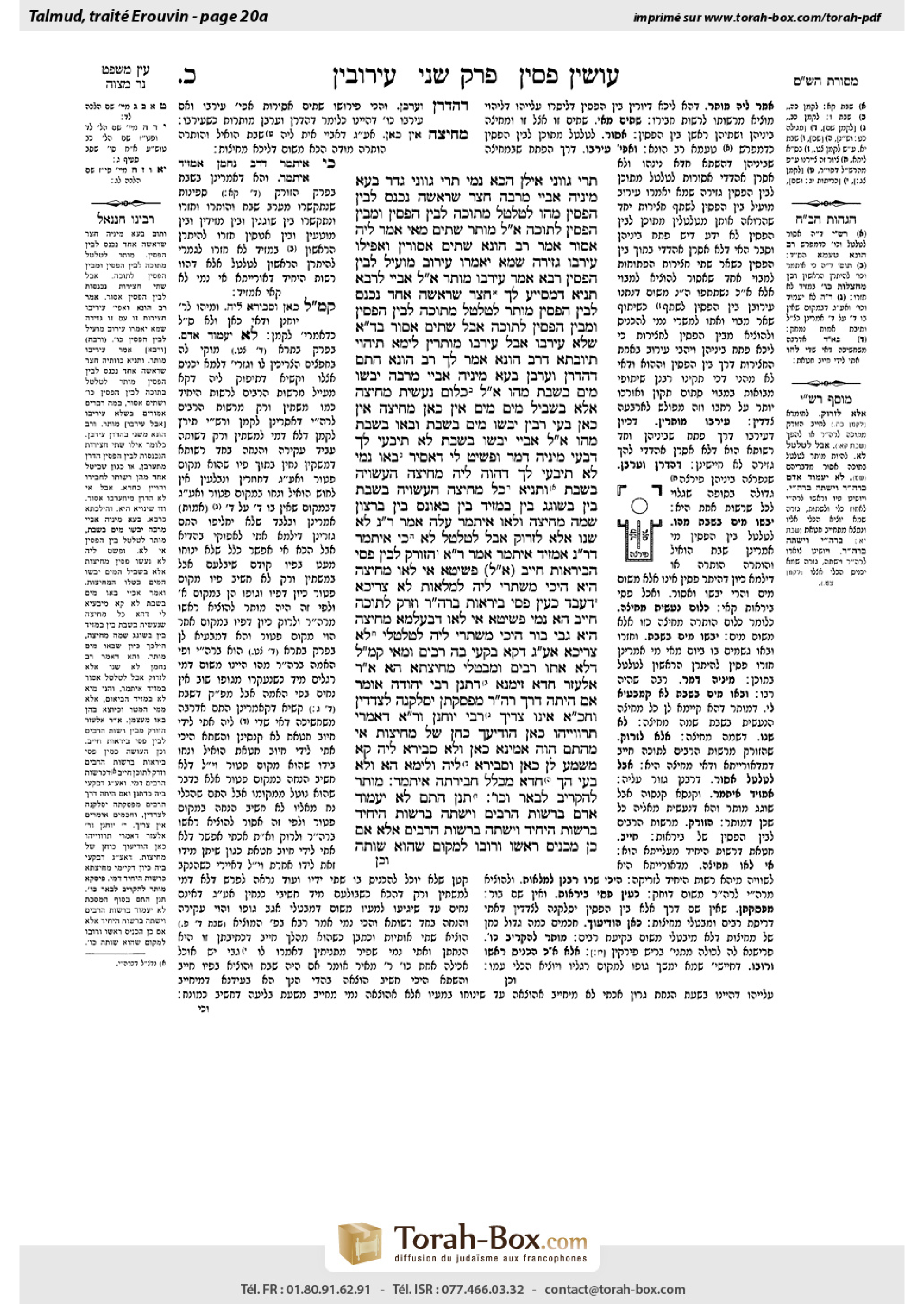
This page of Eruvin includes the Aramaic text, an English translation and an AI-generated French translation, alongside the scan above.
עירובין כ׳ א · Aramaic and Hebrew text
תְּרֵי גַוְונֵי אִילָן? הָכָא נָמֵי, תְּרֵי גַוְונֵי גָּדֵר.
בְּעָא מִינֵּיהּ אַבָּיֵי מֵרַבָּה: חָצֵר שֶׁרֹאשָׁהּ נִכְנָס לְבֵין הַפַּסִּין — מַהוּ לְטַלְטֵל מִתּוֹכָהּ לְבֵין הַפַּסִּין, וּמִבֵּין הַפַּסִּין לְתוֹכָהּ? אֲמַר לֵיהּ: מוּתָּר.
שְׁתַּיִם, מַאי? אֲמַר לֵיהּ: אָסוּר.
אָמַר רַב הוּנָא: שְׁתַּיִם אֲסוּרִין, וַאֲפִילּוּ עֵירְבוּ. גְּזֵירָה שֶׁמָּא יֹאמְרוּ ״עֵירוּב מוֹעִיל לְבֵין הַפַּסִּין״. רָבָא אָמַר: עֵירְבוּ מוּתָּר.
אֲמַר לֵיהּ אַבָּיֵי לְרָבָא: תַּנְיָא דִּמְסַיַּיע לָךְ — חָצֵר שֶׁרֹאשָׁהּ אֶחָד נִכְנָס לְבֵין הַפַּסִּין מוּתָּר לְטַלְטֵל מִתּוֹכָהּ לְבֵין הַפַּסִּין וּמִבֵּין הַפַּסִּין לְתוֹכָהּ, אֲבָל שְׁתַּיִם אָסוּר. בַּמֶּה דְּבָרִים אֲמוּרִים שֶׁלֹּא עֵירְבוּ, אֲבָל עֵירְבוּ מוּתָּרִין.
לֵימָא תֶּיהְוֵי תְּיוּבְתָּא דְּרַב הוּנָא?! אָמַר לְךָ רַב הוּנָא: הָתָם דְּהָדְרָן וְעָרְבָן.
בְּעָא מִינֵּיהּ אַבָּיֵי מֵרַבָּה: יָבְשׁוּ מַיִם בְּשַׁבָּת מַהוּ? אֲמַר לֵיהּ: כְּלוּם נַעֲשֵׂית מְחִיצָה אֶלָּא בִּשְׁבִיל מַיִם, מַיִם אֵין כָּאן מְחִיצָה אֵין כָּאן.
בָּעֵי רָבִין: יָבְשׁוּ מַיִם בְּשַׁבָּת וּבָאוּ בְּשַׁבָּת מַהוּ? אֲמַר לֵיהּ אַבָּיֵי: יָבְשׁוּ בְּשַׁבָּת לָא תִּיבְּעֵי לָךְ, דִּבְעַי מִינֵּיהּ דְּמָר וּפְשֵׁיט לִי דַּאֲסִיר.
בָּאוּ נָמֵי לָא תִּיבְּעֵי לָךְ — דְּהָוֵה לֵיהּ מְחִיצָה הָעֲשׂוּיָה בְּשַׁבָּת, וְתַנְיָא: כׇּל מְחִיצָה הָעֲשׂוּיָה בְּשַׁבָּת, בֵּין בְּשׁוֹגֵג בֵּין בְּמֵזִיד בֵּין בְּאוֹנֶס בֵּין בִּרְצוֹן — שְׁמָהּ מְחִיצָה.
וְלָאו אִיתְּמַר עֲלַהּ, אָמַר רַב נַחְמָן: לֹא שָׁנוּ אֶלָּא לִזְרוֹק, אֲבָל לְטַלְטֵל — לֹא.
כִּי אִיתְּמַר דְּרַב נַחְמָן — אַמֵּזִיד אִיתְּמַר.
אָמַר רַבִּי אֶלְעָזָר: הַזּוֹרֵק לְבֵין פַּסֵּי הַבֵּירָאוֹת חַיָּיב. פְּשִׁיטָא, אִי לָאו מְחִיצָה הִיא — הֵיכִי מִשְׁתְּרֵי לֵיהּ לְמַלּאוֹת?!
לָא צְרִיכָא, דַּעֲבַד כְּעֵין פַּסֵּי בֵירָאוֹת בִּרְשׁוּת הָרַבִּים, וְזָרַק לְתוֹכָהּ — חַיָּיב.
הָא נָמֵי פְּשִׁיטָא! אִי לָאו דִּבְעָלְמָא מְחִיצָה הִיא — גַּבֵּי בוֹר הֵיכִי מִשְׁתְּרֵי לֵיהּ לְטַלְטֹלֵי? לָא צְרִיכָא, אַף עַל גַּב דְּקָא בָּקְעִי בָּהּ רַבִּים.
וּמַאי קָא מַשְׁמַע לַן — דְּלָא אָתוּ רַבִּים וּמְבַטְּלִי מְחִיצְתָּא, הָא אֲמַר רַבִּי אֶלְעָזָר חֲדָא זִימְנָא!
דִּתְנַן, רַבִּי יְהוּדָה אוֹמֵר: אִם הָיְתָה דֶּרֶךְ רְשׁוּת הָרַבִּים מַפְסַקְתָּן — יְסַלְּקֶנָּה לִצְדָדִין, וַחֲכָמִים אוֹמְרִים: אֵינוֹ צָרִיךְ. רַבִּי יוֹחָנָן וְרַבִּי אֶלְעָזָר דְּאָמְרִי תַּרְוַויְיהוּ: כָּאן הוֹדִיעֲךָ כֹּחָן שֶׁל מְחִיצּוֹת.
אִי מֵהָתָם, הֲוָה אָמֵינָא ׳כָּאן׳ — וְלָא סְבִירָא לֵיהּ. קָא מַשְׁמַע לַן ׳כָּאן׳ — וּסְבִירָא לֵיהּ.
וְלֵימָא הָא, וְלָא בָּעֵי הָךְ! חֲדָא מִכְּלַל חֲבֶירְתָּהּ אִיתְּמַר.
מוּתָּר לְהַקְרִיב לַבְּאֵר וְכוּ׳. תְּנַן הָתָם: לֹא יַעֲמוֹד אָדָם בִּרְשׁוּת הָרַבִּים וְיִשְׁתֶּה בִּרְשׁוּת הַיָּחִיד, בִּרְשׁוּת הַיָּחִיד וְיִשְׁתֶּה בִּרְשׁוּת הָרַבִּים, אֶלָּא אִם כֵּן מַכְנִיס רֹאשׁוֹ וְרוּבּוֹ לִמְקוֹם שֶׁהוּא שׁוֹתֶה.
Eruvin 20a · English translation
that the baraita teaches two types of tree; here too, then, you can say that it teaches two types of fence, and therefore no proof can be brought from this baraita.
And Abaye further inquired of Rabba: With regard to a courtyard, the open end of which interposed between the boards surrounding a well, what is the law with regard to carrying from inside the courtyard to the area between the upright boards, and from the area between the boards into the courtyard? Rabba said to him: It is permitted.
Abaye then asked him: And if two adjacent courtyards interposed between the boards surrounding a well, what is the law? Is it permitted to carry from inside them to the area between the boards, and vice versa? Rabba said to him in response: It is prohibited.
Rav Huna said: In the case of two courtyards, it is prohibited to carry, even if the residents of the two courtyards made an eiruv together. This is because of a decree lest they come to say that an eiruv is effective for the area between the upright boards. Rava, however, disagreed and said: If they made an eiruv together, it is permitted to carry between the courtyards and the area between the boards, and vice versa; with the preparation of the eiruv, the two courtyards are regarded as one.
Abaye said to Rava: What was taught in a baraita supports your opinion, for the baraita states: In the case of a courtyard, one end of which interposes between the upright boards surrounding a well, it is permitted to carry from inside the courtyard to the area between the upright boards, and from the area between the upright boards into the courtyard, but if there were two adjacent courtyards, this is prohibited. With regard to which case was this statement made? The statement applies where the residents of the two courtyards did not make an eiruv together; but if they made an eiruv together, it is permitted to carry between the courtyards and the area between the boards, and vice versa.
The Gemara asks: Shall we say that this is a refutation of the opinion of Rav Huna, for the baraita explicitly contradicts his opinion? The Gemara rejects this argument: Rav Huna could have said to you: There, the baraita is dealing with a case where the two courtyards later became joined by means of the wall that separated them being breached, and it is clear to all that it is a single courtyard, so that there is no concern that people will say that an eiruv is effective for the area between the boards.
Abaye asked Rabba yet another question: If the water in the cistern dried up on Shabbat, what is the law? Is it still permitted to carry between the boards? Rabba said to him: The boards are considered a valid partition only on account of the water; since there is no longer any water here, there is also no longer a valid partition here.
Ravin raised a dilemma: If the water in the well dried up on Shabbat, and then on the same Shabbat it rained and other water came in its place, what is the law? Is the original allowance to carry restored? Abaye said to him: The case where the water dried up on Shabbat should not be a dilemma for you, for I already raised this dilemma before my Master, Rabba, and he resolved for me that it is prohibited to carry in the enclosed area.
The case where other water came on Shabbat should also not be a dilemma for you, for this is a case of a partition erected on Shabbat, and it was already taught in a baraita: Any partition erected on Shabbat, whether it was erected unwittingly, or whether intentionally, whether by unavoidable accident, or whether willingly, it is called a valid partition. The fact that it was erected in a prohibited manner, in violation of prohibitions related to building, does not negate its effectiveness.
Ravin raised a difficulty: Was it not stated with regard to this halakha that Rav Naḥman said: They only taught that such a partition is called a partition as a stringency; it is prohibited by Torah law to throw objects from an area enclosed by such a partition into the public domain and vice versa, but to carry in it as a full-fledged private domain is not permitted by the Sages?
The Gemara refutes this objection: Rav Naḥman’s statement applies only in a case where the partition was erected intentionally. Since the partition was erected intentionally on Shabbat, the Sages imposed a penalty that it is prohibited to carry within the enclosed area. However, in the case of a partition that was erected unwittingly or that arose by itself, no such penalty was imposed, and it is permitted to carry there.
Rabbi Elazar said: One who throws an object from the public domain into the area between the upright boards surrounding a well is liable. The Gemara asks: This is obvious, for were it not a valid partition, how could he be permitted to draw water from the well? This shows that it is a full-fledged private domain.
The Gemara answers: Rabbi Elazar’s ruling is only necessary to teach that in the case where one arrange an enclosure similar to the upright boards surrounding a well in the public domain, in a place where there was no well, and threw an object into it from the public domain, he is liable.
The Gemara raises a difficulty: Isn’t this obvious as well? As, were it not regarded as a partition in general, how could he be permitted to carry in the case of a cistern? The Gemara explains: It is only necessary to teach you that even though such a partition does not bar entry and many people pass through it, it is nonetheless considered a partition in regard to Shabbat.
The Gemara asks: And what is he teaching us by this statement, that the passage of many people does not come and negate the effectiveness of a partition? But Rabbi Elazar stated this idea once before.
As we learned in a mishna: Rabbi Yehuda says the following with regard to the upright boards surrounding a well: If the path of the public domain passes through the area of the wells and the posts and obstructs them, he must divert it to the sides, or else the partition is invalid. And the Rabbis say: He need not divert the path of the public domain, for even if many people pass through there, the partition is valid. With regard to this mishna, Rabbi Yoḥanan and Rabbi Elazar both said: Here, the Rabbis informed you of the strength of partitions. Therefore, we see that Rabbi Elazar already expressed his opinion that the validity of a partition is not canceled by the passage of many people through it.
The Gemara answers: If it was derived from there alone, I would have said that what Rabbi Elazar meant is that here the Rabbis informed you of the strength of partitions, but he, Rabbi Elazar, does not agree with them. He therefore teaches us in his present ruling that what he meant is that here they informed you of this law and he agrees with them.
The Gemara asks: If so, let Rabbi Elazar say this ruling that one who throws an object into the area enclosed by upright boards is liable, and he would not have need to make his other comment that here the Rabbis informed you of the strength of partitions. The Gemara answers: Rabbi Elazar did not in fact make two statements, but rather one was stated by inference from the other. He only made one of these statements explicitly; the other was reported by his students in his name based on an inference from what he had said.
We learned in the mishna: It is permitted to bring the upright boards closer to the well, provided that the enclosed area is large enough for a cow to stand in and drink, with its head and most of its body inside the partitioned space. Similarly, we learned there in a mishna: A person may not stand in a public domain and drink in the private domain, and likewise he may not stand in the private domain and drink in a public domain, unless he brings his head and most of his body into the place where he is drinking.
Eruvin 20a · Traduction française (IA)
que la baraïta enseigne deux types d'arbres ; ici aussi, donc, on peut dire qu'elle enseigne deux types de clôture, et par conséquent, on ne peut pas établir de preuve à partir de cette baraïta.
Abaye interrogea ensuite Rabba : En ce qui concerne un courtil, dont l'extrémité ouverte est interposée entre les planches entourant un puits, quelle est la loi concernant le transport depuis l'intérieur du courtil vers la zone entre les planches verticales, et depuis la zone entre les planches vers le courtil ? Rabba répondit à lui : C'est permis.
Abaye demanda alors à Rabba : Et si deux courtils adjacents sont interposés entre les planches entourant un puits, quelle est la loi ? Est-il permis de transporter depuis l'intérieur d'eux vers la zone entre les planches, et inversement ? Rabba répondit à lui : C'est interdit.
Rav Huna dit : Dans le cas de deux courtyards, il est interdit de porter, même si les habitants des deux courtyards ont fait un eiruv ensemble. Cela est dû à un décret afin qu'ils ne disent pas que l'eiruv est efficace pour la zone entre les planches verticales. Rava, cependant, s'est opposé et a dit : Si ils ont fait un eiruv ensemble, il est permis de porter entre les courtyards et la zone entre les planches, et inversement ; avec la préparation de l'eiruv, les deux courtyards sont considérés comme un seul.
Abaye dit à Rava : Ce qui a été enseigné dans une baraïta soutient votre opinion, car la baraïta dit : Dans le cas d'un courtyard, dont l'une des extrémités est interposée entre les planches verticales entourant un puits, il est permis de porter depuis l'intérieur du courtyard vers la zone entre les planches verticales, et depuis la zone entre les planches vers le courtyard, mais si deux courtyards adjacents sont présents, cela est interdit. À quel cas cette déclaration s'applique-t-elle ? Cette déclaration s'applique dans le cas où les habitants des deux courtyards n'ont pas fait un eiruv ensemble ; mais si ils ont fait un eiruv ensemble, il est permis de porter entre les courtyards et la zone entre les planches, et inversement.
La Guemara demande : Devons-nous dire que cela est une réfutation de l'opinion de Rav Huna, car la baraïta contredit explicitement son opinion ? La Guemara rejette cet argument : Rav Huna pourrait avoir dit à vous : Là, la baraïta traite d'un cas où les deux courtyards sont devenus un seul grâce à la rupture du mur qui les séparait, et il est clair pour tous qu'il s'agit d'un seul courtyard, de sorte qu'il n'y a pas de crainte que les gens disent que l'eiruv est efficace pour la zone entre les planches.
Abaye demanda à Rabba une autre question : Si l'eau du cisternes s'est tarie le sabbat, quelle est la loi ? Est-il encore permis de porter entre les planches ? Rabba répondit à lui : Les planches sont considérées comme une partition valide uniquement en raison de l'eau ; puisque plus n'y a plus d'eau ici, il n'y a plus de partition valide ici.
Ravin souleva un dilemme : Si l'eau du puits s'est tarie le sabbat, et puis, le même sabbat, il a plu et d'autres eaux sont entrées à sa place, quelle est la loi ? L'autorisation initiale de porter est-elle restaurée ? Abaye dit à lui : Le cas où l'eau s'est tarie le sabbat ne devrait pas être un dilemme pour vous, car je l'ai déjà soulevé devant mon maître, Rabba, et il m'a résolu que porter dans l'espace clos est interdit.
Le cas où d'autres eaux sont venues le sabbat ne devrait pas non plus être un dilemme pour vous, car c'est un cas d'une partition érigée le sabbat, et cela a déjà été enseigné dans une baraïta : toute partition érigée le sabbat, qu'elle ait été érigée sans intention, ou intentionnellement, qu'elle ait été érigée par accident ou volontairement, est appelée une partition valide. Le fait qu'elle ait été érigée de manière interdite, en violation des prohibitions liées à la construction, n'annule pas son efficacité.
Ravin souleva une difficulté : N'a-t-il pas été dit concernant cette halakha que Rav Naḥman a dit : Ils n'ont enseigné que telle partition est appelée une partition comme une stricte interdiction ; il est interdit par la Torah de jeter des objets d'une zone enclose par telle partition vers le domaine public et inversement, mais de transporter dans cette zone comme un domaine privé complet n'est pas permis par les Sages ?
La Guemara réfute cette objection : L'expression de Rav Naḥman s'applique uniquement dans le cas où la partition a été érigée intentionnellement. Puisque la partition a été érigée intentionnellement le sabbat, les Sages ont imposé une sanction selon laquelle il est interdit de transporter dans l'espace enclos. Cependant, dans le cas d'une partition érigée sans intention ou qui s'est formée d'elle-même, aucune telle sanction n'a été imposée, et il est permis de transporter là.
Rabbi Elazar dit : Celui qui jette un objet du domaine public dans la zone entre les planches verticales entourant un puits est responsable. La Guemara demande : Cela est évident, car s'il n'était pas une partition valide, comment pourrait-il être autorisé à tirer de l'eau du puits ? Cela montre qu'il s'agit d'un domaine privé complet.
La Guemara répond : La décision de Rabbi Elazar est nécessaire uniquement pour enseigner que dans le cas où l'on érige une clôture semblable aux planches verticales entourant un puits dans le domaine public, dans un lieu où il n'y a pas de puits, et qu'on jette un objet dedans depuis le domaine public, il est responsable.
La Guemara soulève une difficulté : N'est-ce pas évident également ? Car, s'il n'était pas considéré comme une partition générale, comment pourrait-il être autorisé à transporter dans le cas d'un puits ? La Guemara explique : Il est seulement nécessaire de vous enseigner que même si une telle partition ne bloque pas l'entrée et que beaucoup de personnes passent par là, elle est néanmoins considérée comme une partition concernant le sabbat.
La Guemara demande : Et qu'enseigne-t-il par cette déclaration, que le passage de beaucoup de personnes n'annule pas l'efficacité d'une partition ? Mais Rabbi Elazar a déjà exprimé cette idée auparavant.
Comme nous avons appris dans une mitsna : Rabbi Yéhuda dit ceci concernant les planches verticales entourant un puits : Si le chemin du domaine public passe par la zone des puits et des poteaux et en entrave ceux-ci, il doit le détourner vers les côtés, sinon la séparation est invalide. Et les Sages disent : Il n'est pas nécessaire de détourner le chemin du domaine public, car même si beaucoup de personnes passent par là, la séparation est valide. Concernant cette mitsna, Rabbi Yoḥanan et Rabbi Eléazar ont tous les deux dit : Ici, les Sages vous ont informés de la solidité des séparations. Nous voyons donc que Rabbi Eléazar a déjà exprimé son opinion selon laquelle la validité d'une séparation n'est pas annulée par le passage de beaucoup de personnes à travers elle.
Le Guemara répond : Si cela avait été tiré uniquement d'ici, je dirais que ce que Rabbi Eléazar voulait dire est que ici les Sages vous ont informés de la solidité des séparations, mais lui, Rabbi Eléazar, ne s'accorde pas avec eux. Il a donc enseigné à travers sa décision actuelle que ce qu'il voulait dire est que ici ils vous ont informés de cette loi et qu'il s'accorde avec eux.
Le Guemara demande : Si c'est ainsi, que Rabbi Eléazar dise cette décision selon laquelle celui qui jette un objet dans la zone enclose par des planches verticales est responsable, et il n'aurait pas besoin de faire ce commentaire supplémentaire selon lequel ici les Sages vous ont informés de la solidité des séparations. Le Guemara répond : Rabbi Eléazar n'a en fait pas fait deux déclarations, mais plutôt l'une a été déduite de l'autre. Il n'a fait qu'une de ces déclarations explicitement ; l'autre a été rapporté par ses élèves en son nom, en se basant sur une déduction de ce qu'il avait dit.
Nous avons appris dans la Michna : Il est permis de rapprocher les planches verticales du puits, à condition que la zone enclose soit suffisamment grande pour qu'une vache puisse se tenir et boire, avec sa tête et la plus grande partie de son corps à l'intérieur de l'espace séparé. De même, nous avons appris là dans une Michna : Une personne ne peut pas se tenir dans un domaine public et boire dans un domaine privé, et de même il ne peut pas se tenir dans un domaine privé et boire dans un domaine public, à moins qu'il ne mette sa tête et la plus grande partie de son corps dans l'endroit où il boit.
Traduction française générée par IA à partir de l’édition anglaise de Sefaria. Vérifie toujours un passage avec le texte source.
Text from Sefaria: William Davidson Edition - Vocalized Aramaic (CC BY NC); William Davidson Edition - English (CC BY NC).