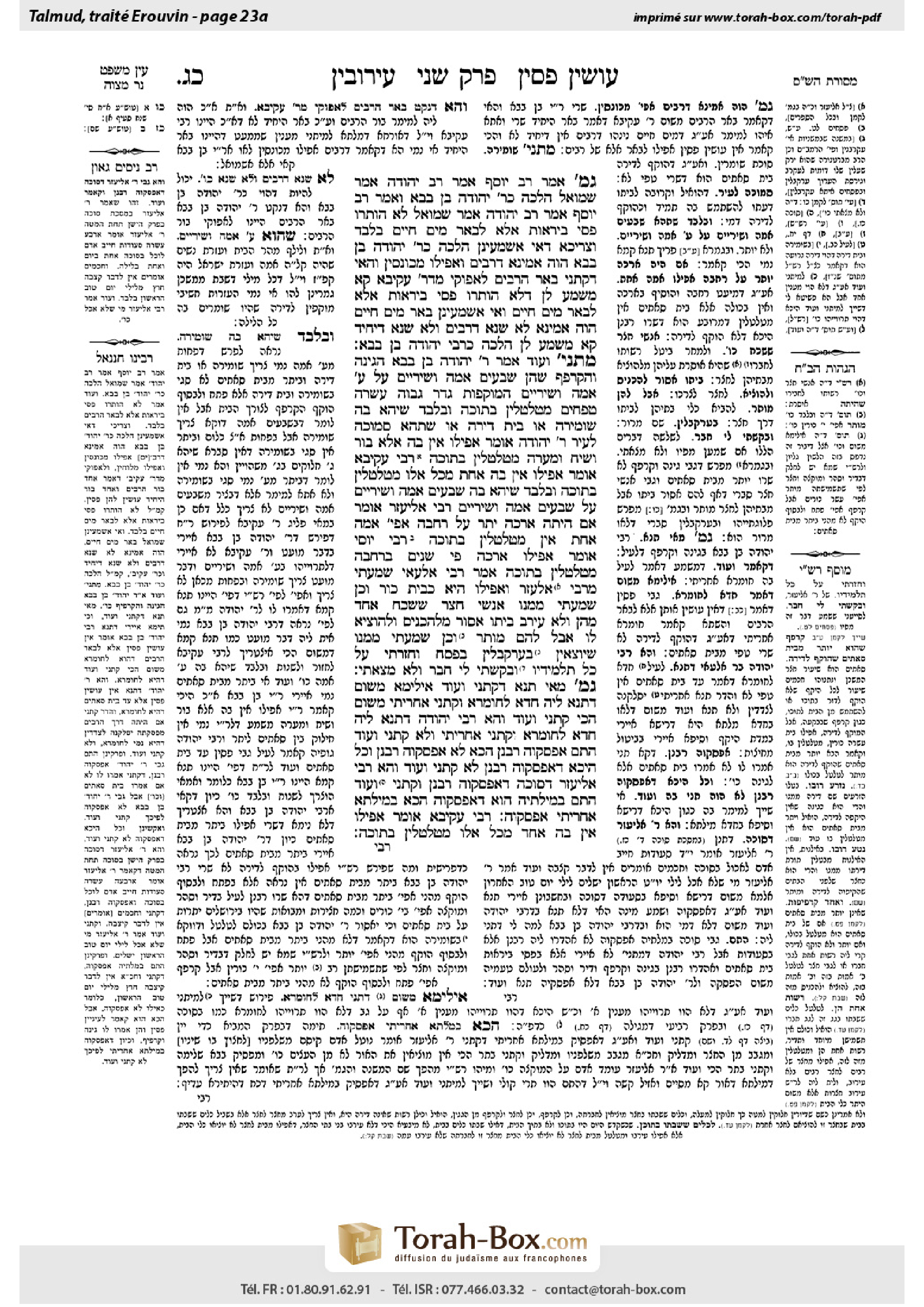
Eruvin 23a: Talmud study for Daf Yomi
Study the Talmud for Daf Yomi with scanned pages, Hebrew text, English translations from Sefaria and AI-generated French translations.
Passage selection and English or AI-generated French translation are available where the scan has annotations. Daf Study is independent of Torah-Box and Sefaria.
Browse Eruvin · עירובין · All tractatesEruvin 23a text and translations
This page of Eruvin includes the Aramaic text, an English translation and an AI-generated French translation, alongside the scan above.
עירובין כ״ג א · Aramaic and Hebrew text
גְּמָ׳ אָמַר רַב יוֹסֵף אָמַר רַב יְהוּדָה אָמַר שְׁמוּאֵל: הֲלָכָה כְּרַבִּי יְהוּדָה בֶּן בָּבָא. וְאָמַר רַב יוֹסֵף אָמַר רַב יְהוּדָה אָמַר שְׁמוּאֵל: לֹא הוּתְּרוּ פַּסֵּי בֵירָאוֹת אֶלָּא לִבְאֵר מַיִם חַיִּים בִּלְבַד.
וּצְרִיכָא: דְּאִי אַשְׁמְעִינַן הֲלָכָה כְּרַבִּי יְהוּדָה בֶּן בָּבָא, הֲוָה אָמֵינָא: דְּרַבִּים — וַאֲפִילּוּ מְכוּנָּסִין,
וְהַאי דְּקָתָנֵי בְּאֵר הָרַבִּים — לְאַפּוֹקֵי מִדְּרַבִּי עֲקִיבָא. קָא מַשְׁמַע לַן דְּלֹא הוּתְּרוּ פַּסֵּי בֵירָאוֹת אֶלָּא לִבְאֵר מַיִם חַיִּים.
וְאִי אַשְׁמְעִינַן בְּאֵר מַיִם חַיִּים, הֲוָה אָמֵינָא: לָא שְׁנָא דְּרַבִּים וְלָא שְׁנָא דְּיָחִיד, קָא מַשְׁמַע לַן: הֲלָכָה כְּרַבִּי יְהוּדָה בֶּן בָּבָא.
מַתְנִי׳ וְעוֹד אָמַר רַבִּי יְהוּדָה בֶּן בָּבָא: הַגִּינָּה וְהַקַּרְפֵּף שֶׁהֵן שִׁבְעִים אַמָּה וְשִׁירַיִים עַל שִׁבְעִים אַמָּה וְשִׁירַיִים הַמּוּקָּפוֹת גָּדֵר גָּבוֹהַּ עֲשָׂרָה טְפָחִים — מְטַלְטְלִין בְּתוֹכָהּ, וּבִלְבַד שֶׁיְּהֵא בָּהּ שׁוֹמֵירָה אוֹ בֵּית דִּירָה, אוֹ שֶׁתְּהֵא סְמוּכָה לָעִיר.
רַבִּי יְהוּדָה אוֹמֵר: אֲפִילּוּ אֵין בָּהּ אֶלָּא בּוֹר וְשִׁיחַ וּמְעָרָה מְטַלְטְלִין בְּתוֹכָהּ. רַבִּי עֲקִיבָא אוֹמֵר: אֲפִילּוּ אֵין בָּהּ אַחַת מִכׇּל אֵלּוּ מְטַלְטְלִין בְּתוֹכָהּ, וּבִלְבַד שֶׁיְּהֵא בָּהּ שִׁבְעִים אַמָּה וְשִׁירַיִים עַל שִׁבְעִים אַמָּה וְשִׁירַיִים.
רַבִּי אֱלִיעֶזֶר אוֹמֵר: אִם הָיְתָה אׇרְכָּהּ יָתֵר עַל רׇחְבָּהּ אֲפִילּוּ אַמָּה אַחַת — אֵין מְטַלְטְלִין בְּתוֹכָהּ. רַבִּי יוֹסֵי אוֹמֵר: אֲפִילּוּ אׇרְכָּהּ פִּי שְׁנַיִם בְּרׇחְבָּהּ — מְטַלְטְלִין בְּתוֹכָהּ.
אָמַר רַבִּי אִלְעַאי: שָׁמַעְתִּי מֵרַבִּי אֶלְעָזָר, וַאֲפִילּוּ הִיא כְּבֵית כּוֹר.
וְכֵן שָׁמַעְתִּי מִמֶּנּוּ: אַנְשֵׁי חָצֵר שֶׁשָּׁכַח אֶחָד מֵהֶן וְלֹא עֵירַב — בֵּיתוֹ אָסוּר מִלְּהַכְנִיס וּלְהוֹצִיא לוֹ, אֲבָל לָהֶם מוּתָּר.
וְכֵן שָׁמַעְתִּי מִמֶּנּוּ: שֶׁיּוֹצְאִין בְּעַרְקַבָּלִין בַּפֶּסַח. וְחָזַרְתִּי עַל כׇּל תַּלְמִידָיו וּבִקַּשְׁתִּי לִי חָבֵר, וְלֹא מָצָאתִי.
גְּמָ׳ מַאי תַּנָּא דְּקָתָנֵי ״וְעוֹד״.
אִילֵּימָא מִשּׁוּם דִּתְנָא לֵיהּ חֲדָא לְחוּמְרָא וְקָתָנֵי אַחֲרִיתִי, מִשּׁוּם הָכִי קָתָנֵי ״וְעוֹד״ — וְהָא רַבִּי יְהוּדָה דִּתְנָא לֵיהּ חֲדָא לְחוּמְרָא וְקָתָנֵי אַחֲרִיתִי, וְלָא קָתָנֵי ״וְעוֹד״!
הָתָם אַפְסְקוּהּ רַבָּנַן, הָכָא לָא אַפְסְקוּהּ רַבָּנַן.
וְכׇל הֵיכָא דְּאַפְסְקוּהּ רַבָּנַן לָא קָתָנֵי ״וְעוֹד״? וְהָא רַבִּי אֱלִיעֶזֶר דְּסוּכָּה, דְּאַפְסְקוּהּ רַבָּנַן, וְקָתָנֵי ״וְעוֹד״?
הָתָם, בְּמִילְּתֵיהּ הוּא דְּאַפְסְקוּהּ. הָכָא, בְּמִילְּתָא אַחֲרִיתִי אַפְסְקוּהּ.
רַבִּי עֲקִיבָא אוֹמֵר: אֲפִילּוּ אֵין בָּהּ אֶחָד מִכׇּל אֵלּוּ מְטַלְטְלִין בְּתוֹכָהּ.
Eruvin 23a · English translation
GEMARA: Rav Yosef said that Rav Yehuda said that Shmuel said: The halakha is in accordance with the opinion of Rabbi Yehuda ben Bava. And Rav Yosef also said that Rav Yehuda said that Shmuel said: Upright boards surrounding a well were permitted only in the case of a well containing potable, running spring water.
The Gemara comments: And it was necessary to cite both of these statements, even though their content appears to be the same. As had he taught us only that the halakha is in accordance with the opinion of Rabbi Yehuda ben Bava that upright boards may only be set arranged for a well, I would have said that with regard to water belonging to the public, upright boards are permitted not only in the case of spring water, but even in the case of water collected in a cistern.
And that which was taught: One may only arrange boards for a public well, that was to exclude the opinion of Rabbi Akiva that upright boards may be arranged even for a private well, but not to allow us to infer that boards may not be arranged for a public cistern filled with collected water. Therefore, Shmuel teaches us that boards surrounding a well were permitted only in the case of a well of spring water.
And in the opposite direction, had he taught us that upright boards may only be arranged for a well containing potable, running spring water, I would have said that there is no difference whether it is a public well and there is no difference whether it is a private well. Shmuel therefore teaches us that the halakha is in accordance with the opinion of Rabbi Yehuda ben Bava, who says that upright boards may be arranged only for a public well, but not for one that belongs to an individual.
MISHNA: And furthermore, Rabbi Yehuda ben Bava said: With regard to a garden or a karpef, an enclosed courtyard used for storage, that is not more than seventy cubits and a remainder, a little more, as will be explained below, by seventy cubits and a remainder, and is surrounded by a wall ten handbreadths high, one may carry inside it, as it constitutes a proper private domain. This is provided that it contains a watchman’s booth or a dwelling place, or it is near the town in which its owner lives, so that he uses it and it is treated like a dwelling.
Rabbi Yehuda says: This is not necessary, for even if it contains only a water cistern, an elongated water ditch, or a cave, i.e., a covered pit containing water, one may carry inside it, as the water bestows upon it the status of a dwelling. Rabbi Akiva says: Even if it has none of these one may carry inside it, provided that it measures not more than seventy cubits and a remainder by seventy cubits and a remainder.
Rabbi Eliezer says: If its length is greater than its breadth, even by one cubit, one may not carry inside it, even though its total area does not exceed an area of two beit se’a, because in an area that was enclosed not for the purpose of residence, carrying is only permitted if the area is perfectly square. Rabbi Yosei says: Even if its length is double its breadth, one may carry inside it, and there is no need to be particular about a square shape.
Rabbi Elai said: I heard from Rabbi Eliezer that one is permitted to carry in a garden or karpef, even if the garden is an area of a beit kor, i.e., thirty times larger than the area of a beit se’a.
Incidentally, he adds: And I also heard from him another halakha: If one of the residents of a courtyard forgot and did not join in an eiruv with the other residents when they established an eiruv, and on Shabbat he ceded ownership of his part in the courtyard to the other residents, then it is prohibited for him, the one who forgot to establish an eiruv, to bring in objects or take them out from his house to the courtyard; however, it is permitted to them, the other residents, to bring objects from their houses to that person’s house via the courtyard, and vice versa. We do not say that the failure of one resident to join in the eiruv nullifies the validity of the eiruv for the entire courtyard.
And I also heard from him another halakha, that one may fulfill his obligation to eat bitter herbs on Passover with arkablin, a certain bitter herb. With regard to all three rulings, I circulated among all of Rabbi Eliezer’s disciples, seeking a colleague who had also heard these matters from him, but I could not find one.
GEMARA: The Gemara first analyzes the wording of this mishna: What was taught previously, that the tanna teaches in this mishna: And furthermore Rabbi Yehuda ben Bava said, which implies a continuation of the previous mishna?
If you say that because he first taught one stringency concerning the upright boards surrounding a well, and then he teaches another stringency about an enclosure, and for that reason the tanna of the mishna teaches: And furthermore, then there is a difficulty. Didn’t Rabbi Yehuda also teach one stringency and then teach another stringency, and yet the tanna of the mishna does not teach: And furthermore Rabbi Yehuda said?
The Gemara answers that the cases are different: There, the Rabbis interrupted Rabbi Yehuda’s statements in order to disagree with him, and hence it is not possible to say: And furthermore Rabbi Yehuda said. Here, however, the Rabbis did not interrupt him, as the two statements of Rabbi Yehuda ben Bava immediately follow one another.
The Gemara raises a difficulty: Does this mean that wherever the disputing Rabbis interrupt their colleague, the tanna does not teach: And furthermore? But with regard to Rabbi Eliezer in a mishna in tractate Sukka (27a), where the Rabbis interrupted his statements, nonetheless the tanna teaches: And furthermore.
The Gemara answers: It is not the same; there, they interrupted Rabbi Eliezer with a ruling with regard to his own topic; here, however, they interrupted Rabbi Yehuda with a ruling with regard to an altogether different matter. Consequently, his first statement had already been forgotten, and it is not the Mishna’s style to join together statements where the sequential link between them has already been severed.
We learned in the mishna: Rabbi Akiva said: Even if the courtyard has none of these elements that indicate dwelling stipulated by the other Rabbis, one may carry inside it, provided that it measures no more than seventy cubits and a remainder by seventy cubits and a remainder.
Eruvin 23a · Traduction française (IA)
GUEMARA : Rav Yosef a dit que Rav Yehuda a dit que Shmuel a dit : La halakha suit l'opinion de Rabbi Yehuda ben Bava. Et Rav Yosef a aussi dit que Rav Yehuda a dit que Shmuel a dit : Les planches verticales entourant un puits étaient permises uniquement dans le cas d'un puits contenant de l'eau potable, d'eau courante.
La Guemara commente : Et il était nécessaire de citer ces deux déclarations, même si leur contenu semble être le même. Car s'il nous avait appris seulement que la halakha suit l'opinion de Rabbi Yehuda ben Bava selon laquelle les planches verticales peuvent être installées uniquement pour un puits, je dirais que concernant l'eau publique, les planches verticales sont permises non seulement dans le cas d'un puits d'eau courante, mais aussi dans le cas d'eau stockée dans un cistern.
Et ce qui a été enseigné : On peut uniquement installer des planches pour un puits public, cela visait à exclure l'opinion de Rabbi Akiva selon laquelle les planches verticales peuvent être installées même pour un puits privé, mais pas pour permettre d'inférer que les planches ne peuvent pas être installées pour un cistern public rempli d'eau stockée. Ainsi, Shmuel nous enseigne que les planches entourant un puits étaient permises uniquement dans le cas d'un puits d'eau courante.
Et dans l'autre sens, s'il nous avait appris que les planches verticales peuvent être installées uniquement pour un puits contenant de l'eau potable, d'eau courante, je dirais qu'il n'y a pas de différence entre un puits public et un puits privé. Shmuel enseigne donc que la halakha suit l'opinion de Rabbi Yehuda ben Bava, qui dit que les planches peuvent être installées uniquement pour un puits public, mais pas pour un puits appartenant à un individu.
MICHNA : Et de plus, Rabbi Yehuda ben Bava a dit : Concernant un jardin ou un karpef, un cour de fermeture utilisé pour le stockage, qui n'excède pas soixante-dix coudées et un reste, un peu plus, comme expliqué ci-dessous, soixante-dix coudées et un reste, et entouré d'un mur de dix tefachim de haut, on peut porter à l'intérieur, car cela constitue un domaine privé approprié. Cela est conditionnel à ce qu'il contienne une cabane de veilleur ou un lieu de résidence, ou qu'il soit proche de la ville où son propriétaire habite, de sorte qu'il l'utilise et qu'il soit traité comme une résidence.
Rabbi Yehuda dit : Cela n'est pas nécessaire, car même s'il contient uniquement un cistern, un canal d'eau allongé ou une grotte, c'est-à-dire un puits couvert contenant de l'eau, on peut porter à l'intérieur, car l'eau confère à ce lieu le statut de résidence. Rabbi Akiva dit : Même s'il n'a aucun de ces éléments, on peut porter à l'intérieur, à condition qu'il ne dépasse pas soixante-dix coudées et un reste par soixante-dix coudées et un reste.
Rabbi Eliezer dit : Si sa longueur est supérieure à sa largeur, même d'une coudée, on ne peut pas porter à l'intérieur, même si sa surface totale ne dépasse pas une surface de deux beit se'a, car dans un espace entouré sans l'intention de résidence, le port est permis uniquement si l'espace est parfaitement carré. Rabbi Yosei dit : Même si sa longueur est double de sa largeur, on peut porter à l'intérieur, et il n'est pas nécessaire d'être précis sur la forme carrée.
Rabbi Elai a dit : J'ai entendu de Rabbi Eliezer que l'on peut porter dans un jardin ou un karpef, même si le jardin est une surface d'un beit kor, c'est-à-dire trente fois plus grande que la surface d'un beit se'a.
Par ailleurs, il ajoute : Et j'ai aussi entendu de lui une autre halakha : Si l'un des habitants d'un cour a oublié et n'a pas participé à l'eiruv avec les autres habitants lorsqu'ils ont établi l'eiruv, et samedi il a cédé la propriété de sa part dans le cour aux autres habitants, alors il est interdit à celui qui a oublié d'établir l'eiruv de ramener des objets ou de les enlever de sa maison vers le cour ; cependant, il est permis aux autres habitants de ramener des objets de leurs maisons vers la maison de cette personne via le cour, et vice versa. Nous ne disons pas que l'échec d'un habitant à participer à l'eiruv annule la validité de l'eiruv pour l'ensemble du cour.
Et j'ai également entendu de lui une autre halakha, selon laquelle on peut remplir son obligation de manger des herbes amères pendant la Pessah avec des arkablin, une certaine herbe amère. En ce qui concerne ces trois décisions, j'ai parcouru tous les disciples de Rabbi Eliezer, cherchant un collègue qui avait également entendu ces choses de lui, mais je n'ai pas réussi à en trouver un.
GUEMARA : La Guemara analyse d'abord la formulation de cette mishna : Qu'est-ce qui a été enseigné précédemment, que le tanna enseigne dans cette mishna : Et de plus, Rabbi Yehuda ben Bava a dit, ce qui implique une continuation de la mishna précédente ?
Si vous dites que c'est parce qu'il a d'abord enseigné une stricte exigence concernant les planches verticales entourant un puits, et ensuite il enseigne une autre stricte exigence concernant une clôture, et pour cette raison le tanna de la mishna enseigne : Et de plus, alors il y a un problème. N'avait-il pas aussi enseigné une stricte exigence et puis une autre stricte exigence, et pourtant le tanna de la mishna ne dit pas : Et de plus Rabbi Yehuda a dit ?
La Guemara répond que les cas sont différents : Là, les Rabbins ont interrompu les déclarations de Rabbi Yehuda afin de s'opposer à lui, et par conséquent il n'est pas possible de dire : Et de plus, Rabbi Yehuda a dit. Ici, cependant, les Rabbins ne l'ont pas interrompu, car les deux déclarations de Rabbi Yehuda ben Bava suivent immédiatement l'une l'autre.
La Guemara soulève un problème : Cela signifie-t-il que partout où les Rabbins interrompent leur collègue, le tanna ne dit pas : Et de plus ? Mais concernant Rabbi Eliezer dans une mishna du traité de Sukka (27a), où les Rabbins ont interrompu ses déclarations, néanmoins le tanna dit : Et de plus.
La Guemara répond : Ce n'est pas la même chose ; là, ils ont interrompu le maître Rabbi Eliezer avec un décret concernant son propre sujet ; ici, en revanche, ils ont interrompu Rabbi Yéhuda avec un décret concernant une tout autre affaire. Par conséquent, sa première déclaration avait déjà été oubliée, et ce n'est pas le style du Michna de relier des déclarations dont le lien séquentiel a déjà été rompu.
Nous avons appris dans le Michna : Rabbi Akiva a dit : Même si le courtil n'a aucun de ces éléments qui indiquent la résidence selon les autres maîtres, on peut porter à l'intérieur, à condition qu'il mesure au plus soixante-dix coudées et un reste, par soixante-dix coudées et un reste.
Traduction française générée par IA à partir de l’édition anglaise de Sefaria. Vérifie toujours un passage avec le texte source.
Text from Sefaria: William Davidson Edition - Vocalized Aramaic (CC BY NC); William Davidson Edition - English (CC BY NC).