Eruvin 23b: Talmud study for Daf Yomi
Study the Talmud for Daf Yomi with scanned pages, Hebrew text, English translations from Sefaria and AI-generated French translations.
Passage selection and English or AI-generated French translation are available where the scan has annotations. Daf Study is independent of Torah-Box and Sefaria.
Browse Eruvin · עירובין · All tractatesEruvin 23b text and translations
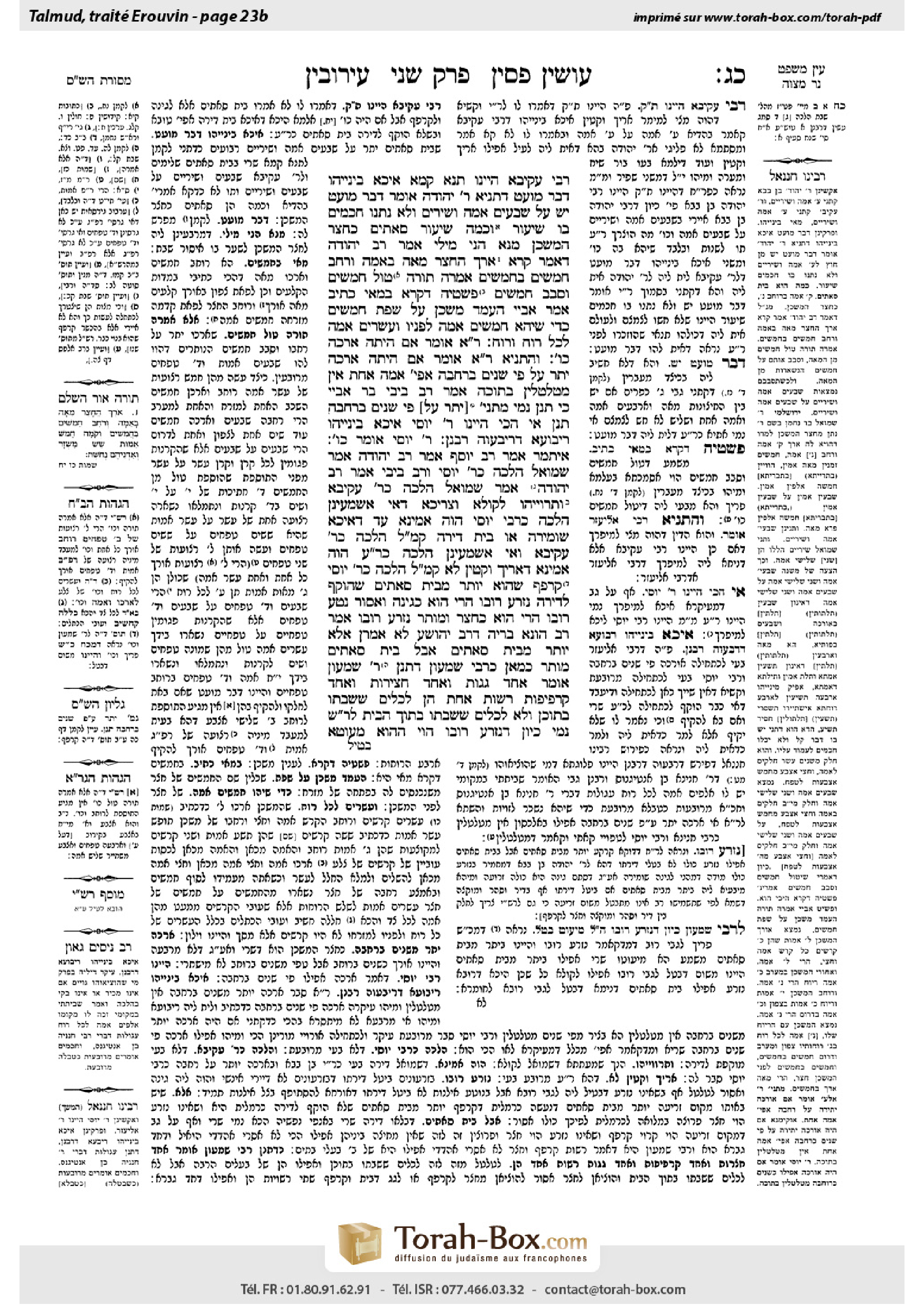
This page of Eruvin includes the Aramaic text, an English translation and an AI-generated French translation, alongside the scan above.
עירובין כ״ג ב · Aramaic and Hebrew text
רַבִּי עֲקִיבָא הַיְינוּ תַּנָּא קַמָּא!
אִיכָּא בֵּינַיְיהוּ דָּבָר מוּעָט. דְּתַנְיָא, רַבִּי יְהוּדָה אוֹמֵר: דָּבָר מוּעָט יֵשׁ עַל שִׁבְעִים אַמָּה וְשִׁירַיִם, וְלֹא נָתְנוּ חֲכָמִים בּוֹ שִׁיעוּר.
וְכַמָּה שִׁיעוּר סָאתַיִם? כַּחֲצַר הַמִּשְׁכָּן.
מְנָא הָנֵי מִילֵּי?
אָמַר רַב יְהוּדָה, דְּאָמַר קְרָא: ״אֹרֶךְ הֶחָצֵר מֵאָה בָאַמָּה וְרֹחַב חֲמִשִּׁים בַּחֲמִשִּׁים״. אָמְרָה תּוֹרָה: טוֹל חֲמִשִּׁים, וְסַבֵּב חֲמִשִּׁים.
פְּשָׁטֵיהּ דִּקְרָא בְּמַאי כְּתִיב?! אָמַר אַבָּיֵי: הַעֲמֵד מִשְׁכָּן עַל שְׂפַת חֲמִשִּׁים, כְּדֵי שֶׁיְּהֵא חֲמִשִּׁים אַמָּה לְפָנָיו וְעֶשְׂרִים אַמָּה לְכׇל רוּחַ וָרוּחַ.
רַבִּי אֱלִיעֶזֶר אוֹמֵר: אִם הָיְתָה אׇרְכָּהּ כּוּ׳. וְהָתַנְיָא, רַבִּי אֱלִיעֶזֶר אוֹמֵר: אִם הָיְתָה אׇרְכָּהּ יָתֵר עַל פִּי שְׁנַיִם בְּרׇחְבָּהּ אֲפִילּוּ אַמָּה אַחַת — אֵין מְטַלְטְלִין בְּתוֹכָהּ!
אָמַר רַב בִּיבִי בַּר אַבָּיֵי: כִּי תְּנַן נָמֵי מַתְנִיתִין — [יָתֵר עַל] פִּי שְׁנַיִם בְּרׇחְבָּהּ תְּנַן. אִי הָכִי, הַיְינוּ רַבִּי יוֹסֵי?!
אִיכָּא בֵּינַיְיהוּ רִיבּוּעָא דְּרִיבְּעוּהָ רַבָּנַן.
רַבִּי יוֹסֵי אוֹמֵר כּוּ׳. אִיתְּמַר, אָמַר רַב יוֹסֵף אָמַר רַב יְהוּדָה אָמַר שְׁמוּאֵל: הֲלָכָה כְּרַבִּי יוֹסֵי. וְרַב בִּיבִי אָמַר רַב יְהוּדָה אָמַר שְׁמוּאֵל: הֲלָכָה כְּרַבִּי עֲקִיבָא.
וְתַרְוַיְיהוּ לְקוּלָּא. וּצְרִיכָא, דְּאִי אַשְׁמְעִינַן הֲלָכָה כְּרַבִּי יוֹסֵי, הֲוָה אָמֵינָא עַד דְּאִיכָּא שׁוֹמֵירָה אוֹ בֵּית דִּירָה. קָא מַשְׁמַע לַן הֲלָכָה כְּרַבִּי עֲקִיבָא.
וְאִי אַשְׁמְעִינַן הֲלָכָה כְּרַבִּי עֲקִיבָא, הֲוָה אָמֵינָא דַּאֲרִיךְ וְקַטִּין — לָא. קָא מַשְׁמַע לַן הֲלָכָה כְּרַבִּי יוֹסֵי.
קַרְפֵּף שֶׁהוּא יוֹתֵר מִבֵּית סָאתַיִם שֶׁהוּקַּף לְדִירָה, נִזְרַע רוּבּוֹ הֲרֵי הוּא כְּגִינָּה, וְאָסוּר.
נָטַע רוּבּוֹ הֲרֵי הוּא כְּחָצֵר, וּמוּתָּר.
נִזְרַע רוּבּוֹ, אָמַר רַב הוּנָא בְּרֵיהּ דְּרַב יְהוֹשֻׁעַ: לָא אֲמַרַן אֶלָּא יוֹתֵר מִבֵּית סָאתַיִם. אֲבָל בֵּית סָאתַיִם — מוּתָּר.
כְּמַאן? כְּרַבִּי שִׁמְעוֹן. דִּתְנַן, רַבִּי שִׁמְעוֹן אוֹמֵר: אֶחָד גַּגּוֹת וְאֶחָד חֲצֵירוֹת וְאֶחָד קַרְפֵּיפוֹת רְשׁוּת אַחַת הֵן לְכֵלִים שֶׁשָּׁבְתוּ בְּתוֹכָן, וְלֹא לְכֵלִים שֶׁשָּׁבְתוּ בְּתוֹךְ הַבַּיִת.
לְרַבִּי שִׁמְעוֹן נָמֵי, כֵּיוָן דְּנִזְרַע רוּבּוֹ — הָוֵי הָהוּא מִעוּטָא
Eruvin 23b · English translation
The Gemara asks: But the view of Rabbi Akiva is the same as that of the first tanna, i.e., Rabbi Yehuda ben Bava, who maintains that in the case of a garden that was not enclosed for the purpose of residence, one is only permitted to carry if the area of the enclosed area is no more than two beit se’a. Rabbi Akiva disagrees only about whether we require a watchman’s booth or a dwelling place as well, but the two agree with regard to the size of the garden. Therefore, Rabbi Akiva’s stipulation: Provided that it measures not more than seventy cubits and a remainder by seventy cubits and a remainder, is superfluous.
The Gemara answers: There is a practical difference between them with regard to a tiny amount. And what is this tiny amount? It is as it was taught in a baraita: Rabbi Yehuda says: It is by a tiny amount that one of the sides of a square measuring two beit se’a exceeds seventy cubits and a remainder, but the Sages did not give its exact measurement, owing to its small size and because it is impossible to be absolutely precise about the matter.
And what is the measure of the area of two beit se’a? It is as large as the courtyard of the Tabernacle, which was fifty cubits by one hundred cubits. The first tanna and Rabbi Akiva dispute this issue: The first tanna maintains that the garden may have an area as large as two beit se’a, whereas Rabbi Akiva says that it must not exceed seventy and two-thirds cubits squared.
The Gemara asks: From where are these matters derived? The matters referred to are that we must square the courtyard of the Tabernacle in order to reach the size of garden or similar enclosure in which one is permitted to carry on Shabbat.
The Gemara answers: Rav Yehuda said: This is learned from the verse that stated: “The length of the courtyard shall be a hundred cubits, and the breadth fifty by fifty, and the height, five cubits of fine twined linen, and their sockets of brass” (Exodus 27:18). The Torah said: Take a square of fifty cubits by fifty cubits, and surround it with the remaining fifty cubits until they form a square, each side of which measures seventy cubits and a remainder.
The Gemara asks: But to what does the plain meaning of the verse refer? The plain sense of the text cannot be coming to teach us the laws of carrying. Abaye said that it means as follows: The Tabernacle was thirty cubits long and ten cubits wide. The courtyard was a hundred cubits long and fifty cubits wide. Position the Tabernacle in the middle of the courtyard at the edge of fifty cubits, so that there is a space of fifty cubits in front of it, and a space of twenty cubits in every direction, on each of the two sides and behind it.
We learned in the mishna that Rabbi Eliezer says: If its length is greater than its breadth, even by one cubit, one may not carry inside it. The Gemara asks: Wasn’t it taught in a baraita that Rabbi Eliezer says: If its length is more than double its breadth, even by one cubit, one may not carry inside it?
Rav Beivai bar Abaye said: When we learned this in the mishna, we also learned that it refers to a case where the length of the enclosure is more than double its breadth. The Gemara raises a difficulty: If so, this is the same as the opinion of Rabbi Yosei, who stated that one is permitted to carry in the garden or karpef even if its length is double its width.
The Gemara answers: There is a difference between them with regard to the square that the Sages squared it, because the Sages calculated squares with the diagonal. According to the opinion of Rabbi Eliezer, if the diagonal is more than double the breadth, even though the length may not be more than double the breadth, it is prohibited to carry within the enclosure. According to Rabbi Yosei, however, it is permitted (Rabbeinu Ḥananel).
We learned in the mishna that Rabbi Yosei says: Even if its length is double its breadth, one may carry inside it. It was stated that the amora’im disagreed on the following matter: Rav Yosef said that Rav Yehuda said that Shmuel said: The halakha is in accordance with the opinion of Rabbi Yosei. And Rav Beivai said that Rav Yehuda said that Shmuel said: The halakha is in accordance with the opinion of Rabbi Akiva.
The Gemara explains that both rulings are stated leniently, and that both were necessary. As had the Gemara taught only that the halakha is in accordance with the opinion of Rabbi Yosei, I would have said that one is not permitted to carry unless the place contains a watchman’s booth or a dwelling place, for Rabbi Yosei did not specify that these are not required. Therefore, the Gemara teaches us that the halakha is in accordance with Rabbi Akiva, who is particular only about the courtyard’s size, but not that it be enclosed for the purpose of residence.
And, on the other hand, had the Gemara taught only that the halakha is in accordance with the opinion of Rabbi Akiva, I would have said that if the courtyard is long and narrow, one is not permitted to carry. Therefore, the Gemara teaches that the halakha is in accordance with the opinion of Rabbi Yosei, who clearly states that the courtyard need not be square.
The Sages taught: Within a karpef that is greater than two beit se’a, but which was enclosed from the outset for the purpose of residence, carrying is permitted regardless of its size; however, if subsequently the greater part of it was sown with seed crops, it is considered like a garden, which is not a place of dwelling, and it is prohibited to carry anything within it.
However, if the greater part of it was planted with trees, it is considered like a courtyard, which is a place of dwelling, and one is permitted to carry. The reason for this distinction is that the presence of trees does not nullify the status of the karpef as a place of residence, because people normally plant trees even in their courtyards. However, people ordinarily plant seed crops only in gardens at some distance from their houses, in places they do not use for dwelling; therefore, the presence of seed crops does nullify the residential status of the karpef.
It was stated above that if the greater part of the karpef was sown with seed crops, it is prohibited to carry in it. Rav Huna, son of Rav Yehoshua, said: We only said this in a case where the sown section is greater than two beit se’a, but if it is no more than two beit se’a, it is permitted.
The Gemara comments: In accordance with whose opinion was this stated? It was stated in accordance with the opinion of Rabbi Shimon, as we learned in a mishna: Rabbi Shimon says: Roofs, courtyards, and karpeifot are all one domain with regard to utensils that began Shabbat in them, even if the utensils belong to different people. Since these are not proper dwelling places, setting an eiruv is unnecessary, and objects may be carried from place to place within them. But they are not one domain with regard to utensils that began Shabbat in the house and that were later taken outside. This shows that the unsown part of a karpef and the sown part, which has the status of a garden, are considered a single domain, in which one is permitted to carry, as the garden section does not prohibit the karpef section.
The Gemara rejects this argument: Even according to the opinion of Rabbi Shimon, since the greater part of the karpef is sown, the minor part
Eruvin 23b · Traduction française (IA)
La Guemara pose la question : Mais la vue de Rabbi Akiva est la même que celle du premier tanna, c'est-à-dire Rabbi Yéhuda ben Bava, qui maintient que dans le cas d'un jardin non clôturé à des fins de résidence, on est autorisé à porter seulement si la surface de la clôture ne dépasse pas deux beit se'a. Rabbi Akiva ne s'oppose qu'à la question de savoir si nous exigeons une cabane de veilleur ou un lieu de résidence, mais les deux s'accordent sur la taille du jardin. Ainsi, la stipulation de Rabbi Akiva : « À condition qu'elle ne mesure pas plus de soixante-dix coudées et un reste par soixante-dix coudées et un reste », est superflue.
La Guemara répond : Il existe une différence pratique entre eux concernant une quantité minuscule. Et quelle est cette quantité minuscule ? C'est ce qui a été enseigné dans une baraïta : Rabbi Yéhuda dit : C'est par une quantité minuscule que l'un des côtés d'un carré mesurant deux beit se'a dépasse soixante-dix coudées et un reste, mais les Sages n'ont pas donné sa mesure exacte, en raison de sa petitesse et parce qu'il est impossible d'être absolument précis à ce sujet.
Et quelle est la mesure de la surface de deux beit se'a ? Elle est aussi grande que la cour du Tabernacle, qui mesurait cinquante coudées par cent coudées. Le premier tanna et Rabbi Akiva débattent de ce point : le premier tanna affirme que le jardin peut avoir une surface aussi grande que deux beit se'a, tandis que Rabbi Akiva dit qu'il ne doit pas dépasser soixante-dix et deux tiers de coudées carrées.
La Guemara pose la question : D'où ces choses sont-elles déduites ? Les choses mentionnées sont que nous devons rendre carré le jardin du Tabernacle afin d'atteindre la taille d'un jardin ou d'une clôture similaire dans lequel on est autorisé à porter le sabbat.
La Guemara répond : Rav Yéhuda dit : Cela est appris de la parole : « La longueur de la cour sera cent coudées, la largeur cinquante par cinquante, la hauteur cinq coudées de lin tissé fin, et leurs fondations d'airain » (Exode 27:18). La Torah dit : Prends un carré de cinquante coudées par cinquante coudées, et entoure-le avec les cinquante coudées restantes jusqu'à ce qu'ils forment un carré, chaque côté mesurant soixante-dix coudées et un reste.
La Guemara pose la question : Mais à quoi fait référence le sens littéral de la parole ? Le sens littéral du texte ne peut pas être venu enseigner les lois du port. Abaye dit que cela signifie comme suit : Le Tabernacle mesurait trente coudées de long et dix coudées de large. La cour mesurait cent coudées de long et cinquante coudées de large. Place le Tabernacle au milieu de la cour à l'extrémité des cinquante coudées, de sorte qu'il y ait un espace de cinquante coudées devant lui, et un espace de vingt coudées dans chaque direction, sur chaque côté et derrière lui.
Nous avons appris dans la Michna que Rabbi Eliezer dit : Si sa longueur est supérieure à sa largeur, même d'une coudée, on ne peut pas porter à l'intérieur. La Guemara pose la question : N'était-il pas enseigné dans une baraïta que Rabbi Eliezer dit : Si sa longueur est plus que le double de sa largeur, même d'une coudée, on ne peut pas porter à l'intérieur ?
Rav Béivai bar Abaye dit : Lorsque nous avons appris cela dans la Michna, nous avons aussi appris qu'il s'agit d'un cas où la longueur de la clôture est supérieure au double de sa largeur. La Guemara soulève une difficulté : Si c'est ainsi, cela est identique à l'opinion de Rabbi Yosei, qui affirme qu'on est autorisé à porter dans le jardin ou le karpef même si sa longueur est double de sa largeur.
La Guemara répond : Il existe une différence entre eux concernant le carré que les Sages ont carré, car les Sages calculaient les carrés avec la diagonale. Selon l'opinion de Rabbi Eliezer, si la diagonale est supérieure au double de la largeur, même si la longueur ne dépasse pas le double de la largeur, il est interdit de porter à l'intérieur. Selon Rabbi Yosei, en revanche, cela est permis (Rabbeinu Hananel).
Nous avons appris dans la mitsna que Rabbi Yosei dit : Même si sa longueur est double de sa largeur, on peut porter à l'intérieur. Il a été dit que les amoraïm s'opposaient sur la suivante : Rav Yosef dit que Rav Yéhuda dit que Shmuel dit : La halakha suit l'opinion de Rabbi Yosei. Et Rav Béivai dit que Rav Yéhuda dit que Shmuel dit : La halakha suit l'opinion de Rabbi Akiva.
La Guemara explique que les deux décisions sont formulées de manière clémente, et que les deux étaient nécessaires. Si la Guemara avait seulement enseigné que la halakha suit l'opinion de Rabbi Yosei, j'aurais dit qu'on n'est pas autorisé à porter à moins que la place contienne une cabane de veilleur ou un lieu de résidence, car Rabbi Yosei n'a pas spécifié que ces éléments ne sont pas requis. Ainsi, la Guemara nous enseigne que la halakha suit l'opinion de Rabbi Akiva, qui est particulier uniquement à la taille de la cour, mais pas à ce qu'elle soit clôturée à des fins de résidence.
Et, en revanche, si la Guemara avait seulement enseigné que la halakha suit l'opinion de Rabbi Akiva, j'aurais dit que si la cour est longue et étroite, on n'est pas autorisé à porter. Ainsi, la Guemara nous enseigne que la halakha suit l'opinion de Rabbi Yosei, qui affirme clairement que la cour n'a pas besoin d'être carrée.
Les Sages enseignèrent : Dans un karpef supérieur à deux beit se'a, mais clôturé dès le départ à des fins de résidence, le port est autorisé indépendamment de sa taille ; cependant, si une grande partie a été semée de cultures, il est considéré comme un jardin, qui n'est pas un lieu de résidence, et il est interdit de porter quelque chose à l'intérieur.
Cependant, si la majorité de cette surface est plantée d'arbres, elle est considérée comme un courtil, lieu de résidence, et l'on est autorisé à porter des objets. La raison de cette distinction réside dans le fait que la présence d'arbres ne nul lise pas le statut du karpef comme lieu de résidence, car les gens plantent des arbres même dans leurs courtils. Cependant, les gens plantent généralement des cultures à distance de leur maison, dans des lieux qu'ils ne utilisent pas comme résidence ; par conséquent, la présence de cultures annule le statut résidentiel du karpef.
Il a été dit ci-dessus que si la majorité du karpef était semée de cultures, il est interdit de porter des objets dedans. Rav Huna, fils de Rav Yéhoshua, a dit : Nous avons dit cela uniquement dans le cas où la partie semée est supérieure à deux beit se'a, mais si elle n'atteint pas deux beit se'a, elle est permise.
La Guemara commente : Selon quel avis a-t-on dit cela ? Cela a été dit selon l'avis de Rabbi Shimon, comme nous l'avons appris dans une mitsna : Rabbi Shimon dit : Les toits, les courtils et les karpefot sont tous un seul domaine concernant les ustensiles qui ont commencé le sabbat en eux, même si ces ustensiles appartiennent à des personnes différentes. Puisque ces lieux ne sont pas des lieux de résidence appropriés, il n'est pas nécessaire d'établir un eiruv, et les objets peuvent être transportés d'un endroit à un autre à l'intérieur d'eux. Cependant, ils ne constituent pas un seul domaine concernant les ustensiles qui ont commencé le sabbat dans la maison et qui ont ensuite été emportés à l'extérieur. Cela montre que la partie non semée d'un karpef et la partie semée, qui a le statut d'un jardin, sont considérées comme un seul domaine, dans lequel l'on est autorisé à porter des objets, car la section du jardin ne prohibe pas la section du karpef.
La Guemara rejette cet argument : Même selon l'avis de Rabbi Shimon, puisque la majorité du karpef est semée, la partie mineure est considérée
Traduction française générée par IA à partir de l’édition anglaise de Sefaria. Vérifie toujours un passage avec le texte source.
Text from Sefaria: William Davidson Edition - Vocalized Aramaic (CC BY NC); William Davidson Edition - English (CC BY NC).