Eruvin 24a: Talmud study for Daf Yomi
Study the Talmud for Daf Yomi with scanned pages, Hebrew text, English translations from Sefaria and AI-generated French translations.
Passage selection and English or AI-generated French translation are available where the scan has annotations. Daf Study is independent of Torah-Box and Sefaria.
Browse Eruvin · עירובין · All tractatesEruvin 24a text and translations
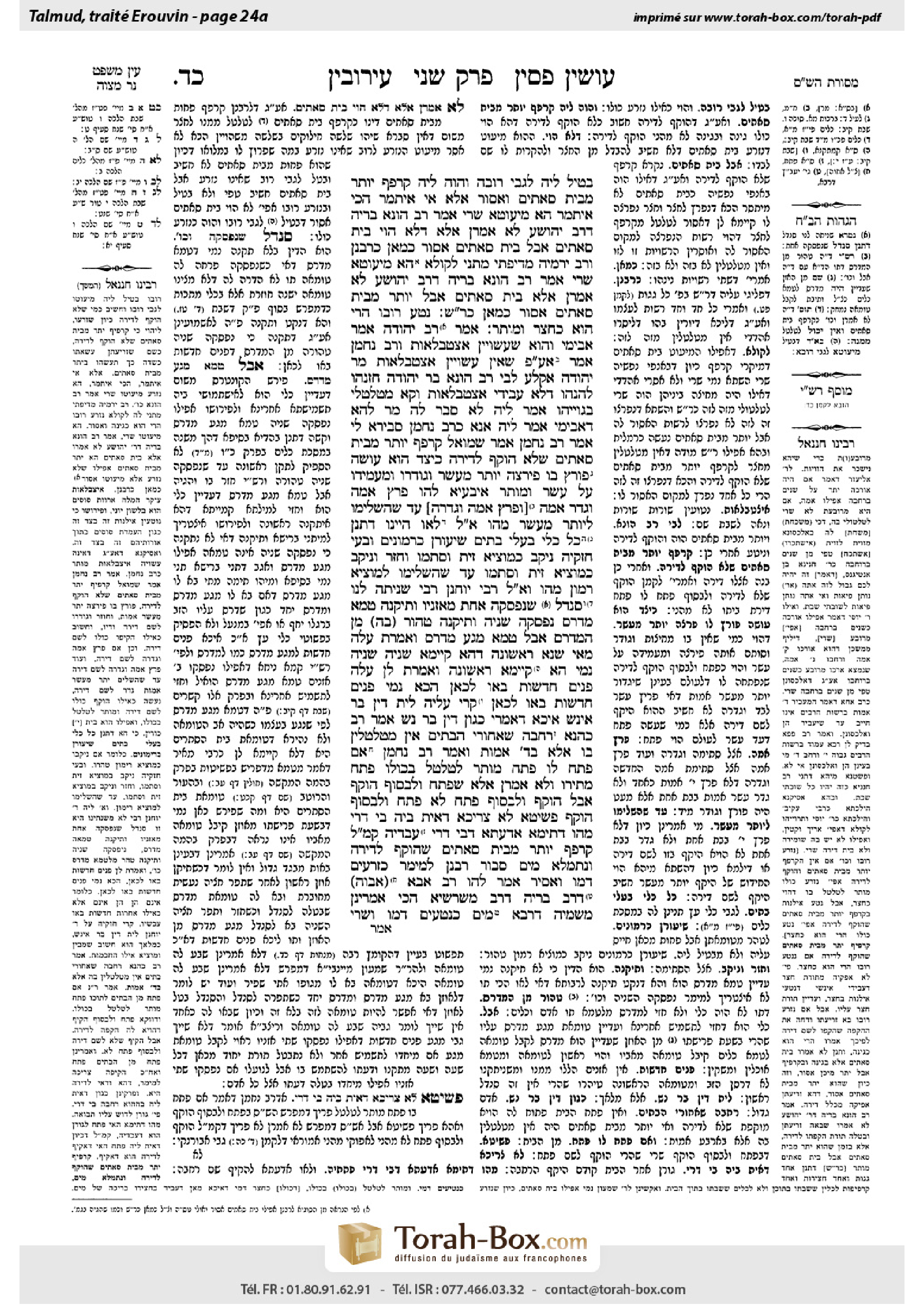
This page of Eruvin includes the Aramaic text, an English translation and an AI-generated French translation, alongside the scan above.
עירובין כ״ד א · Aramaic and Hebrew text
בְּטִיל לֵיהּ לְגַבַּי רוּבָּה, וְהָוֵה לֵיהּ קַרְפֵּף יוֹתֵר מִבֵּית סָאתַיִם — וְאָסוּר.
אֶלָּא אִי אִיתְּמַר הָכִי אִיתְּמַר: הָא מִיעוּטָא — שָׁרֵי. אָמַר רַב הוּנָא בְּרֵיהּ דְּרַב יְהוֹשֻׁעַ: לָא אֲמַרַן אֶלָּא דְּלָא הָוֵי בֵּית סָאתַיִם, אֲבָל בֵּית סָאתַיִם — אָסוּר.
כְּמַאן? כְּרַבָּנַן.
וְרַב יִרְמְיָה מִדִּיפְתִּי מַתְנֵי לְקוּלָּא: הָא מִיעוּטָא — שְׁרֵי, אָמַר רַב הוּנָא בְּרֵיהּ דְּרַב יְהוֹשֻׁעַ: לָא אֲמַרַן אֶלָּא בֵּית סָאתַיִם, אֲבָל יוֹתֵר מִבֵּית סָאתַיִם — אָסוּר. כְּמַאן? כְּרַבִּי שִׁמְעוֹן.
נָטַע רוּבּוֹ — הֲרֵי הוּא כְּחָצֵר, וּמוּתָּר. אָמַר רַב יְהוּדָה אָמַר אֲבִימִי: וְהוּא שֶׁעֲשׂוּיִין אִצְטַבְּלָאוֹת. וְרַב נַחְמָן אָמַר: אַף עַל פִּי שֶׁאֵין עֲשׂוּיִין אִצְטַבְּלָאוֹת.
מָר יְהוּדָה אִקְּלַע לְבֵי רַב הוּנָא בַּר יְהוּדָה. חֲזַנְהוּ לְהָנְהוּ דְּלָא עֲבִידִי אִצְטַבְּלָאוֹת, וְקָא מְטַלְטְלִי בְּגַוַּיְיהוּ. אֲמַר לֵיהּ: לָא סָבַר לַהּ מָר לְהָא דַּאֲבִימִי? אֲמַר לֵיהּ: אֲנָא כְּרַב נַחְמָן סְבִירָא לִי.
אָמַר רַב נַחְמָן אָמַר שְׁמוּאֵל: קַרְפֵּף יוֹתֵר מִבֵּית סָאתַיִם שֶׁלֹּא הוּקַּף לְדִירָה, כֵּיצַד הוּא עוֹשֶׂה? פּוֹרֵץ בּוֹ פִּירְצָה יוֹתֵר מֵעֶשֶׂר, וְגוֹדְרוֹ וּמַעֲמִידוֹ עַל עֶשֶׂר, וּמוּתָּר.
אִיבַּעְיָא לְהוּ: פָּרַץ אַמָּה וְגָדַר אַמָּה [וּפָרַץ אַמָּה וּגְדָרָהּ], עַד שֶׁהִשְׁלִימוֹ לְיוֹתֵר מֵעֶשֶׂר, מַהוּ?
אֲמַר לֵיהּ, לָאו הַיְינוּ דִּתְנַן: כׇּל כְּלֵי בַּעֲלֵי בָתִּים, שִׁיעוּרָן כְּרִמּוֹנִים.
וּבָעֵי חִזְקִיָּה: נִיקַּב כְּמוֹצִיא זַיִת וּסְתָמוֹ, וְחָזַר וְנִיקַּב כְּמוֹצִיא זַיִת וּסְתָמוֹ, עַד שֶׁהִשְׁלִימוֹ לְמוֹצִיא רִמּוֹן מַהוּ?
וַאֲמַר לֵיהּ רַבִּי יוֹחָנָן: רַבִּי, שָׁנִיתָה לָנוּ: סַנְדָּל שֶׁנִּפְסְקָה אַחַת מֵאׇזְנָיו וְתִיקְּנָהּ — טָמֵא מִדְרָס.
נִפְסְקָה שְׁנִיָּה וְתִיקְּנָהּ — טָהוֹר בָּהּ מִן הַמִּדְרָס, אֲבָל טָמֵא מַגַּע מִדְרָס.
וַאֲמַרְתְּ עֲלַהּ: מַאי שְׁנָא רִאשׁוֹנָה — דְּהָא קָיְימָא שְׁנִיָּה? שְׁנִיָּה נָמֵי — הָא קָיְימָא רִאשׁוֹנָה?!
וַאֲמַרְתְּ לַן עֲלַהּ: פָּנִים חֲדָשׁוֹת בָּאוּ לְכָאן. הָכָא נָמֵי, פָּנִים חֲדָשׁוֹת בָּאוּ לְכָאן.
קָרֵי עֲלֵיהּ: לֵית דֵּין בַּר אִינָשׁ. אִיכָּא דְּאָמְרִי: כְּגוֹן דֵּין בַּר נַשׁ.
אָמַר רַב כָּהֲנָא: רְחָבָה שֶׁאֲחוֹרֵי הַבָּתִּים — אֵין מְטַלְטְלִין בּוֹ אֶלָּא בְּאַרְבַּע אַמּוֹת.
וְאָמַר רַב נַחְמָן: אִם פָּתַח לוֹ פֶּתַח — מוּתָּר לְטַלְטֵל בְּכוּלּוֹ, פֶּתַח מַתִּירוֹ. וְלָא אֲמַרַן אֶלָּא שֶׁפָּתַח וּלְבַסּוֹף הוּקַּף, אֲבָל הוּקַּף וּלְבַסּוֹף פָּתַח — לָא.
פָּתַח וּלְבַסּוֹף הוּקַּף פְּשִׁיטָא! לָא צְרִיכָא, דְּאִית בֵּיהּ בֵּי דָרֵי. מַהוּ דְּתֵימָא: אַדַּעְתָּא דְּבֵי דָרֵי עַבְדֵיהּ. קָא מַשְׁמַע לַן.
קַרְפֵּף יוֹתֵר מִבֵּית סָאתַיִם שֶׁהוּקַּף לְדִירָה וְנִתְמַלֵּא מַיִם, סְבוּר רַבָּנַן לְמֵימַר כִּזְרָעִים דָּמוּ — וַאֲסִיר.
אֲמַר לְהוּ רַב אַבָּא אֲבוּהּ דְּרַב בְּרֵיהּ דְּרַב מְשַׁרְשְׁיָא: הָכִי אָמְרִינַן מִשְּׁמֵיהּ דְּרָבָא: מַיִם כִּנְטָעִים דָּמוּ, וּשְׁרֵי.
Eruvin 24a · English translation
is nullified relative to the greater part, and it is as though the karpef were entirely sown. And therefore, it is regarded as a karpef greater than two beit se’a, in which it is prohibited to carry.
Rather, if this was stated, this is what was stated by Rav Huna, son of Rav Yehoshua: If the greater part of the karpef was sown, it is prohibited to carry within it. It follows that if only a minor part of the karpef was sown, it is permitted to carry within it. Rav Huna, son of Rav Yehoshua, said: We said that it is permitted to carry only if the sown section is not as large as two beit se’a, however, if it is at least two beit se’a, it is prohibited to carry anywhere in the karpef, even though most of it is not sown.
The Gemara asks: According to whose opinion was this stated? It is according to the opinion of the Rabbis, who disagree with Rabbi Shimon and say that a karpef and a courtyard are regarded as separate domains, so that it is prohibited to carry from one to the other.
And Rav Yirmeya from Difti would teach this matter as a leniency, as follows: It was stated that if the greater part of the karpef was sown, it is prohibited to carry within it. From here it follows that if only a minor part was sown, it is permitted to carry within it. Rav Huna, son of Rav Yehoshua said: We only said that it is permitted to carry if the sown section is not more than two beit se’a, but if it is more than two beit se’a, it is prohibited to carry. According to whose opinion was this stated? It was according to the opinion of Rabbi Shimon.
It was stated earlier that if the greater part of the karpef was planted with trees, it is considered like a courtyard, and it is permitted to carry. Rav Yehuda said that Avimi said: This is only if the trees were planted in rows [itztablaot], the customary manner of planting ornamental trees in a courtyard. But if they were arranged differently it is considered an orchard, which is not made for dwelling, and where it is prohibited to carry. But Rav Naḥman said: This applies even if they were not planted in rows, as people commonly plant trees in any arrangement in the courtyards of their houses.
Mar Yehuda happened to come to the house of Rav Huna bar Yehuda, where he saw certain trees that were not planted in rows, and people were nevertheless carrying among them. Mar Yehuda said to Rav Huna: Doesn’t the Master hold in accordance with this opinion of Avimi? Rav Huna said to him: I hold like the opinion of Rav Naḥman, that it is permitted to carry even if the trees are not planted in rows.
Rav Naḥman said that Shmuel said: With regard to a karpef that is greater than two beit se’a, and which was not enclosed from the outset for the purpose of residence, what should one do if he wishes to carry within it? He should make a breach in the fence larger than ten cubits, which nullifies the partition, and then fence it off and reduce the opening to only ten cubits, which thereby creates an entrance. He is then permitted to carry in the karpef, because it is now regarded as having been enclosed for the purpose of residence.
The Gemara raises a dilemma: If he did not make the breach at once, but rather he breached one cubit and fenced off that same cubit, and then breached another cubit and fenced it off, until he completed the breaching and fencing off of more than ten cubits, what is the law?
He said to him: Is this not as we learned in a mishna: All ritually impure wooden utensils belonging to ordinary homeowners become ritually pure through breaking the utensil, if they have holes the size of pomegranates.
And Ḥizkiya raised a dilemma: If a utensil was perforated with a hole large enough for an olive to emerge, and he sealed it, and then it was perforated again with a hole large enough for an olive to emerge, and he sealed it again, and this went on until the holes together completed a space large enough for a pomegranate to emerge, what is the halakha? In other words, is the ruling that because the sum of all the holes is the size of a pomegranate the utensil is pure, or is the ruling that it remains ritually impure because each hole was filled before the next hole was formed?
Rabbi Yoḥanan his student said to him: Master, you taught us that with regard to a sandal that became ritually impure by impurity imparted by the treading of a zav, and one of its ears, i.e., straps, broke and he repaired it, it remains ritually impure with impurity imparted by treading [midras] and can still render people and utensils ritually impure. If one of a sandal’s straps is torn, it can still be used as a sandal, and therefore it does not lose its status as a utensil.
If the second ear broke and he repaired it, it is ritually pure in the sense that it no longer renders other objects ritually impure as would a vessel that became a primary source of ritual impurity by means of impurity imparted by treading. However, the sandal itself is ritually impure due to contact with an object that became ritually impure with impurity imparted by treading, i.e., the sandal before its second strap ripped. Therefore, it can transmit ritual impurity to food and liquids.
And you said about this halakha: What is different in a case where the first ear breaks, that the sandal remains impure? It is because the second one is intact. However, when the second ear breaks, the first ear is intact; so how does the sandal lose its utensil status?
And then you said to us with regard to this that the reason it is no longer a utensil is because a new entity has arrived here. The legal status of the sandal with the two repaired ears is not that of the original sandal; it is a new sandal. Here, too, with regard to a utensil that was perforated several times, where the sum of all the holes adds up to the size of a pomegranate, let us say that a new entity has arrived here, as the entire area of the hole is completely new, and the utensil is no longer the same utensil that had been ritually impure.
Ḥizkiya was so impressed by Rabbi Yoḥanan’s comment that he exclaimed about him: This is not a human being; rather, he is an angel, as he is capable of resolving a problem that I struggle with, from something that I myself taught. Some say that he said: This is an ideal human being. This parallel analysis teaches that if one breached one cubit and fenced it off, breached another cubit and fenced it off, and continued this way until he breached and fenced off more than ten cubits, then this is effective, and he need not breach more than ten meters at once.
Rav Kahana said: A fenced-in yard located behind a group of houses, which is used to store objects not in regular use and which measures more than two beit se’a, is not treated as a full-fledged private domain. Therefore, inside it, one may carry objects a distance of only four cubits.
Rav Naḥman said: If one opened an entrance to it from the house, it is permitted to carry throughout the entire area, because the entrance permits it, allowing it to be considered as part of the house. And we stated this allowance only where he opened the entrance and afterward fenced in the area; but if he first fenced it in and only afterward opened the entrance, he may not carry throughout the yard.
The Gemara raises a difficulty: If he first opened the entrance and afterward fenced in the area, it is obvious that it is permitted to carry throughout the yard, because it is clear that the area was enclosed for the entrance, i.e., in order to use it from the house. The Gemara answers: This ruling is necessary only in the case where there is a threshing floor in the yard. This is because you might have said that he made the entrance with the threshing floor in mind, and not so that he would be able to use the entire yard. He therefore comes and teaches us that the entrance renders it permitted to carry in the yard in all cases.
The Gemara considers a new case: With regard to a karpef measuring more than two beit se’a, which had been enclosed for the purpose of residence but became filled with water, by floods or any other cause, the Rabbis thought to say that the water is considered like seeds. This means that the karpef is regarded as if it were sown with seeds, so that it is prohibited to carry. It is no longer considered as having been enclosed for the purpose of dwelling, since it is not normal to live in a place filled with water.
Rav Abba, father of Rav, son of Rav Mesharshiya, said: We say in the name of Rava as follows: Water is considered like planted trees, so that one is permitted to carry. A courtyard filled with water is still suitable for dwelling, since the water benefits the residents of the courtyard.
Eruvin 24a · Traduction française (IA)
il est annulé par rapport à la partie plus grande, et on peut considérer que le karpef a été entièrement semé. Et donc, on le considère comme un karpef supérieur à deux beit se’a, dans lequel il est interdit de porter des objets.
En réalité, si cela a été dit, c’est ce que Rav Huna, fils de Rav Yehoshua, a dit : Si la partie plus grande du karpef a été semée, il est interdit de porter des objets à l’intérieur. Il en découle que si seulement une petite partie du karpef a été semée, il est permis de porter des objets à l’intérieur. Rav Huna, fils de Rav Yehoshua, a dit : Nous avons dit qu’il est permis de porter des objets uniquement si la partie semée n’est pas aussi grande que deux beit se’a, cependant, si elle est au moins deux beit se’a, il est interdit de porter des objets partout dans le karpef, même si la majorité n’est pas semée.
La Guemara pose la question : Selon l’opinion de qui a-t-on dit cela ? C’est selon l’opinion des Rabbins, qui s’opposent à Rabbi Shimon et affirment que le karpef et le cour de la maison sont considérés comme des domaines séparés, de sorte qu’il est interdit de porter des objets d’un domaine à l’autre.
Et Rav Yirmeya de Difti enseignait cette question comme une facilité, comme suit : On a dit que si la partie plus grande du karpef a été semée, il est interdit de porter des objets à l’intérieur. De cela découle que si seulement une petite partie a été semée, il est permis de porter des objets à l’intérieur. Rav Huna, fils de Rav Yehoshua, a dit : Nous avons dit qu’il est permis de porter des objets uniquement si la partie semée n’est pas plus grande que deux beit se’a, mais si elle est plus grande que deux beit se’a, il est interdit de porter des objets. Selon l’opinion de qui a-t-on dit cela ? C’était selon l’opinion de Rabbi Shimon.
On avait dit précédemment que si la majorité du karpef était plantée d’arbres, on le considérait comme un cour, et il était permis de porter des objets. Rav Yehuda a dit que Avimi a dit : Cela est vrai uniquement si les arbres étaient plantés en rangs [itztablaot], la manière habituelle de planter des arbres décoratifs dans un cour. Mais si ils étaient disposés différemment, on le considérait comme un verger, qui n’est pas fait pour habiter, et où il est interdit de porter des objets. Mais Rav Naḥman a dit : Cela s’applique même si les arbres n’étaient pas plantés en rangs, car les gens plantent des arbres dans n’importe quelle disposition dans les cours de leurs maisons.
Mar Yehuda est venu chez Rav Huna bar Yehuda, où il a vu certains arbres qui n’étaient pas plantés en rangs, et des gens portaient des objets parmi eux. Mar Yehuda a dit à Rav Huna : N’est-ce pas selon l’opinion d’Avimi que le Maître se tient ? Rav Huna a répondu à lui : Je me tient selon l’opinion de Rav Naḥman, qui affirme qu’il est permis de porter des objets même si les arbres ne sont pas plantés en rangs.
Rav Naḥman a dit que Shmuel a dit : En ce qui concerne un karpef supérieur à deux beit se’a, et qui n’a pas été entouré dès le départ à des fins de résidence, que doit-on faire si l’on veut porter des objets à l’intérieur ? Il doit faire un trou dans le mur plus grand que dix coudées, ce qui annule la séparation, puis entourer à nouveau le mur et réduire l’ouverture à dix coudées seulement, ce qui crée ainsi une entrée. Il est alors permis de porter des objets dans le karpef, car il est désormais considéré comme ayant été entouré à des fins de résidence.
La Guemara soulève un dilemme : Si l’on n’a pas fait le trou tout de suite, mais plutôt l’on a fait un trou d’une coudée et l’on a entouré cette même coudée, puis un autre trou d’une coudée et l’on a entouré cette même coudée, jusqu’à ce qu’on ait complété le trou et l’entourage d’un espace supérieur à dix coudées, quelle est la loi ?
Il a dit à lui : N’est-ce pas comme nous avons appris dans une mitsna : Tous les ustensiles en bois impurs des habitants ordinaires deviennent purs par la destruction de l’ustensile, si ils ont des trous de la taille d’un pamplemousse.
Et Ḥizkiya a soulevé un dilemme : Si un ustensile a été percé d’un trou suffisamment grand pour que la taille d’une olive en émerge, et l’on a scellé ce trou, puis il a été percé à nouveau d’un trou suffisamment grand pour que la taille d’une olive en émerge, et l’on a scellé à nouveau ce trou, et cela s’est répété jusqu’à ce que les trous ensemble forment un espace suffisamment grand pour que la taille d’un pamplemousse en émerge, quelle est la halakha ? En d’autres termes, est-ce que la décision est que, parce que la somme de tous les trous est la taille d’un pamplemousse, l’ustensile est pur, ou est-ce que la décision est qu’il reste impur, car chaque trou a été scellé avant que le prochain trou ne soit formé ?
Rabbi Yoḥanan, son élève, a dit à lui : Maître, vous nous avez appris que concernant un sandal devenu impur par l’impureté transmise par la marche d’un zav, et que l’un de ses orteils, c’est-à-dire ses lanières, a cassé et qu’il l’a réparé, il reste impur avec l’impureté transmise par la marche et peut encore rendre les personnes et les ustensiles impurs. Si l’une des lanières d’un sandal est déchirée, il peut encore être utilisé comme un sandal, et donc il ne perd pas son statut d’ustensile.
Si le deuxième orteil a cassé et qu’il l’a réparé, il est pur dans le sens où il ne rend plus d’autres objets impurs comme un ustensile devenu une source principale d’impureté par l’impureté transmise par la marche. Cependant, le sandal lui-même est impur en raison du contact avec un objet devenu impur par l’impureté transmise par la marche, c’est-à-dire le sandal avant que son deuxième orteil ne se déchire. Ainsi, il peut transmettre l’impureté rituelle aux aliments et aux liquides.
Et vous avez dit à propos de cette halakha : Qu’est-ce qui diffère dans le cas où le premier orteil casse, que le sandal reste impur ? C’est parce que le deuxième orteil est intact. Cependant, lorsque le deuxième orteil casse, le premier orteil est intact ; donc comment le sandal perd son statut d’ustensile ?
Et ensuite vous avez dit à propos de cela que la raison pour laquelle il n'est plus considéré comme un ustensile est que quelque chose de nouveau est arrivé ici. Le statut juridique du sandal avec les deux oreilles réparées n'est pas celui du sandal originel ; c'est un nouveau sandal. Ici aussi, concernant un ustensile percé plusieurs fois, où la somme de tous les trous atteint la taille d'une pomegranate, disons que quelque chose de nouveau est arrivé ici, car toute la surface des trous est totalement nouvelle, et l'ustensile n'est plus le même ustensile que celui qui était impur rituellement.
Ḥizkiya fut tellement impressionné par la remarque de Rabbi Yoḥanan qu'il exclama à son sujet : Ce n'est pas un être humain ; c'est un ange, car il est capable de résoudre un problème que je lutte, à partir de quelque chose que j'ai moi-même enseigné. Certains disent qu'il a dit : C'est un être humain idéal. Cette analyse parallèle enseigne que si l'on a percé un cubit et l'a clôturé, percé un autre cubit et l'a clôturé, et a continué ainsi jusqu'à avoir percé et clôturé plus de dix cubits, cela est efficace, et il n'a pas besoin de percer plus de dix coudées d'un seul coup.
Rav Kahana a dit : Un jardin clôturé situé derrière un groupe de maisons, utilisé pour stocker des objets non utilisés régulièrement et mesurant plus de deux beit se'a, n'est pas considéré comme un domaine privé complet. Par conséquent, à l'intérieur, on peut transporter des objets à une distance de seulement quatre coudées.
Rav Naḥman a dit : Si l'on a ouvert une entrée vers ce jardin depuis la maison, il est permis de transporter des objets à travers toute la surface, car l'entrée permet cela, considérant que le jardin fait partie de la maison. Et nous avons énoncé cette permission uniquement dans le cas où l'on a ouvert l'entrée et ensuite clôturé la surface ; mais si l'on a d'abord clôturé la surface et seulement ensuite ouvert l'entrée, on ne peut pas transporter des objets à travers le jardin.
La Guemara soulève une difficulté : Si l'on a d'abord ouvert l'entrée et ensuite clôturé la surface, il est évident qu'il est permis de transporter des objets à travers le jardin, car il est clair que la surface a été clôturée à l'intention de l'entrée, c'est-à-dire afin de l'utiliser depuis la maison. La Guemara répond : Cette décision est nécessaire uniquement dans le cas où il y a un terrain de battage dans le jardin. Cela est dû au fait que l'on pourrait penser qu'il a fait l'entrée en pensant au terrain de battage, et non pour pouvoir utiliser toute la surface. Il vient donc enseigner que l'entrée permet de transporter des objets à travers le jardin dans tous les cas.
La Guemara considère un nouveau cas : Concernant un karpef mesurant plus de deux beit se'a, qui avait été clôturé à l'intention de la résidence mais s'est rempli d'eau, par inondation ou toute autre cause, les Rabbins ont pensé dire que l'eau est considérée comme des graines. Cela signifie que le karpef est considéré comme si on y avait semé des graines, de sorte qu'il est interdit de transporter des objets. Il n'est plus considéré comme clôturé à l'intention de la résidence, car il n'est pas normal de vivre dans un lieu rempli d'eau.
Rav Abba, père de Rav, fils de Rav Mesharshiya, a dit : Nous disons en nom de Rava comme suit : L'eau est considérée comme des arbres plantés, de sorte qu'il est permis de porter des objets. Un jardin rempli d'eau est encore adapté à la résidence, car l'eau est bénéfique pour les habitants du jardin.
Traduction française générée par IA à partir de l’édition anglaise de Sefaria. Vérifie toujours un passage avec le texte source.
Text from Sefaria: William Davidson Edition - Vocalized Aramaic (CC BY NC); William Davidson Edition - English (CC BY NC).