Eruvin 25a: Talmud study for Daf Yomi
Study the Talmud for Daf Yomi with scanned pages, Hebrew text, English translations from Sefaria and AI-generated French translations.
Passage selection and English or AI-generated French translation are available where the scan has annotations. Daf Study is independent of Torah-Box and Sefaria.
Browse Eruvin · עירובין · All tractatesEruvin 25a text and translations
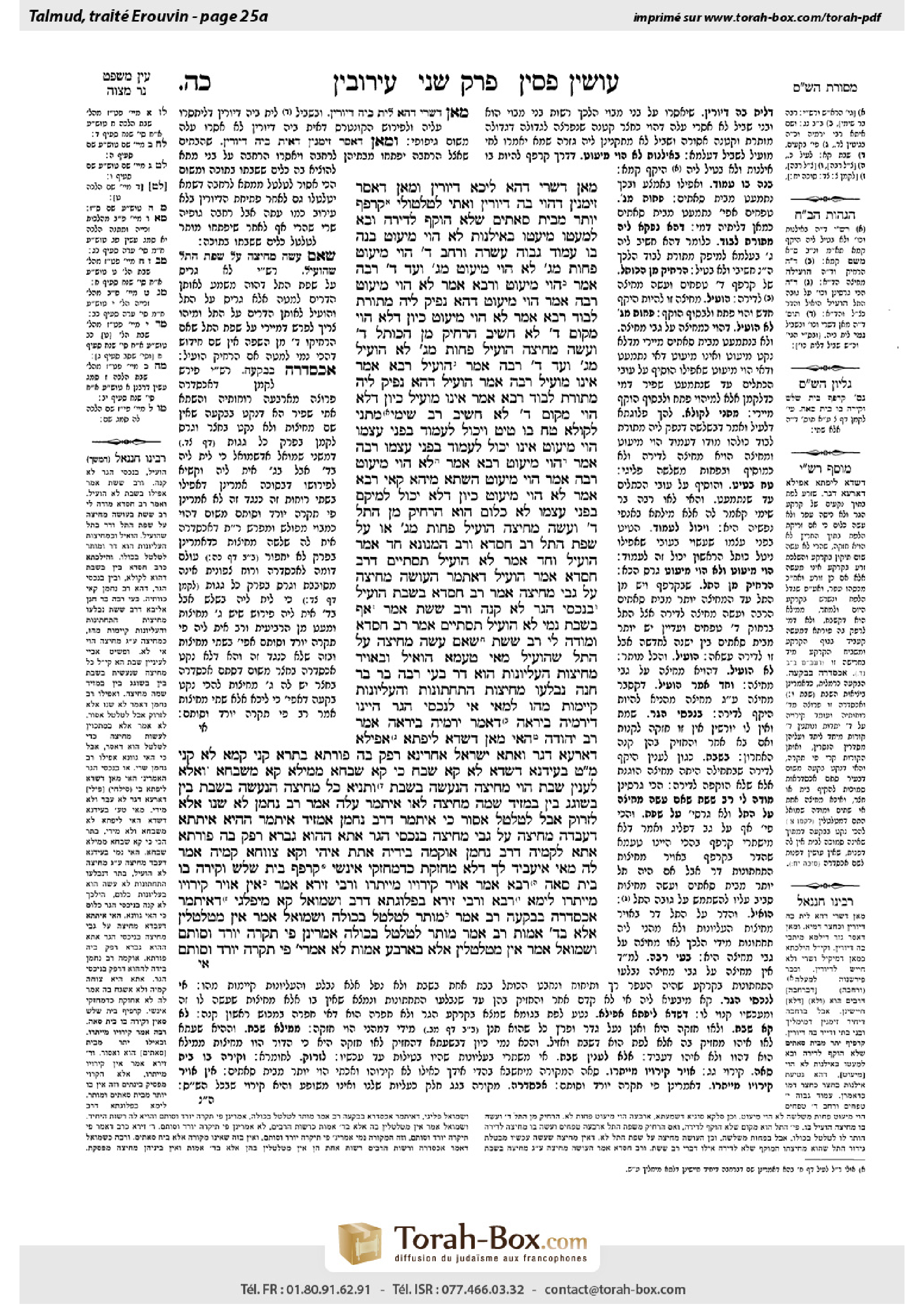
This page of Eruvin includes the Aramaic text, an English translation and an AI-generated French translation, alongside the scan above.
עירובין כ״ה א · Aramaic and Hebrew text
מַאן דְּשָׁרֵי — דְּהָא לֵיכָּא דָּיוֹרִין. וּמַאן דְּאָסַר — זִימְנִין דְּהָוֵי בַּהּ דָּיוֹרִין וְאָתֵי לְטַלְטוֹלֵי.
קַרְפֵּף יוֹתֵר מִבֵּית סָאתַיִם שֶׁלֹּא הוּקַּף לְדִירָה וּבָא לְמַעֲטוֹ, מִיעֲטוֹ בָּאִילָנוֹת — לָא הָוֵי מִיעוּט.
בָּנָה בּוֹ עַמּוּד גָּבוֹהַּ עֲשָׂרָה וְרָחָב אַרְבָּעָה — הָוֵי מִיעוּט. פָּחוֹת מִשְּׁלֹשָׁה — לָא הָוֵי מִיעוּט. מִשְּׁלֹשָׁה וְעַד אַרְבָּעָה — רַבָּה אָמַר: הָוֵי מִיעוּט, וְרָבָא אָמַר: לָא הָוֵי מִיעוּט.
רַבָּה אָמַר: הָוֵי מִיעוּט, דְּהָא נָפֵיק לֵיהּ מִתּוֹרַת לָבוּד. רָבָא אָמַר: לָא הָוֵי מִיעוּט, כֵּיוָן דְּלָא הָוֵי מְקוֹם אַרְבָּעָה — לָא חֲשִׁיב.
הִרְחִיק מִן הַכּוֹתֶל אַרְבָּעָה וְעָשָׂה מְחִיצָה — הוֹעִיל. פָּחוֹת מִשְּׁלֹשָׁה — לֹא הוֹעִיל. מִשְּׁלֹשָׁה וְעַד אַרְבָּעָה — רַבָּה אָמַר: הוֹעִיל, רָבָא אָמַר: אֵינוֹ מוֹעִיל.
רַבָּה אָמַר: הוֹעִיל, דְּהָא נָפֵיק לֵיהּ מִתּוֹרַת לָבוּד. רָבָא אָמַר: אֵינוֹ מוֹעִיל, כֵּיוָן דְּלָא הָוֵי מְקוֹם אַרְבָּעָה, לָא חֲשִׁיב.
רַב שִׁימִי מַתְנֵי לְקוּלָּא: טָח בּוֹ טִיט וְיָכוֹל לַעֲמוֹד בִּפְנֵי עַצְמוֹ — הָוֵי מִיעוּט. אֵינוֹ יָכוֹל לַעֲמוֹד בִּפְנֵי עַצְמוֹ — רַבָּה אָמַר: הָוֵי מִיעוּט, רָבָא אָמַר: לָא הָוֵי מִיעוּט.
רַבָּה אָמַר: הָוֵי מִיעוּט, הַשְׁתָּא מִיהָא קָאֵי. רָבָא אָמַר: לָא הָוֵי מִיעוּט, כֵּיוָן דְּלָא יָכוֹל לְמֵיקַם בִּפְנֵי עַצְמוֹ, לֹא כְּלוּם הוּא.
הִרְחִיק מִן הַתֵּל אַרְבָּעָה וְעָשָׂה מְחִיצָה — הוֹעִיל.
פָּחוֹת מִשְּׁלֹשָׁה אוֹ עַל שְׂפַת הַתֵּל, רַב חִסְדָּא וְרַב הַמְנוּנָא, חַד אָמַר: הוֹעִיל, וְחַד אָמַר: לֹא הוֹעִיל.
תִּסְתַּיֵּים דְּרַב חִסְדָּא אָמַר הוֹעִיל, דְּאִתְּמַר: הָעוֹשֶׂה מְחִיצָה עַל גַּבֵּי מְחִיצָה, אָמַר רַב חִסְדָּא: בְּשַׁבָּת הוֹעִיל.
בְּנִכְסֵי הַגֵּר לֹא קָנָה.
וְרַב שֵׁשֶׁת אָמַר: אַף בְּשַׁבָּת נָמֵי לֹא הוֹעִיל. תִּסְתַּיֵּים.
אָמַר רַב חִסְדָּא: וּמוֹדֶה לִי רַב שֵׁשֶׁת שֶׁאִם עָשָׂה מְחִיצָה עַל הַתֵּל — שֶׁהוֹעִיל.
מַאי טַעְמָא, הוֹאִיל וּבַאֲוִיר מְחִיצוֹת הָעֶלְיוֹנוֹת הוּא דָּר.
בָּעֵי רַבָּה בַּר בַּר חָנָה: נִבְלְעוּ מְחִיצוֹת הַתַּחְתּוֹנוֹת, וְהָעֶלְיוֹנוֹת קַיָּימוֹת, מַהוּ?
לְמַאי? אִי לְנִכְסֵי הַגֵּר, הַיְינוּ דְּיִרְמְיָה בִּירָאָה. דְּאָמַר יִרְמְיָה בִּירָאָה אָמַר רַב יְהוּדָה: הַאי מַאן דִּשְׁדָא לִיפְתָּא אַפִּילָא דְּאַרְעָא דְגֵר, וַאֲתָא יִשְׂרָאֵל אַחֲרִינָא רְפַק בָּהּ פּוּרְתָּא — בָּתְרָא קָנֵי, קַמָּא לָא קָנֵי.
מַאי טַעְמָא? בְּעִידָּנָא דִּשְׁדָא — לָא קָא שָׁבַח. כִּי קָא שָׁבְחָא — מִמֵּילָא קָא מְשַׁבְּחָא.
וְאֶלָּא לְעִנְיַן שַׁבָּת, הָוֵי מְחִיצָה הַנַּעֲשֶׂה בְּשַׁבָּת.
וְתַנְיָא: כׇּל מְחִיצָה הַנַּעֲשֶׂה בְּשַׁבָּת, בֵּין בְּשׁוֹגֵג בֵּין בְּמֵזִיד — שְׁמָהּ מְחִיצָה.
לָאו אִיתְּמַר עֲלַהּ, אָמַר רַב נַחְמָן: לֹא שָׁנוּ אֶלָּא לִזְרוֹק, אֲבָל לְטַלְטֵל — אָסוּר.
כִּי אִיתְּמַר דְּרַב נַחְמָן — אַמֵּזִיד אִיתְּמַר.
הָהִיא אִיתְּתָא דַּעֲבַדָה מְחִיצָה עַל גַּבֵּי מְחִיצָה בְּנִכְסֵי הַגֵּר. אֲתָא הָהוּא גַּבְרָא, רְפַק בָּהּ פּוּרְתָּא. אֲתָא לְקַמֵּיהּ דְּרַב נַחְמָן, אוֹקְמַהּ בִּידֵיהּ. אֲתַא[י] אִיהִי וְקָא צָוְוחָא קַמֵּיהּ. אֲמַר לַהּ: מַאי אֶיעְבֵּיד לָךְ, דְּלָא מַחְזְקַתְּ כִּדְמַחְזְקִי אִינָשֵׁי.
קַרְפֵּף בֵּית שָׁלֹשׁ וְקֵירָה בּוֹ בֵּית סְאָה. רָבָא אָמַר: אֲוִיר קֵירוּיוֹ מְיַיתְּרוֹ. וְרַבִּי זֵירָא אָמַר: אֵין אֲוִיר קֵירוּיוֹ מְיַיתְּרוֹ.
לֵימָא רָבָא וְרַבִּי זֵירָא בִּפְלוּגְתָּא דְּרַב וּשְׁמוּאֵל קָא מִיפַּלְגִי. דְּאִיתְּמַר: אַכְסַדְרָה בְּבִקְעָה, רַב אָמַר: מוּתָּר לְטַלְטֵל בְּכוּלָּהּ, וּשְׁמוּאֵל אָמַר: אֵין מְטַלְטְלִין אֶלָּא בְּאַרְבַּע אַמּוֹת.
רַב אָמַר: מוּתָּר לְטַלְטֵל בְּכוּלָּהּ — אָמְרִינַן פִּי תִקְרָה יוֹרֵד וְסוֹתֵם. וּשְׁמוּאֵל אָמַר: אֵין מְטַלְטְלִין אֶלָּא בְּאַרְבַּע אַמּוֹת — לָא אָמְרִינַן פִּי תִקְרָה יוֹרֵד וְסוֹתֵם.
Eruvin 25a · English translation
The Sage who permits doing so holds that it is permitted since in the yard itself there are no residents, and a place without residents cannot prohibit carrying in another, adjacent domain. And the Sage who prohibits doing so holds that it is prohibited because sometimes there are residents in it who can prohibit carrying in the other domain, and people might unwittingly come to carry from the yard to the town in their usual manner, even though it is prohibited.
With regard to a karpef that measures more than two beit se’a and that had not been fenced in from the outset for the purpose of residence, and one came to reduce its size, if he reduced it by planting trees in a section of the space, it is not a valid reduction, because trees are commonly found in a karpef designed for dwelling; therefore, they are not considered something out of the ordinary that would reduce its size.
But if he built up a column ten handbreadths high and four handbreadths wide, it is an effective reduction, i.e., if the karpef is thereby reduced to the area of two beit se’a, one is permitted to carry within it. However, if the column is less than three handbreadths wide, it is not an effective reduction. And if it is between three to four handbreadths wide, there is a dispute between amora’im. Rabba said: It constitutes an effective reduction, and Rava said: It does not constitute an effective reduction.
The Gemara explains the two opinions. Rabba said that it constitutes an effective reduction because it is large enough to be excluded from the principle of lavud, namely, that solid surfaces with gaps between them less than three handbreadths are considered joined. Since the column stands independently, it reduces the size of the karpef. Rava said that it does not constitute a valid reduction because as it is not a place of at least four handbreadths, it is not significant. An area of less than four handbreadths is not considered independent.
It was further stated: If one distanced himself four handbreadths from the wall of the karpef and erected an additional partition for the sake of dwelling, it is effective in permitting one to carry in the fenced-off inner area. But if the distance is less than three handbreadths, it is not effective, as the new wall is considered attached to the first by means of the principle of lavud, and it is like one partition built on top of another. And if the distance is between three to four handbreadths, that is the topic of the dispute among the amora’im, in which Rabba said: It is effective, and Rava said: It is not effective.
The Gemara explains the two opinions. Rabba said: It is effective, as it is far enough away to be removed from the principle of lavud. Rava disagreed and said: It is not effective, because as it is not a place of at least four handbreadths, it is not significant.
Rav Simi would teach a more lenient version of the dispute between Rabba and Rava. If one plastered the walls of a karpef larger than two beit se’a with plaster, and the plaster can stand on its own, all agree that it is an effective reduction, as it is considered as if he has made a new partition. But if the plaster cannot stand on its own, and it only stays in place because it is attached to the existing wall, there is an amoraic dispute in which Rabba said: It is an effective reduction, and Rava said: It is not an effective reduction.
The Gemara explains the two opinions. Rabba says: It is an effective reduction, because for now, in any case, it stands. Rava says: It is not an effective reduction, because as it cannot stand on its own, it is nothing, i.e., it is insignificant.
If one distanced himself four handbreadths from a mound ten handbreadths high that stands in a karpef larger than two beit se’a, and he erected a partition for the sake of dwelling, it is effective to permit one to carry.
But if he erected the partition less than three handbreadths from the mound or on the edge of the mound itself, so that it is like a partition built on top of another partition, this is a dispute between Rav Ḥisda and Rav Hamnuna. One of them said: It is effective, and the other one said: It is not effective.
The Gemara seeks to clarify which of the Sages held which opinion. Conclude that it was Rav Ḥisda who said it is effective, for it was stated that the amora’im disagreed about the following: If one erected a partition on top of an existing partition, Rav Ḥisda said: With regard to the halakhot of Shabbat, e.g., if the first partition was not erected for the purpose of residence, the second partition is effective.
However, with regard to the property of a convert, he does not acquire it. The property of a convert who dies without heirs is regarded as ownerless unless he had transferred it to someone as a gift during his lifetime. Whoever first implements a valid mode of acquisition upon such property acquires it. For example, one may acquire property by performing an act of taking possession, such as construction of a partition around it. But if one erects a partition around the property of a deceased convert on top of an existing partition, he does not acquire the property in this manner.
And Rav Sheshet said: Even with regard to Shabbat it is not effective. The Gemara comments: Indeed, conclude that it is Rav Ḥisda who maintains that one partition built on top of another is effective for Shabbat.
Rav Ḥisda said: Rav Sheshet agrees with me that if one erected a partition on the mound, rather than merely adjacent to it, that it is effective to permit one to carry on the mound itself, even though, according to him, it is prohibited to carry in the rest of the karpef.
What is the reason for this? Since he dwells in the space between the upper partitions, he utilizes these new partitions and they serve a function. Although in relation to one positioned below the mound these are partitions built on top of the pre-existing partitions of the mound, and therefore they do not allow him to carry in the karpef, they are nonetheless effective in allowing him to carry on the mound itself.
Rabba bar bar Ḥana raised a dilemma: If the lower partitions were swallowed up, e.g., if they sank in boggy ground, and the upper partitions that he had erected still stand, what is the law?
The Gemara asks: With regard to what issue was this dilemma raised? If it was raised with regard to acquiring the property of a convert, this is precisely the same as the ruling cited by Yirmeya Bira’a, as Yirmeya Bira’a said that Rav Yehuda said: If one sowed turnip seeds in cracks which he found in land that had belonged to a convert, and another Jew came and plowed the ground a little, the latter one, the one who plowed, acquires the property, and the first one does not acquire it.
What is the reason that the first one who sowed the seeds does not acquire the property? At the time that he sowed, the land was not improved by his sowing. When it did improve, with the growth of the turnips, it improved on its own. That is to say, the act of sowing alone is not a sufficiently noticeable action that changes and improves the property at the time. Although the sowing later proves to have been beneficial, this is seen as an improvement of the land that comes on its own. Therefore, an action that will only provide benefit in the future cannot serve as an act of acquisition.
Rather, you must say that the dilemma was raised with respect to Shabbat, in which case it is a partition that was made on Shabbat; beforehand it was not a valid partition, and the upper ones acquired the status of a partition only after the lower partitions sank into the ground.
And it was already taught in a baraita: Any partition made on Shabbat, whether unwittingly or intentionally, is called a valid partition. Consequently, the upper partitions should be regarded as valid partitions that allow one to carry in the karpef.
The Gemara raises a difficulty: Wasn’t it stated about this law that Rav Naḥman said: They taught that such a partition is called a partition only as a stringency, in that it is prohibited to throw from an area enclosed by such a partition into the public domain and vice versa; but to carry within it as a full-fledged private domain is prohibited. This implies that these are not proper partitions.
The Gemara refutes this objection: When that statement of Rav Naḥman was stated, it was stated with regard to a case where one erected the partition intentionally. Since one intentionally violated Shabbat when he erected the partition, the Sages imposed a penalty that he is prohibited to carry within the enclosed area. But if the partition was made unwittingly or came about by itself, no such penalty was imposed, and one is permitted to carry.
The Gemara cites a related incident: A certain woman erected a partition on top of another partition in the property of a deceased convert. A certain man then came and plowed the ground a little. The man came before Rav Naḥman, who established the property in his possession. The woman then came and cried out before Rav Naḥman. He said to her: What can I do for you, as you did not take possession of the property in the manner that people take possession.
With regard to a karpef the size of three beit se’a, and one roofed one beit se’a of it, the amora’im disputed whether or not the area of karpef is two beit se’a, in which case it is permitted to carry there, or three beit se’a, in which case it would be prohibited. Rava said: Its roofed space renders it in excess of two beit se’a, meaning that the roofed area is not considered separate from the rest, and so it is prohibited to carry in the karpef. And Rabbi Zeira said: Its roofed space does not render it in excess of two beit se’a, and it is permitted to carry there.
The Gemara comments: Let us say that Rava and Rabbi Zeira dispute the same point that was the subject of dispute between Rav and Shmuel. These amora’im disagreed about the following, as it was stated: With regard to an enclosed veranda [akhsadra], which is a roofed structure without walls or with incomplete walls, in a field that has the status of a karmelit, Rav said: One is permitted to carry in the entire enclosed veranda, as it is considered a private domain. And Shmuel said: One may carry only a distance of four cubits.
The Gemara explains the two opinions: Rav said: One is permitted to carry in the entire enclosed veranda, since we say that the edge of the roof descends to the ground and closes up the enclosed veranda on all sides; consequently, it is considered a separate private domain. And Shmuel said: One may carry only a distance of four cubits, as we do not say that the edge of the roof descends and closes up the enclosed veranda.
Eruvin 25a · Traduction française (IA)
Le Sage qui permet considère qu'il est permis, car dans la cour même il n'y a pas de résidents, et un lieu sans résidents ne peut pas interdire le portage dans un autre domaine adjacent. Le Sage qui interdit considère qu'il est interdit, car parfois il y a des résidents dans ce lieu qui peuvent interdire le portage dans le domaine adjacent, et les gens pourraient, sans le savoir, venir porter des choses de la cour vers la ville selon leur habitude, même si cela est interdit.
Concernant un karpef dont la mesure est supérieure à deux beit se’a et qui n'avait pas été clôturé dès le départ à des fins de résidence, et si l'on est venu réduire sa taille, si l'on a réduit sa taille en plantant des arbres dans une partie du terrain, cela ne constitue pas une réduction valide, car les arbres sont courants dans un karpef conçu pour la résidence ; par conséquent, ils ne sont pas considérés comme quelque chose de particulier qui réduirait sa taille.
Mais si l'on a construit une colonne de dix tefachim de haut et de quatre tefachim de large, cela constitue une réduction efficace, c'est-à-dire, si le karpef est ainsi réduit à la taille de deux beit se’a, on est autorisé à porter à l'intérieur. Cependant, si la colonne est moins de trois tefachim de large, cela ne constitue pas une réduction efficace. Et si elle est entre trois et quatre tefachim de large, il y a un désaccord entre les amoraïm. Rabba a dit : cela constitue une réduction efficace, et Rava a dit : cela ne constitue pas une réduction efficace.
La Guemara explique les deux opinions. Rabba a dit que cela constitue une réduction efficace, car il est suffisamment grand pour être exclu du principe de lavud, c'est-à-dire que les surfaces solides avec des espaces entre elles inférieurs à trois tefachim sont considérées comme jointes. Puisque la colonne est indépendante, elle réduit la taille du karpef. Rava a dit que cela ne constitue pas une réduction valide, car comme il n'est pas un lieu de quatre tefachim, il n'est pas significatif. Une surface inférieure à quatre tefachim n'est pas considérée comme indépendante.
Il a été dit de plus : si l'on s'est éloigné de quatre tefachim du mur du karpef et qu'on a érigé une nouvelle clôture à des fins de résidence, cela est efficace pour permettre le portage dans la zone clôturée. Mais si la distance est inférieure à trois tefachim, cela n'est pas efficace, car la nouvelle muraille est considérée comme jointe à la première par le principe de lavud, et cela ressemble à une seule muraille construite sur une autre. Et si la distance est entre trois et quatre tefachim, c'est le sujet du désaccord entre les amoraïm, dans lequel Rabba a dit : cela est efficace, et Rava a dit : cela n'est pas efficace.
La Guemara explique les deux opinions. Rabba a dit : cela est efficace, car il est suffisamment éloigné pour être éloigné du principe de lavud. Rava a désaccordé et a dit : cela n'est pas efficace, car comme il n'est pas un lieu de quatre tefachim, il n'est pas significatif.
Rav Simi enseignait une version plus clémente du désaccord entre Rabba et Rava. Si l'on a enduit les murs d'un karpef plus grand que deux beit se’a avec de la chaux, et que la chaux peut rester debout toute seule, tous s'accordent sur le fait qu'il s'agit d'une réduction efficace, car on la considère comme une nouvelle clôture. Mais si la chaux ne peut pas rester debout toute seule et qu'elle ne reste en place que parce qu'elle est attachée au mur existant, il y a un désaccord entre les amoraïm, dans lequel Rabba a dit : cela constitue une réduction efficace, et Rava a dit : cela ne constitue pas une réduction efficace.
La Guemara explique les deux opinions. Rabba dit : cela constitue une réduction efficace, car pour l'instant, en tout cas, elle tient debout. Rava dit : cela ne constitue pas une réduction efficace, car comme elle ne peut pas rester debout toute seule, elle est insignifiante.
Si l'on s'est éloigné de quatre tefachim d'une montagne de dix tefachim de haut qui se trouve dans un karpef plus grand que deux beit se’a, et qu'on a érigé une clôture à des fins de résidence, cela est efficace pour permettre le portage.
Mais si l'on a érigé la clôture à moins de trois tefachim de la montagne ou sur le bord même de la montagne, de sorte qu'elle ressemble à une clôture érigée sur une autre clôture, c'est un désaccord entre Rav Ḥisda et Rav Hamnuna. L'un d'eux a dit : cela est efficace, et l'autre a dit : cela n'est pas efficace.
La Guemara cherche à clarifier quel Sage a soutenu quelle opinion. On conclut que c'est Rav Ḥisda qui a dit que cela est efficace, car il a été dit que les amoraïm s'entendaient sur le suivant : si l'on érige une clôture sur une clôture existante, Rav Ḥisda a dit : concernant les halakhot de Shabbat, par exemple, si la première clôture n'était pas érigée à des fins de résidence, la deuxième clôture est efficace.
Cependant, concernant la propriété d'un converti, il ne l'acquiert pas. La propriété d'un converti décédé sans héritiers est considérée comme sans propriétaire à moins qu'il n'ait transféré cette propriété à quelqu'un comme cadeau pendant sa vie. Celui qui premièrement met en œuvre un mode valide d'acquisition sur cette propriété l'acquiert. Par exemple, on peut acquérir une propriété par un acte de prise de possession, comme la construction d'une clôture autour d'elle. Mais si l'on érige une clôture autour de la propriété d'un converti décédé sur une clôture existante, on ne l'acquiert pas ainsi.
Et Rav Sheshet a dit : même concernant le Shabbat, cela n'est pas efficace. La Guemara commente : En effet, conclure que c'est Rav Ḥisda qui affirme que l'érection d'une clôture sur une autre est efficace pour le Shabbat.
Rav Ḥisda a dit : Rav Sheshet est d'accord avec moi sur le fait que si l'on a érigé une clôture sur la montagne, plutôt que simplement à côté d'elle, cela est efficace pour permettre le portage sur la montagne elle-même, même si, selon lui, il est interdit de porter dans le reste du karpef.
Quelle est la raison de cela ? Parce qu'il demeure dans l'espace entre les parois supérieures, il utilise ces nouvelles parois et elles remplissent une fonction. Bien que, par rapport à celui qui est placé en dessous du tas, ces parois soient des parois construites sur les parois existantes du tas, et donc ne lui permettent pas de porter dans le karpef, elles sont toutefois efficaces pour lui permettre de porter sur le tas lui-même.
Rabba bar bar Ḥana a soulevé un dilemme : Si les parois inférieures avaient été avalées, par exemple si elles s'étaient enfoncées dans un terrain boueux, et que les parois supérieures qu'il avait érigées restaient debout, quelle est la loi ?
La Guemara demande : À l'égard de quelle question a-t-on soulevé ce dilemme ? Si c'était à l'égard de l'acquisition de la propriété d'un converti, cela est exactement la même que la décision citée par Yirmeya Bira’a, comme Yirmeya Bira’a a dit que Rav Yehuda a dit : Si l'on a semé des graines de navet dans des fissures que l'on a trouvées dans un terrain appartenant à un converti, et qu'un Juif est venu ensuite labourer un peu le sol, celui qui a labouré, celui qui a semé, acquiert la propriété, et celui qui a semé ne l'acquiert pas.
Quelle est la raison pour laquelle celui qui a semé les graines ne peut pas acquérir la propriété ? À l'époque où il a semé, le terrain n'était pas amélioré par son semis. Lorsqu'il s'est amélioré, avec la croissance des navets, c'était par lui-même. Cela signifie que l'acte de semis seul n'est pas une action suffisamment marquante qui change et améliore la propriété à l'époque. Bien que le semis ait plus tard prouvé être bénéfique, cela est vu comme une amélioration du terrain qui vient d'elle-même. Par conséquent, une action qui ne fournira que des bénéfices à l'avenir ne peut pas servir d'acte d'acquisition.
Plutôt, vous devez dire que le dilemme a été soulevé en ce qui concerne le Shabbat, dans ce cas, il s'agit d'une paroi érigée le Shabbat ; auparavant, elle n'était pas une paroi valide, et les parois supérieures ont acquis le statut de paroi seulement après que les parois inférieures aient sombré dans le sol.
Et il a déjà été enseigné dans une baraïta : Toute paroi érigée le Shabbat, que ce soit involontairement ou intentionnellement, est appelée une paroi valide. Par conséquent, les parois supérieures devraient être considérées comme des parois valides qui permettent de porter dans le karpef.
La Guemara soulève une difficulté : N’a-t-il pas été dit à ce sujet que Rav Naḥman a dit : Ils ont enseigné que telle paroi est appelée paroi uniquement comme une stricte interdiction, dans le sens où il est interdit de jeter d’une zone enclose par telle paroi vers le domaine public et vice versa ; mais porter à l’intérieur d’une manière complète est interdit. Cela implique que ces parois ne sont pas des parois appropriées.
La Guemara réfute cette objection : Lorsque cette déclaration de Rav Naḥman a été faite, elle a été faite en référence à un cas où l’on avait érigé la paroi intentionnellement. Puisque l’on avait violé le Shabbat intentionnellement lors de l’érection de la paroi, les Sages ont imposé une sanction selon laquelle il est interdit de porter à l’intérieur de la zone enclose. Mais si la paroi avait été érigée involontairement ou s’était formée d’elle-même, aucune telle sanction n’avait été imposée, et l’on était autorisé à porter.
La Guemara cite un incident lié : Une certaine femme avait érigé une paroi sur une autre paroi dans la propriété d’un converti décédé. Un certain homme est ensuite venu labourer un peu le sol. L’homme est venu devant Rav Naḥman, qui a établi la propriété en son possession. La femme est ensuite venue et a crié devant Rav Naḥman. Il lui a dit : Que puis-je faire pour vous, comme vous n’avez pas pris possession de la propriété de la manière dont les gens prennent possession.
Concernant un karpef de la taille de trois beit se’a, et l'on a couvert un beit se’a de ce karpef, les amora’im ont disputé si la surface du karpef était de deux beit se’a, dans ce cas il est permis de porter là, ou trois beit se’a, dans ce cas il serait interdit. Rava a dit : Son espace couvert rend le karpef au-delà de deux beit se’a, c'est-à-dire que l'espace couvert n'est pas considéré comme distinct du reste, et donc il est interdit de porter dans le karpef. Et Rabbi Zeira a dit : Son espace couvert ne rend pas le karpef au-delà de deux beit se’a, et il est permis de porter là.
La Guemara commente : Disons que Rava et Rabbi Zeira disputent le même point que celui qui était la matière de la dispute entre Rav et Shmuel. Ces amora’im étaient en désaccord sur le suivant, comme il a été dit : Concernant une véranda couverte [akhsadra], qui est une structure couverte sans murs ou avec des murs incomplets, dans un champ ayant le statut de karmelit, Rav a dit : On est autorisé à porter dans toute la véranda couverte, car elle est considérée comme un domaine privé. Et Shmuel a dit : On peut porter seulement une distance de quatre cubits.
La Guemara explique les deux opinions : Rav a dit : On est autorisé à porter dans toute la véranda couverte, car nous disons que l'extrémité du toit descend jusqu'au sol et ferme la véranda couverte de tous les côtés ; par conséquent, elle est considérée comme un domaine privé distinct. Et Shmuel a dit : On peut porter seulement une distance de quatre cubits, car nous ne disons pas que l'extrémité du toit descend et ferme la véranda couverte.
Traduction française générée par IA à partir de l’édition anglaise de Sefaria. Vérifie toujours un passage avec le texte source.
Text from Sefaria: William Davidson Edition - Vocalized Aramaic (CC BY NC); William Davidson Edition - English (CC BY NC).