Eruvin 25b: Talmud study for Daf Yomi
Study the Talmud for Daf Yomi with scanned pages, Hebrew text, English translations from Sefaria and AI-generated French translations.
Passage selection and English or AI-generated French translation are available where the scan has annotations. Daf Study is independent of Torah-Box and Sefaria.
Browse Eruvin · עירובין · All tractatesEruvin 25b text and translations
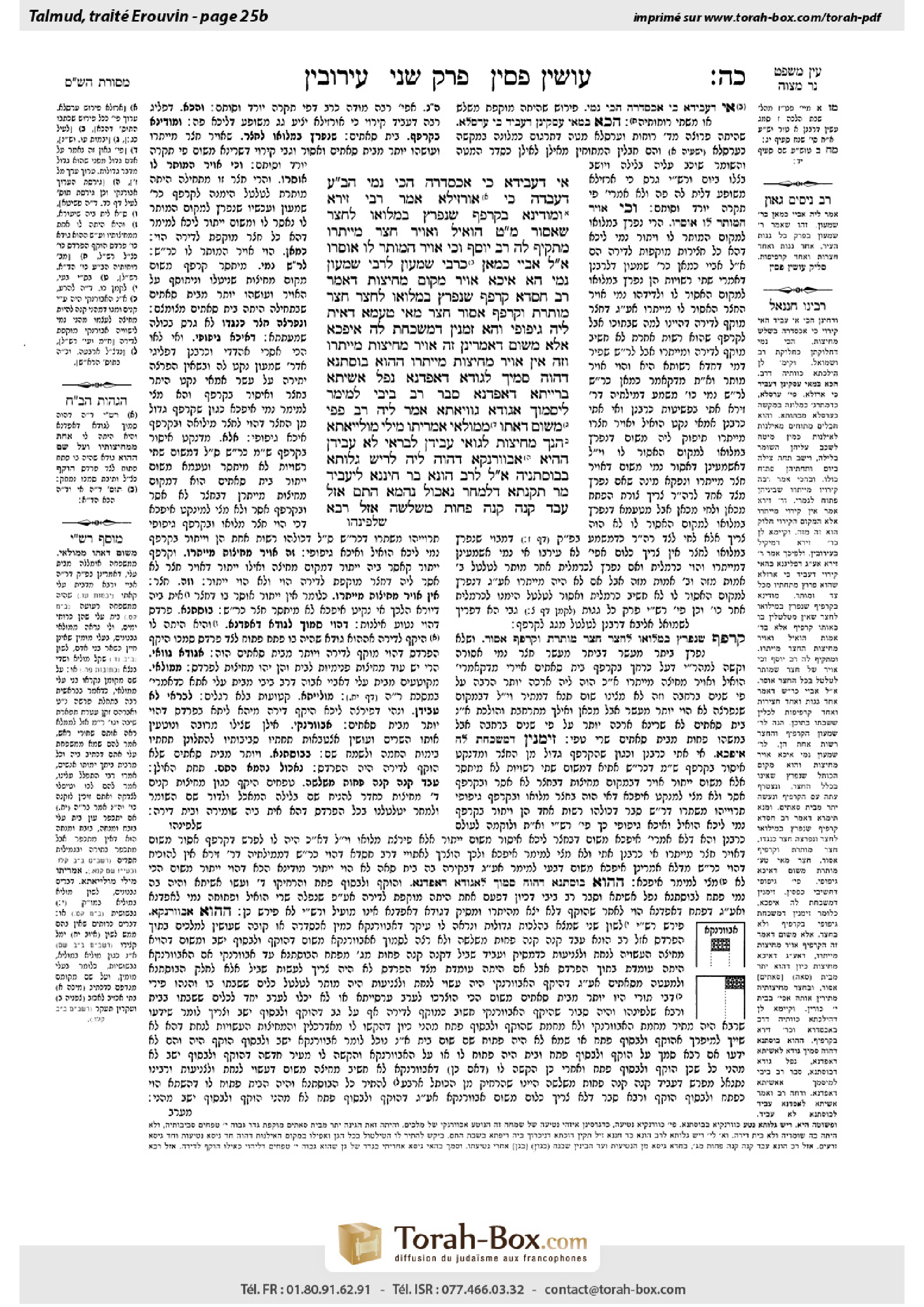
This page of Eruvin includes the Aramaic text, an English translation and an AI-generated French translation, alongside the scan above.
עירובין כ״ה ב · Aramaic and Hebrew text
אִי דַּעֲבִידָא כִּי אַכְסַדְרָה הָכִי נָמֵי. הָכָא בְּמַאי עָסְקִינַן, דְּעַבְדַהּ כִּי אוּרְזִילָא.
אָמַר רַבִּי זֵירָא: וּמוֹדֵינָא בְּקַרְפֵּף שֶׁנִּפְרַץ בִּמְלוֹאוֹ לֶחָצֵר שֶׁאָסוּר. מַאי טַעְמָא? הוֹאִיל וַאֲוִיר חָצֵר מְיַיתְּרוֹ.
מַתְקֵיף לַהּ רַב יוֹסֵף: וְכִי אֲוִיר הַמּוּתָּר לוֹ אוֹסְרוֹ?
אֲמַר לֵיהּ אַבָּיֵי: כְּמַאן, כְּרַבִּי שִׁמְעוֹן? לְרַבִּי שִׁמְעוֹן נָמֵי, הָא אִיכָּא אֲוִיר מְקוֹם מְחִיצוֹת.
דְּאָמַר רַב חִסְדָּא: קַרְפֵּף שֶׁנִּפְרַץ בִּמְלוֹאוֹ לְחָצֵר — חָצֵר מוּתֶּרֶת וְקַרְפֵּף אָסוּר.
חָצֵר מַאי טַעְמָא? דְּאִית לֵיהּ גִּיפּוּפֵי? וְהָא זִמְנִין דְּמַשְׁכַּחַתְּ לַהּ אִיפְּכָא.
אֶלָּא, מִשּׁוּם דְּאָמְרִינַן: זֶה — אֲוִיר מְחִיצוֹת מְיַיתְּרוֹ, וְזֶה — אֵין אֲוִיר מְחִיצוֹת מְיַיתְּרוֹ.
הָהוּא בּוּסְתָּנָא דַּהֲוָה סְמִיךְ לְגוּדָּא דְּאַפַּדְנָא. נְפַל אֲשִׁיתָא בָּרַיְיתָא דְּאַפַּדְנָא. סָבַר רַב בִּיבִי לְמֵימַר לִיסְמוֹךְ אַגּוּדָּא גַוּוֹיָאתָא.
אֲמַר לֵיהּ רַב פַּפִּי: מִשּׁוּם דְּאַתּוּ מִמּוּלָאֵי אָמְרִיתוּ מִילֵּי מוּלְיָיאתָא. הָנָךְ מְחִיצוֹת, לְגַוַּאי — עֲבִידָן, לְבָרַאי — לָא עֲבִידָן.
הָהִיא אַבְּווֹרַנְקָא דַּהֲוָה לֵיהּ לְרֵישׁ גָּלוּתָא בְּבוּסְתָּנֵיהּ. אֲמַר לֵיהּ לְרַב הוּנָא בַּר חִינָּנָא: לֶיעְבֵּיד מָר תַּקַּנְתָּא, דְּלִמְחַר נֵאכוּל נַהֲמָא הָתָם.
אֲזַל עֲבַד קָנֶה קָנֶה פָּחוֹת מִשְּׁלֹשָׁה, אֲזַל רָבָא
Eruvin 25b · English translation
The Gemara rejects this argument: If the roof in the covered section of the karpef were made like an enclosed veranda whose roof is level, indeed, both Rava and Rabbi Zeira would agree that the edge of the roof descends to the ground and closes up the area. With what are we dealing here? We are dealing with a case where the roof is made like a hammock, i.e., slanted, and therefore one cannot say that the edge of the roof descends to the ground and encloses the area.
Rabbi Zeira said: I agree with Rava with regard to a karpef that is fully breached into a courtyard, meaning the entire wall between them is breached, that it is prohibited to carry in it. What is the reason for this? Because the additional space of the courtyard joins to the karpef and renders it in excess of two beit se’a. Consequently, it is prohibited to carry in it.
Rav Yosef strongly objects to this explanation: Does a space in which it is permitted to carry, the courtyard, render the karpef, prohibited? Given that it had been permitted beforehand to carry from the courtyard to the karpef, why say that now that the partition between them is breached, the additional space, which was itself permitted, should render it prohibited to carry in the karpef?
Abaye said to him: In accordance with whose opinion do you say this? Apparently, it is in accordance with the opinion of Rabbi Shimon, who holds that one is permitted to carry from a courtyard to a karpef. But even according to Rabbi Shimon, there is the space where the walls that are now breached had once stood. This space had not been fit for carrying from the outset, even according to Rabbi Shimon; therefore, if the karpef had been at first exactly the area of two beit se’a, it would be prohibited to carry in the entire karpef due to the additional space of the fallen walls.
This is as Rav Ḥisda said with regard to a karpef that is fully breached into a courtyard: In the courtyard one is permitted to carry and in the karpef he is prohibited to carry.
The Gemara asks: As for the courtyard, what is the reason that this is permitted? Is it because it has the remnants of the original walls on either side of the breach, which allow the breach to be treated like an entrance? But at times you find just the opposite; if the courtyard was narrower than the karpef and the partition between them was fully breached, it is the karpef that retains the remnants of the original walls on either side of the breach, while the courtyard is breached in its entirety.
Rather, it is because we say that with regard to this one, the karpef, which was not enclosed for the purpose of residence and where one is permitted to carry only if it is no more than two beit se’a, the space of the fallen walls renders it in excess of two beit se’a. However, with regard to that one, the courtyard, which was enclosed for the purpose of residence and where there is no size limit above which it is prohibited to carry, the space of the fallen walls does not render it in excess of any limit.
The Gemara cites a related incident: A certain orchard [bustana] was adjacent to the wall of a mansion [apadna]. The orchard was larger than two beit se’a and was enclosed for the purpose of residence by a wall, part of which was the wall of the mansion. One day the outer wall of the mansion, which also served as a wall for the orchard, collapsed. Rav Beivai thought to say that we can rely upon one of the mansion’s inner walls to serve as a partition for the orchard and thereby permit one to carry there in the future as well.
Rav Pappi said to him: Because you come from truncated [mula’ei] people, as Rav Beivai’s family traced their lineage to the house of Eli, all of whose descendants were destined to be short-lived (see i Samuel 2:31), you speak truncated [mulayata] matters, as the inner wall cannot be relied upon at all. That is because these walls were made for the inside of the mansion, and they were not made for the outside; that is, they were not designed from the outset to serve as partitions for the orchard.
The Gemara relates: The Exilarch had a banqueting pavilion [abvarneka] in his orchard that was larger than two beit se’a and that had not been enclosed from the outset for the purpose of residence. The Exilarch said to Rav Huna bar Ḥinnana: Let the Master make some arrangement so that tomorrow, on Shabbat, we may eat bread there, i.e., so that we may be permitted to carry food and utensils from the house to the pavilion via the orchard.
Rav Huna bar Ḥinnana went and erected a fence of reeds, each reed separated from the next by less than three handbreadths. That is to say, he erected two such partitions between the house and the pavilion with a passageway between them, through which the Exilarch and his men could carry whatever they needed, as the partitions were constructed in the proper manner for the purpose of residence. Rava, however, went
Eruvin 25b · Traduction française (IA)
La Guemara rejette cet argument : Si le toit de la section couverte du karpef était fait comme un porche fermé dont le toit est plat, en effet, Rava et Rabbi Zeira auraient convenu que la bordure du toit descend jusqu'au sol et ferme la zone. De quoi s'agit-il donc ici ? Il s'agit d'un cas où le toit est fait comme un hamac, c'est-à-dire incliné, et par conséquent on ne peut pas dire que la bordure du toit descend jusqu'au sol et ferme la zone.
Rabbi Zeira a dit : Je suis d'accord avec Rava concernant un karpef qui est entièrement percé dans une cour, c'est-à-dire que l'ensemble du mur entre eux est percé, qu'il est interdit de porter dedans. Quelle est la raison de cela ? Parce que l'espace supplémentaire de la cour s'ajoute au karpef et le rend supérieur à deux beit se’a. Par conséquent, il est interdit de porter dedans.
Rav Yosef s'oppose fermement à cette explication : Un espace où il est permis de porter, la cour, rend-il le karpef interdit ? Étant donné qu'il avait été permis auparavant de porter de la cour au karpef, pourquoi dire maintenant que, avec la percée du mur entre eux, l'espace supplémentaire, qui était lui-même permis, devrait rendre le karpef interdit à porter ?
Abaye dit à lui : Selon l'opinion de qui dites-vous cela ? Apparemment, c'est selon l'opinion de Rabbi Shimon, qui considère que l'on peut porter d'une cour à un karpef. Mais même selon Rabbi Shimon, il y a l'espace où les murs qui sont maintenant percés avaient autrefois été. Cet espace n'était pas d'abord adapté à la portée, même selon Rabbi Shimon ; par conséquent, si le karpef avait été initialement exactement l'aire de deux beit se’a, il serait interdit de porter dans l'ensemble du karpef en raison de l'espace des murs tombés.
C'est ce que Rav Ḥisda a dit concernant un karpef qui est entièrement percé dans une cour : Dans la cour, on peut porter, et dans le karpef, on ne peut pas porter.
La Guemara pose une question : En ce qui concerne la cour, quelle est la raison qu'elle est permise ? Est-ce parce qu'elle a les restes des murs originaux des deux côtés de la percée, ce qui permet de traiter la percée comme une entrée ? Mais parfois, on trouve l'opposé : si la cour était plus étroite que le karpef et que la percée entre eux était entièrement faite, c'est le karpef qui retient les restes des murs originaux des deux côtés de la percée, tandis que la cour est entièrement percée.
En réalité, c'est parce que nous disons que concernant celui-ci, le karpef, qui n'était pas entouré à des fins de résidence et où l'on peut porter uniquement si l'aire ne dépasse pas deux beit se’a, l'espace des murs tombés le rend supérieur à deux beit se’a. Cependant, concernant celui-ci, la cour, qui était entourée à des fins de résidence et où il n'y a pas de limite d'aire au-delà de laquelle il est interdit de porter, l'espace des murs tombés ne le rend pas supérieur à toute limite.
La Guemara cite un incident lié : Un certain verger [bustana] était adjacent au mur d'une maison [apadna]. Le verger était plus grand que deux beit se’a et était entouré à des fins de résidence par un mur, partie duquel était le mur de la maison. Un jour, le mur extérieur de la maison, qui servait également de mur au verger, s'est effondré. Rav Beivai avait l'intention de dire qu'on peut compter sur l'un des murs internes de la maison pour servir de séparation au verger et permettre ainsi de porter dedans à l'avenir.
Rav Pappi a dit à lui : Parce que vous venez de gens tronqués [mula’ei], comme la famille de Rav Beivai remontait à la maison d'Eli, dont tous les descendants étaient destinés à avoir une courte vie (voir 1 Rois 2:31), vous parlez de choses tronquées [mulayata], car le mur interne ne peut être compté du tout. C'est parce que ces murs étaient faits pour l'intérieur de la maison et non pour l'extérieur ; c'est-à-dire qu'ils n'étaient pas conçus d'abord pour servir de séparations au verger.
La Guemara rapporte : L'Exilarch avait un pavillon de banquet [abvarneka] dans son verger qui était plus grand que deux beit se’a et qui n'avait pas été entouré d'abord à des fins de résidence. L'Exilarch dit à Rav Huna bar Ḥinnana : Faites une disposition pour que demain, le sabbat, nous puissions manger du pain là, c'est-à-dire pour que nous puissions être autorisés à porter des aliments et des ustensiles de la maison au pavillon via le verger.
Rav Huna bar Ḥinnana est allé et a érigé un mur de roseaux, chaque roseau séparé du suivant par moins de trois palmes. C'est-à-dire qu'il a érigé deux tels murs entre la maison et le pavillon avec un passage entre eux, par lequel l'Exilarch et ses hommes pouvaient porter ce qu'ils avaient besoin, car les murs étaient construits de manière appropriée à des fins de résidence. Rava, cependant, est allé
Traduction française générée par IA à partir de l’édition anglaise de Sefaria. Vérifie toujours un passage avec le texte source.
Text from Sefaria: William Davidson Edition - Vocalized Aramaic (CC BY NC); William Davidson Edition - English (CC BY NC).