Eruvin 26a: Talmud study for Daf Yomi
Study the Talmud for Daf Yomi with scanned pages, Hebrew text, English translations from Sefaria and AI-generated French translations.
Passage selection and English or AI-generated French translation are available where the scan has annotations. Daf Study is independent of Torah-Box and Sefaria.
Browse Eruvin · עירובין · All tractatesEruvin 26a text and translations
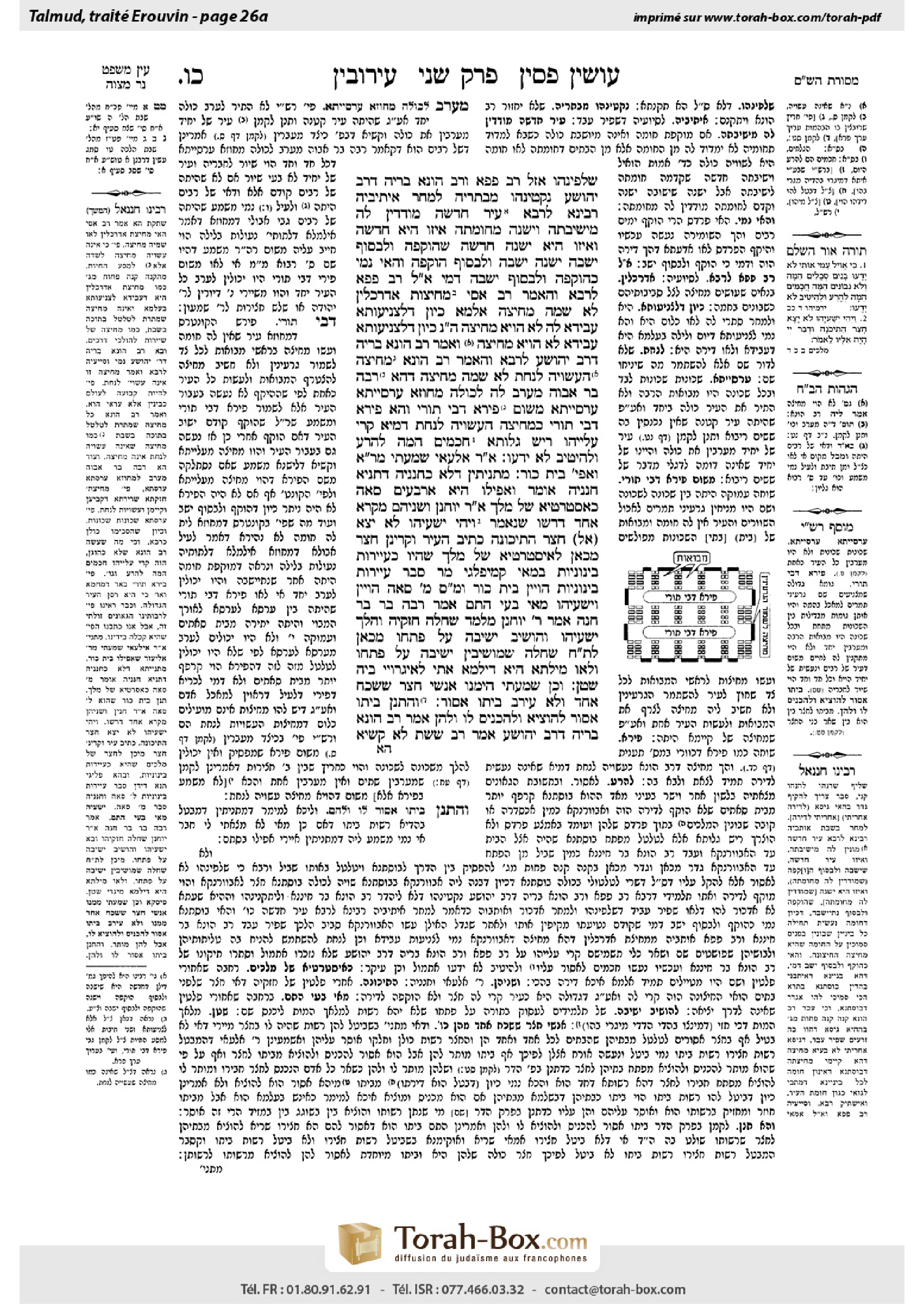
This page of Eruvin includes the Aramaic text, an English translation and an AI-generated French translation, alongside the scan above.
עירובין כ״ו א · Aramaic and Hebrew text
שַׁלְפִינְהוּ. אֲזַל רַב פָּפָּא וְרַב הוּנָא בְּרֵיהּ דְּרַב יְהוֹשֻׁעַ, נַקְטִינְהוּ מִבָּתְרֵיהּ.
לִמְחַר אֵיתִיבֵיהּ רָבִינָא לְרָבָא: עִיר חֲדָשָׁה מוֹדְדִין לָהּ מִיְּשִׁיבָתָהּ, וִישָׁנָה מֵחוֹמָתָהּ.
אֵיזוֹ הִיא חֲדָשָׁה וְאֵיזוֹ הִיא יְשָׁנָה? חֲדָשָׁה, שֶׁהוּקְּפָה וּלְבַסּוֹף יָשְׁבָה. יְשָׁנָה, יָשְׁבָה וּלְבַסּוֹף הוּקְּפָה. וְהַאי נָמֵי כְּהוּקְּפָה וּלְבַסּוֹף יָשְׁבָה דָּמֵי!
אֲמַר לֵיהּ רַב פָּפָּא לְרָבָא: וְהָאָמַר רַב אַסִּי מְחִיצוֹת אַדְרְכָלִין לָא שְׁמָהּ מְחִיצָה, אַלְמָא כֵּיוָן דְּלִצְנִיעוּתָא עֲבִידָא לַהּ — לָא הָוְיָא מְחִיצָה. הָכָא נָמֵי, כֵּיוָן דְּלִצְנִיעוּתָא עֲבִידָא — לָא הָוְיָא מְחִיצָה.
וְאָמַר רַב הוּנָא בְּרֵיהּ דְּרַב יְהוֹשֻׁעַ לְרָבָא: וְהָאָמַר רַב הוּנָא: מְחִיצָה הָעֲשׂוּיָה לְנַחַת — לֹא שְׁמָהּ מְחִיצָה!
דְּהָא רַבָּה בַּר אֲבוּהּ מְעָרֵב לַהּ לְכוּלַּהּ מָחוֹזָא עַרְסְיָיתָא עַרְסְיָיתָא מִשּׁוּם פֵּירָא דְּבֵי תוֹרֵי. וְהָא פֵּירָא דְּבֵי תוֹרֵי כִּמְחִיצָה הָעֲשׂוּיָה לְנַחַת דָּמְיָא.
קָרֵי עֲלַיְיהוּ רֵישׁ גָּלוּתָא: ״חֲכָמִים הֵמָּה לְהָרַע וּלְהֵיטִיב לֹא יָדָעוּ״.
אָמַר רַבִּי אִלְעַאי, שָׁמַעְתִּי מֵרַבִּי אֱלִיעֶזֶר: וַאֲפִילּוּ בֵּית כּוֹר. מַתְנִיתִין דְּלָא כַּחֲנַנְיָה. דְּתַנְיָא, חֲנַנְיָה אוֹמֵר: וַאֲפִילּוּ הִיא אַרְבָּעִים סְאָה כְּאִסְטְרַטְיָא שֶׁל מֶלֶךְ.
אָמַר רַבִּי יוֹחָנָן: וּשְׁנֵיהֶם מִקְרָא אֶחָד דָּרְשׁוּ, שֶׁנֶּאֱמַר: ״וַיְהִי יְשַׁעְיָהוּ לֹא יָצָא אֶל חָצֵר הַתִּיכוֹנָה״. כְּתִיב ״הָעִיר״ וְקָרֵינַן ״חָצֵר״ — מִכָּאן לָאִסְטְרַטְיָא שֶׁל מֶלֶךְ שֶׁהָיוּ כַּעֲיָירוֹת בֵּינוֹנִיּוֹת.
בְּמַאי קָמִיפַּלְגִי? מָר סָבַר: עֲיָירוֹת בֵּינוֹנִיּוֹת הָוְיָין בֵּית כּוֹר. וּמָר סָבַר: אַרְבָּעִים סְאָה הָוְיָין.
וִישַׁעְיָהוּ מַאי בָּעֵי הָתָם? אָמַר רַבָּה בַּר בַּר חָנָה אָמַר רַבִּי יוֹחָנָן: מְלַמֵּד שֶׁחָלָה חִזְקִיָּה, וְהָלַךְ יְשַׁעְיָהוּ וְהוֹשִׁיב יְשִׁיבָה עַל פִּתְחוֹ.
מִכָּאן לְתַלְמִיד חָכָם שֶׁחָלָה, שֶׁמּוֹשִׁיבִין יְשִׁיבָה עַל פִּתְחוֹ. וְלָאו מִילְּתָא הִיא, דִּילְמָא אָתֵי לְאִיגָּרוֹיֵי בֵּיהּ שָׂטָן.
וְכֵן שָׁמַעְתִּי הֵימֶנּוּ: אַנְשֵׁי חָצֵר שֶׁשָּׁכַח אֶחָד וְלֹא עֵירַב — בֵּיתוֹ אָסוּר.
וְהָתְנַן: בֵּיתוֹ אָסוּר לְהוֹצִיא וּלְהַכְנִיס לוֹ וְלָהֶן?!
אָמַר רַב הוּנָא בְּרֵיהּ דְּרַב יְהוֹשֻׁעַ אָמַר רַב שֵׁשֶׁת: לָא קַשְׁיָא,
Eruvin 26a · English translation
and removed the reeds, as he maintained that they were unnecessary; he regarded the entire orchard as having been enclosed for the purpose of residence, owing to the banqueting pavilion. Rav Pappa and Rav Huna, son of Rav Yehoshua, went after him and collected the reeds, so as to prevent Rav Huna bar Ḥinnana from restoring the partitions, as they were Rava’s students and wanted to enforce his ruling.
On the following day, on Shabbat, Ravina raised an objection to Rava’s opinion from a baraita which states: In the case of a new town, we measure the Shabbat limit from its settled area, from where it is actually inhabited; and in the case of an old town, we measure the Shabbat limit from its wall, even if it is not inhabited up to its wall.
What is a new town, and what is an old town? A new town is one that was first surrounded by a wall, and only afterward settled, meaning that the town’s residents arrived after the wall had already been erected; an old town is one that was first settled, and only afterward surrounded by a wall. Ravina raised his objection: And this orchard should also be considered like a town that was first surrounded by a wall and only afterward settled, as it had not been enclosed from the outset for the purpose of residence. Even if a dwelling was later erected there, this should not turn it into a place that had been enclosed for the purpose of residence.
Seeing that an additional objection could be raised against his teacher’s position, Rav Pappa said to Rava: Didn’t Rav Asi say that the temporary screens erected by architects to serve as protection against the sun and the like are not deemed valid partitions? Apparently, since it was erected only for privacy, and not for the purpose of permanent dwelling, it is not considered a valid partition. Here too, then, with regard to the fence around the orchard, since it was erected only for privacy, it should not be considered a valid partition.
And Rav Huna, son of Rav Yehoshua, said to Rava: Didn’t Rav Huna say that a partition made for resting objects alongside it and thereby providing them with protection is not considered a valid partition?
This is as Rabba bar Avuh did, when he constructed an eiruv separately for each row of houses in the whole town of Meḥoza, due to the ditches from which the cattle would feed that separated the rows of houses from one another. Shouldn’t such cattle ditches be considered like a partition made for resting objects alongside it? Such a partition is invalid. All these proofs indicate that Rava was wrong to remove the reed fences erected by Rav Huna bar Ḥinnana, for those fences were indeed necessary.
With regard to the resolution of this incident, the Exilarch recited the following verse about these Rabbis: “They are wise to do evil, but to do good they have no knowledge” (Jeremiah 4:22), as on Friday they ruined the arrangement that Rav Huna bar Ḥinnana had made to permit carrying from the house to the pavilion, and the next day all they could do was prove that they had acted improperly the day before and that it was prohibited to carry in the orchard.
We learned in the mishna: Rabbi Elai said: I heard from Rabbi Eliezer that one is permitted to carry in a garden or karpef, even if the garden is the size of a beit kor, thirty times larger than a beit se’a. The Gemara notes that all agree that what the mishna taught was not in accordance with the opinion of Ḥananya, as it was taught in a baraita that Ḥananya says: One is permitted to carry even if it is the size of forty beit se’a, like the court of a king.
Rabbi Yoḥanan said: Both Rabbi Elai and Ḥananya derived their opinion from the same verse, as it is stated: “And it came to pass, before Isaiah was gone out into the middle courtyard, that the word of the Lord came to him, saying” (ii Kings 20:4). In the biblical text, it is written: “The city [ha’ir],” and we read it as: “The middle courtyard [ḥatzer],” as there is a difference in this verse between the written word and how it is spoken. From here it is derived that royal courts were as large as intermediate-sized cities. Consequently, there is no contradiction, as the central courtyard of the royal palace was itself like a small town.
The Gemara explains: With regard to what principle do Rabbi Elai and Ḥananya disagree? One Sage, Rabbi Elai, maintains: Intermediate-sized towns are the size of a field that had an area of a beit kor; and one Sage, Ḥananya, maintains: They are the size of forty se’a.
The Gemara asks about the Biblical narrative cited above: What did Isaiah need to do there in the middle court, i.e., why was he there? The Gemara answers: Rabba bar bar Ḥana said that Rabbi Yoḥanan said: This teaches that Hezekiah took ill, and Isaiah went and established a Torah academy at his door, so that Torah scholars would sit and occupy themselves with Torah outside his room, the merit of which would help Hezekiah survive.
Based on this, it is derived, with regard to a Torah scholar who took ill, that one establishes an academy at the entrance to his home. The Gemara comments: This, however, is not a proper course of action, as perhaps they will come to provoke Satan against him. Challenging Satan might worsen the health of a sick person rather than improve it.
The mishna cites another statement made by Rabbi Elai in the name of Rabbi Eliezer: And I also heard from him another halakha: If one of the residents of a courtyard forgot and did not join in an eiruv with the other residents, and on Shabbat he ceded ownership of his share in the courtyard to the other residents, it is prohibited for him, the one who forgot to establish an eiruv, to bring in objects or take them out from his house to the courtyard; but it is permitted to the other residents to bring objects from their houses to that other person’s house via the courtyard, and vice versa.
The Gemara raises an objection: Didn’t we learn in a mishna: It is prohibited for the one who forgot to establish an eiruv to bring in objects or take them out from his house to the courtyard, and for the other residents who did make an eiruv, to take out objects from the house to the courtyard or to bring them into the house from the courtyard.
Rav Huna, son of Rav Yehoshua, said that Rav Sheshet said: This is not difficult.
Eruvin 26a · Traduction française (IA)
et il ôta les roseaux, car il affirmait qu'ils étaient inutiles ; il considérait l'ensemble de l'orangeraie comme étant entouré à l'intention de la résidence, en raison du pavillon de banquet. Rav Pappa et Rav Huna, fils de Rav Yehoshua, le suivirent et ramassèrent les roseaux, afin d'empêcher Rav Huna bar Ḥinnana de rétablir les parquets, car ils étaient les élèves de Rava et souhaitaient faire respecter son jugement.
Le lendemain, le sabbat, Ravina objecta contre l'opinion de Rava à partir d'une baraïta qui stipule : Dans le cas d'une ville nouvelle, on mesure la limite du sabbat à partir de son quartier habité, à partir duquel elle est réellement habitée ; et dans le cas d'une ville ancienne, on mesure la limite du sabbat à partir de ses murailles, même si elle n'est pas habitée jusqu'aux murailles.
Qu'est-ce qu'une ville nouvelle et qu'est-ce qu'une ville ancienne ? Une ville nouvelle est celle qui a été d'abord entourée d'un mur, puis habité, c'est-à-dire que les habitants de la ville sont arrivés après que le mur avait déjà été érigé ; une ville ancienne est celle qui a été d'abord habité, puis entourée d'un mur. Ravina objecta : Et cette orangeraie devrait être considérée comme une ville qui a été d'abord entourée d'un mur et seulement ensuite habité, car elle n'avait pas été entourée dès le départ à l'intention de la résidence. Même si une demeure a été ultérieurement érigée là, cela ne devrait pas la rendre un lieu entouré à l'intention de la résidence.
Vu qu'un autre argument pouvait être soulevé contre la position de son maître, Rav Pappa dit à Rava : N'as-tu pas entendu Rav Asi dire que les écrans temporaires érigés par les architectes à l'intention de protéger contre le soleil et les semblables ne sont pas considérés comme des partitions valides ? Apparemment, puisqu'il a été érigé uniquement pour la discrétion et non à l'intention d'une résidence permanente, il n'est pas considéré comme une partition valide. Ici aussi, donc, concernant le mur autour de l'orangeraie, puisqu'il a été érigé uniquement pour la discrétion, il ne devrait pas être considéré comme une partition valide.
Et Rav Huna, fils de Rav Yehoshua, dit à Rava : N'as-tu pas entendu Rav Huna dire qu'une partition érigée à l'intention de placer des objets à côté et ainsi de les protéger n'est pas considérée comme une partition valide ?
C'est ce que Rabba bar Avuh fit, lorsqu'il construisit un eiruv séparément pour chaque rang de maisons dans toute la ville de Meḥoza, en raison des canaux depuis lesquels les bêtes paissaient qui séparaient les rangs de maisons les uns des autres. Ne devraient-ce pas être considérés comme une partition érigée à l'intention de placer des objets à côté ? Une telle partition est invalide. Tous ces exemples montrent que Rava avait tort de retirer les murs de roseaux érigés par Rav Huna bar Ḥinnana, car ceux-ci étaient effectivement nécessaires.
Concernant la résolution de cet incident, l'Exilarch récita le verset suivant à propos de ces Rabbins : « Ils sont sages pour faire le mal, mais pour faire le bien ils n'ont pas de connaissance » (Jérémie 4:22), car le vendredi ils avaient ruiné l'arrangement que Rav Huna bar Ḥinnana avait mis en place pour permettre le transport depuis la maison vers le pavillon, et le lendemain, tout ce qu'ils pouvaient faire était de prouver qu'ils avaient agi de manière inappropriée la veille et que le transport dans l'orangeraie était interdit.
Nous avons appris dans la Michna : Rabbi Elai dit : J'ai entendu de Rabbi Eliezer que l'on est autorisé à transporter dans un jardin ou un karpef, même si le jardin est aussi grand qu'un beit kor, trente fois plus grand qu'un beit se'a. La Guemara note que tous s'accordent sur le fait que ce que la Michna a appris ne correspondait pas à l'opinion de Ḥananya, car il a été appris dans une baraïta que Ḥananya dit : L'on est autorisé à transporter même si c'est aussi grand que quarante beit se'a, comme la cour d'un roi.
Rabbi Yoḥanan dit : Rabbi Elai et Ḥananya ont tous deux tiré leur opinion d'un même verset, car il est dit : « Et il arriva, avant que l'Israël ne sorte dans le cour d'entrée, que la parole du Seigneur vint à lui, disant » (II Rois 20:4). Dans le texte biblique, il est écrit : « La ville [ha'ir], » et on le lit comme : « Le cour d'entrée [ḥatzer], » car il y a une différence dans ce verset entre le mot écrit et la manière dont il est prononcé. D'où l'on déduit que les cours royales étaient aussi grandes que des villes intermédiaires. Ainsi, il n'y a pas de contradiction, car le cour central du palais royal était lui-même comme une petite ville.
La Guemara explique : Concernant quel principe Rabbi Elai et Ḥananya divergent-ils ? Un Sage, Rabbi Elai, maintient que les villes intermédiaires sont aussi grandes qu'un champ ayant une surface d'un beit kor ; et un autre Sage, Ḥananya, maintient qu'elles sont aussi grandes que quarante se'a.
La Guemara pose la question concernant le récit biblique cité ci-dessus : Qu'est-ce que l'Isaïe avait besoin de faire là dans la cour intérieure, c'est-à-dire pourquoi était-il là ? La Guemara répond : Rabba bar bar Ḥana a dit que Rabbi Yoḥanan a dit : Cela enseigne que Hizqia a eu une maladie, et que l'Isaïe est allé établir une yeshiva à sa porte, afin que les savants de la Torah s'occupent de la Torah en dehors de sa pièce, la mérite de laquelle aiderait Hizqia à survivre.
D'après cela, on déduit, concernant un savant de la Torah qui a eu une maladie, que l'on établit une yeshiva à l'entrée de sa maison. La Guemara commente : Cependant, cela n'est pas une bonne pratique, car peut-être ils viendront à provoquer le Malin contre lui. Défié le Malin pourrait aggraver la santé d'une personne malade plutôt que de l'améliorer.
La Michna cite une autre déclaration faite par Rabbi Elai en nom de Rabbi Eliezer : Et j'ai également entendu de lui une autre halakha : Si l'un des habitants d'un cour oublié et n'ayant pas participé à l'eiruv avec les autres habitants, et samedi il céda la propriété de sa part dans le cour aux autres habitants, il est interdit à lui, celui qui a oublié d'établir l'eiruv, d'apporter des objets ou de les retirer de sa maison vers le cour ; mais il est permis aux autres habitants d'apporter des objets de leurs maisons vers la maison de cette personne et vice versa.
La Guemara évoque un problème : N'avons-nous pas appris dans une mitsna : Il est interdit à celui qui a oublié d'établir un eiruv de ramener des objets ou de les sortir de sa maison vers le cour de l'habitation, et aux autres résidents qui ont établi un eiruv, de sortir des objets de la maison vers le cour ou de les ramener de la cour vers la maison.
Rav Huna, fils de Rav Yéhoshua, dit que Rav Sheshét a dit : Ce n'est pas difficile.
Traduction française générée par IA à partir de l’édition anglaise de Sefaria. Vérifie toujours un passage avec le texte source.
Text from Sefaria: William Davidson Edition - Vocalized Aramaic (CC BY NC); William Davidson Edition - English (CC BY NC).