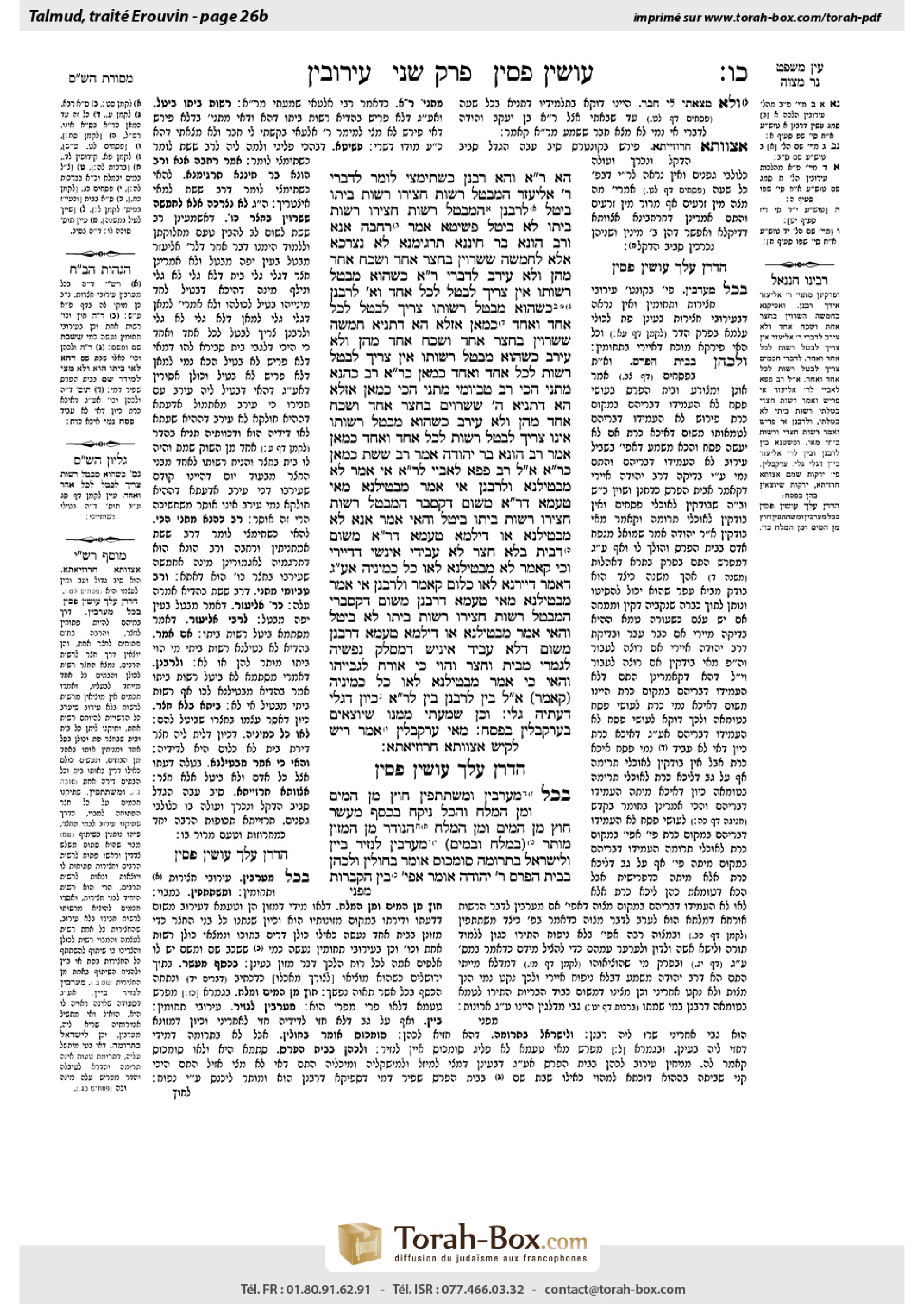
Eruvin 26b: Talmud study for Daf Yomi
Study the Talmud for Daf Yomi with scanned pages, Hebrew text, English translations from Sefaria and AI-generated French translations.
Passage selection and English or AI-generated French translation are available where the scan has annotations. Daf Study is independent of Torah-Box and Sefaria.
Browse Eruvin · עירובין · All tractatesEruvin 26b text and translations
This page of Eruvin includes the Aramaic text, an English translation and an AI-generated French translation, alongside the scan above.
עירובין כ״ו ב · Aramaic and Hebrew text
הָא רַבִּי אֱלִיעֶזֶר, וְהָא רַבָּנַן.
כְּשֶׁתִּימְצֵי לוֹמַר, לְדִבְרֵי רַבִּי אֱלִיעֶזֶר: הַמְבַטֵּל רְשׁוּת חֲצֵירוֹ — רְשׁוּת בֵּיתוֹ בִּיטֵּל. לְרַבָּנַן: הַמְבַטֵּל רְשׁוּת חֲצֵירוֹ — רְשׁוּת בֵּיתוֹ לֹא בִּיטֵּל.
פְּשִׁיטָא!
אָמַר רַחֲבָה: אֲנָא וְרַב הוּנָא בַּר חִינָּנָא תַּרְגֵּימְנָא: לֹא נִצְרְכָא אֶלָּא לַחֲמִשָּׁה שֶׁשְּׁרוּיִן בְּחָצֵר אֶחָד וְשָׁכַח אֶחָד מֵהֶן וְלֹא עֵירַב.
לְדִבְרֵי רַבִּי אֱלִיעֶזֶר: כְּשֶׁהוּא מְבַטֵּל רְשׁוּתוֹ, אֵין צָרִיךְ לְבַטֵּל לְכׇל אֶחָד וְאֶחָד.
לְרַבָּנַן: כְּשֶׁהוּא מְבַטֵּל רְשׁוּתוֹ, צָרִיךְ לְבַטֵּל לְכׇל אֶחָד וְאֶחָד.
כְּמַאן אָזְלָא הָא דְּתַנְיָא: חֲמִשָּׁה שֶׁשְּׁרוּיִן בְּחָצֵר אֶחָד וְשָׁכַח אֶחָד מֵהֶן וְלֹא עֵירַב, כְּשֶׁהוּא מְבַטֵּל רְשׁוּתוֹ, אֵין צָרִיךְ לְבַטֵּל רְשׁוּת לְכׇל אֶחָד וְאֶחָד. כְּמַאן? כְּרַבִּי אֱלִיעֶזֶר.
רַב כָּהֲנָא מַתְנֵי הָכִי. רַב טַבְיוֹמֵי מַתְנֵי הָכִי: כְּמַאן אָזְלָא הָא דְּתַנְיָא: חֲמִשָּׁה שֶׁשְּׁרוּיִם בְּחָצֵר אֶחָד וְשָׁכַח אֶחָד מֵהֶן וְלֹא עֵירַב, כְּשֶׁהוּא מְבַטֵּל רְשׁוּתוֹ אֵינוֹ צָרִיךְ לְבַטֵּל רְשׁוּת לְכׇל אֶחָד וְאֶחָד, כְּמַאן? אָמַר רַב הוּנָא בַּר יְהוּדָה אָמַר רַב שֵׁשֶׁת: כְּמַאן? כְּרַבִּי אֱלִיעֶזֶר.
אֲמַר לֵיהּ רַב פָּפָּא לְאַבָּיֵי: לְרַבִּי אֱלִיעֶזֶר, אִי אָמַר: לָא מְבַטֵּילְנָא, וּלְרַבָּנַן, אִי אָמַר: מְבַטֵּילְנָא — מַאי?
טַעְמָא דְּרַבִּי אֱלִיעֶזֶר מִשּׁוּם דְּקָסָבַר: הַמְבַטֵּל רְשׁוּת חֲצֵירוֹ, רְשׁוּת בֵּיתוֹ בִּיטֵּל. וְהַאי אָמַר: אֲנָא לָא מְבַטֵּילְנָא.
אוֹ דִילְמָא, טַעְמָא דְּרַבִּי אֱלִיעֶזֶר מִשּׁוּם דְּבַיִת בְּלָא חָצֵר לָא עֲבִידִי אִינָשֵׁי דְּדָיְירִי. וְכִי קָאָמַר לָא מְבַטֵּילְנָא — לָאו כָּל כְּמִינֵּיהּ, אַף עַל גַּב דְּאָמַר דָּיַירְנָא — לָאו כְּלוּם קָאָמַר.
וּלְרַבָּנַן, אִי אָמַר: מְבַטֵּילְנָא. מַאי טַעְמָא דְרַבָּנַן? מִשּׁוּם דְּקָסָבְרִי: הַמְבַטֵּל רְשׁוּת חֲצֵירוֹ — רְשׁוּת בֵּיתוֹ לֹא בִּיטֵּל, וְהַאי אֲמַר מְבַטֵּילְנָא.
אוֹ דִילְמָא, טַעְמָא דְרַבָּנַן מִשּׁוּם דְּלָא עֲבִיד אִינִישׁ דִּמְסַלֵּק נַפְשֵׁיהּ לִגְמָרֵי מִבַּיִת וְחָצֵר, וְהָוֵי כִּי אוֹרֵחַ לְגַבַּיְיהוּ. וְהַאי כִּי אָמַר מְבַטֵּילְנָא — לָאו כָּל כְּמִינֵּיהּ קָאָמַר.
אֲמַר לֵיהּ: בֵּין לְרַבָּנַן בֵּין לְרַבִּי אֱלִיעֶזֶר, כֵּיוָן דְּגַלִּי דַּעְתֵּיהּ — גַּלִּי.
וְכֵן שָׁמַעְתִּי מִמֶּנּוּ שֶׁיּוֹצְאִים בְּעַרְקַבָּלִין בְּפֶסַח. מַאי עַרְקַבָּלִין? אָמַר רֵישׁ לָקִישׁ: אַצְווֹתָא חָרוּזְיָאתָא.
הֲדַרַן עֲלָךְ עוֹשִׂין פַּסִּין
מַתְנִי׳ בַּכֹּל מְעָרְבִין וּמִשְׁתַּתְּפִין, חוּץ מִן הַמַּיִם וּמִן הַמֶּלַח.
וְהַכֹּל נִיקָּח בְּכֶסֶף מַעֲשֵׂר, חוּץ מִן הַמַּיִם וּמִן הַמֶּלַח. הַנּוֹדֵר מִן הַמָּזוֹן — מוּתָּר בְּמֶלַח וּבְמַיִם.
מְעָרְבִין לַנָּזִיר בְּיַיִן וּלְיִשְׂרָאֵל בִּתְרוּמָה. סוֹמְכוֹס אוֹמֵר: בְּחוּלִּין.
וְלַכֹּהֵן בְּבֵית הַפְּרָס. רַבִּי יְהוּדָה אוֹמֵר: אֲפִילּוּ בֵּין הַקְּבָרוֹת.
Eruvin 26b · English translation
This, the mishna here, is in accordance with the opinion of Rabbi Eliezer, while that, the other mishna, is in accordance with the opinion of the Rabbis.
Rav Sheshet adds: When you examine the matter closely, you will find that according to the statement of Rabbi Eliezer, one who renounces his authority over his share in the courtyard to the other residents of the courtyard also renounces his authority over his own house. However, according to the opinion of the Rabbis, one who renounces his authority over his share in the courtyard to the other residents does not renounce his authority over his own house to them.
The Gemara expresses surprise at this comment: But it is obvious that this is the point over which the tanna’im disagree.
The Gemara answers: Raḥava said: Both Rav Huna bar Ḥinnana and I explained: Rav Sheshet’s explanation was necessary only with regard to the case of five people who lived in the same courtyard, one of whom forgot to join in an eiruv with the others.
According to the statement of Rabbi Eliezer, when he renounces his authority, he need not renounce it to each and every one of the residents, as we already know that Rabbi Eliezer holds that one who renounces authority does so in a generous manner, renouncing authority not only of his share in the courtyard, but also of his own house. Consequently, if he is required to renounce authority to many people, we assume that he does so even if this is not explicitly stated.
In contrast, according to the opinion of the Rabbis, when he renounces his authority, it does not suffice that he renounces it in favor of one person; rather, he must explicitly renounce it to each and every one, as we cannot presume that he renounces authority in a generous manner.
The Gemara continues: In accordance with which tanna is the ruling that was taught in the following baraita? If five people lived in the same courtyard, and one of them forgot and did not join in an eiruv with the other residents, when he renounces his authority, he need not renounce his authority to each and every one of the residents. The Gemara asks: In accordance with whose opinion is it? It is in accordance with Rabbi Eliezer, as explained above.
Rav Kahana taught the passage this way, as cited above, that it was Raḥava and Rav Huna bar Ḥinnana who applied Rav Sheshet’s explanation to the case of the five people living in the same courtyard. Rav Tavyomei, on the other hand, taught it as follows, that it was Rav Sheshet himself who applied it to that case: In accordance with which tanna is the ruling that was taught in the following baraita? If five people lived in the same courtyard, and one of them forgot and did not join in an eiruv with the other residents, when he renounces his authority, he need not renounce his authority to each and every one of the residents. This statement is in accordance with whose opinion? Rav Huna bar Yehuda said that Rav Sheshet said: In accordance with whom? In accordance with Rabbi Eliezer.
Rav Pappa said to Abaye: According to the opinion of Rabbi Eliezer, which presumes that one renounces his authority over his house as well, if one who forgot to join in an eiruv with the other residents of the courtyard explicitly stated: I am not renouncing authority of my house, and likewise, according to the opinion of the Rabbis, if he explicitly stated: I am renouncing authority of my house, what is the halakha in such cases?
The Gemara clarifies: Is Rabbi Eliezer’s reason because he maintains in general that one who renounces authority over his share in a courtyard to the other residents presumably also renounces to them authority over his own house, but that since this person explicitly stated: I am not renouncing authority of my house, he therefore maintains his authority?
Or perhaps Rabbi Eliezer’s reason is because people do not generally live in a house without a courtyard, and therefore anyone who renounces authority over his share in a courtyard automatically renounces authority over his own house regardless of what he says. Therefore, when he says: I am not renouncing authority over my house, it is not in his power to do so, as even though he says: I will continue to live in and retain authority over my house, he has said nothing.
And the question likewise arises according to the opinion of the Rabbis. If one explicitly stated: I am renouncing authority of my house as well, what is the halakha? Is the reason for the opinion of the Rabbis because they maintain that one who renounces authority over his share in a courtyard to the other residents presumably does not renounce authority over his own house to them, but since this person explicitly stated: I am renouncing authority over my house, the other residents should be permitted to carry?
Or perhaps the reason for the opinion of the Rabbis is because one does not usually remove himself entirely from a house and courtyard, making himself like a guest among his neighbors. And therefore, when he states: I am renouncing authority over my house, it is not in his power to do so, and his statement is disregarded.
Abaye said to Rav Pappa in answer to his question: Both according to the Rabbis and according to Rabbi Eliezer, once one has revealed his wishes, he has revealed them, and everything follows his express wishes.
The mishna records yet another teaching handed down by Rabbi Elai: And I also heard from Rabbi Eliezer another halakha, that one may fulfill his obligation to eat bitter herbs on Passover with arkablin, a certain bitter herb. The Gemara asks: What is arkablin? Reish Lakish said: It is Atzvata ḥaruziyata, a type of fiber that wraps itself around a date palm.
MISHNA: One may establish a joining of houses in courtyards [eiruv ḥatzerot] in order to permit carrying on Shabbat in a courtyard shared by two or more houses, and one may establish a joining of Shabbat borders [eiruv teḥumin] in order to extend the distance one is permitted to walk on Shabbat; and similarly, one may merge courtyards in order to permit carrying in an alleyway shared by two or more courtyards. This may be done with all kinds of food except for water and salt, as they are not considered foods and therefore may not be used for these purposes.
The mishna continues with two similar principles: All types of food may be bought with second-tithe money, which must be taken to Jerusalem and used to purchase food (Deuteronomy 14:26), except for water and salt. Similarly, one who vows that nourishment is prohibited to him is permitted to eat water and salt, as they are not considered sources of nourishment.
It was further stated with regard to the laws of joining courtyards that one may establish an eiruv teḥumin for a nazirite with wine, even though he is prohibited to drink it, because it is permitted to others. And similarly, one may establish an eiruv teḥumin for an Israelite with teruma, even though he may not eat it, because it is permitted to a priest. The food used for an eiruv teḥumin must be fit for human consumption, but it is not essential that it be fit for the consumption of the one for whom it is being used. Summakhos, however, says: One may only establish an eiruv teḥumin for an Israelite with unconsecrated food.
It was additionally stated that one may establish an eiruv teḥumin for a priest in a beit haperas, a field containing a grave that was plowed over. There is doubt as to the location of bone fragments in the entire area. A priest is prohibited to come into contact with a corpse, and therefore may not enter a beit haperas. Rabbi Yehuda says: An eiruv teḥumin may be established for a priest even between the graves in a graveyard, an area which the priest may not enter by Torah law,
Eruvin 26b · Traduction française (IA)
Cette mésorah, ici, est conforme à l'opinion du Rabbi Elézer, tandis que celle-ci, l'autre mésorah, est conforme à l'opinion des Sages.
Rav Sheshét ajoute : Lorsque l'on examine la question de près, on découvre que selon l'opinion du Rabbi Elézer, celui qui renonce à son autorité sur sa part de cour aux autres habitants de la cour renonce également à son autorité sur sa propre maison. Cependant, selon l'opinion des Sages, celui qui renonce à son autorité sur sa part de cour aux autres habitants ne renonce pas à son autorité sur sa propre maison à leur égard.
La Guemara exprime une surprise à ce commentaire : Mais cela est évident que c'est le point sur lequel les tannaïm s'opposent.
La Guemara répond : Raḥava a dit : à la fois Rav Huna bar Ḥinnana et moi-même avons expliqué que l'explication de Rav Sheshét était nécessaire uniquement dans le cas de cinq personnes vivant dans la même cour, dont l'une avait oublié de participer à l'eiruv avec les autres.
Selon l'opinion du Rabbi Elézer, lorsqu'il renonce à son autorité, il n'a pas besoin de le faire à chaque habitant, car nous savons déjà que le Rabbi Elézer considère que celui qui renonce à son autorité le fait de manière généreuse, renonçant non seulement à sa part de cour, mais aussi à sa propre maison. Ainsi, si l'on doit renoncer à l'autorité devant plusieurs personnes, on suppose qu'il le fait même si cela n'est pas explicitement mentionné.
En revanche, selon l'opinion des Sages, lorsqu'il renonce à son autorité, il ne suffit pas qu'il le fasse en faveur d'une seule personne ; il doit explicitement le faire à chaque individu, car nous ne pouvons pas supposer qu'il renonce à son autorité de manière généreuse.
La Guemara continue : Selon quel tanna est la décision enseignée dans la baraïta suivante ? Si cinq personnes vivaient dans la même cour, et qu'une d'entre elles avait oublié de participer à l'eiruv avec les autres habitants, lorsqu'il renonce à son autorité, il n'a pas besoin de renoncer à son autorité à chaque habitant. La Guemara demande : Selon l'opinion de qui est-ce ? C'est selon l'opinion du Rabbi Elézer, comme expliqué ci-dessus.
Rav Kahana a enseigné ce passage ainsi, comme mentionné ci-dessus, que c'était Raḥava et Rav Huna bar Ḥinnana qui avaient appliqué l'explication de Rav Sheshét au cas des cinq personnes vivant dans la même cour. Rav Tavyomei, en revanche, a enseigné ainsi : c'était Rav Sheshét lui-même qui avait appliqué cela à ce cas. La Guemara demande : Selon quel tanna est la décision enseignée dans la baraïta suivante ? Si cinq personnes vivaient dans la même cour, et qu'une d'entre elles avait oublié de participer à l'eiruv avec les autres habitants, lorsqu'il renonce à son autorité, il n'a pas besoin de renoncer à son autorité à chaque habitant. Cette déclaration est-elle selon l'opinion de qui ? Rav Huna bar Yéhuda a dit que Rav Sheshét a dit : selon qui ? Selon le Rabbi Elézer.
Rav Pappa a dit à Abaye : Selon l'opinion du Rabbi Elézer, qui suppose que l'on renonce à son autorité sur sa maison également, si l'un d'entre eux avait oublié de participer à l'eiruv avec les autres habitants de la cour et avait explicitement déclaré : Je ne renonce pas à mon autorité sur ma maison, et de même, selon l'opinion des Sages, si il avait explicitement déclaré : Je renonce à mon autorité sur ma maison, quelle est la halakha dans de tels cas ?
La Guemara clarifie : Est-ce que la raison du Rabbi Elézer est qu'il affirme généralement que celui qui renonce à son autorité sur sa part de cour aux autres habitants renonce également à leur autorité sur sa propre maison, mais que puisque cette personne a explicitement déclaré : Je ne renonce pas à mon autorité sur ma maison, il maintient donc son autorité ?
Ou peut-être que la raison du Rabbi Elézer est que les gens ne vivent généralement pas dans une maison sans cour, et donc tout celui qui renonce à son autorité sur sa part de cour renonce automatiquement à son autorité sur sa propre maison, indépendamment de ce qu'il dit. Ainsi, lorsque il dit : Je ne renonce pas à mon autorité sur ma maison, il n'a pas le pouvoir de le faire, car même s'il dit : Je continuerai à vivre et à conserver mon autorité sur ma maison, il n'a rien dit.
Et la question se pose également selon l'opinion des Sages. Si l'un d'entre eux avait explicitement déclaré : Je renonce à mon autorité sur ma maison également, quelle est la halakha ? Est-ce que la raison de l'opinion des Sages est qu'ils affirment généralement que celui qui renonce à son autorité sur sa part de cour aux autres habitants ne renonce pas à leur autorité sur sa propre maison, mais que puisque cette personne a explicitement déclaré : Je renonce à mon autorité sur ma maison, les autres habitants devraient être autorisés à porter des objets ?
Ou peut-être que la raison de l'opinion des Sages est que l'on ne quitte généralement pas entièrement sa maison et sa cour, se faisant ainsi passer pour un invité parmi ses voisins. Et donc, lorsque l'on dit : Je renonce à mon autorité sur ma maison, il n'est pas en mesure de le faire, et sa déclaration est ignorée.
Abaye répondit à Rav Pappa à la question qu'il avait posée : Selon les Sages et selon Rabbi Elézer, une fois que l'on a révélé ses souhaits, il les a révélés, et tout suit ses souhaits exprimés.
La mésorah rapporte une autre enseignement transmis par Rabbi Elai : Et j'ai également entendu de Rabbi Elézer une autre halakha, selon laquelle l'on peut accomplir son obligation de manger des herbes amères pendant la Pâque avec des arkablin, une certaine herbe amère. La Guemara demande : Qu'est-ce que les arkablin ? Reish Lakish a dit : C'est l'Atzvata ḥaruziyata, un type de fibre qui s'enroule autour d'un palmier.
MICHNA : On peut établir un eiruv ḥatzerot afin de permettre le transport le sabbat dans un courtyard partagé par deux ou plusieurs maisons, et on peut établir un eiruv teḥumin afin d'étendre la distance autorisée pour marcher le sabbat ; de même, on peut fusionner des courtyards afin de permettre le transport dans un passage partagé par deux ou plusieurs courtyards. Cela peut être fait avec tous les types de nourriture sauf l'eau et le sel, car ils ne sont pas considérés comme des aliments et donc ne peuvent pas être utilisés à ces fins.
La mishna continue avec deux principes similaires : Tous les types de nourriture peuvent être achetés avec l'argent de la deuxième part, qui doit être emmené à Jérusalem et utilisé pour acheter de la nourriture (Deutéronome 14:26), sauf l'eau et le sel. De même, celui qui jure que la nourriture lui est interdite est autorisé à manger l'eau et le sel, car ils ne sont pas considérés comme des sources de nourriture.
Il fut également dit concernant les lois de l'eiruv ḥatzerot qu'on peut établir un eiruv teḥumin pour un nazirite avec du vin, même s'il est interdit de le boire, car il est permis aux autres. De même, on peut établir un eiruv teḥumin pour un Israélite avec la terouma, même s'il ne peut pas le manger, car il est permis au prêtre. La nourriture utilisée pour un eiruv teḥumin doit être propre à la consommation humaine, mais il n'est pas nécessaire qu'elle soit propre à la consommation de celui pour qui elle est utilisée. Summakhos dit cependant : On peut établir un eiruv teḥumin pour un Israélite uniquement avec de la nourriture non consacrée.
Il fut également dit que l'on peut établir un eiruv teḥumin pour un prêtre dans un beit haperas, un champ contenant un sépulcre qui a été labouré. Il y a un doute sur la localisation des fragments d'os dans l'ensemble de la zone. Un prêtre est interdit de toucher un cadavre, et donc ne peut pas entrer dans un beit haperas. Rabbi Yehuda dit : On peut établir un eiruv teḥumin pour un prêtre même entre les sépulcres d'un cimetière, une zone que le prêtre ne peut pas entrer selon la loi torahique,
Traduction française générée par IA à partir de l’édition anglaise de Sefaria. Vérifie toujours un passage avec le texte source.
Text from Sefaria: William Davidson Edition - Vocalized Aramaic (CC BY NC); William Davidson Edition - English (CC BY NC).